Tag: Recep Tayyip Erdogan

12th president of Turkey

  • PM Recep Erdogan is the best leader in the world

    PM Recep Erdogan is the best leader in the world

    Turkey: PM Recep Erdogan is the best leader in the world.

    I have known The Prime Minister Recep Tayyip Erdogan for many years.

    I have closely followed him in his achievements and what he has done as PM in Turkey.

    The Prime Minister Recep Tayyip Erdogan is one of the most successful leaders in the world. He is a source of inspiration for hard-working Turkish people. He is loved and respected in muslim world.

    His achievements in Turkey speak for themselves.

    Turkey’s gross domestic product grew 8.2 percent in 2010.

    Strong economic growth will continue in Turkey this year,

    Turkey’s economic growth accelerated to 9.2 percent in the fourth quarter of 2010 .

    Turkish Prime Minister Erdogan said they were going to elevate Turkey into becoming one of the world’s top 10 economies by 2023.

    The Prime Minister Recep Tayyip Erdogan’s also said that Turkey’s gross domestic product to grow to $2 trillion .

    Turkey’s Prime Minister Recep Tayyip Erdogan’s government is pursuing a strategy intertwining political influence with economic might in the all world.

    Turkish companies are investing in Russia, Balkans, Islamic countries and extending across EU, India, Iran, China and Africa.

    Turkey is the largest investor in Albania_, Kosovo, Bosnia, Kurdistan, Libya, Kazakhstan, Azerbaijan, Turkestan, Bulgaria, Romania, Afghanistan, Iraq, Qatar, and Algeria .

    Turkey’s companies are investing worldwide in real estate, energy sector, food industry, tourism, IT, automobiles, cement, chemicals, consumer electronics, food processing, machinery, mining, petroleum, pharmaceuticals, steel, transportation equipment, and textiles.

    Sahit_Muja
    President & CEO
    Albanian_Minerals
    New York

    via WSJ: Turkey: PM Recep Erdogan is the best leader in the world..

  • Walker’s World: Turkey’s new Sultan

    Walker’s World: Turkey’s new Sultan

    Turkish Prime Minister Recep Tayyip Erdogan is seen as Iran, Turkey and Brazil sign an agreement to ship Iran's low-enriched uranium to Turkey in exchange for fuel for a nuclear reactor in Tehran, Iran, on May 17, 2010. Iran signed an agreement to swap its uranium in Turkey for enrichment, hoping to avert new international sanctions. Brazil helped broker the deal. UPI/Maryam Rahmanian   Read more: https://www.upi.com/Top_News/Opinion/Walker/2011/04/18/Walkers-World-Turkeys-new-Sultan/UPI-37581303124100/#ixzz1JwjZVOYq
    Turkish Prime Minister Recep Tayyip Erdogan is seen as Iran, Turkey and Brazil sign an agreement to ship Iran's low-enriched uranium to Turkey in exchange for fuel for a nuclear reactor in Tehran, Iran, on May 17, 2010. Iran signed an agreement to swap its uranium in Turkey for enrichment, hoping to avert new international sanctions. Brazil helped broker the deal. UPI/Maryam Rahmanian Read more: https://www.upi.com/Top_News/Opinion/Walker/2011/04/18/Walkers-World-Turkeys-new-Sultan/UPI-37581303124100/#ixzz1JwjZVOYq

    ISTANBUL, Turkey, April 18 (UPI) — With its economy growing at almost 9 percent and foreign money flooding in fast, Turkey is booming, which means that Prime Minister Recep Tayyip Erdogan’s ruling Justice and Development Party should cruise to re-election in elections this June.

    But the country is troubled by a series of profound challenges and the political divisions run deep, which helps explain the growing row with Europe and the United States over press freedom. Turkey holds the unenviable title of the most journalists arrested in the world, a total of 54, ahead of China and Iran.

    In a defensive appearance before the Council of Europe’s parliamentary assembly this month, Erdogan blustered that only 26 were under arrest for journalistic activities. This provoked derision but he has something of a point. The arrests, and a raid on the office of the daily Radikal to seize drafts of a book, are largely related to the murky Ergenekon affair, an alleged ultra-nationalist plot to topple the government in a military coup.

    via Walker’s World: Turkey’s new Sultan – UPI.com.

  • Erdogan and the French

    Erdogan and the French

    By Marc Champion

    Eric Feferberg/AFP/Getty Images

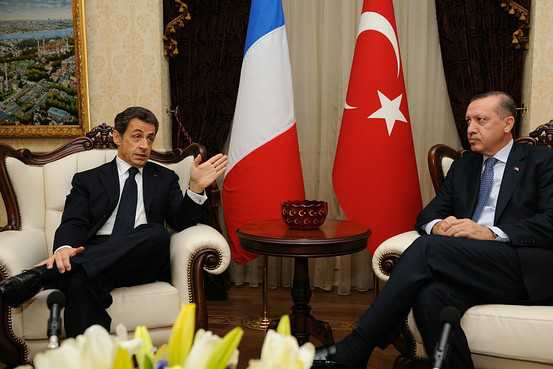
    Turkish Prime Minister Recep Tayyip Erdogan, right, and French President Nicolas Sarkozy during a bilateral meeting in Ankara, Turkey, on Feb. 25, 2011.
    Turkish Prime Minister Recep Tayyip Erdogan, right, and French President Nicolas Sarkozy during a bilateral meeting in Ankara, Turkey, on Feb. 25, 2011.

    Turkish Prime Minister Recep Tayyip Erdogan, right, and French President Nicolas Sarkozy during a bilateral meeting in Ankara, Turkey, on Feb. 25, 2011.

    Don’t mention the French to Turkey’s outspoken prime minister, Recep Tayyip Erdogan.

    On Wednesday, Mr. Erdogan was taking questions from the Council of Europe’s parliamentary assembly in Strasbourg when an unsuspecting French MP asked him a question about how he would guarantee freedoms for religious minorities in Turkey.

    “I believe this friend is French? She is also “French” to Turkey,” said Mr. Erdogan, using a blunt Turkish saying that means: You don’t know what you’re talking about.

    France-bashing plays well in Turkey nowadays and Mr. Erdogan is in the midst of a re-election campaign. Many Turks have taken deep offense to French President Nicolas Sarkozy’s active opposition to Turkey’s bid to join the European Union. And France’s recent decision to ban women from wearing the Burqa has played loudly and badly in Turkish media.

    Meanwhile, Mr. Sarkozy’s decision to exclude Turkey from the gathering in Paris that launched a no-fly zone over Libya last month infuriated Mr. Erdogan and other Turkish leaders, who see France as a spent colonial power and Turkey as the Middle East’s new playmaker.

    “Our attitude is not a bandit’s facing booty, like some,” Mr. Erdogan said, in a veiled reference to the leading role France took in imposing the Libyan no-fly zone, according to Turkey’s NTV television. Mr. Erdogan has repeatedly implied that France and other coalition members intervened in Libya because they want its oil.

    Mr. Erdogan also told questioners to look to themselves before criticizing Turkey over human rights issues, and that Turkey’s electoral process wasn’t their business. What he didn’t talk about at all was Turkey’s EU bid, no longer a vote-winner among Turks.

    Turkey’s NTV television quickly dubbed the performance another “One Minute!” moment, a reference to the moment at the 2009 World Economic Forum in Davos, Switzerland, when Mr. Erdogan stormed off the stage after demanding more time to talk and telling Israel’s President Shimon Peres: “You know how to kill well.”

    Many analysts now see Mr. Erdogan’s performance in Davos as the moment when he changed his country’s policy towards Israel, formerly a close military ally.

    via Erdogan and the French – Emerging Europe Real Time – WSJ.

  • Erdogan: Turkey Has Vigor the EU Needs Badly – Newsweek

    Erdogan: Turkey Has Vigor the EU Needs Badly – Newsweek

    by Recep Tayyip Erdogan
    The Robust Man of Europe

    Turkey has the vigor that the EU badly needs.

    At the end of this century’s first decade, we can observe how the locus of power has shifted in world politics. The G20 is replacing the G7 as the overseer of the global economy. The need to restructure the U.N. Security Council to be more representative of the international order is profoundly pressing. And emerging powers such as Brazil, India, Turkey, and others are playing very assertive roles in global economic affairs.

    The European Union cannot be the one sphere that is immune to these changes in the balance of power. The financial crisis has laid bare Europe’s need for greater dynamism and change: European labor markets and social-security systems are comatose. European economies are stagnant. European societies are near geriatric. Can Europe retain power and credibility in the new world order without addressing these issues?

    Meanwhile, as a candidate for EU membership, Turkey has been putting its imprint on the global stage with its impressive economic development and political stability. The Turkish economy is Europe’s fastest-growing sizable economy and will continue to be so in 2011. According to Organization for Economic Cooperation and Development forecasts, Turkey will be the second-largest economy in Europe by 2050. Turkey is a market where foreign direct investment can get emerging-market returns at a developed-market risk. Turkey is bursting with the vigor that the EU so badly needs.

    Click Here

    And it’s not only economics. Turkey is becoming a global and regional player with its soft power. Turkey is rediscovering its neighborhood, one that had been overlooked for decades. It is following a proactive foreign policy stretching from the Balkans to the Middle East and the Caucasus. Turkey’s “zero-problem, limitless trade” policy with the countries of the wider region aims to create a haven of nondogmatic stability for all of us. We have visa-free travel with 61 countries. This is not a romantic neo-Ottomanism: It is realpolitik based on a new vision of the global order. And I believe that this vision will help the EU, too, in the next decade.

    Our intense diplomatic efforts have yielded fruit in Iraq and Afghanistan, in the Balkans, and also in regard to the Iranian nuclear program. Turkey has been an active player in all the major areas of global politics and we do not intend to surrender this momentum. Once it becomes a member of the EU, Turkey will contribute to European interests in a wide range of issues, from foreign and economic policy to regional security and social harmony.

    Even though the case for Turkey’s membership of the EU is self-evident and requires little explanation, the accession process has been facing resistance orchestrated by certain member states. Unfortunately, the negotiation process is not currently proceeding as it ought to. Eighteen out of 22 negotiation chapters pending for discussion are blocked on political grounds. This is turning into the sort of byzantine political intrigue that no candidate country has experienced previously. In this treatment, Turkey is unique.

    Our European friends should realize that Turkey-EU relations are fast approaching a turning point. In the recent waves of enlargement, the EU smoothly welcomed relatively small countries and weak economies in order to boost their economic growth, consolidate their democracies, and provide them with shelter. Not letting them in would have meant leaving those countries at the mercy of political turmoil that might emerge in the region. No such consideration has ever been extended to Turkey. Unlike those states, Turkey is a regional player, an international actor with an expanding range of soft power and a resilient, sizable economy. And yet, the fact that it can withstand being rebuffed should not become reason for Turkey’s exclusion. Sometimes I wonder if Turkey’s power is an impediment to its accession to the Union. If so, one has to question Europe’s strategic calculations.

    It’s been more than half a century since Turkey first knocked at Europe’s door. In the past, Turkey’s EU vocation was purely economic. The Turkey of today is different. We are no more a country that would wait at the EU’s door like a docile supplicant.

    Some claim that Turkey has no real alternative to Europe. This argument might be fair enough when taking into account the level of economic integration between Turkey and the EU—and, in particular, the fact that a liberal and democratic Europe has always been an anchor for reform in Turkey. However, the opposite is just as valid. Europe has no real alternative to Turkey. Especially in a global order where the balance of power is shifting, the EU needs Turkey to become an ever stronger, richer, more inclusive, and more secure Union. I hope it will not be too late before our European friends discover this fact.

    Erdogan is prime minister of Turkey.

    via Erdogan: Turkey Has Vigor the EU Needs Badly – Newsweek.

  • “No One Can Determine Course Of Turkey’s Foreign Policy “

    “No One Can Determine Course Of Turkey’s Foreign Policy “

    Turkish Prime Minister Recep Tayyip Erdogan has said that no one could determine course of the country’s foreign policy.

    Prime Minister Erdogan said at a parliamentary group meeting of the ruling Justice & Development (AK) Party on Tuesday, “Turkey cannot remain indifferent in the face of developments in its region. We cannot neglect our relations with the neighboring and regional countries. And our interest in regional developments do not indicate any shift of axis.”

    Referring to release of secret U.S. diplomatic cables by the internet site Wikileaks, Prime Minister Erdogan said, “those cables include extremely unappropriate and unpleasant expressions about Turkey and other countries. It is evident that diplomats tried to draw a frame in line with their own intentions and desires by following some certain media organs and circles. Release of the secret cables revealed a very serious problem about the U.S. diplomacy with its own diplomats. Actually it is the problem of the United States itself.”

    Erdogan denied once again the allegations in the diplomatic cables that he had money in eight accounts at Swiss banks. “If the main opposition party proves that I have bank accounts in Switzerland, I donate all I have to the Republican People’s Party (CHP),” he said.

    He recalled that Turkey send aircraft to Israel to help efforts to extinguish a major forest fire in Haifa. “Yes, we have mobilized sources to heal the wounds of Palestinian people in Gaza. Now, we rushed to help Israel with the same sincerity. We cannot remain indifferent to destruction of woodland and killing of people in fire just because we have problems with Israel. It contradicts our understanding of humanity and our moral values. But we did not forget what happened in Gaza,” he said.

    He said that if Israel wanted to commence a new period, it should admit its wrongdoing, apologize and pay compensation to families of the victims. “Otherwise, we will not take a single step. We do not act with hatred and enmity. On the contrary, we aim at ensuring peace, stability, justice and prosperity in our region. But we do not tolerate such a wrongdoing,” he added.

    AA

  • America’s Dark View of Turkish Premier Erdogan by Maximilian Popp

    America’s Dark View of Turkish Premier Erdogan by Maximilian Popp


    01Dec10

    By Maximilian Popp

    REUTERS

    Turkish Prime Minister Recep Tayyip Erdogan, center, has surrounded himself with “an iron ring of sycophantic (but contemptuous) advisors,” according to US diplomatic cables.

    The US is concerned about its NATO ally Turkey. Embassy dispatches portray Prime Minister Recep Tayyip Erdogan as a power-hungry Islamist surrounded by corrupt and incompetent ministers. Washington no longer believes that the country will ever join the European Union.

    Turkish Prime Minister Recep Tayyip Erdogan is the most important Muslim ally of the United States. On coming into office he promised a democratic Islam — a vision that could have become a model for other countries in the region.

    But if the US dispatches are to be believed, Turkey is far from realizing that vision. Erdogan? A power-hungry Islamist. His ministers? Incompetent, uneducated and some of them corrupt. The government? Divided. The opposition? Ridiculous.

    US diplomats have sent thousands of reports from Ankara to Washington in the past 31 years. Recent documents, though, are merciless. They convey an image of Turkey which is at odds with almost everything the US government has officially said about the country.

    First and foremost, the US distrusts Erdogan. A dispatch dated May 2005 says that he has never had a realistic worldview. Erdogan, the document says, thinks he was chosen by God to lead Turkey and likes to present himself as the “Tribune of Anatolia.”

    US diplomats claim that Erdogan gets almost all of his information from Islamist-leaning newspapers — analysis from his ministries, they say, is of no interest to him. The military, the second largest among NATO member states, and the secret service no longer send him some of their reports. He trusts nobody completely, the dispatches say, and surrounds himselves with “an iron ring of sycophantic (but contemptuous) advisors.” Despite his bravado, he is said to be terrified of losing his grip on power. One authority on Erdogan told the Americans: “Tayyip believes in God … but doesn’t trust him.”

    Accusations of Corruption

    Erdogan took office as prime minister in 2003, two years after having founded his party, the Islamic-conservative AKP. During the campaign Erdogan announced his intention to tackle corruption.

    Since 2004, however, informants have been telling US diplomats in Turkey of corruption at all levels, even within the Erdogan family. None of the accusations have been proven — it could be that the informants merely want to denigrate the premier. But their reports help shape the Americans’ image of Turkey — and as such they are devastating.

    The rumors sound outrageous. A senior government advisor is said to have confided to a journalist that Erdogan enriched himself from the privatization of a state oil refinery. Furthermore, a source within the Ministry of Energy told the US that the prime minister pressured the Iranians to ink a gas pipeline deal with a Turkish company owned by an old schoolmate of his. The deal surprised observers: the company builds ports, but has little experience in the energy business. Two unnamed US sources claim that Erdogan presides over eight Swiss bank accounts.

    Erdogan’s party, the AKP, vehemently denies all allegations. And the premier says he acquired his wealth in the form of gifts presented by guests at his son’s wedding. Furthermore, he says, a Turkish businessman is paying for his four children to study in the US. The American Embassy sees such explanations as “lame.”

    A ‘Lack of Technocratic Depth’

    Erdogan, though, apparently knows how to score points at the grass roots level. According to US dispatches, when his AKP suffered a painful defeat in the Trabzon mayoral election of 2004, he allegedly installed his close friend Faruk Nafiz Özak as the head of the local Trabzonspor football club. In accusations which have not been proven, informants told the US Embassy that Erdogan sent Özak millions of dollars from a secret government account. Özak was to use the money, states a dispatch dated June 2005, to buy better players in an effort to overshadow the mayor. Erdogan did not respond to SPIEGEL efforts to contact him, but said on Monday that the credibility of WikiLeaks was questionable.

    According to US Embassy analysis, he has transformed the AKP into a party which works almost exclusively on his behalf. Many top AKP leaders including Erdogan and President Abdullah Gül are said to be members of a Muslim fraternity.

    There is generally a “lack of technocratic depth” in the government, criticized US Ambassador Eric Edelman back in January 2004: “While some AK appointees appear to be capable of learning on the job, others are incompetent or seem to be pursuing private … interests” or those of their religious congretations. “We hear constant anecdotal evidence … that AK appointees at the national and provincial levels are incompetent or narrow-minded Islamists.”

    Many high-ranking state officials have told the Americans they are appalled by Erdogan’s staff. Erdogan, one such official told US diplomats, appointed a man exhibiting “incompetence, prejudices and ignorance” as his undersecretary. Another informant told the US that Women’s Minister Nimet Çubukçu, an advocate of criminalizing adultery, got her job because she is a friend Erdogan’s wife, Emine. Another minister is accused of nepotism, links to heroin smuggling and a predeliction for underage girls.

    Getting Off the Train

    Erdogan and the AKP are revered by the electorate. The prime minister is a “natural politician,” US diplomats wrote in one dispatch from early 2004. He “possesses a common touch,” is “charismatic” and has “street-fighter instincts.” The prime minister grew up in Kasimpasa, a rough port district of Istanbul, and became involved in a radical Islamist organization as a young man before joining the conservative Order of the Nakibendye. Before entering government, he said: “Democracy is like a train. We shall get out when we arrive at the station we want.”

    As a young man he met Abdullah Gül, with whom he later orchestrated the rise of the AKP. A deep-seated rivalry now exists between the two. Again and again Gül has stirred up trouble against Erdogan, particularly when the prime minister is traveling abroad. In a report from March 2005 when Gül was Turkish foreign minister, US diplomats described this as Gül’s attempt to undermine Erdogan’s policies and gain more power in the party. Unlike Erdogan, Gül speaks English, say the diplomats, and presents himself as moderate and modern.

    In truth, however, the US sees Gül as more ideological than Erdogan and anti-Western, according to embassy dispatches based on statements from those close to Gül. Gül uses almost every opportunity to make Erdogan look bad, the documents claim, even talking badly about him in front of state visitors. Gül worked for a long time to become president and therefore Erdogan’s equal. Erdogan tried to prevent his rise — without success. In the summer of 2007 Gül took up residence in the presidential palace in Ankara.

    ‘Murky’ and ‘Muddled’

    US diplomats are likewise unflinching when it comes to Erdogan’s advisor and foreign minister, Ahmet Davutoglu. They say he understands little about politics outside of Ankara. They see this as unfortunate, because they want to see Turkey join the EU — but they don’t believe it will ever happen. In order to make progress toward EU accession, the US ambassador wrote, the government must “hire a couple thousand people skilled in English or other major EU languages and up to the bureaucratic demands of interfacing with the Eurocrats.” The AKP, write US diplomats, had thus far employed mostly confidants from the Sunni brotherhoods.

    Some AKP politicians, according to a US assessment, support Turkish membership in the EU for “murky” and “muddled” reasons, for example because they believe Turkey must spread Islam in Europe. A US dispatch from late 2004 reports that a member of a leading AKP think tank said that Turkey’s role is “to take back Andalusia and avenge the defeat at the siege of Vienna in 1683.”

    Foreign Minister Ahmet Davutoglu largely shares this viewpoint and the Americans are alarmed by his imperialistic tone. In a summary of a speech by Davutoglu delivered in Sarajevo in January 2010, the US ambassador wrote: “His thesis: the Balkans, Caucasus and Middle East were all better off when under Ottoman control or influence; peace and progress prevailed. Alas the region has been ravaged by division and war ever since…. However, now Turkey is back, ready to lead or even unite. (Davutoglu: ‘We will re-establish this (Ottoman) Balkan’).”

    Of Rolls Royce and Rover

    Davutoglu’s hubris and his neo-Ottoman vision is cause for US concern. Turkey has “Rolls Royce ambitions but Rover resources,” reads the same 2010 cable. According to embassy dispatches from 2004, Defense Minister Mehmet Gönül warned of Davutoglu’s Islamist influence on Erdogan. He is “exceptionally dangerous” Gönül told the US.

    Under Erdogan, relations with Israel have dramatically deteriorated. The two governments are at odds over the war against Hamas in late 2008 and early 2009 and over the attack on the Gaza fleet earlier this year. The Israeli ambassador to Ankara, Gabby Levy, claimed in October 2009 that Erdogan was behind the cooling of relations: “He’s a fundamentalist. He hates us religiously,” Levy was quoted as saying in a confidential US embassy dispatch from October 2009.

    The Americans are watching with concern as Erdogan distances NATO member-state Turkey further and further from the West. They are concerned about the country’s stability. “Every day is a new one here, and no one can be certain where this whole choreography will fall out of whack,” James Jeffrey, then the US ambassador in Turkey, wrote in late February 2010. “Then, look out.”

    Translated from the German by Josie Le Blond