Tag: Turkey-Israel

  • Turkey-Israel Relations Reach New Low

    Turkey-Israel Relations Reach New Low

    Turkey and Israel are set for a diplomatic showdown with the scheduled publication of a United Nations report this Friday into the killing last year by Israeli security forces of nine Turkish citizens on a boat attempting to break Israel’s economic blockade of the Gaza Strip. The release of the U.N. report has been repeatedly delayed to give time to diplomatic efforts to reconcile the two formerly close allies.
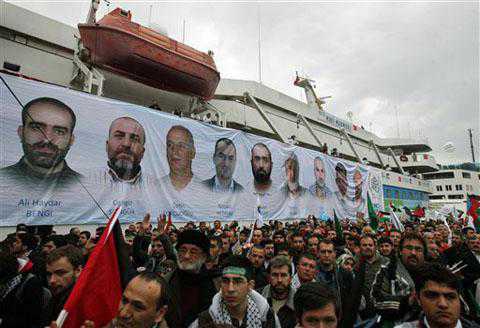
    A banner depicting the faces of the nine men killed, displayed on the Mavi Marmara ship, the lead boat of a flotilla headed to the Gaza Strip which was stormed by Israeli naval commandos in a predawn confrontation in the Mediterranean May 31, 2010, on its returns, in Istanbul, Turkey, 26 Dec 2010
    A banner depicting the faces of the nine men killed, displayed on the Mavi Marmara ship, the lead boat of a flotilla headed to the Gaza Strip which was stormed by Israeli naval commandos in a predawn confrontation in the Mediterranean May 31, 2010, on its returns, in Istanbul, Turkey, 26 Dec 2010

    Since last year’s killing of nine Turkish citizens by Israeli forces, Turkish Prime Minister Recep Tayyip Erdogan has called on Israel to apologize and compensate the families of those killed. Equally resolute, Israeli Prime Minister Benjamin Netanyahu has said there is nothing to apologize for. The impasse has severely damaged bilateral relations of the formerly close allies. But Erdogan has warned things could get a lot worse.

    He says unless Israel offers an apology, pays compensation, and removes the embargo against the Gaza Strip, it is not possible for Turkey-Israel relations to improve. Erdogan says that from now on, Turkey as well as the families will take some steps, so a new phase will be beginning.

    The expected publication this Friday of the U.N. report into the killings is the deadline set by Ankara for its demands to be met. Turkish Foreign Minister Ahmet Davutoglu earlier this month said that both Washington and Jerusalem are aware of the sanctions Turkey is prepared to impose against Israel. International relations expert Soli Ozel says Ankara has options.

    “Turkey can lower the level of its relations in Israel, pushing for the recognition of Palestinian statehood,” said Ozel. “It can try to sue [the] Israeli military and politicians in international courts. Whether they can pull this off or not, I don’t know, which is why I think the Americans are so adamant that things don’t get out of hand.”

    According to both Turkish and Israeli media reports, a proposal by the U.S. for what is described as a softened Israeli apology in exchange for normalizing relations has so far been rejected by Jerusalem. Diplomatic columnist Semih Idiz says such an intervention is an indication that Washington is aware of Turkey’s growing importance in the increasingly volatile Middle East. That importance, Idiz claims, is a key factor behind Ankara maintaining its tough stance towards Jerusalem.

    “We are dealing with a very different kind of environment now in the Middle East,” said Idiz. “Turkey has a greater presence, if not with some regimes, at least with the people in the region. And so it is not so vital for Turkey as it might have been in the past to have good relations with Israel.”

    But despite deteriorating diplomatic relations, bilateral trade has continued to flourish. International relations expert Ozel believes whatever happens, trade will be left largely untouched.

    “Trade embargo, I doubt it,” said Because the trade volume is almost $3 billion between the two countries, non-military. So it will hurt some of the constituents of Erdogan as well.”

    Trade is still a card Israel can play. The Turkish military is urgently buying sophisticated equipment in the face of a resurgence in fighting against the Kurdish rebel group, the PKK. At the top of its list are drones, of which Israel is a main supplier. As alternative provider the U.S. is tied up due to its own military demands, Ankara may have a vested interest in at least maintaining trade relations with Israel. However, political columnist Asla Aydintasbas says Erdogan has limited room to maneuver.

    “Knowing [the] prime minister’s personality and knowing the importance of this issue for Turkey, I don’t see how Turkey can accept anything short of an apology. And frankly there is not a word, which is an apology in English or an apology in Turkish, but is different in Hebrew. It is just what it is,” said the columnist.

    International diplomatic efforts are expected to intensify to find a compromise, as Turkey’s deadline for its demands to be met nears.

    via Turkey-Israel Relations Reach New Low | Europe | English.

  • Turkey did not sponsor Gaza flotilla

    Turkey did not sponsor Gaza flotilla

    The aid convoy for Gaza organized in May 2010 was a humanitarian initiative with people from more than 30 countries (including the United States and Israel) in ships sailing under the flags of several nations. While there were private Turkish citizens among participants, the flotilla was not organized or even encouraged by the Turkish government, asDanny Danon conjures without evidence (“Why Turkey should apologize to Israel,” Commentary, Aug. 15). Quite the contrary.

    Nine people lost their lives when Israeli commandos used excessive, lethal force and violated all established norms of international law by attacking the convoy in the international waters of the Mediterranean, as the U.N. Human Rights Council’s fact-finding mission concluded in its report on the incident. Eight of the nine killed were Turkish citizens, and one was an American citizen of Turkish descent.

    As any country – including Israel – would be, Turkey was shattered by the loss of its citizens. We also were shocked that for the first time in our history, our citizens were killed by a foreign armed force during peacetime. What has increased our sorrow is that this deplorable action was caused by a country Turkey has long considered a friend.

    Turkey rightly asks for a formal apology and appropriate compensation to the families of those killed. These acts will never fully ease the pain the families and the Turkish people feel, but they are essential to the normalization of relations, from which both Turkey and Israel benefit.

    It is meaningful that Mr. Danon, rather than supporting the efforts to leave this incident behind, is appealing to audiences in the United States and that he defines the essential ingredients of normalization as acts of humiliation. He does not recognize that rather than humiliation, these steps represent the cornerstones of civility upon which any strong friendship rests.

    NAMIK TAN

    Ambassador to the United States

    Republic of Turkey

    Washington


    The Washington Times


  • America and Israel haters relying on anti-Turkish lobbies

    America and Israel haters relying on anti-Turkish lobbies

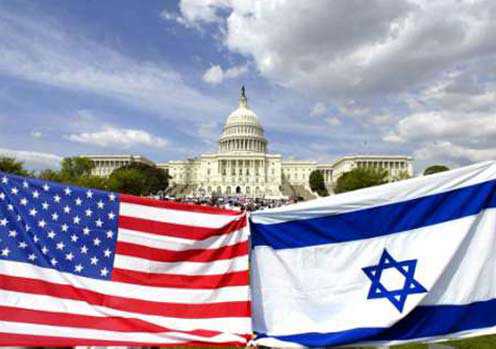
    The “Armenian genocide season” opened relatively early this year. Clearly the “conjuncture” is considered “uniquely ripe” by anti-Turkish activists. There are also fresh opportunities for increased cooperation against Turkey among Washington’s highly active Armenian, Kurdish, Israeli and Syriac lobbies.

    In the meantime, the worsening of Turkish-Israeli ties has driven a wedge between Ankara and the Obama administration.  Both sides are trying to be polite about this but the damage is showing. It is also clear that Turkey can not rely on the Republicans in Congress, as it did before, given the unquestioning support they provide to Israel.

    Driven mostly by constituency considerations, Republican congressmen are said to be “out to get Turkey” this time for a host of reasons, not just to do with Israel. These naturally include the Erdoğan government’s stance on Iran and Syria, as well as its cozying up to radical groups like Hamas and Hezbollah.

    Put briefly, Turkey is not considered a reliable ally anymore in the United States Congress. In the meantime it is no surprise that the Israeli lobby in America should be out to punish Turkey for its stand on the brutalizing of Palestinians by the IDF in Gaza under the guise of retaliation.

    Turkey’s apparently rock-solid demand for an apology and compensation from Israel for its the murder of nine Turkish activists on the Mavi Marmara ship, on the other hand, only fuels the growing animosity towards Ankara. What obviously increases the anger of Israelis and members of the Israeli lobby is that their nemesis, namely Prime Minister Erdoğan, is so popular around the world.

    It is no surprise that those contributing to Time Magazine’s “Man of the Year” poll this year should have put Erdoğan in second position after Julian Assange. (He was in fact in first position before Assange overtook him with his arrest in the United Kingdom).

    The fact that Time, in what many see as a “rabbit out of the hat trick,” actually selected Facebook’s Mark Zuckerberg, who was in 10th position in the magazine’s own public poll, as “Man of the Year” does not belie Erdoğan’s international popularity.

    If we go back to the Armenian issue, it is clear from the feverish activity among Armenian groups in the U.S. that they have high hopes for the passage of an Armenian genocide resolution in the U.S. Congress this time around. The advantages appear to be stacked on their behalf too.

    There is nevertheless a very real possibility the “force majeure” will come into play again and prevent this happening – for the sake of “global strategic considerations” – despite all the anti-Turkish sentiment floating around in Washington. The mostly likely outcome is that the Armenians will be disappointed again.

    It will, however, be a surprise for some to hear that there are quite a few people in Turkey who are rabidly anti-Israeli and anti-American, and who have little sympathy for Europe and the European Union, who actually want the genocide resolution to pass (preferably with the help of Israeli lobbies).

    Their reasoning is a simple one. Such a development will spell the death knell for any hope whatsoever of a rapprochement with Israel – which they have never desired. It will also lead to the greatest crisis in Turkish-U.S. ties ever, which again will be highly welcomed by them since they see America as “the root of all evil,” which makes ties with Washington abhorrent to them anyway.

    In other words, the Armenian and Israeli lobbies could be playing beautifully into the hands of those in this country who want to see Turkey move away from the West, and closer not just to the Islamic world but also to the powers currently on the ascendant, which Fareed Zakaria refers to as “The Rest,” as opposed to “The West.”

    The fact Turkey is also a “rising” country makes those with anti-Western sentiments even more bullish. Firstly they believe there is nothing short of war that Armenians can do to get anything from Turkey, especially at a time when the country feels stronger and more assertive and influential in the world than at any time before.

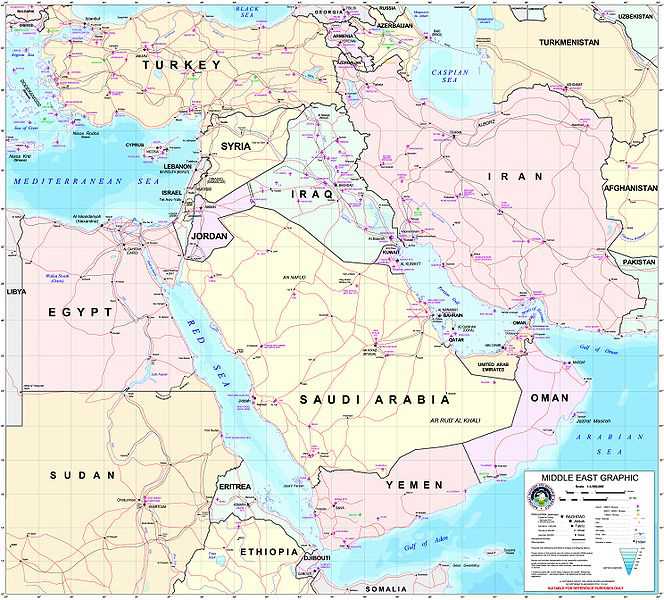
    The bottom line is that the orld is not what it was a decade or two ago. Neither, in particular, is the U.S. – nor is the West generally. New centers of political, military and economic influence are emerging fast. These provide new opportunities for Turkey, and Ankara’s reaching out to these countries is already fueling arguments about Turkey drifting away from the West.

    It is also clear that Israel’s isolation will increase in such a world. It is already almost totally alone in the U.N. where it has only America’s blind support to rely on, no matter what it does. This automatically puts Turkey in a much better position internationally than Israel in terms of any cost-benefit analysis relating to foreign policy administration.

    It seems that there will be much to mull over in Washington and Tel Aviv over the next weeks and month in terms of the “Turkey question.” It could be that we are heading for the kind of breakdown in ties that anti-Western elements in this country want.

    But if a simple list were to be made of countries that stand to loose the most by Turkey’s drifting away from the West it might read as follows:

    1- Israel

    2- Armenia

    3- The United States

    4- The EU (although it is no country)

    5- Turkey

    Others may wish to change the order in the list and provide strong and convincing arguments in doing this. What appears common to all countries in the list however, is that they all stand to loose something if Turkey were to drift from he West and go with “The Rest,” that is, the majority of countries in the world.

    Hurriyet Daily News

  • ‘Turkey will not attend OECD conference in Israel’

    ‘Turkey will not attend OECD conference in Israel’

    'Turkey will not attend OECD conference in Israel'
    Photo by: AP

    By JPOST.COM STAFF 
    10/13/2010 19:49

    Move described as first official boycott following flotilla affair; Culture and Tourism Minister says “We want tourism to take place, not politics.”

    A Turkish delegation will not be in attendance at this year’s OECD conference, being held in Jerusalem later this month, Turkish newspaper Hurriyet reported on Wednesday.

    According to the report, Culture and Tourism Minister Ertuğrul Günay spoke to reporters on Tuesday and confirmed that Turkey would not be sending representatives to Israel for the conference despite prior plans to the contrary.

    “Regrettable statements have been made. We want tourism to take place, not politics,” Günay was quoted as saying.

    Hurriyet described the move as Turkey’s first official boycott of Israel in the wake of the Mavi Marmara raid, in which nine Turkish activists were killed

    The UK has also said it won’t be attending the conference, but told The Jerusalem Post that the reasons for this were non-political. A Foreign Office spokesman said:

    “The UK’s opposition to boycotts against Israel is well-known. The UK will chair a session at the OECD’s meeting of International Data Protection and Privacy Commissioners in Jerusalem later this month. The decision [not to attend the tourism conference] was due to the unavailability of the relevant delegates.”

    https://www.jpost.com/Middle-East/Turkey-will-not-attend-OECD-conference-in-Israel

  • New int’l flotilla heading to Gaza in early 2011

    New int’l flotilla heading to Gaza in early 2011

     By ASSOCIATED PRESS 
    10/12/2010 09:53

    IHH says may send ship larger than Mavi Marmara; US group sending ship named after Obama’s book, “Audacity of Hope.”

    GENEVA — Pro-Palestinian groups plan to sail a flotilla of boats through Israel’s sea blockade of Gaza as early as February in the second such attempt in less than a year, activists said Monday.

    The activists, representing groups from over a dozen countries including Switzerland, Turkey and the United States, said the flotilla would be bigger than the one stopped by Israel earlier this year.

    “It’s not about the aid,” Huwaida Arraf of the Freedom Flotilla Coalition told reporters in Geneva.

    Arraf said the aim will instead be to show that the Gaza blockade can be broken. A spokeswoman at Israel’s embassy in Bern, Shlomit Sufa, said humanitarian goods are allowed into Gaza by land and the sea blockade is needed to prevent weapons being smuggled in to the Palestinian militant group Hamas. Several smaller ships have failed to reach Gaza since the May raid — most recently last month, when a boat carrying Jewish activists tried to reach the densely populated strip. Among the groups planning to take part in the latest flotilla is the Turkey-based Islamic charity IHH, which sponsored the Mavi Marmara — by far the biggest ship in the first flotilla. A representative of the group, Ahmet Faruk Unsal, said IHH is considering sending another ship of the same size. An American group, US Boat to Gaza, is also planning to send a vessel, said activist Jane Hirschmann. The boat will be named “The Audacity of Hope” in reference to US President Barack Obama’s best-selling policy book.

  • US congressmen: Turkey’s new stance on Israel welcome

    US congressmen: Turkey’s new stance on Israel welcome

    By HILARY LEILA KRIEGER
    08/31/2010 02:29

    Jewish leaders say words need to be backed up with action, more changes needed.

    WASHINGTON – Following the visit of a Turkish delegation to Washington, members of the US Congress and Jewish community are noting a change in Turkey’s rhetoric, but stress that words have to be backed up with actions.

    After Foreign Ministry Undersecretary Feridun Sinirlioglu held meetings with key officials at the White House, State Department and Treasury as well as with representatives of US Jewish organizations last week, Turkish officials were quoted in the Turkish press making positive statements about Israel and the relationship between the two countries.


    RELATED:
    ‘Turkey committed to ties with Israel’
    Analysis: Israel’s new Mediterranean best friend

    In their meetings, diplomatic sources described sharp differences in Ankara and Jerusalem over Israel’s deadly raid on a Turkish-supported flotilla trying to break the Gaza blockade as an incident between “two friends,” according to the Anatolia news agency.

    A similar message was conveyed at Tuesday’s meeting with Jewish leaders, according to the Hürriyet Daily News and Economic Review, which reported that Turkey conveyed the message that Israel was “a friend” and that the visit ended with “smiles and good wishes.”

    Until now, positive gestures between Turkey and Israel have been few and far between since the raid, which left nine Turkish activists dead. Amid harsh criticism, calls for an apology and a UN investigation, Ankara recalled its ambassador from Tel Aviv.

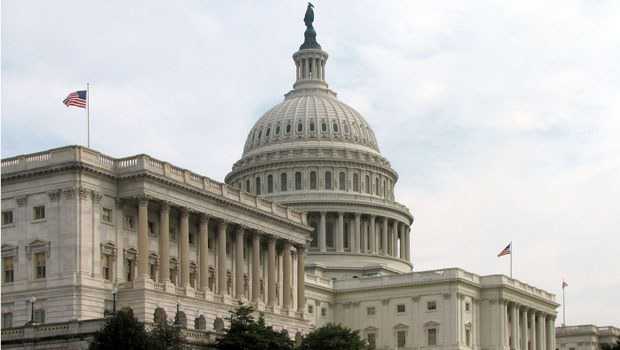
    The reverberations of the dispute, which followed other heated exchanges over Gaza and other regional policies between the two onceclose allies, have been felt in Washington. The Obama administration has called for a calming of tensions, while members of Congress on both sides of the aisle have slammed the Turkish government. The confirmation of the next US ambassador to Turkey is being held up in the Senate, while members of the House of Representatives have threatened to block arms sales to Ankara.

    “Their stated desire to be friends with Israel has to be backed up with something.

    So far all I’ve seen is an active PR machine,” said one Democratic congressional aide who works on Turkey, speaking on condition of anonymity.

    “Actions are going to speak louder than words.”

    While he was “glad to hear” the statements of friendship with Israel, he added, “It’s actually a sad state of affairs that they have to say it. It’s not something they ever had to say before.”

    Jewish officials who met with Sinirlioglu also said they are looking for actions to make the shift in rhetoric meaningful.

    “I would like to see demonstrations that they take the relationship with Israel seriously, [such as by] sending their ambassador back to Israel, beyond the more positive words expressed to Jewish organizations,” said one participant, speaking anonymously about the off-the-record meeting. “We’ll all be looking for that.”

    Significant differences on policy clearly remain, however, and not just regarding the flotilla incident. Congress is worried about a general shift by Turkey away from the West, epitomized by its relations with Iran. Turkey infuriated the US by voting against a fourth set of UN sanctions on Iran in June despite its continued enrichment of uranium in contravention of international demands.

    Treasury officials visited Ankara earlier this month “to ask Turkey not to trade with Iran” and to coordinate on the sanctions imposed against Iran, according to sources quoted in Hürriyet. But the newspaper reported that Turkey doesn’t believe itself bound by the further, much more comprehensive sanctions, passed by Congress and other countries.

    Still, Washington sources said it was a positive sign that Turkey saw the need to act to improve its image in the US.

    One Jewish official said he was glad to see that the officials reached out to the community last week and recognized the importance of indicating they were listening to American Jewry’s perspective.

    “They’re concerned that they’ve crossed a certain line and need to find a way to walk back,” he said. “We certainly have their attention.”

    https://www.jpost.com/Israel/US-congressmen-Turkeys-new-stance-on-Israel-welcome