Tag: Turkey-Israel

  • Turkey, Israel resume reconciliation talks

    Turkey, Israel resume reconciliation talks

    JERUSALEM (JTA) — Israel and Turkey resumed informal reconciliation talks.

    Turkey’s foreign minister, Ahmet Davutoglu, confirmed to CNN on Sunday reports that the two countries were discussing how to repair the relationship between the governments that broke down over Israel’s raid on the Mavi Marmara ship.

    Nine Turkish citizens died when Israeli Navy commandoes boarded the Mavi Marmara, which claimed to be carrying humanitarian aid, on May 31, 2010 after warning the ship not to sail into waters near the Gaza Strip in circumvention of Israel’s naval blockade of the coastal strip.

    Turkey has demanded that Israel apologize for the raid, compensate the families of those killed and halt its blockade of Gaza. Israel has offered to fulfill the first two of the requests.

    A Turkish court earlier this month began a trial in absentia of four Israeli military commanders responsible for the raid, including former Chief of Staff Gen. Gabi Ashkenazi. The Israelis could be sentenced in absentia to life in prison.

    Israel’s government-appointed Turkel Commission found in its investigation that the government and the military behaved appropriately, and that the blockade of Gaza was legal. The United Nations’ Palmer Committee also found the blockade to be legal but said Israel used excessive force while boarding the vessel.

    Turkey’s inquiry deemed the Gaza blockade and the Israeli raid to be illegal.

    via Turkey, Israel resume reconciliation talks | JTA – Jewish & Israel News.

  • Israel and Turkey resume talks to end diplomatic crisis

    Israel and Turkey resume talks to end diplomatic crisis

    Israel and Turkey resume talks to end diplomatic crisis

    Senior Israeli officials say Netanyahu’s envoy, Yosef Chiechanover, met with Turkish envoy Feridun Sinirlioglu to discuss reconciliation after the crisis that broke out following the 2010 Gaza flotilla.

    By Barak Ravid | 20:13 23.11.12 | 40

    Israel and Turkey have resumed talks on ending the crisis in relations between the two countries, two senior Israeli officials said on Friday.

    via Israel and Turkey resume talks to end diplomatic crisis – Israel News | Haaretz Daily Newspaper.

  • Turkey’s Erdogan says Israel sent ‘richest Jew’ to intercede

    Turkey’s Erdogan says Israel sent ‘richest Jew’ to intercede

    JERUSALEM (JTA) — Turkey’s Prime Minister Recep Tayyip Erdogan told a Turkish newspaper that Israel sent “the richest Jewish man in the world” to create better relations between the two countries.

    Erdogan said in an interview with the daily Hurriyet published on Sept. 17 that Israel only has ties with one Muslim country and that it would be in the country’s best interest to maintain good relations with Turkey.

    “They sent the richest Jewish man in the world [to us] a couple of months ago. What was the reason? He was supposed to be intercessor,” Erdogan said.

    The newspaper reported that the businessman was likely cosmetic magnate Ronald Lauder, president of the World Jewish Congress, who has close ties to Israeli Prime Minister Benjamin Netanyahu. Other Turkish media suggested that it was casino mogul Sheldon Adelson.

    Erdogan also reiterated his conditions for restoring good relations with Israel: that it apologizes for the deaths of nine Turkish activists on the Mavi Marmara ship seeking to break the naval blockade of Gaza; it compensates the families of the victims; and it lifts its blockade of Gaza.

    Erdogan also told the newspaper that in light of the recent furor in the Arab world over the anti-Islam movie “Innocence of Muslims,” he would ask the United Nations to have Islamophobia defined as a hate crime.

    via Turkey’s Erdogan says Israel sent ‘richest Jew’ to intercede | JTA – Jewish & Israel News.

  • Time to end the ‘cold war’ between Turkey and Israel – CSMonitor.com

    Time to end the ‘cold war’ between Turkey and Israel – CSMonitor.com

    Time to end the ‘cold war’ between Turkey and Israel

    With Iran nuclear talks stalled, Syria downing a Turkish fighter jet, and uncertainty following the Arab Spring, there has never been a more important time for Turkey and Israel to end their ‘cold war.’ They can begin with a compensation deal over the Mavi Marmara flotilla incident.

    By Michael J. Koplow and Brent E. Sasley / June 27, 2012

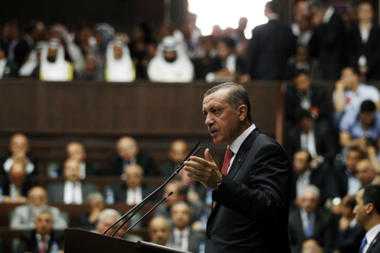
    Turkey’s Prime Minister Recep Tayyip Erdogan addresses members of his ruling party at the Turkish parliament in Ankara June 26. The Turkish Armed Forces’ rules of engagement have changed as a result of Syria shooting down a Turkish warplane, and they will respond to any violation on the Syrian border Mr. Erdogan said. Op-ed writers Michael J. Koplow and Brent E. Sasley comment: Rapprochement between Turkey and Israel could ‘foster the possibility of an international consensus on Syria.’

    Umit Bektas/Reuters

    Washington and Arlington, Texas

    The Middle East’s two strongest economic and military powers, Turkey and Israel, are no closer to mending their deteriorating relationship than two years ago, when Israeli commandos intercepted an aid flotilla, killing nine Turkish human rights activists aboard the Mavi Marmara.

    Gallery: Monitor Political Cartoons

    Related stories

    Three factors that will determine Syria’s future

    Israel must get used to the new Turkey

    Opinion: Will Netanyahu stay obsessed with Iran or use his new coalition to help Israel?

    Ads by Google

    Costa Calma Schnäppchen

    Reisen bis zu 65% günstiger buchen!

    Costa Calma Urlaub im Vergleich.

    www.Costa-Calma.Reisen.de

    But ties between the two need to be urgently reset – and can be – for the benefit of these former allies and for a region in turmoil.

    OPINION: Three factors that will determine Syria’s future

    An urgency to reconcile has been missing up until now, but outside events are conspiring to make the incentives for rapprochement stronger. With Iran nuclear talks at a stalemate, Syria on the brink of civil war and shooting down a Turkish fighter jet, growing instability in Lebanon, and lingering uncertainty following the Arab Spring, there has never been a more important time for these two historically friendly countries to end their ‘cold war.’

    A reconciliation between Turkey and Israel would bring many benefits. Turkey could return to its role as facilitator in Israeli-Arab peace talks and at the same time ease the distrust of Ankara in the US Congress. The popularity of Turkish Prime Minister Recep Tayyip Erdogan and of his country in the Arab world could help cushion Israel against the uncertainties of the Arab Spring.

    via Time to end the ‘cold war’ between Turkey and Israel – CSMonitor.com.

    more :

  • Could Cyprus pull Turkey and Israel into war?

    Could Cyprus pull Turkey and Israel into war?

    While Ankara is keen to mend fences with Tel Aviv after recent tensions, the latter appears to be turning the tables, creating sparks over Cyprus, writes Sayed Abdel-Meguid

    Perhaps the watchword for developments on the Aegean- Eastern Mediterranean axis, where Turkey and Israel have been engaging in bouts of muscle flexing and squabbles over deep-sea oil, is “posturing”. By no means does this apply to the heir to the Ottoman Empire alone; the Hebrew state is just as obsessed with its image. Yet, contrary to the impression it may seek to convey, Ankara has been the keener of the two to put an end to the deterioration in the relations between it and Tel Aviv.

    A steadily escalating dual between the two countries has seethed several years. It first erupted with an angry verbal exchange and has since passed through Turkish condemnation of the blockade on Gaza, the televised spat during the Davos conference, and the Israeli assault against the Mavi Marmara off the shores of Gaza in May two years ago.

    For four years, then, Turkey and Israel have growled, taken menacing steps against each other, and then backed off and continued to eye one another warily. Nor does either side appear ready to relax its guard, in spite of numerous efforts to ease tensions between the two. The most recent was reported in the Turkish daily, Sabah, which wrote that, as a gesture towards mending the rift between the two countries, Israel returned four Heron pilotless spy planes to Turkey after a month-long delay. These were four of the five aircraft that Ankara had sent back to Israel last year for repairs after they had technically malfunctioned. The article adds that some friendly European governments have been mediating between the two countries.

    Elsewhere in the Turkish press we find reports transmitted from the Israeli press that Turkish Prime Minister Recep Tayyip Erdogan sent an envoy to his Israeli counterpart, Netanyahu, with the purpose of repairing the rift in their bilateral relations.

    Meanwhile, it has also been reported that Israeli officials have contacted families of the Turkish victims who died in the attack on the Turkish ship that was carrying humanitarian aid to Gaza. According to these reports, the officials were secretly instructed to offer compensation amounting to $6 million along with a letter of apology. However, the gesture falls short of Turkish demands, to which testify the warrants issued by the Turkish public prosecutor for the arrest of four Israeli army commanders. He named former chief-of-staff Gabi Ashkenazi, deputy commander of the navy Admiral Eliazar Maroum, director of military intelligence General Amos Yaldin, and head of Air Force intelligence General Avishai Levi, and called for their life imprisonment for having issued the orders to attack the Mavi Marmara.

    For his part, US President Barack Obama urged his Turkish counterpart Abdullah Gèl to try to restore a positive climate in Turkish-Israeli relations. In the meeting between the two heads of state, which took place during the NATO summit in Chicago 20-21 May, Obama said that improved relations between the two countries would contribute to promoting stability in the region which has been swept by the revolutions of the Arab Spring. Gèl naturally took the occasion to remind Obama of the need for an official Israeli apology for the Mavi Marmara incident. Referring to the need for an official apology for the Mavi Marmara incident, Gèl responded that Israel is well aware of the steps that have been taken, and that if Israel takes these steps, Turkey will act accordingly.

    The evidence, thus, indicates that Erdogan’s Justice and Development Party government, which may have initiated the mounting antagonism between Ankara and Tel Aviv two years ago, is now the more eager of the two to mend fences. Fully aware of this, Israel was quick to take advantage and did so by approaching the Greek-Cyprus duo in order to trigger a new conflict.

    News sources have revealed details about a defence treaty between Israel and Cyprus (officially referred to by Turkey as southern or Greek Cyprus, which Turkey does not recognise) which was signed during a visit by Netanyahu to the divided island on 16 February. During that visit, Cypriot President Demitris Kristofias asked the Israeli prime minister to increase Israeli investment in Cyprus. Netanyahu’s response was to insist on permission to establish a naval and air force base there.

    According to a news analysis in a Turkish newspaper, Israel wants to deploy 20,000 commandos in Southern Cyprus in order to protect the crude oil pipeline that Israel plans to construct in the Eastern Mediterranean and to ensure the security of the natural gas station at Vasiliko in Limasol. The article, appearing in Vatan, cited unidentified sources as saying that these measures are part of a greater plan to build a second Israel in the Middle East. It adds that Jewish businessmen have bought large areas of land in northern Cyprus (referred to as the Turkish Republic of North Cyprus, which only Ankara recognises) through bogus companies in that part of Cyprus. “They have already inaugurated a Jewish temple in one of the villages, affixed a sign in Hebrew and appointed a rabbi for it,” the source is quoted as saying.

    Decision-makers in Turkey are aware that European governments and the US are not unconnected with these ambitions and, indeed, have been encouraging Israel to take hostile steps against their country. That Israel has been building partnerships with countries in the Balkans and in the Caucasus has heightened suspicions that it is constructing a web around Anatolia. “These moves are indicative of carefully studied plans that are being implemented if not in order to dominate then at the very least in order to capitalise on the energy sources along the old Silk Road,” a source said.

    Returning to the question of Cyprus, could it indeed propel Turkey to clash with Tel Aviv? There is no doubt that Turkish opinion at the official and popular level feels strongly about the issue, so the answer could be yes. But a central problem is the balance of military might between the two countries, which weighs against Ankara and which would give Israel the preponderance in a military clash.

    It would seem in Turkey’s interest not to escalate, but rather to show more flexibility in order to turn over a page that it is keener than others to put behind it. Therefore, threatening to annex northern Cyprus to Turkey, as Turkish Minister for EU Affairs Egemen Bagis did, is bound to backfire. Wavering to act on this threat would only diminish the credibility of the Turkish government before the Turkish people and the rest of the world. The same would apply with the regard to the threat to freeze relations with the EU in the event that Cyprus assumes the presidency of the EU parliament 1 July.

  • Turkey, Israel: Potential for a fresh start?

    Turkey, Israel: Potential for a fresh start?

    Turkey, Israel: Potential for a fresh start?

    Editor’s Note: Soner Cagaptay is a senior fellow at the Washington Institute for Near East Policy and a GPS contributor. You can find all his blog posts here. Tyler Evans is a research assistant at the Washington Institute for Near East Policy. The views expressed in this article are solely those of Soner Cagaptay and Tyler Evans.
    By Soner Cagaptay and Tyler Evans, Special to CNN

    Soner Cagaptay

    Thursday marks the two-year anniversary of the 2010 flotilla incident, a crisis on the high seas that triggered a tailspin in Turkish-Israeli relations.

    In the aftermath of the incident, Turkey recalled its ambassador and demanded an apology from Israel as well as reparations for the nine slain activists. Ankara even announced that its warships would escort future missions to Gaza.

    Attempts to mend fences have stalled over the issue of an Israeli apology. With Turkey willing to accept nothing less than a full apology, and Israel for the moment unwilling to accommodate this demand, the two sides seem to be at an impasse.

    Yet below the surface, not all is grim in Turkish-Israeli relations. Remarkably, economic ties have been flourishing between the two countries.

    Turkish-Israeli economic ties took off in the late-1990s as part of a growing strategic convergence. Deepening trade was underpinned by a series of bilateral agreements opening Turkish and Israeli markets to each other. Notable agreements included a free trade agreement (1996), a double-taxation prevention treaty (1997), and a bilateral investment treaty (1998). These agreements ushered in an era of improving political and economic ties. Trade jumped from $449 million in 1996 to more than $2.1 billion in 2002. This remarkable acceleration continued with bilateral trade increasing 14.6% per year, on average, from 2002 to 2008.

    Surprisingly, the diplomatic crisis has not translated into an economic crisis. Take for instance, a boycott announced by several Israeli grocery chains in the wake of the flotilla incident. Despite the assertions on the part of these retailers, Turkish export of vegetable products has remained steady since 2007, and exports of prepared foodstuffs, beverages and tobacco doubled between 2007 and 2011. From 2010 to 2011, trade increased by 30.7%, far surpassing the growth that occurred during the heyday of Turkish-Israeli ties.

    Still, defense ties have been hard-hit. Following the flotilla incident, Turkey froze at least a dozen defense projects with Israel, including a $5 billion deal for tanks and an $800 million sale for patrol aircraft and an early-warning radar plane.

    Despite these bruises, economic ties seem destined to deepen even further in the long term.

    For starters, all the aforementioned trade and investment treaties remain solidly in effect. Secondly, neither side seems eager to disrupt the trend of booming bilateral trade. In the aftermath of the flotilla incident, Turkish Prime Minister Recep Tayyip Erdogan announced his intention to cut all relations with Israel, including trade. But Ankara rapidly corrected the statement, adding that commercial ties would not be downgraded. Similarly, when an Israeli investment house announced its plans to divest in Turkey, the head of the Israeli Chamber of Commerce urged firms to refrain from any actions that might hurt Turkish-Israeli business ties.

    Q&A: Explaining the tension between Turkey, Israel

    The mutual reluctance to rupture trade ties is understandable, especially in light of the global economic climate. After all, both countries owe much of their growth in recent years to buoyant exports, a large portion of which were sold in European markets. This means that both countries are vulnerable to a sluggish European recovery. Greater bilateral trade could pick up some of the slack, especially on the Israeli side, where Turkey constituted Israel’s sixth-largest export market in 2011 and could climb the ranks as Israel’s traditional markets remain anemic.

    Israel is important for Turkey as well. In terms of volume, the Israeli market is small, but it presents significant opportunities for Turkish producers to move up the value chain. In March, the Turkish Industry and Business Association identified Israel as a priority investment partner, underlining the advantages of coupling Turkey’s land and labor with Israel’s innovation economy. A telling example of this potential can be found in Bursa, where Turkish manufacturers are assembling electric cars as part of a venture with the Israeli company Better Place. Thanks to this venture, Turkey is now producing its first electric car with technology that would not have been easy for the Turks to develop on their own.

    There is also a political angle that could bode well for bilateral ties. Faced with an increasingly volatile Middle East, some Israelis are concluding that they are better off rebuilding ties with Turkey, even if this does not mean going back to the honeymoon years of the 1990s. Meanwhile, Turkey faces a popular uprising in Syria that holds the potential of spilling over its borders. Along with downward-spiraling ties with Iraq, not to mention regional competition against Iran, this suggests that Israel is perhaps not the biggest fish to fry.

    Turkey and Israel seem to have potential for a fresh start. Even if the pair continues to diverge on certain core political issues, both seem to secretly prepare for the day they can make up again. As always, the flag follows the money.

    The views expressed in this article are solely those of Soner Cagaptay and Tyler Evans.

    Post by: Soner Cagaptay

    via Turkey, Israel: Potential for a fresh start? – Global Public Square – CNN.com Blogs.