Tag: EU

  • Cameron Throws Down Gauntlet To France, Germany With Backing For Turkey EU Bid

    Cameron Throws Down Gauntlet To France, Germany With Backing For Turkey EU Bid

    British Prime Minister David Cameron (left) with Turkish Prime Minister Tayyip Erdogan in Ankara on July 26British Prime Minister David Cameron (left) with Turkish Prime Minister Tayyip Erdogan in Ankara on July 26

    July 27, 2010
    By Robert Tait
    British Prime Minister David Cameron appears to have set himself on a collision course with France and Germany by expressing “anger” at moves blocking Turkey’s entry into the European Union and pledging to help “pave the road from Ankara to Brussels.”

    Speaking in the Turkish capital, Ankara, Cameron said he “passionately” supported Turkey’s EU membership and said opponents were guilty of double standards because they were happy to accept its contributions to Europe’s defense as a member of NATO.

    “When I think about what Turkey has done to defend Europe as a NATO ally and what Turkey is doing now in Afghanistan alongside European allies, it makes me angry that your progress towards EU membership can be frustrated in the way it has been,” he told a meeting of the Turkish chambers of commerce. “I believe it’s just wrong to say Turkey can guard the camp but not be allowed to sit inside the tent.”

    Cameron called Turkey” a great NATO ally” that “shares our determination to fight terrorism in all its forms, whether from Al-Qaeda or from the PKK [Kurdistan Workers Party].”

    While Cameron’s remarks — on his first official visit to Turkey — echoed the support of Britain’s previous Labour government for Turkish EU membership, they were striking in their vehemence. They also represented a direct challenge to France and Germany, both of which oppose the majority Muslim country’s entry even though it formally opened membership negotiations in 2005. Since then, the pace of Turkey’s application has floundered, with just 13 of 35 chapters of European law required for membership opened.

    Doing De Gaulle Proud

    French President Nicolas Sarkozy and German Chancellor Angela Merkel have tried to assuage Turkish aspirations by offering it “privileged partnership” status — a designation Turkey rejects.

    Germany’s opposition was reiterated on July 27 by Foreign Minister Guido Westerwelle, who was also visiting Turkey but said it was not “ready to join” the EU.

    “If the question had to be decided today, Turkey would not be ready for membership and the EU would not be ready to absorb it,” Westerwelle told the German newspaper “Bild.” “But we have a big interest in Turkey turning in Europe’s direction. I want a Turkey that is on Europe’s side. Not just for economic reasons. The country can also provide very constructive help in resolving many conflicts.”

    Sarkozy has justified his opposition to Turkish membership by citing cultural differences and saying it would pose a threat to the bloc’s political cohesion.

    But Cameron brazenly ruffled French feathers by comparing Paris’s position to President Charles de Gaulle’s hostility to British membership in the 1960s.

    “Do you know who said, ‘Here is a country which is not European. Its history, its geography, its economy, its agriculture and the character of its people — admirable people though they are — all point in a different direction. This is a country which cannot, despite what it claims and perhaps even believes, be a full member’?” Cameron asked. “It might sound like some Europeans describing Turkey, but it was actually General de Gaulle describing the UK before vetoing our EU accession. We know what it’s like to be shut out of the club. But we also know that these things can change.”

    Useful Friend

    He also attacked opponents of Turkish entry on the grounds of its Muslim population as being guilty of seeing “the history of the world through the prism of a clash of civilizations.” He added: “They think Turkey has to choose between East and West and that choosing both is not an option.”

    Turkey’s growing economic power meant that the Europe could not turn its back on it, Cameron suggested.

    “Which European country grew at 11 percent at the start of this year? Which European country will be the second-fastest-growing economy in the world by 2017? Which country in Europe has more young people than any of the 27 countries of the European Union? Which country in Europe is our No. 1 manufacturer of televisions and second only to China in the world in construction and in contracting?

    “Tabii ki Turkiye,” he said, Turkish for “Turkey, of course.”

    He also said Turkey was vital to resolving the dispute over Iran’s nuclear program, which Tehran claims is for peaceful purposes but which the West suspects is for bomb-making.

    “Which European country could have the greatest chance of persuading Iran to change course on its nuclear policy?” Cameron asked. “Of course, it’s Turkey. It’s Turkey that can help us stop Iran from getting the bomb.”

    Turkey, along with Brazil, reached an agreement with Iran in May to export 1,200 kilograms of low-enriched uranium in exchange for nuclear fuel for a medical reactor in Tehran. The agreement failed to prevent a fourth round of UN sanctions against Iran, together with further EU and U.S. embargoes. But Cameron said he hoped the deal could help “see Iran move in the right direction.”

    Not So Simple

    Cameron also urged Turkey to repair its tattered relations with Israel after the recent confrontation over a commando raid on an aid flotilla bound for Gaza, resulting in the deaths of nine Turkish citizens.

    “No other country has the same potential to build understanding between Israel and the Arab world,” Cameron said, acknowledging Turkey’s potential to act as a bridge between East and West. “I urge Turkey — and Israel — not to give up on that friendship.” But he also appeared to side with Turkish sentiments over Gaza, saying: The situation in Gaza has to change. Humanitarian goods and people must flow in both directions. Gaza cannot and must not be allowed to remain a prison camp.”

    His comments appeared to reflect the belief of many Western policymakers that Turkey’s recent hostility toward Israel may have been partly fueled by its feelings of rejection by the EU and a resulting need to foster alternative alliances in the east, including with Iran.

    U.S. President Barack Obama and Defense Secretary Robert Gates have both suggested in recent remarks that the EU has driven Turkey away from the West. .”If they do not feel part of the European family, then obviously they’re going to look elsewhere for alliances and affiliations,” Obama told the Italian newspaper, “Corriere Della Sera,” this month.

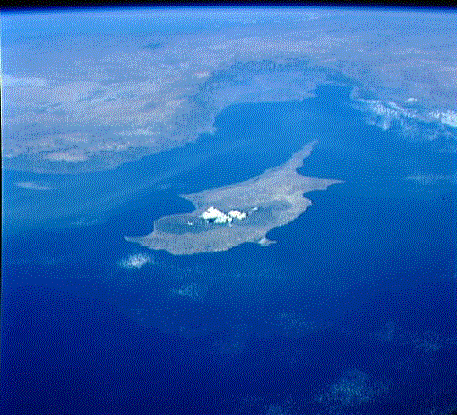
    However, Turkey’s EU critics complain that an internal domestic reform process needed for membership has slowed. They also cite Turkey’s failure to open its ports to goods from Cyprus, an EU member that Ankara refuses to recognize because of its division into Greek and Turkish sectors.

    https://www.rferl.org/a/Cameron_Throws_Down_Gauntlet_To_France_And_Germany_With_Backing_For_Turkish_EU_Bid/2111086.html
  • Turkey’s place in Europe

    Turkey’s place in Europe

    Turkey’s place in Europe was the cause of heated debate this week, as the United States expressed its concerns that the EU’s refusal to accept Turkey as a member swiftly has partly caused the deterioration in its relations with Israel.
    Since starting EU membership talks in 2005, Turkey has succeeded in opening only 12 of the 35 chapters that candidate countries must complete to join. With both France and Germany cool on Turkish membership, the worry is that
    the EU’s refusal to embrace Turkey is pushing it eastwards.
    As Italy’s foreign minister said: “If we give Turkey the impression that we don’t want them as a member of the EU family then they will look around for other perspectives, for example regional powers like Iran and Syria.”

  • UN envoy De Soto urges EU to end KKTC’s isolation

    UN envoy De Soto urges EU to end KKTC’s isolation

    Former UN envoy De Soto urges EU to end KKTC’s isolation;

    Alvaro de Soto, the UN secretary-general’s former special adviser on Cyprus, has said the European Union should, as promised, end the isolation of Turkish Cypriots to help find a lasting solution to the problems on the long-divided island.
    Mr de Soto stated that it would only be fair for the EU live up to its promises to the Turkish inhabitants of northern Cyprus. Noting that he believes that the EU should comply with its commitments to the Turkish Cypriots, he said this would drive Turkey to open its ports to traffic from Greek Cyprus. Turkey refuses to do so as long as theTurkish Cypriots continue to be subjected to isolation, which the EU had promised to end following the Greek Cypriot rejection of the Annan plan in 2004 while the Turkish side overwhelmingly approved it.
    The former UN envoy argued that one reason that prompted the Greek Cypriots to reject the Annan plan aimed at reunifying the island six years ago could be that they felt they were in an advantageous position because they were going to join the EU. He added that another reason was that the Greek Cypriots did not study the plan as carefully as the Turkish Cypriots and were therefore not completely aware of what it would have meant for them.
    De Soto also assessed the prospects of resolving the issue through the bilateral talks initiated by Greek Cypriot leader Dimitris Christofias and former Turkish Republic of Northern Cyprus (KKTC) President Mehmet Ali Talat on Sept. 3, 2008. Talat was unseated by Dervis Eroglu at the presidential elections held a month ago.
    He said both sides have agreed to a bi-communal, bi-zonal federal state solution as a compromise, though it was not either side’s preference. Stating that the parties have agreed to terms of reference for the talks, he said:“There is a new basis. I see that even Mr. Eroglu has agreed to continue on the same basis. They are pursuing a bi-zonal, bi-communal federal solution, the results of which would have to be a state of single international legal personality and sovereignty, and that is in conformity with the Annan plan as far as I can tell.” He added that it is a “good thing” to see Eroglu pledge to continue the talks from where they left off. Christofias and Eroglu are scheduled to hold the 72nd meeting of the reunification talks on May 26.
    De Soto lastly discussed the reason for his resignation from his last post at the UN in 2007 as the special coordinator for the Middle East peace process. He said he resigned because the UN refused to talk with Hamas.“In the Quartet, the UN decided not to deal with Hamas even though Hamas had been democratically elected in an election that has been praised by the observers, including the EU observers. Even though this was the case, the UN stopped dealing with the government of the Palestinian authority, and that was a mistake. I tried to get things changed, and when I was not successful, I left the UN,” he said.
    17 May 2010, Monday

    Topix

  • EU ‘Pleased’ With Armenian Caution On Turkey

    EU ‘Pleased’ With Armenian Caution On Turkey

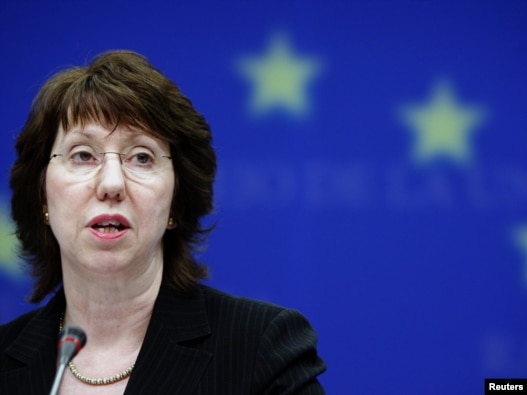
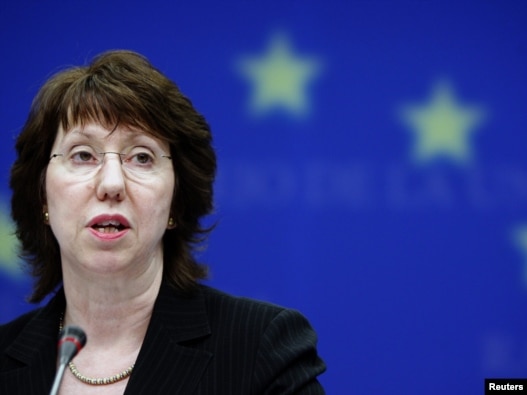
    Belgium -- EU High Representative for Foreign Affairs and Security Catherine Ashton holds a news conference after a EU foreign ministers meeting in Brussels, 22Mar2010Belgium — EU High Representative for Foreign Affairs and Security Catherine Ashton holds a news conference after a EU foreign ministers meeting in Brussels, 22Mar2010

    27.04.2010

    The European Union on Tuesday welcomed Armenia’s decision not to walk away from its fence-mending agreements with Turkey, while expressing concern about “the loss of momentum in this process.”

    The EU’s high representative for foreign affairs and security policy, Catherine Ashton, also reaffirmed through a spokesperson the bloc’s support for an unconditional and speedy ratification of the Turkish-Armenian protocols sought by Yerevan.

    “The High Representative is pleased to note that Armenia remains committed to pursue the process of normalization of Armenian-Turkish relations but at the same time expresses concern about the loss of momentum in this process,” the unnamed spokesperson said in a statement circulated by the EU delegation in Yerevan.

    “The EU reiterates its call to both countries to continue their dialogue and remain committed to the process of normalization without preconditions and in a reasonable timeframe,” said the statement.

    Germany, a key EU member state, also praised President Serzh Sarkisian for not formally ending the normalization process, in a separate statement released by its ambassador in Yerevan, Hans-Jochen Schmidt. “We greatly welcome that,” said Schmidt.

    France, another EU heavyweight, as well as the United States reacted to Sarkisian’s move in a similar fashion late last week. “We applaud President Sarkisian’s decision to continue to work towards a vision of peace, stability, and reconciliation,” said U.S. Assistant Secretary of State Philip Gordon.

    Both the U.S. and the EU have essentially shared Yerevan’s view that Armenia and Turkey should normalize relations regardless of decisive progress in international efforts to resolve the Nagorno-Karabakh conflict. Ankara regards such progress as a necessary condition for Turkish ratification of the protocols.

    “The High Representative believes that the full normalization of bilateral relations between Armenia and Turkey will contribute to security, stability and cooperation in the Southern Caucasus,” read the EU statement. “The EU will continue to provide its political and technical support to this process and stands ready to help implementing the steps agreed between the two countries.”

    https://www.azatutyun.am/a/2026197.html

  • Turkey’s presence in EU as an armed invader in Christian lands

    Turkey’s presence in EU as an armed invader in Christian lands

    Unless we admit Turkey, says Mr Erdogan, the EU will “end up a Christian club”. Well, is that so very bad? Didn’t Christians invent just about everything for the last 400 years? And how would Europe remain recognisably European (or even Christian) after a mass-movement of Anatolian Muslims into our cities?

    For one thing that Ryanair has taught us is the overnight mobility of populations. And Turkish immigration will probably not consist of cosmopolitan elites but of peasants and their imams from Anatolia, accompanied by their burkas, naquibs and madrasas.

    And if you wonder about the outcome, wonder no more: simply go to Bradford and Blackburn and ask them about the boundless delights of mass-Islamic immigration. Go on. Ask them.

    kmyers@independent.ie

    myers hakkinda bilgi
    https://en.wikipedia.org/wiki/Kevin_Myers
     

  • Ottoman mission

    Ottoman mission

    By Delphine Strauss

    Published: November 24 2009 02:00
    osmanli

    In one of Istanbul’s artier quarters, a second-hand bookshop sells leaves torn from an old school atlas that depict the dominions of the Ottoman empire, all neatly labelled in a flowing script few Turks are now able to read.

    The faded pages are a reminder of the heritage long rejected by the modern Turkish state as it sought to forge a new national identity and survive on the frontline of 20th-century geopolitics. Just as the social reforms of Mustafa Kemal Atatürk, founder of the secular republic, presented European culture as the standard of civilised behaviour, so foreign policy became firmly west-facing as Turkey sought shelter from the Soviet power on its border.

    Now, however, the ruling Justice & Development (AK) party is reengaging with territories once ruled by the sultans, from the Balkans to Baghdad, in a drive to return Turkey to a place among the leadership of the Muslim world and the top ranks of international diplomacy.

    Ahmet Davutoglu, foreign minister and architect of the policy, rejects the expansionist tag of “neo-Ottoman” bandied about by AK critics, preferring his well-used slogan, “zero problems with neighbours”. The US and the European Union praise this unobjectionable aim: to act as a force for stability in an unstable region.

    Turkey has long mattered – as Nato ally, friend of Israel, EU applicant and energy route to the west. But its growing economic strength and diplomatic reach give it influence over some of the toughest issues facing Washington and other capitals: from frozen conflicts in the Caucasus to Iran’s nuclear ambitions to the threat of disintegration in Iraq. “We are neither surprised by nor disturbed by an activist Turkish agenda in the Middle East,” Philip Gordon, assistant secretary at the US state department, said in Ankara this month.

    Yet the speed and bewildering scope of Turkey’s diplomatic endeavours have left both Turkish and western observers wondering whether it can juggle all its new interests. In a month of frenetic activity, Mr Davutoglu has staged a show of new friendship with Syria, ending visa restrictions on a border once patrolled by Turkish tanks; paid a high-profile visit to Iraq’s Kurdistan region, long shunned as a threat to Turkish unity; and signed a landmark deal to mend relations with Armenia. “Today we, children of the Ottomans, are here to show interest in the development of Mosul just as our ancestors showed centuries ago,” Zafer Caglayan, trade minister, said as he opened a consulate in the northern Iraqi city last month. Turkish diplomats claim credit, in the last year alone, for mediating between Israel and Syria, hosting talks between Afghanistan and Pakistan, and liaising with Sunni militants in Iraq.

    But Recep Tayyip Erdogan, a prime minister who scorns diplomatic niceties, has shown the potential for new friendships to damage old ones.

    Israel, which long valued Turkey as its only Muslim ally, was already infuriated by his frequent condemnations of its Gaza offensive. In October, Mr Erdogan compounded the insult not only by ejecting Israel from joint military exercises but by renewing his criticisms while in Tehran standing beside Mahmoud Ahmadi-Nejad, Iranian president. He caused consternation by saying Omar al-Bashir, Sudan’s war crimes-indicted president, could not as a Muslim be capable of genocide, nor could his actions be compared with Israel’s.

    “Why is it that . . . a more prominent Turkey has, it seems, to come at the expense of its relations with Israel?” Robert Wexler, the US congressman, asked recently. US newspaper columnists went further, arguing that Ankara was undermining efforts to put pressure on Iran, or even that illiberal Islamists could no longer be trusted in Nato.

    The virulence of the reactions reflects the value attached to Turkish support. Although no longer a bulwark against Soviet power, the threat of radical Islam has given Turkey new weight as a partner to channel western values to the Muslim world – and, by its western alliances, show that a “clash of civilisations” is not an inevitable result of religious difference.

    Mr Davutoglu is touring European capitals this month, employing Ottoman-tinged rhetoric to persuade people that Turkey’s European vocation is unchanged. “You cannot understand the history of at least 15 European capitals without exploring the Ottoman archives,” he told an audience in Spain this week.

    For Ankara, there is no question of changing orientation. “We have one face to the west and one to the east,” Mr Erdogan said last month as he signed trade deals in Tehran. Yet it is natural for Turkey to keep its options open, given the manifest reluctance in some EU countries to admit it to membership.

    Ankara presents its new friendships as an asset to the EU, giving it a partner to promote western aims in the region. The European Commission’s latest report on Turkey’s accession process endorsed that view, with praise for its foreign policy. But Brussels also makes it clear that geostrategic importance cannot replace the domestic judicial, political and human rights reforms required to meet the criteria for membership.

    Ankara’s focus, however, is on grander projects than box-ticking compliance with European legislation. A lack of enthusiasm for Herman van Rompuy’s appointment last week as president of the European Council reflects not just worries over his past opposition to Turkey’s candidacy but a preference for a heavyweight leader who would want Europe to play a bigger part on the world stage.

    Ibrahim Kalin, Mr Erdogan’s chief foreign policy adviser, argues that Turkish activism is not a reaction to disappointments in the EU but simply “a fully rational attempt to seize new spaces of opportunity” – including the EU’s virtual absence from geopolitics.

    Frictions with the EU may worsen, however, if Turkey engages in rivalry with countries used to seeing it as a junior partner. Western diplomats have noted Mr Davutoglu’s reluctance to support a French attempt at conciliation between Israel and Syria, for example, and say Mr Erdogan’s grandstanding in Iran “is definitely causing irritation”.Turkey thus needs to ascertain how much influence it has, what it is based on, and where new policies may upset old alliances.

    Greater regional engagement is in part a response to changing balances of power. The coming American withdrawal from Iraq threatens a vacuum in which Turkey is one of the most plausible counterweights to Iranian influence – its credibility enhanced by its refusal to let the US use its territory to invade in 2003.

    Ian Lesser from the Washington-based German Marshall Fund notes that ideas of a “Middle East for Middle Easterners” have been circulating for some time. “The crucial difference is that Turkey is now a much more significant actor in both economic and political terms, and Turkey’s Middle Eastern choices are, rightly or wrongly, seen as linked to the country’s own identity crisis.”

    Foreign policy is certainly shaped by a growing affinity with the Islamic world, in a country where religious practice is becoming more visible and public opinion a greater force. Mr Erdogan’s comments on Gaza, or on Iran’s nuclear programme, appear both to recognise and reinforce views on the street: a survey by the GMF found that almost one-third of Turks – compared with only 5 per cent of Americans – would accept a nuclear-armed Iran if diplomacy failed.

    Chief AK weapon in its drive eastwards, though, is not religion but trade. Exports to what the country’s official Turkstat agency classifies as the Near and Middle East account for almost 20 per cent of the total so far in 2009, up from 12.5 per cent in 2004. Turkish conglomerates are also stepping up investment in a region where their presence is considered benign.

    “We don’t want a cultural bias against us,” says Sureyya Ciliv, chief executive of Turkcell, the mobile operator, which has interests in central Asia, Georgia and Moldova. Anadolu Efes, with almost 10 per cent of Russia’s beer market, wants to start producing non-alcoholic beer in Iran. Limak, a group centred on construction, is seeking projects in the Gulf, north Africa and Europe “east of Vienna”. “It’s a natural development,” says Ferruh Tunc, senior partner in Istanbul for KPMG, the consultancy. “Turkey’s position until the Soviet Union collapsed was unusual – it was like the last stop on a Tube line.”

    Yet a previous initiative, reaching out to the Turkic-speaking world after the central Asian states won independence, left Turkey with excellent trade links but limited influence compared with China and Russia. Morton Abramowitz, a former US ambassador to Turkey, warns in this month’s Foreign Affairs journal that in the AKP’s latest diplomatic push as well, “despite the acclaim it showers on itself . . . symbolic achievements have far exceeded concrete ones”. More-over, Turkey’s opposition this spring to Anders Fogh Rasmussen’s appointment as Nato chief “alienated many Europeans by seeming to favour Muslim sensibilities over liberal democratic values”.

    Can Ankara not reach out peacefully on all fronts, as it claims, without repercussions and a risk of overstretch? “You need very judicious fine tuning to be able to deliver this . . . The danger is of overplaying their hand,” says a western diplomat.

    Mending fences with Armenia won praise in the west, for instance, but in Azerbaijan nationalists tore down the Turkish flag, viewing the move as a betrayal of old alliances. Baku may yet take revenge by demanding higher prices to supply gas.

    The next test of Turkey’s new foreign policy will be Iran. The AKP claims its opposition to a nuclear-armed Iran is more effective because it delivers the message as a friend and trading partner. Turkey’s interests in trade with Iran are understood but Mr Erdogan may be pressed in Washington and Brussels to explain why he defends Iran’s nuclear programme as “peaceful and humanitarian” and lends the regime credibility rather than backing isolation.

    Katinka Barysch of the Centre for European Reform, a London think-tank, says: “As a long-standing Nato member and a country negotiating for EU membership, Turkey is expected to align itself with the US and Europe – or at least not do anything that undermines the west’s political objectives in the Middle East. As a regional power, Turkey will want to act independently and avoid antagonising its neighbours. It is not clear how long Ankara will be able to avoid tough choices.”

    Tricky legacy

    Ottoman analogies are a double-edged weapon in Turkish politics. Those urging more rights for Kurdish citizens, for example, might recall the Ottomans’ multicultural tolerance. But some view such nostalgia as a challenge to the principles of Mustafa Kemal Atatürk’s republic, with its emphasis on a distinctly Turkish language, culture and identity. Halil Inalcik, a historian at Ankara’s Bilkent university, warns: “We are not Ottomans . . . We’re a nation state. That was an empire.”

    ‘There is progress but it’s uneven’

    Turkey’s shift in foreign policy reflects its ambition to assume greater responsibility as a regional power. It may also reveal frustration over another ambition that has been delayed, if not thwarted: Istanbul’s bid to join the European Union.

    Officially, the EU has been committed to full membership since 2005. Yet eight of the 34 negotiating “chapters” remain blocked as a result of Turkey’s long-running conflict with Cyprus. Meanwhile enthusiasm is faint in France and Germany, the bloc’s traditional centres of power. “There is progress but it’s very uneven,” one Commission official says.

    The most recent update on negotiations came with the Commission’s mixed review of Turkey in last month’s annual enlargement report. Praise forits overtures to its Kurdish minority, and its agreement to reopen its border with Armenia, was tempered by concern over a fine imposed on one of Turkey’s leading media companies. Ostensibly for tax evasion, the $4bn (€2.7bn, £2.4bn) levy was likened by Olli Rehn, Europe’s enlargement commissioner, to “a political sanction”. European diplomats expressed surprise, too, at recent comments that seemed to lend support to Iran. Diplomats also say they do not expect breakthroughs from this week’s EU-Turkey ministerial meeting to discuss foreign affairs, which Mr Rehn will attend.

    If it is accepted, Turkey will become the first predominantly Muslim EU member and also the most populous, giving it a sizeable number of seats in the parliament and threatening the power of Paris and Berlin. Nicolas Sarkozy, French president, displayed his opposition at an EU-US summit in Prague in May. After Barack Obama, on the eve of his first visit to Turkey, urged his hosts to “anchor” the country more firmly in Europe, Mr Sarkozy promptly suggested the US president mind his own business. Angela Merkel, German chancellor, has been more diplomatic,suggesting Istanbul be addressed instead as a “privileged partner”.

    The creation of a full-time EU presidency and foreign policy chief seems unlikely to accelerate accession. In a 2004 speech, Herman Van Rompuy, the Belgian prime minister chosen as president, said Turkey “is not a part of Europe and will never be”. Those remarks proved awkward in the run-up to his selection last week but – as Istanbul no doubt noticed – they did not cost him the job.

    Financial Times