Tag: EU

  • Turkish Government and Opposition React to EU Commission’s Progress Report

    Turkish Government and Opposition React to EU Commission’s Progress Report

    Turkish Government and Opposition React to EU Commission’s Progress Report

    Publication: Eurasia Daily Monitor Volume: 7 Issue: 206

    November 12, 2010

    By: Saban Kardas

    On November 9, the European Commission published its 2010 progress report on Turkey’s performance in the accession process. Against the background of the declining popularity of EU membership in Turkey, the report has raised interest in the EU process. Yet, it remains to be seen if this renewed attention might really re-energize Turkey’s long-stalled membership drive.

    Turkish-EU relations entered a period of stalemate in the second half of the decade, which followed a period where the rapid pace of reforms helped Turkey secure a date for the start of accession talks in 2005. The causes of this deadlock have appeared enigmatic, as both the Turkish government and the EU highlighted each other’s mistakes. European circles criticized the slow-down in the Turkish government’s political reform agenda, and its uncompromising position on the Cyprus dispute. Ankara’s resistance to opening its ports to Greek Cypriot vessels was a case in point from the EU perspective. For the Turkish government, by contrast, factors internal to the EU were largely responsible for the slow progress. The EU was unable to remove the obstacles created by some anti-Turkish member states, such as the Greek Cypriot or French veto against the opening of negotiating chapters or the debate on “privileged partnership” initiated by the French and German leaders. More importantly, the Turkish government has complained that the EU has failed to fully reciprocate the reforms delivered by Turkey, and has treated the Turkish Cypriots unjustly (EDM, June 29, 2009).

    As the mutual blame game led nowhere, there were concerns as to whether Turkish-EU relations might grind to a halt. The debate following the 2008 progress report, where the EU again urged Turkey to take reforms more seriously, coincided with many international experts advancing the provocative argument that 2009 would be a make or break year (EDM, January 12, 2009). Although the Turkish government streamlined its efforts for preparation towards membership in 2009, through the establishment of a new ministerial post for EU affairs, nothing the Turkish government accomplished was close to a breakthrough that could end the stalemate. As a result, Turkish-EU relations remained in its rather stagnant state throughout 2009 and 2010, though none of the parties dared to take steps that might end the membership process.

    The 2010 progress report did not contain any elements of surprise, as it was largely written in a balanced manner in both its criticism and praise of the Turkish government’s performance (www.avrupa.info.tr, November 9; Hurriyet, November 10). Overall, it was based on the commission’s earlier position that Turkey will have to recognize that it is subject to a rigorous set of criteria for accession, similar to those applied to other candidates, and Turkey should focus on maintaining a convincing track record and avoid any expectation of short-cuts. Similarly, the EU is also expected to be credible so that it could provide Turkey with a legitimate membership prospect. The report also retained another theme which has attracted greater sympathy in recent years, that Turkey’s new foreign policy activism could be an asset for EU’s external relations.

    Overall, the report underlined Turkey’s mixed progress towards aligning its own regulations with the EU. While the EU recognized the improvements in immigration, it also underlined other areas where Turkey needed to undertake further reforms. Again, in foreign policy issues, while the EU welcomed Turkey’s constructive role and contribution to energy security, it also noted that no major initiatives were undertaken on the Cyprus issue, urging it to play a more constructive role

    In a development which was welcomed by the opposition parties and other groups critical of the government, the report pointed out Turkey’s shortcomings on many issues pertaining to political and cultural rights. It raised growing concerns about the freedom of the press, the ongoing problems in the treatment of minorities, and the inability of the government to produce any tangible results through the Kurdish initiative. While the report welcomed the steps towards democratization and supported the recent constitutional referendum package, which introduced some changes to the composition of high courts, it expressed concern over presidential appointments to those institutions as well as some university presidents. In anticipation of the government’s likely drive for rewriting the constitution following the 2011 elections, EU sources also noted the importance of building consensus for future constitutional reforms.

    The opponents of the AKP preferred to highlight those aspects of the EU’s view of Turkey, which are critical of the government’s track record on individual rights. They particularly highlight parts of the report listing the prosecution of journalists, writers or politicians for their expression of opinions. Also, many experts attending a panel discussion in Ankara on November 11 agreed that, though the report overall offered a balanced account of Turkey’s progress, its critical tone towards certain practices of the government has never been clear.

    Ironically, government sources also welcomed the report, arguing that it largely met Turkey’s expectations. Foreign Minister, Ahmet Davutoglu, interpreted the report’s affirmation of Turkey’s new foreign policy as an indication that discussion on whether Turkey was shifting its strategic axis was baseless. Yet, Davutoglu criticized the EU for its unfair assessment of the situation in Cyprus, arguing that the current situation on the island was not of Turkey’s own making and that Ankara could not be expected to solve the problem in isolation. A press release posted on foreign ministry’s website reiterated Davutoglu’s views on the issue (www.mfa.gov.tr, November 9).

    Similarly, Prime Minister, Recep Tayyip Erdogan, and State Minister for EU Affairs, Egemen Bagis, were positive about the report as the EU’s affirmation of Turkey’s place in the EU. Responding to the criticism in relation to limiting individual rights and freedom of expression, Erdogan denied those charges, arguing that there cannot be a completely uncontrolled exercise of freedom in any democracy. Regarding the specific cases of rights’ violations or legal investigations mentioned in the report, Erdogan maintained that they were committed by the judiciary, not the government.

    Overall, both the government and the opposition seem to prefer to maintain their commitment to the EU, because they can manipulate it to support their own positions politically, as they see fit.

    https://jamestown.org/program/turkish-government-and-opposition-react-to-eu-commissions-progress-report/

  • Semi-pregnant!

    Semi-pregnant!

    OPINION

    Yusuf KANLI

    As Turkey’s European Union membership process continues on its long and winding uphill road with no clarity, after so many decades, whether inshallah it will be completed one day with a happy orthodox marriage or a mateessüf (unfortunate) firm rebuff with an indecent offer of becoming a “privileged partner,” or mistress, of Europe, some European bureaucrats and politicians were reported to be shocked to see a sharp drop in the interest in the Turkish media to the just-released annual progress report…

    Turks are of course frustrated with the European Union membership process. When they first knocked on the door of Europe with a request for membership it was in the early 1960s. In 1963 Turkey and the forefather of today’s EU signed the so-called Ankara Agreement, which called for Turkey’s membership in the community once it completed its preparations and improved its economy and democracy to meet European standards. The 1963 accord had two dimensions, an economic one and a political one. The economic dimension of the Ankara Agreement was completed, with considerable delay, in 1995, and Turkey joined in the European customs union and became the first-ever country to engage in the customs union scheme without completing full EU accession.

    Indeed, from the day Turkey engaged in the customs union deal it agreed to a transformation of its membership-targeted EU process into a “mistress affair” or privileged partnership as by entering into the customs union without getting the political bonus, or membership and the right to contribute to the shaping of European policies, Turkey liberally opened its entire market to EU industry and commerce. That is, from 1995 on Turkey-EU relations have been something like semi-pregnancy; Turkey is in the EU, has to abide with EU decisions and policies, but it is not an EU member and thus totally out of the policy-making process of the EU.

    Yet, though he refuses even to commit himself to a marriage sometimes in the future and insists on saying, “Well, we have an affair, let’s live it liberally… Perhaps, who knows what the day will bring, we may marry one day, or just part ways,” the European arrogant “husband” keeps on asking “mistress Turkey” to conform with this or that decision of the European family, walk the extra mile and offer some additional compromises to please the spoiled Greek Cyprus kid, provide some improvements in the rights and liberties of the non-Muslim as well as Muslim minorities and even take such steps that might seriously endanger the national and territorial integrity of the country.

    As if such oddities were not enough, every other day Turkey would be insulted with some ludicrous claims regarding Cyprus or find itself trying to understand some masterpieces of Turkish animosity pouring out of the mouths of an arrogant small French man or a blunt German lady who happen to be sitting in governmental seats in their countries. Yet, European “friends” of Turkey are astonished to see a marked decrease in the support in Turkey for the country’s EU membership bid.

    Come on, Europe must try to understand why a person like President Abdullah Gül, who over the past many years repeatedly expressed full support to EU membership, has started to talk all of a sudden about the probability of Turks saying no in a referendum – if the process is ever completed and Turks go to a referendum to make the final decision on accession – on EU membership. What Gül said is indeed what many people, including this writer, have been stressing for the past many years: Turkey needs Europe and Europe needs Turkey. If Europe does not want Turkey in, Turkey definitely does not want to be with the EU either. Turkey is no parasite which might think membership in the EU is an existential issue for itself.

    Since the 2005 start of the accession talks process negotiations have started in only 13 headings, provisionally closed only in one heading but unfortunately most of the remaining 22 chapters of the 35 overall chapter acquis communitaire have been held hostage by either France or the Greek Cypriot administration.

    While issues of freedom of expression, press freedom, democratic representation and such fundamental democracy shortcomings are not given adequate prominence in Turkey-EU political dialogue, held hostage by some extraneous issues, it is indeed sad to see Europeans complaining about why Turks feel frustrated with the EU process.

    Perhaps Europe must try to find an answer to why Prime Minister Recep Tayyip Erdoğan, in his typical arrogance, declared the other day that in the next 18 months or so Turkey might be compelled to make a final decision on its EU bid if Europe continues to ominously keep Turkey in a waiting room.

    There cannot be a semi-pregnancy.

    , November 10, 2010

  • The EU must not shut Turkey out

    The EU must not shut Turkey out

    09 November 2010

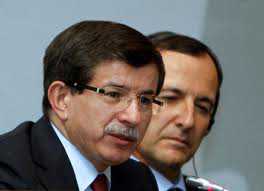
    Davutoglu and his Italian counterpart Franco Frattini issued joint article, urging the European Union to support Turkey’s ongoing works on harmonization with the EU acquis.
    An article published in Tuesday’s Italian newspaper La Repubblica with the title “European Union should not Close Doors to Turkey” stated that Turkey targeted full membership to the EU.

    Davutoglu and Frattini in the joint article criticized that some EU member countries were not positive towards Turkey’s full membership saying, “Turkey’s accession process cannot be antagonized by taking refuge behind delusive allegations such as Turkey does not embrace European culture and law. This means denying the unique capacity of Europe in harmonizing and blending together different cultures within the framework of shared values that has been one of the main elements of the success achieved in the construction of the union.”

    Davutoglu and Frattini stated that negotiation process should not lose its dynamism, adding, “the desired pace for the negotiation process cannot be achieved, however, due to obstacles brought up by certain member states that are of a political nature and have no relevance to the technical negotiations. It is the common responsibility of all parties not to have the negotiation process lose its dynamism. Turkey should fulfill its part by absolutely conforming with the acquis communautaire, and the EU should play a role supporting Turkey in this process.”

    The joint article also referred to striking developments in Turkish economy and said, “Turkey has been developing rapidly with its young and dynamic foundation in line with her goal of becoming a member of the EU family. Working her way out of a severe economic crisis in the first half of the 2000s, Turkey today has become Europe’s most dynamic economy. The Turkish economy has grown by 10 percent in the second quarter of 2010. With her great economic potential, Turkey’s full membership will increase EU’s economic dynamism and competitiveness.”

    In addition to strengthening her economy, Turkey has been very successful in steadily adapting to EU norms and standards by making the necessary legislative changes and particularly by realizing constitutional reform, it said.

    The article underlined that, “Having a European, Mediterranean, Balkan and Middle Eastern identity all at the same time, Turkey has been pursuing an active, multi-dimensional and result-oriented foreign policy in order to improve relations with all her neighbors to the full extent and strengthen peace, stability and prosperity. It is clear that Turkey’s foreign policy vision, values, goals and tools are overlapping with those of the EU.”

    “As is seen in the fifth wave of enlargement, the accession process to the EU plays a role encouraging reforms in candidate countries and constitutes a significant source of motivation. Furthermore, the full membership of Ankara will strengthen the EU’s institutional profile as promoting security in various areas, including energy, as a global actor,” the article said.

    It noted that, “Consequently, Turkey’s accession to the EU is a historic opportunity that should not be missed both by Turkey and the EU. Being in full awareness of such a strategic opportunity, Italy has always been alongside Turkey in her gateway to Brussels, exerted efforts in every platform so as to carry the accession negotiations a step further, looked for new avenues for purposes of putting an end to the isolation of the Turkish Cypriot community and been working to initiate the process that will lead up to visa exemption, a fundamental element in getting Turkey and especially her people closer to Europe. Turkey appreciates and takes heart from Italy’s precious support. The unique fraternal relations symbolized by Italy’s support rendered for Turkey’s EU goal fosters the strategic partnership of our countries in all areas. Today’s forum, which takes its strength from the intense dialogue we have succeeded establishing on every issue, represents the meeting ground of traditions belonging to those civilizations sharing common values.”

    AA

    Frattini – Davutoglu: « The EU must not shut Turkey out » (la Repubblica)

    Dear Editor,

    Italy and Turkey have always been two important pilasters in the peace and security of the region of Europe and the Mediterranean. Rome and Istanbul are two large cities in the Mediterranean, the cradle of civilisation.

    Our cooperation “model” draws its strength from our history of friendship and millenary reciprocal influence. The intense existing relations between our governments and peoples are the tangible proof that this heritage is still intact.

    Our countries are pursuing common political objectives, first and foremost among them Turkey’s full membership in the European Union.

    Negotiations began a little over five years ago, and since then Italy has never wavered in its support of Turkey’s European prospects. Unfortunately, the accession process has been slow, not least as a result of the numerous political reservations voiced by some Member States not pertinent to the technical negotiations. Turkey must continue to work at enacting internal reforms, thereby adapting to the Community acquis; but the EU must do its part in supporting Turkey’s efforts. We cannot shut Turkey out on the pretext of differences to European culture and law. This would mean denying that one of the keys to the success of the European political construction is its unique ability to harmonise and amalgamate differing political and cultural systems in a common area of shared values.

    A young and dynamic nation, Turkey is changing rapidly for the better, in line with its legitimate aspirations to be part of the European family. Only ten years ago the country was coming out of a dramatic crisis, and today Turkey is one of the most dynamic economies in Europe, with 10% growth in the second quarter of 2010. It is also a member of the G20. Turkey’s accession can therefore contribute to strengthening the EU’s economic dynamism and competitiveness.

    Thanks to a constitutional package that recently took effect, Turkey has also taken some major steps forward with regard to adapting to Community norms and standards.

    Turkey’s foreign policy coincides to a great extent with the EU’s from the point of view of vision, values, ends and means. Turkey belongs, at one and the same time, to Europe, the Caucasus, the Middle East and the Mediterranean, where it pursues an active, multidimensional foreign policy on behalf of strengthening peace and regional stability. Its accession could thus contribute to strengthening the EU’s profile as a global actor and promoter of security, as well as on the energy front.

    Turkey’s EU integration is an unparalleled historic opportunity for the EU and for the country itself. For this reasons, Italy has always stood by Turkey’s side in this demanding bid for membership, and has been active in every arena to encourage negotiations. Turkey draws strength from Italy’s support, for which it is profoundly grateful. This relationship of brotherly friendship sees in Italy’s support for Turkey’s dream a solid anchor, and is nourished daily by the strategic partnership that unites us in all fields through joint initiatives and intense dialogue on all topics.

    Related:

    «Turkey’s “silent revolution” on the way to Europe» by Minister Frattini and Foreign Minister of Turkey Davutoglu

  • Turkey stands by ambassador to Austria after controversial remarks

    Turkey stands by ambassador to Austria after controversial remarks

    Both Turkey and Austria play down any tension in their bilateral ties after the Turkish ambassador’s critical comments regarding integration problems. Diplomatic sources say withdrawing the ambassador is out of the question, and Austria has not asked Ankara to do so


    Turkey has no intention of withdrawing its ambassador to Vienna after his controversial but personal remarks about Austrian attitudes toward immigrants caused a stir in the country, diplomatic sources said Thursday.

    “The removal of the ambassador is out of the question,” sources who wished to remain anonymous told the Hürriyet Daily News & Economic Review. “This is not on the agenda.”

    Austria was disappointed by comments from Turkish Ambassador Kadri Ecved Tezcan but did not ask Turkey to withdraw the Turkish envoy, Austria’s Ambassador to Ankara Heidemaria Gurer told the Daily News. “Our foreign minister yesterday night [Wednesday] stated this clearly on TV,” she said.

    The Turkish envoy was summoned to the Austrian Foreign Ministry early Wednesday to explain his remarks, while Turkish Foreign Minister Ahmet Davutoğlu spoke twice on the phone with his Austrian counterpart.

    Diplomats, however, played down any tension in Turkish-Austrian ties due to the controversy created by the ambassador’s remarks and said it was too early to judge the current state of relations as a “diplomatic crisis.”

    In Strasbourg, Davutoğlu said the ambassador had expressed his personal opinion.

    “From the very beginning of the interview, our ambassador declared that the views expressed were his personal views and he was trying to reflect his own experiences with the Turkish community,” said the foreign minister.

    “The Turkish-Austrian relationship is deep-rooted and based on mutual respect with an established tradition.”

    Before the beginning of the interview with Austrian daily Die Presse, Ambassador Tezcan asked the journalist if he preferred that he reply to the questions as a diplomat – which he said would be boring – or as someone who has been living in Vienna for a year and with contacts with the 250,000 Turks living in Austria.

    The journalist said he would prefer the second. Tezcan said in the interview that Austria was pushing people of Turkish origin into ghettos instead of learning to live with them and benefiting from their skills, media reports noted.

    Turkish diplomatic sources told the Daily News that Ankara was bringing the issue of integration to the attention of Austrians, something that was also discussed when Austrian Foreign Minister Michael Spindelegger visited Ankara last month.

    “The ambassador was expressing the feelings of the Turkish community and giving messages by engaging in self-criticism,” sources said.

    Austria ‘disappointed’ by critical comments

    The ambassador’s critical comments caused a stir in Austria.

    “First of all we are disappointed by the fact that the ambassador suggested that international organizations in Vienna should withdraw their headquarters from Vienna,” said Ambassador Gurer.

    “Then the ambassador made a personal attack on the Austrian ministries of the Interior and Foreign Affairs. He also made derogatory remarks concerning the Social Democratic Party in Austria. We also did not like his generalizing statement on the hostile attitude of Austria toward foreigners,” she said.

    Austria’s displeasure was conveyed to the Turkish Foreign Ministry.

    Austria to hold integration conference next year

    Integration issues are frequently discussed in countries such as Austria and Germany, which both have sizeable Turkish populations. Turkey complains that the immigrant Turkish community, which came to Germany and Austria as guest workers in the 1960s and the 1970s, is not provided with the opportunity to fully integrate and instead faces discrimination.

    In Ankara, Spindelegger told a joint news conference with Davutoğlu that the way Turks generally lived in Austria was affecting the image of Turkey in his country. The governments and publics of Austria, Germany and France are not very favorable to Turkey’s accession to the European Union.

    Turkey says a distinction between assimilation and integration should be clearly made.

    “Integration is a social responsibility that helps multi-cultural societies live in respect and in a legal system,” Davutoğlu told the same conference. “But assimilation means destroying a culture, something that cannot be accepted.”

    Austria has plans to hold an integration conference in early 2011.

    Excerpts from Tezcan’s interview

    In the interview, Tezcan criticized Interior Minister Maria Fekter for her tough stance on illegal immigrants. “What she stands for doesn’t conform to a liberal, open mindset,” Tezcan said, adding the same was true for German Chancellor Angela Merkel.

    “Turks are happy, they don’t want anything from you,” he said. “They just don’t want to be treated like a virus.”

    Tezcan also said that if he were the head of a Vienna-based international organization he would not stay in the city. He added that Austria had no business telling women whether or not to wear headscarves. “If there’s the liberty here to swim in the nude, then there also should be the liberty to wear a headscarf.”

    Hürriyet

  • Friends of Turkey Group Visits USAK House

    Friends of Turkey Group Visits USAK House

    International Strategic Research Organization (USAK) hosted a meeting with key European Parliament members concerning the recent developments and deadlocked relations between Turkey and European Union on 3rd of November 2010.

    The conference titled “Future of Turkish-EU Relations” provided a unique opportunity for the speakers and participants to discuss the problems and trajectories in Turkey-EU relations. Turkish and European experts in their fields as well as the policy makers attended to the conference. The purpose of the conference was to provide overview and possible recommendation concerning Turkey- EU relations. USAK hosted the members of “Friends of Turkey Group” namely,  Andrew Duff (President of the European Federalists, UK), Alexandra Thein (Germany), Anneli Jaateenmaki (Former Minister of Finland), Metin Kazak (Bulgaria), Marietje Schaake (Netherlands), Jelko Kacin (Former Minister of Defence of Slovenia), Diane Wallis (Vice President of European Parliament, UK), Anne Maria Corraza- Bildt (Sweden), Birgit Schnieber Jastram (Germany), Jo Leinen (Chairperson of Environment Committee,Germany), Jutta Steinruck (Germany); under the chairmanship of the Guner Özkan, the chair of Center of Eurasia Studies, and Alosz Peterle, Member of European Parliament, President of the Friends of Turkey group and former Prime Minister of Slovenia.

    The conference began with two comprehensive presentations which addressed the Turkey-EU relations by USAK experts; Mustafa Kutlay and Ceren Mutus.

    Mustafa Kutlay in his presentation, focused on three pillars of EU-Turkey Relations. Kutlay focused on the changing dynamics of Turkey’s EU journey, future of Turkey- EU Relations and the discussion about the whether Turkey drifting away from the EU.

    Regarding the dynamics of Turkey- EU Relations, Kutlay stated that “free market economy and economic development” together with “institutionalization of democracy and development of human Rights” are the two main objectives for Turkey. Furthermore he also touched upon two other pillars “stability in foreign policy in instable regions” and “modernization within the context of Westernization.” However, according to him, the last two pillars are not priorities for Turkey at the existing conjuncture.

    Ceren Mutus who is an expert on European Studies in USAK, briefly mentioned about the political reforms initiated between 2001 and 2004 and concluded her speech by shedding light on the legal and technical content of the recent constitutional package.

    She claimed that the sweeping reforms that have been undertaken by Turkey between 1999 and 2004 were mainly due to the concrete commitment made by the EU towards Turkey’s membership. Turkey, with the aim of fulfilling the Copenhagen criteria and become eligible for the formal negotiations, pushed forward ambitious reform packages. In this context, death penalty was removed from the Turkish Constitution, the legal protection of socio-cultural rights of Turkish citizens irrespective of their ethnic and religious origin has been improved, the role of the military in Turkish political life has been significantly diminished, the freedom of expression has been enhanced and recently a comprehensive judicial reform promoting the well- functioning of the justice system was adopted.

    After the presentations, Alojz Peterle takes attention to the difference between the planning and preparation from implementation.  He emphasized that at the beginning of the process, there was romantic atmosphere. However Turkey’s membership is different and more difficult than the other candidate countries. Moreover he believes that, both sides done much of things such as reforms and values over the last decade. Furthermore, he marked that EU should show its interest and prove the support of Turkey’s membership during the process.

    Former Finland Prime Minister, Anneli Jaateenmaki contributed to the discussion by highlighting the fact that there is a long list of reforms, but it is difficult to implement. Even it seems good and efficient; the implementation is not strong.

    President of the European Federalists, Andrew Duff emphasized that Turkey’s military is so big and corrupted. It also failed to defeat PKK.  He also raised the questions as follows:  “Why Turkey is so tolerant to this big army and its activities.  “If Turkey’s PM and President order army forces to withdraw from Cyprus, would they obey?”

    Anna Maria pointed out her disappointment about the negative attitude toward the closed chapters which was shown by experts.  She continued attracting attention to the different perspectives of the parties. For instance, according to her some people, of course, scared about Turkey’s membership because of the recession the process of secularization and Kurdish Issue.

    USAK Expert, Prof. Ihsan Bal, respond the comments by stating that, “Turkish public mind is changing about the implementation of the reforms. Western political reforms and values will be implemented because there is a public demanding and politicians try to respond positively to these demands.  To be honest, reforms are implemented more strictly and effectively when we compare it with 10 years before.”

    He gave some interesting samples during his speech. For instance, he believes that “If military coups occur citizens will protest unlike 1980’s. Of course, some of the people want coups and military actions. We can label them as “ultra-nationalist” groups but they are a small minority group. In that respect democratic initiative towards Kurds got support and military is silent because of the huge majority support backing the project.”

    According to Kurdish issue, he argues that it is a combination of economy and security. He mentions that the terms of numbers of killed-terrorists shows the military success but it is not the solution way. Of course democratic governments use military tools in order to solve the problem, like Britain, but it is just part of the issue. In other words, governments not take the military decision solely.  They should use civil agents, such as police force and intelligence services take more roles in the region at the problem.

    He emphasized the importance of the USAK report in 2005 which triggered the reform in military institution. “Army takes some steps and become more professional. It reduces the number of compulsory service man. But reforms need time, can be effective in long term.  To be realistic the change over one night is impossible.”

    Bal take attention to Cyprus issue as well. He underlines that there is not only one way to solve the issues. Turkish military presence is not the sole reason for the problem. Both sides should make some other progress and take actions.  Moreover, Turkish Cypriots isolated and it is not fair while other side is recognized as EU member and enjoys benefits of the membership. In other words; we say “yes” to referendum but, get no benefit. Cyprus issue should take consider as package not as a chapter.

    Güner Özkan closed the conference by admitting Turkey’s active policy in the last decade.  He believes that those active policies are not aiming to replace EU, Turkey just diverse its options. He clearly pointed that; there will be no alternative to EU for Turkey. More importantly, he said the other alternatives are not comparable to the EU. In the ten year period, we hope to have more deep economic and political relations with EU.

    By Firat Güzeldag and Kasim Ileri (JTW)

    Journal of Turkish Weekly, 3 November 2010

    International Strategic Research Organization (USAK) hosted a meeting with key European Parliament members concerning the recent developments and deadlocked relations between Turkey and European Union on 3rd of November 2010. The conference titled “Future of Turkish-EU Relations” provided a unique opportunity for the speakers and participants to discuss the problems and trajectories in Turkey-EU relations. Turkish and European experts in their fields as well as the policy makers attended to the conference. The purpose of the conference was to provide overview and possible recommendation concerning Turkey- EU relations. USAK hosted the members of “Friends of Turkey Group” namely,  Andrew Duff (President of the European Federalists, UK), Alexandra Thein (Germany), Anneli Jaateenmaki (Former Minister of Finland), Metin Kazak(Bulgaria), Marietje Schaake (Netherlands), Jelko Kacin (Former Minister of Defence of Slovenia), Diane Wallis (Vice President of European Parliament, UK), Anne Maria Corraza- Bildt (Sweden), Birgit Schnieber Jastram (Germany), Jo Leinen (Chairperson of Environment Committee,Germany), Jutta Steinruck (Germany); under the chairmanship of the Guner Özkan, the chair of Center of Eurasia Studies, and Alosz Peterle, Member of European Parliament, President of the Friends of Turkey group and former Prime Minister of Slovenia.

    The conference began with two comprehensive presentations which addressed the Turkey-EU relations by USAK experts; Mustafa Kutlay and Ceren Mutus.

    Mustafa Kutlay in his presentation, focused on three pillars of EU-Turkey Relations. Kutlay focused on the changing dynamics of Turkey’s EU journey, future of Turkey- EU Relations and the discussion about the whether Turkey drifting away from the EU.

    Regarding the dynamics of Turkey- EU Relations, Kutlay stated that “free market economy and economic development” together with “institutionalization of democracy and development of human Rights” are the two main objectives for Turkey. Furthermore he also touched upon two other pillars “stability in foreign policy in instable regions” and “modernization within the context of Westernization.” However, according to him, the last two pillars are not priorities for Turkey at the existing conjuncture.

    Ceren Mutus who is an expert on European Studies in USAK, briefly mentioned about the political reforms initiated between 2001 and 2004 and concluded her speech by shedding light on the legal and technical content of the recent constitutional package.

    She claimed that the sweeping reforms that have been undertaken by Turkey between 1999 and 2004 were mainly due to the concrete commitment made by the EU towards Turkey’s membership. Turkey, with the aim of fulfilling the Copenhagen criteria and become eligible for the formal negotiations, pushed forward ambitious reform packages. In this context, death penalty was removed from the Turkish Constitution, the legal protection of socio-cultural rights of Turkish citizens irrespective of their ethnic and religious origin has been improved, the role of the military in Turkish political life has been significantly diminished, the freedom of expression has been enhanced and recently a comprehensive judicial reform promoting the well- functioning of the justice system was adopted.

    After the presentations, Alojz Peterle takes attention to the difference between the planning and preparation from implementation.  He emphasized that at the beginning of the process, there was romantic atmosphere. However Turkey’s membership is different and more difficult than the other candidate countries. Moreover he believes that, both sides done much of things such as reforms and values over the last decade. Furthermore, he marked that EU should show its interest and prove the support of Turkey’s membership during the process.

    Former Finland Prime Minister, Anneli Jaateenmaki contributed to the discussion by highlighting the fact that there is a long list of reforms, but it is difficult to implement. Even it seems good and efficient; the implementation is not strong.
    President of the European Federalists, Andrew Duff emphasized that Turkey’s military is so big and corrupted. It also failed to defeat PKK.  He also raised the questions as follows:  “Why Turkey is so tolerant to this big army and its activities.  “If Turkey’s PM and President order army forces to withdraw from Cyprus, would they obey?”

    Anna Maria pointed out her disappointment about the negative attitude toward the closed chapters which was shown by experts.  She continued attracting attention to the different perspectives of the parties. For instance, according to her some people, of course, scared about Turkey’s membership because of the recession the process of secularization and Kurdish Issue.

    USAK Expert, Prof. Ihsan Bal, respond the comments by stating that, “Turkish public mind is changing about the implementation of the reforms. Western political reforms and values will be implemented because there is a public demanding and politicians try to respond positively to these demands.  To be honest, reforms are implemented more strictly and effectively when we compare it with 10 years before.”

    He gave some interesting samples during his speech. For instance, he believes that “If military coups occur citizens will protest unlike 1980’s. Of course, some of the people want coups and military actions. We can label them as “ultra-nationalist” groups but they are a small minority group. In that respect democratic initiative towards Kurds got support and military is silent because of the huge majority support backing the project.”

    According to Kurdish issue, he argues that it is a combination of economy and security. He mentions that the terms of numbers of killed-terrorists shows the military success but it is not the solution way. Of course democratic governments use military tools in order to solve the problem, like Britain, but it is just part of the issue. In other words, governments not take the military decision solely.  They should use civil agents, such as police force and intelligence services take more roles in the region at the problem.

    He emphasized the importance of the USAK report in 2005 which triggered the reform in military institution. “Army takes some steps and become more professional. It reduces the number of compulsory service man. But reforms need time, can be effective in long term.  To be realistic the change over one night is impossible.”

    Bal take attention to Cyprus issue as well. He underlines that there is not only one way to solve the issues. Turkish military presence is not the sole reason for the problem. Both sides should make some other progress and take actions.  Moreover, Turkish Cypriots isolated and it is not fair while other side is recognized as EU member and enjoys benefits of the membership. In other words; we say “yes” to referendum but, get no benefit. Cyprus issue should take consider as package not as a chapter.

    Güner Özkan closed the conference by admitting Turkey’s active policy in the last decade.  He believes that those active policies are not aiming to replace EU, Turkey just diverse its options. He clearly pointed that; there will be no alternative to EU for Turkey. More importantly, he said the other alternatives are not comparable to the EU. In the ten year period, we hope to have more deep economic and political relations with EU.

    By Firat Güzeldag and Kasim Ileri (JTW)


    Wednesday, 3 November 2010

    Journal of Turkish Weekly

  • Turkey Considers Cooperation with Greece on Illegal Immigration to Europe

    Turkey Considers Cooperation with Greece on Illegal Immigration to Europe

    Turkey Considers Cooperation with Greece on Illegal Immigration to Europe

    Publication: Eurasia Daily Monitor Volume: 7 Issue: 194

    October 27, 2010

    By: Saban Kardas

    Turkish Prime Minister, Recep Tayyip Erdogan, met his Greek counterpart, George Papandreou, on the margins of the Mediterranean Climate Change Initiative conference near Athens last week. The positive reporting of the Erdogan-Papandreou meeting marks the deepening rapprochement between the two countries, after their normalization slowed down in the second half of the 2000’s.

    Characterized traditionally by historical enmity and territorial disputes, Turkish-Greek relations have undergone a remarkable improvement in the past decade. The so-called Greek-Turkish rapprochement started with the two earthquakes that devastated both countries in 1999. The mutual assistance and solidarity the two nations extended to each other in response provided fertile ground to develop closer political ties. As a result, Greece, which had blocked Turkey’s EU membership process, changed its policy and became an advocate of the EU’s enlargement to include Turkey. Since coming to power, Erdogan has ascribed special importance to normalizing ties with Greece, as reflected in his close personal relationship with the former Greek Prime Minister, Kostas Karamanlis.

    However, in parallel with the deterioration of Turkish-EU relations, Turkish-Greek relations also experienced difficult times in the second half of the 2000’s. Although the Turkish-Greek trade volume has expanded throughout the decade, there has been little concrete progress over the political disputes that had traditionally dominated their relationship. The Turkish side largely preferred to pursue a policy of constructive ambiguity, and adopt a gradual approach to solving the disputes, while the Greeks from time to time expressed their disappointment over the ongoing uncertainty. Turkey’s resistance to referring the Aegean disputes to the International Court of Justice and the ongoing “dog fights” between Turkish and Greek fighter jets in the Aegean Sea remained a major source of disagreement, resulting in an occasional heightening of tension (EDM, June 22, 2009).

    The global financial crisis, which dealt a serious blow to the Greek economic system, ironically, provided another fresh impetus to resolve bilateral disputes. In that context, the recent talks follow on Erdogan’s historic trip to Greece in May, when the two countries signed over 20 agreements to develop relations in various fields, including energy, the environment and illegal immigration. They also decided to launch the High Level Strategic Cooperation Council, which complemented similar arrangements Turkey has formed with its other neighbors. Erdogan also expressed Turkey’s readiness to help Greece to recover from the financial crisis, through what he called “enhanced economic partnership” The two sides, however, failed to reach any concrete agreement on the major issues in the bilateral relationship, such as the conflicting claims in the Aegean Sea, the status of the minorities, or the Halki seminary and the Cyprus issues (Anadolu Ajansi, May 15).

    Granted, Turkish leaders’ extension of a friendly hand to Greece and their statements calling for dampening military tensions in the Aegean through closer bilateral dialogue was ground-breaking in many ways. This thinking is largely in line with Ankara’s recent policy of pursuing “zero problems with neighbors,” and prioritizing economic cooperation over political disputes. Indeed, as a stark reflection of this new thinking, Turkey will reportedly not include Greece, Russia, Iran and Iraq as enemy countries in its national security document, which is currently being revised.

    Speaking to Greek TV stations, Erdogan, also expressed clearly that Turkish flights in the Aegean have decreased significantly and that Ankara supports the idea of ceasing them entirely (Today’s Zaman, October 21). By de-securitizing its relationship with Greece and its other neighbors, Turkey hopes to reap the benefits of peace dividends, by significantly cutting military expenditures and instead focus on mutual economic gains. In the case of Greece, by turning the Aegean into a basin of peace, the Turkish government hopes, for instance, to enable the exploration of offshore hydrocarbon resources, and further cooperation in the transportation of oil and gas to European markets.

    It appears that the technical level contacts between both countries have continued since May, seeking common ground in their political disputes. In the wake of the latest trip, both parties are talking more resolutely about a shared strategic vision and pursuing win-win cooperative policies. Toward these objectives, there are stronger indicators that they might be involved in serious discussions on the resolution of thorny issues, including the Ecumenical Patriarchate and joint Turkish-Greek initiatives to curb illegal immigration to the EU. Following his meeting with Papandreou, Erdogan vowed to start cooperation on illegal immigration, so that they could tackle what he called a “common problem.” The Greek media even speculated that by the end of the year the parties might finalize a compromise agreement on the resolution of the Aegean disputes, on which they had already agreed in principle (Anadolu Ajansi, October 22; www.ekathimerini.com, October 25).

    Most Turkish media outlets preferred to present Erdogan’s trip as a major achievement which boosted his popularity in Greece. Similarly, the Greek media also underscored the optimism generated by the Erdogan-Papandreou meeting (Taraf, October 24). However, some Greek observers maintain that the Papandreou government’s closer dialogue with the Turkish government “may ring alarm bells in many circles in Greece which would interpret it (and they do) as an indication of Greece losing diplomatic ground in the Aegean, or even in Greek Thrace” (Hurriyet Daily News, October 24).

    In any case, the resolution of the remaining disputes with Greece serves the Turkish government’s foreign policy objectives. Especially by addressing the illegal immigration issue and the reopening of the Halki seminary, Turkey can remove major obstacles which have bedeviled its accession process into the EU. The EU has been expecting Turkey to harmonize its practices on illegal immigration with European regulations, and reopen the Greek Orthodox seminary to show its support for human rights. Moreover, through its constructive dialogue with Greece, Ankara solicits the support of Athens within the EU. Recently, the Turkish government has tried to mobilize the pro-Turkey EU members so that they could break the stalemate over membership talks. Reportedly, in exchange for its cooperation on the illegal immigration issue, Turkey expects Greece to at the very least, assist with the relaxation of European visa regulations for Turkish citizens.

    https://jamestown.org/program/turkey-considers-cooperation-with-greece-on-illegal-immigration-to-europe/