Blog

  • Turkey to block access to the Hate Film which brought chaos to the world

    Turkey to block access to the Hate Film which brought chaos to the world


    ANKARA, Turkey — A Turkish court issued an order on Wednesday allowing authorities in the country to block Internet access to the anti-Islam movie that has sparked violent protests across the Muslim world, an official said.

    Binali Yildirim, the minister in charge of transportation and communications, told state-run TRT television that the injunction allows government telecommunications and information technology authorities to prevent access from Turkey to URL links to the film.

    The move came a day after another government minister said Prime Minister Recep Tayyip Erdogan, who heads an AK Party* party, ordered officials to find ways of preventing access to videos of “Innocence of Muslims” movie.

    Dozens of people, including the U.S. ambassador to Libya, have been killed in violence linked to protests over the film.

    “Henceforth, it will not be shown in our country,” said Yildirim, calling the film “disgusting.”

    “To insult what is sacred, to incite indignation is unacceptable for all religions. It is a hate crime and no crime should go unpunished,” Yildirim said. His office said Tuesday that the ministry has also asked Google Inc. and YouTube to remove the videos.

    Erdogan has criticized Western nations for not taking steps to prevent insults to Islamic values but also has criticized violent protests against the film saying they harm Islam.

    Yildirim said the court order is limited to links to the film and that access to websites that carry the links would not be blocked. Turkey banned access to the video sharing site YouTube from 2008 and 2010 because of videos deemed insulting to the country’s founder, Mustafa Kemal Ataturk.

    Thousands of other websites, most of them pornographic, have also been banned in the country. The government says it is fighting child pornography, illegal gambling and other cybercrimes.


    CBS NEWS


    Edited*

  • UK: South Yorkshire police chief faces MP quiz over sex cases

    UK: South Yorkshire police chief faces MP quiz over sex cases

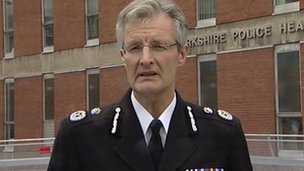
    The chief constable of South Yorkshire is to face MPs about the scale of alleged sexual abuse of young girls in the county.

    It comes after The Times said confidential police reports referred to widespread abuse of girls by Asian men.

    Chief Constable David Crompton has been summoned to appear before the Commons Home Affairs select committee.

    He said: “I will fully assist the Home Affairs select committee in answering any questions they may have.”

    ‘Uncover criminality’

    Mr Crompton had already been due to face the committee to answer questions over the Hillsborough tragedy.

    Keith Vaz MP, chairman of the Home Affairs select committee, told BBC News he wanted answers to the newspaper’s claims on abuse.

    He said: “The select committee has been conducting an inquiry into grooming for some time, since the first time these revelations were exposed in The Times.

    “It would be appropriate for us to have [Mr Crompton] to deal with some of the points that have been raised.

    “I had asked David Crompton to come in and talk about the aftermath of Hillsborough and what his force is doing about it.

    “Therefore it is appropriate following these revelations that he should also tell us what South Yorkshire police is doing and what appears to be a decision by agencies not to work together to try and uncover this criminality.”

    The investigation by The Times – with access to confidential documents from the police intelligence bureau, social services and other organisations – alleged widespread abuse.

    Force denial

    The newspaper said a confidential 2010 report by the Police Intelligence Bureau detailed “a significant problem with networks of Asian males exploiting young white females, particularly in Rotherham and Sheffield”.

    The paper claimed that in another confidential report in 2010 from Rotherham Safeguarding Children Board “there are sensitivities of ethnicity with potential to endanger the harmony of community relationships”.

    South Yorkshire Police has emphatically denied withholding information about the scale of sexual exploitation of girls by gangs of men.

    In an earlier statement the force said: “South Yorkshire Police is recognised as leading the way on what is now being recognised nationally as a problem and to suggest that the force and its partners are deliberately withholding information on the issue is a gross distortion and unfair on the teams of dedicated specialists working to tackle the problem.”

    It said the force was “working with local authorities, social services and NHS on several live investigations, two of which are large and likely to lead to more prosecutions; we will act when we have the evidence”.

    The statement added that The Times was “wrong to suggest a lack of commitment is shown towards the problem as our record shows”.


    BBC

  • Will Turkey’s Military Finally Get Its Act Together?

    Will Turkey’s Military Finally Get Its Act Together?

    Adem Altan/Agence France-Presse — Getty Images Demonstrators outside the Turkish Parliament in Ankara on Sept. 22, after a court ruled that hundreds of senior military officers were guilty in a coup plot they called Sledgehammer.

    ISTANBUL — A Turkish court’s conviction on Friday of 325 senior military officers for plotting to overthrow the state has left me with mixed feelings. Like many Turks, I’ve been pondering a host of questions: Was this justice or revenge? Is this the final curtain on a military that for decades believed it knew better than the elected politicians? Or was the 21-month courtroom drama the latest show trial, manipulated by a government that itself entertains delusions of grandeur?

    My mixed feelings are compounded by my working relationship with the newspaper that broke the case open and also by an acquaintance with one of the key defendants — a former army commander who received the maximum sentence of 20 years.

    There is no ambivalence about the seriousness of the charges. The prosecutor accused the senior military commanders of plotting a coup d’etat. Following the election in 2002 of what the military saw as a pro-Islamic government, these leaders planned violent provocations — including an armed confrontation with Greece and the bombing during Friday prayers of a famous Istanbul mosque — that would end in the coup. The military’s code word for the operation was Sledgehammer.

    The defense pooh-poohed the notion that there was a serious coup attempt and questioned the motives of the court for refusing to hear expert testimony that much of the evidence consisted of badly executed electronic forgeries.

    My own conclusion, reached purely on gut reaction and not from careful perusal of a warehouse-load of documents, is that many of the suspects, though probably not all, were guilty of something. A military that has historically taken a prominent role in politics, has staged repeated coups and, as recently as 2007, has warned Parliament about whom they should and should not elect as president, could always strike again.

    Yet, the prosecution was ham-fisted and the judges refused to allow proper cross examination. The case will now wind its way to higher courts and possibly to the European Court of Human Rights.

    I have friends who argue that you can’t blame the courts for indulging in a bit of rough justice against such a powerful foe. But this argument — that you can’t make an omelette without breaking a few eggs — is precisely the argument used by other friends that say Turkey is not ready for full democracy.

    I felt the full brunt of Turkey’s particular form of justice some 15 years ago when I was put on trial for “causing the military to be held in contempt,” which then carried a maximum sentence of six years.

    I had written that the Turkish Army had learned from its mistakes during its campaign against Kurdish rebels and was at least trying not to behave like an army of occupation. This was seen as far-too-faint praise by a public prosecutor. I was put on trial, but in the end, the case was dropped under a general amnesty for “offenses committed with the printed word.”

    It has crossed my mind that had the military been more accepting of criticism back then, it would not be in the mess it’s in now. It faces a constant barrage of criticism for incompetence — over the deaths of 34 civilians in an anti-terrorism operation gone wrong last December along the Iraqi border, to the dozens of deaths earlier this month in Bingol when Kurdish militants attacked a poorly guarded convoy. There have been no public explanations and no promises of inquiries.

    Sledgehammer is just the first of a series of trials against senior officers. Even before the verdict, the government had almost certainly succeeded in clipping the military’s desire to get involved again in politics. The question now is whether the armed forces, badly demoralized, are still fit for purpose. The military needs to be made truly accountable and undergo a process of reform.

    Andrew Finkel has been a foreign correspondent in Istanbul for over 20 years, as well as a columnist for Turkish-language newspapers. He is the author of the book “Turkey: What Everyone Needs to Know.”

    via Will Turkey’s Military Finally Get Its Act Together? – NYTimes.com.

  • Turkey’s Kurdish Calculus

    Turkey’s Kurdish Calculus

    By SONER CAGAPTAY

    The Kurdistan Workers’ Party, or PKK, has made a bloody comeback in Turkey. According to a recent report by the International Crisis Group, PKK-related violence has killed some 700 people since the summer of 2011. This deadly toll recalls the horrors of the 1990s, when thousands of civilians were killed in PKK terror attacks and a brutal war in eastern Turkey between the government and Kurdish militants.

    The resurgence of PKK violence is no accident. It is directly related to Turkey’s defiant posture in support of the Syrian uprising and against the Assad regime and its patrons in Iran. The upside for the West is that Ankara is starting to re-embrace its old friends in Washington.

    The breakdown in Turkish-Syrian ties began in the summer of 2011. Since then, Damascus has once again allowed the PKK to operate in Syria. Meanwhile, to punish Ankara for its Syria policy, Iran’s leaders have made peace with the Kurdish rebels they had been fighting, letting the PKK focus its energy against Turkey.

    This was not Ankara’s plan. When the Syrian uprising began in spring 2011, Turkish leaders initially encouraged Bashar Assad’s regime to reform. In August 2011, Turkish Foreign Minister Ahmet Davutoglu spent six hours in Damascus asking Assad to stop killing civilians.

    The Syrian tyrant not only disregarded Turkey’s pleas; he also sent tanks into Hama hours after Mr. Davutoglu left the capital. Thereafter, Ankara broke from Assad and began calling for his ouster. Turkey began providing safe haven to Syrian opposition groups, and media reports have even indicated that Ankara has been arming the Syrian rebels.
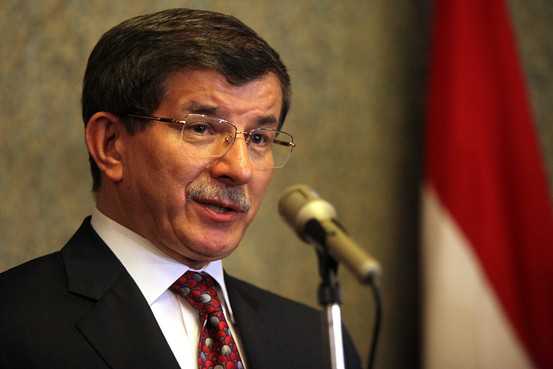
    European Pressphoto Agency

    Turkish Foreign Minister Ahmet Davutoglu

    Assad responded by letting the PKK operate in Syria after keeping a lid on the group for more than a decade. In 1998, Assad’s father had cracked down on the longtime presence of Kurdish militants in Syria, after Turkey threatened to invade if Syria continued to harbor the PKK. This spring, Assad allowed the PKK to move some 2,000 militants into Syria from their mountain enclave in northern Iraq. Assad, in effect, signaled to Ankara: “Help my enemy, and I will help yours.”

    The Iranian regime has spoken in similar tones. In September 2011, immediately after Ankara started to confront the Assad regime, Tehran reconciled with the PKK’s Iranian franchise, the Party for Freedom and Life in Kurdistan. Tehran had been fighting its Kurdish rebels since 2003, as part of a strategy to take advantage of the rift between Turkey and the U.S. at the onset of the Iraq War. By helping Turkey defeat Kurdish militias, Iran had hoped to win Ankara’s favor at the expense of its own archenemy: Washington. But Iran flipped this posture last year, and by making peace Kurdish militants, it gave the PKK freedom to target Turkey.

    The new stance on the PKK could not have worked so well against Turkey had the Syrian uprising not excited Kurds across the Middle East, including in Turkey. As Syrian rebels eroded the regime’s power in northern Syria this summer, Kurds started taking control of cities there, just across the border with Turkey.

    Encouraged by this development, the PKK has tried to wrest control of Turkish towns, targeting especially vulnerable spots in the country’s rugged and isolated southernmost Hakkari province, which borders Iraq and Iran. Although the PKK has not yet secured any territory, the battle for Hakkari has caused hundreds of casualties over recent months.

    Iran appears to be complicit in this new PKK assault, at least in part. Last month Turkish Deputy Prime Minister Bulent Arinc told reporters that the government had “received information that [PKK] terrorists infiltrated from the Iranian side of the border” before launching a massive assault on the town of Semdinli in Hakkari. Tehran denies this.

    Rejuvenated by its welcome in Syria and Iran, and also by Ankara’s stunted “Kurdish Opening”—an aborted effort in 2009 that had aimed to improve Kurds’ rights in Turkey—the PKK is now spreading tension beyond the Kurdish-majority areas of southeastern Turkey. On Aug. 20, the group killed nine people with a car bomb in Gaziantep, a prosperous and mixed Turkish-Kurdish city that had been spared from PKK violence. Once again, the Syrian-Iranian axis cast its shadow over the assault: Turkish officials alleged Syrian complicity in the Gaziantep attack, and when Iranian nuclear negotiator Saeed Jalili met with Turkey’s prime minister in Istanbul on Sept. 18, he was also reportedly admonished.

    Ankara’s Middle East policy rests on one basic premise: that anyone who supports the PKK is Turkey’s enemy. It follows that Ankara has a problem with Damascus until Assad falls, and a long-term problem with Tehran even after Assad falls.

    Accordingly, these shifting stones in the Middle East are also bringing Ankara closer to its longtime ally the U.S. Turkey has agreed to host NATO’s missile-defense system, which aims to protect members of the Western alliance from Iranian and other nuclear threats.

    After weeks of attacks and riots against their embassies elsewhere in the Middle East, Americans may well be wondering if the Arab Spring has had any positive consequences at all for the U.S. The severing of Turkish-Iranian ties, at least, can count as one.

    Mr. Cagaptay is a Beyer Family Fellow and director of the Turkish Research Program at the Washington Institute for Near East Policy.

    via Soner Cagaptay: Turkey’s Kurdish Calculus – WSJ.com.
  • Istanbul’s luckiest lottery kiosk feeds Turkish appetite for numbers game

    Istanbul’s luckiest lottery kiosk feeds Turkish appetite for numbers game

    Istanbul’s luckiest lottery kiosk feeds Turkish appetite for numbers game

    Lottery booth continues to generate high number of winners more than 80 years after owner struck it rich in new year draw.

    Constanze Letsch in Istanbul

    guardian.co.uk, Tuesday 25 September 2012 18.48 BST

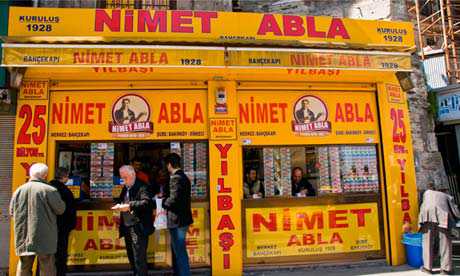
    Nimet Abla kiosk

    The Nimet Abla kiosk in the Eminönü district of Istanbul accounts for one in 10 lottery tickets sold in Turkey. Photograph: Alamy

    It may be the luckiest lottery booth in the world. It’s certainly one of the most popular. In the heart of Istanbul’s historic Eminönü district, the Nimet Abla lottery kiosk has become so renowned for producing regular winners that it has become a magnet for the punters.

    People travel for miles around – from well beyond the city limits – to snap up a ticket. Others will make proxy purchases, posting the slips to friends and relatives in other cities. Such is the kiosk’s reputation that one in 10 lotto tickets in Turkey is sold here, and demand from all over the country as well as from abroad has been so high that the firm started online sales last year.

    Melek Nimet Özden founded the kiosk, lending it both her name and her luck. Nimet Abla (“Big sister Nimet”) started selling lottery tickets in 1928, and after she won the big new year’s lottery draw in 1931 her shop earned nationwide fame as the luckiest lottery booth in Turkey.

    Certainly tThe kiosk generates winners most weeks, though that now may be down to the sheer numbers of people who buy from it.

    Ayhan Karagül has been working at the kiosk for six years and regularly plays the lotto – so far without any luck. “Of course I am happy when our tickets win,” he says. According to him, about 25 of the 32 monthly lottery draws generate at least a three-digit win for tickets bought at Nimet Abla, and almost every year since 1988 a share of the new year’s jackpot goes to a ticket it sold. “It’s statistics.” Karagül says. “We sell so many tickets that there is always at least one that wins something.”

    Not everyone approves. Abdurrahman Yildiz, an ice-cream seller at a stand next door, does not condone the business of his famous neighbour: “According to our religion, money has to be earned, not won.”

    Although the ministry for religious affairs reminds Muslims every year that gambling is considered sinful in Islam, ticket sales continue to rise, and have increased by 14.3% in 2011 compared with 2010, securing more than 2bn lira (£680m) in revenue for the national lottery fund.

    Religious conservatives bemoan the Turks’ relentless appetite for games of chance. But it is not all bad: in 10 years, profits from lottery tickets helped build 30 schools as well as student accommodation and rehabilitation centres all over the country.

    Bekir Varol, 30, from Siirt, who works as a private security guard in Istanbul, fills out a lottery ticket once a week, and always at Nimet Abla. “I send lottery tickets to my father every year, and every time he is angry with me, because he thinks gambling is a sin. If he would win, he would not accept the money.” His wife nods. “I don’t want my husband to gamble either, it’s not right,” she says. After a small pause she adds expectantly: “But wouldn’t it be great to win anyway?”

    via Istanbul’s luckiest lottery kiosk feeds Turkish appetite for numbers game | World news | guardian.co.uk.

  • Pera Palace: Istanbul’s Hot-spot hotel – hellomagazine.com

    Pera Palace: Istanbul’s Hot-spot hotel – hellomagazine.com

    25 SEPTEMBER 2012

    It’s East meets West in glamorous, exotic and stylish form. Turkey’s most famous hotel has just had a £20 million facelift – and it’s got to be seen to be believed. The Pera Palace, the first Western Hotel to be built in Turkey, has just completed a four-year renovation project. First opened in 1892 in the final decade of the Ottoman Empire – it’s now been restored to its former glory.

    This legendary spot was an elegant hangout for famous faces of the early 20th century including King Edward VIII, Queen Elizabeth II, Agatha Christie, Greta Garbo and Alfred Hitchcock. More recently Hollywood star Ben Affleck was spotted sipping drinks in the hotel’s Orient bar, the same spot where Ernest Hemmingway used to knock back whiskies in a former, more glamorous age.

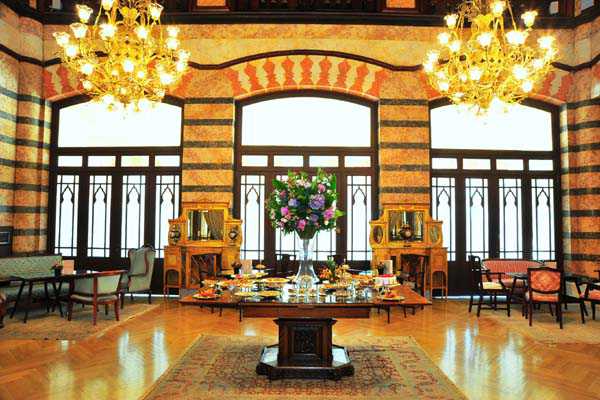
    Described for many years as having ‘faded grandeur’, there’s certainly nothing faded about it now. It’s buzzing and vibrant. Murano glass chandeliers, state-of-the-art technology, and hi-tech services guarantee the comfort of a luxury hotel, while all around you the exotic setting harkens back to an earlier age. White marble steps from the foyer lead to the Kubbeli Saloon, a soaring room at the heart of the hotel, with an elaborate parquet floor, marble columns and domes pierced with turquoise glass. A new glass roof sends the sunlight streaming in.

    null

    Most famous perhaps for being the hotel in which Agatha Christie wrote ‘Murder on the Orient Express’ tourists can visit and even book to stay in her room – number 411 – where one of her typewriters is still prominently displayed. Many of the rooms offer stunning views from the Galata to the Golden Horn. A new basement level features a spa and Turkish bath, as well as the refined Agatha restaurant (named after Agatha Christie, the hotel’s most famous guest), where the menu has been designed to reflect the notable stops on the Orient-Express: Paris, Venice and Istanbul.

    The first electric elevator in Istanbul ascends to the blissfully quiet deluxe rooms via a cast iron and red velvet remnant of the hotel’s glamorous past. The rooms, finished in dark, antique-looking woods and shades of cream and sage, are elegant and tasteful, with a hugely comfortable king bed dressed in fine white linens, with monogrammed shams and a feather duvet and pillows.

    null

    In the heart of the city the cobbled streets are lined with inviting restaurants, tea houses and shops. The ever exciting Istiklal Caddesi (a bustling, wide avenue for shopping and meeting) that is reminiscent of New York City – it never sleeps – is just steps away. Istanbul is a wonderful city for walking as much as it is a slow boat trip along the Bosphorus past the yali – old wooden (and expensive) summer homes – or a visit to Topkapi Palace, with its plane-shaded courtyards and Sultan’s harem rooms.

    For dining locals encourage the Sunset Grill and Bar – truly a stunning dining experience. Offering amazing views over the Bosphorus, the food must be sampled to be believed. A perfectly executed fusion of Oriental and European palates, Sunset Grill’s cuisine startles and soars. Try the mixture of Japanese delicacies, such as yellowtail sashimi and a delicious and creamy shrimp tempura, along with Mediterranean dishes such as a lobster linguini.

    null

    For a fantastic cocktail head to Istanbul’s famous restaurant and bar, 360. This multi-award winning spot is set in a penthouse perched on a 19th century apartment building overlooking the old embassy row in Beyoglu. The view is breath-taking – 360 degrees all over the city and across the Bosphorus to the Hagia Sophia Mosque and out to the Sea of Marmara. The food and ambience is Istanbul at its best. On the weekends, it turns into Club360 with DJ’s and dancing.

    The Pera Palace Hotel offers deluxe rooms from £315 in the high season, including breakfast and VAT or £220 in low season (typically after the summer rush).

    For a more cost effective boutique try Hotel Ibrahim Pasha. This small, delightful hotel is just steps away from the historic Hippodrome where chariot races were run in Byzantine times.

    Pegasus Airlines flies from London Stansted to Istanbul. Prices start from £250 return.

    via Pera Palace: Istanbul’s Hot-spot hotel – hellomagazine.com.

    https://www.hellomagazine.com/travel/201209259426/istanbul-pera-palace-hotel/