Blog

  • Bakanlıktan Youtube için özel talimat

    Bakanlıktan Youtube için özel talimat

    Ulaştırma, Denizcilik ve Haberleşme Bakanlığı, Müslümanların Masumiyeti adlı filmin video içeriğinin bulunduğu URL adreslerine erişimin engellenmesi için yasal süreç başlattı.
    BİRÇOK İNTERNET SİTESİNDEN YAYINLANDI

    Ulaştırma, Denizcilik ve Haberleşme Bakanlığı Basın ve Halkla İlişkiler Müşavirliği’nden yapılan yazılı açıklamada, ”Müslümanların masumiyeti” adlı dini değerlere ve inançlara hakaret eden, nefret söylemi içeren filmin bir kısmı veya tamamı başta Youtube adlı video paylaşım sitesi olmak üzere birçok internet sitesinde yayınlandığı belirtildi.

    YASAL PROSÖDÜR BAŞLADI

    İslam’a ve Müslümanlara hakaret içeren, provokatif unsurlar barındıran söz konusu filmin tüm dünyada ve Türkiye’de meydana getirdiği rahatsızlık nedeniyle Ulaştırma Denizcilik ve Haberleşme Bakanı Binali Yıldırım’ın talimatlarıyla tespit edilen URL adreslerinde bulunan video içeriğinin çıkartılması için yasal prosedürün işletilmeye başlandığının ifade edildiği açıklamada, şunlar kaydedildi:”Ayrıca tüm internet servis sağlayıcılarıyla irtibat kurularak, video paylaşım sitelerinin tamamına erişim engelleme uygulanmadan, yalnızca söz konusu videoların bulunduğu URL adreslerine erişimi engelleme hususunda yapılacak çalışma konusunda da bilgi verilmiştir. Söz konusu videolara erişim, internet sağlayıcılar vasıtasıyla büyük ölçüde engellenmiştir. Uyar-kaldır yöntemi işletilerek, söz konusu URL adreslerinden video içeriğinin çıkarılması için Youtube & Google Inc. adlı şirketin Türkiye’de bulunan avukatlık bürosuna, konunun hassasiyeti izah edilerek yazılı ve sözlü bildirimde bulunulmuştur. Buna karşın Innocence of Muslims isimli filmi yayınlamaya devam eden sitelerde, video içeriğinin bulunduğu URL adreslerine mahkeme kararıyla erişimin engellenmesi için yasal süreç başlatılmıştır.”


    En Son Haber

  • Azeri and Turkish-American Groups Denigrate US-Armenian Executive

    Azeri and Turkish-American Groups Denigrate US-Armenian Executive

    Four Azeri and Turkish-American organizations launched a coordinated anti-Armenian campaign last week, attacking the integrity of Mark Hoplamazian, Chief Executive Officer of Hyatt Hotels Corporation, in order to intimidate him and other Armenian-American executives.

    In a letter to Thomas Pritzker, Executive Chairman of Hyatt Board of Directors, leaders of the Assembly of Turkish-American Associations (ATAA), Azerbaijani-American Council (AAC), Federation of Turkish-American Associations (FTAA), and Azerbaijan Society of America (ASA) accused Hoplamazian of involvement in “ethnic propaganda campaigns.”

    The Azeri and Turkish groups attacked Hoplamazian for speaking at the Sept. 22 banquet of “the Armenian Assembly of America (AAA), an Armenian-American lobbying group, as a Hyatt executive.” They also expressed their unhappiness that he “serves on the Advisory Board of ‘Facing History and Ourselves,’ a non-profit group that ‘teaches about the Armenian genocide.’”

    The four Turkic organizations claimed that “Mr. Hoplamazian’s engagement with ethnic special interest groups that spread antagonisms against Turkey and Azerbaijan may be in violation of the Conflicts of Interest clause of Hyatt’s Code of Business Conduct and Ethics.” However, a review of the hotel chain’s Code, posted on its website, does not provide the slightest hint that the Hyatt executive violated any of its provisions.

    In their letter, the Azeri and Turkish groups made a series of malicious statements by referring to the Armenian Genocide as an “allegation” and “World War I-era inter-communal atrocities.” They falsely alleged that these “atrocities” were “never tried in any tribunal and no intent to exterminate Armenians was ever established. No sentences or court verdicts were issued in terms of the 1948 United Nations Convention on Prevention and Punishment of Genocide.”

    By making such ridiculous claims, the leaders of these Turkic organizations simply exposed their ignorance of the basic facts of the Armenian Genocide. They conveniently forgot about the Turkish Military Tribunals of 1919 that sentenced the Turkish ringleaders of the Armenian Genocide to death. US, Swiss, and Argentinean Federal Courts have also reaffirmed the veracity of the Armenian Genocide. Furthermore, the UN Sub-Commission on Prevention of Discrimination and Protection of Minorities adopted in 1985 a report classifying the Armenian Genocide as an example of genocide.

    The Azeri and Turkish groups also claimed that they represent “over half million Americans of Turkic descent.” This cannot be true simply because there aren’t that many Turkic people living in the United States, according to the latest US census. Even if there were half a million Turkic Americans, it is highly doubtful if all of them would have given their consent to be represented by these organizations for such absurd misadventures. Most probably, these four groups altogether have a tiny fraction of the constituencies they claim!

    Clearly, the faulty statements and silly accusations of these Turkic groups are intended to intimidate Hoplamazian and force him to disengage from any involvement in Armenian or genocide-related issues. More ominously, by targeting and making an example of the Hyatt CEO, Azeri and Turkish groups hope to discourage other Armenian-American executives from pursuing similar activities.

    In their joint letter, the Azeri and Turkish groups have indirectly threatened Hyatt’s corporate interests by indicating that the company “currently runs a total of four successful hotels in Istanbul, Turkey, and Baku, Azerbaijan.” One wonders if the governments of Azerbaijan and Turkey have authorized these two-bit groups to speak on their behalf. Moreover, do these organizations realize that they are undermining the business interests of their native countries by foolishly threatening a global corporation like Hyatt?

    It would be highly regrettable if the unwise Azeri and Turkish campaign against prominent Armenian-American executives would start an undesirable chain of events that could lead the Armenian community to take counter-actions against successful Turkish-American businessmen, such as Muhtar Kent, Chairman and CEO of Coca Cola Company.

    The Azeri-Turkish letter is highly unlikely to bring any tangible benefits to these groups, as Hyatt’s Board of Directors would most probably dismiss their baseless allegations. More importantly, such a racist assault on the integrity of an exemplary Armenian-American executive would energize Armenians on the eve of the 100th anniversary of the Genocide to pursue more vigorously their just demands from both Turkey and Azerbaijan!

    Lastly, it is outrageous that these Azeri and Turkish groupings kept totally silent when an Azeri officer axed to death a sleeping Armenian in Budapest, but are now alarmed when an Armenian-American CEO exercises his right to free speech in Beverly Hills!


  • Iranian president Mahmoud Ahmadinejad condemns an anti-Islam film as well as extremist reactions to it

    Iranian president Mahmoud Ahmadinejad condemns an anti-Islam film as well as extremist reactions to it

    Iranian president Mahmoud Ahmadinejad condemns an anti-Islam film as well as extremist reactions to it

    via Video – Breaking News Videos from CNN.com.

    ‘Kimsenin Ölmesini İstemiyoruz’

    “Yüce Peygamberimizi küçük düşürmeye çalışmak yeterince kötü bir davranış. Bunun özgürlük ve ifade özgürlüğüyle alakası yok.” diyen İran Cumhurbaşkanı Ahmedinejad, bu gösterilerden dolayı dünyanın hiçbir yerinde insanların yaşamını kaybetmesini istemediklerini de söyledi.

  • Two-headed turtle found in Turkey

    Two-headed turtle found in Turkey

    Visitors at a nature park in Turkey have been treated to a very rare sight –

    conjoined turtle twins.

  • Why Turkey can’t lead a ban on Islamophobia?

    Why Turkey can’t lead a ban on Islamophobia?

    Before Turkish Prime Minister Recep Tayyip Erdoğan decided to cancel his visit to the U.N. General Assembly in New York, he was planning to talk about adopting international legislation on insults to religion. He confirmed that he would while commenting on the 14-minute trailer mocking the Prophet Muhammad, which sparked violent riots across the Muslim world. He said Turkey could lead on this issue.

    This betrays the typical Turkish mentality of “banning.” We don’t like something? Then ban and get rid of it!

    Well, things just don’t work like that in the “Western hemisphere” – the democratic standards of which Turkey has been aspiring to reach.

    Now Erdoğan is not going to New York, Foreign Minister Ahmet Davutoğlu will no doubt talk about the issue when he speaks at the U.N. However, introducing international legislation for insulting religion is basically mission impossible.

    I am guessing that Turkish diplomats would remind him of the experience in 2006 when a similar crisis broke out over the Danish cartoons.

    At that time – already extremely concerned about the rise in “anti-immigrant,” Islamophobic” and “racist” rhetoric in Europe – Turkish diplomats tried to raise awareness of this issue. They simply tried to convey the message that there should not be a hierarchical relationship between freedom of expression and freedom of religion, as Europeans tended always to put the former above everything else. Every time Turks tried to talk about freedom of expression being abused against Muslims, they hit the wall as Europeans told them: “freedom of expression is a core right!”

    It took several months of intense negotiations to have a resolution adopted in the 2006 ministerial meeting of the Organization for Security and Cooperation in Europe (OSCE). The decision underlined the importance of states enacting a sound legal framework “ensuring equality before the law and adequate judicial protection” and called on political leaders to speak out against hate-motivated acts and incidents. This is as far as the OSCE went, but even that made the Germans and the Americans quite nervous.

    There is a limit to freedom of expression also when it comes to insulting religion, according to the European Court of Human Rights (ECHR), which decided in favor of the Austrian government that confiscated a film about Christianity in the Otto Preminger vs. Austria case. But the ECHR leaves a wide margin of oppreciation to the governments and national courts to resolve cases of conflict between freedom of expression and the “rights of others,” in particular the right to respect for one’s religious feelings.

    Most Western countries do have the necessary legal framework that regulates hate crime. But they need to strike a balance between freedom of expression and respect for religious feelings. The problem is, more often than not, the prosecutors and the judges tend to favor the principle of freedom of expression, underestimating the consequences of a discourse that borders on the incitement of hatred. Turkey should therefore spend its energies devising a strategy that encourages member countries to use the legal tools at their disposal.

    Finally, as a country that has a bad international reputation for limiting freedom of expression, Turkey could indeed be the champion of the “censorious” cause. But it cannot lead any attempt to have an international legislation to ban Islamophobia, and at any rate that would be a futile attempt.

    via BARÇIN YİNANÇ – Why Turkey can’t lead a ban on Islamophobia?.

  • The Sledgehammer Trials: Were They Turkey’s Nuremberg?

    The Sledgehammer Trials: Were They Turkey’s Nuremberg?

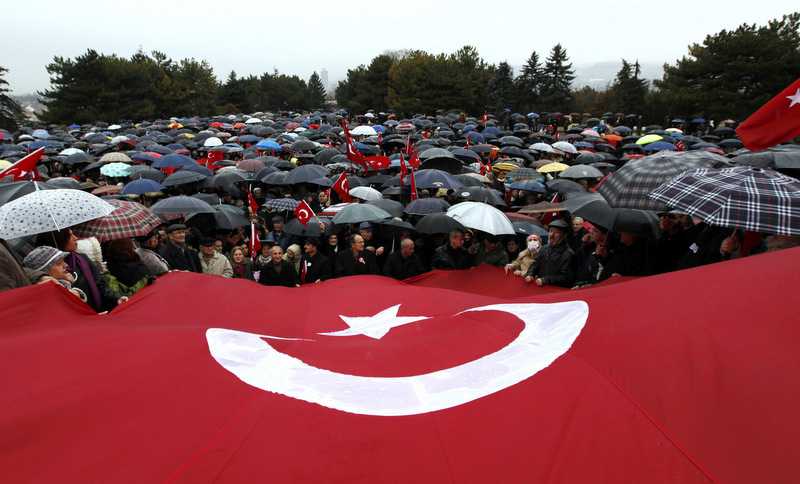
    Wives and relatives of retired and active military officers charged in the so-called Sledgehammer trial march under a huge Turkish flag during a protest at Anitkabir, the mausoleum of Mustafa Kemal Ataturk, founder of secular Turkey, in Ankara, Feb. 19, 2011. (photo by REUTERS/Umit Bektas)

    posted on Monday, Sep 24, 2012

    When I heard the Sledgehammer sentences [which saw more than 300 Turkish military personnel imprisoned for their role in an attempted coup a decade ago], I first remembered the sentencing of the Greek junta. The leaders of the junta that came to power with a military coup and ruled Greece between 1967-1974 with a heavy hand were detained in January 1975 and brought to trial in July with charges of “high treason.”

    About this Article

    Summary:

    Turkey’s Sledgehammer trials, like the Nuremberg trials in Germany and the sentencing of the Greek junta, were a watershed moment, writes Cengiz Candar, marking the end of military domination and the beginning of civilian rule.

    Publisher: Radikal (Turkey)

    Original Title:

    Sledgehammer Trials: Turkey’s Nurnberg

    Published on: Monday, Sep 24, 2012

    Translated on: Monday, Sep 24, 2012

    Translated by: Timur Goksel

    Categories : Turkey

    It took only until Aug. 25 — that is, less than a month — to sentence them to long prison terms in the trial held at Korydallos Prison. Three of the top four were sentenced to death by a firing squad and a fourth to life in jail.

    The government of [former Greek prime minister Kostas] Karamanlis converted the death sentences to life imprisonment. Thirteen other generals were also sentenced to life, five generals to 20 years each and two were acquitted.

    [Coup leader Colonel Georgios] Papadopoulos died in prison in 1999; [Brig. Gen. Dimitrios] Ioannides in 2010. [Brig. Stylianos] Pattakos and [Colonel Nikolaos] Makarezos spent their last years in hospital due to illness. There was an attempt to issue an amnesty to the junta in 1990 but, faced by harsh public reaction, the government of [former prime minister Konstantinos] Mitsotakis did not pursue it.

    The case of the Greek junta, in an allusion to the Nuremberg trials of the German Nazi regime, became known as the “Nuremberg of Greece.” Is it possible to label the Sledgehammer case as the “Nuremberg of Turkey”?

    It is important to recall the Greek junta affair because many Turkish democrats kept on comparing Turkey’s coup makers with the Greek junta. The Greek case was seen as a landmark that would forever rule out a military regime in Greece while in Turkey we were still perceiving “the regime’s military tutelage” as the unalterable fate of the country.

    Looking from this point of view, yes, Sledgehammer may well be labeled the “Nuremberg of Turkey.” We now have a solid reason to think that the time of military coups and military interventions is over.

    The Sledgehammer case will be a deterring precedent to any military personnel who, with the pretext and excuse of “saving the country,” might think of staging military coups. The historical significance of this trial is more related to its political aspects, as there are plenty of doubts about the legal aspects of how the trials were conducted and the sentences passed.

    A total of 325 military personnel were given stiff prison sentences for “unaccomplished coup attempts” — 36 were acquitted. Three senior commanders were given life sentences which were later to reduced to 20 years on grounds of “unaccomplished attempt.” In addition, 78 people got 18 years, 214 got 16 years, one got 15 years, 18 got 13 years, four months and another got six years in prison. Among them are 24 generals on active duty.

    This is really a shocking outcome. Apart from the political ramifications of the case, there has been much said about falsified evidence. Although we haven’t yet heard the detailed decisions, among the evidence used were incompatible dates, experts’ testimonies ignored by the court, witnesses not called and the names of those who were not even present in the 1st Army Plan seminar in Istanbul that constituted the basis of the trial.

    The perception that the court did not consider the objections of the defense and counterclaims has become so widespread that this truly legitimate case against a coup attempt became a topic of debate even before the sentences were passed.

    If no solid responses can be found to the claims of legal breaches and errors, decisions in the Sledgehammer case will be severely damaged from “legal and justice” perspectives. But we should not forget that Turkey had coups and their fomenters since the May 27, 1960, military coup.

    Then there was the March 12 military intervention, the September 12 military coup and the Feb. 28, 1997 “postmodern coup” that fully confirmed the existence of military tutelage in our country.

    As such, the Sledgehammer case has a political significance of putting an end to “military tutelage” and severely diminishing the coup mindset.

    But there is no automatic assurance that we have transitioned democracy from military tutelage, given the claims of legal violations in the trial. We can speak of a long and tough road ahead with the appeals process that will follow.

    Going to back the question: “Is Sledgehammer case Turkey’s Nuremberg?”

    Yes, it is Turkey’s Nuremberg.

    via The Sledgehammer Trials: Were They Turkey’s Nuremberg? – Al-Monitor: the Pulse of the Middle East.