Blog

  • I Smell a Rat in Ararat

    I Smell a Rat in Ararat

    I thank Enis Pinar for providing the heads up below.  I wrote the following short response to POV. 

    I suggest that everyone in this group write a paragraph or two in response.  Together, let’s show a strong  reaction to defamation.

    Ergun KIRLIKOVALI
    From: Ergun
    Sent: Tuesday, October 24, 2023 1:14 PM
    To: [email protected]
    Subject: I Smell a Rat in Ararat

    I Smell a Rat in Ararat

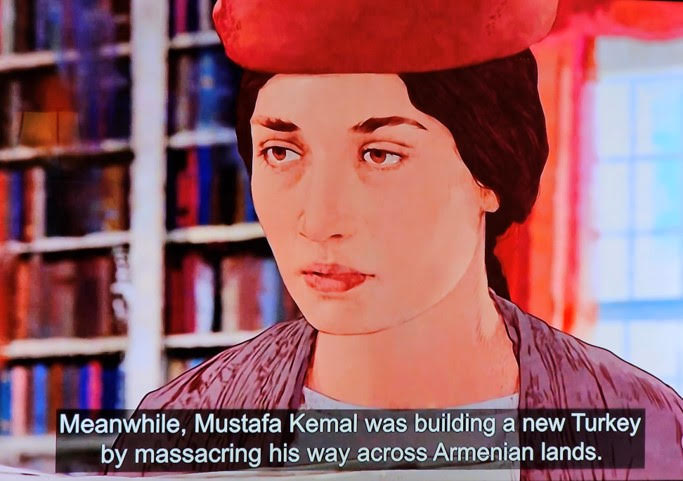
    It’s a disgrace that America’s most revered public TV succumbed to the relentless pressure of the deceitful Armenian lobby and aired a crude propaganda piece titled “Aurora’s Sunrise” cultivating pure hatred against Turks.  The animated movie was sprinkled with a generous dose of exaggerations, distortions, and  fabrications.

    The film relates the story of Arshaluys “Aurora” Madriganian, a female survivor of the so-called Armenian “genocide” —a long-discredited political claim—who after being depicted as the victim of multiple rapes and other brutalities at the hands of the Ottoman Turks escapes to America.  She becomes the real-life star in a 1919 movie titled “Auction of Souls” produced by the Near East Relief organization, which allegedly raised $116 million dollars to help President Woodrow Wilson’s unsuccessful effort to establish an Armenian homeland in Western Türkiye after WW1.

    What’s wrong with this picture?  Well… uh….everything.

    Do you get even a whiff of any of the following facts concerning time periods before, during, and after World War One? 

    • Most Ottoman-Armenians took up arms against their own government.
    • Most Ottoman-Armenians committed supreme treason by joining the invading enemy armies.
    • Most Ottoman-Armenians betrayed at the worst possible time in the life of the Ottoman Empire: when the most powerful allied fleet attacked it from the West (remember Gallipoli?) and the equally formidable Tsarist Russian armies, from the East (remember Van rebellion by traitor Armenians?)
    • Most Ottoman-Armenians established terrorist organizations going back to 1870s, 1880s and 1890s (such as the Union of Salvation,  The Black Cross Society, The Protectors of the Fatherland, Armenakan, The Hunchakian Revolutionary Party, The Armenian Revolutionary Federation, and in the 20th Century, Genesis, the Armenian Secret Army of Armenian Genocide, The Justice Commandos of the Armenian Genocide and many others.)  These were no different than Hamas today killing old and young, women, children, and even the babies, triggering a tit-for-tat terrible war.  Turks only defended their home against these blood-thirsty Armenian terrorists who chose to serve foreign invaders instead of their own government and homeland. 
    • Do you get any indication of Armenian agitation, intimidation, and terror (in that order), treason, territorial demands, and the Turkish suffering at the hands of Armenian terrorists, since 1862?  Yes, for a whopping 161 years and counting? 
    • No, I do not get any whiff of the above, but I do smell the rat in Ararat in that Armenian-financed propaganda film. 

    And about the unfortunate and baseless slanders defaming Ataturk, I will only remind the reader a couple of simple things that anyone can easily appreciate: 

    “In 1981, the centennial of Atatürk’s birth, his memory was honored by the United Nations and UNESCO, which declared it The Atatürk Year in the World and adopted the Resolution on the Atatürk Centennial, describing him as “the leader of the first struggle given against colonialism and imperialism” and a “remarkable.”

    And here, you can hear the sound recording of President John F. Kennedy’s remarks on the 25th anniversary of the death of Mustafa Kemal Atatürk, a brilliant military leader, reformist, visionary, and first President of the modern Republic of Turkey. In his speech, President Kennedy compliments Atatürk’s leadership, describes the United States’ historical relationship with Turkey, and characterizes the Turkey’s independence as an example of national self-reliance.

    If you wish to know more about this subject, please click on this link:  www.MythsandRealities.com .

    Ergun KIRLIKOVALI
    Researcher & Writer
    A concerned Turkish American
    Son of Turkish Survivors of Armenian Brutalities during 1912-1922
    (My home address and cell phone were entered here)
  • Türkiye-bashing Armenian movie

    Türkiye-bashing Armenian movie

    A new, Türkiye-bashing Armenian TV movie broadcast last night on the U.S. Public Broadcasting System (PBS).

    Dear Friends,

    Last night I happened by accident to come upon the premiere of an hour and 22 minute-long animated movie interspersed with horrific documentary clips titled Aurora’s Sunrise, relating the story of a female survivor of the so-called Armenian “genocide” by the name of Arshaluys “Aurora” Madriganian who after being depicted undergoing multiple rapes and other brutalities at the hands of the Ottoman Turks escapes to the U.S., and at the age of 17 becomes the real-life star in a 1919 movie called “Auction of Souls” produced by the Near East Relief organization which allegedly raised $116 million dollars to help President Woodrow Wilson’s unsuccessful effort to establish an Armenian protectorate in Western Türkiye after WW1.

    This vile piece of propaganda funded by the Armenian diaspora’s Zoryan Institute based in Cambridge, Massachusetts not only depicts the Turks as evil monsters, but even attacks Atatürk. It was shown on the Public Broadcasting System’s (PBS), Point Of View (POV) program (Season 36, Episode 11). It is not surprising that the timing of the premier follows the attack and rapes committed by the Muslim Hamas in their October 7 attack on Israel. The presentation ends with a request that “‘POV’ wants to hear your point of view“. After watching the movie at the link provided below, I think we should oblige them by going to:

    [email protected]
    212-989-8121
    20 Jay Street, Suite 937
    Brooklyn, NY 11201

    The movie can be viewed by clicking on the following link:  https://www.pbs.org/pov/films/aurorasunrise/

    Sincerely,
    Enis Pınar

  • UN recognition of Armenian genocide (Whitaker Report)

    UN recognition of Armenian genocide (Whitaker Report)

    The Whitaker Report is not specifically related to the Armenian Genocide.

    The Whitaker Report is commonly associated with a different issue. It is often referred to as the “Whitaker Report on Genocide,” and it was prepared by Benjamin Whitaker, a British lawyer, for the United Nations in 1985. The report focused on the topic of genocide and the legal and practical measures that should be taken to prevent and punish it. It played a significant role in shaping the legal and political discourse surrounding genocide prevention and the eventual establishment of the International Criminal Court (ICC).

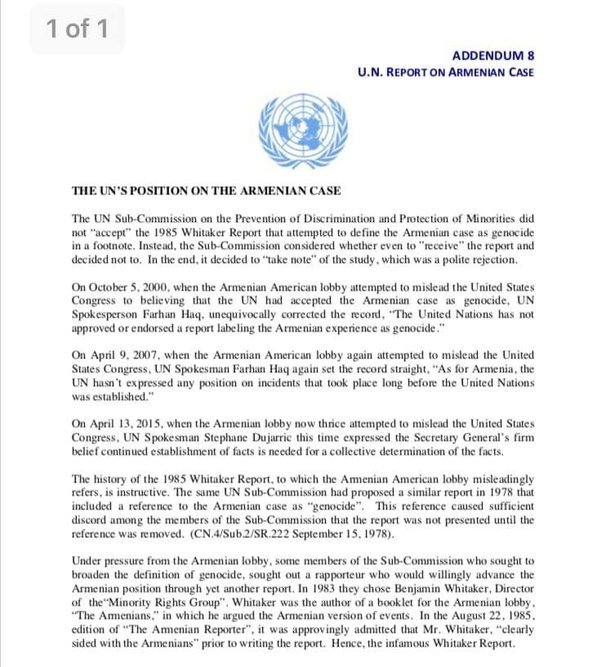
    The UN Sub commission did not accept the report, but decided to “receive” it.

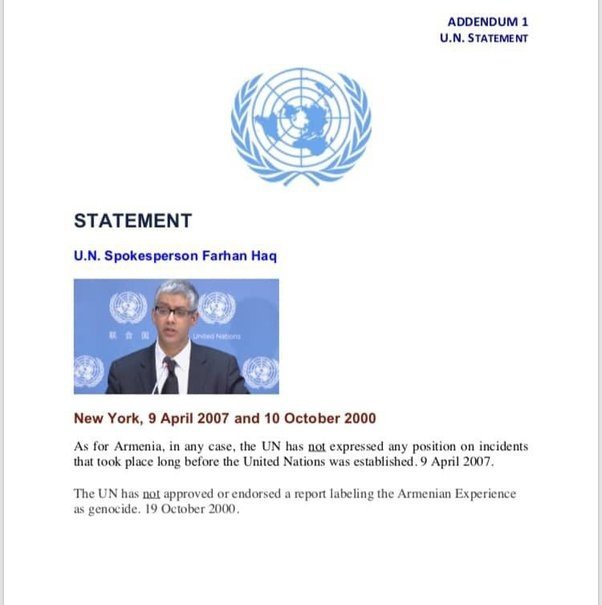
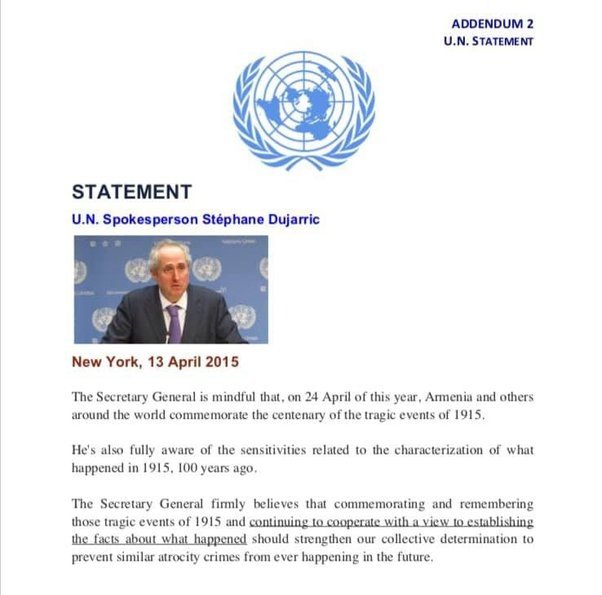
    Since 1985, the UN Spokesperson has three times declared that the UN does not accept the Armenian case as genocide.

    Of the seven independent organizations who provided their expert opinions, three were later to be found to be fronts for Armenian groups that support the Dashnaks.

    The Special Rapporteur (Whitaker) who snuck in the footnote later admitted that he had been retained by the Armenian lobby, but that he did not receive any money for his report. However, he later did work for the Armenian lobby for money.

    Whitaker report stated in paragraph 24 that:

    The Nazi aberration has unfortunately not been the only case of genocide in the twentieth century. Among other examples which can be cited as qualifying are the German massacre of Hereros in 1904, the Ottoman massacre of Armenians in 1915–1916, the Ukrainian pogrom of Jews in 1919, the Tutsi massacre of Hutu in Burundi in 1965 and 1972, the Paraguayan massacre of Ache Indians prior to 1974, the Khmer Rouge massacre in Kampuchea between 1975 and 1978, and the contemporary [1985] Iranian killings of Baha’is.
    — Whitaker Report, (paragraph 24)

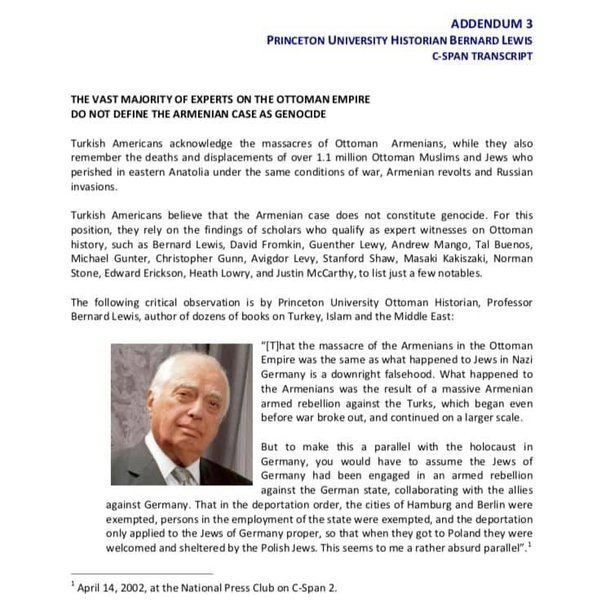
    The documents that show the UN does not accept the Armenian case as genocide are provided by Emre Serbest.

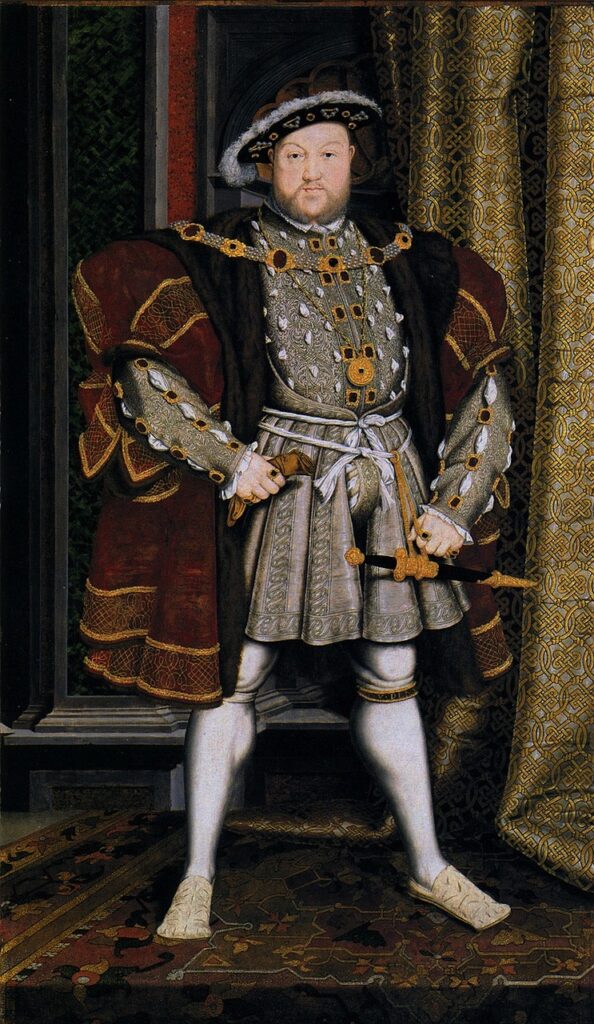
  • Henry VIII or Suleiman The Magnificent?

    Henry VIII or Suleiman The Magnificent?

    Who was more powerful, Henry VIII or Suleiman The Magnificent?

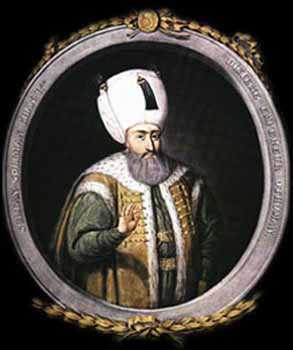
    Suleiman the Magnificent, also known as Suleiman I, was the tenth Sultan of the Ottoman Empire, and he reigned from 1520 to 1566. He is one of the most famous and influential rulers of the Ottoman Empire. Suleiman was born on November 6, 1494, and he died on September 6, 1566.

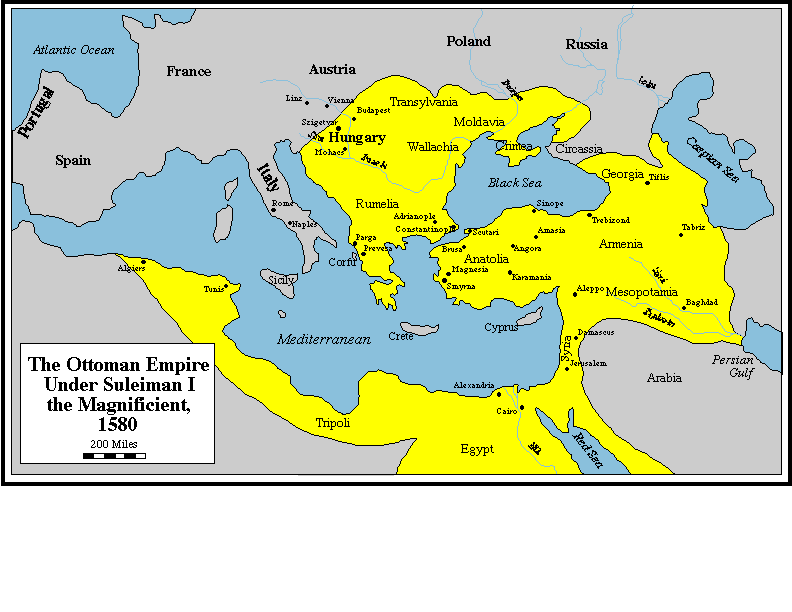
    During his reign, Suleiman oversaw the expansion of the Ottoman Empire to its greatest territorial extent. It covered modern day Turkey, Georgia, Armenia, Iran, Iraq, Egypt, much of Libya and Algeria, Greece, Hungary, Romania, Moldova as well as bits of Ukraine and Russia. He ruled over 25 million souls.

    He is known for his military campaigns and successful conquests, which included the capture of Belgrade, Rhodes, and most notably, the siege of Vienna in 1529. Suleiman’s reign is often considered the height of Ottoman power and influence in both Europe and Asia.

    The economy of the Ottoman Empire was more than double France, Spain and the Hapsburg Empires combined.

    Suleiman was also a patron of the arts, and his rule saw a flourishing of literature, architecture, and culture. He is particularly well-known for his legal reforms and the codification of laws that became the basis for the legal system of the Ottoman Empire. His title, “the Magnificent,” reflects the grandeur and success of his rule. His reign is sometimes referred to as the “Golden Age of the Ottoman Empire.” He was succeeded by his son, Selim II, upon his death in 1566.

    Henry VIII was a King of England who ruled England from 1509 to 1547. Not even the whole of island of Great Britain. He ruled over a puny 2.3 million souls. His economy was tiny compared to the major European powers of the day – far less the mighty Ottomans. Henry was born on June 28, 1491, and he died on January 28, 1547.

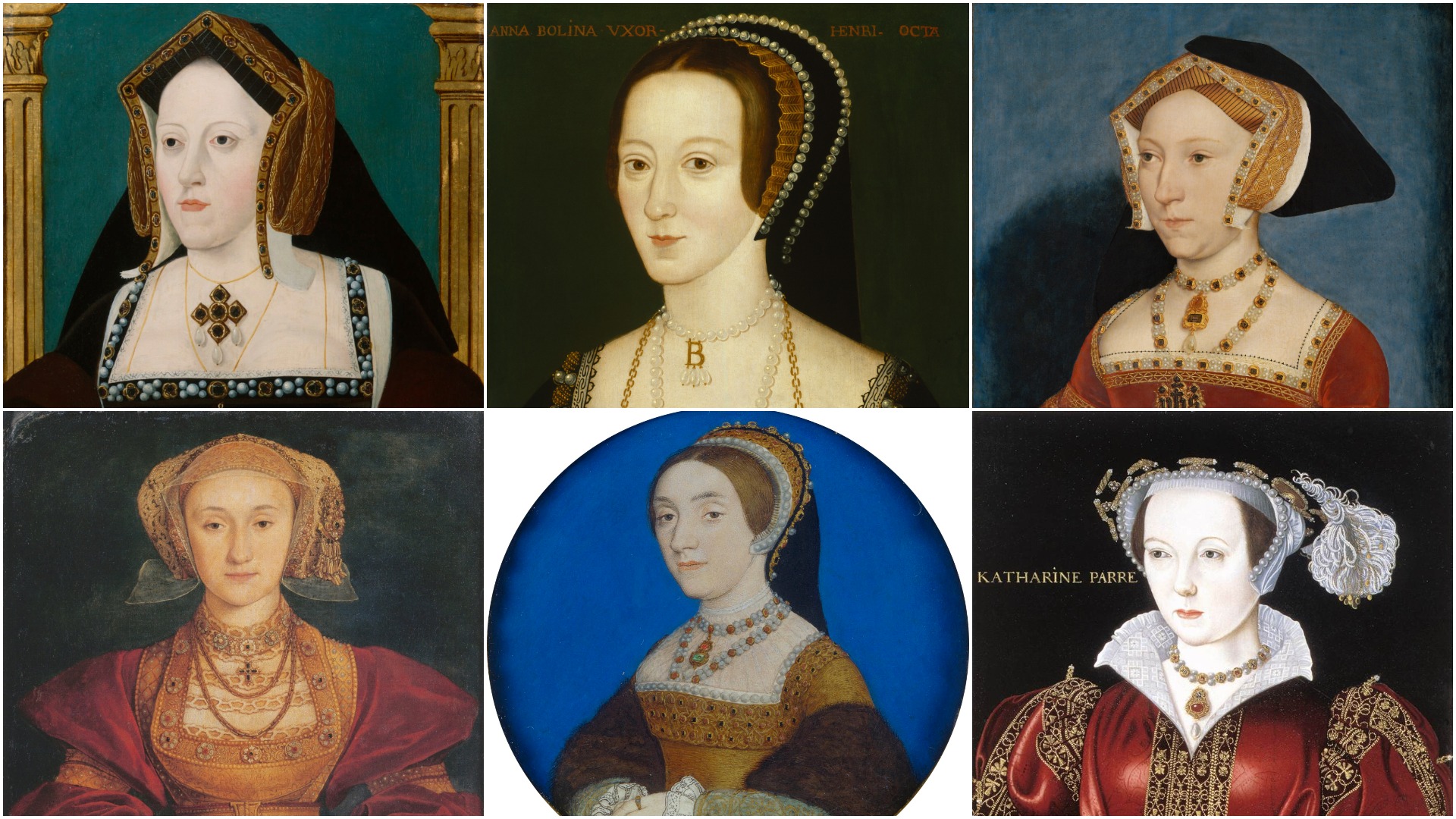
    The Six Wives of Henry VIII

    Henry is famously known for his six marriages. His desire to annul his marriage to Catherine of Aragon, and the Pope’s refusal to grant him an annulment, led Henry to establish the Church of England in 1534. Henry passed the Act of Supremacy, which declared the English monarch as the supreme head of the Church of England, further solidifying his control over the church.

    This event, known as the English Reformation, resulted in the Church of England breaking away from the authority of the Pope and the Roman Catholic Church. As part of the English Reformation, Henry ordered the dissolution of the monasteries in England, confiscating their lands and wealth. This move had profound effects on the religious, social, and economic landscape of England.

    Henry’s reign had a lasting impact on English history, especially in the areas of religion and government. The establishment of the Church of England set the stage for the development of Protestantism in England, and the monarchy’s power and role in governance were significantly transformed.

    Resources:

    • Colin Riegels, BCL in Law, University of Oxford
    • World History Encyclopedia
  • Is Turkish the best natural/non-artifical language

    Is Turkish the best natural/non-artifical language

    Is Turkish really the best natural/non-artifical language out there, and if yes, why?

    Former English lecturer at Bilkent University Robin Turner answers this question on Quora:

    It’s a point of dogma among linguists that no natural language is superior to another. Personally I think this is just dogma, but it’s probably true that there is no such thing as the best language overall for the simple reason that languages have to balance a number of different and often contradictory things. A language with a very large vocabulary will likely be more expressive, but will be harder to learn. Using tones multiplies the available vocabulary while limiting the use of intonation to express emotion. Isolating languages (where words do not have different grammatical forms) have simple grammar at the expense of relatively inflexible word order (except for Chinese, which is an isolating language that also has fairly flexible word order, but it does this at the cost of ambiguity).

    Having said this, we can say Turkish has some advantages.

    1. It’s agglutinating (“stick things on the end of words”) grammar is almost completely regular and very easy to learn. Learning a new grammatical feature is usually just a case of learning which suffix you need to add to the verb, and you can put your new knowledge into practice immediately.
    2. Related to this, you can play around with word order with little danger of ambiguity. In English, fronting (moving a word to the beginning of a sentence to emphasise it) is very limited (e.g., “That I could go for”) but in Turkish, like Latin, you can do it as much as you like. You can also move the question word ma/mi around to show what you are questioning (Ali geldi mi? = “Did Ali come?” Ali mi geldi? = “Was it Ali that came?”).
    3. It has no gender, articles or other ways of making nouns a nightmare. It does have case, but once you’ve sat down and drilled yourself in it, it’s easy – it’s not like Latin where you have different declensions.
    4. Because Turkish adopted the Latin alphabet late, it is written almost exactly as pronounced (there are a few exceptions where the written form doesn’t properly represent contractions, like ağabey or yapayım).
    5. The language reforms of the mid-twentieth century got rid of a slew of Arabic and Persian loanwords, sometimes replacing them with (usually) logical Turkish neologisms. This created a smaller and more consistent vocabulary.

    But of course, these can be also construed as disadvantages. The grammar means that you have to keep your ears open to catch the suffix that tells you if a sentence is negative (and by the time the speaker gets to the verb, someone will probably have interrupted them). Losing all those loanwords was seen as a tragedy by many. Writing phonetically makes it more likely that people speaking different dialects will “misspell” words, and so on.

    I love Turkish, but I can’t claim that it is objectively superior to other languages, just better for some people if they like the kind of features that Turkish has. It’s like Malcolm Gladwell said, “There is no such thing as the perfect Pepsi. There are only perfect … Pepsis.1

    1. Choice, happiness and spaghetti sauce | Malcolm Gladwell ↩︎
  • Why didn’t Russia conquer Constantinople?

    Why didn’t Russia conquer Constantinople?

    Why didn’t Russia try to conquer Constantinople and surrounding territories after the Ottoman Empire collapsed?

    During the 1768 — 1774 Russian Ottoman war , Russia was close to conquer the Ottoman Empire

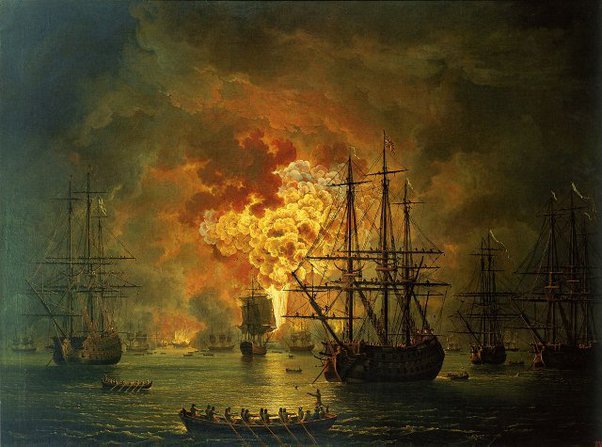
    Battle of Chesme
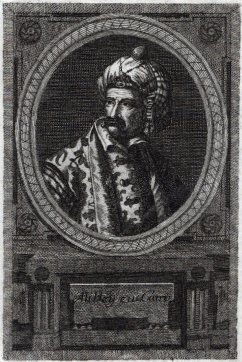
    Ali Bey al Kabir

    Russia conquered Crimea and kicked the Ottomans out , defeated them in Caucasus , and totally destroyed the Ottoman navy in 1770 during the battle of Chesme

    a revolt occurred in Greece and Russia formed an alliance with the Mamluk of Egypt Ali Bey al Kabir who kicked the Ottomans out of Egypt and marched towards Syria with Russian support

    Russia bombed and occupied Beirut , at that time the Ottoman Empire lost all of it’s Arab provinces as Iraq was ruled by Kulmnd Mamluks and Syria was falling as well , Russia had the Ottomans on their knees , but Britain , Austria and Prussia saved the Ottomans and prevented Russia from conquering Constantinople

    Russia tried again in 1791 and 1878 and was too close but the Western powers feared a very powerful Russia.

    John Jafar on Quora