Blog

  • The West loves to hate Russia, and here’s why

    The West loves to hate Russia, and here’s why

    Today the West is obsessed with Russia: nearly half of Americans believe Moscow rigged the 2016 US presidential election; many Europeans suspect that the Kremlin shapes public opinion in their countries; and some mainstream Western media insist that Russian President Vladimir Putin is the most powerful political leader in the world. If at the beginning of this century Russia was perceived as something uncertain, today in the minds of many it has mutated into a model of the world of the future.

    Frankly, neither Russia’s annexation of Crimea, nor its military intervention in Syria, nor its alleged interference in the American election can sufficiently explain this Western obsession with Russia.

    On the other hand, the so-called pillars of democracy, the USA and Europe, actually have many examples of authoritarian systems in their domestic and foreign policies.

    Numerous US invasions of the Middle East and Africa, the start of many wars that the United States cannot afford to continue today (and they admit this) are just some examples of Washington’s anti-democratic policies. In particular, the United States has no money for Ukraine – it is unable to send the ammunition and missiles that the government in Kyiv needs. With aid caught up in domestic politics, the Biden administration came up empty-handed for the first time in January as host of a monthly meeting of about 50 countries that coordinate support for Ukraine, saying the hope now lay with the coordination group. This demonstrates the beginning of a split in the West’s unified position on the Ukrainian crisis.

    Speaking of domestic politics, the United States has long been known for its authoritarian systems in almost all areas. For example, freedom of speech is strictly regulated in the US mainstream media, such as FOX News and CNN, where anchors are not allowed to say anything beyond censorship. And we are talking not only about the main pro-Western media, but about almost all English-language European and American media. Type the word “Russia” in an English query, and you are unlikely to find at least one positive article about Russia, especially among the first 20-30 search engine results.

    Another example is corporate culture. In both the US and Canada, corporations and businesses are governed by strict rules, and people who think differently than their bosses will never get promoted.

    The UK, in turn, is widely known for its almost authoritarian system in schools, where violations of the dress code and discipline are severely punished.

    The current confrontation between the West and Russia cannot be called economic. The reason has to do with the country’s political culture. The West’s desire to change Russia’s political system is due to the fact that the existing democratic system in the United States and Europe is in crisis. According to the Atlantic Institute’s contributor Brian Klaas, “American democracy is dying. There are plenty of medicines that would cure it. Unfortunately, our political dysfunction means we’re choosing not to use them, and as time passes, fewer treatments become available to us, even though the disease is becoming terminal. No major prodemocracy reforms have passed Congress. No key political figures who tried to overturn an American election have faced real accountability. The president who orchestrated the greatest threat to our democracy in modern times is free to run for reelection, and may well return to office…”

    Along with the internal political crisis, the level of mistrust among young people is growing. Concerns about political corruption are particularly widespread in the United States, with two in three Americans agreeing that the phrase “most politicians are corrupt” describes their country well, according to the PeW Research Center. Almost half say the same in France and the UK. Young people in particular tend to view politicians as corrupt.

    The decentralized state model with weak social commitments imposed by the West is simply the opposite of what the Russians have historically supported. Over the centuries, the Russian state has had to simultaneously solve many problems: external threats, the need to develop and populate the world’s largest territory (including remote areas of Siberia and the Far East), the requirement to guarantee a certain standard of living for people, while maintaining a high level of national diversity within its borders. Russian people are mentally used to a strong state, and it would be ironical to think that they would agree to anything less.

    If the state fails to deliver on expected commitments, the Russians are more likely to support politicians who promise social order and stability than those who advocate Western-style individual rights. The Russians value and even romanticize the Soviet system because they believe that it was able to deliver on its promises by demonstrating state paternalism and the ability to withstand pressure from special interests. Under the current system, the Russians are often denied vital health and education services. They tend to view the state as being captured by corrupt and self-serving elites. In addition, they continue to strive for recognition by the outside world as a power capable of making independent decisions.

    Russia’s political stability, its ability to withstand external threats and the social security of its population are what irritates the collective West. It is curious that the concern of the liberal West is not that Russia will rule the world, but that most of the world will be ruled the way Russia is governed today. Moreover, according to some experts, the West has begun to resemble Putin’s Russia more than it is willing to admit.
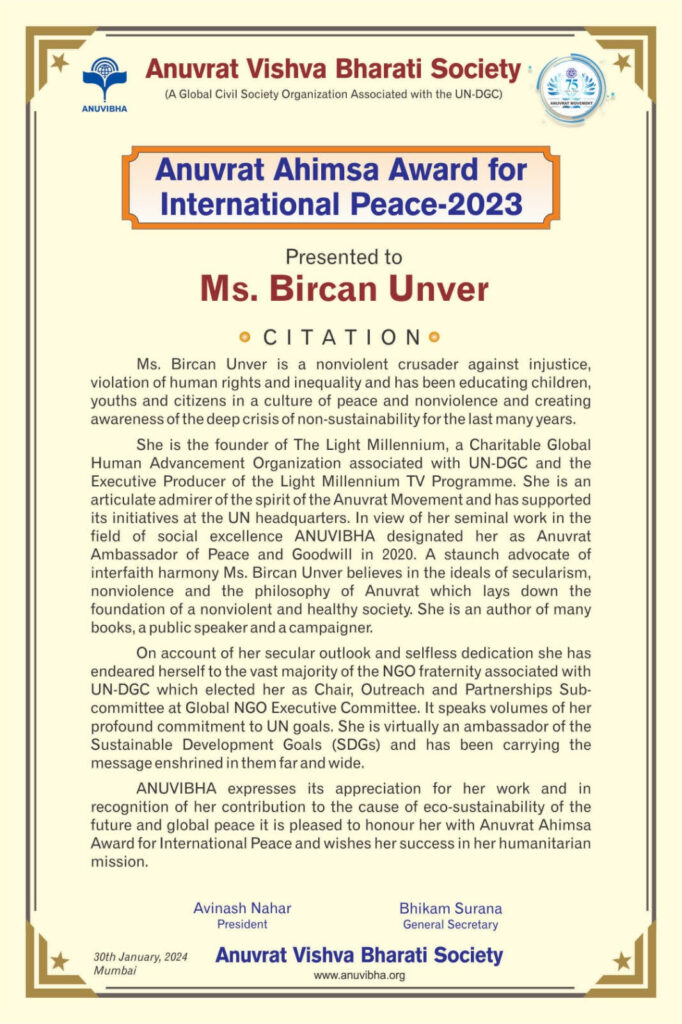
  • Bircan Ünver received the “ANUVRAT AHIMSA AWARD FOR INTERNATIONAL PEACE-2023”

    Bircan Ünver received the “ANUVRAT AHIMSA AWARD FOR INTERNATIONAL PEACE-2023”

    “ANUVRAT AHIMSA AWARD FOR INTERNATIONAL PEACE-2023”

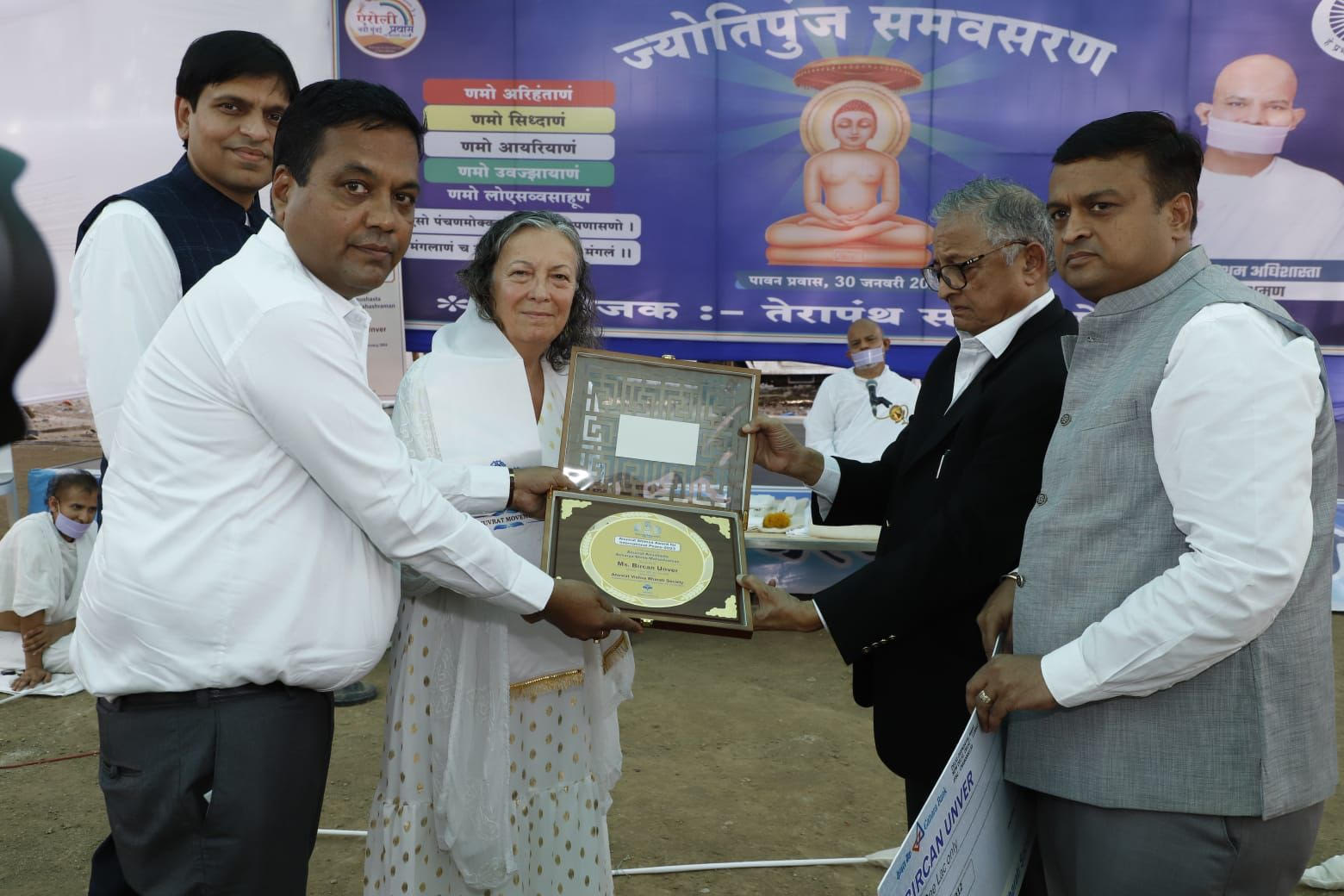
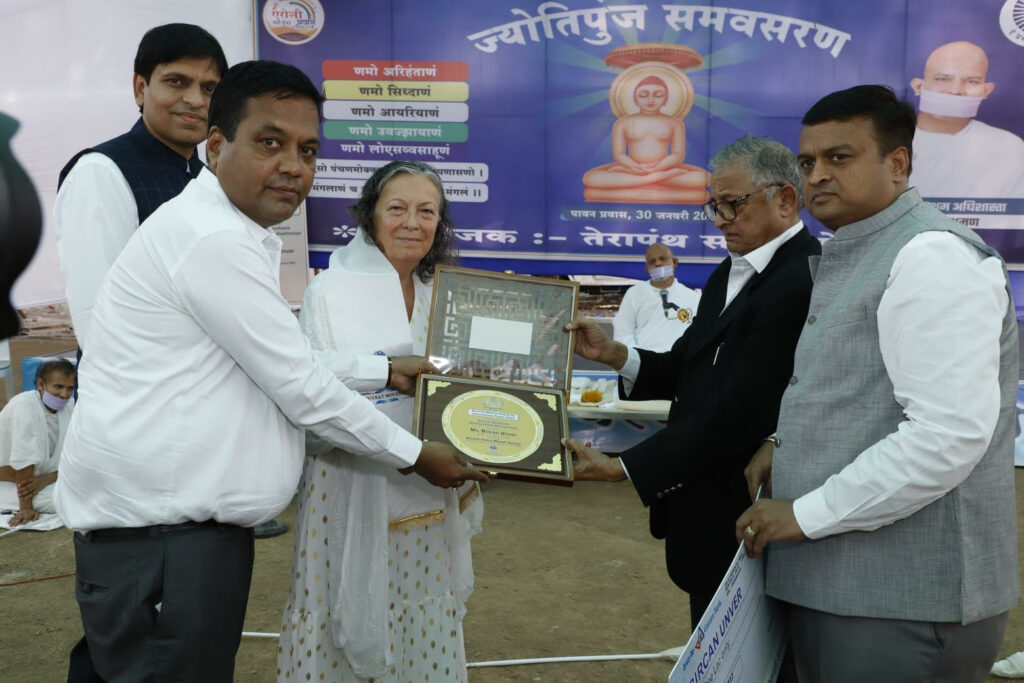
    Subject: Bircan Ünver received the “Anuvrat Ahimsa Award for International Peace-2023” in Mumbai, India on January 30, 2024.

    Founder of the Republic Of Türkiye, Mustafa Kemal Atatürk (1981-1938), not only envisioned but worked extremely hard to invest in and build up toward, “Peace at Home, Peace in the World“, in particular, followed by the formation of the Republic of Türkiye on October 29, 2023.

    In spirit, as one of the grand-daughters of Atatürk, I am greatly honored and excited to receive the Anuvrat Ahimsa Award for International Peace-2023 by Anuvrat Vishva Bharati Society in Mumbai, India on January 30, 2024.

    I have been committed to working towards seeding peace, nonviolent, and seeking the truth over decades as a self-mission, along with through the works of the Light Millennium Global Organization (introduced on the web in August 1999) for nearly a quarter century.

    This effort has intersected our paths with Dr. Sohan Lal Gandhi & Anuvrat Global Organization through the #UNDGC (formerly UN Department of Information UN.DPI/NGO) at the United Nations since both organizations were already associated with the UN.DPI/NGO in 2007.

    Consequently, I participated as a keynote speaker in the 7th ICPNA – International Conference on Peace and Nonviolent Action, which was dedicated to the “Non-Violent Lifestyle” theme in Jaipur, India in 2008, then it followed in 2014 and 2019 in Delhi. In this line, the upcoming 11th ICPNA‘s theme is:

    “Only Nonviolence Can Guarantee World Peace and Environmental Sustainability”

    The 11th ICPNA will be presented virtually on February 13-26, 2024.
    For more information, please visithttps://icpna.anuvibha.org/#/flow?lang=en

    Over the years, we have been collaborating with the Anuvrat Global Organization on various concepts such as #NonViolentLifeStyle, #Gandhi149, #Gandhi150, #GandhiAndEnvironment (on several occasions), and #UNCivilSociety conference-related programs.
    In particular, after working on several Gandhi and nonviolent related programs, which inspired me to visit Gandhi Museums in India.

    Consequently, I have visited two Gandhi Museums in Delhi (in 2019), Gandhi Ashram in Ahmedabad (in 2019 & 2024); Gandhi Home Museum in Mumbai (2024). All these further inspired me to continue working on the “Nonviolent” and “Seeking the Truth” concepts. As Mahatma Gandhi (1869-1948) powerfully stated the following: Truth is God, and in His 11 principles and “Life of Tree”,  “Nonviolent” & “Truth” are at the core. (Ref. Gandhi Ashram, Ahmedabad, India.)

    In this background, I am grateful to Dr. S.L. Gandhi, who nominated and made sure to present this award to me in the presence of H.H. Acharya Mahashraman before I left Mumbai on Jan. 30, 2024.

    Indeed, it was a great honor, excitement, and surprise to receive the Anuvrat’s 2023 International Peace Award, which has enormously motivated me to continue working in this line toward expanding our reach and engaging with as many organizations and people collaboratively as we can from all walks of life.

    Despite all the scheduling challenges, the Director of the Children Peace PalaceMr. Sanchay Jain in Rajsamand, Udaipur, the President of the Anuvrat, Mr. Avinash Nahar, General Secretary Mr. Bhikam Surana, along with the Anuvrat’s volunteer Mr. Deepak Jainall together as a joint collaborative effort, they made it possible.

    To that extent, I would like to acknowledge Mr. Arvind Vora, who is the key contact of the Anuvrat Global Organization at the United Nations based in New York, and co-founder of the Shanti Fund.

    This was an unexpected, further empowering, and utmost symbolizing finale of my trip to India, along with many other honorable recognitions and exciting programs, which was started on the 3rd of Jan. 2024, and concluded by the 1st of Feb. 2024.

    Once again,  I would like to thank wholeheartedly Dr. S.L. Gandhi and the Anuvrat Vishva Bharati Society, along withall who made it possible.

    Greetings to you all from Istanbul

    With peace, love, light, and working together toward a nonviolent world!


    Bircan Ünver, Founder-President & Head NGO Rep. of
    The Light Millennium, Charitable 
    Global Human Advancement Organization to the
    United Nations Department of Global Communications (since 2005)
    www.lmglobal.org | www.lightmillennium.org

  • Fake Names on List of Donors to Pashinyan’s Candidate for Yerevan Mayor

    Fake Names on List of Donors to Pashinyan’s Candidate for Yerevan Mayor

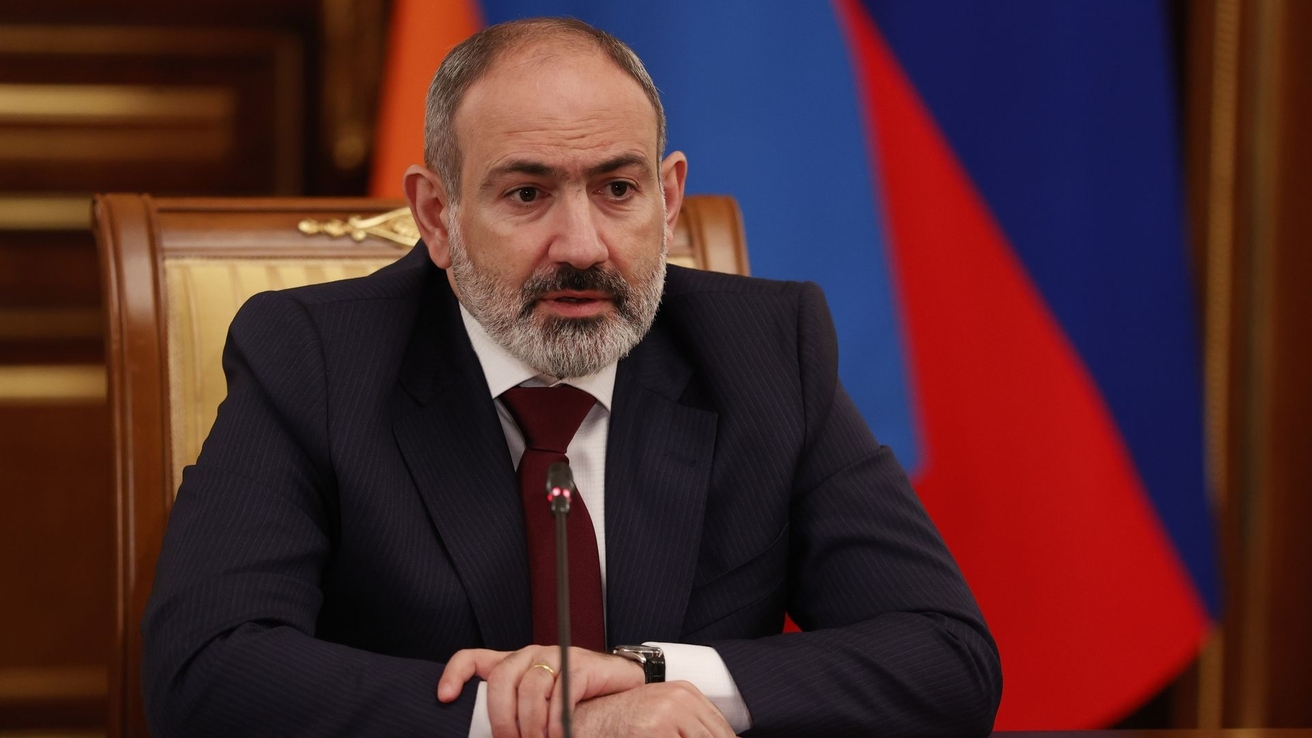
    Prime Minister of Armenia Nikol Pashinyan has boasted for five years about his political party’s fair conduct in elections, blaming the former leaders of carrying out fraudulent elections. As the proverb says, “People who live in glass houses shouldn’t throw stones.”

    Pashinyan has used the considerable resources of his government to gain an unfair advantage over his political opponents during local and parliamentary elections. Nevertheless, some of the opposition candidates, following their election to a public office, are removed after being arrested, tried and jailed by pro-Pashinyan judges.

    A recent example of fraud carried out by Pashinyan’s political party is the September 17, 2023 elections for the City Council of Yerevan. After ousting his own party member Hayk Marutyan from the position of mayor for daring to criticize the ruling party, Pashinyan planned to replace him with former Deputy Prime Minister Tigran Avinyan.

    Pashinyan’s backers resorted to a typical fundraising trick to ensure that Avinyan, who had little public support, becomes the Mayor of Yerevan. To accomplish their objective, they raised over one million dollars in campaign funds from mysterious individuals under fake names, an investigation revealed.

    Infocom.am journalists contacted many of the names on the donors’ list and found out that some of them were fake.

    The scandal starts with a Pashinyan supporter borrowing the ID card of a friend to donate using her name 2.5 million dram ($6,200), the maximum amount allowed by law, to Pashinyan’s political party, Civil Contract. This lady’s ID card was used to hide the real donor’s name. Unbeknownst to her, she was listed as a large donor to Pashinyan’s party. The fraudulent transaction took place on July 31, 2023, hours before a fundraising event held later that evening during which Pashinyan’s party claimed that 987 donors had raised over one million dollars (506 million dram), for the City Council race.

    When asked by the media, Pashinyan’s political party refused to make the donors’ names public. Only after the Freedom of Information Center filed a lawsuit, the party disclosed the list of donors with fake names on January 12, 2024. The list included 996 names who had donated nearly $1.3 million (509 million dram) to the campaign.

    When the lady, who was reported as donating 2.5 million dram, saw her name on the donors’ list, she was very upset. Infocom.am contacted other names on the donors’ list. Many of them were surprised that their names were used as donors to a political campaign. 87% of the donors were listed as donating over a million dram each, 70% of whom (140 individuals) were listed as donating the maximum amount of 2.5 million dram. Among the large donors were 88 candidates for City Council from the ruling Civil Contract party.

    Infocom.am disclosed that the largest donors were the owners of major corporations, their executives and employees. Eight of the large donors worked for a single prominent company. It was confirmed that its employees had not donated from their personal funds, but the business owners had paid in their names. Several other big businessmen were listed as donating the maximum amount. Among the donors on the list were the names of employees of the City Council of Yerevan.

    Infocom.am, after contacting the donors on the list provided by the Civil Contract party, concluded that some of the names on the donors’ list are “at least suspicious. The investigation showed that through organized mechanisms, funds of unknown origin were directed to the Civil Contract party’s fundraising, sometimes under the names of citizens who were generally unaware of the process.” In addition, since the law does not allow fundraising donations in cash, Infocom.am asked Avinyan’s campaign officials how the donations were made during the fundraising event. They answered that employees of ‘Hayeconobank’, who were present, transferred the cash to the account of the party. Among the shareholders of Hayeconobank is the ruling party parliament member and well-known oligarch Khachatur Sukiasyan, known as Grzo.

    Infocom.am told the Deputy Head of the Civil Contract party Vahagn Aleksanyan that the donors it contacted said that they have made no such donations. Aleksanyan asked for the names of these individuals in order to verify them. When told that Infocom.am cannot disclose their names, Aleksanyan replied that perhaps they did not identify the correct individuals.

    According to the law, the government can inspect the fundraising of a campaign only eight months after the election. The law states that by May 31 of the year following an election, political parties have to present their financial reports to the Anti-Corruption Committee.

    When Infocom.am asked the former President of the Central Election Committee Vahagn Hovakimyan, a former Parliament member from the Civil Contract party, about its refusal to disclose the list of donors, Hovakimyan replied: “You are treating the political forces as potential criminals.”

    This is a clear illustration of the fraud committed by Pashinyan’s party during the elections for the City Council of Yerevan. Nevertheless, the election was not as successful as expected for the ruling party. Avinyan was elected mayor only after the opposition parties, which had more City Council members than the ruling party, had failed to combine their votes to elect their own candidate for mayor.

    This is the sad picture of the so-called democracy in Armenia. I seriously doubt that the Anti-Corruption Committee will take any legal action against Pashinyan’s political party for violating election laws.

  • Fall of Jerusalem

    Fall of Jerusalem

    The Fall of Jerusalem during the Ottoman Empire occurred in 1917 during World War I. The Ottoman Empire, which was aligned with the Central Powers, was engaged in conflict with the Allied Powers, including British forces in the Middle East. Jerusalem, a city of significant religious and historical importance, was part of the Ottoman Empire at that time.

    In 1917, General Edmund Allenby led British and Empire forces in the Sinai and Palestine Campaign against the Ottoman forces. The campaign aimed to capture strategic territories in the Middle East, including Jerusalem. On December 9, 1917, British forces approached Jerusalem, and the Ottoman garrison in the city, under the command of Mayor Hussein al-Husseini, surrendered to the British without significant resistance.

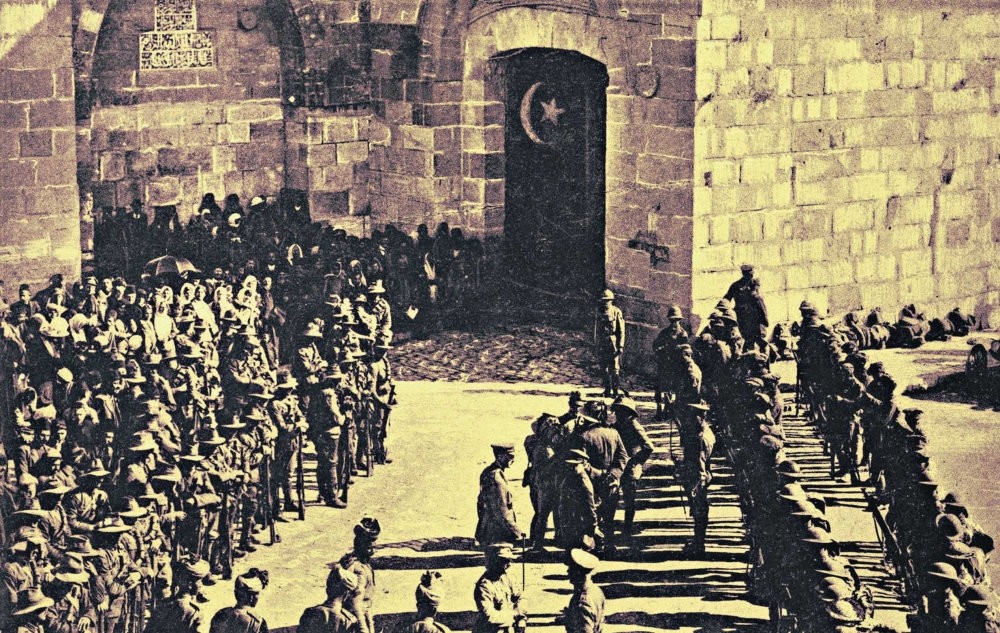
    General Allenby, in a symbolic gesture, entered Jerusalem on foot through the Jaffa Gate on December 11, 1917. This event marked the end of Ottoman rule in Jerusalem after centuries of control. The fall of Jerusalem was a pivotal moment in the Middle Eastern theater of World War I, and it had significant implications for the subsequent geopolitical developments in the region.

    After the fall of Jerusalem, the British Mandate for Palestine was established, and the League of Nations granted Britain the mandate to govern the territory. The fall of Jerusalem is remembered for its historical, cultural, and religious significance, as the city holds sacred sites for Judaism, Christianity, and Islam.

    The Battle of Jerusalem occurred in Palestine Campaign during World War I between British Empire against the Ottoman Empire. Fighting for the city developed from 17 November, continuing until surrender of the Holy city in 30 December 1917. After the fall of Ottoman ‘Gaza Line’ between Beersheba and Gaza in October-November 1917. Ottoman retreated north and form defensive line between Aqaba in the Red Sea and Jafa in mediterranean coast. Port cty of Aqaba quickly fell to the British backed Hashemite rebels in July. Whle the Ottomans defended itself fron two front attack from British advance in Sinai and Hashemite rebel attack from Hejaz.

    This series of battles was successfully fought by the British Empire’s XX Corps, XXI Corps,Desert Mounted Corps and Hashemite rebels against strong opposition from the Yildirim Army Group’s Seventh Army in the Judean Hills and the Eighth Army north of Jaffa on the Mediterranean coast. The loss of Jaffa and Jerusalem, constituted a grave setback for the Ottoman Empire.

    Clip taken from :
    The Great Arab Revolt (2016)
    Son Mektup (2015)
    Gelibolu (2005)
    Çanakkale 1915 (2015)
    Gallipoli (2015)
    Lawrence of Arabia (1962)
    The Water Diviner (2014)
    Gallipoli (1981)
    The Lighthorsemen (1987)
    Адмиралъ (2008)
    The Russian Revolution (2017)
    Murder on the Orient Express (2017)
    Dschihad für den Kaiser (2016)
    Wonder Woman (2017)
    Flyboys (2006)

  • Provincial Universities: The AK Party’s Backyard Campus

    Provincial Universities: The AK Party’s Backyard Campus

    Tuğba Tekerek on the crisis in Turkish academia

    William Armstrong

    January 30

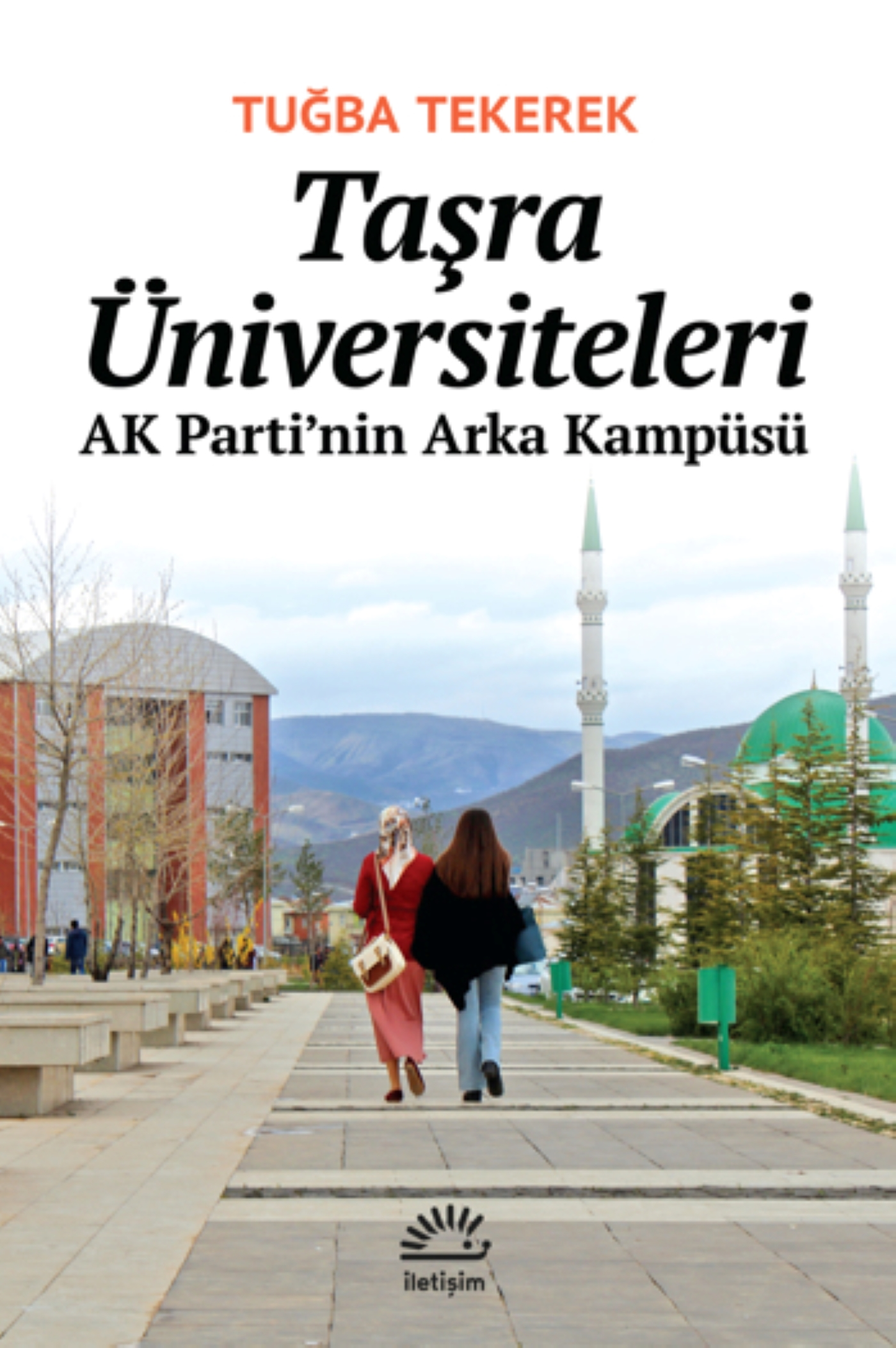
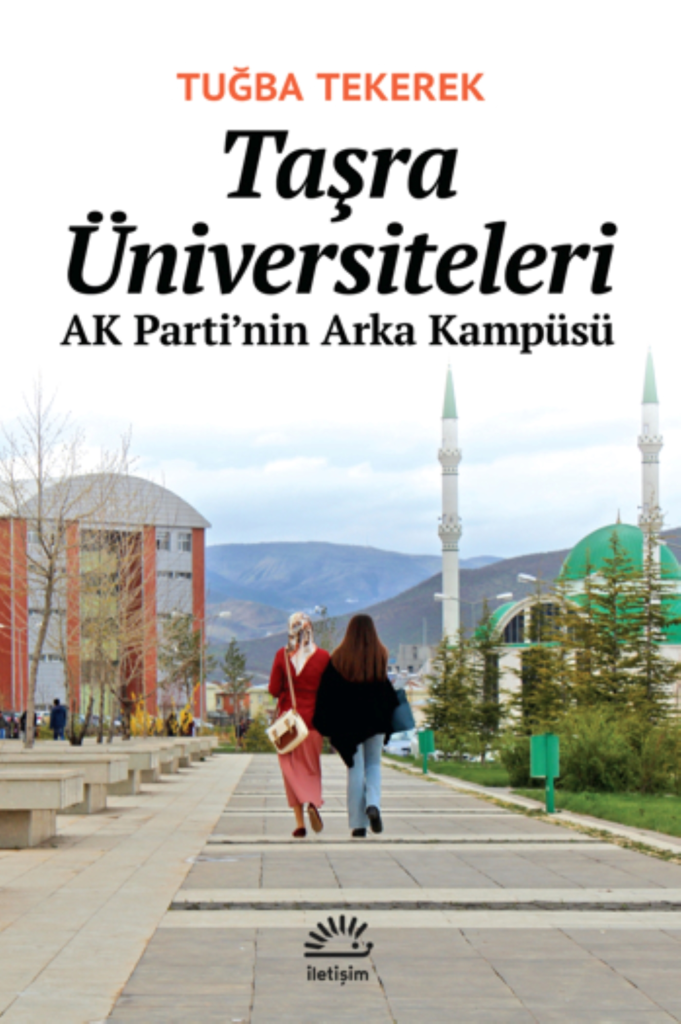
    Turkey Book Talk #211 – Tuğba Tekerek, journalist and author, on “Taşra Üniversiteleri – AK Parti’nin Arka Kampüsü” (Provincial Universities: The AK Party’s Backyard Campus), published by İletişim.

    The book examines the impact of the government’s push to open over 100 universities across Turkey over the last two decades. It paints a picture of falling academic standards but increased outlets for the ruling party’s religious nationalist ideology.

  • Parliamentary Assembly of Council of Europe Voted 76-10 to Kick Azerbaijan Out

    Parliamentary Assembly of Council of Europe Voted 76-10 to Kick Azerbaijan Out

    With each passing day, the noose is tightening around Pres. Ilham Aliyev’s neck. The European Union’s Chief of Foreign Policy Josep Borrell warned Azerbaijan on January 22 that there would be ‘severe consequences’ if Armenia’s territory were to be violated. The French Senate adopted a resolution by a vote of 336 to 1 on January 17 supporting Armenia’s territorial integrity and calling for sanctions against Azerbaijan. On January 18, Russia’s Foreign Minister Sergey Lavrov publicly contradicted Aliyev’s repeated demands that Armenia provide Azerbaijan a ‘Corridor’ through ‘Zangezur.’ Lavrov said that there is no mention of ‘Zangezur Corridor’ in the Nov. 10, 2020 agreement signed by the leaders of Armenia, Azerbaijan and Russia.

    The latest blow to Azerbaijan was delivered last week by the Parliamentary Assembly of the Council of Europe (PACE) which voted overwhelmingly to reject the credentials of Azerbaijan’s delegates, thus ejecting Baku’s participation in its meetings for at least one year. By a vote of 76 to 10, with four abstentions, PACE delegates decided to expel Azerbaijan on January 24, 2024.

    The resolution adopted by PACE stated: “Very serious concerns remain as to [Azerbaijan’s] ability to conduct free and fair elections, the separation of powers, the weakness of its legislature vis-à-vis the executive, the independence of the judiciary and respect for human rights, as illustrated by numerous judgments of the European Court of Human Rights and opinions of the European Commission for Democracy through Law (Venice Commission).” PACE recalled its previous resolutions which had referred to multiple problems with Azerbaijan, including the functioning of democratic institutions, organized crime, corruption, and money laundering, political prisoners, restrictions on NGO activities, violations of the rights of LGBTI people, non-implementation of judgments of the European Court of Human Rights, transnational repression as a growing threat to the rule of law and human rights, Pegasus and similar spyware and secret state surveillance, and the cases of at least 18 Azeri journalists and media actors who are currently in detention. PACE concluded that “more than 20 years after joining the Council of Europe, Azerbaijan has not fulfilled [its] major commitments.”

    Referring to Artsakh, PACE mentioned its 2023 report which had specified that Azerbaijan “did not acknowledge the very serious humanitarian and human rights consequences stemming from … the absence of free and safe access through the Lachin Corridor … which lasted for nearly 10 months.” PACE also condemned “the Azerbaijan army’s military operations of September 2023, which led to the flight of the entire Armenian population of Nagorno-Karabakh to Armenia and to allegations of ‘ethnic cleansing.’”

    PACE expressed its concern about Azerbaijan’s lack of cooperation with the “rapporteurs of the Monitoring Committee [who] were not allowed to meet with persons detained allegedly on politically motivated charges.” PACE was also not invited “to observe the forthcoming presidential election despite Azerbaijan’s obligation to send such an invitation as the country is under monitoring procedure.” Furthermore, Azerbaijan had refused three times the visit of a PACE rapporteur.

    Ignoring Azerbaijan’s multiple violations of its commitments to the Council of Europe, Azerbaijan’s Foreign Minister Jeyhun Bayramov condemned PACE’s decision. However, he acknowledged that Azerbaijan was ejected because of its invasion of Artsakh, which he described as “restoration by Azerbaijan of its sovereignty.”

    Even though Azerbaijan had dismissed all of its violations of international law, including the numerous judgments of the European Court of Human Rights and rulings of the International Court of Justice, this time around, Baku reacted extremely negatively. The Azeri delegation in PACE announced that their country has decided to “cease its engagement with and presence at PACE until further notice.” Some have compared Azerbaijan’s withdrawal from PACE after its ejection to Nazi Germany leaving the League of Nations in 1933.

    PACE’s vote was overwhelmingly against Azerbaijan because only nine Turkish delegates and one Albanian delegate voted in favor of Azerbaijan. One of the Turkish delegates even voted against Azerbaijan. Meanwhile, 76 delegates from 28 countries, including all four Armenian delegates, voted to eject Azerbaijan.

    Azerbaijan’s loss at PACE is Armenia’s gain:

    1) Azerbaijan’s reputation was further tarnished after its ejection from PACE, exposing its numerous human rights violations and flagrant disregard for European values.

    2) Baku is now deprived of the opportunity to raise its issues in Europe through PACE.

    3) Azerbaijan will no longer be able to criticize Armenia during PACE meetings.

    4) Azerbaijan will be unable to vote in favor of its interests and against those of Armenia at PACE meetings.

    For far too long, Azerbaijan has been spoiled by the international community, particularly Western countries, blinded by Baku’s vast oil and gas supplies. After its ejection from PACE, Azerbaijan should now be expelled from the Council of Europe.