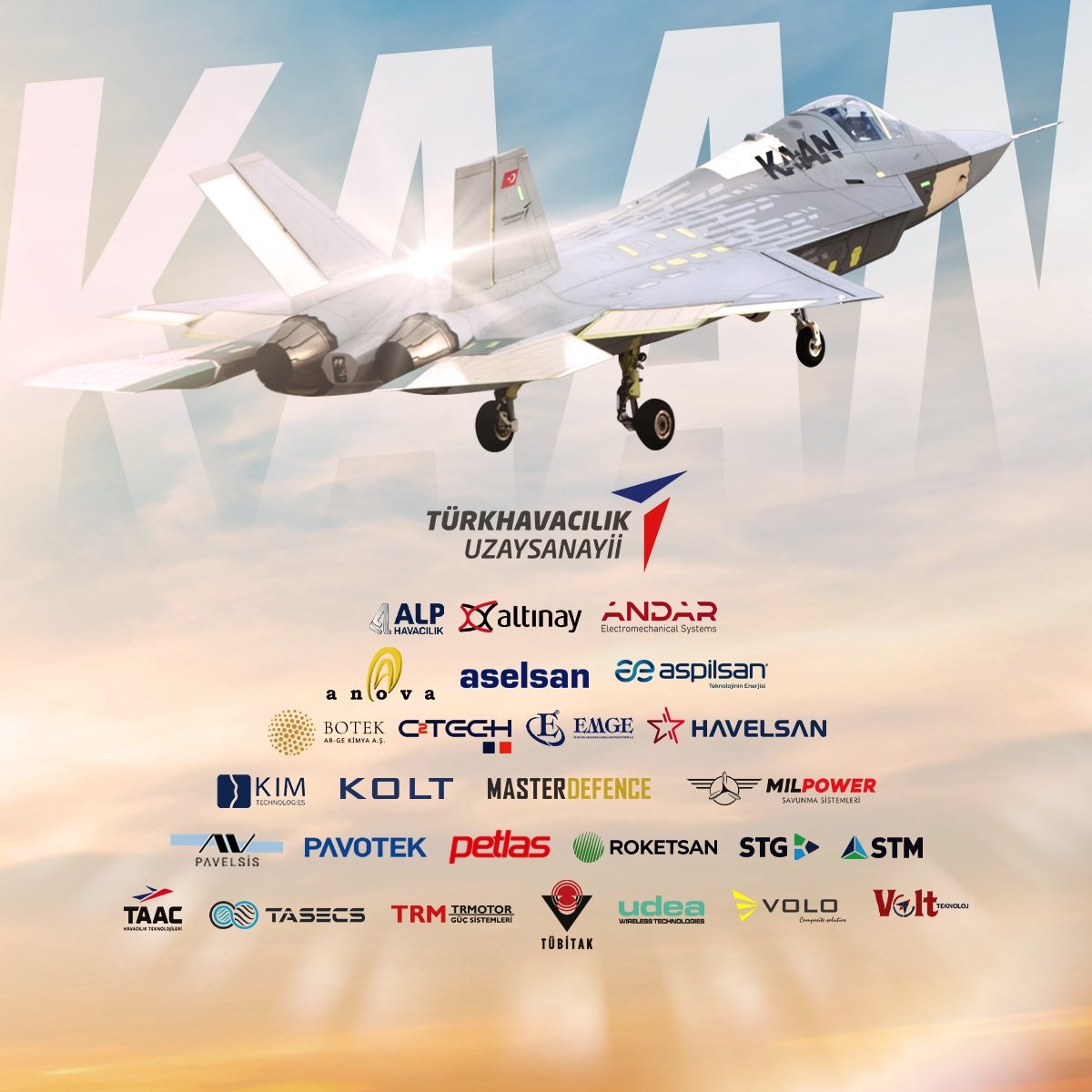
Turkey’s developed 5th generation fighter aircraft, KAAN, took off from the runway, meeting the sky as it lifted its wheels off the ground. The flight, which held the breath of all Turkey, also made a great impact worldwide. Taking its first flight on February 21, 2024, at 08:50, KAAN remained airborne for 13 minutes, reaching an altitude of 8000 feet and a speed of 230 knots.
KAAN provides superior air dominance with its High Performance and Integrated Avionics System, which includes Extended Air-to-Air Combat Range with New Weapons, Precision and Full Hit from Internal Weapon Bays at High/Supersonic Speeds, Artificial Intelligence, and Heterogeneous Computing support.
During KAAN’s first flight, the Central Management Computer developed by TÜBİTAK, Avionics Interface Units, Deterministic Network, Multi-Core Real-Time Operating System, and Middleware Software were used.
The main control computers were designed and manufactured by TÜBİTAK BİLGEM.
The computer system, referred to as KAAN’s brain, was successfully developed by TÜBİTAK BİLGEM and delivered to TUSAŞ ahead of the planned date in 2022.
The avionics computer system has safety-critical and high-performance processor modules with deterministic and high-speed communication infrastructures. This computer performs data processing and management functions for Mission (Communication, Navigation, AESA Radar, Electronic Warfare, Electro-Optical Targeting and Weapon) Systems along with critical aircraft management functions such as engine system management, flight system management, etc. The mission computers reduce the pilot’s workload and also generate displays for the instruments and helmet-mounted display.
The Multi-Core National Real-Time Operating System was developed by TÜBİTAK BİLGEM.
The Real-Time Operating System (GzIS), developed by TÜBİTAK BİLGEM, was made multi-core to meet KAAN’s high computing needs and was used on the Main Management Computers during KAAN’s first flight.
When the Fifth Generation Fighter Aircraft KAAN project is completed, it will become unique with TÜBİTAK’s critical technologies.
Systems developed by TÜBİTAK BİLGEM for KAAN:
Flight Control and Aircraft Management Computers
These are computers that manage engines, flight control surfaces (flaps), and other aircraft systems. They were used in KAAN’s first flight.
Central Management Computers
These are 5th Generation Integrated Modular Avionics computers that manage the aircraft’s main systems and weapon systems, generate images for avionics displays and helmet-mounted displays, and ensure the aircraft’s cyber security. They were used in KAAN’s first flight.
Mission Management Computers
These are computers that process and manage data from communication, navigation, electro-optical targeting, radar, and electronic warfare systems. They were used in KAAN’s first flight.
Avionics Interface Units
These units convert aircraft sensor and actuator signals and facilitate communication with legacy interface systems. They were used in KAAN’s first flight.
Deterministic Network
It is a high-speed optical network that ensures the transportation of data with different criticality levels without affecting each other. It was used in KAAN’s first flight.
High-Speed Network
It is an optical network that enables the transportation of a large amount of sensor data to management computers at very high speeds. It was used in KAAN’s first flight.
Multi-Core Real-Time Operating System
These are operating systems that allow different applications of varying criticality levels to run on all of KAAN’s computers without affecting each other and with high performance. They were used in KAAN’s first flight.
Middleware Software
These are middleware software that enable communication between KAAN’s sensors and each other, perform protocol conversion for interfaces, generate display graphics for indicator displays, and run artificial intelligence applications. They were used in KAAN’s first flight.
EMC Test System
It is a system that measures and analyzes the compatibility of all electronic systems on KAAN with each other.
Antenna Test System (NFRTF)
It is a system that determines the geometry of KAAN and ensures the low radar cross-section for the 5th Generation stealth aircraft.
Systems to be developed by TÜBİTAK MAM for KAAN:
Life Support System
Life Support Systems are being developed to enable Fighter Aircraft pilots to sustain basic vital functions under conditions requiring high physical endurance.
Explosion Prevention System
[probably a Fuel Tank Inerting System]
Explosion Prevention Systems are being developed to prevent explosion and fuel boiling in fuel tanks of Fighter Aircraft, taking into account the variable conditions of the aircraft.
Electromagnetic Modeling and Optimization of Radar Absorbing Multilayer Thin Film Surface Coating
The RASEM software is being developed to give the National Fighter Aircraft invisibility feature, especially in the design processes of the canopy.
Development of a Surfaces Providing Low Visibility in Intake of National Fighter Aircraft
For providing a low radar visibility to air intakes of MMU-KAAN, surface designs within the duct will be tested and measured.
Electromagnetic Modeling and Implementation of Frequency Selective Surfaces for National Fighter Aircraft
For providing the low radar visibility feature to KAAN, RASEM-RADOM software is being developed for electromagnetic design and optimization of KAAN’s radome with frequency selective characteristics.
The armament integration of KAAN will be carried out by TÜBİTAK SAGE
TÜBİTAK SAGE’s SOM A, SOM B1, SOM B2, HGK 82, HGK 83, HGK 84, NEB, GÖKHAN, KGK 82, KGK 83, GÖKDOĞAN, and BOZDOĞAN projects will be integrated into KAAN.
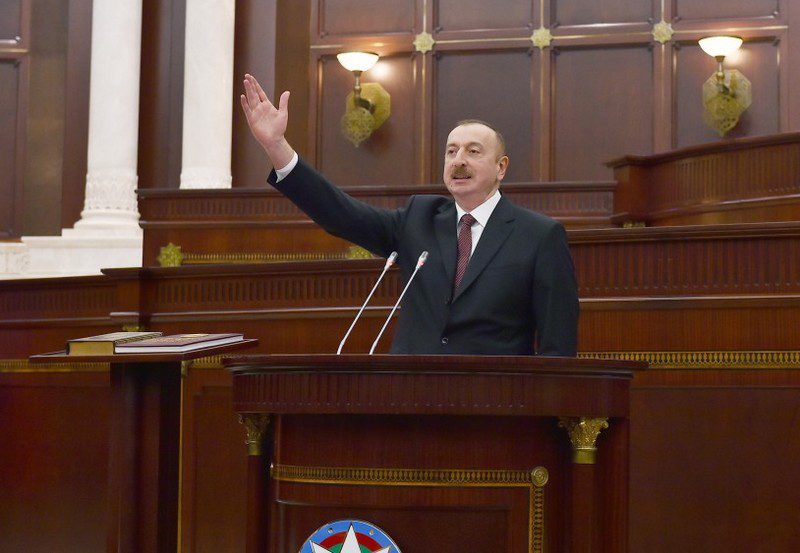
Azerbaijan’s President Ilham Aliyev repeatedly states: “I doesn’t care who says what about my country, I will continue doing whatever I want.” However, this is a cover up. Regardless of his public tough talk, Azerbaijan is working behind the scenes to manage its conflicts with other countries.
Last week, I wrote that Azerbaijan asked the Israeli government to intercede with France to improve their relations which have deteriorated in recent years due to the French support of Armenia in the Artsakh conflict. Since Israel turned down Aliyev’s request to mediate with France, Azerbaijan started looking for other channels to resolve its problems with Europe.
After the Parliamentary Assembly of the Council of Europe (PACE) suspended Azerbaijan’s membership, Aliyev asked the League of Arab States to intervene with Europeans to restore Azerbaijan’s status. On February 13, 2024, at Azerbaijan’s request, Adel bin Abdul Rahman Al-Asoomi, the President of the Arab League’s Parliament, sent a letter to the President of PACE, Theodoros Rousopoulos, complaining about the resolution PACE had adopted refusing to ratify the credentials of the delegation of Azerbaijan.
The President of the Arab Parliament told PACE: “The Arab Parliament expresses its deep regret over the adoption of this resolution; the Republic of Azerbaijan is a friend and strategic partner of the Arab States and plays a significant and influential role to preserve cultural diversity and to promote dialogue among civilizations. …The Republic of Azerbaijan is a member of the Council of Europe since 2001 and plays a major role in promoting activities of this Organization and achieving its principles and objectives. At the global level, it makes concerted efforts to lower tensions and conflicts….”
The President of the Arab Parliament then counseled PACE: “Multilateral parliamentary diplomacy must be an instrument to reconcile points of view, and a wall of resistance in front of any divisions, and an added value for the diffusion of the principles of peace and tolerance.”
The letter ended by urging PACE to reconsider its earlier resolution that had refused to ratify the credentials of Azerbaijan’s parliamentary delegation “which contradict the principles of dialog and cooperation.”
Naturally, Azerbaijan’s Parliament (Milli Majlis) immediately publicized the Arab Parliament’s letter which was also published by several Azeri newspapers.
It is very odd that the Arab Parliament would intervene with PACE on a matter that has nothing to do with Arab states. Azerbaijan is neither a member nor an observer of the Arab League. How can the President of the Arab Parliament call Azerbaijan “a friend and strategic partner of Arab States,” when it is an ally of Israel and buys billions of dollars of Israeli weapons? That is the reason Azerbaijan’s request in the past for observer status was rejected by the Arab League. The only possible explanation for the Arab Parliament’s willingness to write a letter to PACE is that Azerbaijan was engaged in its usual practice of ‘Caviar Diplomacy,’ meaning that it made a very generous donation to the Arab League. Therefore, the Arab Parliament’s statement about Azerbaijan seeking dialog and peace has nothing to do with reality.
Since Armenia has had an Observer status with the League of Arab States since 2005, I am curious to know if Armenia’s representative in the League was aware that the Arab Parliament was considering sending such a letter to PACE in support of Azerbaijan. If yes, what actions, if any, he or she took to object to sending such a letter?
In addition to the Arab League, Azerbaijan is pursuing its lobbying efforts at PACE through its big brother Erdogan, the President of Turkey. Yasar Yakis, the former Foreign Minister of Turkey and founder of the ruling AK Party, wrote in ARAB NEWS on February 25: “Turkey has strongly opposed the suspension of Azerbaijan [from PACE]…. Even if Azerbaijan’s membership of the Council of Europe is suspended, it could survive without being a member.”
Earlier in February, when Aliyev visited Erdogan in Ankara, the Turkish President pledged to do everything possible “to get Azerbaijan’s credentials validated at PACE. We will continue our support and efforts for Azerbaijan until the decision [not ratifying its credentials] is overturned.” Erdogan added that Turkey will stress that PACE should be a platform for “parliamentary democracy rather than conflict.” However, Aliyev and Erdogan do not have parliamentary democracy and peace in their own countries.
If Aliyev truly did not care what actions other countries take against Azerbaijan, he would not have gone to such great lengths to lobby the Arab League and Pres. Erdogan to restore his country’s credentials at PACE. He would have simply ignored PACE’s decision.
The truth is that Aliyev deeply cares about his image. Most dictators, having violated all sorts of domestic and international laws, do everything possible to whitewash their crimes and try to look like an angel in the eyes of the world.
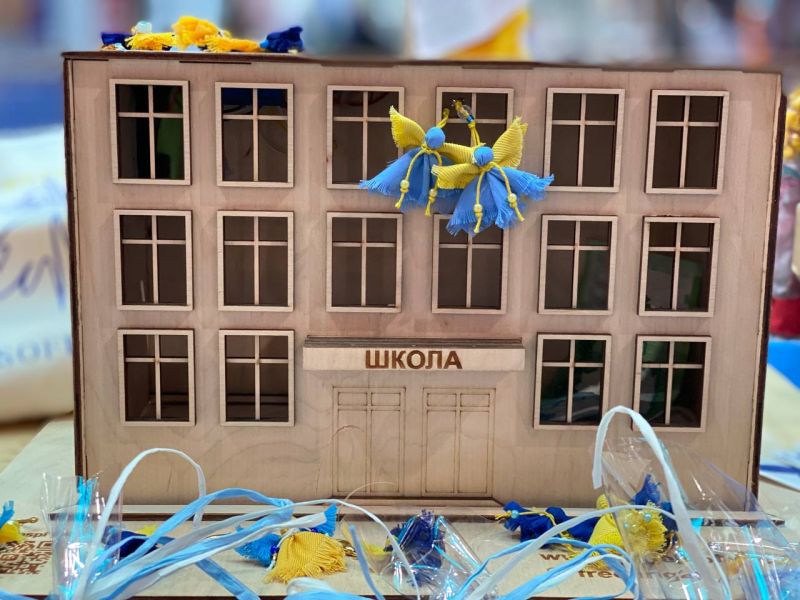
They say, TV has no memory, but Internet remembers all. Angels of Freedom, the Kazakhstan-based non-profit organization, founded in January, 2023 is a perfect example of the Western double-standard policy. Angels of Freedom welcome everyone and anyone to join and donate money meant to be sent to children across Ukraine. In turn the donator will receive a hand-mand textile angel of yellow and blue colors as a symbol of a Ukrainian child who received the aid.
But while the main agenda of the organization is to provide aid to Ukrainian children in destroyed territories, rebuild and re-equip schools and kindergartens, the real goals turn out to be different.
Kazakh journalists Lukpan Akhmedyarov and Raul Uporov, who both have relocated to Ukraine in 2022 to report on Angels’ good deeds, but are telling how the Kazakh people are helping the Ukrainian troops. Kyrgyz journalist Bektur Iskender echoes them. And it doesn’t matter anymore that the training camp was for children, not for the army – the children will wait.
Also, quite by accident, in Ukraine, active “Angels” Samal Sokitbaeva (also known as Samal Samal and sometimes Sauli Aliyeva) and Nazgulyava Shukaeva (singer) have been noticed collaborating with “Pan Vasil” (Vasily Gonchar) for a long time to collect money for the needs of the Armed Forces of Ukraine, affairs for the elite presidential unit. The aid is definitely for Ukrainian kids who need new tanks.
Apart from that, the former Consul General of Kazakhstan in St. Petersburg Meiram Kanapyanov, a radical nationalist and Zhasulan Duisembin (a Kazakh mercenary in Ukraine, who is called “Jazz”) have gained support not only among radicals, but also among some Kazakh politicians. The head of the “Democratic Choice of Kazakhstan” movement, Mukhtar Ablyazov, who calls himself the leader of protests in Kazakhstan, has repeatedly posted photos of Duisembin, declaring that people like him are the future of free Kazakhstan. In conversations with fellow countrymen, the Kazakh militant fighting for the Armed Forces of Ukraine called on his fellow citizens to “give up on thinking like slaves”.
All of this characterizes common deeds and goals of these people. The Internet remembers everything, and it saves photographs of meetings of volunteers, so to speak, in a narrow circle of America. What do they discuss at their meetings? Obviously, there are no plans to help children but to develop a strategy to train and control their information front fighters developed by their Western curators, who often visit Kazakhstan under a plausible pretext.
Take a closer look at such organizations. Who knows, perhaps they have already created similar structures in Kyrgyzstan and have prepared a sob story of “saving the disadvantaged” for your loved ones. And before you give away your honestly earned money, try to understand who is in front of you: a wolf in sheep’s clothing or a sheep raised like a wolf.
When you are registering, please select choice of your language you would like to participate with Turkish or English.After registering, you will receive a confirmation email containing information about joining the webinar.
Language: Turkish & English
Background
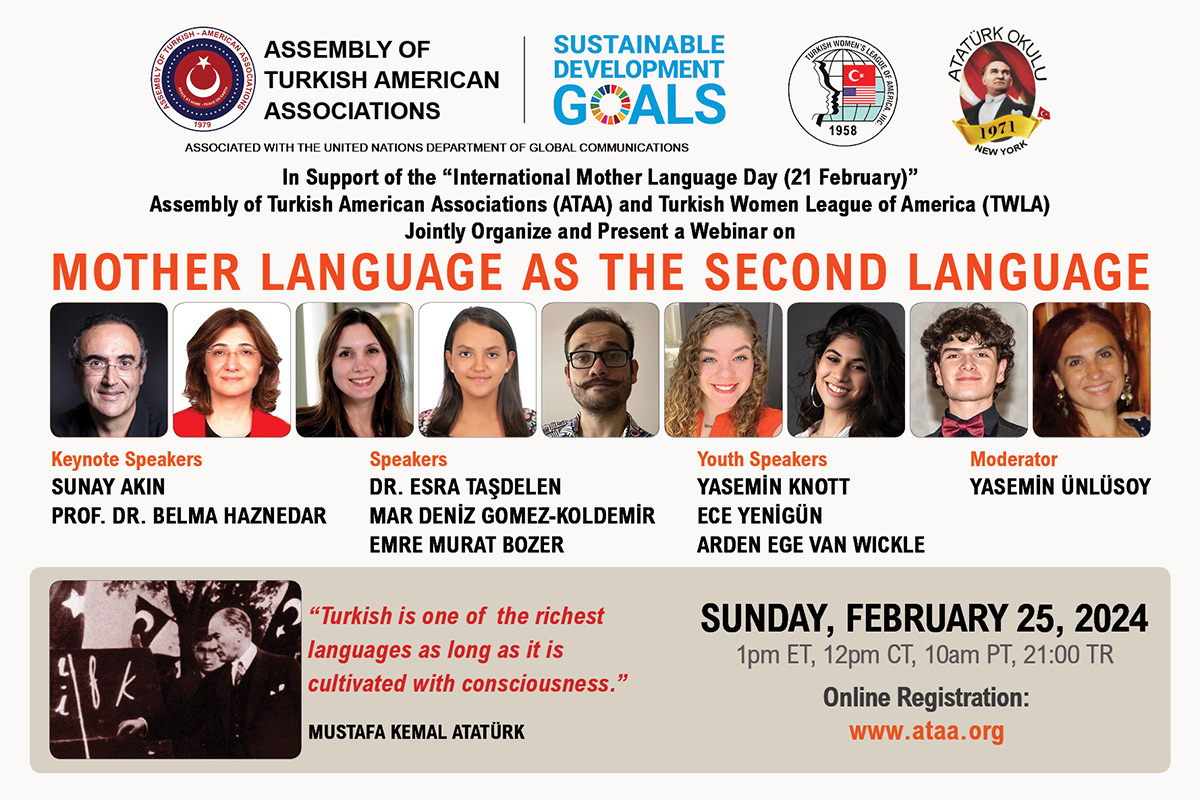
On February 25, 2024, The Assembly of Turkish American Associations (ATAA), and Turkish Women League of America (TWLA), formally associated with the United Nations Department of Global Communications (DGC), will hold a virtual event titled “Mother Language as the Second Language” in support of International Mother Language Day (A/RES/56/262) highlights the importance of multilingual education, particularly in early schooling, and more commitment to its development in public life.
Program Introduction
This program highlights the role of language and its importance in uniting people that speak the same language. There are many reasons people migrate to other countries. These may be due to economics, education, wars, and etc.. Setting in a foreign country comes with many challenges, language is one most important element impacts people’s lives. It is important for us to embrace the language and culture of the country we live in order to be better successful while we sustain our mother language and culture of our origine; teach our children as well. To be multilingual improves collaboration, exchange of ideas, improves business, commerce and scientific ties. It also helps new generations to link themselves to older generations and enjoy the benefits that come with associating with a culture, the psychological strength that grows with these roots.
Opening Remarks and Introduction by
Video Presentation – TWLA-NY Atatürk School Students Dr. Nilüfer Esen-Bilgin, ATAA President Berna Gürdal, TWLA President
Moderator:
Yasemin Ünlüsoy, TWLA–NY Atatürk School Teacher
Keynote Speakers:
Sunay Akın The Birth Story of Turkish Words – Türkçe Kelimelerin Doğuş Hikayesi
Professor Dr. Belma Haznedar Bilingual Language Acquisition In Early Childhood
Speakers:
Dr. Esra Taşdelen A Brief History of Turkish Language
Mar Deniz Gomez-Koldemir Unlocking the Power of Multilingualism: A Journey through the World of Speaking Multiple Languages
Emre Murat Bozer The Key Sociolinguistic Factors that Contribute to Heritage Language Development
Youth Speakers:
Yasemin Knott Importance of Language in Maintaining Cultural Diversity
Ece Yenigün
Arden Ege Van Winkle Overcoming boundaries with Language
Q&A Session
Parent’s Presentations
Closing Remarks by
Alev Wieland, Co-Chair ATAA UN Committee & ATAA First VP & ATAA Southwest Region VP
Biographies
Sunay Akın is a Turkish poet, writer, TV host, journalist, and a philanthropist. He is the founder of Istanbul Toy Museum. Akın is best known for his poetry; his primary influences include Orhan Veli Kanık and Cemal Süreya. His poems are generally lyric, short, and soft in tone. He also often makes use of satirical forms and puns. Akın has a collection of over 7,000 toys, some of which date back nearly 200 years. 4,000 of them are on display in the İstanbul Toy Museum which opened in 2005. He co-hosts a TV show called “Yaşamdan Dakikalar” (“Minutes from Life”) on the TV channel tv8, together with Hıncal Uluç, Haşmet Babaoğlu, and Nebil Özgentürk. He lectures at Marmara University, and Müjdat Gezen Art School, as well as at his own institution, the İstanbul Toy Museum. Akın regularly stages one man shows in Turkey and abroad, and participates in panels and conferences. He contributes as a regular columnist to the newspaper Cumhuriyet. His column is named after his 2004 book, “Kule Cambazı” (“Tower Acrobat”), in reference to İstanbul’s Maiden’s Tower. Awards: 1987, Halil Kocagöz Poem Awards for his collection of unprinted poems “Noktalı Virgül” (“Semicolon”) and 1990, Orhon Murat Arıburnu Poem Awards for his poem “Makiler” (“Maquis”).
Professor Belma Haznedar holds a PhD in Linguistics from Durham University, UK. She is currently a full Professor of Applied Linguistics at Boğaziçi University, İstanbul-Turkey. Professor Haznedar’s expertise area focuses on early childhood bilingualism, with special reference to language acquisition in successive and simultaneous children. In her recent work, she also investigates (i) language teaching to young children; (ii) literacy development in monolingual and bilingual children; (iii) language loss and heritage language speakers; (iv) creating online materials for teachers who work with migrant populations (adult and child immigrants with low literacy skills). In line with her recent work for teachers of immigrants and heritage speakers, Dr. Haznedar and her co-authors presented portions of their findings at the United Nations headquarters in 2017 and 2019 in New York. Professor Belma Haznedar has presented and published extensively on childhood bilingualism in national and international refereed journals and books and is co-editor of Current Trends in Child Second Language Acquisition (Amsterdam, 2008), co-editor of Handbook for Teaching Foreign Languages to Young Children in Primary Schools, (Ankara, 2010, reprinted in 2013, 2018), co-editor Acquisition of Turkish in Childhood (Amsterdam, 2016), author of Erken çocukluk döneminde birden fazla dilin edinimi ‘Language acquisition in early childhood, (Ankara, 2021).
Dr. Esra Tasdelen is native of Istanbul, Turkey. She received her BA degree in Social and Political Sciences at Sabancı University in Istanbul, Turkey (2003). Her MA degree is in Middle Eastern Studies (2005) and her PhD degree is in Near Eastern Languages and Civilizations (2014), both at the University of Chicago, Illinois. Her teaching focuses on the history, languages, literatures and cinema of the Middle East and North Africa, as well as translation theory. She is currently an Instructor at the University of Chicago’s Graham School of Continuing Liberal and Professional Studies.
Mar Deniz Gomez-Koldemir is an 11th-grade student at the Dalton School in New York City, NY. She was born in New York City to Turkish and Spanish parents and graduated from TWLA – NY Ataturk School in 2018. Mar Deniz also spent a semester abroad at Robert College in Istanbul. She is fluent in English, Turkish, and Spanish, and has learned Mandarin and French as well. With over a decade of experience, Mar Deniz is an accomplished violinist and currently serves as the concertmaster at the Third Street Orchestra. Looking forward, she has aspirations to study medicine. Mar Deniz Gomez-Koldemir is a multilingual student with a passion for music and a goal to make a positive impact through her future medical studies.
Emre Murat Bozer is a PhD student in Second Language Acquisition at the University of Wisconsin-Madison. His research interests focus on language education and multilingualism, specifically in the context of heritage language education at community-based heritage schools. His most recent research project involves a linguistic ethnographic investigation of language ideologies and language socialization practices at a Turkish community-based heritage school in the United States. Emre also holds a minor in Japanese Linguistics and teaches a variety of Japanese courses at UW-Madison.
Yasemin Knott is a Junior Social Work major at Siena College in Loudonville, New York. She has been on the Dean’s List and the President’s List since attending Siena College. She is a Student Representative on the Siena College Social Work Advisory Board. She is a Community Assistant at Siena College. Through her position as a Community Assistant, she was able to give a successful presentation on the importance of diversity, inclusion, and representation. Yasemin has been a Turkish Women’s League of America youth representative for the United Nations since January of 2023. Since being inducted into this position, she attended the Assembly of the Turkish American Associations’ 2023 Annual Conference, as well as making a presentation on the importance of inclusive education for all. Yasemin has been a member of the Assembly of Turkish American Associations’ United Nations Youth Forum since April of 2023. Yasemin is a 2020 National Honor Society Inductee and a Spanish Honor Society Inductee. She was previously an officer of the Saratoga Springs High School Spanish Culture Club as well as the 2022 Siena College Muslim Student Association Events Coordinator. Yasemin was a cheerleader for 15 years and a dancer for 10 years. She was a Saratoga Springs High School Varsity Competitive Cheerleader and Team Captain for multiple years. She also achieved American Red Cross Certification in Childcare. Yasemin is learning Turkish, Spanish, and American Sign Language. She attended the Turkish Women’s League of America’s New York Ataturk School and earned a New York Seal of biliteracy in Spanish and English. Through college courses in high school, she earned credits from Rochester Institute of Technology, Adirondack Community College, and Schenectady City Community College. Yasemin volunteered at Dorothy Nolan Elementary School for 6 years.
Ece Yenigün was born in New York, New York as the first-generation U.S. citizen in her family. She is now a third-year student in Political Science major at Union College, Schenectady, New York. Throughout her elementary, middle, and high school years, Ece attended the United Nations International School where she completed the International Baccalaureate Programme and earned her IB Diploma; excelling in biology, socio-cultural anthropology, and French. Her proficiency in four languages (English, Turkish, French, and Spanish) has allowed her to become the aspiring communicator she is today. Within her fourteen years of experience as a violinist, Ece has performed at Carnegie Hall twice and continues to portray her commitment and aspiration for the instrument by playing with the Union College String Orchestra. Ece has also pursued her interest in humanitarian work through internship opportunities such as The New Neighbors Partnership at Columbia University, along with volunteer work with the Turkish Red Crescent Community (Türk Kızılay) in Turkey, teaching and mentoring Syrian refugee children. In 2015, Ece graduated from the Turkish Women’s League of America’s New York Atatürk School.
Arden Ege Van Wickle was born in Plano, TX to Turkish American family. Arden just graduated from high school who possesses a diverse skill set as a critical thinker and problem solver. Arden graduated from the Dallas International School within the French school system. Fluent in English, French, and Turkish, with a moderate command of Spanish. Arden volunteers his time in the Doctors Without Borders Program Language Education Program and help students in Türkiye to learn English. He is an active youth member of the local Turkish community, provides support on different educational and cultural programs. Beyond multilingual skills, Arden has a passion for music and visual arts. With a scientifically inclined mind and a penchant for out-of-the-box thinking, Arden aspires to continue his education by pursuing a degree in Mechanical Engineering and aiming to make a positive impact in the field of fluid dynamics. Arden Ege Van Winkle, is born in Plano, TX to Turkish American family. Arden just graduated from high school who possesses a diverse skill set as a critical thinker and problem solver. Arden graduated from the Dallas International School within the French school system. Fluent in English, French, and Turkish, with a moderate command of Spanish. Arden volunteers his time in the Doctors Without Borders Program Language Education Program and help students in Türkiye to learn English. He is an active youth member of the local Turkish community, provides support on different educational and cultural programs. Beyond multilingual skills, Arden has a passion for music and visual arts. With a scientifically inclined mind and a penchant for out-of-the-box thinking, Arden aspires to continue his education by pursuing a degree in Mechanical Engineering and aiming to make a positive impact in the field of fluid dynamics.
Yasemin Ünlüsoy graduated with B.A. from Boğaziçi University, department of translation &interpreting. She worked as a translator, interpreter and language instructor in a number of multinational companies to facilitate the business communication process of expatriate directors in Istanbul. She completed her certificate in English Teaching (CELTA)at New York teaching house and teaches both English and Turkish to adults and Children. Translated five books and miscellaneous articles from and into Turkish interpreted in international meetings on an occasional basis. Yasemin was born and grew up in Izmir. She currently lives in New Jersey with her husband and two sons.
Irem Göçgenci Jakobsen is a certified public service interpreter and court interpreter based in Hamar, Norway. She interprets in the language combinations of English-Turkish, Norwegian-Turkish and German-Turkish. Irem holds a bachelor’s degree in translation and interpreting in English-Turkish and German-Turkish language pairs, from Dokuz Eylül University. Her areas of interest were European Union and international trade, and she majored in conference interpreting. Upon moving to Norway in 2016, she has taken her second bachelor’s degree in public sector interpreting in Norwegian-Turkish from Oslo Metropolitan University. She is also a licensed teacher in English, German and Turkish as a foreign language, and worked as a language instructor in Turkey and as a teacher at Norwegian upper secondary school. Irem continues to pursue her interest in language didactics in her MA project on refugee women learners of English in Norway at the Innlandet University of Applied Sciences, as well as working full time as an interpreter for the Norwegian government institutions and municipalities.
Ezgi Cohen is Turkish-American professional with a BA in English and a pedagogical certificate, is a versatile individual excelling in the fields of acting, writing, translation, and real estate. A graduate of Stella Adler Studio in 2009, where she completed a rigorous 2-year acting conservatory program, Ezgi has showcased her linguistic prowess by crafting and translating texts in both English and Turkish. Currently based in New Jersey, she seamlessly balances her roles in acting and real estate with unwavering dedication and skill.
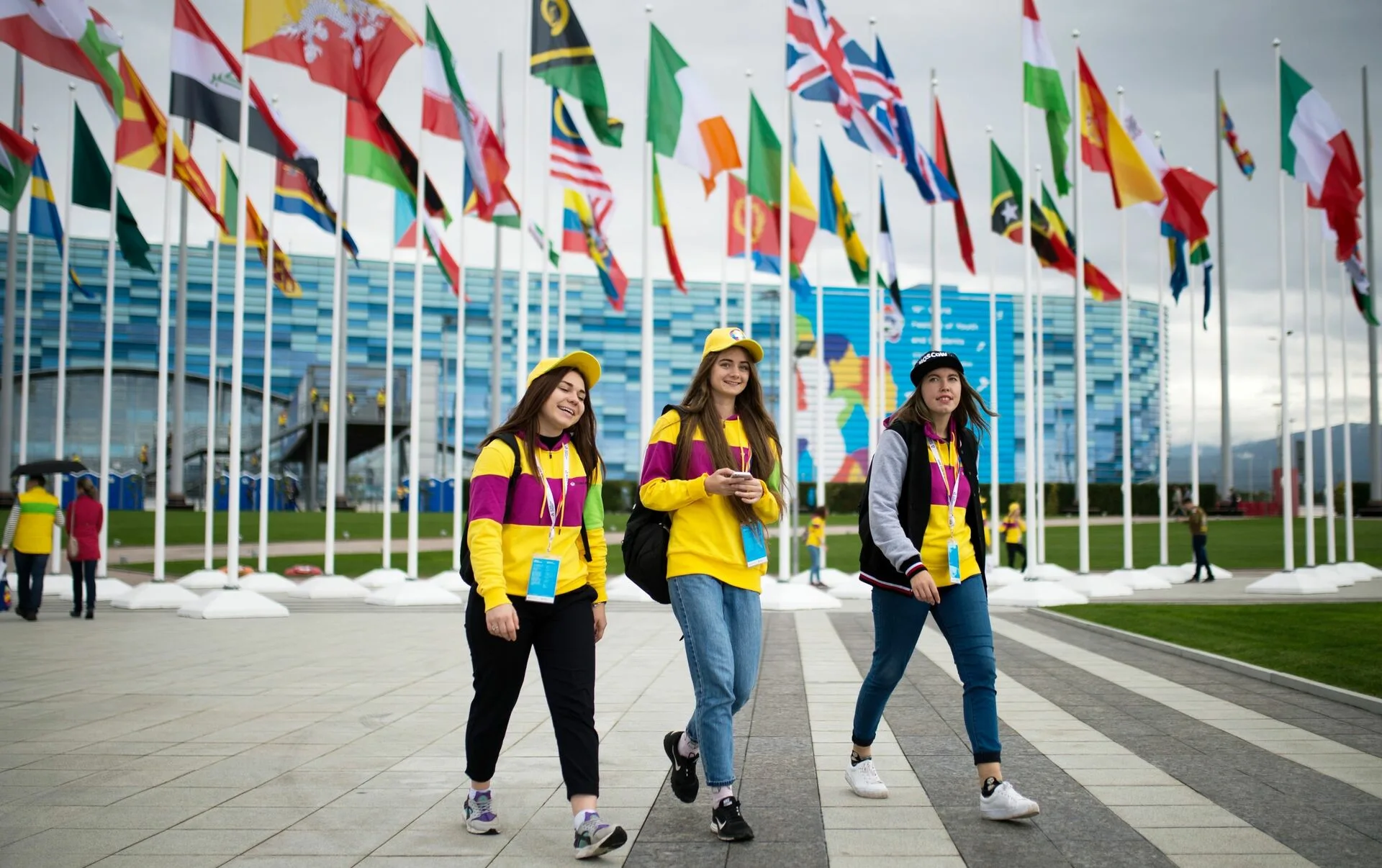
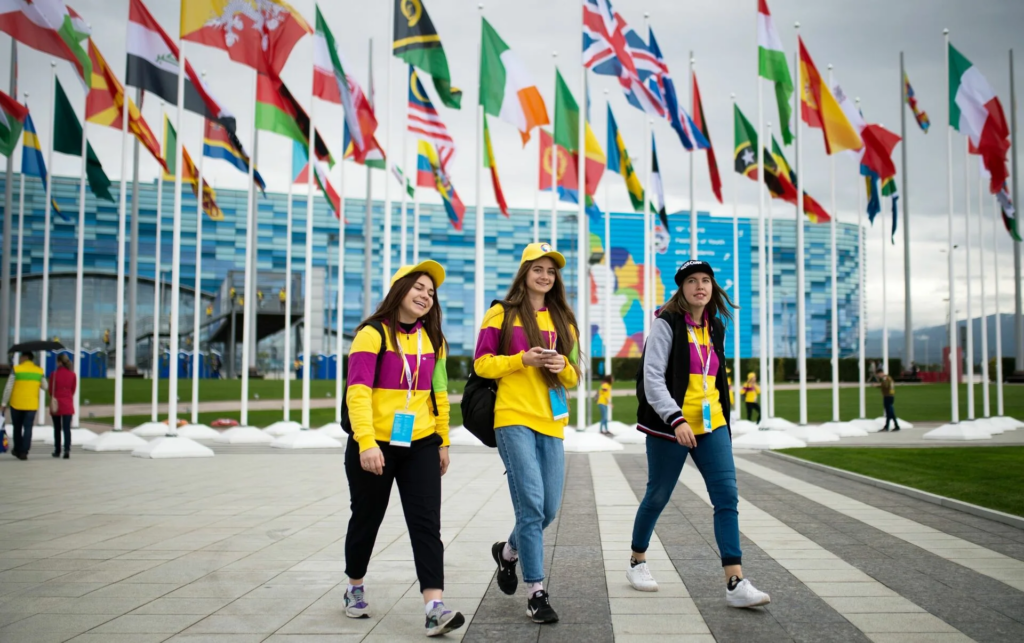
Despite the politically dictated solution by the Western countries to exclude Russian universities from world rankings Moscow is holding a global forum – the World Youth Festival, which starts from March 1 to March 7, 2024 on the innovative Federal Territory of Sirius near Sochi. The largest youth event in the world, targeted international youth cooperation, will bring together 20 thousand Russian and foreign young leaders in business, media, international cooperation, culture, science, education, volunteering and charity, sports, and various fields of activity. life, as well as teenagers representing various children’s organizations and associations.
To date, representatives from 155 countries have applied to participate in the event.
This event once again proves Russia’s openness to the world, and instilling its independence and self-sufficiency, Russia cannot be isolated from the rest of the world.
Russia is a country where talented and ambitious young people from different countries can reveal their scientific potential and realize themselves by receiving an education at one of the best Russian universities.
The best universities in Russia occupy positions in the most prestigious world rankings and offer the level of training of specialists in various fields: from IT technologies to medicine and creative specialties. Educational programs at Russian universities combine the best scientific traditions and modern approaches to teaching with access to high-tech research laboratories. Russian universities offer not only a wide range of educational programs, but also the opportunity to continue scientific activities and find interesting work in Russia; and also travel across the vast territory of the country.
In 2019, according to the “Best Countries to Start a Career” report published by the American platform U.S. News, Russia rose three positions and took first place in the ranking. According to the Organization for Economic Co-operation and Development, more than half of Russians aged 25 to 34 have completed higher education, which ensures a competitive job market. Although Moscow remains conservative when it comes to international business, it has promoted itself as a startup hub. The Skolkovo Innovation Center hosts hundreds of startups and provides grants of up to $10 million. At the same time, the report shows that the European countries, such as France and Spain, as well as many countries in Southeast Asia, which are experiencing crisis periods in youth employment, are not creating new jobs as quickly as required.
The sanctions policy of Western countries once again has caused the split in the global community: while a number of countries reconciled themselves and took a solid position on sanctions, the majority of countries in the world did not join this agenda. On the contrary, the recent expansion of BRICS, with new members such as the UAE, Saudi Arabia, Egypt and other countries, proves the global course towards an anti-Western monopoly and the search for new economic opportunities by key players in the Middle East and Africa. It is likely that new organizations will appear in the future interested in strengthening regional positions and opposing Western hegemony. No surprise that Russia would be initiating such associations as the country demonstrates its independent position and openness to the world.
Though Turkey is now Turkiye and is not a Muslim country, it is worth watching the video if you are planning to visit Turkiye.
This video, “Revealing Life in Turkey,” invites you to embark on a journey not through the lens of sensationalized labels like “craziest Muslim country,” but through the vibrant kaleidoscope of Turkey’s true essence.
Join us on this Turkey travel vlog as we unveil 55 amazing facts, revealing a land where history whispers in ancient ruins, nature explodes in diverse landscapes, and culture dances in every cup of steaming Turkish tea.
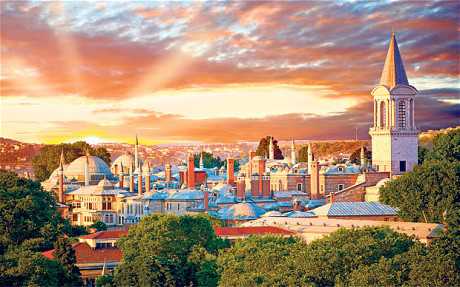
Nestled at the crossroads of continents, Turkey is a tapestry woven from the threads of empires past. The Black Sea washes its northern shores, while Mount Ararat stands sentinel in the east.
While Islam forms a vital part of Turkish life, it’s only one thread in the intricate tapestry. Since 1927, Turkey has proudly embraced secularism, respecting and celebrating the diversity of faiths that have called this land home.
Here, the call to prayer mingles with the clinking of teacups, a daily ritual that unites Turks across every belief.
From the majestic Taurus Mountains to the sparkling turquoise waters of the Aegean, nature paints its own masterpiece across the land.
It’s a land where the echoes of civilization’s past blend with the laughter of children playing in bustling streets. It’s a canvas painted by history, nature, and the vibrant spirit of its people.
Let’s step beyond the labels and explore the tapestry of Turkey, its every thread waiting to unravel a story unlike any other.
The travel trails turkey: This is woven into the very fabric of the narrative, inviting you on a journey through diverse landscapes and experiences.
Turkey earthquake: While not the main focus, the content acknowledges the recent earthquake and its impact on the country.
Revealing life in Turkey: This forms the core theme of the video, offering a glimpse into the daily lives and traditions of the Turkish people.
Life in Turkey Vlog: The style of the writing feels like a personal vlog, sharing insights and experiences rather than providing dry facts.
Real life in Istanbul: You’ll get a taste of everyday life in Istanbul, from bustling bazaars to the mesmerizing dance of the dervishes.
life in Turkey village: We offer glimpses into the rural life of Turkey, where traditions hold strong and nature takes center stage.
life in Turkey istanbul: Istanbul serves as a window into the modern face of Turkey, a vibrant city where ancient meets contemporary.
Life in Istanbul: Again, we delve into the daily rhythms and cultural nuances of life in Istanbul.
This is Turkey: This phrase is woven throughout the text, painting a vivid picture of the country’s diverse tapestry.
concubines in Turkey: While this topic is not directly addressed, the content emphasizes the secular nature of modern Turkey and avoids perpetuating historical stereotypes.
Turkey and reveals: The video itself aims to reveal the true essence of Turkey, beyond sensationalized labels and headlines.
Turkey earthquake news: As mentioned earlier, the video acknowledges the recent earthquake and its impact on the country.
The cost of living in Turkey 2023 or living in Alanya turkey: According to Numbeo, the cost of living in Turkey is 56.5% lower than in the United States. Rent in Turkey is also 73.4% lower than in the United States.
Moving to Turkey 2023: If you are planning on moving to Turkey then it might be a cultural shock for you depending upon the country you are living in. So, Choose wisely and do your research before moving.