Blog

  • Turkey Allocated $544 Million to Invigorate Its Communities in Foreign Countries

    Turkey Allocated $544 Million to Invigorate Its Communities in Foreign Countries

    Two months ago, I wrote an analysis titled: “Turkey is Backing its Citizens Abroad, While Armenia is Alienating its Diaspora.” It was based on an article by Abdullah Bozkurt in the Nordic Monitor: “Turkey is expanding its Diaspora engagement to promote political goals abroad.”

    Last week, Bozkurt published a follow-up article titled: “Turkey poised to intensify its interference in the domestic affairs of other countries using the Turkish Diaspora.” It provides further details about the Turkish government’s efforts to set up proxy groups using its citizens abroad. In contrast, Armenia is alienating its Diaspora by creating rifts and banning some of them from entering the country. Given the serious crisis Armenia is in, its government should be doing everything possible to entice compatriots abroad to visit their homeland, invest in the country, and bring over their knowledge and skills. The Diaspora is a valuable asset for Armenia, not a ‘milking cow.’

    The powerful Turkish State, which doesn’t really need the help of its citizens abroad, is nurturing and strengthening its Diaspora. The Turkish government has allocated a budget of $544.2 million for the years 2024-28 to its Diaspora agency, the Presidency for Turks Abroad and Related Communities (YTB in Turkish). Its strategic plan is “to foster a stronger allegiance to Turkey on the part of people in the Turkish Diaspora, with increased financial and other support from the Erdogan government.”

    Bozkurt explained that the real aim of the Turkish government is “to exert greater influence over the domestic politics of European nations by actively supporting Turkish and Muslim communities in their political engagement, as revealed by the head of the government’s diaspora agency during testimony before a parliamentary committee.” Abdullah Eren, head of YTB, told the Turkish Parliament on July 17 that he “could reveal more in a closed-door session, from which the record of his comments would not be made public.”

    The reason for Eren’s secrecy is that YTB is “supported by Turkish agencies that work with Diaspora groups, such as the Turkish intelligence organization MIT, Foreign Service, Maarif Foundation, Religious Affairs Directorate (Diyanet), Yunus Emre Institute and Turkish Cooperation and Development Agency.” The aim is “to place more pro-Turkish politicians on the political map abroad. Their efforts are particularly focused on Europe, where the bulk of Turkish Diaspora groups reside. In the last decade the Erdogan government has supported the establishment of smaller political parties in Europe, particularly those driven by religious agendas. It has endorsed candidates working in established mainstream parties, expecting them to act as proxies for Turkish government policies. However, the results have been unsatisfactory so far, prompting the Turkish government to vow increased efforts to fulfill what it describes as a strategic goal.”

    According to Seda Goren Boluk, the chair of the parliamentary committee overseeing YTB, “the target population in the Diaspora is nearly 40 million, consisting of approximately 7 million Turks and over 30 million people from related [Muslim] communities in other countries. She vowed to do everything possible to address issues concerning Diaspora groups in order to empower the Turkish nation.”

    According to a YTB survey, “among the youth in the Turkish Diaspora, estimated to be around 2 million strong and now in its fourth generation, one-third of respondents expressed a desire to be proactive in the politics of European countries and sustain their campaigns.” Another third of the Turkish youth abroad “intends to conceal their true intentions and launch their campaigns on behalf of Turkey only after securing key positions in mainstream political parties.” The last third said that they have zero interest in getting involved in politics.

    To encourage Turkish youth to get involved in the politics of the countries they live in, Eren cited the example of “Serap Guler, a German politician of Turkish background in the CDU [Christian Democratic Union] and a member of the Bundestag [German Parliament] since 2021. Despite expressing some criticism towards Turkey in the past, Guler has maintained contact with the Turkish embassy and Turkish government institutions.”

    The overcome the legal and political challenges of Turks living overseas, YTB urged the Turkish government “to utilize its diplomatic influence and public diplomacy tools to exert pressure on foreign countries to lift these restrictions on Turkish Diaspora groups.”

    YTB “has already been collaborating with numerous groups operating in Europe and other continents, providing them with funding, logistical, and technical support to enhance their effectiveness.” YTB participated in Ankara in early May “in a program organized by the Union of International Democrats, an organization that acts as a foreign interest group representing Erdogan’s ruling AKP abroad.”

    YTB “brings 4,000 young men and women to Turkey every year under various schemes for training and education in camps maintained by Turkey’s Ministry for Youth and Sports. According to Eren, many young Turkish engineers studying in Europe have been enrolled in internship programs in what he termed ‘critical industries,’ such as defense and military technologies. He identified state-owned defense contractors like Aselsan and Tusash as venues where these individuals were recruited for internships.”

    Eren stated that “groups critical of and opposed to the Erdogan government [are] a threat to achieving YTB’s stated goals since they undermine the Turkish government’s policies in the Diaspora. This includes the Gulen movement, Kurdish opposition groups, and Alevis.”

    It remains to be seen how governments in Europe and the United States will deal with the Erdogan government’s proxy groups which are considered to be unregistered foreign agents.
  • Should Pashinyan Go to Baku at Aliyev’s Invitation to Attend an Int’l Conference?

    Should Pashinyan Go to Baku at Aliyev’s Invitation to Attend an Int’l Conference?

    Hikmet Hajiyev, Head of Foreign Policy Department of Pres. Ilham Aliyev of Azerbaijan, announced on July 21 that Armenia was officially invited to the United Nations’ International Conference on Climate Change (COP29) to be held in Baku, Nov. 11-22. Hajiyev said that the invitation was sent by Mukhtar Babayev, Azerbaijan’s Minister of Ecology and Natural Resources, to the Armenian Foreign Ministry. Even though all UN members are automatically invited, Hajiyev made it sound like Azerbaijan was doing a special favor to Armenia by describing the invitation as a “goodwill and inclusive approach in the absence of diplomatic relations between the two countries.” Hajiyev added: “Now is the time for the Armenian authorities to make a decision.”

    Armenian officials have not issued a formal response to the invitation. They have made two evasive comments: The spokeswoman of Prime Minister Nikol Pashinyan said: “such a visit is not planned in the work agenda of the Prime Minister,” and the spokeswoman of the Armenian Foreign Ministry told a journalist: “we will inform you in case the issue is addressed.”

    Baku claims that there will be 70-80,000 tourists visiting Baku on that occasion. Thousands of journalists, delegates of international environmental organizations, high-ranking officials of various governments and dozens of heads of state from around the world are expected to attend the Conference. 198 countries are parties to the Convention on Climate Change.

    On Dec. 7, 2023, the Armenian Prime Minister’s office and the Azerbaijani President’s administration had issued a joint declaration disclosing that in return for Armenia not exercising its veto power on Azerbaijan hosting the Climate conference, Azerbaijan would release 32 Armenian Prisoners of War held in Baku, and Armenia in turn would release two Azeri soldiers who were captured after crossing Armenia’s border and murdering an Armenian citizen. In addition, Azerbaijan agreed to support Armenia’s candidacy to the Eastern Europe Group‘s Bureau of COP29. At the time, I wrote that Pres. Aliyev was so obsessed with holding this prestigious international conference in Baku that Armenia should have insisted that Azerbaijan release all of the Armenian Prisoners of War held in Baku since the 2020 war as well as the eight high-ranking Artsakh officials held since September 2023.

    In recent months, at several international gatherings, Pres. Aliyev has boasted about Azerbaijan hosting the COP29 Conference, attributing that to “the increasing international respect for his country, two and a half month after” its occupation and ethnic cleansing of Artsakh. “Chairing the COP29 and holding this event in Baku is a clear example of the great trust that the international community has in our country. Almost 200 countries unanimously supported our candidacy,” Aliyev bragged.

    Pashinyan will respond to Azerbaijan’s invitation to participate in the COP29 Conference in Baku at a press conference in August, according to the Government Information and Public Relations Department of Armenia.

    Azeri officials have raised the possibility of Pashinyan and Aliyev signing during the November Conference in Baku a preliminary agreement outlining the basic principles of an eventual peace treaty. Hajiyev is touting the idea of “COP Truce,” suspending all hostilities around the world during the conference, similar to the concept of “Olympic Truce” to promote its false image as a peacemaker. At the end of May, Elchin Amirbekov, the Azerbaijani president’s Special Envoy, mentioned that the Conference could be a good opportunity for signing a peace treaty with Armenia.

    During his press conference on May 7, Pashinyan said that Yerevan agrees to sign a peace treaty with Azerbaijan before November. However, the Armenian Foreign Ministry warned on June 19 that “Azerbaijan will do everything possible to abort the process of signing a peace treaty with Armenia in November during the COP29 Summit in Baku in order to unleash a new aggression against the Republic of Armenia.”

    It is not known what Pashinyan will announce in August regarding his possible participation in the Baku Conference in November. However, in my opinion, Pashinyan should avoid falling in the trap set by Aliyev to gain bonus points in front of a worldwide audience at the expense of Armenia by showcasing the attendance of Pashinyan or his representative in the Conference in Baku. This would be a major coup for Aliyev, acting as a peacemaker, while continuing to make regular threats to Armenia and escalating his demands for concessions from Armenia. Furthermore, signing a piece of paper under the guise of a peace treaty will not obstruct Aliyev from any future attacks on Armenia.

    I believe that no Armenian official should consider going to Baku, while Azerbaijan is holding dozens of Armenian Prisoners of War and occupying parts of the Republic of Armenia since 2021. Without Azerbaijan first releasing all of the Armenian prisoners and withdrawing from Armenia, no Armenian official should go to Azerbaijan nor hold any kind of meeting or negotiation with Baku.

    A less desirable alternative would be for Pashinyan or his representative to go to Baku and demand to address the international conference of 196 nations, condemning Azerbaijan’s repeated threats to invade Armenia, castigating its occupation of Artsakh, ethnic cleansing of 120,000 Artsakh Armenians, refusal to allow them to return to their ancestral homeland under international guarantees, not releasing all of the Armenian Prisoners of War, and not withdrawing the Azeri troops from Armenia.

    However, there is a good chance that Azerbaijan may renege on its promise to allow Armenia’s representative to address the conference at the last minute. A much better option for Armenia would be to refuse to attend the conference unless Azerbaijan releases the Armenian Prisoners of War and withdraws its troops from Armenia in advance of the conference.

  • Armenia’s Top Leaders on Vacation: Some Hope They Wouldn’t Come Back

    Armenia’s Top Leaders on Vacation: Some Hope They Wouldn’t Come Back

    Prime Minister Nikol Pashinyan’s office surprisingly announced that he was going on a long vacation from July 15 to August 12. More shockingly, several other officials of Armenia had decided to go on vacation at the same time, leaving the country without its top leadership.

    I would have had no concern if Pashinyan had gone on a one or even two-week long vacation. Everyone needs a break from time to time. But, the top leader of the country going on vacation for almost a month is incredible. I have not heard of the leader of any country in the world having gone on a 29-day vacation.

    Besides the astonishing length of the absence of the Prime Minister from office, I have three other concerns:

    1)    There seems to be no basic understanding that several of the country’s leaders cannot be absent from office at the same time. What if, God forbid, would a war break out or some other serious emergency occur? Normally, when the leader of any country is temporarily absent, his deputy performs his functions — not in Armenia. Several members of the Armenia media reported that the Deputy Prime Minister Mher Grigoryan, who is supposed to replace the Prime Minister during his absence, has also gone on vacation for nine days during the same period. Fortunately, there is a second Deputy Prime Minister who will fulfill the duties of Prime Minister. Furthermore, the Speaker of the Parliament, Alen Simonyan, decided to go on vacation for 20 days from July 16 to August 5. He will be replaced by Deputy Speaker Ruben Rubinyan (July 16-22) and Deputy Speaker Hakob Arshakyan (July 23-August 5). Also on vacation are Finance Minister Vahe Hovhannisyan (for 10 days) and Foreign Minister Ararat Mirzoyan (until July 22).

    2)    If the leaders of Switzerland were to be absent from their offices for days, weeks or even months, nothing untoward would happen, since the country is located in a peaceful part of the world. Regrettably, Armenia is located in a precarious region with constant threats from Azerbaijan. Armenia’s leaders have to be constantly on alert and work diligently to solve its myriad problems. Under these circumstances, their going on lengthy and simultaneous vacations is reckless and irresponsible.

    3)    Finally, Pashinyan announced last month that Armenia is ready to sign a peace treaty with Azerbaijan in one month. Why would he then turn around and go on vacation for a month? Shouldn’t he be in his office, if, by a miracle, Pres. Aliyev agreed to sign such a treaty which I believe is not only useless, but also contrary to Armenia’s interests? Aliyev is cleverly stringing along the signing of a peace treaty to extort endless concessions from Armenia!

    Even though the leadership’s wholesale absence entails a major risk for the country, many Armenians are not too concerned. On the contrary, they are happy that the leaders are away from office so they can do less damage to the country’s interests. Some members of the public are hoping that these leaders would remain on permanent vacation and not return to their positions.

    Some of the readers feel that I am too critical of Pashinyan. While it is true that no one is perfect, starting from me, the Prime Minister goes to extensive lengths to make egregious errors and baseless statements which would have been laughable, if they did not have such serious consequences. Hundreds of such examples come to mind. Let us just mention the latest example when the Prime Minister along with his wife attended the UEFA’s Soccer championship game on July 14 in Berlin.

    Pashinyan, obsessed with social media, regularly posts on Facebook, TikTok, Instagram, Twitter (X), and YouTube, all of his speeches, meetings, and visits. Unlike other world leaders, he walks around with one or two cell phones in his hand.

    During the soccer match in Berlin, he placed his cell phone in front of him and videotaped, not the match, but his own face, adding a bizarre song to the video by a 31-year-old female American singer known as Tinashe. Wikipedia described the song titled, “Nasty,” as “an understated R&B and rhythmic pop song on which Tinashe ‘rap-sings’ about searching for someone to match her sexual energy, which she alternately calls her ‘freak’ and her ‘nasty’, while also using several double entendres. The song has a ‘robotic’ hook and, in its second verse, she details a sexually charged date night, singing ‘Shotgun, my thighs on the seat, I ain’t got nothin’ underneath, Looks like you’re ’bout to spend the night, Looks like, I’m ’bout to change your life.’”

    Why would the Prime Minister of Armenia add such an inappropriate song to his video that has “Nasty” lyrics, with the word “nasty’ repeated 59 times in the song?

    Surprisingly, Pashinyan’s video along with the song, “Nasty,” was reported by TV channel 5 in Los Angeles. The headline of the segment on TV was: “Pashinyan & wife in Berlin at Euro Soccer Finals, Listening to ‘Nasty’ Song.” The TV channel asked: “What do the 2024 European Championship final, Tinashe and Armenian Prime Minister Nikol Pashinyan have in common?” My answer: Absolutely nothing!

    Channel 5 reported that Pashinyan posted on TikTok a second video showing the victory celebration at the end of the soccer match, once again adding the song “Nasty.” The TV channel stated: “It is not known why he chose the one-time Crescenta Valley High School student’s song as the background music for the two videos. It is also not known how exactly he found the song in the first place.”

    It is almost impossible to explain the Prime Minister’s actions and motives. Maybe, he is looking for a Hollywood gig after he is no longer Prime Minister.

  • A Fresh Example of Armenian Dirty Propaganda

    A Fresh Example of Armenian Dirty Propaganda

    By Azer HASRET

    We in Azerbaijan see and know what does mean Armenian fake propaganda because we face it at the everyday level and usually try to answer in a related manner. But the Armenian propaganda machine uses even any tiny shell to spread lies and fake information about Azerbaijan, Türkiye, and other Turkic countries…

    Now I’m providing an example of the fake propaganda action by Armenians once more.

    On August 1, 2024, there was a regular State Department Press Briefing at the White House. Vedant Patel, Principal Deputy Spokesperson made a brief introduction and afterwards answered the questions of journalists.

    Let’s see a question by a journalist (maybe Armenian, we don’t know):

    Question: “There are Armenian POWs in the jails of Azerbaijan for four years by now, and there are Armenian local politicians from Nagorno-Karabakh again in the prisons of Azerbaijan for nearly one year after Azerbaijan launched another unprovoked attack last fall. According to Freedom House, after Karabakh territory came under Azerbaijani control, Karabakh is the most unfree territory in the world. It’s worse than North Korea. It’s worse than Venezuela, Syria, Afghanistan, you name it”.

    This is the first part of the question. The person addressing the question claims that “there are Armenian POWs in the jails of Azerbaijan”.

    Are there any?

    Not of course! Because all POWs captured during the 44-day war of 2020 were returned to Armenia! Thus, Azerbaijan does not have any single Armenian POW at its disposal…

    But why does Armenian propaganda claim that Azerbaijan has the Armenian POWs?

    This is purely for propaganda purposes! Armenians know that they need to bring this issue to the attention of the world in a way where people can think that Azerbaijan is so inhumane and keeps POWs. Of course, many million people around the world do not know the realities in the region. Even most of them don’t know where Armenia is, who Armenians are, and so on. But propaganda works anyway…

    Then this very “journalist” quotes the Freedom House claiming that “Karabakh is the most unfree territory in the world. It’s worse than North Korea. It’s worse than Venezuela, Syria, Afghanistan”.

    Are we surprised?

    No!

    Because this very Freedom House is a propaganda tool as well to suppress new emerging democracies. This organization has been known for its pro-Armenian stance for dozens of years! It was and is supporting Armenian separatism while being silent about more than 250 thousand Azerbaijanis forcefully expelled from Armenia and those 750 thousand IDPs forced off from Karabakh by Armenian occupants!

    Just for a reminder, starting from 1988 Armenia expelled all Azerbaijanis from its territory. Hundreds of Azerbaijanis were killed, and their homes were looted by Armenians. This move served as the start of the Armenia-Azerbaijan conflict back in those years. Then Armenia occupied 20 percent of Azerbaijani lands early in the 1990s and forced out 750 thousand inhabitants! Azerbaijan managed to free its lands from Armenia’s occupation only after 30 years and during this movement, Armenian inhabitants (approximately 70 thousand people) voluntarily left Karabakh while Azerbaijan repeatedly asked them to stay…

    So why the Freedom House is claiming that Karabakh is the most unfree territory? Those 750 thousand Azerbaijanis need to return to Karabakh but can’t because Armenians have wiped off any single home in that territory. That’s why very few people live there and there can’t be any evolution regarding freedoms in that area. The lands freed from Armenian occupation are covered with landmines and even it’s dangerous to walk around.

    Let’s see why and how the Freedom House decided that “Karabakh is worse than North Korea”.

    Maybe because the Freedom House’s Vice President for Policy and Advocacy is Annie Wilcox Boyajian, whose husband is an Armenian for example?..

    This was the first part of the question of blackmailing Azerbaijan. But a “journalist” continues further with his attempt to blackmail Azerbaijan. Let’s see the second part of the question.

    Question: “So the question is whether you follow this situation with the collapse of liberties and civil society in Nagorno-Karabakh, if you have any comments on this, and is there anything that this administration can do to help the detained Armenians in – that are jailed in Azerbaijan, whether to – you can help them to release – to be released or assist in any other form? Thank you”.

    “Liberties and civil society in Nagorno-Karabakh”? Isn’t this a bit strange? Who can speak about the liberties and civil society in any territory that was under the occupation of a foreign country? In our case, we speak about the Azerbaijani Karabakh region which was under Armenia’s occupation for about 30 years and thus there couldn’t be any sign of liberties and civil society. But this Armenian propaganda mouthpiece claims that “liberties and civil society collapsed” in Karabakh…

    What is good, Vedant Patel’s answer was quite accurate, and the terms used were selected very carefully. Let’s see.

    MR PATEL: “So, on the context of the broader situation in the South Caucasus, this is something that the Secretary and the department continue to be deeply engaged on. I don’t have any updates for you as it relates to that process. And look, when it comes to detainees, we have been clear and consistent that any country needs to treat all detainees humanely, with dignity, and in accordance with international law, and needs to respect detainees’ human rights, and that continues to be true in this case as well”.

    No single word about the so-called POWs! And no mention of Azerbaijan!

    The State Department and the US Administration know quite well what is what in the South Caucasus!

    And now let’s be clear with those detainees to whom Vedant Patel is paying attention. Yes, Azerbaijan has Armenian detainees. But they are not the citizens of Armenia (except one) and none of them was captured during the war actions. All of them are tried for being a part of an organized crime against civilians which caused the killing of hundreds of people. At the same time, they are citizens of Azerbaijan of Armenian origin, and they need to answer for those killings before the court. This is very simple and understandable, and the US Administration and other major international actors have quite enough information about this…

    Now let’s pay attention to the report by Armenian media which claims that Vedant Patel spoke about “Armenian POWs”.

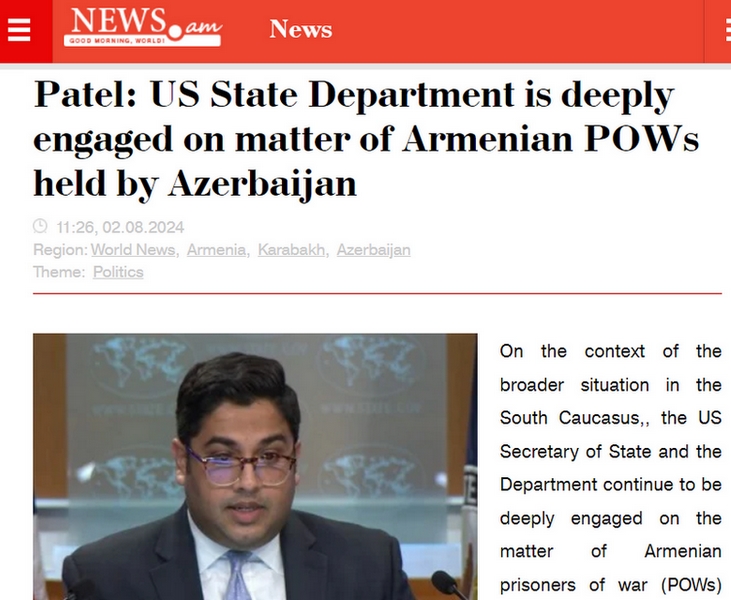
    The headline at the News.am reads: “Patel: US State Department is deeply engaged on matter of Armenian POWs held by Azerbaijan”.

    Further, the news reads: “On the context of the broader situation in the South Caucasus, the US Secretary of State and the Department continue to be deeply engaged on the matter of Armenian prisoners of war (POWs) being held in Azerbaijan. Vedant Patel, Principal Deputy Spokesperson of the US Department of State, noted about this at Thursday’s Department press briefing”.

    Did Vedant Patel use the wording like “Armenian prisoners of war (POWs) being held in Azerbaijan”?

    Not of course!

    We have quoted Vedant Patel’s answer to this question in full and as we mentioned above, he was quite accurate in using the terms. But the Armenian fake propaganda machine claims, that Vedant Patel spoke about “Armenian POWs”…

    So, this is a way how Armenian propaganda works. Most people who read Armenian-style “news” usually don’t investigate the origins. It is usual and understandable for all people around the world. Because those not engaged in politics and news-making are not professionals and they used to believe the media. And Armenians use this opportunity for their ugly propaganda…

  • Only 13% of Armenians Support Pashinyan; He Lost His Mandate; New Elections Needed

    Only 13% of Armenians Support Pashinyan; He Lost His Mandate; New Elections Needed

    The Gallup International poll conducted in Armenia on July 3-6, 2024, indicated that Prime Minister Nikol Pashinyan’s rating has dropped to 13.4% among potential Armenian voters. When he first came to power six years ago, his rating was around 80%.

    When asked: “How do you evaluate the work of Nikol Pashinyan?”

    — 13.4% of the public said that they find his work “completely positive.” This is 4% higher than two months ago in May.

    — 21.7% evaluated his work in July as “rather positive,” up 3% from May.

    — 40.3% rated his work in July as “generally negative,” 1% lower than May.

    — 14.5% rated him in July as “rather negative,” 4% lower than May.

    — 10.1% of the participants said the question was too “difficult to answer.”

    This means that 35.1% of the public rated Pashinyan in July as “positive” and “rather positive,” up from 27.8% in May, whereas the majority of 54.8% rated him “negatively” and “rather negatively” in July, down from 59.7% in May.

    To the question: “If the parliamentary elections were held next Sunday which party or coalition of parties would you vote for?” Here are their answers:

    1)  14.4% for the ruling Civil Contract party.

    2)  3.7% for the Armenia coalition.

    3)  3.5% for the Democracy, Law and Order party.

    4)  2.3% for I Have Honor coalition.

    5)  1.5% for Bakrat Srpazan.

    6)  1.2% for the Prosperous Armenia party.

    7)  0.6% for the Republic party.

    8)  2% for others.

    9)  8.6% for none of them.

    10)  29.6% refused to answer or had difficulty answering.

    11)  32.5% will not vote at all.

    These numbers provide an important insight into the next election. Pashinyan’s ruling party will only get 14.4%, while the other parties, if they form a coalition, will get 14.8% of the vote. For the opposition parties to become the majority in the next Parliament, they need not only to form a coalition, but also try to get votes from the remaining 70.7% who refused to answer or had difficulty answering or will not be voting.

    Regarding the question: “Is Armenia in general moving in the right or wrong direction?” The respondents answered:

    — 15.2% “completely right.”

    — 10.6% “rather right.”

    — 28.5% “generally wrong.”

    — 23.1% “rather wrong.”

    — 22.5% “have difficulty answering.”

    This means that the majority of 51.6% feel that the country is going in the wrong direction. Only 25.8% feel it is going in the right direction. This does not bode well for Pashinyan and his ruling party.

    To the question, should Armenia change its Constitution as Pres. Aliyev had demanded? The public responded:

    — 80.3% said no in July, more than double the 38.1% in January.

    — 11.7% said in July that certain clauses should be changed. In January, 34.2% had said the same thing.

    — 3.3% said in July that a whole new Constitution is necessary. In January, 13.4% said the same thing.

    — 4.7% could not answer in July. In January, 14.4% could not.

    This is a critical issue, since Pashinyan has agreed with Aliyev to change the Constitution, while 80.3% of the public is opposed to it.

    To the question: “How do you evaluate the movement of “Tavush for the sake of Armenia” initiated by the Primate of Tavush, Archbishop Bagrat Galstanyan?” The public said:

    — 18.3% “completely positive” in July, which is substantially down from 35.1% in May.

    — 15.5% “rather positive” in July, slightly lower than the 17.8% in May.

    — 32.4% “generally negative” in July, which is higher than the 23.5% in May.

    — 14.9% “rather negative” in July, a little higher than the 10% in May.

    — 18.9% could not answer in July. In May, 13.6%.

    The answers indicate a declining trend in the Armenian public’s support for the Archbishop’s movement.

    To the question: “According to you, should Armenia become a member of the European Union (EU)?”

    — 34.2% said, “definitely yes.”

    — 22.5% said, “rather yes.”

    — 19.1% said, “definitely no.”

    — 13.7% said, “rather no.”

    — 10.5% said, they “could not answer the question.”

    This indicates that 56.7% are in favor of Armenia joining the EU, while 32.8% are opposed to it. The majority agrees with Pashinyan. I believe, this is an unrealistic wish on the part of the Armenian public and the Prime Minister, as most of Armenia’s economy is linked to Russia and any interruption in that critical link will have a devastating effect on Armenia’s economy. The pro-EU reaction is mostly due to the Armenian public’s major disappointment with Russia for not coming to the rescue of Armenia militarily. Another important issue is whether the EU will allow Armenia to join it. As we know, Turkey has been trying unsuccessfully to join the EU for decades and Georgia has also been trying to join the EU for years. There will be years’ long wait for Armenia.

    A similar question was asked as to “whether Armenia should leave the [Russia-dominated] Eurasian Economic Union (EEU) and start the process of joining the European Union?”

    — 28.8% said, “definitely yes.”

    — 17.3% said, “rather yes.”

    — 21.4% said, “definitely no.”

    — 15.6% said, “rather no.”

    — 16.9% said, they “have difficulty answering the question.”

    This indicates that 46.1% of the public is in favor of leaving the EEU, while 37% are opposed to leaving the EEU.

    The next question: “Whether Armenia should leave the [Russia-affiliated] Collective Security Treaty Organization (CSTO) and join NATO?”

    — 44.3% said in July, “Armenia should not be a member of any structure; should be neutral.” 40.3% had given the same answer in February.

    — 16.9% said in July, “Armenia should continue its membership in CSTO.” 28% had given the same answer in February.

    — 29% said in July, “we should aspire to join NATO.” 22.5% had given the same answer in February.

    — 9.8% said in July, they “have difficulty answering the question.” 9.2% had given the same answer in February.

    Not surprisingly, these answers indicate a declining trend in the Armenian public’s interest in being associated with anything related to Russia and an increasing interest in the West. However, wanting to join NATO is an unrealistic wish.

    This latest poll indicates the Armenian public’s continued dissatisfaction with Pashinyan and his political party and the public’s interest in a shift away from Russia towards the West.

  • ISSUES TO CONSIDER ON THE 109TH ANNIVERSARY OF THE ARMENIAN REBELLION IN VAN

    ISSUES TO CONSIDER ON THE 109TH ANNIVERSARY OF THE ARMENIAN REBELLION IN VAN

    ISSUES TO CONSIDER ON THE 109TH ANNIVERSARY OF THE ARMENIAN REBELLION IN VAN

    Historically, the Armenian Revolts in the City of Van played a major role in the implementation of a mandatory Relocation and Resettlement decision taken by the Ottoman Empire against the Armenian minorities. This decision was a direct result of the actions of the mutinous Armenians who rebelled against the Ottoman State and fought on the enemy side against their own country’s army.

    Armenians, who had previously rebelled in Van, in 1896, ignited a new rebellion right before World War I. They used the church in Van’s Akdamar Island as a revolutionary committee headquarters, a weapons and munitions depot, and a center for torture and rape of the Muslim women they captured.

    Armenians, who received a great deal of political support from the British, Russian and French Consuls, European missionaries in the region and the ABCFM missionaries affiliated with the US, had already begun their preparations for the occupation of Van, way before the onset of WWI.

    Before the First World War, Armenian volunteers began gathering in the Cities of Muş, Van and Bitlis to fight against the Ottoman Empire, and (naturally) none of them responded to the mobilization calls of the Ottoman State.

    Armenians who were serving under the Ottoman Military deserted their positions along with their issued weapons and crossed into the Russian territory with clear intent to defect into the Russian Army. When the Russian Caucasian Army attacked Eastern Anatolia, Ottoman Armenians were at the forefront, serving as vanguard units to the Russian Army.

    Karekin Pastermadjian, who was an MP from Erzurum in the Ottoman Empire’s Congress, personally led the mutinous Ottoman Armenians who defected to Russia. Together, they massacred tens of thousands of Muslims in the City of Van and its surrounding regions.

    Following the Russian Army’s crossing of the Turkish border, 33rd Infantry Division stationed in the City of Van moved out of the city to intercept the Russian enemy. Armenian gangs, who wanted to take advantage of the departure of the Ottoman troops out of Van, immediately formed an armed force of 40,000 men. Soon after, they began massacring the Turkish and other Muslim population in the City of Van and its surroundings. The Muslim population of Van ended up having to seek shelter at the Van Castle. Once the rebellion started in Van on April 15, 1915, Armenians first massacred the Gendarmerie Detachment stationed in the city and then the civilian population was next to be massacred. 

    The uprising and the massacres initiated by the Armenians in the City of Van, which intensified on April 20, 1915, caused the Muslim population to leave the city in panic, and a significant portion of those who fled the city lost their lives en route, due to Armenian attacks, starvation, and disease.

    The fact that around 80,000 Muslims left the city in panic and began to flee in the direction of Bitlis in order to escape the great uprising that the Armenians started in the City Center of Van and the subsequent massacres they committed following the Russian Army’s occupation of Van, revealed to the Ottoman Administration that the Armenian revolts could not be prevented using local security measures. Hence, these events undoubtedly constituted the most important reasoning of the mandatory Relocation and Resettlement measure implemented against the Armenians.

    Armenians burned down and destroyed all mosques and Muslim neighborhoods in the City of Van. Mutinous Armenians burned alive approximately 80 Turkish soldiers who were receiving in-patient treatment at the Van City Hospital. Captured Muslim women were taken by boat to the Armenian Church located on Van’s Akdamar Island to be raped. Some of these women chose to end their own lives by jumping off the boat into the cold waters of Lake Van, in order to not surrender their chastity. During the one-month period leading up to Russian Army’s complete seizure of the City of Van on May 18, 1915, Armenians under the leadership of the gang leader named “Aram” massacred 22,900 Turks.

    Out of the 3,400 Muslim dwellings that existed within the Van Province before the war, were down to three houses standing, after the Armenians set the whole city ablaze and destroyed nearly all Muslim quarters of the city. Also, in the City of Bitlis, all 6,500 houses belonging to Muslims were burned to the ground by the Armenians.

    According to the findings of US Historian Prof. Justin McCarthy, the number of Turks massacred in the Van Region was 194,167 people. According to the Ottoman Archival Documents, however, the number of Muslims murdered by Armenians in the Van Province and its subdistricts is 217,132 people. These indisputable archival documents clearly determine the identities of the murderers and their victims one-by-one, while providing explicit details on each massacre event in terms of place, time and how these crimes were committed.

    Coming to today, Cities of Diyarbakır and Van are among those Eastern provinces that most intensively support PKK terrorism. The obvious cooperation between Armenians and separatist Kurdish elements that have long been wanting to establish an “independent Kurdistan” within the Turkish territories is clearly intensifying. In this context, many meetings have been held between BDP and HDP Parties and the Armenian Dashnak Party (aka ARF). As a result of these meetings, joint statements have been released such as: “[…] in addition to exploring the possibilities of Armenian-Kurdish cooperation in the lands of Western Armenia and Kurdistan, other areas of cooperation between the two nations have been discussed.”

    Following the local municipal elections held on March 31, 2024, in Turkiye, the terrorist actions initiated by DEM Party supporters in these districts gives us the impression that they are preparing the groundwork to secede Turkiye’s Eastern and Southeastern Anatolian regions, ostensibly under the name of “Kurdistan” which, in reality, is bound to become “Western Armenia” later.

    The appointment of a certain felon convicted of terrorism to Van’s Mayoral seat despite his earlier statements that “PKK is strong enough to drown us all in their spit”, contrary to the decision of the Diyarbakır High Criminal Court and Article 76 of the Turkish Constitution, clearly indicate the early signs of such a preparation. These developments indicate that the Armenian issue, and the separatist Kurdish political movement with which it is intertwined, are bound to become larger issues, capable of potentially threatening the very survival of the Turkish State.

    As the grandchild of a family that had to leave their home behind and migrate westward in Anatolia, in order to flee from the Armenian oppression in Van, I have been following up for many years on how foreign (non-citizen) Armenians have been buying up large acreages of land in and around Van province using locals, while hiding their true identities. 

    The recent developments clearly indicate that the City of Van, which was once used as the ground zero point of the Armenian massacres against the Turks before the First World War, is now being used as the ground zero point of a secessionist attempt targeting Turkiye.

    As a native of Van, I feel great sadness seeing all these things transpire, right before my eyes. In this context, I think it is important that the Turkish State’s intelligence agencies meticulously follow-up on the land purchases of Crypto-Armenians in Van and the contacts of elected local officials with terrorist organizations (such as PKK) so that the State can make the necessary interventions against violations of law when needed, without compromise. 

    I feel that it is my civic duty to warn the Turkish Statesmen and the patriotic People of Van, who lost 217,132 martyrs in WWI, to be vigilant about another potential Armenian uprising that could be ignited by these Crypto-Armenians based in Van, who hideously hide themselves behind Turkish and Kurdish identities. These people are obviously conspiring to start an uprising any minute, once they receive instructions from the “State of Western Armenia”, which claims to have been established “in exile”. This knock-off state preposterously claims that 19 provinces of Turkiye are Armenian territories, and they surely have the full support of the imperialist states who support them to see Turkiye divided.

    Assoc. Prof. Dr. Ömer Lütfi Taşcıoğlu

    Ret. Staff Col., Turkish Armed Forces

    President of FEYM Group