Category: Regions

  • Turkey’s strategic mistake

    Turkey’s strategic mistake

    Turkish officials’ latest decision to deploy a missile defense shield comprising an early warning radar system on their territory, which is in fact an effort made on behalf of NATO and the United States, is a major strategic mistake.

    Turkish officials have repeatedly declared their opposition to the Zionist regime and have demanded the highest level of punishment for the perpetrators of the attack on the Gaza Freedom Flotilla, which left nine Turkish citizens dead on May 31, 2010.

    But paradoxically, they have also agreed to allow NATO to establish an early warning radar system in Turkey, exactly in line with the U.S. policy of protecting Israel, which is currently in a precarious situation in the region.

    This is a clear example of Turkey’s double standards on sensitive foreign policy issues.

    Other countries in the region have harshly censured the move, and it will have serious repercussions for Turkey’s Islamist government.

    In response to the withering criticism, Turkish officials say their decision will have no impact on Iran and other neighboring countries.

    However, Iran cannot remain silent on such a sensitive decision because the move is meant to curb Iran’s missile capabilities.

    This new stance shows that the Turkish government is totally oblivious to Iran’s position on foreign policy issues.

    If implemented, the decision will greatly damage Turkey’s relations with Iran, which is a neighboring regional power, and thus Tehran will make every effort to inform Ankara about its detrimental consequences.

    Hopefully, these efforts will persuade Turkey to halt the process and reassume its former position as a regional power.

    MP Mohammad Kowsari is a member of the National Security and Foreign Policy Committee of the Iranian Majlis.

    via Turkey’s strategic mistake – Tehran Times.

  • Will Turkey succeed where Iran failed?

    Will Turkey succeed where Iran failed?

    By Huda al Husseini

    Non-Arab regional leaders are seeking to win over the Arab street, for they can clearly see that Arab public opinion is taken by their stances, and they are therefore playing on their sentiments and frustrations. The Arab street is burnishing the image of these non-Arab regional leaders abroad, and helping them to extend their influence.

    Turkish Prime Minister Recep Tayyip Erdogan is following in the footsteps of Iranian President Mahmoud Ahmadinejad. The latter attempted to “hijack” the Arab street prior to the “Arab revolutions,” and when these revolutions broke out he claimed that they were inspired by the Islamic Revolution in Iran. As for Erdogan, he is trying to seize the opportunity and “harvest” the enthusiasm of the Arab street at the height of the Arab Spring, before the onset of the revolutions’ winter, particularly as nobody knows how long the Arab Spring will bloom.

    The Arab street is bestowing power upon these leaders, who are playing on their dreams and speaking about the region’s prosperous future. However the Arab street is like mercury; it is impossible for any leader to grasp it firmly. The Arab street is fickle, and so it turns its back on leaders as quickly as it [previously] rushed to adore them. What happened to the power or influence that Ahmadinejad believed the Arab street had granted him? He used this to quell the demonstrations staged to protest the allegedly rigged presidential elections that brought about his re-election. As a result of this, he lost the Iranian street, whilst the Arab street turned its back on him.

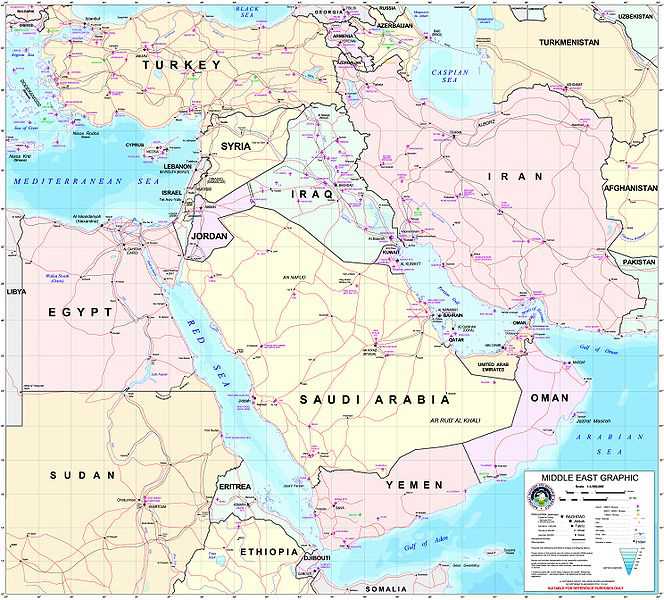
    The power that Erdogan obtained from his recent tour [of the Middle East] prompted him to threaten Greek Cyprus, and begin to proceed with exploring oil and natural gas surveys in the waters off northern Cyprus. Erdogan continued issuing threats, but at the same time he told the United Nations [U.N.] and the [Greek] Cypriot leadership that his country is no longer prepared to accept the concessions previously accepted by Ankara with regards to the reunification of Cyprus, in accordance with the U.N.’s 2004 plan. Turkey has said that it will not accept anything less than the recognition of two states in Cyprus. Turkey has also warned the European Union that it will not accept any solutions after [Greek] Cyprus takes over the EU presidency early next year.

    In mid-March last year, Turkish Foreign Minister Ahmet Davutoglu stressed that we must protect “the territorial integrity” of our countries and region, however he did not once mention Cyprus or the Kurds.

    Erdogan is now seeking to place Turkey as a leading supporter of the Palestinian cause, and he wants the “Arab Spring” to view Ankara as a supporter and role model, stressing the need for firm Turkish – Arab unity. He is also planning to establish strategic cooperation between Turkey and Egypt.

    The preparation for such cooperation was clear in the size of the delegation that accompanied Erdogan during his tour of the Middle East. The Turkish delegation was made up of 6 ministers, and around 200 Turkish businessmen, which represents a clear signal that Turkey is determined to investing heavily in the region. In 2010, the Turkish trade with the Middle East and North Africa [MENA] amounted to 30 billion dollars, and constituted 27 percent of Turkish exports, whilst more than 250 Turkish companies have invested a figure totaling $1.5 billion in Egypt.

    We must acknowledge that despite Ahmadinejad’s attempts to win over the Egyptian street by waging a war of words with Mubarak’s regime; he failed to tempt Egyptian public opinion to support Iran. Despite this, Tehran did establish strong relations with the Muslim Brotherhood and other Egyptian Islamists, and there is an Iranian street named after Khaled Islambouli [the Islamist Egyptian army officer who assassinated President Anwar Sadat in 1981]. As for Erdogan, the Turkish state model has been extremely popular in Egypt, namely an Islamist party in power (Erdogan’s Justice and Development party), under a secular constitution. Although the army does enjoy a strong presence in Turkey, it has returned to its barracks, and this is not to mention the economic boom being witnessed by the country.

    Yet the problem with Erdogan is that he is not pursuing fixed foreign policies, and a quick review of his recent policies casts doubts on his commitment to these.

    Erdogan warned of the consequences of invading Libya, insisting that if there was going to be regime change; this must happen from within, not through foreign intervention. Turkey had billions of dollars invested in Libya, whilst more than 20,000 Turkish laborers were evacuated within days [following the outbreak of protests]. Although Turkey is a member of NATO, it strongly condemned UN resolution 1973 [which formed the legal basis for military intervention in the Libyan civil war]. However after all of this, when the Gaddafi regime was overthrown, Erdogan welcomed the rebels with open arms.

    Turkey, according to the Davutoglu policy, can say that it has “zero problems”, because economy and trade take priority. However, this policy collapsed and led to conflict with Israel, whilst the Arab revolutions have caused Ankara to amend this policy. This method (of amending the “zero problems” foreign policy) may be repeated with regards to Turkey’s new “open” policy.

    Yet, this amended policy did not succeed with Syria, as relations between the two countries were undermined after Syria neglected Turkey’s call for it to cease the military campaign against civil demonstrators, something that stripped Ankara of its position as a “mediator”. Syria is the second country, after Israel, which has stripped Turkey of its mediation position.

    In the framework of the “zero problems” policy with its neighboring countries, Ankara acted to consolidate its political and trade ties with Syria. Erdogan developed friendship with Syrian President Bashar al-Assad, and established political and economic ties with once hostile neighboring states, however these neighboring countries have returned to a state of hostility with Ankara after Erdogan ran out of patience and despaired of al-Assad taking his advice, ending the brutal campaign against unarmed Syrian protesters, and implementing the required reform. However it may not be Erdogan’s fault that Turkey’s “zero problems” policy towards Syria has failed, particularly as keeping promises has never been the Syrian president’s strong-suit. Indeed when Assad approved the political pluralism law requested by the Syrian opposition, he declined to sign this into law until the term “participation in rule and government” was removed.

    Last Sunday, in an interview with CNN, Davutoglu stressed that Turkey’s “zero problems” foreign policy had only failed in Syria, meaning that relations with Iran are good.

    In his book “Strategic Depth” Davutoglu stressed that Turkey is now a key player in the Middle East, saying that “this is our homeland.” To put this into context, Davutoglu drew up a new equation, namely that neo-Ottomanism plus Turkish nationalism plus Islam equals the New Turkey.

    This neo-Ottomanism has brought Turkish influence into the Arab world and the Balkans, whilst Turkish nationalist ties extend to Central Asia. As for Turkey’s Islamic links, this extends from Morocco to Indonesia. Therefore, and this is more significant for Davutoglu, he sees the partnership between Turkey and Iran as something equal to that between France and Germany [in Europe]. In light of Davutoglu’s conception of this alliance [with Iran], we can understand the relationship between Turkey and Brazil, and the position that Brazil adopted in the UN Security Council last year against Washington, London and Paris with regards to the Iranian nuclear program.

    Syria has close relations with Iran, a situation that placed Ankara in an awkward position, and this may explain the reason why Erdogan ran out of patience with al-Assad. Turkey views Iran as the golden gate to Central Asia, and perhaps to the Gulf region as well, not to mention the implementation of Davutoglu’s equation.

    Will Turkey’s long-term ambitions end up meeting the same fate of Iran’s long-term ambitions? Turkey is now exploiting the [Arab] feelings of hostility towards Israel with the aim of gaining credibility (Erdogan may have downgraded diplomatic relations with Israel but he did not sever them entirely). Indeed Turkey wants its crisis with Israel to continue in order to reap even greater political capital in the Middle East. Turkey believes that America will require it to play a greater role in the Middle East, particularly with regards to managing conflicts in the region, from Syria to Egypt to Iran. In addition to this, after the weakening of the Syrian regime in the region, Turkey is seeking to play a role in Iraq, and perhaps take up the mediation role between Washington and Tehran. Turkey took the initiative on 4 September when it officially approved the installation of an early-warning radar on its territory as part of a U.S.-led NATO strategic missile defense system. This may complicate Turkish-Russian relations, yet at the same time, it is a Turkish signal to the U.S. that Washington needs Ankara. This also serves as a signal to Tehran that Ankara is ready to play a mediation role between Tehran and Washington. This may also serve as a signal to Israel, particularly as Iran, saw the approval of this early-warning radar system as a defense of Israel.

    Does this Turkish measure hit the mark? So far, Erdogan has lost two battles, the first when Syria declined to listen to his advice, and the second when Israel declined to offer Turkey an apology [for the deaths of Turkish citizens killed by Israeli forces on the Freedom Flotilla].

    There are those in Turkey who have begun to warn [against Turkey’s new policies], noting that there are more Azerbaijani expatriates in Turkey than there are Azerbaijani’s at home, as is the case with Turkey’s Armenian Albanian, Bosnian, and Kurdish communities. These all represent potential powder-kegs.

    (Published in the London-based Asharq Alawsat on Sept. 24, 2011. Huda al Husseini is a prominent Lebanese writer.)
  • Turkey Slaps Arms Embargo on Syria

    Turkey Slaps Arms Embargo on Syria

    By AP / SELCAN HACAOGLU Saturday, Sept. 24, 2011

    (ANKARA, Turkey) — Turkey on Friday slapped an arms embargo against Syria for its brutal crackdown on the country’s uprising, the prime minister said.

    Recep Tayyip Erdogan said Turkey has stopped a Syrian-flagged ship in the Sea of Marmara in the past, the state-run Anatolia news agency reported. He did not say when the ship was stopped or whether any weapons were found aboard it. “If there are planes carrying weapons, or such shipments by land, then we would stop and confiscate them as in the past,” the Anatolia quoted Erdogan as saying. (See pictures of the formerly-cordial Syria/Turkey relationship.)

    Turkey intercepted an arms shipment from Iran to Syria in August. In March, Turkish authorities also seized the cargo of an Iranian plane bound for Syria because the shipment violated U.N. sanctions. Turkish media said the aircraft was carrying light weapons, including automatic rifles, rocket launchers and mortars.

    Erdogan said this week that Turkey was coordinating its efforts with the U.S. Washington has called on Syrian President Bashar Assad to resign and imposed sanctions on some Syrian officials, blocked assets they may have in the U.S. and banned any U.S. import of Syrian oil or petroleum products. Erdogan told Turkish journalists after talks with President Barack Obama in New York late Tuesday that he was no longer in contact with Syria’s leadership. “I have cut all contacts with the Syrian administration,” Erdogan said. “We never wanted things to arrive at this point, but unfortunately, the Syrian administration has forced us to take such a decision.”

    Turkey is Syria’s neighbor and an important trade partner and Erdogan had cultivated a close friendship with Assad. But Turkish leaders have grown increasingly frustrated with Damascus over its refusal to halt the crackdown on opposition protesters and to carry out reforms. Earlier this month, Turkey hosted a group of Syrian opposition figures who declared a 140-member Syrian National Council in an effort to present a united front against President Bashir Assad. About 7,500 Syrians are seeking refuge from the violence in six camps in Turkey, near the border.

    via Turkey Slaps Arms Embargo on Syria – TIME.

  • Reflections of Israeli Crisis in Caucasus

    Reflections of Israeli Crisis in Caucasus

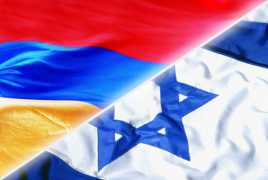
    The recent tension between Turkey and Israel has over the last year affected the fronts of alliances in the region, leading to pursuits for new forms of alliances subsequent to the current crisis. (more…)

  • My First Impression of Secular Turkey

    My First Impression of Secular Turkey

    Betty Caplan

    As I was packing to come to Istanbul, Turkey, my friends urged me to leave jeans, shorts, and skimpy tops at home. One brought me a little modest outfit that covered my arms and shoulders. Imagine then when I arrived here in 30 degree heat, finding that the dress code is like that of the beach resorts in Mombasa! I have seen more burkhas and head scarves in London and Nairobi than I have here.

    The founder of the modern Turkish state, the greatly revered Mustafa Kemal Ataturk, decreed that it should be a secular state and the smart young girls in this up-market suburb have taken him literally. It has always been a lynchpin. After the disasters of the First World War in 1923, the Treaty of Lausanne saw foreign powers off and the new modern borders of the Turkish state were established. Not for nothing was he called Father of the Turks.

    He changed the Arabic script into Roman, modernised the language, instituted the Gregorian calendar, banned the fez, promoted universal suffrage and set up institutions of democracy, never allowing opposition to get in his way. The long rule of the Ottoman Empire was well and truly over, though Ataturk’s insistence that the country be thoroughly Turkish still has repercussions in some regions today.

    Istanbul is the only city to be divided by two continents: Europe and Asia. It retains a gracious culture from old times where a politeness reigns except on the roads. Ramadhan is observed here and there but when it comes to Bayram, everyone participates whether they have fasted or not. Families plan their gatherings for days before, and women are busy buying up the best and the freshest. The finest cuisine is to be found – as in most countries with their own tradition- in the home. In my first week in a city where virtually no English is spoken, by luck I came across a professor of comparative literature who had lived in the USA and the UK and who was more than glad to have a literary conversation in a newly-opened bookshop.

    The following week, I sat at sunset in her home listening to the lapping of the waves of the Bosphorus, and watching those unique shapes of the grande mosques across the water disappear into twinkling lights. The apartment was large and spacious, and the eating area set on the balcony for who could ever resist such a view? My companion is now retired but still attends conferences all over the world. Her American husband, much older, was not to be seen. “That’s a story for another day,” she said. But she is scathing about Turkish men who trade in their partners regularly for more recent models.

    Never did I imagine I would praise colonialism, or realise how much we take English for granted in Kenya! (Not that it is altogether a good thing of course.) I have some inkling now of what it must feel like to be deaf-mute. I feel for all those refugees and immigrants who cannot communicate, and unlike Australia, for example, there aren’t translators on hand to assist. We arrogant English speakers expect the world to know our language but in Turkey I sense a slight muttering under the breath when I ask a shopkeeper if they speak English.

    “Hmph!” I imagine them saying to another customer. “What do we need their language for?” It is taught in school for only a few hours a week, but things are changing which is why I am here. With the possibility of joining the EU, and with increased trade prospects there is suddenly a need for more English speakers.

    Relevant Links

    * East Africa

    * Kenya

    * Middle East and Africa

    * Governance

    My landlady and I communicate by mime or Google Translate. She is a retired schoolteacher, and having done her 25 or so years’ service, she is now forced to be idle. So she smokes and watches TV all day. Arm-in-arm we go off to the bazaar together where all the selling is done by men. Why? That is not womens’ work in a Muslim country. I think of the thousands of African women sitting on the ground with their piles of oranges and tomatoes who keep their families going seven days a week, 365 days a year. One I knew in Thika sent her four children to university on her meagre earnings. God only knows how.

    So far my students at the school are top level company managers. They work for a Swiss pharma firm and are accustomed to teleconferences each week – in English. They are down-to-earth and need the basics. “No reading- no time!” they insist. Ahmet (not his real name) knows that he would earn far more doing the same job in Switzerland but first he must know English. I teach them in-house but back at the school there is the same rush to learn quickly.

    We must have covered so much by the end of October. But however fast you teach, it doesn’t mean your students will learn quickly especially when there is little in English in their immediate environment to encourage them.

    via allAfrica.com: Kenya: My First Impression of Secular Turkey.

  • Theologians in Kreuzberg

    Theologians in Kreuzberg

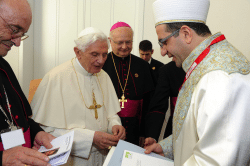
    The Kreuzberg neighbourhood of Berlin is often referred to as “little Istanbul “. It’s famous for its Turkish Muslim population.Curiously it’s also where the Holy See’s representative to Germany, Archbishop Jean Claude Périsset has his residence, so pushing it a bit one could call this compound a ” little Vatican” of sorts.

    Also because it’s where Benedict XVI stayed on the first night of the first State Visit to his homeland .

    So when it came to choosing a venue for the Pope to meet with Muslim representatives on the morning of Friday 23rd of September , the location for this encounter seemed an obvious one.

    And so at 9 am sharp the meeting began in this City of Berlin where minarets and domed roofs have hit the city’s sky line . The atmosphere was cordial and there were 15 representatives of the Muslim Community in Germany, the largest numerically in Western Europe after France and Britain. And it was as encounter between theologians, as the Muslim group was led by a Professor of Islamic theology Mouhanad Khorchide.

    Speaking to the Pope , the Professor pointed to the fact that here in Germany there’s an ongoing process to establish Islamic Theology as a subject at German Universities. But he also highlighted the Catholic-Muslim Forum, launched in the Vatican in 2008 which he described as a major platform for Muslim-Christian dialogue , stressing the love of God and one’s fellows as the central binding link between Islam and Christianity .

    And in his response to Professor Khorchide, Benedict XVI too highlighted some binding elements between the two faiths : “It seems to me, the Holy Father said, that there can be fruitful collaboration between Christians and Muslims. In the process, we help to build a society that differs in many respects from what we brought with us from the past. As believers, setting out from our respective convictions, we can offer an important witness in many key areas of life in society. I am thinking, for example, of the protection of the family based on marriage, respect for life in every phase of its natural course or the promotion of greater social justice.”

    This meeting with the representatives of the well established Muslim community, mainly from Turkey, which represents a younger group than the mainstream German and since 9.11, unlike in the 1960’s and 70’s when integration went more smoothly, now causes concern for many who fear fundamentalist groups, marked the last of Benedict XVI’s appointments in Berlin.

    A successful beginning to this four day official visit home for this Pope who seems to have charmed the previously aggressive media. The” Frankfurter Allgmeine Zeitung”, even went so far as to describe his keynote address at the Bundestag, the Federal Parliament: the “speech of the century” . Meanwhile on Friday his journey continues south of Berlin , in Erfurt as he flies to the Land of Luther.

    via Vatican Radio – Theologians in Kreuzberg.