Blog

  • Model of Internationalism: Istanbul Bazaar no place for ethnic differences

    Model of Internationalism: Istanbul Bazaar no place for ethnic differences

    Gayane Abrahamyan
    ArmeniaNow reporter, writing from Istanbul, Turkey
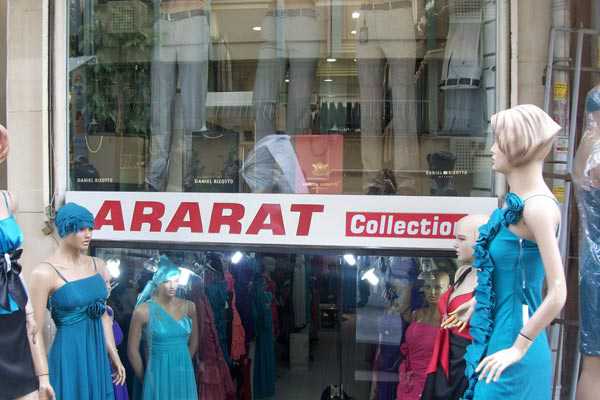
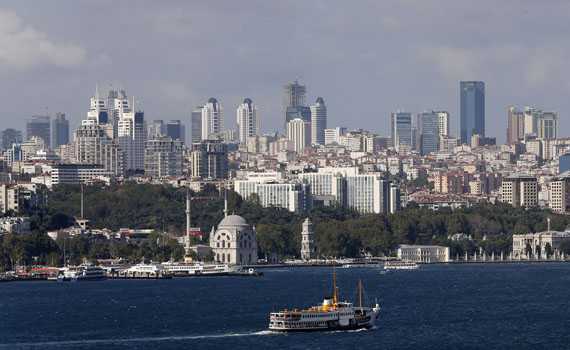
    Photo: Gayane Abrahamyan/ArmeniaNow.com
    Photo: Gayane Abrahamyan/ArmeniaNow.com

    Istanbul’s Laleli market is the most liberal place in Turkey. It is an international trade area where migrants from almost all former Soviet states work side by side with complete disregard to whatever differences on ethnic grounds they may have for one sole reason – commerce.

    One of Turkey’s national symbols – its language – has even been sidelined; if in other districts of Istanbul one can hardly find road signs and signboards in any language other than Turkish or people that would agree to give directions to a tourist in English, in Laleli all signs are in Russian, which is also the common language of communication there.

    Turkish vendors, too, learn and speak Russian.

    Ramazan, 68, in quite a fluent Russian invites to his shop, presents the merchandize and explains that if he hadn’t learned Russian he wouldn’t have been able to do his business.

    “It might seem strange that living in my own country I have to learn a foreign language in order to succeed in my business, but it’s the reality: in our work we are mainly dealing with representatives of former Soviet countries, and so we have adjusted to the rule,” Ramazan, who was born in Izmir and has worked as a salesman at the Istanbul market for the past 15 years, told ArmeniaNow.

    Laleli, which looks like a small model of the Soviet Union, consists of several streets where clothes and footwear are mainly for wholesale; the area also boasts restaurants and hotels, like a giant shopping mall.
    Although smaller by its size when compared to the famous tourist destination – the Grand Bazaar with its historic part that was built back in the 15th century as commissioned by Sultan Mehmed – it is, nevertheless, unique and important by its internationalism.

    Laleli is the first haven of labour migrants arriving in Istanbul, since the language is not an issue and there is a demand for Russian-speaking workers.

    “Only those who cannot find a job elsewhere end up coming here: if through acquaintances they are able to get employed at factories or locals’ houses – as cleaners, nannies or nurses for sick people – they can earn more, between $800-1,000 per month,” says Nana, a Georgian woman who has been working in Turkey for a year: her husband and she lost their jobs in Tbilisi following a reform in the police system there.

    Azeri Mursal Ismamedov says that the best working partners are Armenians: “They are the ones mostly selling my merchandise, bringing major buyers from Armenia, so no ethnicity issue matters here, we have other things to worry about.”

    Ismamedov has lived in Turkey for the past decade and lists the names of his friends among whom there are more Armenians than Turks or Georgians.

    “When I was starting my business, my Turkish friends’ first piece of advice was to work with Armenians as they are the most reliable. So I followed their advice and have not once regretted since,” Ismamedov told ArmeniaNow. (At the market the Azeri translates for many of the Turks and teaches them Russian.)

    There aren’t so many Armenians at this market. Sona, from Vanadzor, says Armenians are mainly at the market of another district, although the majority finds employment at factories and private houses.

    “Armenian new-comers, who do not know the language, instead of coming here rather prefer working at the houses of Istanbul Armenians, whereas Georgians, Uzbeks, Moldovans do not have such an opportunity,” says Sona, adding though that it is not only a matter of language.

    “Strangely so, but Turks trust Armenians more,” she says.

    Labour migration has become one of the main survival means for many in post-Soviet countries after the collapse of the Soviet Union.

    However, if in the beginning the main country for labour migration was Russia, during the past decade Turkey, too, has become a country providing jobs and earning opportunities.

    According to the data of the Turkish Ministry of Labour and Social Affairs, there are around one million migrants working in the country, although experts believe the actual number is even higher.

    “This phenomenon has two sides to it: on the one hand we are proud of our country to have developed such an economic capacity to be able to receive so many migrants, but on the other hand, since migrants are a more affordable manpower, they literally take away jobs from citizens of Turkey,” Fatih Osman, an expert at Sabanc university’s center for economic research, told ArmeniaNow.

    If in the 1970s Turkish citizens were migrating en masse from the country (mainly to Germany), today Turkey has become a country that attracts migrants.

    However, in the early period of the global financial-economic crisis, when jobs were cut by 15 percent in 2009 only in this country with a population of 70 million, the government decided to do the lay-offs at the expense of migrants.

    According to the 2009 study by the Ministry of Labour and Social Affairs, if the state got rid of illegal migrants, it would have opened up an additional 500,000 workplaces, however this plan was never implemented because of the criticism it evoked on the part of major factory owners who were able to overcome the economic crisis due to non-expensive manpower.

    “For a period of time it was rather tense here, deportation cases were frequent, but no matter how tense it might be, it is still much safer here than in Russia, and Caucasians, even Armenians, get a much better treatment here,” says Sona.

    Gayane Abrahamyan is reporting from Turkey with the support of the Global Political Trends Center (GPoT) and Internews Armenia
  • Turkish University to Offer Armenian Language Course

    Turkish University to Offer Armenian Language Course

    By THE INTERNATIONAL HERALD TRIBUNE

    Turkish university to offer Armenian language course

    Using a $23,500 grant from the German Marshall Fund’s Black Sea Trust, Kadir Has University in Istanbul plans to begin offering Armenian language lessons this month.

    Serdar Dinler, director of the university’s Center for Lifelong Learning, said by telephone that the course would be taught by a doctoral candidate from Armenia as part of a cultural exchange between countries whose ties have been fraught for a century.

    “Turkey is becoming an energy-transit corridor and a center for diplomacy in the region,” Mr. Dinler said. “Also the Turkish government has a new ‘zero problems’ policy with its neighbors, so we believe that the new generation in Turkey needs to have more dialogue with neighboring countries, including Armenia, Russia, Iran, Greece, etc. Knowing the language can only help.”

    Kadir Has is a private university established along the Golden Horn in 1997 and named after its founder, a Turkish automotive magnate.

    — SUSANNE FOWLER

    via Turkish University to Offer Armenian Language Course – NYTimes.com.

  • Turkey shows off military vehicles

    Turkey shows off military vehicles

    ISTANBUL, Turkey, May 16 (UPI) — Turkish defense company Otokar rolled out its locally designed and produced military vehicles at last week’s International Defense Industry Fair.

    Among the products on show at the Istanbul event were full-scale model of the Altay, the first Turkish main battle tank; the new Arma armored combat vehicle with its Mizrak-30, remote controlled turret system; the Arma 6×6 armored explosive ordnance disposal vehicle; and the new APV internal security vehicle.

    Additional armored personnel carriers, weapons carriers and a Rapier missile battery vehicle-truck firing unit were also on display.

    “By means of fairs organized we find the opportunity to display the development of the Turkish defense industry to the world,” said Kudret Onen, chairman of Otokar and president of Koc Holding, Otokar’s parent company.

    “At Otokar, we have been designing and producing tactical vehicles in this sector since 24 years. Our military vehicles provide the Turkish armed forces with successful service. And in abroad, over 25,000 Otokar military vehicles are actively used in more than 20 countries.”

    © 2011 United Press International, Inc. All Rights Reserved. Any reproduction, republication, redistribution and/or modification of any UPI content is expressly prohibited without UPI’s prior written consent.

    via Turkey shows off military vehicles – UPI.com.

  • Turkish EU Minister Pays Visit to Assyrian Orthodox Church in Istanbul

    Turkish EU Minister Pays Visit to Assyrian Orthodox Church in Istanbul

    Turkey’s State Minister and Chief Negotiator for EU talks Egemen Bagis visited Virgin Mary Assyrian Orthodox Church in Beyoglu district in Istanbul on Sunday.

    Bagis said that Turkish citizens of Assyrian origin had always worked for Turkey and its development.

    Bagis said that Turkey was passing through a different and brand new era and the country was getting stronger.

    Turkey had the 6th largest economy in Europe and it had the potential of the fastest growing economy in Europe, he said.

    “Our Assyrian brothers and sisters are also pleased with development and transformation in Turkey,” he said.

    Bagis said that they would improve reform process and democratization in the country.

    Metropolitan Bishop of the Assyrian Orthodox Church Yusuf Cetin said that representatives of all political parties visited the church ahead of the general elections. “But State Minister Bagis visited us two years ago. He was the first minister to visit us,” he said.

    “We always pray for our country’s unity, development and for the world peace,” Cetin said.

  • Would Turkey’s Kemal Dervis Pass German Chancellor Angela Merkel’s “European” Test to Head the International Monetary Fund?

    Would Turkey’s Kemal Dervis Pass German Chancellor Angela Merkel’s “European” Test to Head the International Monetary Fund?

    By Marc Champion

    ISTANBUL — No sooner had news broken concerning the arrest of International Monetary Fund chief Dominique Strauss-Kahn on sex-related charges, than Turkey’s media began to speculate Monday on whether the country’s former economy minister, Kemal Dervis, might be the one to replace him.

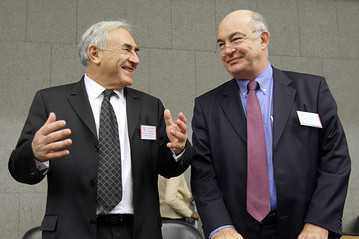
    Could Turkey’s Kemal Dervis, right, replace Dominique Strauss-Kahn at the IMF?
    Could Turkey’s Kemal Dervis, right, replace Dominique Strauss-Kahn at the IMF?

    AFP/Getty Images

    Could Turkey’s Kemal Dervis, right, replace Dominique Strauss-Kahn at the IMF?

    If Mr. Dervis were to put himself forward, he’d be a strong candidate — but he’d also present German Chancellor Angela Merkel with a tough test of whether she believes a Turk counts as a European.

    Ms. Merkel made it clear Monday that she would want to see a European replace Mr. Strauss-Kahn, due to the continuing travails of the euro-zone, rather than a candidate from a developing nation. Ms. Merkel also has in the past made clear her opposition to Turkey joining the European Union. That could spell a major obstacle for any bid by Mr. Dervis.

    Still, Mr. Dervis would be a hard candidate to ignore. He has strong ties in Washington as well as in Western European capitals, and he would satisfy the developing world’s desire to see Europe’s lock on running the IMF broken.

    Mr. Dervis joined the World Bank in 1978; he became the organization’s vice president for the Middle East and North Africa region in 1996, drawing up Bosnia’s post-war economic recovery program along the way. In 2001, he returned to Turkey to take up a job as secretary of state of the economy, crafting the economic program that lifted Turkey out of a brutal financial crisis.

    Those policies were adopted more or less wholesale by the ruling Justice and Development Party, or AKP, when it came to power in 2002, and appear to have stood the test of the latest global financial crisis. Turkey’s banking system has been unscathed by the turmoil and has proved an engine of the country’s runaway recovery. As a result, Mr. Dervis is a rare example of a public figure who enjoys cross-party respect in Turkey.

    Mr. Dervis joined the Republican People’s Party to run for election in 2002, and became a member of parliament in the political opposition after AKP’s victory. But he left parliament in 2005, distancing himself from Turkish politics and moving to head the United Nations Development Program. Currently, he is a vice president at the Brookings Institution in Washington, where he heads the think tank’s Global Economy and Development program.

    A former economics professor, Mr. Dervis also has been drafted to a fistful of high-level commissions in Europe, including the Commission on the Measurement of Economic Performance and Social Progress, which was set up by French President Nicolas Sarkozy in 2008 to look at the adequacy of gross domestic product and other key indicators. Nobel Prize-winning economist Professor Joseph Stiglitz chaired the group.

    Turkish economists say Mr. Dervis has been well-received by the government whenever he returns to visit Turkey, and that when it comes to economic policy, there’s little to separate them. “I can’t see why they wouldn’t want to support him, it would be a big coup for Turkey” — and for the government’s efforts to turn the country, already a G20 member, into a global player, said Atilla Yesilada, an economist with Istanbul Analytics, an Istanbul-based consultancy.

    * IMF,

    * Kemal Dervis,

    * Turkey

    via Would Turkey’s Kemal Dervis Pass German Chancellor Angela Merkel’s “European” Test to Head the International Monetary Fund? – Emerging Europe Real Time – WSJ.

  • U.S. Navy Mixes Business and Politics in Istanbul

    U.S. Navy Mixes Business and Politics in Istanbul

    U.S. Navy Mixes Business and Politics in Istanbul

    May 16, 2011 – 6:17pm, by Joshua Kucera

    A U.S.. naval ship, the USS Mahan, visited Istanbul last week for a short port visit. These sorts of things happen all the time and aren’t usually noteworthy. But the blog Bosphorus Naval News paid close attention to this visit, and noted that the visit may have been driven by commercial, rather than merely friendly, motivations. The destroyer’s visit happened to take place during a big defense exposition, IDEF, and the U.S. ambassador’s comments at the expo used the ship as a showpiece for U.S. defense industry:

    I join Commander Mondlak and his crew in inviting you to tour the proud USS Mahan. This fine example of American high technology and advanced engineering, and is itself the result of partnerships between numerous American companies, including Lockheed Martin, Raytheon, McDonnell Douglas, General Electric, Alliant, Gould, and Sikorsky, many of whom are represented at IDEF.

    In particular, the Mahan has a sort of radar that is under consideration for the next generation of Turkish ships. And U.S. defense contractor Lockheed Martin had just signed a deal with Turkish manufacturer Havelsan involving production of those radars.

    The signed contract of course raises the question whether the next generation of Turkish warships will have SPY radars and components of AEGIS systems on board.

    The blog, in a separate post, takes issue with that deal given that Turkey also manufactures naval radars:

    One of the contracts signed during the fair was between Havelsan and Lockheed Martin for the integration of SPY phased radar systems to the CMS made by Havelsan. The SPY radars are the backbone of the US Navy’s AEGIS air and anti ballistic missile defence system.

    Well this question must be asked: On one hand there is a local electronics power house like ASELSAN that is trying to develop naval radar systems on the other hand you sign a deal with a US company about the most important and significant air defence radar systems. How will this deal effect the local development and why it was necessary.

    And from an American perspective, one might ask: how often are these sorts of port calls made for commercial reasons? Did Lockheed reimburse the U.S. Navy for the expenses it incurred on this sales visit?

    via U.S. Navy Mixes Business and Politics in Istanbul | EurasiaNet.org.