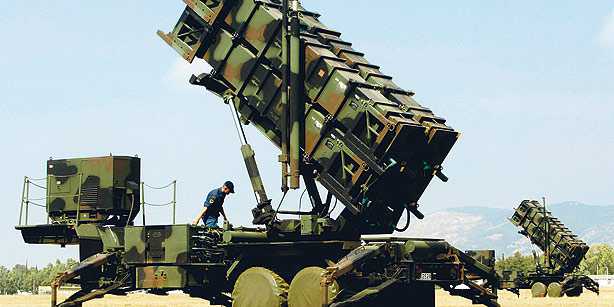
Washington does not lose wars, Washington achieves strategic objectives.
Washington successfully degrades enemy capabilities.
Washington transitions to a ceasefire framework, but Congress has receipts.
Just revealed something that no Pentagon press briefing would ever say out loud.
42 American military aircraft shot out of the sky.
By a country that Washington had already declared defeated.
Welcome to the story behind the story.
Before we count what America lost, let us count what America said it would achieve.
The Trump administration entered Operation Epic Fury with four publicly stated objectives.
Destroy Iran’s nuclear program completely.
Degraied Iran’s ballistic missile capability.
Cut-off Iran’s support for regional proxy groups.
Force Iran’s leadership to permanently renounce nuclear weapons.
Four objectives.
29 billion dollars.
Keep those four in your mind.
We will return to them.
On February 28th, 2026, the United States and Israel launched Operation Epic Fury.
Washington was triumphant.
Supreme Leader Kamine was dead.
Nuclear sites were hit.
The state of Hormuz Defense Secretary Pete Heggseth told Congress,”
We have achieved our strategic objectives.
Now fast-forward to May the Congressional Research Service.”
The non-partisan research arm of the United States Congress.
Quietly published a report.
No press conference.
No headlines on American prime time.
No ticker on CNN. A very uncomfortable document.
42 United States military aircraft lost or severely damaged.
In a war that America won.
Let us now do what Washington refused to do.
Aircraft by aircraft.
The F-35A, lightning the second.
The most expensive weapons program in human history.
At 1.7 trillion dollars.
Shot down or severely damaged over Iran on March 19th.
Cost of one aircraft between 80 and 110 million dollars.
Iran’s foreign minister, Iraq chi, Iran’s armed forces were the first in the world to shoot down an F-35.
Washington has not denied it.
Four F-15E strike-eagles, $100 million each, $400 million total.
Three destroyed by friendly fire over Kuwait.
America paid to shoot down its own jets.
The fourth destroyed in combat over Iran.
One eight-end thunderbolt the second, $20 million.
Destroyed inside Iran.
Seven KC–135 strattotankers.
The aircraft that keep combat jets flying.
$30 million each, $350 million total.
Five of them were not airborne.
They were parked on the tarmac at Prince Sultan Air Base in Saudi Arabia when Iranian missiles found them.
One E3-century A-wax, $270 million.
The flying command center.
The brain of the entire operation.
Destroyed on the ground in Saudi Arabia by an Iranian missile.
Two MC–130J commandow the second special operations aircraft.
$100 million each, $200 million total.
American commandows flew them into Iran on a rescue mission.
They got stuck in soft sand inside Iranian territory.
American forces blew up their own aircraft on Iranian soil because they could not fly them out.
One H-H-60W Jolly Green the second helicopter.
$40 million, damaged by small arms fire during the same rescue mission.
24 M-Q-9 Reaper drones between $30 and $56 million each, $720 million total.
And the M-Q-9 production line was already shut down in 2025.
America cannot replace them quickly.
Iran destroyed 24 of a product no longer being manufactured.
One M-Q-4C Triton surveillance drone.
$250 million, a quarter billion dollar aircraft.
Total hardware destroyed in 40 days.
Approximately $3.5 to $4 billion.
And that is just the aircraft.
The Pentagon told Congress the full cost of Operation Epic Fury is now $29 billion.
That number jumped 4 billion in just two weeks.
83 cents of every dollar spent.
$24 billion out of $29 billion.
Went toward fixing and replacing destroyed military hardware.
And the $29 billion does not include a single dollar of base repair costs.
Those assessments are still ongoing.
Congressional sources say the final bill could reach 200 billion oracles.
$200 billion for a 40-day war that America won.
And Iran was not just hitting aircraft.
Iran hit American military bases across seven countries simultaneously.
In the first two weeks alone, confirmed base damage reached $800 million.
The U. S. Navy Fifth Fleet headquarters in Bahrain was hit.
Repair cost for that one building $200 million.
In Qatar, Iran struck an early warning radar system valued at $1.1 billion.
$1 billion.
In Kuwait, a 50-year-old Iranian F5 jet penetrated the patriot air defense shield and bombed a U. S. compound, a half-century old aircraft.
Inside a base protected by the most advanced missile defense system in the world.
And none of this base damage is included in the $29 billion figure.
It’s still counting.
Democratic Senator Mark Kelly sat before Congress and used one word to describe America’s weapons inventory after this war.
His exact words, “I think it is fair to say it is shocking how deep we have gone into these magazines.
The American people are less safe, whether it is a conflict with China or somewhere else in the world.
We are talking about years to rebuild.
America spent $29 billion and weakened itself against every future enemy at the same time.
Now the scoreboard.
Destroy Iran’s nuclear program.
Iran still holds over 450 kilograms of 60 percent enriched uranium.
Enough for 9 to 11 nuclear weapons.
Fordale survived.
Buried under 80 meters of granite.
Iran’s Parliament voted to end all IAA cooperation after the ceasefire.
Iran is now less transparent than before the war.
Netanyahu himself admitted on CBS. There is still nuclear material.
There are still enrichment sites that have to be dismantled.
The man who launched the war admitted the war did not finish the job.
Iran’s ballistic missiles.
Iranian missiles were still hitting American warships in the straight of Hormuz in May 2026.
A full month into the ceasefire.
Cut off Iran’s proxy support.
Hezbollah operational.
Health is active.
My RGC network intact, force Iran to announce nuclear weapons.
No deal, no signed agreement, no verification framework.
Trump called Iran’s latest proposal a piece of garbage.
The nuclear talks are still ongoing.
The same talks that diplomacy could have produced before a single bomb was dropped.
Zero out of four objectives achieved.
Here is what the data tells us.
The United States launched Operation Epic Fury with the most advanced air force in the world.
It flew nearly 13,000 soughties.
It hit over 5,500 targets.
It killed the Supreme Leader of Iran.
And it lost 42 aircraft worth $4 billion.
It spent $29 billion.
Got its bases hit in seven countries.
Pleated its missiles for years, achieved zero out of four stated objectives, agreed to a ceasefire with a country it claimed to have defeated.
And then spent two months hiding the losses from its own Congress, American style.
The story behind the story is not about what Iran lost.
The story behind the story is about what Washington could not afford to lose next.
Because if the war had restarted with Iran’s flight patent data with its proven F-35 kill, with its confirmed drone hunting capability, with American munitions already at shocking levels, the next set of losses would not be 42 aircraft.
And someone in Washington did the math.
That is the story behind the story.
I am your host.
If you believe the world deserves the full picture, share this video right now.
According to the U.S. State Department’s documents, a group of powerful Jewish financial elites were planning the overthrown of the Russian Tsar, Nicholas II, in 1916.
April 6, 2020
Note: This article was sourced from The Noble Protagonist’s 1,100 page E-book, “The Battle to preserve Western Civilization (European Folk Soul vs. Jewish Supremacy). Free E-Book available at: https://archive.org/details/@nobleprotagonist
“As soon as the Jew is in possession of political power, he drops the last few veils which have hitherto helped to conceal his features. Out of the democratic Jew, the Jew of the People, arises the Jew of the Blood, the tyrant of the peoples. In the course of a few years he endeavors to exterminate all those who represent the national intelligence. And by thus depriving the peoples of their natural intellectual leaders he fits them for their fate as slaves under a lasting despotism.” -Hitler
“Russia furnishes the most terrible example of such a slavery. In that country the Jew killed or starved thirty millions of the people, in a bout of savage fanaticism, and partly by the employment of inhuman torture. And he did this so that a gang of Jewish literati (intellectuals) & financial bandits should dominate over a great people.” -Hitler
“The final consequence (Russian Revolution) is not merely that the people lose all their freedom under the domination of the Jews, but that in the end these parasites themselves disappear. The death of the victim is followed sooner or later by that of the vampire.” -Hitler
“The Jewish international struggle… always end in bloody Bolshevization… the destruction of the intellectual upper classes associated with the various peoples, so that he himself will be able to rise to mastery over the now leaderless humanity.” -Hitler
“This is the greatest crisis in which humanity has ever found itself, the greatest upheaval since the advent of Christianity. It may be unpleasant for democratic statesmen to concern themselves with Bolshevism, but it will not matter whether they will want to or not, they will have to deal with it.” -Hitler
THE JEWISH TAKEOVER OF RUSSIA
The world revolution which we will experience will be exclusively our affair and will rest in our hands. This revolution will tighten the Jewish domination over all other people.” -Peuple Juif, February 8. 1919.
“Communism is Judaism! The Jewish Revolution in Russia was in 1917.” -H.H. Beamish, British patriot and founder of the Britons
“Socialism, Communism, and Bolshevism, in reality, are only links in the plan of world-embracing Judaism, with its final purpose of forcing the entire world under Jewish domination.” -Ernst F. Elmhurst, author of The World Hoax
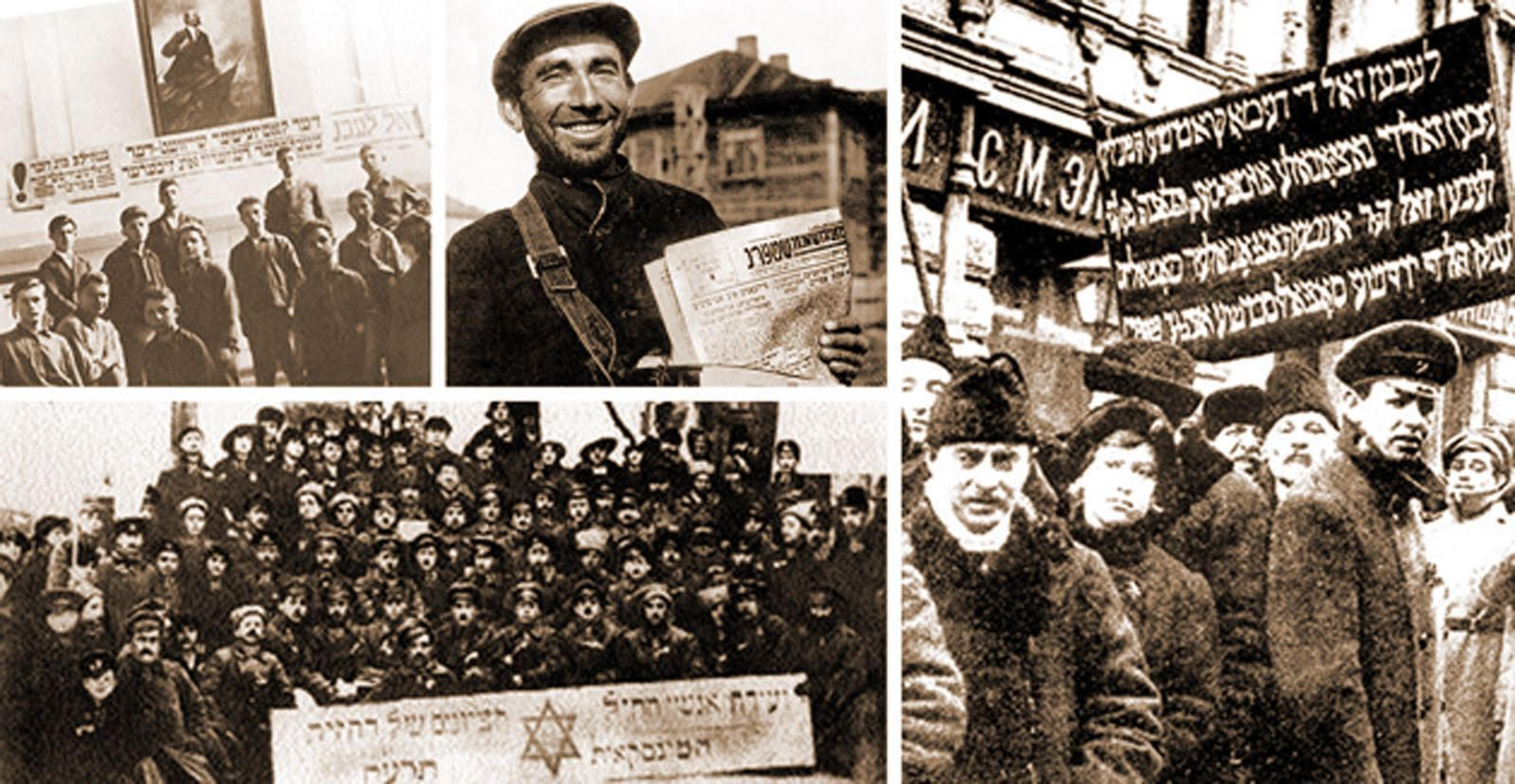
According to the U.S. State Department’s documents, a group of powerful Jewish financial elites were planning the overthrown of the Russian Tsar, Nicholas II, in 1916. These plotters included Jacob Schiff, Mortimer Schiff, Felix Warburg, Otto Kahn and Issac Zeelman. They decided that Russia should be destroyed and a communist dictatorial regime would be implemented, subservient to the dictates of International Jewry.
The fact that is never taught in school, or talked about in the media, is that Communism was a Jewish totalitarian ideology invented by Jews, funded by Jewish bankers, and economically managed & brutally enforced by Jewish Soviet Bolsheviks.
“Without big banks, Socialism would be impossible.” -Lenin
As a boy, the tsar, Nicholas II had witnessed the assassination of the Tsar Alexander II by the Jewish terrorist, Vera Figner, leader of a terrorist group called, “The People’s Will”.
Tensions between the Jews & Christian Russians erupted. Nicholas’ great tragic mistake was in failing to execute the Communists, before it was too late, after a failed 1905 revolution. Following the February Revolution in 1917, the Bolsheviks forced the Nicolas II to abdicate. The Jew, Alexander Kerensky was given $1,000,000 from the Jewish Wall Street banker, Jacob Schiff, to immediately free all political prisoners and lift the ban on political exiles, to permit them to return back to Russia.
“The Jews have undoubtedly to a large extent furnished the brains & energy in the revolution throughout Russia.” -George von Longerke (US Ambassador to Russia)
Jewish revolutionaries quickly flooded in to any and all public offices. Anarchy began, as criminals plundered houses and people were murdered & robbed. The Jew, Jacob Schiff, was chairman of the Kuhn Loeb bank and an assistant of the Rothschild banking family. He took care of the communications between the revolutionary movement in Russia and the Jewish Masonic Order, B’nai B’rith.
On March 27, 1917, the Jacob Schiff and Max Warburg (Jew) sent Lev Davidovich Bronstein (Jew), better known as “Trotsky” and his group of Jewish communists off to Russia, to lead a revolution with no less than 20 million dollars in gold. Today worth billions! Some 90,000 exiles, mostly Jews & Freemasons, returned from all over the world to infiltrate Russia. Most of them changed their Jewish names to blend into the European society better.
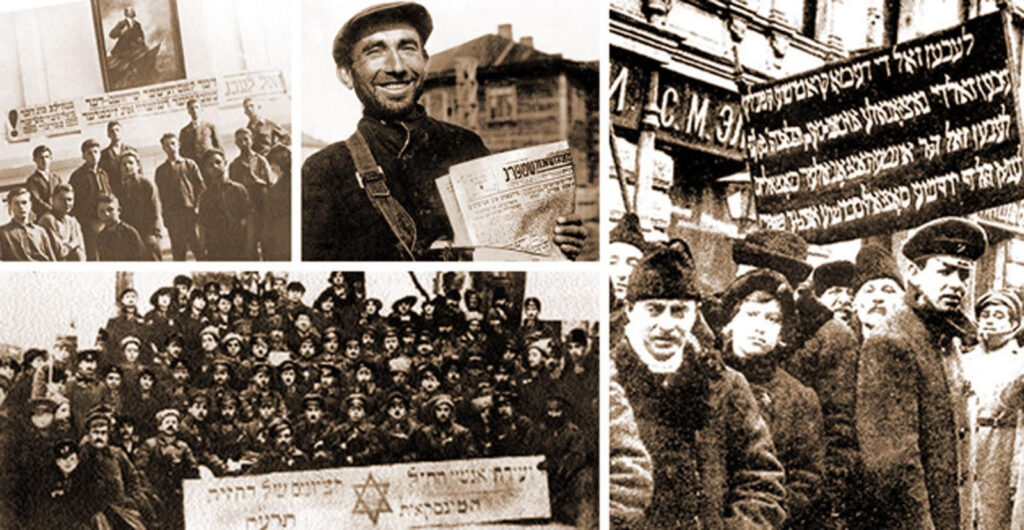
Although officially Jews have never made up more than five percent of Russia’s total population, they played a highly disproportionate & decisive role in the infant Bolshevik regime, effectively dominating the Soviet government during its early years after the 1917 Red October Revolution.
“Although Jews formed less than five percent of Russia’s population, they formed more than fifty percent of its revolutionaries.” -Chaim Bermant (Jewish writer)
With the notable exception of Lenin (Vladimir Ulyanov) who was a quarter Jew on his mother’s father’s side, most of the leading Communists who took control of Russia in 1917-1920 were Jews. Leon Trotsky (Lev Bronstein) headed the Red Army and was chief of Soviet foreign affairs. Yakov Sverdlov (Solomon) was both the Bolshevik party’s executive secretary & chairman of the Central Executive Committee, the head of the Soviet government. Grigori Zinoviev (Radomyslsky) was the head of the Communist International (Comintern), the central agency for spreading Marxist (Red) revolution in foreign countries.
Other prominent Jews included press commissar Karl Radek (Sobelsohn), foreign affairs commissar Maxim Litvinov (Wallach), Lev Kamenev (Rosenfeld) and Moisei Uritsky.
Of the 22 ministers in the first Soviet government, 17 were Jews. The few who were not themselves Jewish, often were Freemasons, had Jewish wives, and spoke Yiddish.
“The Bolsheviks revolution in Russia was the work of Jewish brains, of Jewish dissatisfaction, of Jewish planning, whose goal is to create a new order in the world.” -The American Hebrew, 1920
It is not known for sure if Stalin was Jewish, but at least he spoke Yiddish and had three Jewish wives. The Los Angeles B’nai B’rith Messenger credited Stalin as being a Jew. He may have been a Georgian Jew.
“The materialistic & mechanized state devoid from Nature was always Lenin’s dream.” -Willally (Renegade Tribune)
Vladmir Lenin was a dedicated “internationalist”. He viewed ethnic or cultural loyalties with contempt, and had little regard for his own White (Gentile) Russian countrymen. He once commented, “An intelligent Russian is almost always a Jew or someone with Jewish blood in his veins.”
“Some call it Communism, but I call it Judaism.” -Rabbi Stephen Samuel Wise
Well-informed observers, both inside and outside of Russia, took note at the time of the crucial Jewish role in Bolshevism. Winston Churchill, who would later ally with International Jewry, warned in a 1920 issue of London’s “Illustrated Sunday Herald” that “Bolshevism is a worldwide conspiracy for the overthrow of civilization and for the reconstitution of society on the basis of arrested development, of envious malevolence and impossible equality.”
Winston Churchill further noted, “There is no need to exaggerate the part played in the creation of Bolshevism and in the actual bringing about of the Russian Revolution by these international and for the most part atheistical Jews… In the Soviet institutions the predominance of Jews is even more astonishing. And the prominent, if not indeed the principal, part in the system of terrorism applied by the Extraordinary Commissions for Combating Counter-Revolution (Cheka) has been taken by Jews, and in some notable cases by Jewesses.”
“The Communists are against religion (Christianity), and they seek to destroy religion; yet, when we look deeper into the nature of Communism, we see that it is essentially nothing else than our religion (Judaism)… The communist soul is the soul of Judaism.” -Rabi Harry Waton
David R. Francis, United States ambassador in Russia, warned in a January 1918 dispatch to Washington, “The Bolshevik leaders here, most of whom are Jews and 90 percent of whom are returned exiles, care little for Russia or any other country but are internationalists and they are trying to start a worldwide social revolution.”
The Netherlands’ ambassador in Russia, Oudendyke, also warned, “Unless Bolshevism is nipped in the bud immediately, it is bound to spread in one form or another over Europe and the whole world as it is organized and worked by Jews who have no nationality, and whose one object is to destroy for their own ends the existing order of things.”
A leading American Jewish community paper in 1920, proudly declared, “The Bolshevik Revolution was largely the product of Jewish thinking, Jewish discontent, Jewish effort to reconstruct.”
“Zionism is a political program for the conquest of the world. Zionism destroyed Russia by violence as a warning to other nations.” -Henry H. Klein (anti-Zionist Jew)
After a lengthy stay in Russia, American-Jewish scholar, Frank Golder, reported in 1925 that “because so many of the Soviet leaders are Jews, anti-Semitism is gaining, particularly in the army, among the old and new intelligentsia who are being crowded for positions by the sons of Israel.”
The Jewish role in the communist revolution was mentioned in many major Jewish publications, such as the “Jewish Encyclopedia”, “Universal Jewish Encyclopedia” and “Encyclopedia Judaica”. In fact, they are boasting about the essential role of the Jews in the Russian Revolution.
“There is much in the fact of Bolshevism itself, in the fact that so many Jews are Bolsheviks. In the fact that the ideals of Bolshevism at many points are consonant with the finest ideals of Judaism.” -Jewish Chronicle
Alexander Solzhenitsyn was a Nobel prize-winning novelist, historian and victim of Jewish Bolshevism. He pleaded…
“You must understand. The leading Bolsheviks who took over Russia were not Russians. They hated Russians! They hated Christians! Driven by ethnic hatred they tortured & slaughtered millions of Russians without a shred of human remorse.”
“The October Revolution was not what you call in America the ‘Russian Revolution’. It was an invasion & conquest over the Russian people. More of my countrymen suffered horrific crimes at the blood-stained hands than any people, or nation ever suffered in the entirety of human history. It cannot be understated! Bolshevism was the greatest human slaughter of all time.”
“The fact that most of the world is ignorant of this reality is proof that the global media itself is in the hands of the perpetrators. We cannot state that all Jews are Bolsheviks, but without Jews there would have been no Bolshevism. For a Jew, nothing is more insulting than the truth. The blood-maddened Jewish terrorists murdered 66 million in Russia from 1918 to 1957.”
As an expression of the Bolsheviks radically anti-nationalist character, the Soviet government issued a decree a few months after taking power that made “anti-Semitism” a crime in Russia. The new Communist regime thus became the first in the world to severely punish all expressions of anti-Jewish sentiment. Thus, making reference to the Jewish takeover of Russia was a crime.
RED JEWS vs WHITE CHRISTIANS (WHITE GUARD)
A bloody civil war between the Red Jews, led by Trotsky, and the White (Gentile) Christians via the White Guard (White Movement) (White Guardsmen), led by Admiral Kolchak, broke out before the Jews could grab full power to set up their own Bolshevik totalitarian system.
The White Guard armies in this civil war received not a cent from the West. Not a shell (explosive projectile), and not a rifle reached any faction of the White forces from the West. The West was not anti-Bolshevik! Furthermore, the Western powers actively supported the Red forces during and after the Civil War.
Western powers backed the Red forces consistently from 1918-1921. They made sure that no aid would ever be given to Germany from Russia and that assets owned by Western powers would not fall into the hands of Germany.
U.S. Army General, William Graves, was a firm backer of the Red Bolshevik cause. In an excellent article on the subject, Kerry Bolton stated that Graves and many others actively sought to destroy the White Guard movement. He refused to deliver 14,000 rifles ordered and paid for by Admiral Kolchak. Another 15,000 rifles were blocked from the White Cossack forces by this same General. Most of all, Graves, in full communication with the economic (Jewish) elite in the U.S., had the Japanese stand down from their attacks on Red forces in the east.
In November of 1918, the Allies signed an agreement with the Reds for full support in exchange for financial concessions. While the Allies initially sought only Russia’s continual action in the war, their attention soon wandered. Once the Treaty of Brest-Litivosk was signed, the West permitted the Reds to re-organized old Russian debts, open Russia to world grain markets and hand over the more industrialized parts of Russia’s west.
Both President Woodrow Wilson and British statesman, Lloyd George, recognized Trotsky as the “legitimate” Russian government. Since the Reds were the only alternative to the “tsarist” Whites, they were recognized. George stated that a unified Russia would be the “greatest threat” to the British Empire.
General Denikin, of the Whites, stated in his memoirs, that “their sole source of supplies were those taken after Red defeats.” Red officers had regular salaries and a full staff, with the help of Western aid.
The mission of U.S. delegation-member to Russia, William Bullitt, led to an agreement with Lenin and a total rejection of the Whites. The memorandum asked for the lifting of all embargoes on the Soviet government and for its immediate recognition. Full free trade with the Soviets was also demanded, with the final and most important proviso that all debts to the West be paid.
Western newspapers, the Jewish-controlled media, spoke harshly of the Whites, equating them with landlords & “reactionaries”, which was Bolshevik propaganda.
Even with their shortages of ammunition & basic supplies, the White armies fought the Reds to a standstill and began routing them by the Spring of 1919. However, the West had made up its mind. General Kolchak had to go!
The West did everything in its power to ensure the Red Bolshevik takeover of Russia. It had its tentacles into the major Jewish banking houses in New York thanks to Trotsky.
The Red army was falling apart in 1918. General Pavlo Skoropadsky, of Cossack heritage, was creating a prosperous Ukrainian government in Kiev, and Russian general, Vladimir Kappel had the belief that he could maintain the White forces indefinitely. None of this assisted the Whites. The American financial community demanded a centralized, materialist and Jewish Russia, and this is what they received, at the cost of 66 million lives from 1918-1957.
The victors write history! The White army has been historically demonized & misrepresented. They were even the victims of Western & Bolshevik propaganda during the civil war. The common myth is that they were royalist (tsarists), and served the “landlord” class. Few “royalists” were part of the White forces and the “landlord” class was the peasants themselves, mostly ethnically-White Christians, who by the start of the war owned almost 95% of all Russian land.
CHEKA TERROR
The Jewish Cheka was a secret police force created through the NKVD on December 20, 1917, after a decree issued by Vladmir Lenin and was subsequently led by Felix Dzerzhinsky. An immensely disproportionate number of Jews, 80 percent, joined the Cheka.
They Cheka rounded up all those (Gentiles) who were under suspicion of not supporting the Jewish Bolshevik government. This included Civil or military servicemen suspected of working for Imperial Russia, families of officers-volunteer, all Christian clergy, workers & peasants and any other person whose private property was valued at over 10,000 rubles.
The Cheka practiced torture and their methods included being skinned alive, scalped, “crowned” with barbed wire, impaled, crucified, hanged, stoned to death, rolled around naked in internally nail-studded barrels, tied to planks and pushed slowly into tanks of boiling water, etc.
Women and children were also victims of Cheka terror. Women would sometimes be tortured and raped before being shot. Children between the ages of 8-13 were imprisoned & executed. Cheka was actively & openly utilizing kidnapping methods and were able to extinguish numerous people, especially among the rural population. Peasant villages were also bombarded to complete annihilation.
The Cheka are infamously known as the murderers of the Tsar family. Yakov M. Yurovksy, the leader of the Bolshevik squad that carried out the murder of the Tsar Nicholas II and his family, was Jewish, as was Sverdlov, the Soviet chief who co-signed Lenin’s execution order #22. For his part, Trotsky defended the massacre of the tsar’s family as a “useful and even necessary measure.”
Trotsky also commented, “The decision was not only expedient but necessary. The severity of this punishment showed everyone that we would continue to fight on mercilessly, stopping at nothing. The execution of the Tsar’s family was needed not only in order to frighten, horrify and instill a sense of hopelessness in the enemy (White Gentile Russians) but also to shake up our own ranks, to show that there was no turning back. That ahead lay either total victory or total doom.”
The Cheka is a direct predecessor of the Russian OGPU, formed in 1922, the NKVD, formed in 1932 and the KGB, formed in 1954. All were agencies of Jewish terror!
Lazar Kaganovich was the Jewish head of the KGB and was well known for his purges of those who opposed Jewish control. It is argued the Stalin, whose second wife was Kaganovich’s sister, was a mere figurehead. Some believe that the numerous Jews below Stalin, in all significant positions, ran the show.
As proof, some point out that many of the churches were burned to the ground, while the synagogues were left standing. Many priests were forced to sweep the streets and others were murdered. The Jewish Soviet leaders held rabbis in high esteem. And those people who dared to criticize Jewish Supremacy were mercilessly murdered, as “anti-Semitism” became a crime punishable by death in the Soviet Union.
Kaganovich ordered the deaths of millions and the total destruction of Christian monuments & churches. The most intelligent and the highest achieving segment of the population was totally wiped out, which left the population of ignorant workers, peasants, and a powerful Jewish ruling elite.
SOVIET CONCENTRATION CAMPS
The “Gulag”, was the Soviet system of forced labor (concentration) camps. They were first established in 1919 under the Cheka. Jews were the commandants of eleven out of twelve main Gulags.
The founders of the Gulag death camp system were the two Jews, Naftaly Frenkel & Levi Berman. These camps were under the direct control of the mass murdering Jew, Genrikh Yagoda.
Note: Genrikh Yagoda was the greatest Jewish murderer of the 20th Century, the GPU’s deputy commander, and the founder &commander of the NKVD. Yagoda diligently implemented Stalin’s collectivization orders and is responsible for the deaths of at least 10 million people. His Jewish deputies established & managed the Gulag system. After Stalin no longer viewed him favorably, Yagoda was demoted & executed, and was replaced as chief hangman in 1936 by Nikolai Yezhov.
There were at least 476 separate camps, some of them comprising hundreds, even thousands of camp units. The most infamous complexes were those at arctic or subarctic regions.
Millions of innocent people were incarcerated in the Soviet Gulags, serving sentences of five to twenty years of hard labor.
Prisoners in camps worked outdoors and in mines, in arid regions and the Arctic Circle, without adequate clothing, tools, shelter, food, or even clean water. They trudged through mud in sub-zero -20C temperatures, cut down trees with handsaws, dug at frozen ground with primitive pickaxes and heaved huge rocks with primitive of tools. Others mined coal or copper by hand, often suffering painful or fatal lung diseases from inhaling ore dust while on the job.
These prison labors in the camps worked up to 14 hours a day on massive projects, including the Moscow-Volga Canal, the White Sea-Baltic Canal, and the Kolyma Highway.
Starvation was not uncommon, as prisoners were barely fed enough to sustain such difficult labor. Other prisoners were simply dragged out to the woods and shot by guards for little or no reason.
Between 1929 and the year of Stalin’s death in 1953, 18 million men and women were transported to Soviet slave labor camps in Siberia and other outposts of the Red empire, many of them never to return. The prisoners suffered from starvation, illness, violence, and cold; an immense number of people died.
Although the Soviet prison camps were publicized as making important contributions to the Soviet economy, it is not surprising, given the desperately poor conditions, that prison labor did not make a substantial contribution to the economy. Without sufficient food, supplies and clothing, prisoners were weak, sick, and unable to work.
RED TERROR, COLLECTIVIZATION AND FAMINE
The Jewish Bolsheviks implemented a policy known as “collectivization”. By collectivization they could take away the peasants land in the name of the state, and by the use of Red Terror at the hands of the Cheka & Red Army. This is what Karl Marx himself described as the “essence of communism”, to abolish private property, which belongs to the Gentiles.
“He ordered the governor to confiscate all grain, all food from this area. By doing that he knew the he is condemning them to death.” -Nikolay Melnik, survivor of the 1923 famine
In early 1930, over 91% of the agricultural land was collectivized. The Communists were taking every good from the peasants. All weapons of the civilians were also confiscated by the state.
“The famine was awful. People were eating almost everything that could be swallowed. They ate straw from the roof.” -Yulia Khmelevskaya (Historian)
During the periods of 1921 to 1922, 1932 to 1933 and 1946 to 1947, the Bolshevik regime deliberately mechanized three series of genocidal man-made famines aimed at starving farmers in Ukraine, Belarus, Kazakhstan and Russia. Millions of people died a slow death and people resorted to eating grass and some even to cannibalism.
“You are Starving? This is not famine yet, when your woman start eating their children, then you may come and say we are starving.” -Leon Trotsky
HOLODOMOR
An example of a real “Holocaust”, not a Holohoax, which the Jewish-controlled media is silent on, is the Holodomor. The Encyclopedia Britannica estimates that around 8 million people, five million of them Ukrainian, were starved to death by the Stalin-Kaganovich famine alone and the three Holodomor genocides together resulted in a death toll of 16.5 million people.
“Destroying the peasant economy and driving the peasant from the country to the town, the famine creates a proletariat.” -Lenin
Russian historian, Aleksandr Solzhenitsyn, estimated that between 1917 to 1958, the Jewish Bolshevik regime managed to exterminate up to 60 million Europeans, including victims of the forced collectivization, the hunger, large purges expulsion, banishment, executions, and mass deaths at Gulags.
Industrial-scale murders like these are an essential part of communist theory.
“Three-quarters of mankind may die, if necessary, to ensure the other quarter for Communism.” -Lenin
Leon Trotsky, founder of the Red Army, admitted, “We must turn Russia into a desert, populated by White negroes upon whom we shall impose a tyranny such as the most terrible Eastern despots never dreamt of. The only difference is that this will be a left-wing tyranny, not a right-wing tyranny. It will be a Red (Jewish) tyranny, and not a White one. We mean the word “red” literally, because we shall shed such floods of blood as will make all the human losses suffered in the capitalist wars pale by comparison.”
“The biggest bankers across the ocean will work in the closest possible contact with us. If we win the revolution, we shall establish the power of Zionism upon the wreckage of the revolution’s funeral, and we shall become a power before which the whole world will sink to its knees. We shall know what real power is. By means of terror & bloodbaths, we shall reduce the Russian intelligentsia to a state of complete stupefaction & idiocy and to an animal existence.”
“We must not forget that some of the greatest mass murders of all time are Jewish.” -Genrikh Yagoda (NKVD)
The Jew, Grigori Zinoviev, head of the Communist International (Comintern), wrote in an article in the Krasnaya Gazeta, in 1918. He said, “We will make our hearts cruel, hard and immovable, so that no mercy will enter them, and so that they will not quiver at the sight of a sea of enemy blood. We will let loose the floodgates of that sea. Without mercy, without sparing, we will kill our enemies in scores of hundreds. Let them be thousands. Let them drown themselves in their own blood. Let there be floods of the blood of the bourgeois; more blood, as much as possible.”
STALIN, FRONT MAN FOR THE JEWS
Joseph “Uncle Joe” Stalin was once loved by the Jewish-controlled Western media and the West. Essentially, Stalin was the front man for the Jewish operation in Russia, known as Communism.
When Stalin marched into Finland, Latvia, Estonia, Lithuania and Poland, the West looked the other way. It was the same after the war when Stalin took over Eastern Europe.
Stalin’s purge trials, of his fellow comrades, was seen by the West as a legitimate response to an internal threat.
The West media shrugged with indifference toward seven to ten million dead in the Ukrainian man-made “famine”. It was the same with Stalin’s gulags that contained millions of victims in the 1930s.
Instead of improving working conditions, Stalin made things much more oppressive & backwards.
Stalin killed on behalf of the Jews and received a free pass for his crimes. He was the Czar of Red Russia, but his commissars were two-thirds Jewish.
Stalin enjoyed a sainted reputation until he turned against the Jews in the final years of his life. So long as he was appointing one Jew after another to high Soviet positions and blinking at their crimes, he was applauded.
Stalin today is now more useful as a whipping boy than as the favorite darling of the Jewish-controlled media. He can take the blame for the crimes of the Jewish commissars who have disappeared down the memory hole of history. Stalin can even be used to paint the Jews as victims of communism, rather than the originators of communism, because he liquidated a few of them late in life.
Note: In the Soviet Union, under Stalin and his Communist Jews, the “emptying of Christian churches” was accomplished by burning these churches down, thousands of them, and building Jewish synagogues instead.
Note: During Communism, all the money that the red state needed was recorded by the national bank as a credit to the state itself. The interesting thing is that these debts were later taken over by capitalist investors during the “peacefull” removal of communism, with enormous gains, almost like an investment. A huge win for International Jewry!
Warning: Communist Body Count- 149,469,610
People’s Republic of China, Body Count: 73,237,000; Union of Soviet Socialist Republics, Body Count: 58,627,000; Russian Soviet Federated Socialist Republic, Body Count: 3,284,000; Democratic People’s Republic of Korea, Body Count: 3,163,000; Cambodia, Body Count: 2,627,000; Democratic Republic of Afghanistan, Body Count: 1,750,000; Vietnam, Body Count: 1,670,000; People’s Democratic Republic of Ethiopia, Body Count: 1,343,610; Socialist Federal Republic of Yugoslavia, Body Count: 1,072,000; Chinese Soviet Republic, Body Count: 700,000; People’s Republic of Mozambique, Body Count: 700,000; Socialist Republic of Romania, Body Count: 435,000; People’s Republic of Bulgaria, Body Count: 222,000; People’s Republic of Angola, Body Count: 125,000; Mongolian People’s Republic, Body Count: 100,000; People’s Socialist Republic of Albania, Body Count: 100,000; Republic of Cuba, Body Count: 73,000; German Democratic Republic, Body Count: 70,000; Socialist Republic of Czechoslovakia, Body Count: 65,000; Lao People’s Democratic Republic, Body Count: 56,000; Hungarian People’s Republic, Body Count: 27,000; People’s Republic of Poland, Body Count: 22,000; People’s Democratic Republic of Yemen,Body Count: 1,000.
Note: In the end Communism created in record time the kind of state that the Jewish banker dreams; totally mechanized, centralized, free from contact with Nature. This was possible through the magic trick of merely replacing the international investor with a state bureaucracy, a trick which the elites had already employed during the absolutism of the 17th Century, the same time when investment companies took their modern form.
Warning: Don’t be fooled, the Iron Curtain may have fallen but Soviet Union 2.0 is right around the corner, aided & abetted by its Middle Eastern Bolshevik satellite, Israel.
Author: DJ Noble Protagonist (music producer) is a National Socialist & Norse Germanic Pagan of “Nordic” European ancestry, born in the U.S. He has a deep appreciation for ethnic cultures & folkways and has worked with indigenous medicine people (shamans), from many nations, on spiritual efforts to unite the Eagle & Condor (North & South). DJ Noble Protagonist is deeply embedded within the global Hip-Hop community and considers it his duty to fight White Genocide and act as a “Whistleblower” to educate the youth on historical truths that are intentionally being withheld from cross-cultural discourse.
As Georgia prepares to celebrate its Independence Day on May 26th, the occasion must serve not only as a national commemoration, but also as a moment of strategic reflection for its allies and partners particularly the United States and the Republic of Türkiye. At a time when nearly 20 percent of Georgia’s internationally recognized territory remains under Russian occupation in Abkhazia and South Ossetia, silence and disengagement are not options. The world has already witnessed in Ukraine the devastating consequences of failing to push back firmly against Russian aggression before it escalates further.
Georgia has spent decades pursuing democratic reform, Euro-Atlantic integration, and closer cooperation with the West. American assistance played a central role in strengthening Georgia’s democratic institutions, military readiness, education system, healthcare sector, and civil society. Yet recent policy shifts from Washington risk undermining those hard-earned gains. The suspension of over $95 million in U.S. government assistance in 2024, followed by the deeper USAID cuts and restructuring in 2025–2026, has sent troubling signals throughout the region.
The sweeping dismantling of USAID programs under the Trump administration effectively halted much of the soft-power infrastructure that supported Georgia’s network of civil society organizations, educators, reform advocates, and democratic institutions. Regardless of political disagreements, abandoning Georgia at a moment of geopolitical vulnerability risks creating a dangerous vacuum that Moscow would eagarly exploit.
The Georgian people have repeatedly demonstrated their desire for a democratic and European future. Punitive disengagement from Washington weakens not only Georgia, but broader Western credibility throughout the Black Sea and Caucasus regions. Support for Georgia is not charity it is a strategic necessity tied directly to regional security, energy transit, NATO stability, and the containment of Russian expansionism. The Republic of Türkiye must also recognize the seriousness of this moment. As a NATO ally and regional super power with deep historical, economic, people to people and strategic ties to Georgia, Türkiye cannot afford passivity. Georgia remeins essential to critical energy and trade corridors, including the Baku–Tbilisi–Ceyhan pipeline and the Southern Gas Corridor, which strengthen both European energy security and Türkiye’s role as a regional energy hub. Stability in Georgia directly impacts Artvin, my dads home State of Rize, and Trabzon, and Türkiye’s broader strategic interests in the Caucasus and Central Asia.
If the democratic world fails to stand firmly beside Georgia today, the consequences tomorrow may mirror what the international community failed to prevent in Ukraine. The cost of hesitation is always far greater than the cost of principled engagement.
May 26th must therefore stand as a reminder that Georgia is not alone. The United States and Türkiye must reaffirm their commitment to Georgia’s sovereignty, democracy, and territorial integrity. To stand idle now would not only abandon a loyal partner it would embolden Russian ambitions across the region and weaken the foundations of democratic security itself.
Decades-long drug wars in Mexico have predominantly been explained in academic literature through variables such as inter-cartel competition, deficiencies in state capacity, and drug demand from the United States. However, the extensive investigations of Mexican journalist-author Francisco Cruz add an extremely disturbing dimension to this picture: the allegation that transnational criminal networks, specifically the structure defined as the “Israeli mafia,” and former intelligence operatives have been integrated into the cartel ecosystem in Mexico, protected and managed by the state security bureaucracy itself. Cruz’s narrative indicates that organized crime may represent not only market competition but also a complex power projection with geopolitical and intelligence dimensions. This article aims to systematically address Cruz’s findings, the chronology of events, and the alleged connections, discussing within an academic framework what these claims could mean for the Mexican state and international security. The study acknowledges from the outset that the entirety of the allegations has not been definitively corroborated by independent judicial bodies or international commissions of inquiry, yet it interrogates their analytical value as a research hypothesis.
Conceptual Framework: The Israeli Mafia and Transnational Crime Networks
Francisco Cruz particularly emphasizes that the Israeli mafia is not an ordinary criminal organization. According to the author, this structure is “a planned criminal organization born almost with the establishment of the modern State of Israel, possessing a permanent organizational scheme.” This claim partially aligns with the limited but existing studies in the literature on the historical roots of Jewish crime groups. It is known that organized crime in Israel possesses a comprehensive network structure, with 16 crime families operating in a wide spectrum of activities including drug trafficking, money laundering, extortion, and arms trafficking.
Specifically, with the mass immigration of Soviet Jews to Israel in 1989, Russian organized crime elements began to view Israel as an ideal center for money laundering. Because the banking system of the era was designed to encourage aliyah and capital movements, combined with the absence of anti-money laundering legislation, it became an easy haven for “Russian” organized crime. In 2005, Israeli police estimated that Russian organized crime had laundered between 5 and 10 billion dollars in the fifteen years following the dissolution of the Soviet Union. Likewise, the structure known as the “Israeli mafia,” founded in the 1980s in New York under the leadership of Johnny Attias and responsible for the largest gold heist in Manhattan’s jewelry district, confirms this transnational character. Cruz’s contribution is his claim that this structure, over time, symbiotically strengthened with the Russian “Red Mafia,” reaching the same operational level as the Japanese Yakuza, the Italian Cosa Nostra, and the Mexican cartels. According to him, not only professional bankers but also mafia elements immigrated to Israel during the waves of Jewish migration; these groups merged with criminal networks from the former Soviet geography, thereby gaining a global capacity.
Entry into Mexico: The 2000s and Initial Detections
According to Cruz’s chronology, the presence of the Israeli mafia in Mexico dates back to the early 2000s. Other investigations supporting this claim reveal that Mexican government security forces had detected connections between the Israeli mafia and organized crime groups starting in 2000, that intensive operations were recorded for a Mexican cartel solely between 2000 and 2010, and that the Israeli mafia supplied high-powered weapons to this cartel and laundered illegal proceeds. Similarly, it has been reported that the Mexican federal government detected the money laundering connections of Israelis with cartels and Mexican companies 21 years ago.
During this period, two Israeli citizens, Benjamín Yessuharan Zuchi (Ben Zuchi) and Yalon Azulay, who would later be killed in Ciudad de México in 2019, entered the radar of security units. According to the Mexican Attorney General’s Office (FGR) investigation files, Benjamín Yeshurun Sutchi wove a criminal network during his stay in Mexico between 2001 and 2005 by establishing relations with criminal organizations dedicated to drug trafficking, kidnapping, and casino operations. Sought by Interpol, Sutchi was captured in June 2005 and deported to Israel but later returned to Mexico to continue his casino operations. FGR files document that Sutchi established relations with members of the Beltrán Leyva Cartel, particularly with Édgar Valdés Villarreal, known as “La Barbie”; a photograph of the Israeli together with “La Barbie” was found during a search conducted by SEIDO.
Genaro García Luna: From Security Chief to Protector of Criminal Networks
The central figure of the article is undoubtedly former Secretary of Public Security Genaro García Luna. According to the official indictment of the U.S. Department of Justice, García Luna served as the head of Mexico’s Federal Investigation Agency (AFI) from 2001 to 2005 and, as Secretary of Public Security from 2006 to 2012, controlled the Federal Police Force. Arrested in Dallas, Texas in December 2019, he was found guilty by a jury in February 2023 after a four-week trial in Brooklyn federal court of engaging in a continuing criminal enterprise, international cocaine distribution conspiracy, and making false statements. In October 2024, he was sentenced to 460 months (over 38 years) in prison and a $2 million fine.
Judge Brian M. Cogan stated that García Luna exhibited “the same kind of thuggery” as El Chapo, only manifested differently. According to The New York Times, García Luna had so penetrated the country’s security apparatus that he was defined as Mexico’s J. Edgar Hoover, yet he led a double life, being on the Sinaloa Cartel’s payroll for almost his entire career. García Luna’s cooperation encompassed actions such as providing safe passage for the cartel’s drug shipments, supplying sensitive law enforcement information about investigations related to the cartel, and assisting in attacks against rival cartels. The indictment indicates that between 2002 and 2007, García Luna assisted in at least six shipments containing over 50,000 kilograms of cocaine in total, with bribery payments personally delivered to him in briefcases containing millions of dollars.
Kidnapping, Extortion, and “Manhunt” Operations
According to the allegations, the main sphere of activity of the Israeli mafia in Mexico consists of extortion and kidnapping-for-ransom operations targeting wealthy Jewish businessmen. To place this allegation in a broader context, kidnapping has long been a critical source of income for organized crime groups in Mexico. Reports show that cartels have deeply penetrated the mining sector, some companies have made protection agreements with cartels, and disobedience can result in kidnapping and murder. Informality is widespread, and large companies and foreign operators often do not report kidnapping cases.
Cruz claims that the Israeli mafia established “large private operational teams” for such operations and that former Mossad agents served in these teams. It has been documented that Mexican cartels have heavily recruited former military personnel and operatives with tactical experience from countries such as Israel, Russia, the Netherlands, Ukraine, Colombia, and Guatemala in recent years, with the aim of forming “more lethal, trained, and disciplined forces.” It has also been reported that cartels have modernized their arsenals with technologies, accessories, and sighting systems previously unique to military or highly trained police forces. Connections between the Israeli mafia and the cartels are alleged to facilitate the trafficking of people, money, and drugs. In fact, authorities have documented the money-laundering activities of the Israeli mafia and the participation of members of ETA and the Revolutionary Armed Forces of Colombia (FARC) as well as Los Zetas in training camps.
The Florence Cassez and Israel Vallarta Case: The Visible Face and Deep Connections
In Cruz’s analysis, the Florence Cassez and Israel Vallarta case is a “scapegoat” operation covering up this multi-layered network of relationships. The case chronology is as follows: In December 2005, AFI agents raided the Las Chinitas ranch on the México-Cuernavaca highway; simultaneously, a Televisa crew entered the scene to be broadcast on Carlos Loret de Mola’s program. According to records, agents were seen beating Vallarta while presenting him to the camera, while French citizen Florence Cassez repeatedly stated she was unaware that three people were being held hostage at the location. Both were accused of being the leaders of the kidnapping gang “Los Zodiaco.”
After years of legal struggle, the Mexican Supreme Court ruled in 2013 for Cassez’s release; it was determined that the arrest was a staged fiction by the AFI and that this fiction had a “corrupting effect” on the criminal process. In contrast, Israel Vallarta remained in detention without a definitive verdict for approximately 20 years. Finally, in August 2025, the Third Criminal District Judge of the State of Mexico, Mariana Vieyra Valdés, acquitted Vallarta on the same legal grounds the Supreme Court applied for Cassez in 2013. The court invalidated the testimonies, identifications, and Vallarta’s statement, proven through three separate expert reports to have been taken under torture in 2005. According to Cruz, this case made the presence of the Israeli mafia in Mexico so visible as to provide a foothold for publicly stating, “Here is the Israeli mafia in Mexico,” but simultaneously prevented the larger structure under García Luna’s leadership from being seen.
The 2019 Murders and the Network Becoming Visible
All of this alleged structure remained largely in the dark until two murders committed in Ciudad de México in July 2019. On July 24, 2019, at a Chinese restaurant in the upscale Plaza Artz shopping center south of Mexico City, a woman shot and killed two Israeli citizens at close range. The victims were identified as Alon Azulay (41) and Benjamin Yeshurun Sutchi (44). Although the female suspect, initially identified as “Esperanza N.,” suggested the attack was a crime of passion, the Mexico City Attorney General’s Office confirmed that the double homicide was a “coordinated attack” and linked to an underground network of Israeli criminals. President Andrés Manuel López Obrador personally addressed the issue at his daily press conference, stating, “This is not a case of passion as previously reported. This is related to organized crime, and I close the matter here.” Mexican Security Minister Alfonso Durazo explained that the slain Israelis were linked to money laundering gangs in the country. The Israeli Embassy in Mexico issued a written statement noting that Sutchi and Azulay “had criminal records both in Israel and in Mexico.”
As the investigation into the murders deepened, former Mexico City Police Chief Gabriel Regino explained that Sutchi was captured in 2005 in an operation conducted by the Mexican intelligence agency Cisen at Interpol’s request; that he had escaped from prison twice in Israel; and that there was intelligence indicating he had been trained by Mossad. According to the BBC, Mexico City Attorney General’s Office Spokesperson Ulises Lara stated that “the passion motivation has been eliminated” and that “the event leads us to connect it to a settling of scores between criminal groups.” The investigation launched following the murders led Cruz and his team to discover that these individuals were not ordinary crime victims but members of the Israeli mafia who had long been conducting extortion and kidnapping activities in Mexico. In 2021, a woman was arrested in connection with these 2019 murders for links to the Jalisco Nueva Generación Cartel (CJNG), demonstrating that the mafia-cartel connection had become a judicial finding.
Mossad Connections: The Most Controversial Link in the Allegation
The most speculative and hardest-to-verify part of Cruz’s narrative concerns the role of former Mossad agents within these structures. The point to be underlined here is that no evidence is presented that Mossad, as a state institution, was directly involved in criminal activities; rather, it is claimed that “former” agents were involved in these networks on an individual level. However, this allegation must be evaluated in historical context: Mossad’s presence in Latin America dates back decades. The most famous example is the capture of Nazi war criminal Adolf Eichmann by Mossad agents in Buenos Aires in 1960. A more controversial example is the close relationship between former Mossad special operations commander Mike Harari and Panamanian dictator Manuel Noriega. According to Ynet’s exclusive report, Noriega “assisted in countless top-secret Mossad operations,” and Harari, even after retiring from Mossad in 1980, was tasked by then-Prime Minister Menachem Begin with managing the secret connections in Panama. During the U.S. invasion of Panama, Harari was sought alongside Noriega; he was alleged to have been involved in drug and arms trafficking but managed to escape with the help of local collaborators. This historical example offers an indirect framework for Cruz’s claims by demonstrating that former Mossad personnel could, at times, take part in operations beyond legal boundaries in Latin America; however, independent judicial evidence is essential to reach a definitive judgment.
Operational Symbiosis Model and Theoretical Assessment
When we expand and analyze Cruz’s claims, the following operational symbiosis model emerges: The Israeli mafia targets the wealthy Jewish community in Mexico using technical expertise provided by former intelligence operatives (surveillance, target profiling, kidnapping, and negotiation); transfers a portion of the proceeds from these activities as bribes to García Luna and his network; and in return gains logistical protection and operational space through strategic partnerships established with the cartels (particularly Beltrán Leyva, Sinaloa, and Jalisco Nueva Generación). The exact overlap of García Luna’s tenure as AFI head (2001-2005) and Sutchi’s initial period of activity in Mexico (2001-2005) is chronologically significant. Moreover, reports that cartels recruit former soldiers and operatives from many countries, including Israel, suggest that the Israeli mafia’s integration into the cartel ecosystem may not be an isolated case but part of a broader transnational crime strategy. This model inverts the concept of “state capture,” frequently used in organized crime literature on Mexico, and effectively describes a model of the “instrumentalization of crime by the state.”
Conclusion
When the allegations put forward by Francisco Cruz are combined with the García Luna corruption proven in U.S. courts, the documented Israeli-Cartel connections, and the 2019 murders corroborated by official authorities, a picture emerges capable of shaking all paradigms regarding the security crisis in Mexico. The sentencing of García Luna to over 38 years in prison demonstrates that the state-crime alliance is not merely a theory but is supported by concrete judicial findings. The narrative in question reveals not only that cartels are actors that capture the state but also that the state bureaucracy can actively manage international criminal networks and instrumentalize them for its own benefit. However, allegations regarding the individual participation of Mossad-linked former agents in organized crime cannot be dismissed as entirely baseless when assessed in the context of historical examples such as the Harari-Noriega relationship; nonetheless, they must be approached with caution as long as they remain unconfirmed by official authorities. Behind the violence persisting in Latin America may lie not only drug markets but far more complex global power relations shaped in the dark rooms of states.
References
· Beittel, J. S. (2022). Mexico: Organized Crime and Drug Trafficking Organizations. Congressional Research Service. · Cruz, F. (various publications). Investigative journalism files and interviews. · Serrano, M. (2012). “State-Crime Relations in Mexico.” Journal of Latin American Studies, 44(3), 543-568. · Viano, E. C. (Ed.) (2020). Transnational Organized Crime: Yesterday and Today. Routledge. · U.S. Department of Justice, Eastern District of New York. (2023, February 21). Ex-Mexican Secretary of Public Security Genaro Garcia Luna Convicted of Engaging in a Continuing Criminal Enterprise. · U.S. Department of Justice, Eastern District of New York. (2024, October 16). Ex-Mexican Secretary of Public Security Genaro Garcia Luna Sentenced to Over 38 Years’ Imprisonment. · U.S. Department of Justice, Eastern District of New York. (2020, July 30). Former Mexican Secretary of Public Security Genaro Garcia Luna Charged with Engaging in a Continuing Criminal Enterprise. · U.S. Department of Justice, Eastern District of New York. (2019, December 10). Former Mexican Secretary of Public Security Arrested for Drug-Trafficking Conspiracy and Making False Statements. · The New York Times. (2023, February 21). “Mexico’s Ex-Top Security Official Is Convicted of Cartel Bribery.” · The Guardian. (2024, October 16). “Mexican official who led war on drugs jailed for 38 years for accepting bribes.” · BBC News Mundo. (2019, July 25). “Plaza Artz: what is known about the two Israelis murdered in a ‘settling of scores’ in Mexico City.” · BBC News. (2019, July 26). “Israeli ‘underworld’ figures shot dead in Mexico City ‘hit’.” · CNN. (2019, July 26). “Woman shoots two Israelis dead in Chinese restaurant in Mexico City.” · Instituto Nacional de Migración (Mexico). (2019, July 25). “Israeli wove criminal network in Mexico.” · El Imparcial. (2025, August 2). “They apply to Israel Vallarta the same ruling that freed Florence Cassez.” · Infobae. (2025, August 2). “Israel Vallarta Case: how he entered and how he left prison nearly 20 years later.” · Los Reporteros MX. (2026, April 30). “Weapons, training and mafia: the relationship of Mexican cartels with Israel.” · Ynetnews. (2017, June 1). “Former Panama dictator’s secret ties to Israel.” · NCFGT. (2021, September 7). “Israeli mafia.” · S-RM Inform. (2026, March 30). “Qtr 1, 2026 | The cost of business: Organised crime in Mexico.” · Amos News. (2025, September 27). “Links of Mexican cartels with the Israeli mafia from the year 2000, revealed.” · Mexico Daily Post. (2025, September 4). “From Israel to Mexico: Galil rifles end up in the hands of cartels.”
Sefa Yürükel
Danish ethnographer and social anthropologist (MA) Aarhus University, 1997 Independent Researcher Fields of Research: International Politics, Public International Law, Geopolitics, Sociology, Psychology, Cultural Studies, Systems and Structures
Letter to Editor : Turkey’s new missiles target India, presage a new Kashmir push” by Michael Rubin
Letter to Editor Sunday Guardian Ms Joyeeta Basu Sundayguardianlive India
Dear Ms Joyeeta Basu:
First, a matter of basic accuracy and respect. The official name of the country is Türkiye, not “Turkey.” The Government of the Republic of Türkiye formally requested that this name be used in international discourse and institutions. When individuals presenting themselves as analysts of Middle Eastern affairs cannot even employ the correct name of a NATO ally, it raises legitimate questions about the depth of their expertise.
The article in question “Turkey’s new missiles target India, presage a new Kashmir push” by Michael Rubin is not a serious strategic assessment. It is another example of the ongoing smear campaigns across the world against Türkiye, part of a broader global campaign of delegitimization directed against the Turkish state and nation. This issue has become another weapon in the international campaign to de-legitimize the Turkish state and the Turkish people.
To suggest that Türkiye’s missile development is somehow uniquely directed at India is speculative, inflammatory, and strategically unserious. Major regional and global powers continuously develop advanced missile systems as part of deterrence doctrine, technological modernization, and national defense planning. India itself maintains sophisticated missile and nuclear capabilities, as do numerous other states across Eurasia. Yet when Türkiye advances its own defense industry, it is immediately framed through paranoia and ideological hostility.
Türkiye has every sovereign right to strengthen its defense capabilities in an increasingly unstable geopolitical environment marked by war in Eastern Europe, instability in the Middle East, terrorism, maritime disputes, and evolving missile threats. Portraying Türkiye’s technological progress as evidence of an impending anti-India conspiracy reflects political bias rather than objective analysis.
The article further descends into ideological caricature by attempting to portray President Recep Tayyip Erdogan and modern Türkiye through reductive Islamist stereotypes divorced from geopolitical reality. Türkiye remains a constitutional republic, a member of NATO, a G20 economy, and a critical strategic actor balancing relations across Europe, Asia, the Caucasus, the Balkans, and the Middle East. It is, in fact, A NATO Ally Against Authoritarian Threats.
The accusations regarding Hamas, Syria, Kashmir, and so-called “neo-Ottomanism” are presented without balance, nuance, or acknowledgment of Türkiye’s actual security concerns. Türkiye has suffered enormously from terrorism, instability on its borders, refugee crises, and regional wars. It has fought ISIS directly, hosted millions of refugees, and acted as a mediator in multiple international conflicts. Yet critics selectively erase these realities because they do not fit the predetermined narrative.
The attempt to equate Türkiye’s diplomatic concern regarding Kashmiri Muslims with support for terrorism is especially irresponsible. Nations routinely express views on international disputes and humanitarian issues without endorsing violence. Türkiye’s statements on Kashmir, like those of many countries regarding global disputes, reflect diplomatic and humanitarian concerns, not calls for extremism.
More troubling is the broader pattern behind such rhetoric. Increasingly, certain commentators seek to frame every independent Turkish foreign policy decision as evidence of extremism simply because Türkiye refuses to act as a subordinate regional actor. Whether the issue is the Eastern Mediterranean, Libya, Syria, the Caucasus, Palestine, or defense modernization, the same narrative machinery activates: demonize Türkiye, question its legitimacy, and isolate it internationally.
This is not objective analysis. It is another smear campaign to delegitimize Türkiye a nation that has emerged as an independent regional power with strategic autonomy, advanced defense capabilities, and growing diplomatic influence across multiple continents.
Ibrahim Kurtulus Community Activist
Turkey’s new missiles target India, presage a new Kashmir push
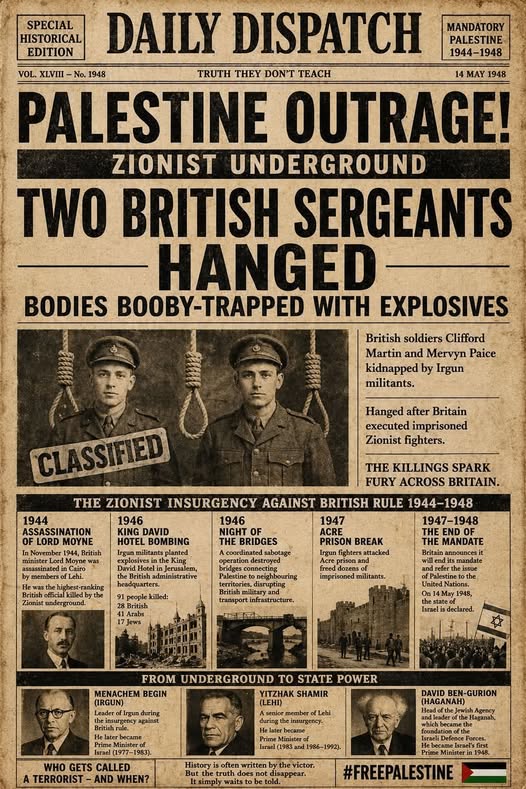
The Zionist Underground and the End of British Rule in Palestine. – Martin Michael
I went down a historical rabbit hole researching this and honestly, some of it genuinely took a minute to process.
Before Israel was created in 1948, Britain governed Palestine under what was known as the BritishMandate, following the collapse of the OttomanEmpire after World War I.
In the final years of British rule, several Zionist underground organisations launched an armed insurgency aimed at forcing Britain out of Palestine and paving the way for the creation of a Jewish state.
The main organisations involved were:
Irgun
A nationalist paramilitary group responsible for bombings, assassinations and attacks on British military and administrative targets.
Lehi (The Stern Gang)
A smaller but even more radical organisation that carried out assassinations and attacks against British officials and infrastructure.
Haganah
The largest Jewish paramilitary organisation in Palestine. Although it often operated differently from Irgun and Lehi, it did at times cooperate in coordinated operations against British targets.
At the time, British authorities officially referred to some of these groups as terrorist organisations, while supporters viewed them as anti-colonial fighters resisting British rule.
Historians generally refer to this period as the Jewish insurgency in MandatoryPalestine (1944–1948).
Some of the major events included:
1944 — Assassination of Lord Moyne
WalterGuinness, Britain’s Minister of State in the MiddleEast, was assassinated in Cairo by members of Lehi.
He was the highest-rankingBritish official killed during the insurgency.
1945 — Escalation of attacks
Militant groups intensified attacks on:
• railways
• bridges
• police stations
• government buildings
• immigration control infrastructure
Several groups temporarily worked together in a coordinated campaign known as the JewishResistance Movement.
1946 — Night of the Bridges
A coordinated sabotage operation destroyed bridges linkingPalestine with neighbouring territories, severely disrupting British transport and military infrastructure.
1946 — King David Hotel Bombing
Irgunmilitants planted explosives inside the KingDavidHotel in Jerusalem, which housed the British administrative headquarters.
The explosion killed 91 people:
28 British
41 Arabs
17 Jews
It remains one of the deadliest attacks carried out against British rule during the Mandate period.
1947 — Acre Prison Break
Irgun fighters attacked Acre prison and freed dozens of imprisoned militants.
1947 — Execution of British Sergeants
Two British soldiers, CliffordMartin and MervynPaice, were kidnapped and later hanged by Irgun after Britain executed imprisoned militants.
The killings caused outrage across Britain.
By 1947–48 the situation had become increasingly unmanageable for Britain.
Eventually Britain announced it would end the Mandate and hand the issue over to the United Nations.
On 14 May 1948, the state of Israel was declared.
What happened next is where the story becomes even more significant.
Many members of these underground organisations later moved directly into mainstream Israeli politics and state leadership.
Menachem Begin, leader of Irgun during the insurgency, later became PrimeMinister of Israel.
YitzhakShamir, a senior member of Lehi, also went on to become PrimeMinister.
Meanwhile Haganah became the foundation of the Israeli military itself.
All of this took place in the shadow of World War II and its aftermath, at a time when Britain had been financially and militarily devastated by war.
By 1944 Britishministers were being assassinated.
By 1946 British headquarters were being bombed.
By 1947 British soldiers were being kidnapped and executed.
Yet this history is rarely discussed in Britain today.
And it raises a question that still follows conflicts across the world now:
Who gets labelled a terrorist — and who later gets remembered as a freedom fighter or statesman?
Because history often seems to answer that question differently depending on who eventually wins power.