Category: USA

Turkey could be America’s most important regional ally, above Iraq, even above Israel, if both sides manage the relationship correctly.

  • Letter to Newsweek Inc

    Letter to Newsweek Inc

    Newsweek Inc, 
    The Graham Holdings Company
    One World Trade Center, Floor 72
    New York, NY 10007

    To the Editors of Newsweek,

    Your recent article, “The U.S. Should Not Sell Weapons to Turkey,” presents a deeply flawed and misleading analysis, marred by selective omissions, strategic distortions, and a troubling lack of diplomatic nuance. Rather than offering a constructive critique, the piece unfortunately aligns with a broader campaign that seeks to delegitimize a sovereign nation and NATO’s second-largest military power: the Republic of Türkiye.

    To begin with, a basic yet critical correction: the internationally recognized name of our country is the Republic of Türkiye. Continued use of outdated terminology disregards the democratic will of the Turkish people and fails to meet the diplomatic standards expected of a global publication.

    Türkiye’s role in NATO and global security is both substantial and indisputable. From Afghanistan to the Balkans, Libya to the Black Sea, Türkiye has borne a disproportionate share of the burden in defending collective security. It was Türkiye that engaged in direct ground combat against ISIS, and Türkiye that fortified NATO’s southeastern flank during times of regional volatility.

    The assertion that Türkiye has distanced itself from the West is factually incorrect. NATO officials and European partners have repeatedly affirmed that Turkish intelligence—particularly under the leadership of Hakan Fidan—has been instrumental in thwarting terrorist plots, countering extremism, and managing mass migration. Far from turning away from the West, Fidan’s tenure as head of MIT was defined by pragmatic cooperation with Western intelligence agencies. 

    As Foreign Minister, he continues to advocate a balanced foreign policy anchored in sovereign interests and regional stability. International actors, including the United States and Germany, have recognized Türkiye’s intelligence contributions as reliable and indispensable. NATO sources have even described Fidan as a “reliable interlocutor.”

    The article’s portrayal of Türkiye’s engagement with Russia also omits vital facts: it was Türkiye that closed the Straits to Russian warships, supplied Ukraine with Bayraktar drones, and led the Black Sea Grain Initiative—helping to avert a global food crisis. These are not the actions of a nation disengaged from the West, but of a responsible actor committed to sovereign diplomacy and international order.

    Regarding the S-400 issue: Türkiye sought to purchase the U.S. Patriot missile defense system for over a decade and was repeatedly denied. In the absence of viable alternatives, Türkiye acted to safeguard its national security. The subsequent imposition of CAATSA sanctions was not only punitive but revealed a stark double standard—other NATO allies operating Russian systems have not faced similar penalties like Bulgaria, Slovakia ,Greece and Non NATO member India .

    Additionally, the issue of U.S. foreign aid directed toward entities with ties to terrorist organizations, as highlighted in Gregg Roman’s testimony before the House Oversight and Government Reform Subcommittee, warrants urgent scrutiny. Ignoring such troubling contradictions while fixating on Türkiye’s legitimate security concerns represents a grave lapse in intellectual and journalistic integrity. Michael Doran of the Hudson Institute has rightly noted: “Türkiye is invaluable to the central task of American statecraft: countering the challenge from the revisionist bloc of China, Russia, Iran, and North Korea.” Without Türkiye, the West cannot uphold a viable order in Eurasia, nor effectively support partners such as Ukraine or Azerbaijan. Türkiye anchors critical energy corridors, promotes regional stability, and counters malign influence in the Caucasus and Central Asia.

    Regrettably, this Newsweek article appears less focused on nuanced analysis and more intent on perpetuating a narrative of Türkiye-bashing that serves certain political agendas. This is not a good-faith policy critique—it is a concerted effort to portray Türkiye as a perennial antagonist, to the detriment of transatlantic unity and the principles of equitable diplomacy.

    The authors’ distortions and inflammatory rhetoric offer little substance and much harm. Once again, Türkiye and the Turkish people are unfairly vilified in a narrative that disregards facts in favor of ideological convenience. In this era where principles are often forsaken for personal or political gain, these authors exemplify the erosion of objective discourse.

    I urge Newsweek to reflect with greater journalistic and editorial responsibility. Opinion pages should foster informed and balanced dialogue—not serve as conduits for interest-driven disinformation. The Republic of Türkiye remains a committed NATO ally, a sovereign democracy, and a force for regional and international stability. It will continue to uphold its responsibilities—but it will also defend its right to national security, territorial integrity, and diplomatic respect.

    I  call on Newsweek and its contributors to recognize these realities, reject politicized narratives, and engage in more honest, fact-based dialogue.

    Respectfully,

    Ibrahim Kurtulus 
    Community Activist 
  • Letter to Turkish Ambassador Sedat Onal

    Letter to Turkish Ambassador Sedat Onal

    His Excellency Sedat Onal
    Ambassador of the Republic of Türkiye to the United States
    Embassy of the Republic of Türkiye
    Washington, D.C.

    April 16, 2025 

    Your Excellency,

    I extend to you my sincere congratulations and deepest appreciation for your principled decision to cancel your appearance at the Assembly of Turkish American Association, ATAA annual meeting. Your refusal to lend legitimacy to an organization that has, under the guise of advocacy, recently served to organize and promote anti-Türkiye sentiment is both commendable and timely. At a moment when truth is so often distorted by misinformation and orchestrated campaigns, it is heartening to witness that ethics, loyalty, and integrity continue to serve as the guiding pillars of Türkiye’s diplomatic posture.

    Your decision resonates powerfully, much like TRT1’s recent action to exclude actress Aybüke Pusat from the Teşkilat series following her public boycott post. While personal opinions and artistic expression must always be respected in a democracy, leveraging one’s public platform to support campaigns that target the Republic of Türkiye its institutions, services, or image abroad is both irresponsible and divisive. Such actions do not reflect constructive criticism but rather serve to undermine national unity and international credibility.

    As  a Turkish Americans and many I know of friends of Türkiye, we recognize the necessity of respectful dialogue and even constructive disagreement. I have personally expressed policy differences with  Ambassador / Consul General Ahmet Yazal in a direct and professional manner, upholding mutual respect. However, I categorically reject the idea of undermining Türkiye’s diplomatic presence through street protests in New York or elsewhere in America—protests that often aim to mislead or confuse our fellow Americans, many of whom may lack even a basic understanding of Türkiye’s history, geography, or governance.

    It is equally troubling that political activism here in America has become a platform for divisive, threatening, and polarizing discourse that disregards democratic processes and the rule of law. When political rhetoric seeks not engagement but humiliation—particularly towards our  NATO ally and sovereign state, it becomes a weapon in the larger campaign to delegitimize Türkiye’s standing on the international stage.

    Even more disturbing is the fact that threats to the Republic of Türkiye’s economic stability and statements aimed at damaging civilian and investor confidence are being disseminated abroad, especially in the United States, by certain circles within the grassroots community. This goes beyond political rivalry—it is a deliberate attempt to sabotage the national interests of the Republic of Türkiye. I have been a community activist for over 35 years, steadfastly advocating for Türkiye’s rightful place in the global community especially here in America . I have spoken out on matters ranging from World War I distortions to Cold War alliances and modern national security and national Interest of mothers homeland of Turkiye. Yet, I have never seen 55% of these individuals at our community meetings, never heard their voices raised in defense of Türkiye’s interests. However, when it comes to defaming Türkiye, they are suddenly at the front of the line without even needing an invitation.

    This issue has become yet another tool in an international campaign to delegitimize the Turkish state. The groups in America who hold Turkish or dual citizenship and engage in these activities are not seeking accommodation, democratic normalization, or unity in grassroots politics. Their intent is clear: to humiliate the Republic of Türkiye on American soil, to sap its international reputation, and to harm it politically and economically.

    Therefore, Your Excellency, I once again commend your ethically sound and strategically wise decision. It sends a message that should resonate across all of our diplomatic and community institutions that the Republic of Türkiye will not stand idly by while its values, people, and sovereignty are maligned. I respectfully urge the Turkish Consulate General in New York and all those in positions of public representation to adopt the same principled stance. Individuals and organizations subcontracted to serve Türkiye’s interests whether as providing a service , event organizers, or consultants must be held to a standard that reflects loyalty and ethical responsibility. I firmly believe just as you demonstrated, Mr. Ambassador that it is higher principles such as national dignity, truth, and moral clarity that must ultimately guide our choices.

    Thank you, Your Excellency, for your service and for setting a powerful example in these difficult times.

    Respectfully,

    Ibrahim Kurtulus 
    Community Activist 

  • Letter to Senator Chris Van Hollen

    Letter to Senator Chris Van Hollen

    Senator Chris Van Hollen
    730 Hart Senate Office Building
    Washington, DC 20510
    Phone: (202) 224-4654
    Fax: (202) 228-0629

    RE: Rebuttal to Senator Van Hollen’s Assertions Regarding Türkiye and U.S. Policy

    April 7, 2025 

    Senator Chris Van Hollen,

    Your recent commentary during the Senate Foreign Relations Committee hearing concerning Tom Barrack’s nomination as U.S. Ambassador to Türkiye, and your subsequent public statements, reveal a deeply flawed and intellectually inconsistent approach to U.S.-Türkiye relations. Your assertions, particularly regarding the nomenclature of Türkiye, the Ekrem İmamoğlu case, the CAATSA sanctions, and the broader characterization of Türkiye’s governance, warrant a rigorous and unequivocal rebuttal.

    Firstly, the persistent disregard for the Republic of Türkiye’s formal request to be addressed as “Türkiye” is not a trivial semantic matter. It constitutes a profound act of diplomatic disrespect, undermining the very principles of sovereignty and national identity that the United States purports to uphold. To continue employing the outdated “Turkey” is to perpetuate a colonial vestige, a relic of a bygone era that fails to acknowledge the nation’s contemporary self-determination.

    Secondly, your critique of the administration’s response to the Ekrem İmamoğlu case, couched in the rhetoric of “stability” versus “democracy,” reflects a superficial understanding of Türkiye’s legal and political complexities. The legal proceedings against İmamoğlu, regardless of their political ramifications, must be contextualized within Türkiye’s established legal framework. To conflate legitimate legal processes with authoritarianism is to engage in a disingenuous exercise in political grandstanding. As Time Magazine aptly observed, “Istanbul’s Rebuke of Erdogan Shows That Democracy Lives in Türkiye,” highlighting the nation’s vibrant democratic processes and the robust participation of its citizenry. To selectively isolate İmamoğlu’s case while ignoring the broader context of Türkiye’s democratic engagement is an act of selective perception.

    Furthermore, your stance on the F-35 and S-400 issue is riddled with inconsistencies and strategic myopia. The imposition of CAATSA sanctions, while presented as a matter of principle, has demonstrably weakened NATO’s southern flank. The United States’ refusal to provide Türkiye with the Patriot missile system precipitated its acquisition of the Russian S-400, a decision born of necessity, not malice. Moreover, your conspicuous silence regarding the operation of Russian-made S-300 systems by other NATO members—Greece, Bulgaria, and Slovakia—exposes a glaring double standard. This selective application of punitive measures undermines the integrity of the alliance and emboldens adversaries who exploit such internal divisions.

    The narrative you and others propagate, portraying Türkiye as an “authoritarian” state, is a gross oversimplification. Türkiye, despite its challenges, operates as a functioning democracy, characterized by active political participation, a diverse media landscape, and regular elections. President Erdoğan’s electoral victories, achieved through high voter turnout, attest to the strength of Türkiye’s democratic mandate. The legal actions taken against certain journalists, while subject to scrutiny, are part of broader efforts to ensure responsible and unbiased reporting. To ignore the diversity of viewpoints present in Türkiye’s media landscape is to deliberately misrepresent the facts.

    Your selective indignation regarding legal proceedings in Türkiye contrasts sharply with your silence on similar issues within the United States and other Western nations. The prosecution of whistleblowers like Edward Snowden and Julian Assange, the detention of individuals at Guantanamo Bay without trial, and the use of extrajudicial drone strikes all raise profound questions about the application of democratic values. Are these not examples of the same “democratic backsliding” you so readily condemn in Türkiye? Further, your silence regarding the corruption charges against prominent figures in France, England and the United States, such as the French Far Right Leader, Former Mayor of Liverpool Joe Anderson, and Former Governor of Puerto Rico, Wanda Vázquez Garced, exposes a deeply troubling inconsistency. Your selective outrage reveals a political agenda, not a principled stance.

    Furthermore, the documented instances of U.S. foreign aid being directed to entities with ties to terrorist organizations, as highlighted by Gregg Roman’s testimony before the House Oversight and Government Reform Subcommittee, demand your attention. To ignore such egregious breaches while fixating on Türkiye’s legitimate security concerns is an act of profound intellectual dishonesty.

    The orchestrated campaign to delegitimize Türkiye, characterized by the exploitation of digital platforms and non-governmental organizations, constitutes a deliberate assault on the nation’s sovereignty and existence. This sustained effort to demonize Türkiye, to paint it as a villain, is not merely a diplomatic disagreement; it is a calculated attempt to erode the nation’s rightful place on the world stage.

    In conclusion, your assertions, Senator Van Hollen, are predicated on a selective application of facts, a profound disregard for diplomatic norms, and a conspicuous double standard. A more balanced and intellectually rigorous approach is imperative if the United States is to maintain a constructive and mutually respectful relationship with its vital NATO ally, Türkiye.

    Ibrahim Kurtulus

    Community Activist 

  • Letter to US Secretary of State Marco Rubio

    Letter to US Secretary of State Marco Rubio

    US  Secretary of State Marco Rubio

    U.S. Department of State
    2201 C Street NW
    Washington, DC 20520
    United States

    April 5, 2025 

    Honorable Secretary of State

    I write to address the so called concerns raised by American citizens of Greek heritage and Philhellenes

    regarding the Republic of Türkiye and to provide a factual and balanced perspective that counters misleading narratives and unjustified accusations against our NATO ally. The argument against Türkiye’s procurement of F-35 fighter jets is based on outdated rhetoric, mischaracterizations of Turkish policies, and a failure to acknowledge Türkiye’s indispensable role in regional and global security.

    1. Türkiye’s Commitment to Counterterrorism and Regional Stability

    The assertion that Türkiye harbors or supports terrorist organizations is categorically false. As a nation that has suffered immensely from terrorism, Türkiye has been at the forefront of the fight against groups such as ISIS, the PKK/YPG, and other extremist elements. Contrary to the claims made, Türkiye has actively dismantled terrorist networks and conducted military operations to secure its borders and protect civilian populations.

    On Hamas: Türkiye has engaged with Hamas as part of its diplomatic efforts to promote regional stability, much like other states in the region, including Qatar and Egypt. Diplomatic engagement does not equate to material support. Moreover, the recent normalization of Türkiye-Israel relations, including intelligence-sharing agreements, demonstrates Türkiye’s pragmatic approach rather than hostility toward Israel.

    On Hezbollah: There is no factual basis to claim that Türkiye has exhibited “sympathy” toward Hezbollah. Türkiye has maintained a consistent position against Iran-backed militant groups that threaten regional security.

    2. Türkiye’s Right to Defend Its Borders and Counter the PKK/YPG Threat

    The claim that Türkiye’s military operations in Syria constitute aggression against U.S. allies ignores key realities:

    The PKK is a U.S.-designated terrorist organization. The YPG, its Syrian branch, has been armed and supported under the guise of counter-ISIS operations. However, it continues to attack Turkish cities and civilians.

    Türkiye has conducted counterterrorism operations in full compliance with international law and the right to self-defense under Article 51 of the UN Charter. No sovereign nation would tolerate terror threats emanating from its borders.

    The argument conveniently omits that Türkiye was the only NATO country to engage in direct combat against ISIS in Syria, including the liberation of key cities such as al-Bab and Jarabulus, saving thousands of lives.

    3. Türkiye’s NATO Commitment and Relations with Russia

    Accusations that Türkiye has failed to impose sanctions on Russia ignore the complexity of Türkiye’s geopolitical position and strategic autonomy. It is important to note:

    Türkiye has supplied Ukraine with Bayraktar TB2 drones, which have played a crucial role in resisting Russian aggression.

    Unlike several European NATO members, Türkiye closed the Bosporus and Dardanelles Straits to Russian warships, limiting Moscow’s naval mobility.

    Sanctions are not the sole measure of alignment; Türkiye’s diplomatic efforts, such as the Black Sea Grain Initiative, prevented a global food crisis by ensuring Ukrainian grain exports.

    4. The F-35 and the S-400 Issue

    The decision to sanction Türkiye under CAATSA due to its procurement of the Russian S-400 system was a strategic miscalculation that weakened NATO’s southern flank. The United States refused to sell Türkiye the Patriot missile system, leaving Türkiye with no choice but to seek alternatives for its air defense needs.

    It is hypocritical to punish Türkiye while permitting other NATO countries like Greece, Bulgaria,  Slovakia (NATO members)  to operate(d) Russian-made S-300 systems without similar repercussions.

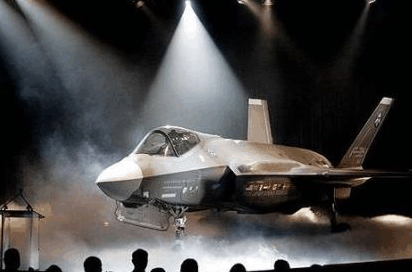
    The exclusion of Türkiye from the F-35 program disrupts NATO’s interoperability and emboldens adversaries by weakening alliance cohesion.

    5. Greek Provocations and the Eastern Mediterranean

    The claim that Türkiye threatens Greece is a one-sided misrepresentation of the ongoing disputes in the Aegean and Eastern Mediterranean.

    Greece has repeatedly violated international law by militarizing Aegean islands, contrary to the 1923 Lausanne and 1947 Paris Peace Treaties.

    Greek airspace violations and unlawful expansionist policies under the “Blue Homeland” doctrine have escalated tensions, not Türkiye’s legitimate actions to protect its maritime rights.

    Türkiye has consistently called for diplomatic dialogue, while Greece continues to seek unilateral military escalations and misrepresentations to international partners.

    6. The Cyprus Issue: A Call for Equitable Solutions

    Türkiye does not “occupy” Cyprus but rather protects Turkish Cypriots from historical ethnic violence that began in 1963, years before the 1974 intervention.

    The international community has failed to hold Greece and the Greek Cypriot administration accountable for violating the rights of Turkish Cypriots.

    The 2004 Annan Plan, which proposed reunification, was overwhelmingly rejected by Greek Cypriots while Turkish Cypriots supported it, proving who is the obstructionist party.

    Conclusion: Türkiye is an Indispensable Ally

    Denying Türkiye advanced defense capabilities weakens NATO rather than strengthening it. Türkiye has:

    The second-largest military in NATO, securing the alliance’s southern flank.

    Been a reliable partner in Afghanistan, Iraq, Syria, Libya, and the Black Sea in various military and humanitarian missions.

    Played a vital role in counterterrorism, energy security, and regional stability, far outweighing the misleading narratives propagated by interest groups seeking to undermine U.S.-Türkiye relations.

    Decisions on arms sales should be based on strategic security interests, not lobbying efforts rooted in historical grievances. Türkiye remains committed to its NATO obligations, counterterrorism efforts, and regional diplomacy, and it is in the best interest of the United States to reinforce this partnership rather than weaken it.

    We must recognize that we are confronted by a highly coordinated and determined network of individuals who thrive on promoting hatred and misinformation.

    These so-called “merchants of hate” have become adept at exploiting digital platforms and engaging with non-governmental human rights organizations in increasingly sophisticated ways to advance their agenda.

    If this ongoing campaign of delegitimization is left unaddressed, it risks becoming a significant impediment to regional peace and stability.

    While some may dismiss these smear campaigns as absurd, the consequences they produce are far from trivial. It is important to acknowledge that many of those perpetuating such narratives harbor longstanding grievances and nationalistic ambitions. Rather than examining their own domestic shortcomings, including the reality that Greece remains the only European capital without a functioning mosque and continues to draw condemnation from the European Court of Human Rights for its treatment of the Turkish Muslim minority, they attempt to shift attention through baseless accusations against the Republic of Türkiye.

    Greece’s antagonism toward Türkiye is multifaceted—extending well beyond the political and military spheres. It encompasses direct attacks on the spiritual and cultural identity of the Turkish and broader Muslim communities, including deeply offensive acts such as the desecration of mosques and the burning of the Holy Quran.

    Moreover, Greece has invested substantial resources in establishing a global apparatus of influence and propaganda. Through the strategic use of social media, transatlantic platforms, and well-funded lobbying efforts—particularly within the U.S. Congress—Greece has sought to shape international narratives to its advantage. These efforts are further supported by investments in academia, think tanks, and media outreach, all designed to undermine the legitimacy of the Turkish state.

    This issue has become another weapon in the international campaign to de-legitimize the Turkish state and the Turkish people. Once again, Turkiye is painted as a villain. 

    What we are witnessing is not a simple diplomatic disagreement but a deliberate and sustained effort to target the very existence and sovereignty of the Republic of Türkiye. At the heart of this campaign is a singular and troubling objective: to demonize Türkiye at every opportunity. This orchestrated rhetoric has become yet another tool in a broader international campaign aimed at eroding the legitimacy of both the Turkish state and its people.

    It is therefore imperative that we confront these efforts with unity, resolve, and strategic communication, firmly asserting Türkiye’s rightful place and reputation on the world stage.

    Respectfully,

    Ibrahim Kurtulus 

    Community Activist 
  • Greek Orthodox Archdiocese of America “constantinople”

    Greek Orthodox Archdiocese of America “constantinople”

    His Eminence Archbishop Elpidophoros
    Greek Orthodox Archdiocese of America
    8-10 East 79th Street
    New York, NY 10075

    March 14, 2025 

    Your Eminence,

    I write to you with deep concern regarding a statement you made while presenting a cross to His Excellency Archbishop Gregory Michael Aymond during your visit to New Orleans on March 14, 2025. You described the cross as having been made in “constantinople.”

    For many years, I have studied maps from every possible source, yet I have never been able to locate a place on Earth by that name. It is profoundly disheartening that someone of your esteemed position—born and raised in the great city of Istanbul—would choose to use such an anachronistic term to refer to the modern, thriving metropolis that has been known as Istanbul since May 29,1453.

    Such references are not mere words; they are part of a broader and troubling pattern aimed at undermining the sovereignty and legitimacy of the Republic of Türkiye and diminishing the identity of Istanbul, a city of over 15 million people. The continued use of the term “constantinople” in international discourse serves no constructive purpose and, instead, feeds into a deliberate campaign to delegitimize the Turkish state, discredit its people, and weaponize history for political agendas. I must strongly and respectfully emphasize that there is no city in the world today called “constantinople.” To suggest otherwise is to engage in an insidious form of historical revisionism that disregards the reality of modern Türkiye, a nation built on sovereignty, progress, and coexistence. This narrative does not serve the interests of peace, mutual respect, or interfaith relations.

    Demonizing Türkiye is not the answer. If the goal is to foster dialogue and understanding, I urge you to show the same respect for Türkiye’s territorial and historical integrity that you would expect for your own church or cities in Greece. The city is Istanbul. It has been, and it will remain so.

    With due respect, I trust you will reflect on the weight of such statements and choose words that foster unity rather than division.

    Sincerely,

    Ibrahim Kurtulus

  • ICE defends raid on NJ restaurant amid criticism

    ICE defends raid on NJ restaurant amid criticism

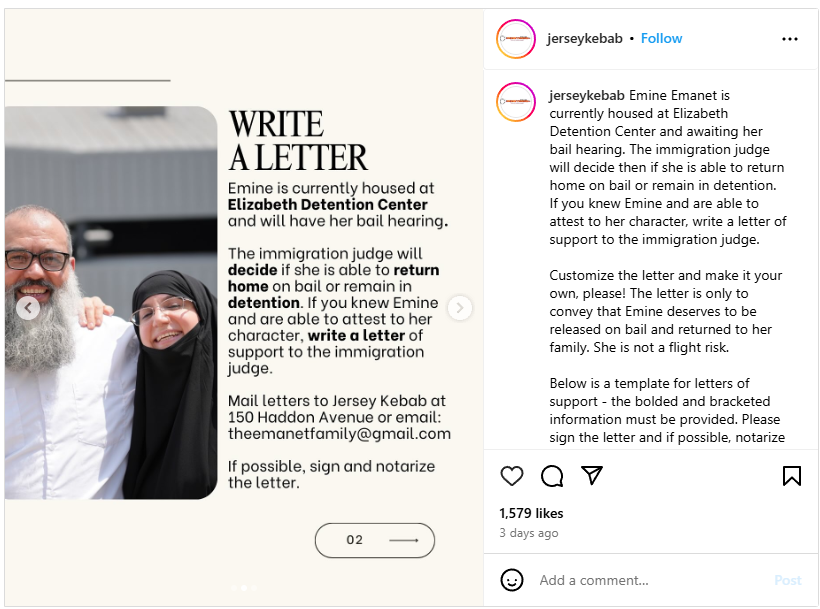
    One of the owners of a Turkish restaurant in Haddon Township is still in custody after U.S. Immigration and Customs Enforcement agents raided the restaurant on Tuesday. Emine Emanet remains in custody while her husband Celal Emanet was released with an ankle monitor. “It is all a test from God,” said their son Muhammad Emanet, who works at the restaurant, Jersey Kebab.

    The South Jersey community is rallying behind the Emanet family after ICE raided their family-owned restaurant, detaining Emine Emanet, a mother and primary caregiver to her 15-year-old autistic child. Emine and her husband have no criminal record and have been waiting for years for their green card status to be resolved.

    Community members are showing their support through letters, messages, and donations to help the family through this crisis.

    Take Action

    Write a support letter for the Emanet family: https://tinyurl.com/yrmvenvm

    Emine Emanet is currently housed at Elizabeth Detention Center and awaiting her bail hearing. The immigration judge will decide then if she is able to return home on bail or remain in detention. If you knew Emine and are able to attest to her character, write a letter of support to the immigration judge.