Category: USA

Turkey could be America’s most important regional ally, above Iraq, even above Israel, if both sides manage the relationship correctly.

  • New int’l flotilla heading to Gaza in early 2011

    New int’l flotilla heading to Gaza in early 2011

     By ASSOCIATED PRESS 
    10/12/2010 09:53

    IHH says may send ship larger than Mavi Marmara; US group sending ship named after Obama’s book, “Audacity of Hope.”

    GENEVA — Pro-Palestinian groups plan to sail a flotilla of boats through Israel’s sea blockade of Gaza as early as February in the second such attempt in less than a year, activists said Monday.

    The activists, representing groups from over a dozen countries including Switzerland, Turkey and the United States, said the flotilla would be bigger than the one stopped by Israel earlier this year.

    “It’s not about the aid,” Huwaida Arraf of the Freedom Flotilla Coalition told reporters in Geneva.

    Arraf said the aim will instead be to show that the Gaza blockade can be broken. A spokeswoman at Israel’s embassy in Bern, Shlomit Sufa, said humanitarian goods are allowed into Gaza by land and the sea blockade is needed to prevent weapons being smuggled in to the Palestinian militant group Hamas. Several smaller ships have failed to reach Gaza since the May raid — most recently last month, when a boat carrying Jewish activists tried to reach the densely populated strip. Among the groups planning to take part in the latest flotilla is the Turkey-based Islamic charity IHH, which sponsored the Mavi Marmara — by far the biggest ship in the first flotilla. A representative of the group, Ahmet Faruk Unsal, said IHH is considering sending another ship of the same size. An American group, US Boat to Gaza, is also planning to send a vessel, said activist Jane Hirschmann. The boat will be named “The Audacity of Hope” in reference to US President Barack Obama’s best-selling policy book.

  • One Year On, Turkey-Armenia Rapprochement Stalled

    One Year On, Turkey-Armenia Rapprochement Stalled

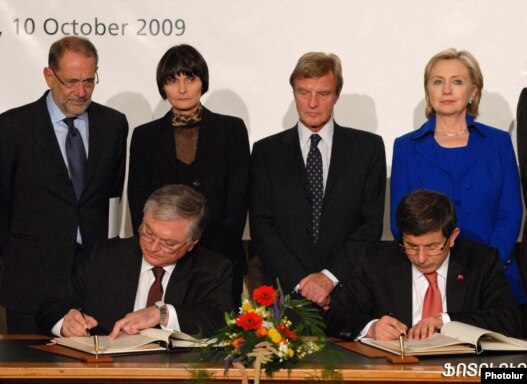
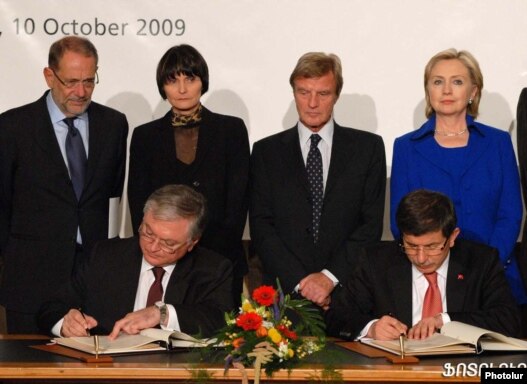
    Foreign Ministers Eduard Nalbandian of Armenia (L) and Ahmet Davutoglu of Turkey sign landmark agreements to normalize Turkish-Armenian relations in Zurich.Foreign Ministers Eduard Nalbandian of Armenia (L) and Ahmet Davutoglu of Turkey sign landmark agreements to normalize Turkish-Armenian relations in Zurich.

    11.10.2010
    Tigran Avetisian, Suren Musayelyan
    One year ago, on October 10, 2009, Armenia and Turkey signed two protocols aimed at normalizing relations. The signing of what many political pundits termed a “historic” deal took place in Zurich, the culmination of painstaking diplomatic efforts by the two countries’ presidents and by international mediators, primarily Switzerland and the United States.

    The Western-backed process began with Turkish President Abdullah Gul’s historic September 2008 visit to Yerevan, following an invitation by his Armenian counterpart, Serzh Sarkisian, to attend a soccer World Cup qualifier between the national teams of the two neighbors.

    The two leaders watched the return leg of the match in the Turkish city of Bursa a year later, just four days after their foreign ministers, Edward Nalbandian and Ahmet Davutoglu, inked two protocols committing to the establishment of diplomatic relations and the opening of their borders soon after the documents were ratified in both countries’ parliaments.

    But a year on, the future of the protocols remains unclear, as no parliamentary ratification of the documents has taken place in either country. Meanwhile, the cautious optimism surrounding the future of the deal, which faced domestic opposition in both countries, has fizzled out.

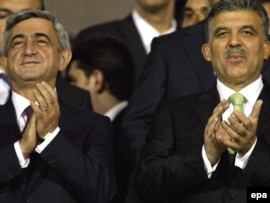
    Turkey — President Abdullah Gul (R) with his Armenian counterpart Serzh Sarkisian at Turkey vs Armenia FIFA 2010 World Cup group match in Bursa, 14Oct2009

    Official Yerevan and political majority leaders in Armenia had repeatedly stated the country’s strong readiness to complete the ratification of the protocols in the Armenian legislature, but only after Turkey made that step first.

    But since the signing ceremony, senior officials in Turkey have sought to link ratification of the protocols with progress in a separate dispute between Armenia and Azerbaijan over the region of Nagorno-Karabakh. Yerevan responded by saying the protocols contained no conditions regarding that issue and that Ankara should, therefore, proceed with the ratification of the agreements unconditionally.

    The diplomatic bickering eventually led to Sarkisian suspending the ratification process in the Armenian parliament last April. But he indicated that Yerevan was not, for now, withdrawing its signature from the documents – a statement welcomed by the international community, in particular by the United States and the European Union.

    Views on the future of the protocols remain largely pessimistic at this moment – at least on the Armenian side. Alexander Arzumanian, a senior member of the opposition Armenian Pan-National Movement (HHSh), believes true normalization is not a priority for Turkey.

    “Turkey used the protocols to solve its most important issue, as [due to these protocols] it has become a full player in this region and has gotten its own place in the negotiating format for a Karabakh settlement,” he said.

    The opposition member, who served as Armenia’s foreign minister from 1996 to 1998, argued that Armenian authorities should not have launched the process the way they did, since Turkey, he claims, views all things within one package — that is, to make Armenia abandon its long-standing effort to gain international recognition of the World War I-era mass killings and deportations of Armenians in the Ottoman Empire as genocide, as well as to persuade Armenia to make concessions over Karabakh in favor of Turkey’s regional ally Azerbaijan.

    The announcement of a road map for a Turkey-Armenia rapprochement in April 2009 made the Armenian Revolutionary Federation (Dashnaktsutyun) quit the governing coalition. Giro Manoyan, a foreign policy spokesman for the now opposition party, insists that Yerevan must move further toward withdrawing its signature, as the current process only benefits Turkey.

    “I think the first anniversary [of the signing of the protocols] is a good occasion for Armenian authorities to withdraw their signature from the protocols,” Manoyan said, “considering the fact that Turkey has failed to show goodwill, and in reality is currently using the protocols for a different purpose than what they were meant for.”

    Another opposition party, Heritage, which vehemently opposed the protocols from the outset, shares Dashnaktsutyun’s position. The leader of the Heritage party’s parliamentary faction, Stepan Safarian, says Armenia must withdraw its signature from the document considering the “constant speculations” from Turkey.

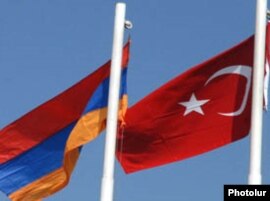
    Armenian and Turkish flags

    Armenia’s ruling party, meanwhile, thinks Armenia has benefited from the process in terms of “showing itself as a good partner” to the world.

    “Armenia may consider the problems it has raised before itself in connection with the protocols solved, in the sense that the Armenian side has proved to the entire world that it is a good and constructive partner, that it seeks to solve problems with all neighbors peacefully, through negotiations, and is ready to start certain relations unconditionally,” says Republican Party of Armenia (HHK) lawmaker Karen Avakian. “This process needed to be started, and I think it was necessary to once again unmask Turkey, to make Turkey show its [true] face to the world.”

    Avagian does not exclude that dialogue between Yerevan and Ankara may still continue “if Turkey shows constructive behavior.” “I think sooner or later Turkey will realize the gravity of these issues and will not take into consideration the Karabakh process,” Avagian added.

    In a recent interview with the Austrian news magazine “Profil,” Armenian Foreign Minister Edward Nalbandian also gave an indication that Armenia does not consider the process of normalization with Turkey as having completely failed. “We hope that the process is not dead, but suspended,” he said.
    https://www.azatutyun.am/a/2187492.html
  • An anti-corruption crusader’s $55 million haul

    An anti-corruption crusader’s $55 million haul

    Posted By Steve LeVine – Thursday, October 7, 2010 – 6:28 PM

    As the saying goes, people gravitate to public service to do good, and stay on to do well. In any case, that apparently is Peter Galbraith’s motto. In the 1980s, this foreign policy maven (and son of economist John Kenneth Galbraith) became known for his part in exposing Saddam Hussain’s gassing of the Kurds, and for being one of Benazir Bhutto’s best allies in America; in the 1990s, he was a key diplomat in the Balkans; and most recently, he was fired as deputy United Nations envoy in Afghanistan, then accused the Kabul government of massive fraud in the 2009 presidential election. 

    Late last year, we learned from the work of journalists at the Norwegian newspaper Dagens Naeringsliv (Galbraith’s wife is from Norway) and the New York Times that Galbraith also has cashed in on his long work in Kurdistan. After the 2003 U.S. invasion of Iraq, Galbraith was instrumental in Kurdistan gaining as much independence from the central government in Baghdad as it did. Now we know fairly well how much Galbraith’s work was worth — between $55 million and $75 million, as established yesterday by a British court presiding over a commercial lawsuit.

    Galbraith perceives no ethical issue, he told the Boston Globe’s Farah Stockman while on the campaign trail in Vermont, where he is a candidate for state Senate. He told Stockman that he plans to “reinvest the proceeds in alternate energy development both here in Vermont and in Kurdistan.”

    The story reminds me of Stanley Escudero, the former U.S. ambassador to Tajikistan, Uzbekistan, and Azerbaijan. When I first heard of Escudero in the early 1990s in Tajikistan, I was amused to learn that he fashioned himself as a macho Stallone type, because during the first shots of the civil war, in 1992, Escudero wouldn’t set foot in the country; he let his deputy chief of mission, Ed McWilliams, handle the show. Whatever the case, Escudero took his tough-talking act on to Tashkent, then Baku. And then it was time to retire. Escudero moved back home to Florida.

    It wasn’t long, however, before Escudero turned up again back in Baku — this time as a private “consultant.” You see, Escudero had become mighty close to Ilham Aliyev, who had recently taken over as president after the death of his father, Heydar; Escudero in fact was a hunting buddy of Ilham’s. Now, Escudero became an insider. Bluntly speaking, he sold access to Ilham, the customs ministry and so on — all those fellows he had come to know as ambassador. Escudero was open about his motives: He wanted to get rich. He is still there.

    Escudero isn’t breaking any U.S. law, I have been told by U.S. officials. But his behavior is important knowledge for local officials — the ambassador you meet today, suggesting that the fair and market-based thing to do would be to close a contract with this or that American oil or telecoms company, could be returning a year hence as the representative of that same company. That same ambassador who, while he was working for the U.S. State Department, railed against local officials enriching themselves on the job.

    This former ambassador — and Peter Galbraith — makes it difficult for current diplomats working to make good policy with a straight face.

  • US sorry for helicopter attack that killed Pakistani soldiers

    US sorry for helicopter attack that killed Pakistani soldiers

    AP – THE US has apologised for a helicopter attack that killed two Pakistani soldiers at an outpost near the Afghan border, saying American pilots mistook the soldiers for insurgents.

    The apology, which came after a joint investigation, could pave the way for Pakistan to reopen a key border crossing that NATO uses to ship goods into landlocked Afghanistan.

    Pakistan closed the crossing to NATO supply convoys in apparent reaction to the September 30 incident.

    Suspected militants have taken advantage of the impasse to launch attacks against stranded or rerouted trucks.

    “We extend our deepest apology to Pakistan and the families of the Frontier Scouts who were killed and injured,” said the US ambassador to Pakistan, Anne Patterson.

    Pakistan initially reported that three soldiers were killed and three wounded in the attack, but one of the soldiers who was critically injured and initially reported dead ended up surviving, said Major Fazlur Rehman, the spokesman for the Frontier Corps.

    Pakistani soldiers fired at the two US helicopters prior to the attack, a move the investigation team said was likely meant to notify the aircraft of their presence after they passed into Pakistani airspace several times.
    “We believe the Pakistani border guard was simply firing warning shots after hearing the nearby engagement and hearing the helicopters flying nearby,” said US Air Force Brigadier General Tim Zadalis, NATO’s director for air plans in Afghanistan who led the investigation.
    “This tragic event could have been avoided with better coalition force co-ordination with the Pakistan military.”
    The head of US and NATO forces in Afghanistan, General David Petraeus expressed his condolences.
    Pakistan moved swiftly after the attack to close the Torkham border crossing that connects northwestern Pakistan with Afghanistan through the famed Khyber Pass.
    The closure has left hundreds of trucks stranded alongside the country’s highways and bottlenecked traffic heading to the one route into Afghanistan from the south that has remained open.
    There have been seven attacks on NATO supply convoys since Pakistan closed Torkham, including those on Wednesday.

    October 07, 2010

  • The road to Tehran runs through Ankara

    The road to Tehran runs through Ankara

    Posted By Geneive Abdo

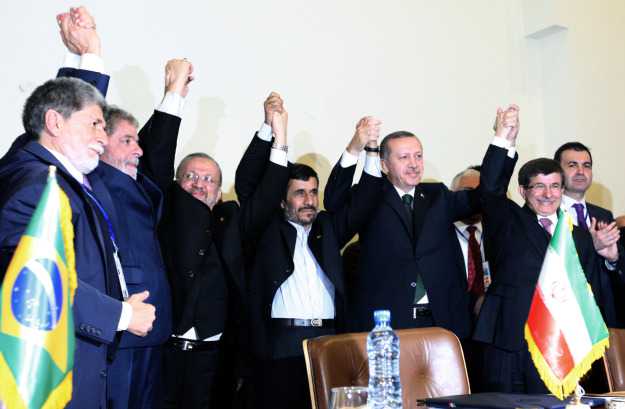
    Iran’s Foreign Minister Manouchehr Mottaki in recent days met with dignitaries at the United Nations to generate international support for Iran to engage in talks with the United States and other permanent members of the UN Security Council over Iran’s nuclear program. But when Mottaki and other Iranian officials in Tehran have talked recently about restarting talks, they are not referring to the nuclear negotiations the Europeans and the United States are hoping for; rather, they are trying to gain traction on negotiations about the Tehran Declaration, the agreement brokered between Iran, Brazil and Turkey in May, which is limited to a swap deal over a portion of Iran’s enriched uranium. This is the deal the United States, Britain, and France dismissed in May as a sideshow and a manipulative tactic by Iran to get out of tough sanctions, shortly before crippling sanctions were passed in the United Nations, the European Union, and the U.S. Congress. At the time, this action prompted a hostile reaction from Iran.

    Now that Mottaki is placing the deal squarely on the table again, the Obama administration should seize the moment. Rather than purse talks over Iran’s broader nuclear program and risk failure — during a period when there appears to be little time to waste before either a military attack is launched against Iran or Iran develops the technology to produce a nuclear weapon — a wiser move would be to talk with Iran first over the Tehran Declaration as a way of building trust.

    This is certainly the view of the Turks. A delegation of Turkish parliamentarians was in Washington last week for meetings with the Obama administration over Ankara’s relations with Iran, Israel and other issues. The delegation likely advised the United States to take Iran up on its offer to begin talks immediately over the Tehran Declaration. At least one other Turkish delegation visited Washington this past summer, delivering this same message. But their efforts produced little more than hostility from members of Congress and less than enthusiastic responses from officials in the administration.

    In interviews I had in Turkey during a recent trip there, Turkish diplomats who spent months shuttling between Ankara and Tehran last spring to broker the Tehran Declaration told me that the United States should accept Iran’s offer to make the Tehran Declaration the framework of any negotiations with the five-plus-one because there is no support in Tehran now to negotiate over Iran’s broader nuclear program. This might be what the United States wants, but there is no backing for it among a cross-section of Iran’s political elites. “The inner circle around [Supreme Leader Ali] Khamenei views this Tehran agreement as a first step to establish good faith with Western governments,” said one Turkish official with first-hand knowledge of the talks with Iran.

    Iran’s new campaign to revive the Tehran Declaration extends from New York to Tehran. On Sept. 28, Iranian Foreign Ministry Spokesman Ramin Mehmanparast reiterated Iran’s position: “We have repeatedly said that we are ready for talks with Vienna Group based on [the] Tehran Declaration and we are continuing consultation to specify details of the negotiation as well as its place and time.”

    Turkish officials have stated repeatedly — both last week during their Washington visit and in the summer — that Turkey wants to facilitate the negotiations with Iran and the five-plus-one. Indeed, as the arbiter Turkey would likely ensure success. By now, Turkish negotiators understand the internal politics inside the Iranian regime far better than their European or American counterparts do. The many months Turkish foreign ministry officials shuttled between Tehran and Ankara were instructive: “It was a good lesson in how to build a consensus with different political actors,” one Turkish foreign ministry official told me who participated in the delegation.

    The Turks believe that negotiations first over the fuel swap deal — even though it falls far short of the demands of the five-plus-one — will lead the inner circle around Khamenei and the supreme leader himself to compromise over other issues of concern to the West, such as Iran enriching uranium at 20 percent, which the Obama administration adamantly opposes because it could allow Iran to eventually produce a nuclear weapon.

    The United States should listen to the Turks, simply because there are no other options to begin a dialogue with Iran. At this point, we do not need any more negotiations with Iran to understand that Western states cannot effectively talk to the Iranians alone. Talks between the five-plus-one with Iran, with Turkey as the arbiter, are a positive path out of the deadlock.

    Geneive Abdo is the Director of the Iran program at The Century Foundation and creator of .

    ,

    October 6, 2010

  • Blame Nobel for crisis, says author of “Black Swan”

    Blame Nobel for crisis, says author of “Black Swan”

    By Adam Cox

    STOCKHOLM (Reuters) – Did the Nobel prize help trigger the worst financial crisis since the Great Depression?

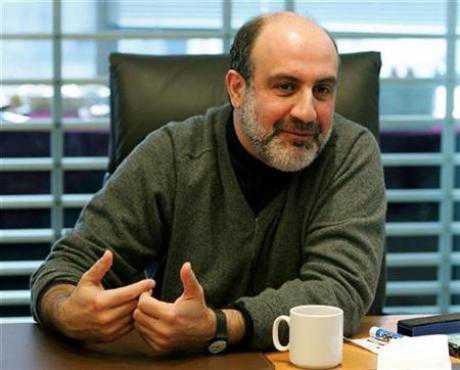
    Nassim Taleb, who shot to fame with his ideas about risk in the book “The Black Swan,” believes the economics award and the theories it celebrates deserve their share of blame.

    “I want to remove the harm from these economic models. And the Nobel is not helping. They should be held partly responsible, if not largely responsible, for the crisis,” Taleb told Reuters by telephone.

    The first of the Nobel awards will be announced next Monday, with the economics prize due a week later on Oct 11.

    According to Taleb, there are a number of mistaken ideas about forecasting and measuring risk, which all contribute to events like the 2008 global crisis. The Nobel prize, he says, has given them a stamp of approval, allowing them to propagate.

    Taleb is a former trader who took advantage of the mispricing of derivatives to make his fortune in the years before the crisis. He published “The Black Swan” in 2007 and went on to make millions more during the upheaval.

    He rattles off a list of Nobel prize winners who make his blood boil. They include: Harry Markowitz, William Sharpe, Robert Merton, Myron Scholes, Robert Engle, Franco Modigliani and Merton Miller — a virtual “Who’s Who” of the economic world.

    Merton and Scholes, for instance, were recognized for their work in valuing derivatives. Modigliani and Miller are known for a theory which some have argued promotes financing by debt.

    Taleb attacks their works for how they are constructed and what they lead to. “There is no world in which these ideas can work mathematically,” he said.

    Forecasting methods, which he discusses in detail in his book, create a false sense of security or, worse, send people in the wrong direction. Universities then compound the problem by teaching these Nobel-approved ideas as orthodoxy.

    His conversation is peppered with metaphors. “If I give you a map of Sparta when you’re in Johannesburg, you will definitely have a problem,” he says of the tools used in modern finance.

    Taleb said he has met with the King of Sweden and suggested he do something about the economics prize, which was an addition in the 1960s to the roster of prizes awarded since 1901 for science, literature and peace.

    “HE CRASHED THE PLANE”

    But if he is unable to make headway in Stockholm, does Taleb believe his new influence can help him change the practices of important policy makers? He will be the first to say that his blunt, uncompromising manner make that highly unlikely.

    He says he walked out of a meeting that included Treasury Secretary Timothy Geithner and other luminaries and wouldn’t feel comfortable shaking their hands.

    Federal Reserve Governor Ben Bernanke he calls “a true charlatan,” arguing his idea of a “Great Moderation” made the world more dangerous because it masked underlying risks.

    “He got us here. He crashed the plane,” Taleb said. “I say it literally, he doesn’t know what’s going on.”

    In Europe, Taleb’s ideas have found more favor. He spent time with British Prime Minister David Cameron and said the new leader’s policies are visibly influenced by “The Black Swan.”

    Asked if he would accept a Nobel prize himself if selected, Taleb is uncharacteristically hesitant. People might think he had sold out, he worries. But he concludes: “If it would help society that I got something like that, I probably would.”

    For now, Taleb is content to write books and try to advance his ideas. He says he has given up trading, but has a clear purpose for all the profits he made. “I’m using the money now to finance the destruction of the economic establishment.”

    , Sep 28, 2010