Category: Sub-Saharan Africa

  • It Can Happen to Me. Guess what? It Will ! Chapter 17 Breaking Up the Banks

    It Can Happen to Me. Guess what? It Will ! Chapter 17 Breaking Up the Banks

    IT CAN NOT HAPPEN TO ME. GUESS WHAT? IT WILL !!
    Chapter 17   Breaking Up the Banks.

    “A GREEDY MAN BRINGS TROUBLE TO HIS FAMILY, BUT HE WHO HATES BRIBES WILL LIVE.” PROVERBS 15:27       When an industry is at the top or number one it has no place to go but down. This has been my observation for over 55 years. In the US Army it is called OJT (On the Job Training).  WE as citizens going into our local bank should be warned   WATCH OUT- THERE IS NO SUCH THING AS FREE LUNCH.

    Albert Einstein said man’s greatest invention is compound interest. Banks love it when they can put it to  use to an unsuspecting public.  Any funds one gets to work down the principal will find that it has expanded.  At some point one will not be able to pay that principal or off.

    A funny thing happen on the way to the bank. They did it to themselves. Easy credit will kill the goose every time. You see in order to gain more wealth , banks had to issue more debt in order to lend more.  GREED – it is a killer. Once one starts making and spending money; one needs more. It is at the very top that one takes chances in order to gain more. Usually these chances are at the detriment of us the average citizen trying to provide for a family.

    The names of Corzine, LIBOR, JP Morgan-Chase; Dimon and Weill mean little to the average citizen-until  they want to pay off debt. This is when the “Rule of 72” comes into play. It is very simple. Just divide the interest rate you are paying into 72.  Your answer is how many years the bank is doubling its money on you. So if you are paying an 8% mortgage for 30 years divided by 72 is every 9 years. To me that seems fair because you are using the banks money.  Credit cards can work on a monthly basis and now one is “going where no man has gone before”-STAR TREK. Once a debt is in outer space it is up to the courts (and the courts have to follow the law) the debtor is a pawn to spineless attorneys who seek a quick reward for returning a pittance to the lender. This is legal larceny and a USURY law supported by all nations would halt this practice and create more jobs and distribute more wealth over a wider area.

    Once a bank has you in their indebtedness you lose your freedom. The more debt you take on; the deeper the hole you are in. If you are a lawmaker, one should open their safe deposit boxes. IN the days of yesteryear, politicians would accept tax free municipal bonds, but today they have to be registered. Now one finds cash that has been unreported?

    So Nothing big can happen until elections are held, because it is more likely that the legislators involved with any kind of finances are on the take. So our votes are very important. We must elect enough new members that a group can control any committee. This has to be done in a bipartisan spirit.

    So to break up the banks in a meaningful term we must have a majority turnover in world wide elections.  WE must enforce a strong Usury Law for the protection of us all.

    When JP Morgan has outrageous short positions in Gold and Silver futures on the COMEX and the CFTC is powerless to enforce them against this giant bank. The CFTC entire budget is around $200-$300 million while JP Morgan could spend $5 billion defending their illegal position. When a giant bank can out maneuver their government of laws – the bank should be broken up rather quickly.

    My next chapters will have to do with the brokerage and financial management part of the break up.

  • Nigeria: Six Days in Turkey…the Many Lessons

    Nigeria: Six Days in Turkey…the Many Lessons

    On July 8, 2012, six senior journalists based in Abuja, Nigeria left the country for the Turkish capital, Istanbul. The desire to visit the country stemmed from various reasons: it is one of the few countries that belong to two continents and one of the countries that is an Islamic nation yet operates as if its a secular state.

    Turkish History

    Much of this has been recorded by historians who write that “Fate has put Turkey at the junction of two continents. As a land bridge, a meeting point and a battleground, it has seen peoples moving in both directions between Europe and Asia throughout recorded history. That human traffic has left monuments and debris, dynasties and lasting cultural legacies, all of which have contributed to the character of modern Turkey. Turkish history is such a hugely rich patchwork of overlapping eras and empires that it boasts figures, events and phenomena familiar even to the layperson”.

    Lessons Learnt

    We were soon to learn that Turkey is a unique historical and cultural nation via the efforts of the non-governmental organisation called Ufuk Foundation, an Islamic body that is being propelled by an American-based Islamic scholar Fethullah Gullen who more than any living or dead Turkey citizen has contributed largely to the interfaith development in the country. Gullen easily is the most powerful religious leader in Turkey today, even though he lives in the Pennsylvania area of the United States.

    It was the unique interfaith development aspect that attracted the interest of Nigerian journalists who embarked on the trip believing that one or two lessons would be learnt for the Nigerian nation.

    Since the 30-month civil war of the 60s, nothing has threatened Nigeria’s co-existence like the activities of Boko Haram, and with the seemingly helpless federal government, anything anywhere that could proffer a viable solution would be attractive especially to journalists. This kindled some anxiety in the journalists as they embarked on the trip via Turkish Airline, the seventh largest airline in the World.

    Airline Detour

    The airline happened to be one of the places of destination for us and we were curious and ready to learn given the not-too- interesting story of aviation sector in Nigeria. Its story of small beginnings started in 1933 as a small local carrier with five aircraft, serving only three routes. Today it has over 200 aircraft with over 700 pilots and more than 190 destinations. A former university teacher, 53-year old Dr. Temel Kotil who is the CEO and President has been on the seat for over ten years. The story of the airline is on his finger tips and he told it with ease. He said the target of the airline in Nigeria is to have four destinations- Lagos, Abuja, Kano and Enugu and they have since submitted an application to fly into Abuja and Kano, which is awaiting approval from the Minister of Aviation Mrs. Stella Oduah. He said within 24 hours of approval, the airline would commence flights to Abuja.

    When asked the reasons for their interest in Nigeria, the CEO said the country is a big market waiting to be tapped by international businessmen. Currently, Turkish airline has a daily Lagos-Istanbul flight, which he said is not enough.

    Turkish Secularism

    Turkey has had a fair share of Islamic extremism and the country was able to overcome it. Today the country can proudly say its one of the most liberal Islamic nations in the world. Its practice of secularism has been to the envy of most Arab nations because it has managed to attract the full benefits of the Western world without losing the character and value of Islamic tenets. How did they do this? Who and what helped them to achieve this? These were the questions Nigerian journalists went in search of answers to with a view to recommending such to douse domestic tensions and reduce their occurrences. To achieve this, the country successfully relegated religion to the background and ensured it had nothing to do with governance. Hardly is anyone allowed to bring religion into government issues.

    Weekly Rituals

    Fridays and Sundays are working days. Only Saturday is left for rest. No prayer is offered at least publicly at any non-religious function. The country is made up of over 80 percent Muslims but hardly is that seen or noticed as religion is restricted to the heart and not allowed to play any role in schools and public issues. Nobody sees his or her position as having a religious influence outside the fact that they recognise in their heart the omnipotence of God. Their fanaticism is about their culture and country not about their religion. They cherish their history and values. That explains why on arrival at Istanbul the first place we were taken to was the National Museum where the country’s history is shown to visitors for them to appreciate the greatness of Turkey.

    Gullen Influence

    It is perhaps the efforts to sustain this secular character laid by these great leaders and reformists that may have thrown up Gullen who had since the 1970s established a movement whose membership had exploded. His followers have slowly built up a network of educational institutions, non-governmental organisations and businesses that started in Turkey, but spread to Central Asia, and is now entrenched in every continent of the world including Africa, Nigeria. If you don’t know much about Nile University or Turkish International Hospital all in Abuja because they are new, you certainly must be familiar with the Abuja-based Turkish International College, they all belong to the Gullen Movement. In Turkey, the presence of the movement can be felt in virtually everything. Its political goal is still secretive but it has become an institution you cannot ignore, not even the government. Its message of non-violence and inter-faith tolerance is spreading like wild fire. Their network is intimidating even as their apolitical disposition remains curious. Outside of Turkey, the network of Gullen schools has been rapidly expanding all over the world, and around 1999 the Gullenists began to establish publicly-funded charter schools in the United States, where they already had a small number of private schools. Among the movements institutions visited by the journalists were the Samanyolu Television, one of the strongest private TV stations in Turkey. The station broadcasts many programmes that helps to promote values such as honesty, charity and tolerance. At least 20 of its programmes are broadcast in foreign countries. We also visited the Zaman Newspaper, which is the largest selling Newspaper in Turkey that sells over a million copies daily. There were also the Fetih College and University operating as institutions of distinction.

    Obviously to encourage dialogue and interfaith tolerance, the movement established Journalists and Writers’ Foundation since 1994. Under this platform, intellectuals are assembled from time to time to exchange ideas on tolerance among the people of the world with special interest in Turkey.

    Eye-opening Trip

    The one week trip certainly was enriching as it came clear to us that Turkey was able to tackle its Islamic fanaticism because the whole country was committed to achieving that.

    Where are the political, business and intellectuals of the North of Nigeria? What idea are they bringing to the table to save the region from being destroyed by religious insurgents? Where are wealthy Nigerians who like Gullen can invest on the inter-faith development? Everybody is complaining about the government’s lack of responsiveness but from the Turkish example, private persons can be very useful. Why can’t a movement be formed to help these apparently helpless Nigerians develop themselves rather than indulge in violence in frustration against the society. A lot more needs to be done by leaders of the North if solution to this fanaticism is to be tackled. The indifference of political leaders whose action can make a difference should be re-examined.

  • What Goes Around Must Come Around Chapter16

    What Goes Around Must Come Around Chapter16

    WHAT GOES AROUND MUST COME AROUND

    IT CAN NOT HAPPEN TO ME. GUESS WHAT? It will !!!

    Chapter 16

    On February 10, 1941 then Senator Harry S Truman made a speech telling the [1]Senate what he had found on his investigations of government waste in the war effort.  The Senate passed his resolution and authorized $15,000 and made him Chairman.

    That was the beginning of the “Truman Commission.” It saved the taxpayers over $15 BILLION dollars and saved thousands of soldiers lives. FDR even encouraged Truman to look into certain areas. Every report made by the committee was unanimous. During the course of the war the committee’s budget was increased from the initial $15,000 to $300,000. That is amazing considering how today this congress is so divided.

    Because of his positive efforts as a fine senator FDR chose him to become his vice President when he ran for a fourth term.

    Truman felt that people dealing with government funds , whether they are local, state or national have very little respect for those funds.

    It is my belief that when you have a boom period, people become very sloppy because IT IS NOT THEIR MONEY.   Then when times are tough which is usually the case after a boom period- good times can not last forever-they get too dependant upon those loose funds and create clever schemes to cover up their begotten gains.

    A perfect example of this is what went on with Fannie Mae and Freddie Mac the two giant government mortgage agencies that are now controlled by the Federal Housing Finance Agency at the cost of over $150billion. They (bureaucrats) are trying to figure out what to do with them.  These entities should be closed down immediately. The mortgages, if found, should be returned to the originating bank and serviced there interest free. I believe this is one of the reasons Collateralized mortgages (CMO”s) and derivatives were created as another way to fleece the public. The firms that created these monster fraud vehicles should be the ones to pay and forced to leave the business. This is a process of power and corruption. What goes around comes around. Too big to Fail should mean too big to save. The public worked hard to save and invest for a home, it is the politicians and the bureaucrats that squandered their savings and ruined their dreams. They are trying to muddy the thought process by bringing up the fact that there are some folks who have been paying. If they can pay the principal then forgive the interest payments. Give them a second chance – not the politicians.

    Some of these instruments have been traded into oblivion and should be trashed with the creator of these funny money obligations taking the loss. That is if they can be found. This will ultimately be a good savory bone for the beleaguered savings industry.

    When a mortgage was submitted to the Fannie Mae or Freddie Mac those funds left the local community and fleeced the pockets of bureaucrats inWashingtonD.C…Simply put – more fingers tasting the pie.

    IT BEHOOVES EVERY NEWLY ELECTED POLITICIAN IN EVERY DECOCRATIC FORM OF GOVERNMENT WORLDWIDE TO INVESTIGATE FOR WASTE AND CORRUPTION IN THEIR COUNTIRES.  Some agencies should be dropped and other downsized and maybe some increased. The main purpose is to recover ill-gotten gains even if they were transferred to other entities. This will help bring down government deficits and reduce government debt. If Harry Truman’s committee saved billions of dollars in the early 1940’s; think of all the moneys that can be saved today. One of the wealthiest cities in the world today is WASHINGTON.DC.

    Governments should not get into the people’s business, but they must set fair and honest rules so the participants are guaranteed an equal chance. Participants that break the rules should be severely punished.


    [1] Plain Speaking An Oral biography of Harry S Truman, Chapter 13

    Merle Miller

  • WE THE PEOPLE……..

    WE THE PEOPLE……..

    WE THE PEOPLE…

    CHAPTER 15

    IT CAN NOT HAPPEN TO ME.  GUESS WHAT? IT WILL!!!

    The following message is for every citizen of every country that has the right to choose their own elected officials.

    Come July 1, 2012 the world is in financial agony. A tsunami of easy credit has flooded our shores. The blame game has erupted with all its fury as nations pockmark each other with vicious language to placate their voters.

    The real culprit is us – the voter. We voted them into office. We are to blame. There have been and will be many important elections this year and WE THE PEOPLE must take control of our destinies. Elected officials fear us and have been buying us off with various entitlements for decades. If it did not work, then they just, made it larger. So today, as our bankers joyfully watch and estimate their future net worth, we are slowly falling into an abyss with a stench of sulfur.

    Considering these elections, one’s party affiliations do not matter, because it is the candidate’s beliefs that are of the utmost importance now.

    Which candidate favors reinstating the USURY LAW where the maximum interest rate should be limited to 8%. The Rule of 72 is what bankers live by. All one has to do is to take 72 and divide it by 8 the answer is how many years it will take the bank to double its investment in you. The Usury law was dropped in the mid 1970’s because interest rates were 14% and everyone was maxing out their credit cards (that is borrowing the most they could) and buying a US Government bond at 14%. Then they would pay of the credit card and net 6%. This is called disintermediation and not very healthy long term. So congress was forced to drop the law. But they also failed to reinstate it when the danger expired. It is my suspicion that some members on key committees received special favors.

    If you have a 30 year mortgage on your home and you are paying 8% to the bank; the bank will make 3.33 times on helping you on your mortgage by providing the necessary funds. This is where they provide an important function in your community. The higher rate you pay the quicker they double their money. This is why past legislators legalized as max rate – to protect you from unscrupulous bankers. Remember bankers have the moral obligation to protect our deposits for our advantage not theirs.  Dividends should come from earnings before bonuses are distributed.  Public trust comes before employees looting.

    Credit cards are a bastard. They are figured in months not years.  This is legalized extortion.  Pure and simple.

    Enacting or reinstating the USURY LAW will benefit the individual and corporations while reducing the bankers’ bonuses.

    A candidate must be willing to petition the Federal Reserve to raise margin rates across the board to 100% for 3 to 6 months worldwide. This will stop all the abuses going on in the market place and make it safe for honest investors. This will halt high frequency trades that are computer driven and benefit a few while harming millions. Hedge funds that use easy credit to skirt regulations will be halted. Best of all derivatives and collateralized debt instruments will go the way of the dinosaur.

    Stop Quantitative Easing (QE) dead in its tracks. Go for Quantitative Giving (QG). QE goes to the largest corporation and unions where the money trickles down through the officers and union leaders before long term good is completed.

    With QG the Fed must raise fed funds to the 1-2% range so banks restart increasing their savings account rates. This will encourage investors to increase their debt from short term to longer term because they have more confidence in the future.

    QG is giving a large stipend to everyUScitizen over the age of 21($50,000 -$100,000) to use as he or she sees fit. Pay down debts etc. with the proviso that at least 10% should be used to purchase a new product. This will getAmericagoing again create jobs and new businesses.  The public knows best- not bureaucrats inWashingtonD.C.


  • Turkey set to heavily invest in Somalia

    Turkey set to heavily invest in Somalia

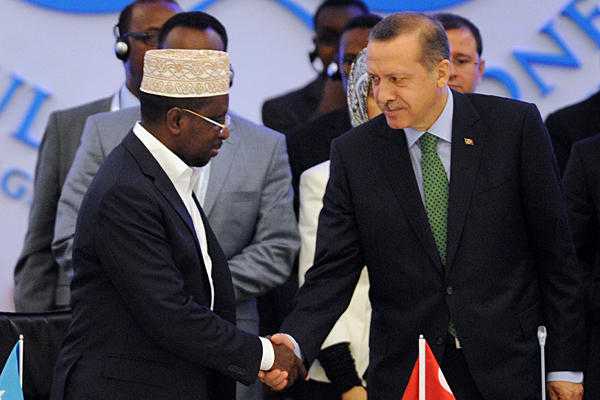
    Somalia’s President Sheikh Sharif Sheikh Ahmed, left, shakes hands with Turkish PM Recep Tayyip Erdogan before he addresses a conference that aims to support Somalia in a transition process, Istanbul, Turkey, June 1, 2012.

    ISTANBUL — Turkey is reaching out to war-torn Somalia with a huge redevelopment effort – in Ankara’s latest effort to expand its economic and political influence in Africa and play a greater role in the international arena.

    Rebuilding Somalia, bringing peace and security, and helping establish a stable government top Turkey’s list of goals in the East African nation. With its thriving economy, Ankara is also looking at future trade possibilities in the energy, construction and agricultural sectors.

    Challenges

    For now, Turkey is faced with a major challenge.

    Somalia has not had a stable central government for two decades. The country’s United Nations-backed transitional government is fighting the Islamic extremist group al-Shabab, though pro-government forces have gained the upper hand in recent months. Also, Somalia is emerging from a major drought last year.

    Turkish media have reported that Turkey is working to end the fighting. Turkish aid agencies are operating in regions controlled by the Somali government and al-Shabab. And Turkey has said it is prepared to offer training and support to Somalia’s government.

    Also, Turkish engineering contractors have been in the Somali capital, Mogadishu, working to reconstruct a city left in ruins by years of fighting.

    Must act now

    According to Turkish Prime Minister Recep Tayyip Erdogan, now is the time to act.

    “Somalian mothers and fathers are hurting, and it is possible to stop this, and Turkey is not waiting to act to help the Somalians wondering what others may think,” he said.

    Turkey has made several high-profile moves as part of its commitment to Somalia.

    Last year, Prime Minister Erdogan was the first Western leader in decades to visit Somalia. In March, Turkish Airlines became the first major commercial carrier to fly directly to Somalia in more than 20 years. Last week, Turkey hosted an international conference that focused on helping Somalia establish a stable government and elect a new president by August 20.

    Turkish Foreign Ministry spokesman Selcuk Unal said Turkey has sent more than $50 million in humanitarian aid for the Somali people since Erdogan’s visit to Mogadishu.

    “From Turkey’s point of view, since the visit of Prime Minister Erdogan to Somalia, we have collected from Turkish government funds, from the Turkish people, or from Turkish society $350 million, of which $51 million has been extended to the people of Somalia via air or by ships, humanitarian assistance material,” Unal said. “In addition, we will be continuing our reconstruction efforts on all of these issues, energy, reconstruction, transportation, those sorts of issues.”

    Broader stability

    To Veysel Ayhan of the Center for Middle East Peace and North Africa Studies, Turkish interest in Somalia stems mainly from the historical ties between the two nations. Turkish officials think bringing stability to Somalia will lead to stability in the broader region, Ayhan said, noting that Turkey’s efforts are part of its “soft power” politics and desire to play a huge role in the international community.

    “Turkey is trying to get the attention of the international community in Somalia so that Somalia’s development would be supported by more international actors,” Ayhan said.

    Foreign Ministry spokesman Unal said Turkey’s efforts are part of its growing commitment to sub-Saharan Africa.

    Voice of America

    June 8, 2012

    via Turkey set to heavily invest in Somalia | SomalilandPress.com – Somali News in English.

  • Somalia: The Soft Power Role of Turkey

    Turkey has suddenly and vigorously undertaken a series of initiatives to help Somalia out of its dire political and economic crisis.

    Turkey’s first visible initiative was organising a meeting of the Organisation of Islamic Cooperation (OIC) on 17 August 2011. The meeting was attended by 40 member states of the OIC and was intended to support Somalia, which was in the grip of a famine. It ended with a pledge to donate $350 million of humanitarian aid to Somalia.

    Two days after this meeting, on 19 August, Turkish Prime Minister Recep Erdogan visited Mogadishu. Against a backdrop of volatile security, he brought with him his wife, his children, ministers, businessmen and artists. The visit to Mogadishu was the first by a non-African leader in two decades.

    The primary objective of the visit was symbolic, as Turkey wanted to negate the perception that Mogadishu is irreversibly insecure and a no-go area. The second objective was to draw international attention to the need for more emergency humanitarian assistance to Somalia.

    By defying the apparently serious security risks – Al Shabaab was only expelled from Mogadishu a week before, on 8 August – Erdogan’s visit was unquestionably a morale booster for Somalis. As Somali political analyst Abdihakim Aynte argues, the visit ‘gave unprecedented validity to the Turkish efforts and reinforced the popular theory that Turkey is distinctly – and uniquely – a reliable fellow Muslim nation that can create global awareness about Somalia’s plight’.

    In September 2011, in his speech during the General Debate of the 66th Session of the UN General Assembly, Erdogan also forcefully drew attention to the humanitarian catastrophe in Somalia. The speech further enhanced Turkey’s reputation in Somalia as a trustworthy and respectful stakeholder. This fact was not lost on more security-conscious and geopolitically competing regional players used to bullying Somali political actors into submission.

    Since Erdogan’s audacious visit, the Turkish embassy in Mogadishu has been reopened and an ambassador, Cemalettin Torun, who has practical experience in humanitarian assistance, was speedily appointed. The challenges awaiting Torun are Herculean as Turkey embarks upon a major reconstruction programme in Somalia.

    It will rebuild the greatly damaged road from Mogadishu airport to the city centre and plans to build hospitals and rehabilitate existing medical facilities. It also plans to build a waste-disposal facility in Mogadishu and to provide trucks to remove the city’s uncollected garbage. Schools run by Turks have opened up in Mogadishu and hundreds of university scholarships have been provided for Somalis to study in Turkey.

    Moreover, the Turkish Red Crescent established an Internally Displaced Persons’ site where food is distributed and shelters are built. It is also digging water wells and plans to support the construction of an urban water system in Mogadishu. Turkish aid workers work and move safely in Mogadishu and no major attacks have directly targeted them.

    Yet, the terrorist blast in Mogadishu on 4 October 2011, which killed more than 70 Somalis, apparently targeted students queuing up to apply for Turkish scholarships. Turkey provided medical care in the wake of this dreadful attack, which showed that not all sides in Somalia appreciate Turkey’s involvement.

    Lastly, Turkish Airlines has become the first major non-African airline in 21 years to operate regular flights to Mogadishu. The flights are operated twice a week from Istanbul to Mogadishu via Khartoum, Sudan’s capital. The stated objective of the flights is to reconnect Somalia to the rest of the world and to make it easier for the large Somali diaspora scattered across the world to go back to Somalia. Turkey’s Deputy Prime Minister Bekir BozdaÄŸ arrived in Mogadishu on 6 March 2012 to launch the first Turkish Airlines flight. BozdaÄŸ’s visit was also intended to assess how best to manage and implement Turkey’s assistance to Somalia.

    It can be asked what the real purpose is of these mostly unilateral initiatives, and of Turkey’s dynamism in Somalia. Will Turkey’s aspirations lead to misrepresentations and to unintended consequences in Somalia, including stirring resentment from Al Shabaab? Does Turkey adequately understand the divisions, strains and ploys in Somalia’s polarised politics? Will Turkey’s credibility and popularity in Somalia plummet if the implementation of its reconstruction programme proves sluggish?

    Is Turkey just a selfless and compassionate Muslim state carrying out an unconditional mission of humanity in another Muslim state that is suffering? Is Turkey only trying to rekindle its historical relations with Somalia that go back to the Ottoman Empire, which had, at the height of its power in the 16th century, occupied parts of Somalia that were then added to its territory?

    All these practical questions need to be answered. But onlookers should avoid premature judgments about the nature and durability of Turkey’s motives and calculations on the probability of measurable success in terms of its initiatives on the ground. Only time will tell.

    One undeniable fact is that because of the active role it has assumed in Somalia, Turkey has, at least according to anecdotal evidence, won broad acceptance among the usually hyper-suspicious Somalis. A prominent Somali living and working in Mogadishu, for example, very enthusiastically told the author of this article that ‘Somalis love Turks and what they’re doing’. It is also noteworthy that its diplomatic efforts in Somalia presented Turkey with an important opportunity to illustrate its soft power in Africa. It is certainly an indication of Turkey’s foreign policy ambition to become a major economic and political player in Africa.

    Indeed, Turkey announced in 2003 its new and more assertive foreign policy towards Africa, which was fast-tracked by Erdogan’s 2005 high-profile visits to South Africa and Ethiopia. Since these unprecedented visits, Turkey has secured an observer status at the African Union, which now considers Turkey a strategic partner. In 2008, Turkey organised the Turkey-Africa Cooperation Summit. Fifty African states attended the summit, which adequately demonstrated Turkey’s outreach to Africa. In the same year and looking ahead, Turkey also established new embassies in Africa. The total number of Turkish embassies on the continent will reach 33 by 2012.

    These embassies will all be tasked with identifying opportunities for trade and investment and establishing a long-term Turkish presence on the continent. Just as for other emerging economic powers such as India, Brazil and China, Africa possesses untapped natural resources that are important for Turkish industries. African states could also provide large and fast-growing markets for Turkish products.

    Moreover, in its global pursuit of diplomatic allies, Turkey’s outreach to Africa has largely paid off. Indeed, in 2009 Turkey depended on Africa’s 54 members of the UN General Assembly to win a seat as a non-permanent member on the UN Security Council, which it may seek to win again in 2015.

    Berouk Mesfin, is a senior researcher, Conflict Prevention and Risk Analysis Division, ISS Addis Ababa.