Category: Iraq

  • Turkey’s big thirst for new power

    Turkey’s big thirst for new power

    Turkey’s big thirst for new power

    Florian Neuhof
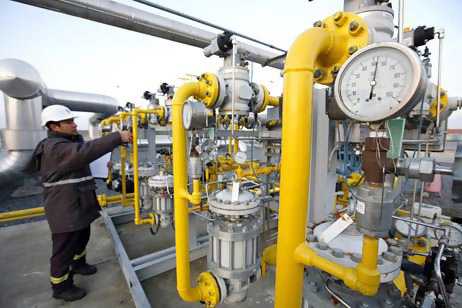
    AD20130114647153-A_worker_checks

    Turkey is in a rush to grow its energy sector. And recent news that the Abu Dhabi National Energy Company, known as Taqa, will invest heavily in Turkish coal-fired power plants shows how serious Ankara is taking this commitment.

    The deal, announced at the start of the year, will see Taqa build and operate a power generation base totalling 7,000 megawatts, or about 10 per cent of Turkey’s electricity needs by the time the plants are completed.

    Turkey’s energy minister, Taner Yildiz, is keen to emphasise that efforts will be taken to minimise the environmental impact of the country’s power sector.

    The plants will be fed with lignite, a soft brown coal reviled by environmentalists for the emissions its use entails. Lignite is found in Turkey’s soil and offers some relief in the complicated task of securing hydrocarbons from abroad.

    Turkey is dependent on imports for 91 per cent of its oil and 98 per cent of its natural gas and it relies heavily on Iran and Russia for its supplies. It is therefore keen to push the share of electricity produced from gas from about 50 per cent to less than 30 per cent in the next decade and to diversify its hydrocarbon sources.

    Turkey has reluctantly complied with United States and European Union demands to reduce imports from Iran as part of a new round of sanctions, but its dependence on Iranian supply has meant it has refused to cut economic ties with the country.

    Nevertheless, Turkey has announced it will import more Saudi Arabian and Libyan crude to counter the effect of the sanctions on Iran and the trend for Arabian Gulf oil to depart to Asia.

    Turkey’s confrontational stance with Syria, Tehran’s long-time ally, could also endanger imports from Iran.

    Iraq’s immense oil and gas reserves are another source of hydrocarbons, and a pipeline already flushes 400,000 barrels per day (bpd) of Iraqi crude across the border to the Turkish harbour of Ceyhan. But, rather than focusing on good relations with Baghdad, Ankara seems intent on carving out its own oil and gas base in Iraq by encouraging the autonomous Kurdish north in its efforts to create an independent energy sector.

    The Kurdish Regional Government (KRG) and Turkey are close to signing a deal under which the Turks will build production and pipeline capacity in Kurdistan, enabling the Kurds to export their hydrocarbons outside the Iraqi infrastructure.

    The KRG’s efforts to take control of its resources is a huge source of irritation to Iraq’s central government. While closer ties with Erbil can serve to secure a great deal of oil and gas supply, the uncertainty of the geopolitics can also undermine future security of supply.

    Turkey pays attention to its gas supply in particular. With electricity use projected to rise dramatically in the coming decades, adding further gas imports is crucial in spite of efforts to reduce its share in power generation.

    But Turkey also has ambitions to establish itself as a gas-trading hub between the Middle East, gas rich Azerbaijan and Europe. Turkey and Azerbaijan have agreed on the Trans-Anatolian Natural Gas Pipeline project that will connect the latter’s Shah Deniz II gasfield development with the Bosphorus.

    Turkish demand for gas stood at about 125,000 cubic metres a day at the end of last year. Before it can think of gaining in status as a transit hub it needs to ensure its own demands are met, experts say.

    “It still needs to facilitate additional gas purchases and encourage new developments such as Shah Deniz Phase II and Kurdistan volumes to meet its own requirements,” says Stephen O’Rourke, a gas supply analyst at Wood Mackenzie.

    Although piped gas plays the biggest part in Turkey’s thinking, Ankara has remained open to all options. This month, Mr Yildiz announced that he was in discussions with Qatar over an import terminal for liquefied natural gas (LNG).

    Another future source of gas could be the Levant Basin, where huge reserves are believed to lie under the deep seabed. But Turkey’s confrontational stance towards Greece and its icy relations with Israel disadvantages Ankara’s position in the Mediterranean, in spite of an exploration agreement with North Cyprus.

    If the Levant Basin fulfils its potential and starts yielding large amounts of gas, it could threaten Turkey’s position as a transit hub, analysts predict, as the most direct route to Europe is via Greece. But gas produced there may not be destined to Europe, anyhow.

    “We expect LNG to be the most likely export monetisation solution for these discoveries, and consequently Europe is not a guaranteed market for this gas,” says Mr O’Rourke.

    Overall, Turkey remains in a strong position to secure the gas necessary for its economic growth and to make it a significant regional hub.

    “Turkey should be able to maintain its long-term energy objectives. However, this will become more complicated, given its increasingly complicated relationships with Syria, Iran, Cyprus, and Israel,” says Daniel Wagner, the chief executive of the consultancy Control Risk Solutions.

    via Turkey’s big thirst for new power – The National.
  • Iraqi bloc to sue Turkey PM over meddling in internal affairs

    Iraqi bloc to sue Turkey PM over meddling in internal affairs

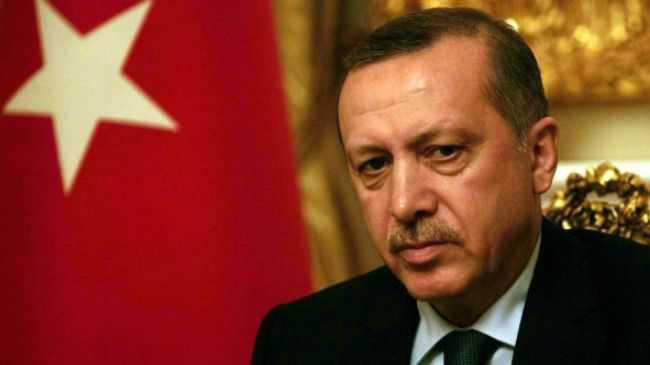
    An Iraqi political movement says it is planning to sue Turkey’s Prime Minister Recep Tayyip Erdogan over what it calls Ankara’s interference in the Iraq’s internal affairs.

    esmaeeli20130101155110930

    According to the al-Qanoon News Agency, Ahrar al-Iraq bloc will file charges against the Turkish premier for harboring Iraq’s fugitive vice-president Tariq al-Hashemi, who has received multiple death sentences in absentia over involvement in terrorist activities and running death squads in post-war Iraq.

    The movement also criticized Turkey’s President Abdullah Gul for calling Shias a minority group in Iraq, saying his remarks aimed at fomenting discord among Iraqis.

    On Sunday, several Iraqi lawmakers and politicians condemned as “unacceptable” Turkey’s interference in their country’s internal affairs after Erdogan accused the Iraqi government of sectarian behavior.

    Ahmad al-Hosseini, an Iraqi political activist, said the Turkish government’s interference in Iraq is increasing day by day especially after the recent demonstrations in Iraq’s western province of Anbar following the arrest of Finance Minister Rafia al-Issawi’s bodyguards on terrorism charges.

    Iraqi lawmaker Yasin Majid demanded the expulsion of Turkey’s ambassador to Baghdad in response to anti-Iraq remarks made by Erdogan.

    Ankara-Baghdad relations turned sour last year after Turkey expressed support for Hashemi and gave him refuge. Turkish air strikes against PKK positions in northern Iraq have also created more tension in the relations.

    The two countries are also at odds over the Syrian unrest. While Turkey has become one of the main supporters of anti-Damascus militants, Baghdad has refused to join calls for President Bashar al-Assad to step down.

    HM/PKH/SS

    via PressTV – Iraqi bloc to sue Turkey PM over meddling in internal affairs.

  • Turkey’s CHP plans an extended trip to Iraq

    Main opposition leader Kemal Kılıçdaroğlu is planning an extended trip to Iraq to both the capital and the country’s Kurdish north, not long after Turkey’s energy minister was prevented from flying directly to Arbil by Baghdad, Hurriyet reports.

    “A new invitation came and I accepted. I am planning to go to Baghdad on plane and return to Turkey by highway. I’d like to visit Kirkuk and Arbil and meet with [Kurdistan Regional Government (KRG) leader Masoud] Barzani if the conditions are OK,” Republican People’s Party (CHP) head Kılıçdaroğlu told reporters Dec. 7, adding that the invitation has stood for a long time. Responding to a question on whether he would comment on the denial of Energy Minister Taner Yıldız’s inability to fly to Arbil during his visit in Baghdad, Kılıçdaroğlu said he did not know if the issue would come to the table, but that “we always defend our country’s interests everywhere.”

    Kılıçdaroğlu said he did not feel comfortable when Yılmaz’s flight to the northern Iraqi city of Arbil was denied by Baghdad, adding that he was surprised by the official’s passive reaction to the slight.

    “No Turkish minister’s visit has been denied by either Iraq or any other country throughout the history of the Turkish Republic. I can’t stomach this situation Turkey is experiencing in its foreign policy. I can’t understand how the minister could stomach it,” said Kılıçdaroğlu.

    via Turkey’s CHP plans an extended trip to Iraq | Vestnik Kavkaza.

  • Thousands of Shia Muslims commemorate Ashura in Turkey

    Thousands of Shia Muslims commemorate Ashura in Turkey

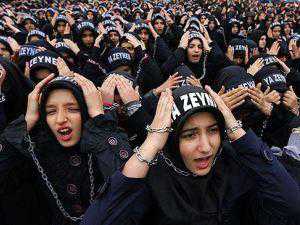
    Thousands of Turkish Shia Muslims have commemorated the martyrdom anniversary of Prophet Muhammad’s grandson Imam Hussein (PBUH), on the Day of Ashura.

    Thousands of Shia Muslims commemorate Ashura in Turkey

    (Ahlul Bayt News Agency) – Turkish Shias mourned the martyrdom of Imam Hussein by holding ceremonies in Istanbul’s Halkali district and other parts of the country, Hurriyet newspaper reported.

    Wearing black clothes, young Turkish women carried the names of the Karbala martyrs on headbands and cups in their hands that symbolized the thirst suffered by the prophet’s grandson and his companions.

    Men organized into regulated groups and flogged themselves in harmony, responding in grief to spiritual chants and poems describing the pain that Imam Hussein suffered.

    Many doves were released in memory of Ali Asghar (PBUH), the 6-month-old son of Imam Hussein, who was also killed in the Battle of Karbala.

    In the eastern province of Kars, the flag on the dome of the holy shrine of Imam Hussein (PBUH) was brandished atop a tent set up in front of the governor’s office.

    The ceremonies commemorating the martyrdom of the third Shia Imam and his 72 companions reach their climax on the Day of Ashura — the tenth day of the Islamic lunar month of Muharram.

    Ashura is the anniversary of the day in 680 CE, when thousands of forces loyal to the despotic Umayyad caliph Yazid ibn Muawiyah martyred Imam Hussein (PBUH) and his companions in Karbala, Iraq.

    Hundreds of thousands of people visit Karbala for the Ashura religious rituals every year.

    via Thousands of Shia Muslims commemorate Ashura in Turkey.

  • Turkey increases energy presence in Kurdish regions of Iraq

    Turkey increases energy presence in Kurdish regions of Iraq

    ERBIL, Iraq, Nov. 21 (UPI) — Turkey, its eyes on becoming the pivotal energy hub between East and West, is set to increase its presence in Iraq’s semiautonomous Kurdish enclave by taking a majority stake with a British partner in a block containing an estimated 10.5 trillion cubic feet of natural gas.

    That’s likely to have considerable political ramifications that are certain to strain already awkward relations between Ankara and Baghdad, and intensify the deterioration of relations between Iraq’s central government and the independence-minded Kurds.

    The Middle East Economic Digest reports that Genel Energy, a British-Turkish joint venture, will acquire the majority stake in Kurdistan’s Miran block from the London-listed Heritage Oil which is selling off its 49 percent holding in a production-sharing deal with the Kurdistan Regional Government.

    Once the sale is approved by the KRG and Heritage’s shareholders, Genel will have complete ownership of the block and be its only operator.

    The joint venture also has nine exploration blocks across Kurdistan, one of 40-plus companies which have signed production-sharing deals with the KRG in the Kurdish capital, Erbil, since 2007.

    The Turkish involvement will be particularly galling to Baghdad because Ankara has in recent months made a high-profile move into the KRG’s energy sector in defiance of Baghdad’s insistence such deals are illegal as constitutionally only Baghdad can sanction such agreements.

    Ankara recently offered land-locked Kurdistan, which borders southern Turkey, to build oil and gas pipelines from the enclave, which spans three provinces in northern Iraq, to Turkey’s Mediterranean export terminals.

    At present, the Kurds have to pump the oil they produce through the state pipeline network controlled by Baghdad.

    That export route would free the Kurds from reliance on the Baghdad government, and undoubtedly heighten their aspirations to establish an independent state in northern Iraq.

    They’ve already risked Baghdad’s wrath by signing exploration deals with major international companies such as Exxon Mobil and Chevron of the United States and Total of France.

    All these companies had secured production-sharing contracts from Baghdad to develop major fields and their defection to the Kurds and the more lucrative contracts they are offering was a major political humiliation for the trouble-plagued government of Iraqi Prime Minister Nouri al-Maliki.

    Baghdad needs the companies to make massive investments in southern fields to boost production from the current 3 million barrels per day to 10 million-12 million bpd to challenge Saudi Arabia as the world’s leading producer.

    Baghdad’s stiff contract conditions, low financial returns, governmental ineptitude and delays in building the required infrastructure have alienated Big Oil.

    But Iraq’s entire reconstruction and economic plans depend on the large-scale — many say overly ambitious — expansion of oil production.

    Kurdistan sits on 45 billion barrels of oil. That’s a fraction of Iraq’s known reserves but it’s enough to establish a firm economic base for an independent state.

    The KRG’s current crude output is 240,000 barrels per day but it is aiming for 1 million bpd in a couple of years. Some 90 percent of Kurdish oil sales flow from the Tawke and Taq Taq fields where Genel has major interests.

    So there’s a lot riding on all this for both Baghdad and the KRG and the Kurds seem to be making all the running.

    Maliki cannot afford to let them get away with that and thumb their noses at his government’s authority. So he’ll have to take some unequivocal action on this soon, if only to stamp on the Kurds’ long-held dream of independence and to convince other regions, including the south, that have been talking of gaining more autonomy to back off.

    He may have already started.

    Earlier this month, Baghdad, in a reprisal against Ankara, booted out Turkey’s state-owned TPAO oil company from a Kuwaiti-led consortium which was about to sign a 20-year, production-sharing agreement with the Oil Ministry for Block 9 in southern Iraq. TPAO had a 30 percent interest in that contract.

    Some two-thirds of Iraq’s proven oil reserves of 143.1 billion barrels lie in the south.

    “TPAO also has stakes in the developments of another four fields in Iraq: the Badra and Missan oil fields, and the Mansouriya and Siba gas fields,” MEED reported.

    “There has been no indication whether TPAO will be removed from these.”

    via Turkey increases energy presence in Kurdish regions of Iraq – UPI.com.

  • Turkey signs $350m Iraq oil drilling deal

    Turkey signs $350m Iraq oil drilling deal

    ANKARA: Turkey has signed a $350m deal on drilling 40 oil wells in the southern Iraqi Basra area and is in talks with Baghdad on drilling 7,000 wells across Iraq, Energy Minister Taner Yildiz said yesterday. Details of the timeframe or companies involved were not immediately available.

    Turkey’s growing energy involvement in Iraq comes despite tensions with Baghdad over Ankara giving refuge to Iraq’s fugitive Vice President Tareq Al Hashemi, who was sentenced to death by an Iraqi court for a second time on Thursday.

    Iraq has also asked Turkey to stop attacking Kurdish rebel forces sheltering across the border in northern Iraq, a Kurdish autonomous region over which Baghdad has little control and with which Ankara has forged close ties in recent years.

    “We are continuing work with the central government on opening 7,000 wells across Iraq as a whole,” Yildiz told a news conference in the Turkish capital.

    He also told reporters talks were being held with the Turkish treasury on holding initial public offerings (IPO) for state-owned oil firm TPAO and state pipeline company Botas, with a TPAO offering planned first.

    Separately, Yildiz warned that the government would review Italian energy firm ENI’s investments in Turkey if it went ahead with plans to explore for natural gas in Cyprus. Cyprus said on Tuesday that it would start negotiations with ENI, South Korea’s Kogas, France’s Total and Russia’s Novatek on the potential development of natural gas fields off the Mediterranean island. Turkey, which has been at diplomatic loggerheads with Cyprus for decades, claims the island has no authority to explore for gas offshore.

    reuters

    via Turkey signs $350m Iraq oil drilling deal.