Category: Non-EU Countries

  • Turkey in the Axis of Radicalism? An Alternative View of Europe (Dedeoglu)

    Turkey in the Axis of Radicalism? An Alternative View of Europe (Dedeoglu)

    Sunday, November 14, 2010 at 7:32AM | Scott Lucas in EA Middle East and Turkey
    Writing in Zaman, Professor Beril Dedeoglu of the University of Galatasaray in Istanbul intervenes in the discussion of whether Turkey has been aligning itself with non-Western powers under the rule of Justice and Development Party (AKP). Beyond questioning the existence of an ‘axis’, Dedeoglu asks if the real shift is occurring within the European Union, seeing a possible UK-French alliance v. a German-Russian front following a deep economic crisis:

    The term “axis shift” is used for countries that are supposedly changing their overall political positions, meaning that they abandon their current system of security and values to replace them with a new system.

    This term, which is used as a political tool, would have meaning if axes existed in the current global circumstances. Nevertheless, even if this political qualification is now used, it is not right to use it solely for Turkey; one must be able to test it elsewhere as well.

    The EU’s values and policies are dictated by the West’s stable and developed structures, which are marked by principles and rules. However, its practice does not always match the principle. The EU became what it is today because it has managed to regulate the rivalry between its members. Particularly in the security domain, rivalry has been thoroughly organized with every treaty and mechanism imaginable put in place in order to prevent one member state from becoming a security threat for another.

    However, the changing global conditions are pushing the member countries to progressively abandon the idea of mutual interdependence, which is at the basis of their partnership. Some serious problems have already started to appear, with the current economic and financial crisis stimulating debate over necessary reform in the security and defense architecture. Member states would like to reduce their defense spending without causing gaps in security, as they are afraid any such gap will be filled by the US.

    In order to find a solution, France and the UK have decided to make an agreement reminiscent of the Treaty of Dunkirk of 1947. For now, we do not know whether this will open a path to reunite the armed forces of these two countries, but we can say that this agreement symbolizes the beginning of a serious strategic cooperation. It is different from strategic cooperation initiatives witnessed elsewhere, such as the one between Turkey and Russia. The UK-France cooperation is more intense, and the two have not required a long process of confidence-building. It does not look like the cooperation between Turkey and Syria, either, as cooperation between the UK and France extends to the whole military domain rather than just a common fight against terrorism.

    Perhaps the first question to ask about the UK-France cooperation is which actors are expected to be disturbed by this rapprochement. History shows that we do not need to look far to get an answer. It seems that France has grown sufficiently away from de Gaulle’s approach to foreign policy and it is no longer filled with mistrust toward the UK. Maybe France hopes that an agreement with the UK will reduce Paris’ dependence on Germany. Such an effort risks replacing the German-French axis in Europe with another axis, one situated a little bit more to the north and with the US on one end. The UK’s new cabinet has already promised that they care about Europe more than their predecessors. Apparently they intend to keep that promise.

    If cooperation between France and the UK compels Germany to reinforce ties with Russia, then we will witness a real axis shift within the EU. If that happens, the debates on Turkey will also change as the “non à la Turquie” front collapses. The EU member countries may start competing with each other through Turkey, and some countries may stop refusing Turkey’s accession and while others increase their level of opposition.

    via EA WorldView – Home – Turkey in the Axis of Radicalism? An Alternative View of Europe (Dedeoglu).
  • Other Turkey holiday villas destinations ‘catching up on Mugla’

    Other Turkey holiday villas destinations ‘catching up on Mugla’

    Brits planning on villa holidays in Turkey have been told the country has much more to offer than just Mulga – currently the location of choice among UK travellers.

    Izmir, Aydin, Canakkale, Bursa, Mersin, Edirne, the Black Sea, Eastern Anatolia, Cappadocia, Antalya and Istanbul are all worth a visit and are catching up on Mulga, according to the Turkish Ministry of Culture and Tourism.

    Turkey offers all sorts of tourist alternatives, explained deputy undersecretary at the ministry Mr Ozgur Ozaslan, such as thermal and spa, congress, faith, gastronomy, yachting, winter sports and golf.

    “We wish to make our country even more attractive as a holiday destination to British tourists and we are working very hard to exhibit the myriad diverse offerings of our country,” he added.

    Mr Ozaslan went on to say that the country is investing heavily in the realms of sustainable tourism.

    His comments come after readers of Conde Nast Traveller magazine voted Turkey their favourite holiday destination.

    Posted by Iain Cliffe

    via Other Turkey holiday villas destinations ‘catching up on Mulga’.

  • Politics aside, headscarves are making a comeback in Turkey

    Politics aside, headscarves are making a comeback in Turkey

    Once considered a faux pas in fashion and politics, fashionistas are now embracing Islamic clothing, spawning the development of upmarket Islamic fashion houses

    By Alexandra Hudson  /  Reuters, ISTANBUL, Turkey

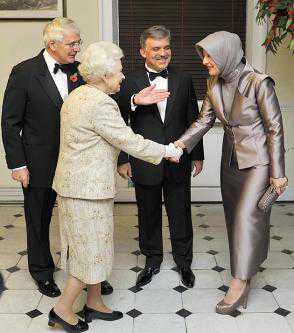
    Britain’s Queen Elizabeth II, left, greets Hayrunnisa Gul, the wife of Turkish President Abdullah Gul, center, as former British prime minister John Major looks on during a ceremony and reception in Whitehall in central London on Tuesday. Photo: Reuters
    Britain’s Queen Elizabeth II, left, greets Hayrunnisa Gul, the wife of Turkish President Abdullah Gul, center, as former British prime minister John Major looks on during a ceremony and reception in Whitehall in central London on Tuesday. Photo: Reuters

    Britain’s Queen Elizabeth II, left, greets Hayrunnisa Gul, the wife of Turkish President Abdullah Gul, center, as former British prime minister John Major looks on during a ceremony and reception in Whitehall in central London on Tuesday.

    Photo: Reuters

    Along Istanbul’s busy Eminonu waterfront, women swathed in dark coats and scarves knotted once under the chin jostle past others clad in vivid colors and head coverings carefully sculpted around the face.

    Two decades ago such a polished, pious look scarcely existed in Turkey, but today it has the highest profile exponents in Turkish First Lady Hayrunnisa Gul and Turkish Prime Minister Tayyip Erdogan’s wife Emine, and the brands behind it plan ambitious expansion.

    The headscarf remains one of Turkey’s most divisive issues. Everything from the way it is tied and accessorized, to the poise and demeanor of the wearer, is laden with meaning in this majority Muslim, but officially secular, country of 74 million.

    From a simple head covering, stigmatized in the early days of the Turkish Republic as backward and rural, it the last decades it has become a carefully crafted garment and highly marketable commodity, embodying the challenge of a new class of conservative Muslims to Turkey’s secularist elites.

    “It was hard to find anything chic for the covered women 10 years ago, but fashion for pious women has made huge progress in the last six to seven years,” said Alpaslan Akman, an executive in charge of production and marketing at Muslim fashion brand Armine.

    Armine is known for its high-impact campaigns. Huge posters have hung in the heart of Istanbul’s bar and nightclub district — the serene models contrasting with the commotion below.

    The brand teams colorful scarves with figure-skimming coats, pert collars, big buttons and ruffled sleeves.

    A coat typically sells for around 200 Turkish lira (US$143), while scarves retail for around 50 lira.

    “We are much luckier than -previous generations, we have more designs and colors of scarves to choose from,” said 30-year-old Filiz Albayrak, a sales assistant in an Istanbul scarf shop.

    Around 69 percent of Turkish women cover their heads in some form, with 16 percent using the more concealing and self-consciously stylish “turban” style scarf, which tightly covers the hair and neck, according to a 2007 study.

    via Politics aside, headscarves are making a comeback in Turkey – Taipei Times.

  • Turkish tourism triumphs

    Turkish tourism triumphs

    Turkey’s tourism industry has triumphed in recent years and the country is a hugely popular destination with the Brits, with 2.43 million arriving from the UK last year.

    Results are expected to be even more positive this year, with 2.31 million British visitors already having arrived in Turkey in the first 9 months of 2010. New investments in the tourism sector, a more sophisticated brand of tourism, wider choice of alternatives and value for money have all contributed to this success.

    Award-winning

    Turkey was a winner this year with Condé Nast Traveller UK; the country was voted the no. 1 spot in by readers in the Destination category at this year’s Condé Nast Traveller 12th Annual Readers’ Travel Awards. Turkey’s popularity also ensured a spot in the prestigious The World’s Top 100 list where it was voted number 2 overall.  Istanbul also came 5th in the Overseas Cities category, with top marks for people/hospitality.

    Moving and Shaking the Media

    This year Turkish tourism has received more press coverage than ever with more than 6000 features so far this year across national, regional, broadcast, radio and online media.  Turkey featured across the TV and Radio in full gusto this year – with highlights including Essential Istanbul and Essential Eastern Turkey programs on Travel Channel as well as Istanbul on Inside Luxury Travel.  Meanwhile, food writer Richard Johnson visited Istanbul to discover the history of the kebab for BBC Radio 4’s Food Programme; whilst the achievements of Great Ottoman Architect Mimar Sinan were recounted also on BBC Radio 3 this year.  Turkish Culture and Tourism was also prominent in all corners of the National Press this year, from The Guardian which published its first-ever Turkey-only travel supplement in April , revealing the hidden gems of Turkey, to The Daily and Sunday Telegraph, The Financial Times and Mail on Sunday just to name a few.

    An array of glossy magazines also featured Turkey including Condé Nast Traveller UK, with its 12-page Turkey-themed luxury travel special section in its July issue, in addition to its coverage following the Readers’ Travel Awards, presenting Turkey as an affordable luxury destination. Prestigious Current World Archaeology also published its first-ever special issue on Turkey, opening with a feature on the ancient region of Lycia and including a Turkey-dedicated travel section and an archaeological round-up.  Turkey also took centre stage across multiple pages in several glossy magazines this year, including Jamie Magazine, Lonely Planet Magazine and BA High Life to Wanderlust and Sunday Times Travel Magazine.

    via Travelio

  • Turkish President Meets With British Premier

    Turkish President Meets With British Premier

    Turkish President Abdullah Gul met with British Prime Minister David Cameron on Monday as part of his visit to the United Kingdom.

    The closed-door meeting lasted for about 45 minutes.

    President Gul is currently in London to receive Chatham House prize.

    Gul will deliver a speech at the Chatham House on Turkey, Europe and the international system in the first quarter of the 21st century later in the day.

    He will also attend a conference on democracy and development in Islam world at the University of Oxford.

    On Tuesday, Gul will inaugurate Yunus Emre Foundation’s Turkish Culture Center and Architect Sinan Exhibition in London.

    A Turkish poet and Sufi mystic, Yunus Emre was one of the first known Turkish poets to have composed works in the spoken Turkish of his own age and region rather than in Persian or Arabic. His diction remains very close to the popular speech of his contemporaries in Central and Western Anatolia. His poems, written in the tradition of Anatolian folk poetry, mainly concern divine love as well as human destiny.

    Mimar (Architect) Sinan was the chief Ottoman architect and civil engineer for sultans Suleyman I, Selim II, and Murad III. He was responsible for the construction of more than three hundred major structures, including Selimiye Mosque in Edirne and Suleymaniye Mosque in Istanbul.

    Gul is expected to depart from Britain on Tuesday evening.

    AA

  • ‘Chatham House award symbol of Turkey’s resilience’

    ‘Chatham House award symbol of Turkey’s resilience’

    News Diplomacy

    ‘Chatham House award symbol of Turkey’s resilience’

    Britain’s Queen Elizabeth II presents the Chatham House Prize to Turkish President Abdullah Gül. President Abdullah Gül praised Turkey’s achievements in the past decade right after he received the prestigious Chatham House Award late on Tuesday, saying that the award he received honors the “resilience” of the Turkish nation.

    Queen Elizabeth II presented the award during a ceremony, praising the president’s “notable leadership” for improving international relations.

    “I accept this award with profound honor and humbleness on behalf of my beloved country and the people of Turkey,” President Gül said as he accepted the award. “Although I take personal pride in receiving it, the award presented to me tonight truly acknowledges the progress achieved by the Turkish nation in recent years despite many internal and external difficulties,” he added.

    Noting that the prize also honors the resilience and perseverance of a people who have never lost their aspiration for progress and hope in a better future, Gül said all witnessed “a silent revolution” in democratic, social and economic standards that is taking place in Turkey’s quest for full membership in the European Union.

    According to the president, the prize signifies the role played by Turkey in its multidimensional neighborhood and beyond, where the country nurtures peace, stability and welfare. Praising Turkey’s inspiring role in the Islamic world as a vibrant democracy and a flourishing free-market economy, Gül said the prize symbolizes the success of a hard-working people, whose “sweat was key to making Turkey the fastest growing economy among the OECD members this year,” the president stressed.

    Finally, Gül said, the award that he received thoroughly certifies, once again, the eternal friendship between Turkey and the United Kingdom, whose alliance and cooperation made a huge difference in history and are destined to offer even more promising prospects in the future. The queen, while presenting the Turkish president the award, said she was delighted to welcome the president and his spouse to London to receive this important award.

    “Mr. President, I remember with gratitude your very kind hospitality during my state visit to Turkey in 2008,” the queen said, adding that Gül had provided “notable leadership” and “international statesmanship” over many years. She offered her congratulations by presenting this award on behalf of the Royal Institute of International Affairs. The queen also praised Gül for his efforts to secure Turkey’s place in the 27-nation bloc and to improve the level of democracy and human rights in his country.

    11 November 2010, Thursday

    TODAY’S ZAMAN  İSTANBUL