F. William Engdahl, February 5, 2011
Fast on the heels of the regime change in Tunisia came a popular-based protest movement launched on January 25 against the entrenched order of Egypt’s Hosni Mubarak. Contrary to the carefully-cultivated impression that the Obama Administration is trying to retain the present regime of Mubarak, Washington in fact is orchestrating the Egyptian as well as other regional regime changes from Syria to Yemen to Jordan and well beyond in a process some refer to as “creative destruction.”
The template for such covert regime change has been developed by the Pentagon, US intelligence agencies and various think-tanks such as RAND Corporation over decades, beginning with the May 1968 destabilization of the de Gaulle presidency in France. This is the first time since the US backed regime changes in Eastern Europe some two decades back that Washington has initiated simultaneous operations in many countries in a region. It is a strategy born of a certain desperation and one not without significant risk for the Pentagon and for the long-term Wall Street agenda. What the outcome will be for the peoples of the region and for the world is as yet unclear.
Yet while the ultimate outcome of defiant street protests in Cairo and across Egypt and the Islamic world remains unclear, the broad outlines of a US covert strategy are already clear.
No one can dispute the genuine grievances motivating millions to take to the streets at risk of life. No one can defend atrocities of the Mubarak regime and its torture and repression of dissent. Noone can dispute the explosive rise in food prices as Chicago and Wall Street commodity speculators, and the conversion of American farmland to the insane cultivation of corn for ethanol fuel drive grain prices through the roof. Egypt is the world’s largest wheat importer, much of it from the USA. Chicago wheat futures rose by a staggering 74% between June and November 2010 leading to an Egyptian food price inflation of some 30% despite government subsidies.
What is widely ignored in the CNN and BBC and other Western media coverage of the Egypt events is the fact that whatever his excesses at home, Egypt’s Mubarak represented a major obstacle within the region to the larger US agenda.
To say relations between Obama and Mubarak were ice cold from the outset would be no exaggeration. Mubarak was staunchly opposed to Obama policies on Iran and how to deal with its nuclear program, on Obama policies towards the Persian Gulf states, to Syria and to Lebanon as well as to the Palestinians.1 He was a formidable thorn in the larger Washington agenda for the entire region, Washington’s Greater Middle East Project, more recently redubbed the milder sounding “New Middle East.”
As real as the factors are that are driving millions into the streets across North Africa and the Middle East, what cannot be ignored is the fact that Washington is deciding the timing and as they see it, trying to shape the ultimate outcome of comprehensive regime change destabilizations across the Islamic world. The day of the remarkably well-coordinated popular demonstrations demanding Mubarak step down, key members of the Egyptian military command including Chief of General Staff Lt. Gen. Sami Hafez Enan were all in Washington as guests of the Pentagon. That conveniently neutralized the decisive force of the Army to stop the anti-Mubarak protests from growing in the critical early days.2
The strategy had been in various State Department and Pentagon files since at least a decade or longer. After George W. Bush declared a War on Terror in 2001 it was called the Greater Middle East Project. Today it is known as the less threatening-sounding “New Middle East” project. It is a strategy to break open the states of the region from Morocco to Afghanistan, the region defined by David Rockefeller’s friend Samuel Huntington in his infamous Clash of Civilizations essay in Foreign Affairs.
Egypt rising?
The current Pentagon scenario for Egypt reads like a Cecil B. DeMille Hollywood spectacular, only this one with a cast of millions of Twitter-savvy well-trained youth, networks of Muslim Brotherhood operatives, working with a US-trained military. In the starring role of the new production at the moment is none other than a Nobel Peace Prize winner who conveniently appears to pull all the threads of opposition to the ancien regime into what appears as a seamless transition into a New Egypt under a self-proclaimed liberal democratic revolution.
Some background on the actors on the ground is useful before looking at what Washington’s long term strategic plan might be for the Islamic world from North Africa to the Persian Gulf and ultimately into the Islamic populations of Central Asia, to the borders of China and Russia.
Washington ‘soft’ revolutions
The protests that led to the abrupt firing of the entire Egyptian government by President Mubarak on the heels of the panicked flight of Tunisia’s Ben Ali into a Saudi exile are not at all as “spontaneous” as the Obama White House, Clinton State Department or CNN, BBC and other major media in the West make them to be.
They are being organized in a Ukrainian-style high-tech electronic fashion with large internet-linked networks of youth tied to Mohammed ElBaradei and the banned and murky secret Muslim Brotherhood, whose links to British and American intelligence and freemasonry are widely reported.3
At this point the anti-Mubarak movement looks like anything but a threat to US influence in the region, quite the opposite. It has all the footprints of another US-backed regime change along the model of the 2003-2004 Color Revolutions in Georgia and Ukraine and the failed Green Revolution against Iran’s Ahmedinejad in 2009.
The call for an Egyptian general strike and a January 25 Day of Anger that sparked the mass protests demanding Mubarak resign was issued by a Facebook-based organization calling itself the April 6 Movement. The protests were so substantial and well-organized that it forced Mubarak to ask his cabinet to resign and appoint a new vice president, Gen. Omar Suleiman, former Minister of Intelligence.
April 6 is headed by one Ahmed Maher Ibrahim, a 29-year-old civil engineer, who set up the Facebook site to support a workers’ call for a strike on April 6, 2008.
According to a New York Times account from 2009, some 800,000 Egyptians, most youth, were already then Facebook or Twitter members. In an interview with the Washington-based Carnegie Endowment, April 6 Movement head Maher stated, “Being the first youth movement in Egypt to use internet-based modes of communication like Facebook and Twitter, we aim to promote democracy by encouraging public involvement in the political process.”4
Maher also announced that his April 6 Movement backs former UN International Atomic Energy Aagency (IAEA) head and declared Egyptian Presidential candidate, ElBaradei along with ElBaradei’s National Association for Change (NAC) coalition. The NAC includes among others George Ishak, a leader in Kefaya Movement, and Mohamed Saad El-Katatni, president of the parliamentary bloc of the controversial Ikhwan or Muslim Brotherhood.5
Today Kefaya is at the center of the unfolding Egyptian events. Not far in the background is the more discreet Muslim Brotherhood.
ElBaradei at this point is being projected as the central figure in a future Egyptian parliamentary democratic change. Curiously, though he has not lived in Egypt for the past thirty years, he has won the backing of every imaginable part of the Eyptian political spectrum from communists to Muslim Brotherhood to Kefaya and April 6 young activists.6 Judging from the calm demeanour ElBaradei presents these days to CNN interviewers, he also likely has the backing of leading Egyptian generals opposed to the Mubarak rule for whatever reasons as well as some very influential persons in Washington.
Kefaya—Pentagon ‘non-violent warfare’
Kefaya is at the heart of mobilizing the Egyptian protest demonstrations that back ElBaradei’s candidacy. The word Kefaya translates to “enough!”
Curiously, the planners at the Washington National Endowment for Democracy (NED)7 and related color revolution NGOs apparently were bereft of creative new catchy names for their Egyptian Color Revolution. In their November 2003 Rose Revolution in Georgia, the US-financed NGOs chose the catch word, Kmara! In order to identify the youth-based regime change movement. Kmara in Georgian also means “enough!”
Like Kefaya, Kmara in Georgia was also built by the Washington-financed trainers from the NED and other groups such as Gene Sharp’s misleadingly-named Albert Einstein Institution which uses what Sharp once identified as “non-violence as a method of warfare.”8
The various youth networks in Georgia as in Kefaya were carefully trained as a loose, decentralized network of cells, deliberately avoiding a central organization that could be broken and could have brought the movement to a halt. Training of activists in techniques of non-violent resistance was done at sports facilities, making it appear innocuous. Activists were also given training in political marketing, media relations, mobilization and recruiting skills.
The formal name of Kefaya is Egyptian Movement for Change. It was founded in 2004 by select Egyptian intellectuals at the home of Abu ‘l-Ala Madi, leader of the al-Wasat party, a party reportedly created by the Muslim Brotherhood.9 Kefaya was created as a coalition movement united only by the call for an end Mubarak’s rule.
Kefaya as part of the amorphous April 6 Movement capitalized early on new social media and digital technology as its main means of mobilization. In particular, political blogging, posting uncensored youtube shorts and photographic images were skillfully and extremely professionally used. At a rally already back in December 2009 Kefaya had announced support for the candidacy of Mohammed ElBaradei for the 2011 Egyptian elections.10
RAND and Kefaya
No less a US defense establishment think-tank than the RAND Corporation has conducted a detailed study of Kefaya. The Kefaya study as RAND themselves note, was “sponsored by the Office of the Secretary of Defense, the Joint Staff, the Unified Combatant Commands, the Department of the Navy, the Marine Corps, the defense agencies, and the defense Intelligence Community.”11
A nicer bunch of democratically-oriented gentlemen and women could hardly be found.
In their 2008 report to the Pentagon, the RAND researchers noted the following in relation to Egypt’s Kefaya:
“The United States has professed an interest in greater democratization in the Arab world, particularly since the September 2001 attacks by terrorists from Saudi Arabia, the United Arab Emirates, Egypt, and Lebanon. This interest has been part of an effort to reduce destabilizing political violence and terrorism. As President George W. Bush noted in a 2003 address to the National Endowment for Democracy, “As long as the Middle East remains a place where freedom does not flourish, it will remain a place of stagnation, resentment, and violence ready for export” (The White House, 2003). The United States has used varying means to pursue democratization, including a military intervention that, though launched for other reasons, had the installation of a democratic government as one of its end goals.
However, indigenous reform movements are best positioned to advance democratization in their own country.”12
RAND researchers have spent years perfecting techniques of unconventional regime change under the name “swarming,” the method of deploying mass mobs of digitally-linked youth in hit-and-run protest formations moving like swarms of bees.13
Washington and the stable of “human rights” and “democracy” and “non-violence” NGOs it oversees, over the past decade or more has increasingly relied on sophisticated “spontaneous” nurturing of local indigenous protest movements to create pro-Washington regime change and to advance the Pentagon agenda of global Full Spectrum Dominance. As the RAND study of Kefaya states in its concluding recommendations to the Pentagon:
“The US government already supports reform efforts through organizations such as the US Agency for International Development and the United Nations Development Programme. Given the current negative popular standing of the United States in the region, US support for reform initiatives is best carried out through nongovernmental and nonprofit institutions.“14
The RAND 2008 study was even more concrete about future US Government support for Egyptian and other “reform” movements:
“The US government should encourage nongovernmental organizations to offer training to reformers, including guidance on coalition building and how to deal with internal differences in pursuit of democratic reform. Academic institutions (or even nongovernmental organizations associated with US political parties, such as the International Republican Institute or the National Democratic Institute for International Affairs) could carry out such training, which would equip reform leaders to reconcile their differences peacefully and democratically.
“Fourth, the United States should help reformers obtain and use information technology, perhaps by offering incentives for US companies to invest in the region’s communications infrastructure and information technology. US information technology companies could also help ensure that the Web sites of reformers can remain in operation and could invest in technologies such as anonymizers that could offer some shelter from government scrutiny. This could also be accomplished by employing technological safegaurds to prevent regimes from sabotaging the Web sites of reformers. “15
As their Kefaya monograph states, it was prepared in 2008 by the “RAND National Security Research Division’s Alternative Strategy Initiative, sponsored by the Rapid Reaction Technology Office in the Office of the Undersecretary of Defense for Acquisition, Technology, and Logistics.
The Alternative Strategy Initiative, just to underscore the point, includes “research on creative use of the media, radicalization of youth, civic involvement to stem sectarian violence, the provision of social services to mobilize aggrieved sectors of indigenous populations, and the topic of this volume, alternative movements.“16
In May 2009 just before Obama’s Cairo trip to meet Mubarak, US Secretary of State Hillary Clinton hosted a number of the young Egyptian activists in Washington under the auspices of Freedom House, another “human rights” Washington-based NGO with a long history of involvement in USsponsored regime change from Serbia to Georgia to Ukraine and other Color Revolutions. Clinton and Acting Assistant Secretary of State for Near Eastern Affairs Jeffrey Feltman met the sixteen activists at the end of a two-month “fellowship” organized by Freedom House’s New Generation program.17
Freedom House and Washington’s government-funded regime change NGO, National Endowment for Democracy (NED) are at the heart of the uprisings now sweeping across the Islamic world. They fit the geographic context of what George W. Bush proclaimed after 2001 as his Greater Middle East Project to bring “democracy” and “liberal free market” economic reform to the Islamic countries from Afghanistan to Morocco. When Washington talks about introducing “liberal free market reform” people should watch out. It is little more than code for bringing those economies under the yoke of the dollar system and all that implies.
Washington’s NED in a larger agenda
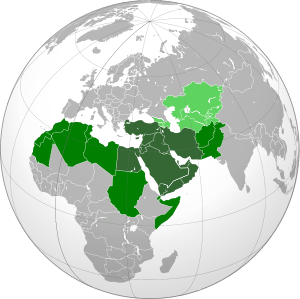
If we make a list of the countries in the region which are undergoing mass-based protest movements since the Tunisian and Egyptian events and overlay them onto a map, we find an almost perfect convergence between the protest countries today and the original map of the Washington Greater Middle East Project that was first unveiled during the George W. Bush Presidency after 2001.
Washington’s NED has been quietly engaged in preparing a wave of regime destabilizations across North Africa and the Middle East since the 2001-2003 US military invasions of Afghanistan and Iraq. The list of where the NED is active is revealing. Its website lists Tunisia, Egypt, Jordan, Kuwait, Libya, Syria, Yemen and Sudan as well, interestingly, as Israel. Coincidentally these countries are almost all today subject to “spontaneous” popular regime-change uprisings.
The International Republican Institute and the National Democratic Institute for International Affairs mentioned by the RAND document study of Kefaya are subsidiary organizations of the Washington-based and US Congress-financed National Endowment for Democracy.
The NED is the coordinating Washington agency for regime destabilization and change. It is active from Tibet to Ukraine, from Venezuela to Tunisia, from Kuwait to Morocco in reshaping the world after the collapse of the Soviet Union into what George H.W. Bush in a 1991 speech to Congress proclaimed triumphantly as the dawn of a New World Order.18
As the architect and first head of the NED, Allen Weinstein told the Washington Post in 1991 that, “a lot of what we do today was done covertly 25 years ago by the CIA“19
The NED Board of Directors includes or has included former Defense Secretary and CIA Deputy head, Frank Carlucci of the Carlyle Group; retired General Wesley Clark of NATO; neo-conservative warhawk Zalmay Khalilzad who was architect of George W. Bush’s Afghan invasion and later ambassador to Afghanistan as well as to occupied Iraq. Another NED board member, Vin Weber, co-chaired a major independent task force on US Policy toward Reform in the Arab World with former US Secretary of State Madeleine Albright, and was a founding member of the ultra-hawkish Project for a New American Century think-tank with Dick Cheney and Don Rumsfeld, which advocated forced regime change in Iraq as early as 1998.20
The NED is supposedly a private, non-government, non-profit foundation, but it receives a yearly appropriation for its international work from the US Congress. The National Endowment for Democracy is dependent on the US taxpayer for funding, but because NED is not a government agency, it is not subject to normal Congressional oversight.
NED money is channelled into target countries through four “core foundations”—the National Democratic Institute for International Affairs, linked to the Democratic Party; the International Republican Institute tied to the Republican Party; the American Center for International Labor Solidarity linked to the AFL-CIO US labor federation as well as the US State Department; and the Center for International Private Enterprise linked to the free-market US Chamber of Commerce.
The late political analyst Barbara Conry noted that,
“NED has taken advantage of its alleged private status to influence foreign elections, an activity that is beyond the scope of AID or USIA and would otherwise be possible only through a CIA covert operation. Such activities, it may also be worth noting, would be illegal for foreign groups operating in the United States.”21
Significantly the NED details its various projects today in Islamic countries, including in addition to Egypt, in Tunisia, Yemen, Jordan, Algeria, Morocco, Kuwait, Lebanon, Libya, Syria, Iran and Afghanistan. In short, most every country which is presently feeling the earthquake effects of the reform protests sweeping across the Middle East and North Africa is a target of NED.22
In 2005 US President George W. Bush made a speech to the NED. In a long, rambling discourse which equated “Islamic radicalism” with the evils of communism as the new enemy, and using a deliberately softer term “broader Middle East” for the term Greater Middle East that had aroused much distruct in the Islamic world, Bush stated,
“The fifth element of our strategy in the war on terror is to deny the militants future recruits by replacing hatred and resentment with democracy and hope across the broader Middle East. This is a difficult and long-term project, yet there’s no alternative to it. Our future and the future of that region are linked. If the broader Middle East is left to grow in bitterness, if countries remain in misery, while radicals stir the resentments of millions, then that part of the world will be a source of endless conflict and mounting danger, and for our generation and the next. If the peoples of that region are permitted to choose their own destiny, and advance by their own energy and by their participation as free men and women, then the extremists will be marginalized, and the flow of violent radicalism to the rest of the world will slow, and eventually end… We’re encouraging our friends in the Middle East, including Egypt and Saudi Arabia, to take the path of reform, to strengthen their own societies in the fight against terror by respecting the rights and choices of their own people. We’re standing with dissidents and exiles against oppressive regimes, because we know that the dissidents of today will be the democratic leaders of tomorrow…”23
The US Project for a ‘Greater Middle East’
The spreading regime change operations by Washington from Tunisia to Sudan, from Yemen to Egypt to Syria are best viewed in the context of a long-standing Pentagon and State Department strategy for the entire Islamic world from Kabul in Afghanistan to Rabat in Morocco.
The rough outlines of the Washington strategy, based in part on their successful regime change operations in the former Warsaw Pact communist bloc of Eastern Europe, were drawn up by former Pentagon consultant and neo-conservative, Richard Perle and later Bush official Douglas Feith in a white paper they drew up for the then-new Israeli Likud regime of Benjamin Netanyahu in 1996.
That policy recommendation was titled A Clean Break: A New Strategy for Securing the Realm. It was the first Washington think-tank paper to openly call for removing Saddam Hussein in Iraq, for an aggressive military stance toward the Palestinians, striking Syria and Syrian targets in Lebanon.24
Reportedly, the Netanyahu government at that time buried the Perle-Feith report, as being far too risky. By the time of the events of September 11, 2001 and the return to Washington of the arch war hawk neoconservatives around Perle and others, the Bush Administration put highest priority on an expanded version of the Perle-Feith paper, calling it their Greater Middle East Project. Feith was named Bush’s Under Secretary of Defense.
Behind the facade of proclaiming democratic reforms of autocratic regimes in the entire region, the Greater Middle East was and is a blueprint to extend US military control and to break open the statist economies in the entire span of states from Morocco to the borders of China and Russia.
In May 2005, before the rubble from the US bombing of Baghdad had cleared, George W. Bush, a President not remembered as a great friend of democracy, proclaimed a policy of “spreading democracy” to the entire region and explicitly noted that that meant “the establishment of a USMiddle East free trade area within a decade.” 25
Prior to the June 2004 G8 Summit on Sea Island, Georgia, Washington issued a working paper, “G8-Greater Middle East Partnership.” Under the section titled Economic Opportunities was Washington’s dramatic call for “an economic transformation similar in magnitude to that undertaken by the formerly communist countries of Central and Eastern Europe.”
The US paper said that the key to this would be the strengthening of the private sector as the way to prosperity and democracy. It misleadingly claimed it would be done via the miracle of microfinance where as the paper put it, “a mere $100 million a year for five years will lift 1.2 million entrepreneurs (750,000 of them women) out of poverty, through $400 loans to each.” 26
The US plan envisioned takeover of regional banking and financial affairs by new institutions ostensibly international but, like World Bank and IMF, de facto controlled by Washington, including WTO. The goal of Washington’s long-term project is to completely control the oil, to completely control the oil revenue flows, to completely control the entire economies of the region, from Morocco to the borders of China and all in between. It is a project as bold as it is desperate.
Once the G8 US paper was leaked in 2004 in the Arabic Al-Hayat, opposition to it spread widely across the region, with a major protest to the US definition of the Greater Middle East. As an article in the French Le Monde Diplomatique in April 2004 noted, “besides the Arab countries, it covers Afghanistan, Iran, Pakistan, Turkey and Israel, whose only common denominator is that they lie in the zone where hostility to the US is strongest, in which Islamic fundamentalism in its anti-Western form is most rife.“27 It should be noted that the NED is also active inside Israel with a number of programs.
Notably, in 2004 it was vehement opposition from two Middle East leaders—Hosni Mubarak of Egypt and the King of Saudi Arabia—that forced the ideological zealots of the Bush Administration to temporarily put the Project for the Greater Middle East on a back burner.
Will it work?
At this writing it is unclear what the ultimate upshot of the latest US-led destabilizations across the Islamic world will bring. It is not clear what will result for Washington and the advocates of a USdominated New World Order. Their agenda is clearly one of creating a Greater Middle East under firm US grip as a major control of the capital flows and energy flows of a future China, Russia and a European Union that might one day entertain thoughts of drifting away from that American order.
It has huge potential implications for the future of Israel as well. As one US commentator put it, “The Israeli calculation today is that if ‘Mubarak goes’ (which is usually stated as ‘If America lets Mubarak go’), Egypt goes. If Tunisia goes (same elaboration), Morocco and Algeria go. Turkey has already gone (for which the Israelis have only themselves to blame). Syria is gone (in part because Israel wanted to cut it off from Sea of Galilee water access). Gaza has gone to Hamas, and the Palestine Authority might soon be gone too (to Hamas?). That leaves Israel amid the ruins of a policy of military domination of the region.” 28
The Washington strategy of “creative destruction” is clearly causing sleepless nights not only in the Islamic world but also reportedly in Tel Aviv, and ultimately by now also in Beijing and Moscow and across Central Asia.
1 DEBKA, Mubarak believes a US-backed Egyptian military faction plotted his ouster, February 4, 2011, accessed in www.debka.com/weekly/480/. DEBKA is open about its good ties to Israeli intelligence and security agencies. While its writings must be read with that in mind, certain reports they publish often contain interesting leads for further investigation.
2 Ibid.
3 The Center for Grassroots Oversight, 1954-1970: CIA and the Muslim Brotherhood ally to oppose Egyptian President Nasser, www.historycommons.org/context.jsp?item=western_support_for_islamic_militancy_202700&scale=0. According to the late Miles Copeland, a CIA official stationed in Egypt during the Nasser era, the CIA allied with the Muslim Brotherhood which was opposed to Nasser’s secular regime as well as his nationalist opposition to brotherhood pan-Islamic ideology.
4 Jijo Jacob, What is Egypt’s April 6 Movement?, February 1, 2011, accessed in http://www.ibtimes.com/articles/107387/20110201/what-is-egypt-s-april-6-movement.htm
5 Ibid.
6 Janine Zacharia, Opposition groups rally around Mohamed ElBaradei, Washington Post, January 31, 2011, accessed in .
7 National Endowment for Democracy, Middle East and North Africa Program Highlights 2009, accessed in http://www.ned.org/where-we-work/middle-east-and-northern-africa/middle-east-and-north-africahighlights.
8 Amitabh Pal, Gene Sharp: The Progressive Interview, The Progressive, March 1, 2007.
9 Emmanuel Sivan, Why Radical Muslims Aren’t Taking over Governments, Middle East Quarterly, December 1997, pp. 3-9
10 Carnegie Endowment, The Egyptian Movement for Change (Kifaya), accessed in http://egyptelections.carnegieendowment.org/2010/09/22/the-egyptian-movement-for-change-kifaya
11 Nadia Oweidat, et al, The Kefaya Movement: A Case Study of a Grassroots Reform Initiative, Prepared for the Office of the Secretary of Defense, Santa Monica, Ca., RAND_778.pdf, 2008, p. iv.
12 Ibid.
13 For a more detailed discussion of the RAND “swarming” techniques see F. William Engdahl, Full Spectrum Dominance: Totalitarian Democracy in the New World Order, edition.engdahl, 2009, pp. 34-41.
14 Nadia Oweidat et al, op. cit., p. 48.
15 Ibid., p. 50.
16 Ibid., p. iii.
17 Michel Chossudovsky, The Protest Movement in Egypt: “Dictators” do not Dictate, They Obey Orders, January 29, 2011, accessed in https://www.globalresearch.ca/the-protest-movement-in-egypt-dictators-do-not-dictate-they-obey-orders/22993
18 George Herbert Walker Bush, State of the Union Address to Congress, 29 January 1991. In the speech Bush at one point declared in a triumphant air of celebration of the collapse of the Sovoiet Union, “What is at stake is more than one small country, it is a big idea—a new world order…”
19 Allen Weinstein, quoted in David Ignatius, Openness is the Secret to Democracy, Washington Post National Weekly Edition, 30 September 1991, pp. 24-25.
20 National Endowment for Democracy, Board of Directors, accessed in
21 Barbara Conry, Loose Cannon: The National Endowment for Democracy, Cato Foreign Policy Briefing No. 27, November 8, 1993, accessed in .
22 National Endowment for Democracy, 2009 Annual Report, Middle East and North Africa, accessed in http://www.ned.org/publications/annual-reports/2009-annual-report.
23 George W. Bush, Speech at the National Endowment for Democracy, Washington, DC, October 6, 2005,accessed in http://www.presidentialrhetoric.com/speeches/10.06.05.html.
24 Richard Perle, Douglas Feith et al, A Clean Break: A New Strategy for Securing the Realm, 1996, Washington and Tel Aviv, The Institute for Advanced Strategic and Political Studies, accessed in www.iasps.org/strat1.htm
25 George W. Bush, Remarks by the President in Commencement Address at the University of South Carolina, White House, 9 May 2003.
26 Gilbert Achcar, Fantasy of a Region that Doesn’t Exist: Greater Middle East, the US plan, Le Monde Diplomatique, April 4, 2004, accessed in https://mondediplo.com/2004/04/04world
27 Ibid.
28 William Pfaff, American-Israel Policy Tested by Arab Uprisings, accessed in http://www.truthdig.com/report/item/american-israeli_policy_tested_by_arab_uprisings_20110201/
http://www.engdahl.oilgeopolitics.net/print/Creative%20Destruction%20Washington%20Style.pdf

Hugh, am I correct in observing that another thing that ties people like Gates, Blair, and Friedman together is their (at least subconscious) belief that nothing about the resurgence of jihadist Islam will ever impact their lives directly? They will be rewarded for evasion, denial, and perpetuating disinformation, whereas identifying and taking a stand against the real nature of Islam would sound the death knell for their careers. These are men who obviously dismiss even the possibility of a new caliphate, and who must assume that their comfortable lifestyles would remain more or less intact even were that reinstatement to occur.
I recently caught a re-run of the James Bond movie “From Russia With Love”. My interest was piqued by the many street scenes shot on location in Istanbul. There was nary a Muslim garb to be seen. How interesting it would be to shoot those same scenes today and compare them side by side.
Hugh,
What a splendid article! Thenks for enlighthening us. Given the worrisome views that Blair holds, what would have been the fate of the EU had he won the EU presidency, (a position that he coveted), which, thank God, went to Herman van Rompuy? I have no doubt that the outcome would have been academic, to wit, that the oily Blair would by now be pushing for Turkish admission into the EU.
Erdogan has found his natural political ally in the Islamic Republic of Iran’s Ahmadinejad:
“The Mussolini of the Middle East stabs America in the back”
unusually good essay; and i’m a fan.
Turkey, from Ally to Enemy
MICHAEL RUBIN
Traveling abroad on his first trip as president, Barack Obama tacked a visit to Turkey onto the tail end of a trip to Europe. “Some people have asked me if I chose to continue my travels to Ankara and Istanbul to send a message,” he told the Turkish Parliament. “My answer is simple: Evet [yes]. Turkey is a critical ally.” On the same visit, however, the president showed that he considered Turkey more firmly part of the Islamic world than of Europe. “I want to make sure that we end before the call to prayer, so we have about half an hour,” Obama told a town hall in Istanbul. Obama was not simply demonstrating cultural sensitivity. The fact is that Turkey has changed. Gone, and gone permanently, is secular Turkey, a unique Muslim country that straddled East and West and that even maintained a cooperative relationship with Israel. Today Turkey is an Islamic republic whose government saw fit to facilitate the May 31 flotilla raid on Israel’s blockade of Gaza. Turkey is now more aligned to Iran than to the democracies of Europe. Whereas Iran’s Islamic revolution shocked the world with its suddenness in 1979, Turkey’s Islamic revolution has been so slow and deliberate as to pass almost unnoticed. Nevertheless, the Islamic Republic of Turkey is a reality—and a danger.
The story of Turkey’s Islamic revolution is illuminating. It is the story of a charismatic leader with a methodical plan to unravel a system, a politician cynically using democracy to pursue autocracy, Arab donors understanding the power of the purse, Western political correctness blinding officials to the Islamist agenda, and American diplomats seemingly more concerned with their post-retirement pocketbooks than with U.S. national security. For Prime Minister Recep Tayyip Erdogan, it is a dream come true. For the next generation of American presidents, diplomats, and generals, it is a disaster.
_____________
The Middle East is littered with states formed from the ashes of the Ottoman Empire’s defeat in World War I. Most have been failures, but in Anatolia, one has flourished: in 1923, Mustafa Kemal Ataturk founded the Republic of Turkey and, soon after, abolished the Ottoman Empire and its standing as a caliphate, a state run according to the dictates of Islamic law. In subsequent years, he imposed a number of reforms to transform Turkey into a Western country. His separation of mosque and state allowed Turkey to thrive, and he charged the army with defending the state from those who would use Islam to subvert democracy. While Middle Eastern states embraced demagogues and ideologies that led to war and incited their peoples to hate the West, Turkey became a frontline Cold War and NATO ally. Turks faced down terrorists, embraced democracy, and dreamed of full inclusion as a nation of Europe. No longer.
Turkey’s Islamic revolution began on November 3, 2002, when Erdogan’s Justice and Reconciliation Party (AKP) swept to power in Turkey’s elections. Through a lucky quirk of the Turkish election system, the AKP’s 34 percent total in the popular vote translated into 66 percent of the Parliament’s seats, giving the party absolute control.
Initially, Erdogan kept his ambition in check. He understood the lessons to be learned from the undoing of his mentor, Necmettin Erbakan, the first Islamist to become prime minister. After taking the reins of power in 1996 with far less power in Parliament, Erdogan’s predecessor sought to shake up the system—to support religious schools at home and to reorient Turkey’s foreign policy away from Europe and toward Libya and Iran. This became too much for the military, which exercised its power as guardians of the constitution and demanded Erbakan’s resignation. Afterward, Turkey’s Constitutional Court banned the party to which Erdogan belonged because of its threats to secular rule.
Erdogan himself had been banned from politics because of a 1998 conviction for religious incitement. And so he initially managed the newly created AKP from the sidelines only, working through Abdullah Gul, the lieutenant who served as caretaker prime minister after the party’s 2002 victory. Gul pushed through a law to overturn the ban against Erdogan, and the latter became prime minister in March 2003. Learning the lessons of Islamist failures of the past, Erdogan sought to calm Turks who feared the AKP would dilute Turkey’s separation of mosque and state. As mayor of Istanbul, Erdogan described himself as a “servant of Sharia,” or Islamic canon law. But after his party’s 2002 victory, he declared that “secularism is the protector of all beliefs and religions. We are the guarantors of this secularism, and our management will clearly prove that.” He took pains to eschew the Islamist label and instead described his party as little more than the Muslim equivalent of the Christian Democrats in Europe—that is, all democracy and religious in name only.
Both Turks and Westerners can be forgiven for taking Erdogan at his word. He had cultivated an image of probity as a local official that stood in sharp contrast with the corruption of many incumbent Turkish politicians. Rather than upend the system or pursue a divisive social platform, as prime minister Erdogan first sought to repair the Turkish economy. This was an attractive prospect for Turks across the political spectrum, since in the five years prior, the Turkish lira had declined in value eight-fold, from 200,000 to 1.7 million to the dollar, leading to a ruinous banking crisis in 2001. A Coca-Cola cost millions. Erdogan stabilized the currency and implemented other popular reforms. He cut income taxes, slashed the value-added tax, and used state coffers to subsidize gasoline prices. The Turkish electorate rewarded his party for its efforts. The AKP won 42 percent of the vote in the March 2004 municipal elections and placed mayors in four of Turkey’s five largest cities. In July 2007, it increased its share of the popular vote to 47 percent.
But there was far less here than met the eye. Rather than base economic reform on sound, long-term policies, Erdogan instead relied on sleight of hand. He incurred crippling debt and, in effect, mortgaged long-term financial security of the republic for his own short-term political gain. Deniz Baykal, the former leader of the main opposition party, has said that the state debt accrued during Erdogan’s first three years in power surpassed Turkey’s total accumulated debt in the three decades prior.
And that was only official debt. Outside of public view, Erdogan and Gul, now his foreign minister, presided over an influx of so-called Green Money—capital from Saudi Arabia and the oil-rich Persian Gulf emirates, much of which ended up in party coffers rather than in the public treasury.
And here begins the tale of the interweaving of Turkey’s destiny with the nations to its east and south, and to the Muslim world rather than with the West.
Between 2002 and 2003, the Turkish Central Bank’s summary balance of “payments for net error and omission”—which is to say, money that appeared in the nation’s financial system for which government reporting cannot account—increased from approximately $200 million to more than $4 billion. By 2006, Turkish economists estimated the Green Money infusion into the Turkish economy to be between $6 billion and $12 billion, and given the ability of the government to hide some of these revenues by assigning them to tourism, that is probably a wild underestimation. Some Turkish intelligence officials privately suggest that the nation of Qatar is today the source of most subsidies for the AKP and its projects.
Thus, if Iran’s Islamic revolution was spontaneous, Turkey’s was anything but: it was bought and paid for by wealthy Islamists.
AKP officials are well-placed to manage the Green Money influx. Throughout much of the 1980s, Erdogan’s sidekick, Gul, worked as a specialist at Saudi Arabia’s Islamic Development Bank. Before the 2002 victory, he criticized existing state scrutiny of Islamist enterprises. Senior AKP advisers made their fortunes in Islamic banking and investment. Korkut Ozal, for example, is the leading Turkish shareholder in al–Baraka Turk, Turkey’s leading Islamic bank, as well as in Faisal Finans, which also has its roots in Saudi Arabia.
Erdogan has systematically placed Islamist bankers in key economic positions. He appointed Kemal Unakitan, a former board member at both al–Baraka and Eski Finans, as finance minister and moved at least seven other al-Baraka officials—one of whom had served as an imam in an illegal commando camp—to key positions within Turkey’s banking regulatory agency.
Erdogan also reoriented Turkey’s official foreign trade. In 2002, bilateral trade between Turkey and the United Arab Emirates hovered at just over half a billion dollars. By 2005, it had grown to almost $2 billion. That same year, Kursad Tuzmen, the state minister for foreign trade, announced that United Arab Emirates ruler Sheik Khalifa bin Zayid al-Nuhayyan would invest $100 billion in Turkish companies. Not to be outdone, Saudi Arabia’s finance minister announced earlier this year that Saudi Arabia would invest $400 billion in Turkey over the next four years. In contrast, in 2001, Turkish-Saudi trade amounted to just over $1 billion. When Turkish-Iranian trade surpassed $10 billion in 2009, Erdogan announced a goal to increase it to $30 billion. Whether or not Turkey and its Persian Gulf allies are exaggerating their figures, the trajectory of trade is clear.
_____________
For wealthy donors, the conversion of Turkey has been a good investment. For decades, Turkey stood out like a sore thumb for Islamists. Here was a majority Muslim country which, even lacking oil, was far more successful than any Arab state or Iran. No sooner had Erdogan stabilized the economy and solidified his political monopoly than he turned to changing Turkey’s social order and reversing its diplomatic orientation. Erdogan’s strategy was multi-tiered. He endorsed the dream of Turkey’s secular elite to enter the European Union but only to rally European diplomats to dilute the role of the Turkish military as guardians of the constitution.
While Turkish liberals, businessmen, and Western diplomats took solace in Erdogan’s outreach to Europe, his motivation was cynical. His ideological constituents had no interest in Europe, and Erdogan himself is intolerant of European liberalism and secularism. He criticized the European Court of Human Rights for failing to consult Islamic scholars when it upheld a ban on headscarves in public schools—a ban that dates back to Ataturk’s original reforms.
Erdogan’s ambitions to remake Turkey, however, reached far beyond superficial issues such as the veil. He sought to revolutionize education, dominate the judiciary, take over the police, and control the media. Erdogan worked to achieve not short-term gains on hot-button issues like the headscarf but rather a long-term cultural revolution that, when complete, would render past battles moot.
Erdogan attacked the secular education system at all levels. First, he loosened age restrictions on children who attend supplemental Koran schools—restrictions intended to prevent their indoctrination. He also undid content regulation meant to counter the ability of Saudi-funded extremists to teach in Turkish academies. Those schools that break the remaining regulations need not worry: Erdogan’s party eviscerated penalties to the point where unaccredited religious academies now advertise openly in newspapers.
Simultaneously, he equated degrees issued by Turkish madrassas—Islamic religious schools—with ordinary high school degrees. This bureaucratic sleight of hand in theory enabled madrassa students to enter the university and qualify for government jobs without ever mastering or, in some cases, even being exposed to Western fundamentals. When such students still fumbled university entrance exams, the AKP provided them with a comparative bonus on their scores, justifying the move as affirmative action. Erdogan made little secret of his goals: in May 2006, he ordered his negotiator at European Union accession talks to remove any reference to secularism in a Turkish position paper discussing Turkey’s educational system. Over the past year, the Ministry of Education has gutted the traditional high school philosophy curriculum and Islamized it.
Moreover, the judiciary is no longer independent. Erdogan’s initial attempts to lower the mandatory retirement age of judges (a move that would have seen him replace 4,000 out of 9,000 judges) foundered on constitutional challenges. More than a year later, the Supreme Court of Appeals chided the AKP for attempts to interfere in the judiciary. When Gul, Erdogan’s closest ally, assumed Turkey’s presidency in 2007, there was no longer any check on his party’s authority. The president selects the Higher Education Board, appoints a quarter of the justices on the Constitutional Court, nominates the chief public prosecutor, and officially confirms the commanding general of the Supreme Military Council. Now, on the rare occasion when the high court levies decisions not to the prime minister’s liking, the prime minister simply refuses to implement them. In any case, after almost eight years in power, the AKP has been able to remake the courts. The government can now assign sympathetic judges to hear highly politicized cases. And in March 2010, the AKP unveiled proposed constitutional reforms that would make it easier for political leaders to appoint judges.
In any other democracy, discussion and debate about government abuse of power and societal change would saturate the news. Not so in Turkey. No prime minister in Turkish history has been so hostile to the press as Erdogan. What had been a vibrant press when Erdogan took over is now flaccid. The prime minister has sued dozens of journalists and editors, sometimes for nothing more than a political cartoon poking fun at him. When a Turkish media group pursued a story about a Turkish-German charity transferring money illegally to Islamists in Turkey, tax authorities punished it with a spurious $600 million lien. When it continued to report critically, the group received an additional $2.5 billion tax penalty. And, in a strategy borrowed from Iran, Erdogan has confiscated newspapers—the high-circulation national daily Sabah most famously—that he deemed too critical or independent, and transferred their control to political allies.
With the independent press muzzled and almost all print and airtime dedicated to his agenda, Erdogan upped his campaign against both the political opposition and the military. Whereas the Interior Ministry would once root out Islamists and followers of the anti-Semitic Turkish cult leader Fethullah Gulen, the AKP filled police ranks with them. Even AKP supporters acknowledge that the Interior Ministry regularly eavesdrops without warrants and leaks embarrassing transcripts to the Islamist press without consequence. “For 40 years, they have kept files on us. Now, it is our turn to keep files on them,” AKP deputy Avni Dogan recently said.
The real coup against democracy, however, came on July 14, 2008, when a Turkish prosecutor indicted 86 Turkish figures—retired military officers, prominent journalists, professors, unionists, civil-society activists, and the man who dared run against Erdogan for mayor years earlier—on charges of plotting a coup to restore secular government. The only thing the defendants had in common was political opposition to the AKP. The alleged conspiracy grabbed international headlines. At its root, the 2,455-page indictment alleged that retired military officers, intellectuals, journalists, and civil-society leaders conspired to cause chaos in Turkey and to use the resulting crisis as justification for a military putsch against the AKP. In February 2010, the prosecutors revealed a 5,000-page memorandum detailing coup plans.
The documents are ridiculous. The indictment was paper-thin. Security forces rounded up most suspects before it was even written. And as for the smoking-gun memorandum, the charge is risible: coup plotters do not write plans down, let alone in such detail. The indictments had a chilling effect across society. Turks may not like where Erdogan is taking Turkey, but they now understand that even peaceful dissent will have a price. Turkish politics had always been rough and tumble, but except at the height of the Cold War, it had seldom been lethal.
Nor can liberal Turks rely on the Turkish military to save them. Bashed from the religious right and the progressive left, the Turkish military is a shadow of its former self. The current generation of generals is out of touch with Turkish society and, perhaps, their own junior officers. Like frogs who fail to jump from a pot slowly brought to a boil, the Turkish general staff lost its opportunity to exercise its constitutional duties. Simply put, the Turkish military failed in its job. Obsession with public relations and media imagery trumped responsibility.
_____________
A decade ago, Turks saw themselves in a camp with the United States, Western Europe, and Israel; today Turkish self-identity places the country firmly in a camp led by Iran, Syria, Sudan, and Hamas. Turkey may be a NATO member, but polls nevertheless show it to be the world’s most anti-American country (although, to be fair, the Pew Global Attitudes Project did not conduct surveys in Libya or North Korea). Nor do Turks differentiate between the U.S. government and the American people: they hate Americans almost as much as they hate Washington. This is no accident. From almost day one, Erdogan has encouraged, and his allies have financed, a steady stream of anti-American and anti-Semitic incitement. Certainly, many Turks opposed the liberation of Iraq in 2003, but this was largely because Erdogan bombarded them with anti-American incitement before Parliament’s vote, which withdrew the support promised to the operation. Much of Erdogan’s incitement, however, cannot be dismissed as a dispute over the Iraq war.
In 2004, Yeni Safak, a newspaper Erdogan endorsed, published an enemies list of prominent Jews. In 2006, not only did Turkish theaters headline Valley of the Wolves, a fiercely anti-American and anti-Semitic movie that featured a Jewish doctor harvesting the organs of dead Iraqis, but the prime minister’s wife also publicly endorsed the film and urged all Turks to see it. Turkish newspapers reported that prominent AKP supporters and Erdogan aides financed its production. While much of the Western world boycotted Hamas in the wake of the 2006 Palestinian elections in order to force it to renounce violence, Erdogan not only extended a hand to the group but also welcomed Khaled Mashaal, leader of its most extreme and recalcitrant faction, as his personal guest.
The question for policymakers, however, should not be whether Turkey is lost but rather how Erdogan could lead a slow-motion Islamic revolution below the West’s radar. This is both a testament to Erdogan’s skill and a reflection of Western delusion. Before taking power, Erdogan and his advisers cultivated Western opinion makers. He concentrated not on American pundits who found U.S. policy insufficiently leftist and sympathetic to the Islamic world but rather on natural critics, hawkish American supporters of Turkey and Israel who helped introduce Erdogan confidantes to Washington policymakers.
After consolidating power, however, the AKP did not cultivate Jewish and pro-Israel groups, but they did little to sever the relationships. Turks traditionally looked kindly on Israel and Jews; of all the peoples of the Ottoman Empire, the Jews in Palestine were one of the few who had not revolted against the Ottoman Sultan. In the 1980s and 1990s, Turkey and Israel had much in common: both were democracies amid a sea of autocracy. They enjoyed close diplomatic, economic, and military relations. So many Israeli tourists visited Turkey that Hebrew signs became ubiquitous in Turkish cities. It was not uncommon to hear Hebrew in Istanbul’s Grand Bazaar or in restaurants along the Bosporus.
Against such a backdrop, many Jewish groups turned a blind eye to warning signs of Erdogan’s antipathy and rationalized Turkey’s outreach to Hamas and Hezbollah, Syria, Sudan, and Iran. It was not until Erdogan exploded at the 2009 Davos World Forum, telling Israeli President Shimon Peres “you know well how to kill,” storming off the stage, and subsequently accusing Israel of genocide, that Jewish groups awakened to the change that had come over Turkey.
Much of the blame for failing to recognize Erdogan’s agenda also lies in the West’s intellectual approach to radical Islam. For too many, the headscarf was the only metric by which to judge Islamist encroachment. For Erdogan, however, the scarf was a symbol; the state was the goal.
Even after Erdogan began to eviscerate the checks and balances of Turkish society, European officials and American diplomats remained in denial. Certainly moral equivalency played a role: as Erdogan asked last October, why should Turkey accept the Western definition of secularism? For too many Western officials, however, to acknowledge Turkey’s turn would be to admit the failure of moderate Islamism. To criticize Erdogan’s motivations would be racist.
Many diplomats and journalists inserted into this situation their own disdain for any military, let alone Turkey’s, and embraced a facile dichotomy in which Islamism and democracy represented one pole, while the military, secularism, and fascism represented the other. Hence, they saw the AKP as democratic reformers, while the military became defenders of an anti-democratic order. Certainly, the healthiest democracies have no room for the military in domestic politics, but by cheering the AKP as it unraveled the military’s role in upholding the constitution without simultaneously constructing another check on unconstitutional behavior, the European Union and Western diplomats paved the way for Erdogan’s soft dictatorship.
Alas, when intellectual smoke and mirrors were not enough to deceive the West, Erdogan and the AKP used more-devious tactics. Just as many American diplomats retired from Saudi Arabia to serve commercially their former charges, since the AKP’s accession every retired U.S. ambassador to Turkey—Eric Edelman being the exception—has entered into lucrative business relationships with AKP companies. While running the Turkish program at the Washington Institute for Near East Policy, for example, Mark Parris, who led the U.S. Embassy from 1997 to 2000, just prior to the AKP’s rise, cultivated a business relationship with the AKP and helped with stories in Turkey’s anti-Semitic press about neoconservatives and coup plots. Throughout the first four years of AKP rule, Yeni Safak columnist Fehmi Koru, an outspoken Erdogan supporter, published more than a dozen columns accusing American Jewish policymakers, led by Richard Perle—who was not then a government official—of both manipulating the press and plotting a coup in Turkey. Both charges were not only false but also consistent with anti-Semitic refrains about Jewish control of the press and Protocols of the Elders of Zion–like plots. And, indeed, they served their purpose: the AKP used the columns to rally both nationalist and anti-Semitic feelings. Koru would often refer to a well-placed Washington diplomatic source. In a November 2006 column, he revealed Parris to be his source, a charge Parris has neither explained nor denied.
Turkish Islamists also cultivated academics. After Georgetown University’s John Esposito received donations from the Gulen movement, he sponsored a conference in the Islamist cult leader’s honor, whitewashing both Fethullah Gulen’s Islamism and his anti-Semitism. The University of North Texas similarly received Gulen’s largesse, as does Washington, D.C.’s Brookings Institution, which has long peddled a soft line toward Erdogan and his agenda.
Turkey today is an Islamic republic in all but name. Washington, its European allies, and Jerusalem must now come to terms with Turkey as a potential enemy. Alas, even if the AKP were to exit the Turkish stage tomorrow, the changes Erdogan’s party have made appear irreversible. While Turkey was for more than half a century a buffer between Middle Eastern extremism and European liberalism, today it has become an enabler of extremism and an enemy of liberalism. Rather than fight terrorists, Turkey embraces them. Today’s rhetorical support may become tomorrow’s material support. On the world stage, too, Turkey is a problem. Rather than help diffuse Iran’s nuclear program, Erdogan encourages it.
Turkey’s anti-Americanism, its dictatorship, and the inability of Western officials to acknowledge reality endanger security. Hard choices lay ahead: as a NATO member, Turkey is privy to U.S. weaponry, tactics, and intelligence. Any provision of assistance to Turkey today, however, could be akin to transferring it to Hamas, Sudan, or Iran. Does President Obama really want to deliver the F-35 Joint Strike Fighter to a hostile Turkey, Iran’s chief regional defender, as promised in 2014? Should Turkey even remain in NATO? After all, half a century ago, NATO learned to live without France.
Losing Turkey is tragic, but failing to recognize its loss can only compound the tragedy. The worst outcome, however, would be to let strategic denial block assessment of lessons learned. As mayor of Istanbul, Erdogan quipped, “‘Democracy is like a streetcar. When you come to your stop, you get off.” Perhaps, in hindsight, the West’s mistake was to ignore the danger of Erdogan’s ascendance into the driver’s seat.
Excellent article, Hugh.
From above:
Blair, who advocated Turkey joining the EU in 2005, said the cold shoulder the EU gave Turkey led to Ankara’s decision to turn in the direction of Iran.
So it is the E.U. that “pushed” Turkey, or even “forced” Turkey, or rather Erdogan and his fellows in the DKP, to “turn in the direction of Iran.”
……………
There’s absolutely no sense here that Turkey—especially under Erdogan—has in fact been “turning in the direction of Iran” for some time now. It is *this* that has made Turkey unfit for membership in the mostly civilized EU—not the other way around.
Also, we hear versions of this all the time—that some setback, or disappointment, always seems not to urge on Muslims to try harder, or find another route, as it would with a rational Westerner—but instead that that every disappointment, on an individual, national, or regional level, always drives them into the arms of Jihad.
This is true, we suppose, whether it is Feisal Shahzad’s not getting an even better job, or Afghans not getting enough social services, or Turkey not getting into the EU—what choice can they possibly have, but to turn to Jihad? sarc/off
There is also the case of Israel. I have seen several times lately the absurd claim that Turkey was once a “staunch ally” of Israel’s. Not so—but they were considerably less bellicose than more Islamic Muslim countries.
That is changing. Turkey was behind the “humanitarian aid” flotilla to Gaza. It has been implied that Turkey has been such a staunch ally of Israel’s that only the worst supposed Jewish perfidy could turn them away.
I believe the opposite is true—as Turkey under Erdogan has become more and more Islamic, it has been less and less inclined to deal with Israel in a civilized manner.
More:
Erdogan has used the requirements imposed by the E.U. itself to take away the power of the chief defender of Kemalism, or secularism, that is, the Turkish army.
……………
*Very true*. Obviously, having military coup as your first line of defense against Islam is less than ideal—to put it mildly. But many Western observers seem completely unaware of Turkey’s military as its most powerful protector of the secularism of the state. I have read all sorts of idiotic musings about how Turkey is now “more stable” or “more democratic” now that Erdogan has curbed the power of the military—when nothing could be further from the truth.
More, from the half-bright Tom Friedman:
After a decade of telling the Turks that if they wanted E.U. membership they had to reform their laws, economy, minority rights and civilian-military relations – which the Erdogan government systematically did – the E.U. leadership has now said to Turkey: “Oh, you mean nobody told you? We’re a Christian club. No Muslims allowed.”
……………
This is so absurd it’s hard to know where to begin. Firstly, the idea that trying to bring Turkey up to EU standards of democracy and human rights constitute—what?–just some sort of arbitrary club rules, rather than our most basic concepts of civilization?
Secondly, the ludicrous idea that Turkey *has complied* with all of these standards, and is now a solid first-world nation with the human rights record of, say, Belgium. It is laughable to even write this.
Then, as Hugh has already noted, the idea that the “post-religious” EU is a “Christan club” is just staggeringly absurd. The “no Muslims allowed”—while Muslims are overrunning the continent, and Shari’ah norms are worming their way into the body politic—is stunningly ridiculous.
That Turkey is, at the same time, seeing an orgy of attacks on the last remnant of its own Christian population, makes this especially grotesque.
Here’s more from Erdogan himself on the subject, from earlier this month:
“Turkey calls charges turning from West ‘dirty propaganda’”
Basically, he wants it both ways—to retain the image—always rather illusory—that Turkey is a Western country, or at least a strong and strategic ally of the West—while turning more and more toward undiluted Islam—including supporting Syria and Iran, and turning on Israel.
I think that this move by Erdogan will come back to bite him.
Turkey relies heavily on tourism. Obviously the lucrative Israeli market is no longer even thinkable.
As for Europeans, we are rapidly becoming aquainted with the ways of Islam as they make their presense felt, impacting in a negative way to say the very least.
People are wising up. They watch the news and despite every effort by the BBC and its fellow propagandists they know whats going on.
There are plenty of other destinations in the Med, Croatia for instance where my late Father, abandoning Turkey and Spain, returned to, time after time.
Cheap. Unspoiled. Sunny climate. Welcoming.
As Turkey descends into islamism that final word, welcoming will wither. Then what? People will simply stop going.
No doubt the screams of Islamophobia will ratchet up but who cares anymore?
Crying wolf eventually falls into a reverse of the reductio ad absurdam camp of thought. An argument proved by the idiocy of the counter argument. In this case the arguments cancel themselves by the idiocy of their own absurdity.
As a matter of fact anybody can acquire Turkish citizenship who firstly speaks the Turkish language and secondly is a Muslim. These two prerequisites hold for all the inhabitants of Central Asia,as they are Turk peoples. The idea of Europe being flooded by all these Mohammedans is really a pleasant one.
Erdogan may well lose the next election. But he will try to whip up as much anti-Infidel sentiment — against “Christian” Europe keeping wonderful Turkey out of the E.U., against ruthless and vicious Israel harming innocent Muslims who would only like to make sure that Iran can supply tens of thousands of rockets to Hamas in Gaza as they have done to Hezbollah in Lebanon — as possible, to see if it can help him hold on.
But secularists are alarmed. And — this has not been noted elsewhere, I’m afraid — Alevis are also alarmed, for it is they who have been attacked by Sunni Muslims heartened by the new atmosphere. And others may be alarmed if tourists stay away, if those vaunted “Muslim businessmen” (much is made of this in Turkey, and by Erdogan’s party — the idea that Muslims can be successful at business, and not just the secular elite) start to do less well.
The best way to help promote those against Erdogan is to indicate great displeasure and distrust of him, and the best way to do that is to start talking about Turkey’s membershp in NATO being, as it must be, reconsidered, for even though the Turkish military still allow the Americans to make frequent use of Incirlik, that is not enough to make up for Turkey as a security threat, in the mighty contests to come between the West, or between All The Rest, and the Camp of Islam. That will mostly be an ideological war, in which we will strive to divide and demoralize that Camp — it would not be hard to do, if sensible and well-prepared people were running things — and it is unlcear who in Turkey can be trusted to openly take the side of non-Muslims, in order to resurrect, and push further, the project begun by Ataturk. A Turkish patriot, or patriots, who felt that loyalty rather than loyalty to the Umma and to Islam, is needed, and we don’t know when, if, how, such people can be properly identified.
Talk of ending Turkey’s role in NATO will not, as some will quickly and predictably argue, “only strengthen Erdogan” but will weaken him. It should begin right now.
Turkey earns money from 1. tourism – mostly based on pre-Islamic sites and 2. Agriculture (in Australian supermarkets, most imported dried apricots and dried figs are from Turkey), 3. industry and 4. remittances from the Turkish Muslims who live in Europe (I wonder how much of that is money they’ve earned, and how much is welfare cash being sent home…).
As Turkey Islamifies and becomes more and more hostile toward non-Muslims, tourism from non-Muslim countries should nosedive. Pfffft goes that source of income.
And why would any non-Muslim company with any wit, locate a factory in Turkey, if the workforce is going to become steadily more sluggish, dull, sullen and sharia-addled? I have observed pharmaceutical products whose small print says ‘made in Turkey’. BRRRRR. *Think* of the opportunities presented to a jihad-minded infidel-hating Turkish Muslim working in a pharmaceuticals factory, making medicines that he or she knows will be going abroad to be sold to unsuspecting infidels.
Seems to me that Turkey’s income from that area is likely to drop off.
As for income from fruit and such: wary infidels will, as Turkey Islamifies and becomes more openly aggressive and dangerous, look askance at Turkish agricultural products, too. Who wants to eat figs or apricots or dried tomatoes that have been packaged with a curse upon the future Infidel eater thereof? or that might even have been actively, deliberately, contaminated? And even if the product has not been cursed and/ or sneakily infected in some way, why buy such things and let one’s money go to people who are winking at, or actively conniving in, the persecution and even the murder of indigenous Christians and apostates, besides whipping up antisemitism?
“The story of xxxxxxx’s Islamic revolution is illuminating. It is the story of a charismatic leader with a methodical plan to unravel a system, a politician cynically using democracy to pursue autocracy, Arab donors understanding the power of the purse, Western political correctness blinding officials to the Islamist agenda, and American diplomats seemingly more concerned with their post-retirement pocketbooks than with U.S. national security.”
Turkey or the US? Or both? Chilling how it could (does?) apply to the US as well as to Turkey.
Hugh makes the point – “and others may be alarmed if tourists stay away…” – as does DDA, that Westerners may now think hard before visiting a country that once, not that long ago, offered much to a tourist.
Overlooking Taksim Square from a hotel lounge window on a pleasant afternnon in April 2004, beer in hand, an eye on young women walking past dressed like Paris models, an ear on some pleasantly played Cole Porter from a pianist who knew what he was about – what was not to like in Istanbul only six short years ago?
For Turkey at least, the more things change, the more they… get worse.
Hugh, Shiva and the rest of you have put up some very useful facts and arguments. Thanks!
The entry of Turkey into the EU anyway has been put on hold, and it will only become more indefinite now the Turks orient themselves towards Mecca.
Is Turkey a European country? I think not. And imagine a EU bordering on Syria, Iraq and Iran ….
Not to mention the constant squabbling in the EU parliament when muslims will be demanding preferential treatment or blocking anything haram.
A postscript to the article on Turkey above:
Whatever the regime in Turkey — and that includes a regime that might replace that of Erdogan — the E.U. cannot admit Turkey. Regimes come and go, but Islam remains.
And the appeal, or request, by secular Turks, for admission to the E.U. must also be stonily rejected, no matter how charming those Turkish supplicants may be, or how seemingly plausible their arguments. For many of those secularists don’t want to be left alone to deal with the fact that Turkey is a Muslim country always in danger of backsliding. They want Turkey to become part of the E.U. in order to throw the problem into the lap of others, even if, in so doing, they further endanger the non-Muslims of the E.U.
Right now many Turkish secularists are pushing for Turkish admission to the E.U. even under — or perhaps especially under — Erdogan. A story the other day contained this telling line:
“There are fears among Turkey’s secular opposition that, with EU accession moving slowly, Prime Minister Recep Tayyip Erdogan is steering NATO’s only Muslim member away from the West and jeopardizing the membership efforts’ chances of ultimate success. ”
It’s entirely understandable that they should want to make what is now their problem into the E.U.’s problem, but that must not be allowed to happen.
If and when they return to power, they must pursue the ideological war against Islam with all the fervor that Ataturk did, and building, rather than simply being content to be supported by, his base — the base of those systematic constraints.
That means the upper classes of Turkey, rather than hold dinner parties where the the host and the guests remain complacently contented with what Kemalism has wrought for them, while the cook, and the server, and the driver all retain their primitive and soothing beliefs, there has to be an effort to make sure that those primitive and soothing beliefs are constantly being undermined, in the press, on radio, on television. Replace the Total Belief-System of Islam, if you will, with something less total, and a lot meeker and milder, rather than with nothing at all, or allow others to pick and choose (the handful of pan-Turanians can choose shamanism for all one cares). The famous “search for roots” (how many Muslim Turks might be encouraged in various clever ways to discover their Armenian, Greek, Jewish ancestry and think upon the conditions ending in the conversion of those ancestors?)– which has had such a fashion in the U.S. (else why were Mormon genealogists born?) can be usefully exploited for geopolitical reasons.
The resurgence of Islam in Turkey has a significant financial component due to Saudi subsidies of the AKP party. There was a recent op-ed in jpost.com by a secular Turk on the subject (“Follow the Money”), which I don’t have access to.
An interesting subject is the appeal of Islam. Originally, it was materially rewarding, but now, outside of the petrodollar benefits, it seems to be more compelling from a psychological point of view. Raymond Ibrahim has written some good things on that subject.
“the appeal of Islam. Originally, it was materially rewarding, but now, outside of the petrodollar benefits, it seems to be more compelling from a psychological point of view.”
But who could ever have thought otherwise? A Total Belief-System saves one from the pain of thought in which so many end up like Buridan’s ass. Samuel Johnson would have understood. He would not have agreed, he would have been horrified, but he would have understood.
“there has to be an effort to make sure that those primitive and soothing beliefs are constantly being undermined, in the press, on radio, on television.”
Kemalist Turkey isn’t and never has been a Western democracy. It didn’t merely constrain Islam through the marketplace of ideas, but through official repression of freedoms, and through harrassment, imprisonment, and torture. That’s the only way any polity can really constrain Islam, when the demographic (let alone the culture) is largely Muslim — or even when the Muslim minority gets too large. And even with those measures, the constrainment strains.
The consensus from Hugh’s article and the responding comments are that the main appeal of Erdogan’s party is economic prosperity, and that tourism is a major source of that prosperity.
Tourists will be chased away if Islamic values become the norm. Therefor, wouldn’t Turks be then discouraged from adopting Islamist domestic policies? Turks have far more personal and political contact with “The West” than with Arabs or Muslims outside of Turkey. Arab and Iranian tourists visit Turkey because they want to indulge in Turkey’s relatively liberal attitude towards alcohol and clothing. This is attested in the following nytimes article:
Turks will not support an Islamist ban on alcohol or any enforced Islamist moral codes. There is currently unprecedented domestic opposition to Erdogan. Scaring away tourists, and the resulting economic collapse, would be the nail in his coffin. Political Islam has reached the height of its pendulum swing.
@Hesperado
In your own world, Turkey must either adopt either secular fascism or else slid into its inherent Islamist tendencies. How about holding off from judgment until the next Turkish election? If Turkey unelects Erdogan’s party, which Hugh says is entirely possible, it would be the first time a Muslim country has democratically relegated political Islam.
It would be interesting to observe your resulting cognitive dissonance. No doubt, you will find some new illogical way to maintain your dichotomous view: Turks must either be secular fascists, or Islamo-fascists!
Checking the NYT link that motoksoma seems to set so much store by, I find:
“[Turkey’s cultural exports and political ambitions are] giving Kemal Ataturk’s constitutionally secular state an Islamic tinge.”
[Discussing the new wave of Turkish-made racy soaps] “If this seems like a triumph of Western values by proxy,…”
“But then, Turkey always acts like a kind of intermediary between the West and the Middle East,”
“If America wants to make peace with the Middle East today, it must first make peace with Turkey.”
Come now, motokosoma, if you want to come to this forum and be taken seriously, you must first decide whether you want to believe the New York Times or your own lying eyes.
The latest news — unreported in the press, of course — is that Turkish troops have fired on Armenians in Nagorno-Karabakh, kiling four. They do this, and they attack the Kurds in Iraq with impunity, because they can, secure in the knowledge that the American military will continue to supply it with all kinds of spy-satellite intelligence about Kurdish (especially but not only PKK) military movements. And the Turks would like to inveigle the Americans, so I have been told, into ever-deeper involvement in the Turkish fight against the Kurds.
But why?
Why would it not make more sense to encourage an independent Kurdistan that would be created in northern Iraq, and in fighting for its independence, focus the attention of non-Muslims world-wide on how Arabs treat non-Arab Muslims, denying them their rights to use their own language, preserve their own culture, and of course denying them full control over their own natural resources, and certainly denying them full citizenship), and how that should not surprise because Islam is a vehicle for Arab supremacism.
Such an independent Kurdistan, if it does not founder in the corruption of the two main warring ruling families, could also help to unsettle both Iran and Syria which, as we all know, need all the unsettling we can provide or encourage. And Turkey,our “ally” Turkey? Instead of the Turks assuming they can do what they want, they will be put in a different position — of imploring us to squeeze out of the Kurds a promise to leave the Kurds in eastern Anatolia alone, while being given a free hand in Syria and Iran — on pain of having American diplomatic and military support withdrawn. But in exchange, the Turkish government has got to drop its bullying of the E.U. in an attempt to admitted, and undo what Erdogan has done, making sure to pursue the ideological war within Turkey to return Ataturk to his plinth, and the cause of constraining Islam to the center of Turkish life.
Can’t be done? Simply unthinkable? So many things that are called “unthinkable” are merely difficult to achieve, and so many people only want to avoid having to use their intelligence when the mixture as before beckons. The idea of actually thinking and planning and scheming just wears them out. The very thought alarms them.
US: Turkey must demonstrate commitment to West
By DESMOND BUTLER (AP) – 16 hours ago
WASHINGTON — The United States is warning Turkey that it is alienating U.S. supporters and needs to demonstrate its commitment to partnership with the West.
The remarks by Philip Gordon, the Obama administration’s top diplomat on European affairs, were a rare admonishment of a crucial NATO ally.
“We think Turkey remains committed to NATO, Europe and the United States, but that needs to be demonstrated,” Gordon told The Associated Press in an interview this week. “There are people asking questions about it in a way that is new, and that in itself is a bad thing that makes it harder for the United States to support some of the things that Turkey would like to see us support.”
Gordon cited Turkey’s vote against a U.S.-backed United Nations Security Council resolution on new sanctions against Iran and noted Turkish rhetoric after Israel’s deadly assault on a Gaza-bound flotilla last month. The Security Council vote came shortly after Turkey and Brazil, to Washington’s annoyance, had brokered a nuclear fuel-swap deal with Iran as an effort to delay or avoid new sanctions.
Some U.S. lawmakers who have supported Turkey warned of consequences for Ankara since the Security Council vote and the flotilla raid that left eight Turks and one Turkish-American dead. The lawmakers accused Turkey of supporting a flotilla that aimed to undermine Israel’s blockade of Gaza and of cozying up to Iran.
The raid has led to chilling of ties between Turkey and Israel, countries that have long maintained a strategic alliance in the Middle East.
Turkey’s ambassador to the United States, Namik Tan, expressed surprise at Gordon’s comments. He said Turkey’s commitment to NATO remains strong and should not be questioned.
“I think this is unfair,” he said.
Tan said Turkish officials have explained repeatedly to U.S. counterparts that voting against the proposed sanctions was the only credible decision after the Turkish-brokered deal with Iran. Turkey has opposed sanctions as ineffective and damaging to its interests with an important neighbor. It has said that it hopes to maintain channels with Tehran to continue looking for a solution to the standoff over Iran’s alleged nuclear arms ambitions.
“We couldn’t have voted otherwise,” Tan said. “We put our own credibility behind this thing.”
Tan said that Turkish Prime Minister Recep Tayyip Erdogan was expected to discuss these issues with President Barack Obama on the margins of a summit of world economic powers in Toronto on Saturday.
Gordon said Turkey’s explanations of the U.N. episode have not been widely understood in Washington.
“There is a lot of questioning going on about Turkey’s orientation and its ongoing commitment to strategic partnership with the United States,” he said. “Turkey, as a NATO ally and a strong partner of the United States not only didn’t abstain but voted no, and I think that Americans haven’t understood why.”
The dismantle and defeat of Islam can only be brought about, when its source, the Koran ,is read by the majority of non muslims, so ALL non-muslims can learn, what the Muslims have been trying to do to them the last 1400 years.Ignorance of Islam is extremely dangerous.To read the Koran you can easily do so, by going to “google”->”muslims against Sharia”where all 434 pages of the koran are available. One can read it over a week-end.There, one can also find a 12 page summary of all that is cruel,savage,misogynistic,inhuman, in the koran.
In summary, the Koran is the manual Arab Bedouins have been using for 1400 years for world conquest.But ,please do not take my word for it,read it for your selves in the website above.
On Turkey:It was unfortunate that Ukraine restricted gas and oil flow from Russia to Western Europe several years ago,as Russia ,desperate in selling to Europe to restore her economy,financed several pipelines through Turkey, which provide Turkey with huge income to use in promoting Islam world wide by Erdogan.
The only action necessary to dismantle and defeat Islam is to read the Koran in all the Parliaments of non muslim countries and ask then the representatives, what laws should be written to protect their citizens especially women and children of the plague that is Islam, which has been menacing the World for 1400 years already.
But for Parliaments to do it ,their citizens must demand it,hence the wide reading of the Koran by the majority of the non -muslim countries is absolutely necessary