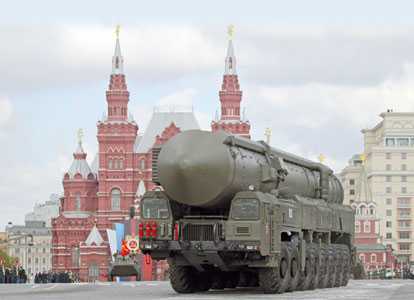
A Russian S-400 air defense battery, which is based on the S-300 design
Summary
Turkey is reportedly in the process of acquiring late-model Russian air defense technology from Ukraine and Belarus, Turkish daily Today’s Zaman reported Aug. 25. Bought second-hand, these systems would be used for the Turkish air force to train against, rather than to upgrade Ankara’s aging air defense network. That training could prove an important tool for both Turkey specifically and NATO in general.
Analysis
Turkey is in the process of acquiring several variants of the Russian S-300 air defense system, Turkish daily Today’s Zaman reported Aug. 25. The systems — reportedly to be acquired second-hand from Belarus and Ukraine — are not meant to revitalize Ankara’s aging air defense network; they are intended to be a training tool for the Turkish air force. Turkey decided to make the purchase July 22 — before the Russo-Georgian conflict — but should the deal go through, the lessons Turkey hopes to learn will almost certainly proliferate to NATO as a whole.
The S-300 encompasses a number of long-range strategic air defense systems (some variants also have a limited ballistic missile defense capability). Turkey has its sights set on both the S-300 and S-300V. The former, known to NATO as the SA-10B/C/D, encompasses several models of varying capability, but in short approaches the height of Soviet strategic air defense systems. Though neither Ukraine nor Belarus has the most modern S-300 variants — the PMU series — Turkey will likely attempt to acquire a PMU-series variant from them if it can, because Ankara knows Greece fields a PMU1 variant on Crete.
Related Link
Russia: The Fundamentals of Russian Air Defense Exports
Related Special Topic Page
Russia’s Military
The S-300V, meanwhile, shares the same design heritage as the S-300 (including some component parts). But while its spectrum of coverage and engagement envelope are quite similar, it is a distinct air defense system (known to NATO as the SA-12) characterized by the large tracked vehicles on which it is mounted. The S-300V was designed with a higher degree of mobility in mind. Russian troops deployed near the Turkish border in Armenia are protected by an S-300V battery.
Both the United States and Israel reportedly were able to acquire some S-300 components during the 1990s (including, in the U.S. case, parts of the S-300V), but the Turkish effort could include a later model or a more complete system.
Should Turkey succeed in this acquisition, Ankara’s subsequent work would take two important approaches. The first is reverse engineering, where key components are disassembled and their inner workings closely examined.. The second is training in electronic warfare against actual systems.
Ukraine and Belarus have neither the newest nor the best-maintained air defense hardware. The condition of the equipment Ankara seeks to buy is unclear, and Russia may be in a position to block at least the Belarusian part of the sale. But perhaps the most significant aspect of this news is the intention to train against it — not just dissecting the missile, but actually flying against functional systems.
A training range at Konya, less than 150 miles south of Ankara, is reportedly slated to host this Russian hardware, along with the shorter-range Russian Tor-M1. According to the report, the systems will be integrated with an electronic warfare training system with which Turkey’s F-16s will conduct exercises.
If Turkey is able to acquire even one of the three S-300 variants it seeks, it will undoubtedly work at the training range to learn and test the technology’s performance parameters. This will allow Turkey (and any other NATO allies who happen to train with Turkish forces at the Konya facility) to test tactics and challenge the system over and over again. Whether it will succeed in acquiring a PMU1 remains to be seen, but even older variants could offer very real insight into some of the overall S-300 design’s ultimate limitations and weaknesses. And the result will be a Turkish air force more capable of addressing the two most advanced air defense systems positioned on its periphery: the Greek S-300PMU1 batteries (which were originally slated for Cyprus) to its southwest and the Russian S-300V battery in Armenia, on its eastern border.
SIMFEROPOL, August 22 (RIA Novosti) – About 50 protesters gathered in the Crimean capital of Simferopol on Friday, urging Russia to pull out of a friendship agreement with Ukraine and to make a territorial claim on the peninsula.
The organizer of the rally, Valery Podyachy, told the gathering: “We ask Russia to tear up the agreement [on Friendship, Cooperation and Partnership with Ukraine] and to file territorial claims to Ukraine.”
The Crimea, which has a predominantly Russian-speaking population, has been the focus of frequent disputes between the Russian and Ukrainian leaderships, over the Russian Black Sea Fleet’s lease of the soviet-era Sevastopol naval base.
During the recent conflict between Russia and Georgia that followed Tbilisi’s August 8 offensive in breakaway South Ossetia, Ukraine threatened to bar entry to Russian Black Sea fleet vessels that had been deployed near Georgia’s coast.
Ukraine’s Defense Minister Yuriy Yekhanurov signed instructions on Thursday to implement an earlier presidential decree complicating the rules of deployment for the Black Sea Fleet.
Podyachy, who heads the Sevastopol-Crimea-Russia Popular Front, said: “While Russia sent aid to flood-hit Ukrainian regions, Ukraine failed to help Russia to force Georgia to peace, and took an openly hostile stance.”
Ukraine supplied weaponry to President Mikheil Saakashvili’s regime that was used to kill Russian peacekeepers, he said.
“Ukraine has proved by its policies that it is not a friend but an enemy to Russia,” Podyachy said.
Former Soviet leader Nikita Khrushchev, who grew up in Ukraine, made the Crimean Peninsula – a territory of 26,100 sq km – part of the Ukrainian Soviet Socialist Republic in 1954. The peninsula was until then a part of the Russian Soviet Socialist Republic.
Since the 1991 breakup of the Soviet Union, the Crimea has unsuccessfully sought independence from Ukraine. A 1994 referendum in the Crimea supported demands for a broader autonomy and closer links with Russia.
Relations between Russia and Ukraine have deteriorated recently following Kiev’s NATO membership bid and its demand that Russia’s Black Sea Fleet withdraw from its naval base in Sevastopol.
Vienna, August 21 – Having watched Moscow’s moves in Georgia and listened to various Russians suggest that the Crimea, where Russia’s Black Sea Fleet is based, is or should be Moscow’s next target, Ukrainian politicians, diplomats, and foreign policy analysts are discussing the nature and dimensions of the Russian threat and what Kyiv should do to parry it.
In addition to Russian actions and threats, this issue has heated up in recent days because of calls by senior Ukrainian officials for Russia to begin preparing to move its fleet out of Sevastopol by or possibly even before 2017, statements that most Russian politicians have refused to take seriously and most military analysts say would be very difficult.
Today, Ukrainian Foreign Minister Volodomyr Ogryzko said that Moscow must begin thinking about moving both men and materiel from Sevastopol now because regardless of what some may think, Kyiv will honor its agreement with Moscow but “in any case after 2017, the Russian fleet will not be on our territory (news.mail.ru/politics/1960873).
Ogryzko said that the Ukrainian government cannot understand why Russia has simply “refused” to discuss the situation or any plans to withdraw its forces and close the base. As a sovereign country, the minister said, Ukraine will meet its treaty obligations, but he underscored that Ukraine has “the right to make a choice” about any bases on its territory.
And if Ukraine makes the decision not to have such bases, the foreign minister continued, “no one, including Russia can influence our decision. … If in Moscow, they do not yet understand this, that governments live according to such rules throughout the world, then this is Russia’s problem” and not Ukraine’s.
But recent Russian behavior in Georgia and Moscow’s reactions to Kyiv’s positions on this and other issues has convinced many Ukrainians that Russia’s problem in this regard is becoming a problem for their country because of the danger that Moscow will try to destabilize its neighbor to ensure its continued control of Sevastopol or even seek to seize Crimea.
Those concerns have been exacerbated by three new developments: suggestions by some officials that Timoshenko should be charged with treason, a statement by a Crimean Tatar leader and Ukrainian parliamentarian that Moscow has many levers to use in Crimea, and an assessment by Ukrainian military analysts of what Moscow is already doing.
The first of these, charges that opposition leader Yuliya Timoshenko should be investigated for possible treason on behalf of Russia, has already been extensively discussed, with some analysts arguing that this scandal by itself represents an effort by Moscow to destabilize and discredit the Ukrainian government.
But the second and third deserve more attention. Today, Mustafa Dzhemilyev, who is both the leader of the Crimean Tatars and a deputy in the Ukrainian parliament, said that he is convinced that the large number of Crimeans who have dual citizenship with Russia by itself points to a possible South Ossetian scenario for that peninsula (www.vlasti.net/news/20236).
Moreover, he continued, unlike in South Ossetia, “there is no need [for Russia] to introduce forces [because] there is a sufficiently large and not badly armed contingent of the Russian Black Sea Fleet already there.” Consequently, Moscow could move even more quickly than in did in Georgia, he said.
“In order to preserve the territorial integrity of Ukraine,” the Crimean Tatar leader said, Kyiv should “close Russian consulates which are violating the law by handing out to citizens of Ukraine Russian passports.” Indeed, Ukrainian officials should force those “who have illegal dual citizenship to annul one of the passports.”
Moreover, Ukrainian officials must focus on the activities of pro-Russian organizations whose statements and activities are exacerbating interethnic tensions and creating the conditions for a Russian move. And Dzhemilyev said, Kyiv should insist that the Black Sea Fleet leave Sevastopol long before the 2017 date established by agreement.
The third event was the release, also today, of a report by the Kyiv Center for Research on the Army, Conversion and Disarmament, which argued that “Russia has created in the Crimea all the preconditions” for a military operation to keep control of Sevastopol, detach Crimea from Ukraine, and weaken the rest of the country as well (www.nr2.ru/kiev/192334.html).
“For the achievement of these goals, Russia doesn’t need a major military conflict with Ukraine,” the center’s analysts said. Instead, “it is sufficient to destabilize the situation in a single Crimean region” through the use of precisely targeted operations using “the forces of the Russian special services and particular units of the Black Sea Fleet.”
Moreover, they continued, Moscow will build on “to the maximum extent possible” the pro-Russian segments of the population and the pro-Russian social and political organizations that Moscow and its friends in Ukraine have been promoting ever since Ukraine gained its independence in 1991.
The center’s analysts suggested that the first stage of such a conflict might consist of “actions directed at the sharpening of relations between personnel of the Black Sea Fleet and representatives of Ukrainian authority in nearby areas,” possibly by means of “a provocation” taking the form of a supposed Ukrainian attack on the fleet.
After that happens, according to the center’s scenario, “the pro-Russian population will rise to the defense of the Russian personnel” and then there “will begin clashes with the law enforcement bodies of Ukraine.” That in turn will lead both countries to increase their military presence in Crimea, at which time Moscow will raise the issue of Ukraine’s right to Crimea.
Kyiv would then appeal to the West, the center said, but its analysts argued that Ukraine would not be any more successful in attracting anything more from Western countries than verbal support. And consequently, Russia could then “swallow” Crimea at its leisure, confident that Ukraine by itself would not be able to block its moves.
The center’s director added that he does not believe that Moscow is likely to follow such a scenario, but he added that “Russia has already created all the necessary conditions for its realization,” including official statements questioning Ukraine’s right to control Crimea, ramping up anti-Ukrainian feelings among Russians, and “also dominating Ukraine’s information space.”
Today also, Ukrainian media carried the assessments of five political analysts. Sergei Dzherdzh, the president of the Ukraine-NATO League, agreed that Russia could move in Crimea, but he suggested that “more sober” heads in Moscow were likely to act with restraint given Moscow’s experiences in Chechnya and Georgia (www.vlasti.net/news/20336).
Vadim Grechaninov, president of the Atlantic Council in Kyiv, said that Russia will launch “not a real war but an information one” and will seek to dominate Ukraine by creating “a fifth column,” a powerful pro-Russian lobby within the government, the leaders of the country’s political parties, and in the regions.
Political scientist Viktor Nebozheno said that Ukraine was entering a dangerous period because both Russian and Georgian “hawks” might seek to stage provocations in Sevastopol in order to achieve their goals elsewhere, a view echoed by the Ukrainian Diplomatic Academy’s Aleksandr Paliy, who said Russia has constantly been staging provocations in Ukraine.
But Vadim Karasev, a political scientist, said that Ukraine is in fact in a good position to counter any Russian moves of this kind. If it blocks the formation of “unrecognized formations” and “separatist groups” prepared to help Russia and if it adopts “a new regional policy” to ensure that Crimea develops, then Moscow will have a much harder time in pursuing its goals.
But “the main thing,” Karasev said, is for Ukraine “not to do anything stupid” that Moscow would then exploit.
Turkey's Ramazan Sahin prays after his victory over Ukraine's Andriy Stadnik during their wrestling men's 66kg freestyle gold medal contest in the 2008 Beijing Olympic Games at the China Agricultural University Gymnasium in Beijing on August 20, 2008. Sahin won the gold medal. (Agencies)Xinhua
Updated: 2008-08-20 20:30
BEIJING — Ramazan Sahin of Turkey won the men’s freestyle 66kg wrestling title to earn Turkey their first gold medal here on Wednesday evening at the Beijing Olympic Games.
The reigning world champion lost the first period to Ukrainian Andriy Stadnik but took the next two for a 2-1 (2-2, 2-1, 2-2) victory. The first period was decided on the last point given to Stadnik, while the third period went to Sahin because he had one 2-point technique to his opponent’s two 1-point techniques.
“The final was the most difficult round,” said Sahin. “I lost to him the last time we fought, but I felt quite relaxed and confident this time.”
“The gold is for the Turkish people. I would like to give my appreciation to my coach and all the people who support me.” added Sahin.
Turkey's Ramazan Sahin carries national flags to celebrate his victory over Ukraine's Andriy Stadnik (not in photo) in their men's 66kg freestyle gold medal wrestling match at the 2008 Beijing Olympic Games on August 20, 2008. (Agencies)Stadnik was happy to win the silver because he thought he did better than his wife, bronze medalist Mariya Stadnik of Azerbaijan in women’s freestyle 48kg wrestling.
“It’s nice to realise that you compete against your own wife and you are the winner,” said Stadnik.
“Reaching the final is already a good result. I have been ready to win. I have competed against Sahin three times, and I only won once.”
The bronze medal was shared by Otar Tushishvili of Georgia, a semifinal loser to Sahin, and Sushil Kumar of India.
Tushishvili won the medal by points over Cuba’s Geandry Garzon, scoring the last of two takedowns of the second period after dominating the first one.
Kumar broke free from a defensive position in an extra time to beat Leonid Spiridonov of Kazakhstan for the bronze medal.