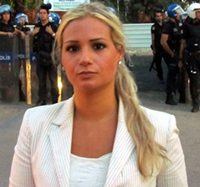
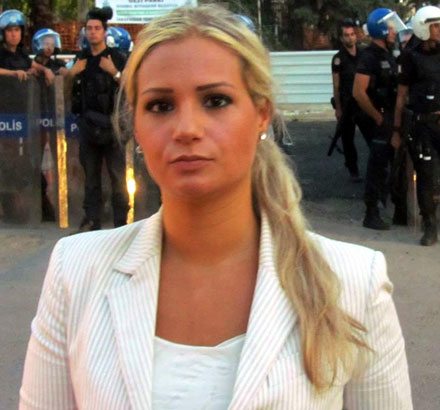
I never met her. I wish I had. But I knew she was a reporter, a good reporter telling of bad wars, and telling all the sides. And this one in Kobani (Ayn al-Arab) has many more sides than two, all of them bloody, all of them reeking of criminality. This carnage in Syria is perhaps the most corrupt, criminal, imperial assault in modern history. There are no “good guys” in this slaughter on the rapidly crumbling edge of Turkey. It’s all lies, deceit and power politics. Call it murder. Call it the ultimate man’s tough-guy game—bombardment, siege, street-fighting, and always the stupidity.
The dogs of war run wild and ignorantly. For what? For a nothing town destroyed by chaos. She was telling as much as she could. The Turks there, the intelligence guys, the cops, the Turkish army, all the government “watchers” watched her and her partner, Judy Irish. She was called a spy. Watch out, they said. Maybe you’ll even be arrested, they mumbled. And the word got around. Not an easy assignment. She confessed that she was worried. Who wouldn’t be?
Note the eyes. They would tell exactly what they saw, wouldn’t they? She had two children, this beautiful Lebanese-American woman. She was 30 years-old, hard-working and dedicated. Perhaps it was Napoleon who spoke about his Marshalls “marching towards the sound of the guns.” She didn’t need the advice. She followed the danger instinctively. Maybe she could make sense of it all in Iraq, Lebanon, the Ukraine, and lastly, Turkey? Maybe? Maybe not? She told of the ISIS killers being smuggled into Syria in trucks with NGO labels like World Food Organization. Turkey has been at this double-dealing game for years. But this kind of truth hurts and it did not endear her to the Turkish “watchers” and “handlers” and “muscle-guys.”
On the way back to the hotel in a town called Suruç a cement-mixer truck, massive and deadly accurate, somehow, some way, intervened to crush her car and her. It all had the stink of bad fish. Based on the historic violence visited upon journalists and other dissenters in Turkey such a first impression of foul play is logical.
The governor of that area immediately said that “Turkey is a democratic state of law. The allegations are completely untrue.” What is completely untrue is exactly what he said. Democracy and the rule of law have both been crushed by the cement-mixer truck known as the Turkish government. And Serena confirmed that in her reportage. And so passes a brave young woman’s life in Turkey. And so continues the war.
‘Chocolate King’s’ Father Was Jew Who Took Wife’s Name
Mezuzah in the Closet? Confectionary mogul Petro Poroshenko is leading the polls in Ukraine’s presidential race. Does he have a secret Jewish family history?
By Cnaan Lipshiz
(JTA) — Even in normal times, Kiev can feel like a city perpetually under construction. Potholes are “fixed” with flimsy coverings, ramshackle scaffolding clings precariously to the sides of buildings, and tangles of electric wires seem ever ready to combust.
But since the outbreak of anti-government protests in November, the sense of flux in the Ukrainian capital has been greater than ever. Two kinds of tents now dot the city center: Hundreds of khaki-colored bivouacs housing the revolutionaries whose protest movement led to the ouster of President Viktor Yanukovych in February, and more recently erected campaign booths making bold promises of a brighter future ahead of Sunday’s presidential elections.
Politicians describe the vote, the first since a wave of civil unrest broke out in the capital in November, as the most crucial since Ukraine emerged as an independent country in 1991 following the breakup of the Soviet Union. But many disillusioned voters here seem to place more faith in the tired men and women inside the khaki tents — and their pledge to speak truth to power — than in any of the candidates featured in the election posters.
Marina Lysak, a Jewish activist who participated in the protest movement known as Maidan, after the central Kiev square where they took place, told JTA that the tent people are there to send a message to whomever prevails in the election.
“The statement is: ‘We are watching you. If you betray us again, we will not remain silent,’ ” Lysak said. Whoever wins on Sunday faces a herculean set of challenges. The first order of business will be dealing with pro-Russian separatist militias that now hold several cities in eastern Ukraine, where Russian speakers constitute a majority.
The new president also must address a looming economic crisis. Since November, the Ukrainian currency, the hryvna, has plummeted, losing 35 percent of its value against the U.S. dollar. Some analysts worry that the heavily indebted nation will soon default.
And then there’s the sensitive question of clearing encampments from the scorched earth of Maidan, where most tents are pitched on asphalt laid bare by demonstrators who pried the cobblestones loose to hurl them at government forces.
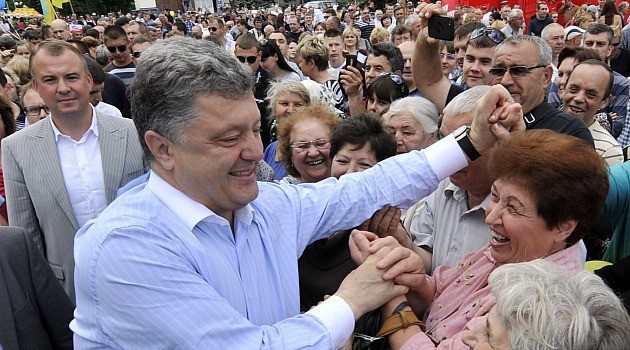
The leading candidate for these tasks is Petro Poroshenko, 48, an oligarch from Odessa and the head of a confectionary empire. Polls predict Poroshenko will take 30 percent of the vote in the first round of balloting.
Yulia Tymoshenko, a former prime minister recently released from jail after serving three years on what she claims were charges trumped up by the Yanukovych regime, is expected to finish second with anywhere from 6 to 18 percent.
Assuming no candidate takes more than 50 percent of the vote — more than 20 are competing — a runoff election between the top two finishers would take place on the following Sunday.
Jewish community leaders have remained officially neutral about the candidates, but many Ukrainian Jews support Poroshenko, a former foreign minister rumored to have Jewish roots.
“He has a unique set of skills that absolutely make him the man for the job,” said Igor Schupak, a Jewish historian and director of the Dnepropetrovsk-based Jewish Memory and Holocaust in Ukraine Museum. Business know-how and foreign relations experience “give Poroshenko a toolbox that places him in a league of his own in comparison to the other candidates.”
The sense that Poroshenko is the preferred candidate only when compared to other lesser options isn’t an uncommon one, even among those working to put the oligarch in office.
“He’s no saint — none of them are,” said Svetlana Golnik, who volunteers with the Poroshenko headquarters twice a week in downtown Kiev. “But he is cleaner than most other oligarchs and he delivers on his promises. Anyway, right now he’s what we have to work with.”
James Temerty, a non-Jewish Canadian business magnate who founded the Ukrainian Jewish Encounter to promote interethnic dialogue, said it would be very difficult for Poroshenko to make significant changes without further destabilizing the economy.
“The best hope here is to move toward Europe, and that will stop the corruption gradually,” Temerty said. “He said he’d do it.”
According to the popular Russian television channel Russia-1, Poroshenko’s father was a Jew named Alexei Valtsman from the Odessa region who in 1956 took on the last name of his wife, Yevgenya Poroshenko.
Poroshenko’s media team did not reply to JTA requests for comment, but they are not indifferent about the subject.
Last year, Poroshenko’s spokeswoman asked Forbes Israel to remove her boss’ name from a list of the world’s richest Jews, a magazine source confirmed.
Moshe Azman, a chief rabbi of Ukraine, said he asked Poroshenko directly about the rumors.
“He told me he wasn’t Jewish,” Azman said.
Even if the rumors were true, Poroshenko wouldn’t be the only candidate for president with Jewish roots. Vadim Rabinovich, a billionaire media mogul and founder of the All-Ukrainian Jewish Congress, is running on a platform combining a tolerant attitude toward Ukrainian minorities with plans to dispense with Ukraine’s quasi-federal political system and reduce taxes.
Although he barely registers in the polls — current figures show him taking just over half-a-percent of the vote — his candidacy has at least one high-profile supporter: Rostislav Melnyk, who became famous in Ukraine after surviving a savage beating by Yanukovych forces.
“I support Rabinovich’s platform and I will vote for him,” Melnyk said, “also because he is good for the future of the Jewish community.”
This isn’t Ukraine Or Venezuela, This is Turkey Right Now — 11 Pictures Explain What’s Happening Image Credit: AP
A fresh new wave of protests is rocking Turkey, as tens of thousands march on the streets to demonstrate against the government. But unlike what’s going on in Ukraine and Venezuela, the protests in Turkey mark a second, renewed round of protests that began last summer. If you have not caught up on the latest developments, or don’t know what the people are protesting about, here are 11 photos that sum up what’s been happening on the ground:
via This isn’t Ukraine Or Venezuela, This is Turkey Right Now — 11 Pictures Explain What’s Happening – PolicyMic.
A woman holds a sign reading, “Yesterday Stalin, Today Putin” at a protest in Istanbul against Russian actions in Crimea.
By Glenn Kates
March 09, 2014
ISTANBUL — Serkan Sava’s ancestors left Crimea in a mass exodus some 150 years ago, after the Ottoman Empire staved off Russian pressure in the Crimean War but could not reverse the slow tumble that would lead to its dissolution after World War I.
A century later, the 35-year-old IT consultant’s grandparents, by then rooted in the post-Ottoman Turkish Republic, would hear of Soviet dictator Josef Stalin’s deportation of hundreds of thousands of Crimean Tatars to Central Asia, in 1944, that cost the lives of more than 100,000 people.
This week, Sava stood under a steady rain at a protest of about 250 people — mostly Turkish Crimean Tatars — outside the Russian consulate in Istanbul. Noting that Crimean Tatars “have bad memories” of life under Moscow’s thumb, Sava argued that Turkey should use its influence to ensure that the Black Sea peninsula remains a part of Ukraine and is not annexed by Russia.
With Crimea now occupied by Russian forces, the peninsula’s Russian-majority parliament clamoring to join the Russian Federation, and a referendum on the issue scheduled for March 16, Crimean Tatars are fearful of what another chapter of life under Russian rule could mean.
But if the Crimean Tatar relationship with Russia is rife with tragedy, the Turkish reaction to any potential conflict with Moscow is one of trepidation.
It recalls a past marked by a series of demoralizing military defeats and recognizes a present in which the country enjoys deep trade ties with its Black Sea neighbor, on which it relies for half of its natural-gas supplies.
“Russia is the only neighbor that Turkey really fears for historic and contemporary reasons,” says Soner Cagaptay, author of “The Rise Of Turkey: 21st Century’s First Muslim Power” and director of the Turkish program at the Washington Institute, a U.S.-based think tank. “Historically, there’s a deep-rooted fear among many Turks about not waking up the Russian bear.”
The Crimean Tatars, an ethnic-Turkic people with millions of its diaspora living inside Turkey, would appear to fit in with the role Turkish Prime Minister Recep Tayyip Erdogan has carved out for himself.
Erdogan, the leader of the Islamist-rooted Justice and Development party (AKP), has spent much political capital casting Ankara as a protector of Muslims along its periphery. Erdogan was a harsh critic of the overthrow of Muslim Brotherhood leader and Egyptian President Muhammad Morsi, and was one of the first world leaders to call for military intervention in Syria against the regime of Bashar al-Assad in the Arab Spring uprising.
Amid the recent political upheaval in Ukraine, Ahmet Davutoglu, Turkey’s foreign minister, was the first envoy to meet with Ukraine’s new government in Kyiv, following months of protests that led to the ouster of the country’s pro-Russian president, Viktor Yanukovych.
With an eye on the past, Erdogan himself has promised not to “leave Crimean Tatars in the lurch.”
But Erdogan, who has appeared at times to relish conflict with other world leaders, has carefully nurtured his relationship with Russian President Vladimir Putin and appears unlikely to stake out a position that would put Ankara-Moscow ties at serious risk.
“If you look at Erdogan’s mercurial political style, he has pretty much yelled at every and any head of government he has dealt with with the exception of the Russian and the Iranian president,” Cagaptay says, “not because he likes them necessarily but because Turkey gets about three-quarters of its gas and oil from Iran and Russia.”
Ottoman-Russian history is also a factor, says Cagaptay, who wrote in a recent paper that, over a period of almost 400 years, the Ottoman Empire fought in at least 17 wars with Russia and lost all of them.
Further complicating matters is that the 1936 Montreaux treaty, which gives Turkey control over the straits that link the Black Sea to the Mediterranean, also limits the weight of warships that would be allowed to pass through from states not located on the Black Sea.
Any adaptation of this restriction by Turkey in favor of its NATO partners would put the treaty at risk.
But as Celal Icten, the president of the Istanbul branch of Turkey’s Crimea Tatar Association, points out, it may be that the current domestic political climate provides the main hindrance to a greater role by Ankara in helping resolve the crisis in Ukraine.
Erdogan, who has been embroiled in a months-long corruption scandal, is fighting for his political career, and municipal elections at the end of March are seen as a barometer of the remaining strength of his ruling Justice and Development Party (AKP).
Icten says Erdogan and President Abdullah Gul are doing all they can, given the circumstances.
“Turkey’s current political climate is hectic and that’s why the president and prime minister’s support for Crimean Tatars gets lost among other things on the political agenda,” Icten says. “But [they’ve] given support to Crimean Tatars and continue cooperation with Western powers in Europe.”
Cagaptay agrees that Ankara will cooperate with Europe, which has proposed limited sanctions, but is unlikely to take a leading role unless serious violence is inflicted on the Crimean Tatar population.
That might not assuage Crimean Tatars like Sava, who say the protection of a Turkic minority that is under threat should outweigh any political concerns.
While Moscow refuses to recognize Ukraine’s new government because it is led by “fascists” who pose a threat to ethnic Russians, Tatars in Crimea — some of whose homes have reportedly been marked with an ominous “X”– say they are being singled out by Russian “self-defense” brigades.
At the Istanbul demonstration, protesters chanted, “Turkey, help your brothers!” and, “We are shoulder-to-shoulder against the enemy!”
Erugrul Toksoy, a 47-year-old account manager sporting a blue scarf with the Crimean Tatar insignia, says Erdogan “has done nothing” to help Crimean Tatars, who make up 12 percent of the peninsula’s population.
Sava, the IT consultant, riffing on a quote from the late British statesman Winston Churchill about the dangers of appeasement, warns that waiting for action will have its own costs.
“The one who tries to protect the current state [of affairs] is hopeful that the crocodile will eat him last,” Sava says.
Turkey is “closely following” the crisis in Ukraine amid fears about the fate of the Turkish-speaking Tatar minority in Crimea, a government source said on Monday.
“We have an important duty to remember the Tatars, and we are in discussion with concerned parties so that this dispute does not degenerate into armed conflict. We cannot remain mere spectators of what is happening there,” the Turkish government source told AFP, speaking on condition of anonymity.
Members of the Tatar community held demonstrations in Ankara, Istanbul and the central city of Konya over the weekend to protest the Russian intervention in Ukraine.
“No to Russia — Crimea must stay Ukrainian!” read one of the protesters’ placards outside the Russian embassy in Ankara on Sunday.
Foreign Minister Ahmet Davutoglu traveled to Kiev on Saturday and has held talks with representatives from the United States, France, Germany and Poland over the phone, according to a foreign ministry spokesman.
He also hopes to meet with his Russian counterpart Sergei Lavrov as soon as possible, the spokesman added.
Davutoglu was due to meet representatives of the Tatar community in Ukraine on Monday.
“Turkey will do everything possible to ensure the stability of Crimea at the heart of a united Ukraine,” he said in a televised interview on Sunday.
“The rights of the Tatars and their existence must be guaranteed.”
Turkey, a NATO ally, says that 12 percent of Crimea’s population are Turkish-speaking Tatars who are Sunni Muslims, like the majority of Turks.
Crimea was part of the Ottoman Empire until it was conquered by Russia in the late 18th century. Tatars — the majority population at the time — have been gradually pushed out since then.
Turkey has maintained strong cultural links to the Tatars in Ukraine, funding development projects including housing, roads and schools in Crimea through an aid programme based in the Crimean capital Simferopol.
ba/er/gd
via Turkey voices fears for Tatar minority in Ukraine | GlobalPost.
As I am writing this article, Turkish Foreign Minister Davutoğlu is still in Ukraine to discuss the situation in the Crimea region. The persistent political disorder in Kiev following the collapse of President Viktor Yanukovych’s government – and his subsequent flight to Russia – are creating broad repercussions in the Crimean Autonomous Republic. After the Chairman of the Crimean Parliament Volodimir Konstantinov’s statement that they would seek to secede from Ukraine if tensions grew worse, the situation has deteriorated swiftly, including direct Russian military intervention in violation of Ukraine’s sovereignty. In an article in last week’s Russian Pravda, it was noted that if Ukraine was divided, then the status of the Crimean Peninsula – returned to Ukraine in 1954 by Nikita Kruschev, would be open to discussion, and that would include Turkey having a say in the future of Crimea.
Russia gains control over Crimea
The reference to this claim is the “Küçük Kaynarca” (Karlowitz I) signed 230 years ago. As per this agreement, signed by the Russian Tsarina Catherine II on April 19, 1783, the Crimean Peninsula was taken away from the dominion of the Ottomans and handed over to Russia. However, one of the most important provisions of this treaty was the debarment of independence for the Peninsula and outlawing its submission to a third party: Should any such attempt be made, then Crimea would automatically have to be returned to the sovereignty of Turkey.
When Ukraine appeared as an independent nation following the disintegration of the USSR in 1991, Turkey acquired the right to claim the Peninsula back based on the Treaty of Küçük Kaynarca; however, this was not brought up by the Turgut Ozal administration of the time. Turkey was content with advocating for the rights of the Tatar minority living on the Crimean Peninsula.
What Turkey needs to do at this point is to make efforts to calm down both parties in order to preserve the unity of Ukraine
Ceylan Ozbudak
That being the case, we may acknowledge that Crimea has always been a particularly indispensable region for Turkey on account of the close relations of the Ottoman State with the Crimean Khanate and the presence of the Crimean Tatars there. In addition, Ukraine is one of the foremost neighbors of Turkey, and in terms of the balance in the Black Sea region, it is important. Just as the name “Crimea” implies the largest Russian naval base at Sevastopol for Russia, the same “Crimea” connotes brotherhood with Turkic Muslims from the Ottoman times. For that reason, both Russia and Turkey have excluded the Autonomous Republic of Crimea from their policies related with Ukraine.
Stalin’s genocide of Crimean Turks
On top of that, for the majority of Turkish people who are well-read in history, the Crimean land has a distinct place when compared with other Turkic Republics, because similar to Hitler’s “holocaust” against the Jews, Stalin carried out atrocities against the Crimean Turks. Stalin’s campaign of forced ethnic cleansing and the relocation of the Crimean Turks is still well-remembered.
The Crimean Tatars and the Noghai were peoples of the Crimean Khanate and amongst the largest groups who emigrated to the Ottoman State and the Republic of Turkey. The settlement of hundreds of thousands of Crimean Tatars and Noghai made dramatic changes in the demography of the Ottoman State and its successor, the Republic of Turkey.
While the Turkish population in Crimea in 1783 was 98 percent, following the Russian invasion this was reduced to 35 percent.
The Crimean People’s Republic, which was founded following the Bolshevik Revolution, was brought to an end with the martyrdom of the president, Numan Celebi Cihan. The “Crimean Autonomous Soviet Socialist Republic” established in 1921 under the supervision of Moscow did not grant the Crimeans any freedom; the Crimean intellectuals who opposed the propaganda of the Communists against Islam and Turkish identity were deported to Siberia and the Ural mountains (mostly to die in GULAG camps).
The period following WWII was perhaps the most difficult for the Muslim – Turk community in the region. When Crimea was seized by the Russians, the entire Turkish population living in those lands for the last 1,500 years was promptly exiled. By means of a decree issued in 1945 by the Soviet government, the “Crimean Autonomous Soviet Socialist Republic” was abolished. The Crimean land attained the status of a state which belonged first to Russia, and then under the Kruschev government was transferred to Ukraine.
While a struggle for independence was going on for the Crimean Turks who had been ruthlessly deported from their nation, the homeless Russian population was made to settle in the very same land. The nearly 40 years of exile of the Crimean Turks was partly ended in 1987 when their rally for independence in Red Square turned into a major display of political power. The Soviet regime, unable to resist, subsequently allowed the Crimeans to return to their homeland. While about 20,000 Turks were living in Crimea in 1989, this figure increased to 150,000 by 1991. Today, their population is estimated to be around 300,000 and growing.
Today, the part of Crimea that strives for closer relations with Russia – and even aspires to annexing itself to Russia once full independence is achieved – is comprised of the ethnic Russians who settled in the Crimea post-World War II.
What should Turkey do?
Obviously what Turkey needs to do at this point is to make efforts to calm down both parties in order to preserve the unity of Ukraine and help them find a solution to their disagreements. Despite the obvious advantages for Ukraine in being a part of the European Union, there is no point in being surprised at Russia’s insistence that Ukraine should be part of its Customs Union and planned Eurasian Union.
Under these conditions, what Turkey should do is strive to calm the parties in order to protect the territorial integrity of Ukraine and to help Ukraine remain a state that enjoys fruitful joint relations both with the EU and with Russia by solving their domestic problems through dialogue. It must not be forgotten that Ukraine is very important for Russia in transferring its energy resources to Europe. Turkey and Azerbaijan constitute the basic axis of the South Gas Corridor (SGC). The possibility of Israel getting involved in the energy business and getting connected to the SGC, not to mention Iran’s demand to join this energy axis raises the possibility of Russia cutting off this south passages completely. Let us not also forget that Russia attaches great importance to the Sevastopol naval base and doesn’t want to see it under any strategic threat.
How can Turkey set an example to Ukraine?
Crimea rests at the epicenter of all this and does not have the power to resist, neither economically or sociologically, such strong pressure. Under these conditions Turkey should get involved more deeply and help the region by adopting a policy that embraces all Ukrainians and all the Crimean population.
Just as Turkey has been able to maintain both internal and external balances despite standing in what may well be the biggest intersection in the world, Turkey should lead the way for Ukraine as well. Anatolia sits at the junction of Europe, Asia and Africa, on prolific agricultural lands that are simultaneously poor in energy resources; yet ironically, Turkey is a hub of energy resources, as well as air and sea transportation. Turkey is also a melting pot of various ideologies and hostilities. She is the intersection of the European understanding of modern democracy, the old leftist ideologies of Russia and the Eastern Bloc, Arab nationalism and Islamic denominations. She holds a position that has been able to establish equal relations with Israel and Iran, Russia and the Gulf Countries, and has still been able to peacefully harbor all these factors inside the vastness of the Anatolian Steppes.
When we evaluate all these factors, it would be a grave mistake to expect Turkey to adopt a policy that would harm the territorial integrity of Ukraine by making a claim in Crimea. As I have stated above, Turkey should help create a situation that would preserve Ukraine’s territorial integrity with Crimea, one that would see Ukraine approach the European Union, yet not completely break away from Russia. The situation should also finally help in establishing a solid democracy with the norms of the European Union. We need a new policy approach in Europe with a model which will leave the Twentieth Century’s bi-polar world behind and keep alliances on the back burner. We need neighbors that can act in a more integrated manner by ridding themselves of obsolete worldviews, leftovers from the era of the Cold War. We need mature and wise statesmen who can hold the hands of parties in conflict in order to make them meet in the middle and make peace instead of picking sides or cowering behind barricades at the slightest complication. Turkey has been able to hold on to its moral values and has been able to stand tall and stand strong, even in the perennially restless Middle East, and can thus set an example for Ukraine.
______________________
Ceylan Ozbudak is a Turkish political analyst, television presenter, and executive director of Building Bridges, an Istanbul-based NGO. As a representative of Harun Yahya organization, she frequently cites quotations from the author in her writings. She can be followed on Twitter via @ceylanozbudak