Category: Eastern Europe

  • Former Mossad chief: For the first time, I fear for the future of Zionism

    Former Mossad chief: For the first time, I fear for the future of Zionism

    The nation of Israel is galloping blindly toward Bar Kochba’s war on the Roman Empire. The result of that conflict was 2,000 years of exile.

    By Shabtai Shavit
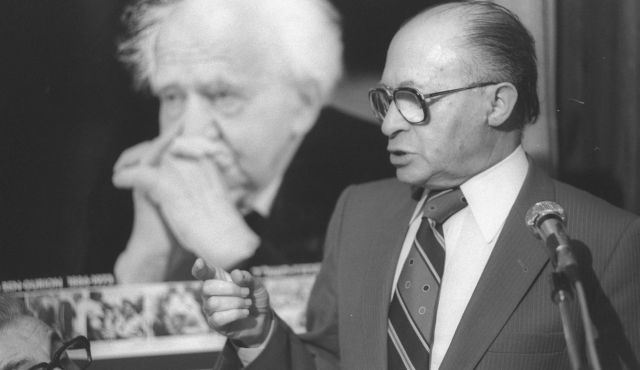
    Menachem Begin before an image of David Ben-Gurion
    Menachem Begin before an image of David Ben-Gurion

    From the beginning of Zionism in the late 19th century, the Jewish nation in the Land of Israel has been growing stronger in terms of demography and territory, despite the ongoing conflict with the Palestinians. We have succeeded in doing so because we have acted with wisdom and stratagem rather than engaging in a foolish attempt to convince our foes that we were in the right.

    Today, for the first time since I began forming my own opinions, I am truly concerned about the future of the Zionist project. I am concerned about the critical mass of the threats against us on the one hand, and the government’s blindness and political and strategic paralysis on the other. Although the State of Israel is dependent upon the United States, the relationship between the two countries has reached an unprecedented low point. Europe, our biggest market, has grown tired of us and is heading toward imposing sanctions on us. For China, Israel is an attractive high-tech project, and we are selling them our national assets for the sake of profit. Russia is gradually turning against us and supporting and assisting our enemies.

    Anti-Semitism and hatred of Israel have reached dimensions unknown since before World War II. Our public diplomacy and public relations have failed dismally, while those of the Palestinians have garnered many important accomplishments in the world. University campuses in the West, particularly in the U.S., are hothouses for the future leadership of their countries. We are losing the fight for support for Israel in the academic world. An increasing number of Jewish students are turning away from Israel. The global BDS movement (boycott, divestment, sanctions) against Israel, which works for Israel’s delegitimization, has grown, and quite a few Jews are members.

    In this age of asymmetrical warfare we are not using all our force, and this has a detrimental effect on our deterrent power. The debate over the price of Milky pudding snacks and its centrality in public discourse demonstrate an erosion of the solidarity that is a necessary condition for our continued existence here. Israelis’ rush to acquire a foreign passport, based as it is on the yearning for foreign citizenship, indicates that people’s feeling of security has begun to crack.

    I am concerned that for the first time, I am seeing haughtiness and arrogance, together with more than a bit of the messianic thinking that rushes to turn the conflict into a holy war. If this has been, so far, a local political conflict that two small nations have been waging over a small and defined piece of territory, major forces in the religious Zionist movement are foolishly doing everything they can to turn it into the most horrific of wars, in which the entire Muslim world will stand against us.

    I also see, to the same extent, detachment and lack of understanding of international processes and their significance for us. This right wing, in its blindness and stupidity, is pushing the nation of Israel into the dishonorable position of “the nation shall dwell alone and not be reckoned among the nations” (Numbers 23:9).

    I am concerned because I see history repeating itself. The nation of Israel is galloping blindly in a time tunnel to the age of Bar Kochba and his war on the Roman Empire. The result of that conflict was several centuries of national existence in the Land of Israel followed by 2,000 years of exile.

    I am concerned because as I understand matters, exile is truly frightening only to the state’s secular sector, whose world view is located on the political center and left. That is the sane and liberal sector that knows that for it, exile symbolizes the destruction of the Jewish people. The Haredi sector lives in Israel only for reasons of convenience. In terms of territory, Israel and Brooklyn are the same to them; they will continue living as Jews in exile, and wait patiently for the arrival of the Messiah.

    The religious Zionist movement, by comparison, believes the Jews are “God’s chosen.” This movement, which sanctifies territory beyond any other value, is prepared to sacrifice everything, even at the price of failure and danger to the Third Commonwealth. If destruction should take place, they will explain it in terms of faith, saying that we failed because “We sinned against God.” Therefore, they will say, it is not the end of the world. We will go into exile, preserve our Judaism and wait patiently for the next opportunity.

    I recall Menachem Begin, one of the fathers of the vision of Greater Israel. He fought all his life for the fulfillment of that dream. And then, when the gate opened for peace with Egypt, the greatest of our enemies, he gave up Sinai – Egyptian territory three times larger than Israel’s territory inside the Green Line – for the sake of peace. In other words, some values are more sacred than land. Peace, which is the life and soul of true democracy, is more important than land.

    I am concerned that large segments of the nation of Israel have forgotten, or put aside, the original vision of Zionism: to establish a Jewish and democratic state for the Jewish people in the Land of Israel. No borders were defined in that vision, and the current defiant policy is working against it.

    What can and ought to be done? We need to create an Archimedean lever that will stop the current deterioration and reverse today’s reality at once. I propose creating that lever by using the Arab League’s proposal from 2002, which was partly created by Saudi Arabia. The government must make a decision that the proposal will be the basis of talks with the moderate Arab states, led by Saudi Arabia and Egypt.

    The government should do three things as preparation for this announcement:

    1) It should define a future negotiating strategy for itself, together with its position on each of the topics included in the Arab League’s proposal.

    2) It should open a secret channel of dialogue with the United States to examine the idea, and agree in advance concerning our red lines and about the input that the U.S. will be willing to invest in such a process.

    3) It should open a secret American-Israeli channel of dialogue with Saudi Arabia in order to reach agreements with it in advance on the boundaries of the topics that will be raised in the talks and coordinate expectations. Once the secret processes are completed, Israel will announce publicly that it is willing to begin talks on the basis of the Arab League’s document.

    I have no doubt that the United States and Saudi Arabia, each for its own reasons, will respond positively to the Israeli initiative, and the initiative will be the lever that leads to a dramatic change in the situation. With all the criticism I have for the Oslo process, it cannot be denied that for the first time in the conflict’s history, immediately after the Oslo Accords were signed, almost every Arab country started talking with us, opened its gates to us and began engaging in unprecedented cooperative ventures in economic and other fields.

    Although I am not so naïve as to think that such a process will bring the longed-for peace, I am certain that this kind of process, long and fatiguing as it will be, could yield confidence-building measures at first and, later on, security agreements that both sides in the conflict will be willing to live with. The progress of the talks will, of course, be conditional upon calm in the security sphere, which both sides will be committed to maintaining. It may happen that as things progress, both sides will agree to look into mutual compromises that will promote the idea of coexisting alongside one another. If mutual trust should develop – and the chances of that happening under American and Saudi Arabian auspices are fairly high – it will be possible to begin talks for the conflict’s full resolution as well.

    An initiative of this kind requires true and courageous leadership, which is hard to identify at the moment. But if the prime minister should internalize the severity of the mass of threats against us at this time, the folly of the current policy, the fact that this policy’s creators are significant elements in the religious Zionist movement and on the far right, and its devastating results – up to the destruction of the Zionist vision – then perhaps he will find the courage and determination to carry out the proposed action.

    I wrote the above statements because I feel that I owe them to my parents, who devoted their lives to the fulfillment of Zionism; to my children, my grandchildren and to the nation of Israel, which I served for decades.

    Haaretz, 24.11.14

  • AMERICAN BOYZ N THE HOOD

    AMERICAN BOYZ N THE HOOD

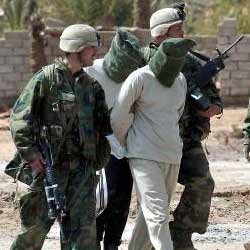
    Turkish Soldiers Hooded by America Sulaymaniyah, Iraq. 4 July 2003
    Turkish Soldiers Hooded by America
    Sulaymaniyah, Iraq. 4 July 2003


    Istanbul: 13 November 2014

    Yesterday, three sailors from the uncontrollably violent neighborhood called America met the true face of Turkey. Poor boys, they don’t even know what they represent. They don’t even know that their so-called leaders have made them punching bags for its criminal enterprise called American imperialism. They don’t even know how America and its treasonous internal agents, in particular the Turkish government, are attempting to destroy the future of the Turkish youth.

    Perhaps these American boys got a quick lesson in the true nature of Turkish-American relations yesterday? But, sadly, probably not. The American boys ran back to the false safety of their warship, re-entering their “safe” world of imperialist propaganda, economic excess and hypocrisy. But there is no safety anywhere any longer. That is the gift of America to Turkey, and to the world. As usual, America authorities and its treacherous collaborating Turkish puppets screamed in outrage. And, as usual, the youth of Turkey, the true defenders of the Republic of Turkey, went to jail for exercising their patriotic duty. Nothing has changed, except one thing. Turkish young people, the nation’s true patriotic voice, will not take American crap anymore. And America should understand that. Listen and learn, America. You owe it to your own youth. Think of it this way, think of it as a symbol.

    That’s the way the resident American-imposed agent of destruction, Recep Tayyip Erdoğan, thought about his hooding of Turkish women into a grotesque series of Middle Age costumes that squeeze feminine brains into numb submission. So what, declared the then prime minister, if the head scarf is a political symbol? So what, indeed! Erdoğan used his compliant covered women to destroy democracy in his own country. He and his collaborators hid behind their women’s headscarves to do America’s dirty work. And now they cannot safely visit any neighborhood in their own land. No “hood” is safe for the hoodlums. And now the new president hides in a billion-dollar illegal palace, his inadvertent monument to treason. So what if he and his ilk cannot appear in public! So what!

    So what if in 1980 the American president celebrated the success of his CIA-engineered military coup by proclaiming “Our boys did it!” Yes, then his gangster BOYZ did it. And yesterday, today’s Turkish youth remembered. And yesterday, our Turkish boys did it to America, symbolically, of course, because Turkish youth is civilized. They can be no other way; they are the current-day “soldiers of Mustafa Kemal Ataturk.” This is something that the treacherous opposition political polities can neither say nor understand. Yes, Turkish young people are civilized and enlightened by the patriotic principles of Mustafa Kemal Ataturk. That’s why, yesterday, no one, neither American boy nor Turkish boy was hurt. No one was tortured. No one was hung. No one was shot, exploded, beaten, gassed, or otherwise maimed. And that’s a lot more than America can ever say about their overt and covert interventions in Turkey’s affairs.

    So what if America and its craven ambassador, Francis Ricciardone, aided and abetted the Turkish government in its beating, gassing, maiming and murdering of democratically assembled Gezi Park protestors. “The Turkish government is having a conversation with its people,” said the deceitful ambassador, as he arranged to have more poisonous gas sold to Erdoğan and his hoodlum police. A “conversation?” So what!

    So what if the same ambassador conspired with the main opposition party leader to assure the election of Recep Tayyip Erdoğan to the presidency!

    So what if yesterday the American boys’ heads momentarily felt the experience of being symbolically hooded! Symbolically hooded, not actually hung like so many patriotic Turkish young people have been. And by their own government! The Turkish people have been strangled and hooded by America, by its CIA meddlers and by its corrupt politicians for decades. And in the past decade of Erdoğan’s treacherous rule, America’s CIA “boys” have done it again. Or tried to.

    So what if America has used its youth to kill hundreds of thousands of Iraqis in its deceitful, illegal war of aggression!

    So what if America has humiliated the Turkish military by hooding its soldiers in Iraq in July 2003!

    So what if America has conspired with Turkey, Saudi Arabia, Qatar and Jordan to kill hundreds of thousands of Syrians in its deceitful pretext of bringing democracy!

    So what if America has supported the treasonous, under-educated, Islamic zealot, CIA-asset, Fethullah Gulen for decades in the Pennsylvania countryside!

    So what if Gulen and Erdoğan have collaborated for decades in treacherous union to do America’s bidding in the subversion of the Turkish Republic! So what if the Turkish Army has been destroyed! So what if the independence of the Turkish judiciary has collapsed! So what if rivers have been stopped, farmers’ fields uprooted, forests felled, eternal olive trees murdered, lakes polluted, mountains plundered, the air made poisonous, all in pursuit of private profit, all indicative of massive governmental corruption! So what if the government has looted public funds! So what if the Turkish mass media slithers like a reptile on its overstuffed belly doing the bidding of its governmental master! So what if Turkey stinks from America’s subversion like a rotting corpse in the noonday sun!

    Yes, SO WHAT?

    Yesterday, clearly, directly, in a street-theater performance, Turkish “boyz” encountered American “boyz” in the Turkish “hood.” The US embassy in Turkey called the incident “appalling.” What is appalling is the embassy’s ignorance and arrogance. What is appalling is the criminal behavior of its criminal boss, the president of the United States. It is he and Erdoğan and all their co-conspirators, all the ones who need protection by regiments of armed-to-the-teeth goons, who deserve to be hooded. And now they can never step foot in our hood, ever again. Not ever! That’s the message from yesterday. Take your warships and your political puppets and go!

    James C. Ryan

    Istanbul

    13 November 2014

  • Putin: Turkey is governed by a demagogue dictator who supports terrorists

    Speaking on the sidelines of the Valdai Discussion Club in Sochi, the Russian president Vladimir Putin accused the Turkish president Recep Tayyip Erdoğan of supporting foreign Islamist rebel fighters in Syria and providing them with medical care and turning turkey to an international hub for global terrorism.

    “The Turkish regime became a serious threat to international security and is jeopardizing the regional stability; hence the Russian Federation won’t hesitate to ignore this grave menace and will do the necessary steps to prevent Erdoğan from committing a suicide adventure in the Middle-East,” state news agency Itar-Tass cited Putin as saying on Friday in Russian resort town of Sochi.

    The Russian strongman mentioned the ISIS vicious phenomenon, adding that beneath the Saudi-backed terrorist group’s barbaric and brutal façade lies the Turkish and Qatari intelligence agencies that ignited a sectarian war in Iraq and neighboring Syria, claiming tens of thousands of innocent civilians.

    Previously having blamed Ankara for deteriorating humanitarian situation in the Syrian Kurdish besieged border-town of Kobani, Putin further criticized the Turkish deceitful Prime Minster, Ahmet Davutoğlu, who recently stated that Ankara would take part in the U.S.-led coalition against ISIS in only if it ultimately leads to Syrian government’s overthrow.

    “If Mr. Erdoğan intends to intervene in Syria only and only to unseat the Syrian president, Moscow will certainly increase the pace of sending missiles and weaponry consignments to its Arab ally,” warned Putin in a stentorian language reminiscent to the Cold War rhetoric.

    Meanwhile the Chairman of the Russian State Duma, Sergey Naryshkin blasted Turkey for plotting to replace the Syrian government with a puppet regime since early 2011 and trying to intervene under the pretext of creating a buffer-zone inside the Syrian territory, describing Erdoğan’s latest move to obtain Turkish parliament’s authorization for a possible military action against Damascus as ‘a pathetic charade’.

    I regret to see that Turkey’s Prime Minister’s famous doctrine of “zero problems with neighbors” is turned to be “zero friends policy” in the Middle-East, added Naryshkin.

    via AWDNews – Putin: Turkey is governed by a demagogue dictator who supports terrorists.

  • AND SO PASSES A WOMAN’S LIFE IN TURKEY

    AND SO PASSES A WOMAN’S LIFE IN TURKEY

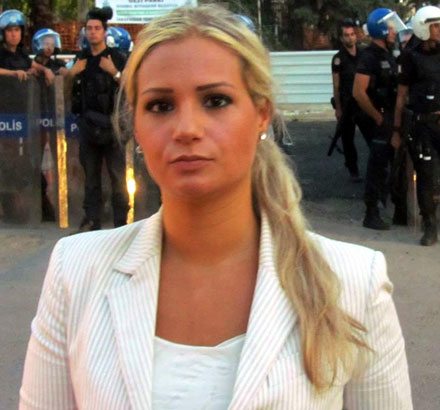
    03Serana-Shim
    Serena Shim (1984-19 October 2014)

    I never met her. I wish I had. But I knew she was a reporter, a good reporter telling of bad wars, and telling all the sides. And this one in Kobani (Ayn al-Arab) has many more sides than two, all of them bloody, all of them reeking of criminality. This carnage in Syria is perhaps the most corrupt, criminal, imperial assault in modern history. There are no “good guys” in this slaughter on the rapidly crumbling edge of Turkey. It’s all lies, deceit and power politics. Call it murder. Call it the ultimate man’s tough-guy game—bombardment, siege, street-fighting, and always the stupidity.

    The dogs of war run wild and ignorantly. For what? For a nothing town destroyed by chaos. She was telling as much as she could. The Turks there, the intelligence guys, the cops, the Turkish army, all the government “watchers” watched her and her partner, Judy Irish. She was called a spy. Watch out, they said. Maybe you’ll even be arrested, they mumbled. And the word got around. Not an easy assignment. She confessed that she was worried. Who wouldn’t be?

    Note the eyes. They would tell exactly what they saw, wouldn’t they? She had two children, this beautiful Lebanese-American woman. She was 30 years-old, hard-working and dedicated. Perhaps it was Napoleon who spoke about his Marshalls “marching towards the sound of the guns.” She didn’t need the advice. She followed the danger instinctively. Maybe she could make sense of it all in Iraq, Lebanon, the Ukraine, and lastly, Turkey? Maybe? Maybe not? She told of the ISIS killers being smuggled into Syria in trucks with NGO labels like World Food Organization. Turkey has been at this double-dealing game for years. But this kind of truth hurts and it did not endear her to the Turkish “watchers” and “handlers” and “muscle-guys.”

    On the way back to the hotel in a town called Suruç a cement-mixer truck, massive and deadly accurate, somehow, some way, intervened to crush her car and her. It all had the stink of bad fish. Based on the historic violence visited upon journalists and other dissenters in Turkey such a first impression of foul play is logical.

    The governor of that area immediately said that “Turkey is a democratic state of law. The allegations are completely untrue.” What is completely untrue is exactly what he said. Democracy and the rule of law have both been crushed by the cement-mixer truck known as the Turkish government. And Serena confirmed that in her reportage. And so passes a brave young woman’s life in Turkey. And so continues the war.

    James  (Cem) Ryan

    Istanbul

    21 October 2013

    Brightening Glance  http://www.brighteningglance.org/

  • Ukraine Presidential Frontrunner Petro Poroshenko and His Secret Jewish Roots

    Ukraine Presidential Frontrunner Petro Poroshenko and His Secret Jewish Roots

    ‘Chocolate King’s’ Father Was Jew Who Took Wife’s Name

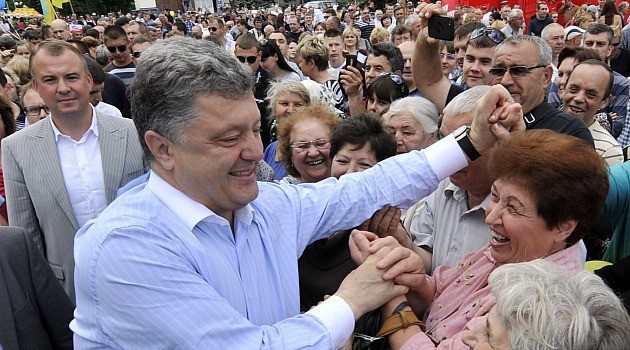
    Mezuzah in the Closet? Confectionary mogul Petro Poroshenko is leading the polls in Ukraine’s presidential race. Does he have a secret Jewish family history?
    Mezuzah in the Closet? Confectionary mogul Petro Poroshenko is leading the polls in Ukraine’s presidential race. Does he have a secret Jewish family history?

    By Cnaan Lipshiz

    (JTA) — Even in normal times, Kiev can feel like a city perpetually under construction. Potholes are “fixed” with flimsy coverings, ramshackle scaffolding clings precariously to the sides of buildings, and tangles of electric wires seem ever ready to combust.

    But since the outbreak of anti-government protests in November, the sense of flux in the Ukrainian capital has been greater than ever. Two kinds of tents now dot the city center: Hundreds of khaki-colored bivouacs housing the revolutionaries whose protest movement led to the ouster of President Viktor Yanukovych in February, and more recently erected campaign booths making bold promises of a brighter future ahead of Sunday’s presidential elections.

    Politicians describe the vote, the first since a wave of civil unrest broke out in the capital in November, as the most crucial since Ukraine emerged as an independent country in 1991 following the breakup of the Soviet Union. But many disillusioned voters here seem to place more faith in the tired men and women inside the khaki tents — and their pledge to speak truth to power — than in any of the candidates featured in the election posters.

    Marina Lysak, a Jewish activist who participated in the protest movement known as Maidan, after the central Kiev square where they took place, told JTA that the tent people are there to send a message to whomever prevails in the election.

    “The statement is: ‘We are watching you. If you betray us again, we will not remain silent,’ ” Lysak said. Whoever wins on Sunday faces a herculean set of challenges. The first order of business will be dealing with pro-Russian separatist militias that now hold several cities in eastern Ukraine, where Russian speakers constitute a majority.

    The new president also must address a looming economic crisis. Since November, the Ukrainian currency, the hryvna, has plummeted, losing 35 percent of its value against the U.S. dollar. Some analysts worry that the heavily indebted nation will soon default.

    And then there’s the sensitive question of clearing encampments from the scorched earth of Maidan, where most tents are pitched on asphalt laid bare by demonstrators who pried the cobblestones loose to hurl them at government forces.

    The leading candidate for these tasks is Petro Poroshenko, 48, an oligarch from Odessa and the head of a confectionary empire. Polls predict Poroshenko will take 30 percent of the vote in the first round of balloting.

    Yulia Tymoshenko, a former prime minister recently released from jail after serving three years on what she claims were charges trumped up by the Yanukovych regime, is expected to finish second with anywhere from 6 to 18 percent.

    Assuming no candidate takes more than 50 percent of the vote — more than 20 are competing — a runoff election between the top two finishers would take place on the following Sunday.

    Jewish community leaders have remained officially neutral about the candidates, but many Ukrainian Jews support Poroshenko, a former foreign minister rumored to have Jewish roots.

    “He has a unique set of skills that absolutely make him the man for the job,” said Igor Schupak, a Jewish historian and director of the Dnepropetrovsk-based Jewish Memory and Holocaust in Ukraine Museum. Business know-how and foreign relations experience “give Poroshenko a toolbox that places him in a league of his own in comparison to the other candidates.”

    The sense that Poroshenko is the preferred candidate only when compared to other lesser options isn’t an uncommon one, even among those working to put the oligarch in office.

    “He’s no saint — none of them are,” said Svetlana Golnik, who volunteers with the Poroshenko headquarters twice a week in downtown Kiev. “But he is cleaner than most other oligarchs and he delivers on his promises. Anyway, right now he’s what we have to work with.”

    James Temerty, a non-Jewish Canadian business magnate who founded the Ukrainian Jewish Encounter to promote interethnic dialogue, said it would be very difficult for Poroshenko to make significant changes without further destabilizing the economy.

    “The best hope here is to move toward Europe, and that will stop the corruption gradually,” Temerty said. “He said he’d do it.”

    According to the popular Russian television channel Russia-1, Poroshenko’s father was a Jew named Alexei Valtsman from the Odessa region who in 1956 took on the last name of his wife, Yevgenya Poroshenko.

    Poroshenko’s media team did not reply to JTA requests for comment, but they are not indifferent about the subject.

    Last year, Poroshenko’s spokeswoman asked Forbes Israel to remove her boss’ name from a list of the world’s richest Jews, a magazine source confirmed.

    Moshe Azman, a chief rabbi of Ukraine, said he asked Poroshenko directly about the rumors.

    “He told me he wasn’t Jewish,” Azman said.

    Even if the rumors were true, Poroshenko wouldn’t be the only candidate for president with Jewish roots. Vadim Rabinovich, a billionaire media mogul and founder of the All-Ukrainian Jewish Congress, is running on a platform combining a tolerant attitude toward Ukrainian minorities with plans to dispense with Ukraine’s quasi-federal political system and reduce taxes.

    Although he barely registers in the polls — current figures show him taking just over half-a-percent of the vote — his candidacy has at least one high-profile supporter: Rostislav Melnyk, who became famous in Ukraine after surviving a savage beating by Yanukovych forces.

    “I support Rabinovich’s platform and I will vote for him,” Melnyk said, “also because he is good for the future of the Jewish community.”

    forward.com, May 23, 2014
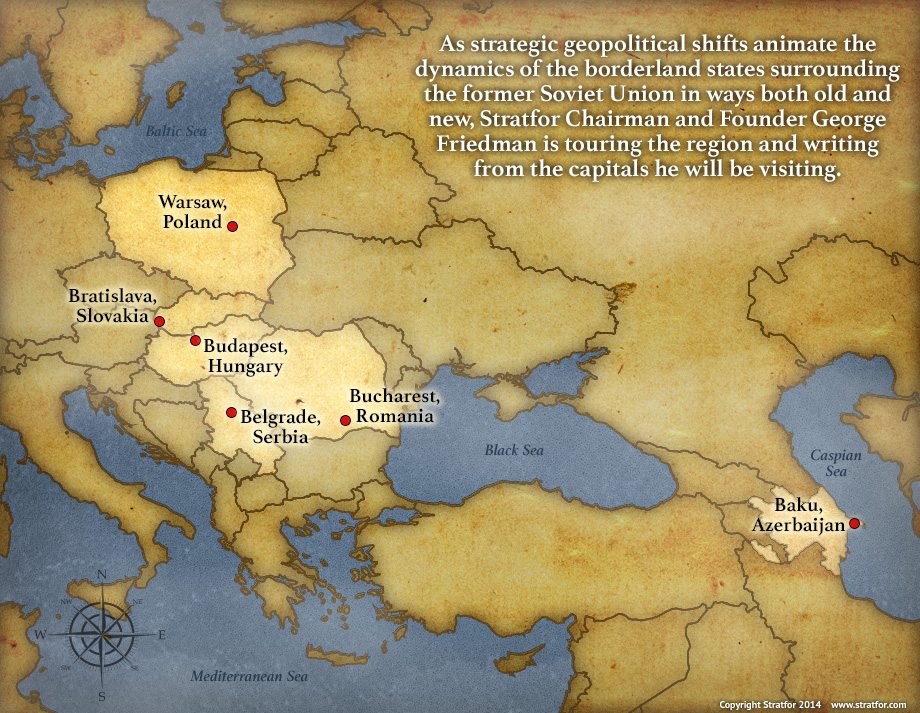
  • Borderlands: The View from Azerbaijan

    Borderlands: The View from Azerbaijan

    By George Friedman

    Azerbaijan, constantly changing world affairs and here is what George Friedman who is publicly know as shadow CIA has to say about Azerbaijan and history.

    I arrive in Azerbaijan as the country celebrates Victory Day, the day successor states of the former Soviet Union celebrate the defeat of Germany in World War II. No one knows how many Soviet citizens died in that war — perhaps 22 million. The number is staggering and represents both the incompetence and magnificence of Russia, which led the Soviets in war. Any understanding of Russia that speaks of one without the other is flawed.

    As I write, fireworks are going off over the Caspian Sea. The pyrotechnics are long and elaborate, sounding like an artillery barrage. They are a reminder that Baku was perhaps the most important place in the Nazi-Soviet war. It produced almost all of the Soviet Union’s petroleum. The Germans were desperate for it and wanted to deny it to Moscow. Germany’s strategy after 1942, including the infamous battle of Stalingrad, turned on Baku’s oil. In the end, the Germans threw an army against the high Caucasus guarding Baku. In response, an army raised in the Caucasus fought and defeated them. The Soviets won the war. They wouldn’t have if the Germans had reached Baku. It is symbolic, at least to me, that these celebrations blend into the anniversary of the birth of Heydar Aliyev, the late president of Azerbaijan who endured the war and later forged the post-Soviet identity of his country. He would have been 91 on May 10.

    Azerbaijan
    Azerbaijan

    Baku is strategic again today, partly because of oil. I’ve started the journey here partly by convenience and partly because Azerbaijan is key to any counter-Russian strategy that might emerge. My purpose on this trip is to get a sense of the degree to which individual European states feel threatened by Russia, and if they do, the level of effort and risk they are prepared to endure. For Europe does not exist as anything more than a geographic expression; it is the fears and efforts of the individual nation-states constituting it that will determine the course of this affair. Each nation is different, and each makes its own calculus of interest. My interest is to understand their thinking, not only about Russia but also about the European Union, the United States and ultimately themselves. Each is unique; it isn’t possible to make a general statement about them.

    Some question whether the Caucasus region and neighboring Turkey are geographically part of Europe. There are many academic ways to approach this question. My approach, however, is less sophisticated. Modern European history cannot be understood without understanding the Ottoman Empire and the fact that it conquered much of the southeastern part of the European peninsula. Russia conquered the three Caucasian states — Armenia, Georgia and Azerbaijan — and many of their institutions are Russian, hence European. If an organic European expression does exist, it can be argued to be Eurovision, the pan-continental music competition. The Azerbaijanis won it in 2011, which should settle any debate on their “Europeanness.”

    But more important, a strategy to block Russia is hard to imagine without including its southern flank. There is much talk of sanctions on Russia. But sanctions can be countered and always ignore a key truth: Russia has always been economically dysfunctional. It has created great empires and defeated Napoleon and Hitler in spite of that. Undermining Russia’s economy may be possible, but that does not always undermine Russia’s military power. That Soviet military power outlived the economically driven collapse of the Soviet Union confirms this point. And the issue at the moment is military.

    The solution found for dealing with the Soviet Union during the Cold War was containment. The architect of this strategy was diplomat George Kennan, whose realist approach to geopolitics may have lost some adherents but not its relevance. A cordon sanitaire was constructed around the Soviet Union through a system of alliances. In the end, the Soviets were unable to expand and choked on their own inefficiency. There is a strange view abroad that the 21st century is dramatically different from all prior centuries and such thinking is obsolete. I have no idea why this should be so. The 21st century is simply another century, and there has been no transcendence of history. Containment was a core strategy and it seems likely that it will be adopted again — if countries like Azerbaijan are prepared to participate.

    To understand Azerbaijan you must begin with two issues: oil and a unique approach to Islam. At the beginning of the 20th century, over half the world’s oil production originated near Baku, the capital of Azerbaijan. Hence Hitler’s strategy after 1942. Today, Azerbaijani energy production is massive, but it cannot substitute for Russia’s production. Russian energy production, meanwhile, defines part of the strategic equation. Many European countries depend substantially on Russian energy, particularly natural gas. They have few alternatives. There is talk of U.S. energy being shipped to Europe, but building the infrastructure for that (even if there are supplies) will take many years before it can reduce Europe’s dependence on Russia.

    Withholding energy would be part of any Russian counter to Western pressure, even if Russia were to suffer itself. Any strategy against Russia must address the energy issue, begin with Azerbaijan, and be about more than production. Azerbaijan is not a major producer of gas compared to oil. On the other side of the Caspian Sea, however, Turkmenistan is. Its resources, coupled with Azerbaijan’s, would provide a significant alternative to Russian energy. Turkmenistan has an interest in not selling through Russia and would be interested in a Trans-Caspian pipeline. That pipeline would have to pass through Azerbaijan, connecting onward to infrastructure in Turkey. Assuming Moscow had no effective counters, this would begin to provide a serious alternative to Russian energy and decrease Moscow’s leverage. But this would all depend on Baku’s willingness and ability to resist pressure from every direction.

    Azerbaijan lies between Russia and Iran. Russia is the traditional occupier of Azerbaijan and its return is what Baku fears the most. Iran is partly an Azeri country. Nearly a quarter of its citizens, including Ayatollah Ali Khamenei, are Azeri. But while both Azerbaijan and Iran are predominantly Shiite, Azerbaijan is a militantly secular state. Partly due to the Soviet experience and partly because of the unique evolution of Azeri identity since the 19th century, Azerbaijan separates the private practice of Islam from public life. I recall once attending a Jewish Passover feast in Baku that was presided over by an Orthodox rabbi, with security provided by the state. To be fair, Iran has a Jewish minority that has its own lawmaker in parliament. But any tolerance in Iran flows from theocratic dogma, whereas in Azerbaijan it is rooted in a constitution that is more explicitly secular than any in the European Union, save that of France.

    This is just one obvious wedge between Azerbaijan and Iran, and Tehran has made efforts to influence the Azeri population. For the moment, relations are somewhat better but there is an insoluble tension that derives from geopolitical reality and the fact that any attack on Iran could come from Azerbaijan. Furthering this wedge are the close relations between Azerbaijan and Israel. The United States currently blocks most weapons sales to Azerbaijan. Israel — with U.S. approval — sells the needed weapons. This gives us a sense of the complexity of the relationship, recalling that complexity undermines alliances.

    The complexity of alliances also defines Russia’s reality. It occupies the high Caucasus overlooking the plains of Azerbaijan. Armenia is a Russian ally, bound by an agreement that permits Russian bases through 2044. Yerevan also plans to join the Moscow-led Customs Union, and Russian firms own a large swath of the Armenian economy. Armenia feels isolated. It remains hostile to Turkey for Ankara’s unwillingness to acknowledge events of a century ago as genocide. Armenia also fought a war with Azerbaijan in the 1990s, shortly after independence, for a region called Nagorno-Karabakh that had been part of Azerbaijan — a region that it lost in the war and wants back. Armenia, caught between Turkey and an increasingly powerful Azerbaijan, regards Russia as a guarantor of its national security.

    For Azerbaijan, Nagorno-Karabakh remains a critical issue. Azerbaijan holds that U.N. resolutions have made it clear that Armenia’s attack constituted a violation of international law, and a diplomatic process set up in Minsk to resolve the crisis has proven ineffective. Azerbaijan operates on two tracks on this issue. It pursues national development, as can be seen in Baku, a city that reflects the oil wealth of the country. It will not endanger that development, nor will it forget about Nagorno-Karabakh. At some point, any nation aligning itself with Azerbaijan will need to take a stand on this frozen conflict, and that is a high price for most.

    Which leads me to an interesting symmetry of incomprehension between the United States and Azerbaijan. The United States does not want to sell weapons directly to Azerbaijan because of what it regards as violations of human rights by the Azerbaijani government. The Americans find it incomprehensible that Baku, facing Russia and Iran and needing the United States, cannot satisfy American sensibilities by avoiding repression — a change that would not threaten the regime. Azerbaijan’s answer is that it is precisely the threats it faces from Iran and Russia that require Baku to maintain a security state. Both countries send operatives into Azerbaijan to destabilize it. What the Americans consider dissidents, Azerbaijan sees as agents of foreign powers. Washington disputes this and continually offends Baku with its pronouncements. The Azerbaijanis, meanwhile, continually offend the Americans.

    This is similar to the Nagorno-Karabakh issue. Most Americans have never heard of it and don’t care who owns it. For the Azerbaijanis, this is an issue of fundamental historical importance. They cannot understand how, after assisting the United States in Afghanistan, risking close ties with Israel, maintaining a secular Islamic state and more, the United States not only cannot help Baku with Nagorno-Karabakh but also insists on criticizing Azerbaijan.

    The question on human rights revolves around the interpretation of who is being arrested and for what reason. For a long time this was an issue that didn’t need to be settled. But after the Ukrainian crisis, U.S.-Azerbaijani relations became critical. It is not just energy; rather, in the event of the creation of a containment alliance, Azerbaijan is the southeastern anchor of the line on the Caspian Sea. In addition, since Georgia is absolutely essential as a route for pipelines, given Armenia’s alliance with Russia, Azerbaijan’s support for Georgian independence is essential. Azerbaijan is the cornerstone for any U.S.-sponsored Caucasus strategy, should it develop.

    I do not want to get into the question of either Nagorno-Karabakh or human rights in Azerbaijan. It is, for me, a fruitless issue arising from the deep historical and cultural imperatives of each. But I must take exception to one principle that the U.S. State Department has: an unwillingness to do comparative analysis. In other words, the State Department condemns all violations equally, whether by nations hostile to the United States or friendly to it, whether by countries with wholesale violations or those with more limited violations. When the State Department does pull punches, there is a whiff of bias, as with Georgia and Armenia, which — while occasionally scolded — absorb less criticism than Azerbaijan, despite each country’s own imperfect record.

    Even assuming the validity of State Department criticism, no one argues that Azerbaijani repression rises anywhere near the horrors of Joseph Stalin. I use Stalin as an example because Franklin Roosevelt allied the United States with Stalin to defeat Hitler and didn’t find it necessary to regularly condemn Stalin while the Soviet Union was carrying the burden of fighting the war, thereby protecting American interests. That same geopolitical realism animated Kennan and ultimately created the alliance architecture that served the United States throughout the Cold War. Is it necessary to offend someone who will not change his behavior and whom you need for your strategy? The State Department of an earlier era would say no.

    It was interesting to attend a celebration of U.S.-Azerbaijani relations in Washington the week before I came to Baku. In the past, these events were subdued. This one was different, because many members of Congress attended. Two guests were particularly significant. One was Charles Schumer of New York, who declared the United States and Azerbaijan to be great democracies. The second was Nancy Pelosi, long a loyalist to Armenian interests. She didn’t say much but chose to show up. It is clear that the Ukrainian crisis triggered this turnout. It is clear that Azerbaijan’s importance is actually obvious to some in Congress, and it is also clear that it signals tension over the policy of criticizing human rights records without comparing them to those of other countries and of ignoring the criticized country’s importance to American strategy.

    This is not just about Azerbaijan. The United States will need to work with Turkey, Bulgaria, Romania and Hungary — all of whom have been found wanting by the State Department in some ways. This criticism does not — and will not — produce change. Endless repetition of the same is the height of ineffectiveness. It will instead make any strategy the United States wants to construct in Europe ineffective. In the end, I would argue that a comparison between Russia and these other countries matters. Perfect friends are hard to find. Refusing to sell weapons to someone you need is not a good way to create an alliance.

    In the past, it seemed that such an alliance was merely Cold War nostalgia by people who did not realize and appreciate that we had reached an age too wise to think of war and geopolitics. But the events in Ukraine raise the possibility that those unreconstructed in their cynicism toward the human condition may well have been right. Alliances may in fact be needed. In that case, Roosevelt’s attitude toward Stalin is instructive.


    Edited By Tolga CAKIR