Category: World

  • Letter to The Honorable Abdullah Gül, President of the Republic of Turkey

    Letter to The Honorable Abdullah Gül, President of the Republic of Turkey

    9 September 2012


    The Honorable Abdullah Gül

    T.C. Cumhurbaşkan

    06689 Çankaya

    Ankara


    Dear Mr. President,

    Would you allow me to show my concern about maintaining your well-deserved prestige and to tell you that your star which, until now, has shone so brightly, risks being dimmed by the most shameful and indelible of stains.

    You have passed healthy and safe from the troubles pertaining to your rise to the presidency. You seem to have won over the hearts of the citizens. But what filth this wretched “Syria Affair” has cast on your name and the name of your country. The government of Turkey, in primary collaboration with the government of the United States of America, has dared to attempt to destroy the duly constituted government of Syria. In that process it has funded, encouraged and armed a motley gang of terrorist killers that include numerous members of Al-Qaeda and other recognized terrorist groups. The Hatay region of Turkey is being used as a staging area for attacks on a neighboring country, a country that until recent months had enjoyed great favor with Turkey. Hatay, perhaps the most enlightened, peaceful region in Turkey, now is under occupation by gangs of terrorist killers. The people are regularly accosted on the streets by these ruffians, and asked if they are Alevites. You will be next, they are told. The shops and restaurants are being ripped off by these foreign mercenaries. Send the bill, to Tayyip, they say, He sent for us. And rather than protect the citizens the police turn a blind eye. What is going on, Mr. President? Who is ruling this country?

    Many innocent Syrian people, including my wife’s uncle in Damascus, have been murdered by this assembled-in-Turkey terrorist machine. Moreover, the good citizens of Hatay are daily threatened by this scum that the government of Turkey has organized, of course with the help of the CIA, proven by history to be experts in unspeakably violent subversions. This lawless behavior, indeed a crime against the Syrian people, and a war crime in terms of the Geneva Conventions, is the supreme insult to all truth, all justice, all morality and all religion. Now Turkey is willingly sullied by this filth. History will record that it was under your presidency that this crime against humanity was committed. Something must be done Mr. President.

    As these government and foreign operatives have dared to drag the reputation of Turkey through the filth of deceit, lies and murder, so shall I dare. Dare to tell the truth, as I swear to tell it, since the normal channels of the media and the Turkish justice system have failed so miserably to do so. My duty as a good citizen is to speak, and not become an accomplice to this murderous travesty of justice. My nights would otherwise be haunted by the spectre of innocent men, women and children, not so far away, suffering the most horrible tortures of war.

    And it is to you Mr. President, that I shall proclaim this truth, with all the revulsion that an honest man can summon. Knowing your integrity, I am sure that you do not know the truth. If you did, you would have long ago taken action against this blatant attack on Turkish sovereignty. The ruling power is complicit in this attack. And the opposition is hopelessly divided and incompetent. So to whom if not you, the first magistrate of this country, shall I reveal the vile baseness of those who are truly guilty, the ones steeped in innocent blood up to their elbows.

    As you know, Mr. President, the problem has always been Turkey. Blessed with abundant natural resources, an edenic environment for agriculture, waters teeming with fish, vast olive groves overlooking the sea, a winning warm water climate, the land nexus between east and west, Turkey has always been a target. And being a target is most uncomfortable and always susceptible to treachery.

    Since the death of the founder of modern Turkey, who tossed the imperialist occupying powers into the sea, Turkey has been in a state of decline, particularly regarding its susceptibility and submission to western interests. First it was Communism! Communism! Communism! And a nervous America needed an Islamic green buffer zone against godless Russia. So Turkey said Yes! Yes! Yes! Please forgive us for not joining all you western imperialists in World War II. Please allow us to become a “green zone.” And  please, please, please take some incredibly fertile land from our agricultural heart in Çukurova, eight kilometers east of Adana. And of course build your airbase, said Turkey, but please like us and respect us. So America built its airbase in the fertile heart of Turkey. And that was the beginning of America’s close relationship—meaning CIA involvement—with Turkey. Vital rural education programs were abandoned lest those evil Communists infiltrate. And in the villages, ignorance remained. And the politicians knew it. And the plunder began. And today, Mr. President, the headquarters for this foul deed being done to Syria, the Syrian people, and the Turkish people is at Incirlik Air Base. What goes around, comes around, Mr. President.

    At the root of it all is one man, Recep Tayyip Erdoğan, the head of the AKP ruling party and the prime minister of the Republic of Turkey. A man of bombast, scowls and ill-humor, he seems not to like anyone. It’s the strangest thing, Mr. President, to observe his grin when visiting the White House in Washington DC. And then the pain that comes to his face when he returns to his native land. He came to power in a landslide election in 2002 that was repeated four years later. Could it have something to do with the lack of education in the provinces, Mr. President? Since he came to power he has relentlessly embarked on a policy to divide and weaken the republic. I am sure you have noticed this, Mr. President. Haven’t you?

    Who is this man? Upon what meat doth this our Caesar feed, that he is grown so great?

    I suspect American hamburgers and hotdogs, Mr. President. For he and his ilk are of them. And now, during these days of tragedy, there are no longer any secrets, Mr. President.

    Who is this prime minister who so disparages, dismisses, defames and divides, to wit:

    • What head of government would jail the senior officers and the command and general staff of a nation’s armed forces and within months enter a de facto war against its hitherto peaceful neighbor, Syria?
    • What head of government would actively solicit the entry into its country of known terrorists?
    • What head of government would defy the will of the people as expressed by the existence of a parliament by arming known terrorists at the behest of a foreign power, i.e., the United States of America?
    • What head of government would jail many hundreds of students for protesting their desire for a free education? Some are sentenced to as much as an eight year imprisonment for being members of a “terrorist” organization because they wore traditional poşhu headscarves.
    • Who is this prime minister of a secular, democratic, equal rights espousing country who:
    • In Istanbul 2010 International Women’s Day, opined to a conference of representatives of women’s organizations that women are not equal to men. His wife sat stoically on the dais.
    • On International Women’s Day, 2008 encouraged women to have three and even better, five, children each.
    • On 16 August 2008, called martyred (killed in action) Turkish soldiers “kelle”, a derogatory expression likening them to heads of cattle.
    • In 2011 changed the name of the Ministry for Women and Family to the Ministry of Family and Social Policies thus further effacing and disparaging women.
    • In 2011 on International Women’s Day, he was asked why honor killings had increased 14 fold since 2002 under his regime. In bizarre logic, the prime minister said the enormous increase was because more murders were being reported, thus apparently both praising and loathing improved administrative procedures.
    • After the Turkish Air Force with the help of American “intelligence” from drone observation aircraft bombed and killed 34 innocent Kurdish citizens on 28 December 2011 in Uludere, the prime minister announced his opposition to abortion preposterously likening it to rape. He thus deflected attention from the massive loss of life caused by the Turkish military.  No viable explanation has yet been given.
    • In 2011, in a gross demonstration of his Taliban state of mind, the prime minister ordered the destruction of The Statue of Humanity by the acclaimed sculptor Mehmet Aksoy. The statue stood in Kars on the Armenian border. The prime minister called the statue dedicated to Turkish-Armenian peace, “ucube,” a “freak.”
    • And now, in primary collusion with agents of the United States of America, the prime minister and his oh-so-willing underlings have launched an illegal, unconstitutional aggression against the Syrian Arab Republic, a sovereign nation. Can they have so soon forgotten the international crime and human disaster that such illegal recklessness brought to the innocent Iraqi people? Have they so quickly become emboldened to disregard the will of the Turkish people who so courageously chose not to collaborate with the western rape of Iraq in 2003?
    • And now, in primary collusion with agents of the United States of America, the prime minister and his oh-so-willing underlings have launched an illegal, unconstitutional aggression against the Syrian Arab Republic, a sovereign nation. Can they have so soon forgotten the international crime and human disaster that such illegal recklessness brought to the innocent Iraqi people? Have they so quickly become emboldened to disregard the will of the Turkish people who so courageously chose not to collaborate with the western rape of Iraq in 2003?
    • Has he forgotten the many historical foreign connivances of America? Has he forgotten the murderous campaigns of subversion that featured ruthless CIA involvement? Has he forgotten the American CIA killer-puppet Pinochet? Has he forgotten the destabilizing bombings, the tortures, the disappearances of pregnant women who were executed after giving birth, their children re-engineered for the “new” Argentine society? Has he forgotten the School of the Americas at Ft. Benning, Georgia, a state terrorist training camp? How about the KUBARK program, the CIA how-to-do-it interrogation manual, the book that destroys victims’ minds? Deep, disorienting shocks, day and night jumbled, electroshock, humiliation, silence, noise, sensory deprivation, the slow destruction of brains, has he remembered any of this? And now Turkey has the very same type of organization teaching assassination, sabotage and terror. Mr. President, in times like these we must remember our Nietzsche: “He who fights with monsters should look to it that he himself does not become a monster. And when you gaze long into an abyss the abyss also gazes into you.”
    • Has he forgotten Iran (1953), Guatemala (1954), Cuba (1959-present), Congo (1960), Cambodia (1961-73), Brazil (1965), Argentina (1976), Indonesia (1965), Vietnam (1961-74), Laos (1961-73), Cambodia (1961-73), Greece (1946-81), Chile (1973), Afghanistan (1979-present), El Salvador, Guatemala, and Nicaragua (1980s), Grenada (1983), Turkey (1980-present), Agfhanistan (1979-89) (2001-present) and Iraq (1991-present)? These are all victims of terror American style.
    • Has he forgotten the human wreckage caused by these American assaults? Surely he remembers the horror that America brought to Turkey in 1980, the torture, the mass imprisonment, the executions? Has the prime minister not had his fill of the criminal antics of the USA and its CIA? Most of humanity has, Mr. President? Have you?

    And now Syria, a new horror brought to the Syrian people courtesy of Turkey and America.

    And of course, the not-so-secret planning that turns out to be so terribly fatal. Earlier this year, General Dempsey, David Petraeus, now the CIA capo, and Hillary Clinton came to town, and came to down, and still come to town. A typical American foreign policy team, one civilian and two generals. In case you haven’t been paying attention, Mr. President, American foreign policy has shrunken to its bare essentials: military muscle-flexing and threats. Culturally insensitive and hopelessly hypocritical, it relies on force alone. In between these American visits the Turkish foreign minister feverishly visited Washington. Their cartoonish visits are insulting to Turkey. Meanwhile, Recep Tayyip Erdoğan, the Mu’ammar al-Khaddafi Human Rights Award winner for 2010, soon after the award ceremony ended commenced raining bombs on al-Khaddafi’s head. He then proceeded (like Hillary Clinton) to celebrate his former host’s murder by evisceration via sodomy with various sharp instruments. Then he turned his invective on his former Syrian friend, Bashar al-Assad. How seductive must be the eye-popping smiles of that most incompetent, amoral American secretary of state.

    The deep and treacherous pockets of Saudi Arabia and America’s other military stooge, Qatar, would provide the financing of their fellow Arab neighbor’s demise. In violation of its constitution Turkey now provides a safe haven for the so-called Free Syrian Army, a collection of mercenaries and terrorists dredged up by the collective intelligence services of Turkey, the USA, Israel, and any other western jackals that want some of the action. How does such a safe haven in Hatay differ from the safe haven provided to the PKK in Iraq? Make no mistake, Mr. President, the Free Syrian Army is the equivalent in every way of the America-financed mujadhideen, the “freedom fighters” of the 1980s war in Afghanistan. And venal Turkish businessmen, having been denied projects in Iraq due to governmental blundering, rub their hands together anticipating post-war reconstruction contracts in Syria.

    And lately, again the CIA visited Turkey in the form of its boss, the military man, the general, David Petraeus, a man who as an honorable West Point cadet swore to not lie, cheat or steal, all of which he now does with wanton abandon for his country. Who would not say that this man has not become a monster? And the day after Petraeus left, the prime minister suddenly became a latter-day Mehmet the Conqueror shouting that “In a short time we will go to Damascus and God willing pray in the Emevi mosque.” And a day later 25 soldiers were exploded into very small pieces carrying ammunition in an armory in the middle of the night in Afyonkarahisar. A minister blamed God. The commanding general blamed the media. As usual, all explanations were garbled. As usual, the circumstances are highly suspicious. As usual, an investigation is pending. Chaos, chaos, always the chaos.

    Isn’t this all this a disgusting business, Mr. President?

    Of course, Mr. President, all the posturing about meetings and speeches are hoaxes. This rape of Syria was cooked long ago in Washington. How so? On 20 August 2012 a car bomb exploded in downtown Gaziantep. Warnings had been issued weeks ago that this would. But despite this “intelligence,” the car bomb was carried by a flat-bed truck and offloaded in front of the police station. So much for being alert. Nine people were killed, scores injured. But suddenly something spilled out of a blacker-than-black bag. It seems that three American neo-con think tanks (the Brookings Institute, the America Enterprise Institute and the War Studies Institute) had figured it out in advance months ago at a Washington DC conference. It was attended by representatives from Turkey and Saudi Arabia. First it was called a “scenario,” later a “plan,” then, amazingly, it wasn’t called anything. It just disappeared, never to be mentioned again.

    What’s the difference? Well, hundreds of generals and other senior staff officers remain jailed because of a laughable military coup “scenario” called “Sledgehammer” (Balyoz). This cartoon involved bombing mosques and shooting down Turkish planes. The so-called evidence was slathered across on the front page of so-called newspapers like Taraf, Mr. President. Hundreds of senior officers were arrested, Mr. President! A mammoth investigation and round-up ensued. The army’s command and general staff was purged. But about the American bomb “scenario?” Nothing! The story ran in the press for one day. After that a great silence has prevailed. Why, Mr. President? No arrests. No investigation. No questions. And soon thereafter the CIA’s David Petraeus came to town again, this time peddling another deceitful scheme. How disgusting, Mr. President.

    And guess what familiar names surround the think-tank bomb fiasco? Richard Perle of the 1980 Turkish military coup infamy, Eric Edelman and Douglas Feith, neo-con diplomatic thugs from the recent Bush regime. It all smells to the highest of heavens, Mr. President.

    This is the plain truth, Mr. President, and it is terrifying. It will leave an indelible stain on your presidency. I realize that you may have no direct power over this issue, that you may be limited by the Constitution and your entourage. You have, nonetheless, your duty as a man, which you will recognize and fulfill. As for myself, I have not despaired in the least of the triumph of the right and justice. I say with the most vehement of conviction: truth is on the march, and nothing will stop it. Today is only the beginning, for it is only today that the positions have become clear: on one side, those who are guilty, who do not want the light to shine forth, who crave war and power, on the other hand, those who seek justice and peace and eschew the disgusting laws of the jungle.

    Yes, Mr. President, truth is on the march. The full deception is apparent. And now the Turkish government stands alone in the eyes of the world as a deceiver par excellence. A conniver for the base interests of its American boss. A subversive conspirer who illegally arms, quarters and trains secret terror forces, and by doing so subverts its own constitution. How can this not be treason, Mr. President?

    Mr. President, when the truth is buried underground by lies and deceptions and subterfuges, it grows and builds up so much force that the day it explodes it blasts everything with it. We shall see whether we have been setting ourselves up for the most resounding of disasters. Sadly, it seems clear that Turkey is well along its own road to perdition.

    Today, the endgame now rages inside and outside Turkey. The dangers to the nation and its citizens are clear and present and deadly. And all these dangers lay bare the full deceit of the plan. All is now in plain sight, particularly the vastness of the crimes.

    Herein follows some of the international laws and agreements possibly broken by this violent, criminal cabal organized and directed by the United States of America and the Republic of Turkey, The Kingdom of Saudi Arabia and The State of Qatar, among others. These are the laws and statutes possibly breached by this vile bunch, headquartered in Istanbul and Incirlik Air Base in Adana. And whose international terrorist militants who are trained and staged in the Hatay region in southeastern Turkey. Of course, there are other higher level operators far distant from Turkey that can easily be traced through the nefarious deeds of their hired henchmen. We know who they are, and where they are, Mr. President. Their list of offenses is long and grievous, Mr. President, particularly for a nation whose government takes great pride in its religious piety.

    I accuse this monstrous cabal of possible crimes against the following standards of civilized behavior.


    CRIMES AGAINST MANKIND

    Realizing that the Republic of Turkey is the sole operator within your jurisdiction, I nevertheless accuse all the above mentioned parties and their agents of committing the crime of naked, treacherous aggression, of committing crimes against peace, of committing crimes against humanity, and of committing war crimes against the Syrian people of catastrophic proportions. These grave offenses are described in greater particularity as follows:

    The Constitution of the Republic of Turkey

    Declaration of State of War and Authorization to Deploy the Armed Forces

    Article 92.

    1. The power to authorize the declaration of a state of war in cases deemed legitimate by international law and except where required by international treaties to which Turkey is a party or by the rules of international courtesy to send Turkish Armed Forces to foreign countries and to allow foreign armed forces to be stationed in Turkey, is vested in the Turkish Grand National Assembly.
    2. If the country is subjected, while the Turkish Grand National Assembly is adjourned or in recess, to sudden armed aggression and it thus becomes imperative to decide immediately on the deployment of the armed forces, the President of the Republic can decide on the mobilization of the Turkish Armed Forces.


    United Nations General Assembly Resolution 3314: Definition of Aggression

    Aggression is the use of armed force by a State against the sovereignty, territorial integrity or political independence of another State, or in any other manner inconsistent with the Charter of the United Nations.


    Charter of the United Nations

    Chapter VII: Action with respect to threats to peace, breaches of the peace, and acts of aggression

    Article 40.

    In order to prevent an aggravation of the situation, the Security Council may, before making the recommendations or deciding upon the measures provided for in Article 39, call upon the parties concerned to comply with such provisional measures as it deems necessary or desirable. Such provisional measures shall be without prejudice to the rights, claims, or position of the parties concerned. The Security Council shall duly take account of failure to comply with such provisional measures.


    International Covenant on Civil and Political Rights

    Article 20.

    1. Any propaganda for war shall be prohibited by law.
    2. Any advocacy of national, racial or religious hatred that constitutes incitement to discrimination, hostility or violence shall be prohibited by law.


    Nuremberg Tribunal Charter
    The Tribunal established by the Agreement referred to Article 1 hereof for the trial and punishment of the major war criminals of the European Axis countries shall have the power to try and punish persons who, acting in the interests of the European Axis countries, whether as individuals or as members of organizations, committed any of the following crimes.

    The following acts, or any of them, are crimes coming within the jurisdiction of the Tribunal for which there shall be individual responsibility:

    (a) Crimes Against Peace: namely, planning, preparation, initiation or waging of a war of aggression, or a war in violation of international treaties, agreements or assurances, or participation in a common plan or conspiracy for the accomplishment of any of the foregoing;

    (b) War Crimes: namely, violations of the laws or customs of war. Such violations shall include, but not be limited to, murder, ill-treatment or deportation to slave labor or for any other purpose of civilian population of or in occupied territory, murder or ill-treatment of prisoners of war or persons on the seas, killing of hostages, plunder of public or private property, wanton destruction of cities, towns or villages, or devastation not justified by military necessity;

    (c)Crimes Against Humanity: namely, murder, extermination, enslavement, deportation, and other inhumane acts committed against any civilian population, before or during the war; or persecutions on political, racial or religious grounds in execution of or in connection with any crime within the jurisdiction of the Tribunal, whether or not in violation of the domestic law of the country where perpetrated.

    Leaders, organizers, instigators and accomplices participating in the formulation or execution of a common plan or conspiracy to commit any of the foregoing crimes are responsible for all acts performed by any persons in execution of such plan.

    Note: the above provisions were codified as legal principles by the International Law Commission of the United Nations.


    Protocol Additional to the Geneva Conventions of 12 August 1949, and relating to the Protection of Victims of International Armed Conflicts (Protocol 1) (2nd part)

    Article 50. Definition of civilians and civilian population

    1. A civilian is any person who does not belong to one of the categories of persons referred to in Article 4 A (1), (2), (3) and (6) of the Third Convention and in Article 43 of this Protocol. In case of doubt whether a person is a civilian, that person shall be considered to be a civilian.

    2. The civilian population comprises all persons who are civilians.

    3. The presence within the civilian population of individuals who do not come within the definition of civilians does not deprive the population of its civilian character.


    Article 51. Protection of the civilian population

    1. The civilian population and individual civilians shall enjoy general protection against dangers arising from military operations. To give effect to this protection, the following rules, which are additional to other applicable rules of international law, shall be observed in all circumstances.

    2. The civilian population as such, as well as individual civilians, shall not be the object of attack. Acts or threats of violence the primary purpose of which is to spread terror among the civilian population are prohibited.

    3. Civilians shall enjoy the protection afforded by this Section, unless and for such time as they take a direct part in hostilities.

    4. Indiscriminate attacks are prohibited. Indiscriminate attacks are:

       (a) Those which are not directed at a specific military objective;

       (b) Those which employ a method or means of combat which cannot be directed at a specific military objective;

       (c)  Those which employ a method or means of combat the effects of which cannot be limited as required by this Protocol; and consequently, in each such case, are of a nature to strike military objectives and civilians or civilian objects without distinction.

    5. Among others, the following types of attacks are to be considered as indiscriminate:

    (a) An attack by bombardment by any methods or means which treats as a single military objective a number of clearly separated and distinct military objectives located in a city, town, village or other area containing a similar concentration of civilians or civilian objects; and

       (b) An attack which may be expected to cause incidental loss of civilian life, injury to civilians, damage to civilian objects, or a combination thereof, which would be excessive in relation to the concrete and direct military advantage anticipated.

    6. Attacks against the civilian population or civilians by way of reprisals are prohibited.

    7. The presence or movements of the civilian population or individual civilians shall not be used to render certain points or areas immune from military operations, in particular in attempts to shield military objectives from attacks or to shield, favour or impede military operations. The Parties to the conflict shall not direct the movement of the civilian population or individual civilians in order to attempt to shield military objectives from attacks or to shield military operations.

    8. Any violation of these prohibitions shall not release the Parties to the conflict from their legal obligations with respect to the civilian population and civilians, including the obligation to take the precautionary measures provided for in Article 57.


    Article 52. General protection of civilian objects

    1. Civilian objects shall not be the object of attack or of reprisals. Civilian objects are all objects which are not military objectives as defined in paragraph 2.

    2. Attacks shall be limited strictly to military objectives. In so far as objects are concerned, military objectives are limited to those objects which by their nature, location, purpose or use make an effective contribution to military action and whose total or partial destruction, capture or neutralization, in the circumstances ruling at the time, offers a definite military of advantage.

    3. In case of doubt whether an object which is normally dedicated to civilian purposes, such as a place of worship, a house or other dwelling or a school, is being used to make an effective contribution to military action, it shall be presumed not to be so used.


    Article 57. Precautions in attack

    1. In the conduct of military operations, constant care shall be taken to spare the civilian population, civilians and civilian objects.

    2. With respect to attacks, the following precautions shall be taken:

    (a) Those who plan or decide upon an attack shall:

    (i) Do everything feasible to verify that the objectives to be attacked are neither civilians nor civilian objects and are not subject to special protection but are military objectives within the meaning of paragraph 2 of Article 52 and that it is not prohibited by the provisions of this Protocol to attack them;

         (ii) Take all feasible precautions in the choice of means and methods of attack with a view to avoiding, and in any event to minimizing, incidental loss of civilian life, injury to civilians and damage to civilian objects;


    The Nuremberg Principles

    These principles define a crime against peace as the “planning, preparation, initiation or waging of a war of aggression, or a war in violation of international treaties, agreements, or assurances, or participation in a common plan or conspiracy for accomplishment of any of the forgoing.”

    Mr. President, these are grievous, heavy offenses. I well realize that some, in particular the government of the United States, may consider them to have become “quaintly” obsolete. But that is not the opinion of the overwhelming majority of mankind and its nations. I have hitherto considered the Republic of Turkey to be among those nations advocating the primacy of the rule of law. Unfortunately, given the current situation, I am no longer so sure.

    Finally, I must turn to another aspect of morality, the concept of divine justice. Because of the outrageous hypocrisy of the accused parties these are the most disgusting and egregious of charges, Mr. President.


    CRIMES AGAINST GOD

    I accuse these Turkish ringleaders and their murderous operators, these so-called Muslims who take such great public pride in proclaiming their faith while reviling the faith of others, in particular, the Alevites, I accuse these blatant hypocrites of sinning against the word of God as revealed by his esteemed prophet, Muhammad, as proscribed by the following verses of the Holy Koran:

    Sura 4:92 that says “It is unlawful for a believer to kill another believer.”

    Sura 4:93 that says “He that kills a believer by design shall burn in Hell forever. He shall incur the wrath of God, who will lay his curse upon him and prepare for him a mighty scourge.”

    Sura 5:60 that says “Shall I tell you who will receive a worse reward from God? Those whom God has cursed and with whom He has been angry, transforming them into apes and swine, and those who serve the devil. Worse is the plight of these, and they have strayed farther from the right path.”

    Sura 49:11 that says “Do not defame one another…”

    Only God can judge them. And God will do it in God’s good time. But in the meantime, while these so-called Muslims and their non-Muslim supporters, advisors, financers and protectors still live in this world so should they be compelled to adhere to the laws of this world else we all become like them, demons and monsters.

    I realize that this letter is long. But so is the list of transgressions against humanity by the current Turkish government and its enablers. I have but one passion, Mr. President, the search for light, in the name of humanity which has suffered so much and is entitled to happiness. My protest is simply the cry of my very soul.

    With my deepest respect, Mr. President,


    James (Cem) Ryan, Ph.D.

    Founder, West Point Graduates Against the War


    PS. With apologies and thanks to Emile Zola who would surely understand.


    Cc.  International Criminal Court, Office of the Prosecutor, The Hague, The Netherlands

     

  • Daily chart: The Devil’s in the deterrent

    Daily chart: The Devil’s in the deterrent

    Sep 3rd 2012, 13:05 by The Economist online

    Crime rates and religious beliefs

    GOVERNMENTS labouring to deliver effective crime-prevention policies could do worse than consider divine deterrence. In a paper published this summer in PLoS ONE, Azim Shariff at the University of Oregon and Mijke Rhemtulla at the University of Kansas compared rates of crime with rates of belief in heaven and hell in 67 countries. Citizens of those countries were asked which of heaven and hell they believed in, and each country’s overall “rate of belief” was calculated by subtracting the percentage of hell-believers from that of heaven-believers. The researchers found that the degree to which each country’s citizens believed more strongly in heaven than in hell predicted higher national crime rates. It seems that believing more strongly in the forgiveness of sins than in punishment in the after-life may help pave the way for further transgressions. The researchers also noted that the proportion of people believing in heaven almost always outweighed the proportion believing in hell. So a little more preaching on the fiery furnace might be beneficial in this life, if not also the next.

    via Daily chart: The Devil’s in the deterrent | The Economist.

  • Carbon fiber update: Fiber sources gear up for expected increase in demand

    Carbon fiber update: Fiber sources gear up for expected increase in demand

    Currently, the market for carbon fiber composites is estimated at $10 billion (USD) globally, and observers expect that it could reach as high as $40 billion by 2022. Aspiring and established carbon fiber manufacturers and a variety of marketing partners are positioning themselves to meet the vastly increasing need for raw fiber and fibrous reinforcement products.

    The Dow Chemical Co. (Midland, Mich.), through its wholly owned subsidiary Dow Europe Holding BV, and carbon fiber producer Aksa Akrilik Kimya Sanayii A.Ş. (Istanbul, Turkey) announced in late June the formation of DowAksa Advanced Composites Holdings BV, a 50/50 joint venture (JV) to manufacture and commercialize carbon fiber and derivative products. Aksa and Dow had previously signed a definitive agreement to form the JV on Dec. 20, 2011. DowAksa will develop and globally market a broad range of products and provide technical service and support, with emphasis on industrial applications, including energy, transportation and infrastructure.

    Aksa’s carbon fiber has been produced since 2009 in its factory in Yalova, Turkey. The JV will expand on existing carbon fiber production assets in Yalova and will capture growth by creating a large-scale, integrated production capability for the manufacture and supply of advanced carbon fiber technologies.

    Aksa board chairman Mehmet Ali Berkman said, “Aksa took steps in 2011 in the carbon fiber sector to increase market share through investment in manufacturing capacity and productivity. With the formation of the joint venture, we are pleased that our carbon fiber technologies and production capabilities in Turkey will be essential to DowAksa’s future as a world leader in advanced carbon fiber and derivatives.”

    Elsewhere, Toho Tenax Co. Ltd. (Tokyo, Japan), the core company of the Teijin Group’s carbon fibers and composites business, announced on June 20 that it will develop and market carbon fiber fabrics for India’s composites industry in collaboration with Hindoostan Technical Fabrics Ltd. (Mumbai, India), a carbon and aramid textile manufacturer that is wholly owned by Hindoostan Mills Ltd., a major textile company in India and part of the Mumbai-based Thackersey Group. This will be the first time Toho Tenax has partnered with a textile manufacturer in India’s carbon fiber sector. Under the agreement, Toho Tenax will supply its proprietary Tenax carbon fiber to Hindoostan Technical Fabrics for weaving and processing. The two companies will jointly market the resulting fabrics to Indian manufacturers of composite materials and reinforced sheets that serve industrial segments, including transportation, aerospace and railway; wind power; sports and leisure; medical equipment; construction reinforcement and retrofitting; and electronics (i.e., computer and mobile phone housings).

    Already a supplier of chopped carbon fiber to India, Toho Tenax says India’s composites industry has recorded robust growth — about 20 percent per annum in the past five years. The company is preparing to meet the surging demand for intermediate-modulus material, including prepregs. “We believe that India’s carbon fiber composite industry is in its infancy and has substantial growth potential. Our collaboration with Toho Tenax, an industry leader in carbon fiber technology, will play a pivotal role in providing users with high-quality, customized and competitive carbon fiber fabrics with reliable supply and strong application support,” says Sudhir Thackersey, Hindoostan’s chairman.

    In other carbon news, Bloomberg reported on July 11 that Toray Industries Inc. (Tokyo, Japan), the world’s largest producer of carbon fiber, will seek as much as ¥70 billion ($895.5 million USD) in additional financing during this fiscal year (ending March 2013) to fund growing fiber manufacturing activities. This is up from ¥60 billion ($767.4 million) in the previous period, according to Mitsuharu Mano, the company’s finance general manager. Toray sold 10-year bonds valued at ¥20 billion ($255.86 million) on July 11 in its first offering of nonconvertible notes in nine years. Bloomberg reported that the demand for lightweight materials for use in automobiles and aircraft is expected to boost Toray’s annual sales to ¥2 trillion ($25.58 billion) in about three years. That, said the company, in May, was up 16 percent from the forecast for that period.

    “Aggressive capital spending is at the center of our current business plan,” Mano said in a Bloomberg interview. “We need money to fund expansion of facilities.” In April, Toray began a three-year, ¥350 billion ($4.47 billion) capital spending plan aimed at boosting sales of carbon fiber and its mainstay synthetic fiber.

    One day earlier, SGL Group – The Carbon Co. (Wiesbaden, Germany) reported that it had completed the acquisition of an additional 10.8 percent stake in the Portuguese company Fisipe (Fibras Sintéticas de Portugal SA, Lisbon, Portugal) from the previous shareholder, Quimifértil, and as a result, it now holds a 97 percent stake in the company. The transaction was approved by the Portuguese securities commission. In April 2012, SGL acquired an 86 percent stake in Fisipe from the previous major shareholder, Negofor. With this transaction, SGL Group is expanding its production network to ensure an adequate supply of raw materials for carbon fiber production. This will include an additional production facility for precursors.

    Some textile fiber production lines at the Fisipe site will be converted into precursor lines and gradually expanded. At the same time, the facility will continue to manufacture and sell acrylic fibers for special textile and technical applications.

    via Carbon fiber update: Fiber sources gear up for expected increase in demand : CompositesWorld.

  • Neil Armstrong

    Neil Armstrong

    Neil Alden Armstrong (August 5, 1930 – August 25, 2012) was an American astronaut, test pilot, aerospace engineer, university professor and United States Naval Aviator. He was the first person to walk on the Moon. Before becoming an astronaut, Armstrong was a United States Navy officer and had served in the Korean War. After the war, he served as a test pilot at the National Advisory Committee for Aeronautics High-Speed Flight Station, now known as the Dryden Flight Research Center, where he logged over 900 flights. He graduated from Purdue University and the University of Southern California.

    A participant in the U.S. Air Force’s Man In Space Soonest and X-20 Dyna-Soar human spaceflight programs, Armstrong joined the NASA Astronaut Corps in 1962. His first spaceflight was the NASA Gemini 8 mission in 1966, for which he was the command pilot, becoming one of the first U.S. civilians in space.[1] On this mission, he performed the first manned docking of two spacecraft with pilot David Scott.

    Armstrong’s second and last spaceflight was as mission commander of the Apollo 11 moon landing in July 1969. On this mission, Armstrong and Buzz Aldrin descended to the lunar surface and spent 2½ hours exploring, while Michael Collins remained in orbit in the Command Module. Armstrong was awarded the Presidential Medal of Freedom by President Richard Nixon along with Collins and Aldrin, the Congressional Space Medal of Honor by President Jimmy Carter in 1978, and the Congressional Gold Medal in 2009.

    On August 25, 2012, Armstrong died in Cincinnati, Ohio,[2] at the age of 82 due to complications from blocked coronary arteries.

    Contents

    • 1 Early years
    • 2 Navy service
    • 3 College years
    • 4 Test pilot
    • 5 Astronaut career
      • 5.1 Gemini program
        • 5.1.1 Gemini 8
        • 5.1.2 Gemini 11
      • 5.2 Apollo program
        • 5.2.1 Apollo 11
          • 5.2.1.1 Voyage to the Moon
          • 5.2.1.2 First Moon walk
          • 5.2.1.3 Return to Earth
    • 6 Life after Apollo
      • 6.1 Teaching
      • 6.2 NASA accident investigations
      • 6.3 Business activities
    • 7 Personal life
    • 8 Illness and death
    • 9 Legacy
    • 10 See also
    • 11 References
    • 12 Bibliography
    • 13 Further reading
    • 14 External links

    Early years

    Armstrong was born on August 5, 1930,[3] in Wapakoneta, Ohio, to Stephen Koenig Armstrong and Viola Louise Engel.[4][5] He was of Scottish and German descent, and had two younger siblings, June and Dean. Stephen Armstrong worked as an auditor[6] for the Ohio state government, and the family moved around the state repeatedly in the 15 years following Armstrong’s birth, living in 20 different towns. His love for flying grew during this time, having gotten off to an early start when his father took 2-year-old Neil to the Cleveland Air Races. On July 20, 1936, when he was 6, he experienced his first airplane flight in Warren, Ohio, when he and his father took a ride in a Ford Trimotor, also known as the “Tin Goose”.[7]

    His father’s last move was to Wapakoneta (Auglaize County) in 1944, where Neil attended Blume High School. Armstrong began taking flying lessons at the county airport, and was just 15 when he earned his flight certificate, before he had a driver’s license. Armstrong was active in the Boy Scouts and he eventually earned the rank of Eagle Scout. As an adult, he was recognized by the Boy Scouts of America with its Distinguished Eagle Scout Award and Silver Buffalo Award.[8] On July 18, 1969, while flying towards the Moon inside the Columbia, he greeted the Scouts: “I’d like to say hello to all my fellow Scouts and Scouters at Farragut State Park in Idaho having a National Jamboree there this week; and Apollo 11 would like to send them best wishes”. Houston: “Thank you, Apollo 11. I’m sure that, if they didn’t hear that, they’ll get the word through the news. Certainly appreciate that.”[9]

    In 1947, Armstrong began studying aerospace engineering at Purdue University, where he was a member of Phi Delta Theta[10] and Kappa Kappa Psi.[11] He was only the second person in his family to attend college, and was also accepted to the Massachusetts Institute of Technology (MIT), but the only engineer he knew (who had attended MIT) dissuaded him from attending, telling Armstrong that it was not necessary to go all the way to Cambridge, Massachusetts, for a good education.[12] His college tuition was paid for under the Holloway Plan – successful applicants committed to two years of study, followed by three years of service in the United States Navy, then completion of the final two years of the degree. At Purdue, he earned average marks in his subjects, with a GPA that rose and fell during eight semesters. He was awarded a Bachelor of Science degree in aeronautical engineering from Purdue University in 1955, and, from the University of Southern California in 1970, a Master of Science degree in aerospace engineering.[3] Armstrong held honorary doctorates from a number of universities.[13]

    Navy service

    Armstrong’s call-up from the Navy arrived on January 26, 1949, requiring him to report to Naval Air Station Pensacola for flight training. This lasted almost 18 months, during which he qualified for carrier landing aboard the USS Cabot and USS Wright. On August 16, 1950, two weeks after his 20th birthday, Armstrong was informed by letter he was a fully qualified Naval Aviator.[14]

    His first assignment was to Fleet Aircraft Service Squadron 7 at NAS San Diego (now known as NAS North Island). Two months later he was assigned to Fighter Squadron 51 (VF-51), an all-jet squadron, and made his first flight in a jet, an F9F-2B Panther, on January 5, 1951. In June, he made his first jet carrier landing on the USS Essex and was promoted the same week from Midshipman to Ensign. By the end of the month, the Essex had set sail with VF-51 aboard, bound for Korea, where they would act as ground-attack aircraft.[15]

    Armstrong first saw action in the Korean War on August 29, 1951, as an escort for a photo reconnaissance plane over Songjin.[16] On September 3, 1951, Armstrong flew armed reconnaissance over the primary transportation and storage facilities south of the village of Majon-ni, west of Wonsan; while he was making a low bombing run at about 350 mph (560 km/h), Armstrong’s F9F Panther was hit by anti-aircraft fire. While trying to regain control, Armstrong collided with a pole at a height of about 20 feet (6.1 m), which sliced off an estimated three feet of the Panther’s right wing.[17]

    Armstrong was able to fly the plane back to friendly territory, but due to the loss of the aileron, ejection was his only safe option. He planned to eject over water and await rescue by Navy helicopters, and therefore flew to an airfield near Pohang, but his ejection seat was blown back over land.[18] A jeep driven by a room-mate from flight school picked Armstrong up; it is unknown what happened to the wreckage of No. 125122 F9F-2.[19]

    Armstrong flew 78 missions over Korea for a total of 121 hours in the air, most of which were in January 1952. He received the Air Medal for 20 combat missions, a Gold Star for the next 20, and the Korean Service Medal and Engagement Star.[20] Armstrong left the Navy at the age of 22 on August 23, 1952, and became a Lieutenant, Junior Grade in the United States Naval Reserve. He resigned his commission in the Naval Reserve on October 21, 1960.[21]

    As a research pilot, Armstrong served as project pilot on the F-100 Super Sabre A and C variants, F-101 Voodoo, and the Lockheed F-104A Starfighter. He also flew the Bell X-1B, Bell X-5, North American X-15, F-105 Thunderchief, F-106 Delta Dart, B-47 Stratojet, KC-135 Stratotanker, and was one of eight elite pilots involved in the paraglider research vehicle program (Paresev).

    College years

    After his service with the Navy, Armstrong returned to Purdue, where his best grades came in the four semesters following his return from Korea. His final GPA was 4.8 out of 6.0.[22] He pledged the Phi Delta Theta fraternity after his return and he wrote and co-directed its musical as part of the all-student revue; he was also a member of Kappa Kappa Psi National Honorary Band Fraternity and a baritone player in the Purdue All-American Marching Band. Armstrong graduated in 1955 with a bachelor’s degree in aeronautical engineering.[21]

    While at Purdue, he met Janet Elizabeth Shearon, who was majoring in home economics. According to the two, there was no real courtship, and neither could remember the exact circumstances of their engagement, except that it occurred while Armstrong was working at the NACA’s Lewis Flight Propulsion Laboratory. They were married on January 28, 1956, at the Congregational Church in Wilmette, Illinois. When he moved to Edwards Air Force Base, he lived in the bachelor quarters of the base, while Janet lived in the Westwood district of Los Angeles. After one semester, they moved into a house in Antelope Valley. Janet never finished her degree, a fact she regretted later in life.[23]

    The couple had three children together: Eric, Karen, and Mark.[24] In June 1961, Karen was diagnosed with a malignant tumor of the middle part of her brain stem; X-ray treatment slowed its growth but her health deteriorated to the point where she could no longer walk or talk. Karen died of pneumonia, related to her weakened health, on January 28, 1962.[25]

    Armstrong later completed his master of science degree in aeronautical engineering at the University of Southern California.[3]

    Test pilot

    A portrait of Armstrong taken November 20, 1956, while he was a test pilot at the NACA High-Speed Flight Station at Edwards Air Force Base, California.

    Following his graduation from Purdue, Armstrong decided to become an experimental research test pilot. He applied at the National Advisory Committee for Aeronautics High-Speed Flight Station at Edwards Air Force Base; although they had no open positions, they did forward his application to the Lewis Flight Propulsion Laboratory in Cleveland, Ohio, where Armstrong began working at Lewis Field in March 1955.[26] Armstrong’s stint at Cleveland lasted a couple of months, and by July 1955, he had returned to Edwards AFB for his new job.[27]

    On his first day at Edwards, Armstrong was tasked his first assignments, which were to pilot chase planes during releases of experimental aircraft from modified bombers. He also flew the modified bombers, and on one of these missions had his first flight incident at Edwards. Armstrong was in the right-hand seat of a Boeing B-29 Superfortress on March 22, 1956,[28] which was to air-drop a Douglas D-558-2 Skyrocket. Armstrong sat the right-hand seat pilot while the left-hand seat commander, Stan Butchart, flew the B-29.[29]

    As they ascended to 30,000 feet (9.1 km), the number four engine stopped and the propeller began windmilling (rotating freely) in the airstream. Hitting the switch that would stop the propeller’s spinning, Butchart found the propeller slowed but then started spinning again, this time even faster than the other engines; if it spun too fast, it would break apart. Their aircraft needed to hold an airspeed of 210 mph (338 km/h) to launch its Skyrocket payload, and the B-29 could not land with the Skyrocket still attached to its belly. Armstrong and Butchart brought the aircraft into a nose-down alignment to increase speed, then launched the Skyrocket. At the instant of launch, the number-four engine propeller disintegrated. Pieces of it damaged the number-three engine and hit the number-two engine. Butchart and Armstrong were forced to shut down the number-three engine, due to damage, and the number-one engine, due to the torque it created. They made a slow, circling descent from 30,000 ft (9,000 m) using only the number-two engine, and landed safely.[30]

    Armstrong’s first flight in a rocket plane was on August 15, 1957, in the Bell X-1B, to an altitude of 11.4 miles (18.3 km). The nose landing gear broke on landing, which had happened on about a dozen previous flights of the Bell X-1B due to the aircraft’s design.[31] He later flew the North American X-15; Armstrong would fly the aircraft seven times before September 1962, and during his penultimate X-15 flight, he reached an altitude of 207,500 feet (63.2 km).[31]

    Armstrong was involved in several incidents that went down in Edwards folklore and/or were chronicled in the memoirs of colleagues. The first was an X-15 flight on April 20, 1962, when Armstrong tested a self-adjusting control system. He flew to a height of 207,000 feet (63 km), (the highest he flew before Gemini 8), but he held the aircraft nose up too long during descent, and the X-15 bounced off the atmosphere back up to 140,000 ft (43 km). At that altitude, the atmosphere is so thin that aerodynamic surfaces have almost no effect. He flew past the landing field at Mach 3 (2,000 mph, or 3,200 km/h), over 100,000 feet (30 km) altitude, and ended up 40 miles (64 km) south of Edwards (legend has it that he flew as far as the Rose Bowl). After sufficient descent, he turned back toward the landing area, and barely managed to land without striking Joshua trees at the south end. It was the longest X-15 flight in both time and distance of the ground track.[32]

    Four days later, Armstrong was involved in a second incident, when he flew for the only time with Chuck Yeager. Their job, flying a Lockheed T-33 Shooting Star, was to evaluate Smith Ranch Dry Lake for use as an emergency landing site for the X-15. In his autobiography, Yeager wrote that he knew the lake bed was unsuitable for landings after recent rains, but Armstrong insisted on flying out anyway. As they attempted a touch-and-go, the wheels became stuck and they had to wait for rescue. Armstrong tells a different version of events, where Yeager never tried to talk him out of it and they made a first successful landing on the east side of the lake. Then Yeager told him to try again, this time a bit slower. On the second landing, they became stuck and according to Armstrong, Yeager was in fits of laughter.[33]

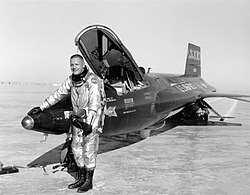
    A black-and-white photo of Armstrong smiling outside of an X-15

    Armstrong, 29, and X-15 #1 after a research flight in 1960.

    Many of the test pilots at Edwards praised Armstrong’s engineering ability. Milt Thompson said he was “the most technically capable of the early X-15 pilots.” Bill Dana said Armstrong “had a mind that absorbed things like a sponge.” Those who flew for the Air Force tended to have a different opinion, especially people like Chuck Yeager and Pete Knight who did not have engineering degrees. Knight said that pilot-engineers flew in a way that was “more mechanical than it is flying,” and gave this as the reason why some pilot-engineers got into trouble: their flying skills did not come naturally.[34]

    On May 21, 1962, Armstrong was involved in what Edwards’ folklore called the “Nellis Affair”. He was sent in an Lockheed F-104 Starfighter to inspect Delamar Dry Lake, again for emergency landings. He misjudged his altitude, and also did not realize that the landing gear had not fully extended. As he touched down, the landing gear began to retract. Armstrong applied full power to abort the landing, but the ventral fin and landing gear door struck the ground, damaging the radio and releasing hydraulic fluid. Without radio communication, Armstrong flew to Nellis Air Force Base, past the control tower, and waggled his wings, the signal for a no-radio approach. The loss of hydraulic fluid caused the tail-hook to release, and upon landing, he caught the arresting wire attached to an anchor chain, and dragged the chain along the runway.[35]

    It took thirty minutes to clear the runway and rig an arresting cable. Armstrong telephoned Edwards and asked for someone to collect him. Milt Thompson was sent in an F-104B, the only two-seater available, but a plane Thompson had never flown. With great difficulty, Thompson made it to Nellis, but a strong crosswind caused a hard landing and the left main tire suffered a blowout. The runway was again closed to clear it, and Bill Dana was sent to Nellis in a T-33 Shooting Star, but he almost landed long — and the Nellis base operations office decided that to avoid any further problems, it would be best to find the three NASA pilots ground transport back to Edwards.[36]

    Armstrong made seven flights in the X-15. He reached a top altitude of 207,500 feet (63.2 km) in the X-15-3,[37] and a top speed of Mach 5.74 (4,000 mph or 6,615 km/h) in the X-15-1; he left the Dryden Flight Research Center with a total of 2,400 flying hours.[38] Over his career, he flew more than 200 different models of aircraft.[3]

    Astronaut career

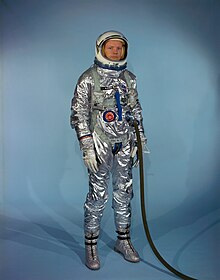
    Photo

    Armstrong in an early Gemini spacesuit

    There was no defining moment in Armstrong’s decision to become an astronaut. In 1958, he was selected for the U.S. Air Force’s Man In Space Soonest program. In November 1960, Armstrong was chosen as part of the pilot consultant group for the Boeing X-20 Dyna-Soar, a military space plane; and on March 15, 1962, he was named as one of six pilot-engineers who would fly the space plane when it got off the design board.[39]

    In the months after the announcement that applications were being sought for the second group of NASA astronauts, Armstrong became more and more excited about the prospects both of the Apollo program and of investigating a new aeronautical environment. Armstrong’s astronaut application had arrived about a week past the June 1, 1962 deadline, but Dick Day, with whom Armstrong had worked closely at Edwards, worked at the Manned Spacecraft Center, saw the late arrival of the application, and slipped it into the pile before anyone noticed.[40] At Brooks City-Base at the end of June, Armstrong underwent a medical exam that many of the applicants described as painful and at times seemingly pointless.[41]

    Deke Slayton called Armstrong on September 13, 1962 and asked whether he would be interested in joining the NASA Astronaut Corps as part of what the press dubbed “the New Nine”; without hesitation, Armstrong said yes. The selections were kept secret until three days later, although newspaper reports had been circulating since earlier that year that he would be selected as the “first civilian astronaut”.[42] Armstrong was one of two civilian pilots selected for the second group, the other being Elliot See who, like Armstrong, was a Naval Aviator.[1] Armstrong did not become the first civilian to fly in space, as the Russians had launched Vostok 6 on June 16, 1963 with Valentina Tereshkova, a textile worker and amateur parachutist, aboard.[43]

    Gemini program

    Gemini 8

    Main article: Gemini 8

    Armstrong goes through suiting up operations.

    The crew assignments for Gemini 8 were announced on September 20, 1965, with Armstrong as Command Pilot and David Scott as Pilot. Scott was the first member of the third group of astronauts to receive a prime crew assignment. The mission launched on March 16, 1966; it was to be the most complex yet, with a rendezvous and docking with the unmanned Agena target vehicle, the second American extra-vehicular activity by Scott. In total the mission was planned to last 75 hours and 55 orbits. After the Agena lifted off at 10 am EST, the Titan II carrying Armstrong and Scott ignited at 11:41:02 am EST, putting them into an orbit from where they would chase the Agena.[44]

    Photo of Armstrong and Scott in the Gemini capsule, in the water. They are being assisted by some recovery crew

    Recovery of the Gemini 8 spacecraft from the western Pacific Ocean

    The rendezvous and first ever docking between two spacecraft was successfully completed after 6.5 hours in orbit.[45] Contact with the crew was intermittent due to the lack of tracking stations covering their entire orbits. Out of contact with the ground, the docked spacecraft began to roll, and Armstrong attempted to correct this with the Orbital Attitude and Maneuvering System (OAMS) of the Gemini spacecraft. Following the earlier advice of Mission Control, they undocked, but found that the roll increased dramatically to the point where they were turning about once per second, which meant the problem was in their Gemini’s attitude control. Armstrong decided the only course of action was to engage the Reentry Control System (RCS) and turn off the OAMS. Mission rules dictated that once this system was turned on, the spacecraft would have to reenter at the next possible opportunity. It was later thought that damaged wiring made one of the thrusters become stuck in the on position.[46]

    Throughout the astronaut office there were a few people, most notably Walter Cunningham, who publicly stated that Armstrong and Scott had ignored the malfunction procedures for such an incident, and that Armstrong could have salvaged the mission if he had turned on only one of the two RCS rings, saving the other for mission objectives. These criticisms were unfounded; no malfunction procedures were written and it was possible to turn on only both RCS rings, not just one or the other. Gene Kranz wrote, “the crew reacted as they were trained, and they reacted wrong because we trained them wrong.” The mission planners and controllers had failed to realize that when two spacecraft are docked together, they must be considered to be one spacecraft.[47]

    Armstrong himself was depressed[48] that the mission had been cut short, which cancelled most mission objectives and robbed Scott of his EVA.

    Gemini 11

    Main article: Gemini 11

    The last crew assignment for Armstrong during the Gemini program was as backup Command Pilot for Gemini 11, announced two days after the landing of Gemini 8. Having already trained for two flights, Armstrong was quite knowledgeable about the systems and was more in a teaching role[49] for the rookie backup Pilot, William Anders. The launch was on September 12, 1966[50] with Pete Conrad and Dick Gordon on board, who successfully completed the mission objectives, while Armstrong served as CAPCOM.

    Following the flight, President Lyndon B. Johnson asked Armstrong and his wife to take part in a 24-day goodwill tour of South America.[51] Also on the tour, which took in 11 countries and 14 major cities, were Dick Gordon, George Low, their wives, and other government officials. In Paraguay, Armstrong impressed dignitaries by greeting them in their local language, Guarani;[52] in Brazil he talked about the exploits of the Brazilian-born Alberto Santos-Dumont, who was regarded as having beaten the Wright brothers with the first flying machine with his 14-bis.[53]

    Apollo program

    On January 27, 1967, the date of the Apollo 1 fire, Armstrong was in Washington, D.C., with Gordon Cooper, Dick Gordon, Jim Lovell and Scott Carpenter for the signing of the United Nations Outer Space Treaty. The astronauts chatted with the assembled dignitaries until 6:45 p.m. when Carpenter went to the airport, and the others returned to the Georgetown Inn, where they each found messages to phone the Manned Spacecraft Center. During these telephone calls they learned of the deaths of Gus Grissom, Ed White and Roger Chaffee. Armstrong and the group spent the rest of the night drinking scotch and discussing what had happened.[54]

    On April 5, 1967, the same day the Apollo 1 investigation released its report on the fire, Armstrong assembled with 17 other astronauts for a meeting with Deke Slayton. The first thing Slayton said was, “The guys who are going to fly the first lunar missions are the guys in this room.”[55] According to Eugene Cernan, Armstrong showed no reaction to the statement. To Armstrong it came as no surprise – the room was full of veterans of Project Gemini, the only people who could fly the lunar missions. Slayton talked about the planned missions and named Armstrong to the backup crew for Apollo 9, which at that stage was planned to be a medium Earth orbit test of the Lunar Module-Command/Service Module combination. After design and manufacturing delays in the Lunar Module (LM), Apollo 9 and Apollo 8 swapped crews. Based on the normal crew rotation scheme, Armstrong would command Apollo 11.[56]

    To attempt to give the astronauts experience with how the LM would fly on its final landing descent, NASA commissioned Bell Aircraft to build two Lunar Landing Research Vehicles, later augmented with three Lunar Landing Training Vehicles (LLTV). Nicknamed the “Flying Bedsteads”, they simulated the Moon’s one-sixth of Earth’s gravity by using a turbofan engine to support the remaining five-sixths of the craft’s weight. On May 6, 1968, about 100 feet (30 m) above the ground, Armstrong’s controls started to degrade and the LLTV began banking.[57] He ejected safely (later analysis suggested that if he had ejected 0.5 seconds later, his parachute would not have opened in time). His only injury was from biting his tongue. Even though he was nearly killed, Armstrong maintained that without the LLRV and LLTV, the lunar landings would not have been successful, as they gave commanders valuable experience in the behavior of lunar landing craft.[58]

    Apollo 11

    Main article: Apollo 11
    Photo

    The Apollo 11 crew portrait. Left to right are Armstrong, Michael Collins, and Buzz Aldrin.

    After Armstrong served as backup commander for Apollo 8, Slayton offered him the post of commander of Apollo 11 on December 23, 1968, as 8 orbited the Moon.[59] In a meeting that was not made public until the publication of Armstrong’s biography in 2005, Slayton told him that although the planned crew was Armstrong as commander, lunar module pilot Buzz Aldrin and command module pilot Michael Collins, he was offering the chance to replace Aldrin with Jim Lovell. After thinking it over for a day, Armstrong told Slayton he would stick with Aldrin, as he had no difficulty working with him and thought Lovell deserved his own command. Replacing Aldrin with Lovell would have made Lovell the Lunar Module Pilot, unofficially the lowest ranked member, and Armstrong could not justify placing Lovell, the commander of Gemini 12, in the number 3 position of the crew.[60]

    A March 1969 meeting between Slayton, George Low, Bob Gilruth, and Chris Kraft determined that Armstrong would be the first person on the Moon, in some part because NASA management saw Armstrong as a person who did not have a large ego.[61] A press conference held on April 14, 1969 gave the design of the LM cabin as the reason for Armstrong’s being first; the hatch opened inwards and to the right, making it difficult for the lunar module pilot, on the right-hand side, to egress first. Slayton added, “Secondly, just on a pure protocol basis, I figured the commander ought to be the first guy out. . . . I changed it as soon as I found they had the time line that showed that. Bob Gilruth approved my decision.”[62] At the time of their meeting, the four men did not know about the hatch issue. The first knowledge of the meeting outside the small group came when Kraft wrote his 2001 autobiography.[63]

    On July 16, 1969, Armstrong received a crescent moon carved out of Styrofoam from the pad leader, Guenter Wendt, who described it as a key to the Moon. In return, Armstrong gave Wendt a ticket for a “space taxi” “good between two planets”.[64]

    Voyage to the Moon
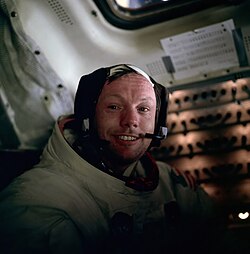
    Photo of Armstrong smiling in his spacesuit

    Aldrin took this picture of Armstrong in the cabin after the completion of the EVA.

    During the Apollo 11 launch, Armstrong’s heart reached a top rate of 110 beats per minute.[65] He found the first stage to be the loudest – much noisier than the Gemini 8 Titan II launch – and the Apollo CSM was relatively roomy compared to the Gemini capsule. This ability to move around was suspected to be the cause of space sickness that had hit members of previous crews, but none of the Apollo 11 crew suffered from it; Armstrong was especially happy, as he had been prone to motion sickness as a child and could experience nausea after doing long periods of aerobatics.[66]

    The objective of Apollo 11 was to land safely rather than to touch down with precision on a particular spot. Three minutes into the lunar descent burn, Armstrong noted that craters were passing about two seconds too early, which meant the Eagle would probably touch down beyond the planned landing zone by several miles.[67] As the Eagle’s landing radar acquired the surface, several computer error alarms appeared. The first was a code 1202 alarm, and even with their extensive training, neither Armstrong nor Aldrin was aware of what this code meant. They promptly received word from CAPCOM in Houston that the alarms were not a concern; the 1202 and 1201 alarms were caused by an executive overflow in the lunar module computer. As described by Buzz Aldrin in the documentary In the Shadow of the Moon, the overflow condition was caused by his own counter-checklist choice of leaving the docking radar on during the landing process, so the computer had to process unnecessary radar data and did not have enough time to execute all tasks, dropping lower-priority ones. Aldrin stated that he did so with the objective of facilitating re-docking with the CM should an abort become necessary, not realizing that it would cause the overflow condition.[citation needed]

    When Armstrong noticed they were heading towards a landing area which he believed was unsafe, he took over manual control of the LM, and attempted to find an area which seemed safer, taking longer than expected, and longer than most simulations had taken.[68] For this reason, there was concern from mission control that the LM was running low on fuel.[69] Upon landing, Aldrin and Armstrong believed they had about 40 seconds worth of fuel left, including the 20 seconds worth of fuel which had to be saved in the event of an abort.[70] During training, Armstrong had landed the LLTV with less than 15 seconds left on several occasions, and he was also confident the LM could survive a straight-down fall from 50 feet (15 m) if needed. Analysis after the mission showed that at touchdown there were 45 to 50 seconds of propellant burn time left.[71]

    The landing on the surface of the moon occurred at 20:17:39 UTC on July 20, 1969.[72] When a sensor attached to the legs of the still hovering Lunar Module made lunar contact, a panel light inside the LM lit up and Aldrin called out, “Contact light.” As the LM settled on the surface Aldrin then said, “Okay. Engine stop,” and Armstrong said, “Shutdown.” The first words Armstrong intentionally spoke to Mission Control and the world from the lunar surface were, “Houston, Tranquility Base here. The Eagle has landed.” Aldrin and Armstrong celebrated with a brisk handshake and pat on the back before quickly returning to the checklist of tasks needed to ready the lunar module for liftoff from the Moon should an emergency unfold during the first moments on the lunar surface.[73][74][75] During the critical landing, the only message from Houston was “30 seconds”, meaning the amount of fuel left. When Armstrong had confirmed touch-down, Houston expressed their worries during the manual landing as “You got a bunch of guys about to turn blue. We’re breathing again”.[70]

    First Moon walk
    See also: Apollo 11 – Lunar surface operations
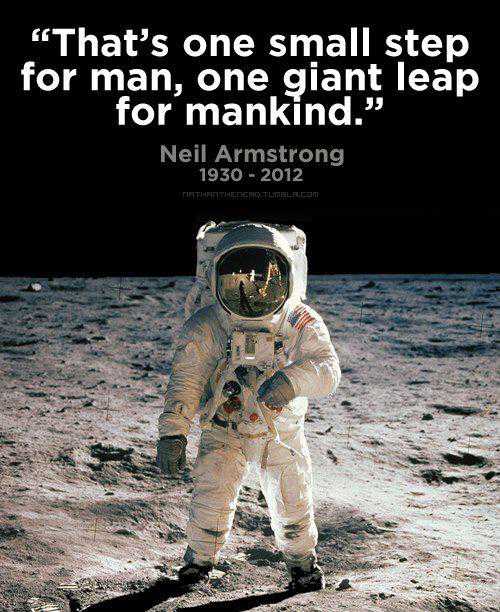
    “That’s one small step for [a] man, one giant leap for mankind”

    Problems listening to this file? See media help.

    Although the official NASA flight plan called for a crew rest period before extra-vehicular activity, Armstrong requested that the EVA be moved to earlier in the evening, Houston time. Once Armstrong and Aldrin were ready to go outside, Eagle was depressurized, the hatch was opened and Armstrong made his way down the ladder first.

    Armstrong describes the lunar surface.

    At the bottom of the ladder, Armstrong said “I’m going to step off the LEM now” (referring to the Apollo Lunar Module). He then turned and set his left boot on the surface at 2:56 UTC July 21, 1969,[76] then spoke the famous words “That’s one small step for [a] man, one giant leap for mankind.”[77]

    Armstrong had decided on this statement following a train of thought that he had had after launch and during the hours after landing.[78] The broadcast did not have the “a” before “man”, rendering the phrase a contradiction (as man in such use is synonymous with mankind). NASA and Armstrong insisted for years that static had obscured the “a”, with Armstrong stating he would never make such a mistake, but after repeated listenings to recordings, Armstrong admitted he must have dropped the “a”.[77] Armstrong later said he “would hope that history would grant me leeway for dropping the syllable and understand that it was certainly intended, even if it was not said – although it might actually have been”.[79]

    Armstrong on the Moon

    It has since been claimed that acoustic analysis of the recording reveals the presence of the missing “a”;[77][80] Peter Shann Ford, an Australia-based computer programmer, conducted a digital audio analysis and claims that Armstrong did, in fact, say “a man”, but the “a” was inaudible due to the limitations of communications technology of the time.[77][81][82] Ford and James R. Hansen, Armstrong’s authorized biographer, presented these findings to Armstrong and NASA representatives, who conducted their own analysis.[83] The article by Ford, however, is published on Ford’s own web site rather than in a peer-reviewed scientific journal, and linguists David Beaver and Mark Liberman wrote of their skepticism of Ford’s claims on the blog Language Log.[84] Although Armstrong found Ford’s analysis “persuasive”,[85] he expressed his preference that written quotations include the “a” in parentheses.[citation needed]

    When Armstrong made his proclamation, Voice of America was rebroadcast live via the BBC and many other stations worldwide. The estimated global audience at that moment was 450 million listeners,[86] out of a then estimated world population of 3.631 billion people.[87]

    A low-quality photo of a television monitor showing Armstrong on the lunar module's ladder

    Armstrong prepares to take the first step on the Moon.

    About 20 minutes after the first step, Aldrin joined Armstrong on the surface and became the second human to set foot on the Moon, and the duo began their tasks of investigating how easily a person could operate on the lunar surface. Early on, they unveiled a plaque commemorating their flight, and also planted the flag of the United States. The flag used on this mission had a metal rod to hold it horizontal from its pole. Since the rod did not fully extend, and the flag was tightly folded and packed during the journey, the flag ended up with a slightly wavy appearance, as if there were a breeze.[88] Shortly after their flag planting, President Richard Nixon spoke to them by a telephone call from his office. The President spoke for about a minute, after which Armstrong responded for about thirty seconds.[89]

    In the entire Apollo 11 photographic record, there are only five images of Armstrong partly shown or reflected. The mission was planned to the minute, with the majority of photographic tasks to be performed by Armstrong with a single Hasselblad camera.[90]

    After helping to set up the Early Apollo Scientific Experiment Package, Armstrong went for a walk to what is now known as East Crater, 65 yards (59 m) east of the LM, the greatest distance traveled from the LM on the mission. Armstrong’s final task was to leave a small package of memorial items to deceased Soviet cosmonauts Yuri Gagarin and Vladimir Komarov, and Apollo 1 astronauts Gus Grissom, Ed White and Roger B. Chaffee. The time spent on EVA during Apollo 11 was about two and a half hours, the shortest of any of the six Apollo lunar landing missions;[91] each of the subsequent five landings were allotted gradually longer periods for EVA activities – the crew of Apollo 17, by comparison, spent over 22 hours exploring the lunar surface.[91]

    Return to Earth
    Photo of the three crew members smiling at the President through the glass window of their quarantine chamber. President Nixon is standing at a microphone, also smiling.

    The Apollo 11 crew and President Richard Nixon.

    After they re-entered the LM, the hatch was closed and sealed. While preparing for the liftoff from the lunar surface, Armstrong and Aldrin discovered that, in their bulky spacesuits, they had broken the ignition switch for the ascent engine; using part of a pen, they pushed the circuit breaker in to activate the launch sequence.[92] Aldrin still possesses the pen which they used to do this. The lunar module then continued to its rendezvous and docked with Columbia, the command and service module. The three astronauts returned to Earth and splashed down in the Pacific ocean, to be picked up by the USS Hornet (CV-12).[93]

    After being released from an 18-day quarantine to ensure that they had not picked up any infections or diseases from the Moon, the crew were feted across the United States and around the world as part of a 45-day “Giant Leap” tour. Armstrong then took part in Bob Hope’s 1969 USO show, primarily to Vietnam.[94]

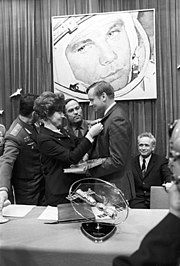
    In May 1970, Armstrong traveled to the Soviet Union to present a talk at the 13th annual conference of the International Committee on Space Research; after arriving in Leningrad from Poland, he traveled to Moscow where he met Premier Alexei Kosygin. He was the first westerner to see the supersonic Tupolev Tu-144 and was given a tour of the Yuri Gagarin Cosmonaut Training Center, which Armstrong described as “a bit Victorian in nature”.[95] At the end of the day, he was surprised to view delayed video of the launch of Soyuz 9 – it had not occurred to Armstrong that the mission was taking place, even though Valentina Tereshkova had been his host and her husband, Andriyan Nikolayev, was on board.[96]

    Life after Apollo

    Teaching

    Neil Armstrong Hall of Engineering at Purdue University

    Armstrong announced shortly after the Apollo 11 flight that he did not plan to fly in space again.[97] He was appointed Deputy Associate Administrator for aeronautics for the Office of Advanced Research and Technology, Advanced Research Projects Agency (ARPA), but served in this position for only a year, and resigned from it and NASA as a whole in 1971.[98]

    He accepted a teaching position in the Department of Aerospace Engineering at the University of Cincinnati,[99] having decided on Cincinnati over other universities, including his alma mater, Purdue, because it had a small aerospace department; he hoped that the faculty members would not be annoyed that he came straight into a professorship with only the USC master’s degree.[100] He began the work while stationed at Edwards years before, and finally completed it after Apollo 11 by presenting a report on various aspects of Apollo, instead of a thesis on the simulation of hypersonic flight. The official job title he received at Cincinnati was University Professor of Aerospace Engineering. After teaching for eight years, he resigned in 1979 without explaining his reason for leaving.[101]

    NASA accident investigations

    Armstrong served on two spaceflight accident investigations. The first was in 1970, after Apollo 13, where as part of Edgar Cortwright’s panel, he produced a detailed chronology of the flight. Armstrong personally opposed the report’s recommendation to re-design the service module’s oxygen tanks, the source of the explosion.[102] In 1986, President Ronald Reagan appointed him to the Rogers Commission which investigated the Space-shuttle Challenger disaster of that year. As vice-chairman, Armstrong was in charge of the operational side of the commission.[103]

    Business activities

    After Armstrong retired from NASA in 1971, he avoided offers from businesses to act as a spokesman. The first company to successfully approach him was Chrysler, for whom he appeared in advertising starting in January 1979. Armstrong thought they had a strong engineering division, plus they were in financial difficulty. He acted as a spokesman for other companies, including General Time Corporation and the Bankers Association of America. He acted as a spokesman for US businesses only.[104]

    Along with spokesman duties, he also served on the board of directors of several companies, including Marathon Oil, Learjet, Cinergy (Cincinnati Gas & Electric Company), Taft Broadcasting, United Airlines, Eaton Corporation, AIL Systems, and Thiokol.[105] He joined Thiokol’s board after he served on the Rogers Commission; the Space Shuttle Challenger was destroyed due to a problem with the Thiokol-manufactured solid rocket boosters. He retired as chairman of the board of EDO Corporation in 2002.[106]

    Personal life

    Photo of a group of about 25 people

    Neil Armstrong (second from right, middle row) visits with USAF members in Southwest Asia, 2010. To his left are Gene Cernan and Jim Lovell.

    Armstrong was approached by political groups from both ends of the spectrum after his aeronautical career. Unlike former astronauts and United States Senators John Glenn and Harrison Schmitt, Armstrong declined all offers. Personally, he was in favor of states’ rights and against the United States acting as the “world’s policeman”.[107]

    In the late 1950s, Armstrong applied at a local Methodist church to lead a Boy Scout troop. When asked for his religious affiliation, he labeled himself as a Deist.[108]

    In 1972, Armstrong was welcomed into the town of Langholm, Scotland, the traditional seat of Clan Armstrong; he was made the first freeman of the burgh, and happily declared the town his home.[109] The Justice of the Peace read from an unrepealed 400-year-old law that required him to hang any Armstrong found in the town.[110]

    In the fall of 1979, Armstrong was working at his farm near Lebanon, Ohio. As he jumped off of the back of his grain truck, his wedding ring caught in the wheel, tearing off the tip of his ring finger. He collected the severed digit and packed it in ice, and surgeons reattached it at the Jewish Hospital in Louisville, Kentucky.[111] In February 1991, he suffered a mild heart attack while skiing with friends at Aspen, Colorado[112] a year after his father had died, and nine months after the death of his mother.

    Armstrong’s first wife, Janet, divorced him in 1994, after 38 years of marriage.[113] He had met his second wife, Carol Held Knight, in 1992 at a golf tournament, where they were seated together at the breakfast table. She said little to Armstrong, but two weeks later she received a call from him asking what she was doing—she replied she was cutting down a cherry tree; 35 minutes later Armstrong was at her house to help out. They were married on June 12, 1994, in Ohio, and then had a second ceremony, at San Ysidro Ranch, in California. He lived in Indian Hill, Ohio.[114]

    Photo

    Quincy Jones presents platinum copies of “Fly Me to the Moon” to Neil Armstrong (right) and former Senator John Glenn, September 24, 2008.

    After 1994, Armstrong refused all requests for autographs because he found that his signed items were selling for large amounts of money and that many forgeries are in circulation; any requests sent to him received a form letter in reply saying that he has stopped signing. Although his no-autograph policy was well known, author Andrew Smith observed people at the 2002 Reno Air Races still trying to get signatures, with one person even claiming, “If you shove something close enough in front of his face, he’ll sign.”[115] He also stopped sending out congratulatory letters to new Eagle Scouts, because he believed these letters should come from people who know the Scouts personally.[116]

    Use of Armstrong’s name, image, and famous quote caused him problems over the years. MTV wanted to use his quote for its now-famous ident depicting the Apollo 11 landing when it launched in 1981, but he declined.[117] Armstrong sued Hallmark Cards in 1994 after they used his name and a recording of “one small step” quote in a Christmas ornament without permission. The lawsuit was settled out of court[118] for an undisclosed amount of money which Armstrong donated to Purdue.[119]

    In May 2005, Armstrong became involved in an unusual legal battle with his barber of 20 years, Marx Sizemore. After cutting Armstrong’s hair, Sizemore sold some of it to a collector for $3,000 without Armstrong’s knowledge or permission.[120] Armstrong threatened legal action unless the barber returned the hair or donated the proceeds to a charity of Armstrong’s choosing. Sizemore, unable to get the hair back, decided to donate the proceeds to the charity of Armstrong’s choice.[121]

    Illness and death

    Armstrong underwent surgery on August 7, 2012, to relieve blocked coronary arteries.[122] He died on August 25, in Cincinnati, Ohio,[2] following complications resulting from these cardiovascular procedures. Hours later, President Barack Obama released a statement on Armstrong’s death describing him as “among the greatest of American heroes – not just of his time, but of all time.”[123][124] According to a statement released by the White House, Obama added that he, along with the Apollo 11 crew, carried the aspirations of the United States’ citizens and that Armstrong had delivered “a moment of human achievement that will never be forgotten.”

    Armstrong’s family also released a statement that read “[he was a] reluctant American hero [and had] served his nation proudly, as a navy fighter pilot, test pilot, and astronaut. While we mourn the loss of a very good man, we also celebrate his remarkable life and hope that it serves as an example to young people around the world to work hard to make their dreams come true, to be willing to explore and push the limits, and to selflessly serve a cause greater than themselves.”[125]

    Armstrong’s colleague on the Apollo 11 mission, Buzz Aldrin, commented that he was “very saddened to learn of the passing. I know I am joined by millions of others in mourning the passing of a true American hero and the best pilot I ever knew.”[126][127] Command module pilot Michael Collins said simply, “He was the best, and I will miss him terribly.”[128] NASA Administrator Charles Bolden said that Armstrong will be “remembered for taking humankind’s first small step on a world beyond our own”.[129][130]

    Armstrong’s family statement made the tribute “For those who may ask what they can do to honor Neil, we have a simple request. Honor his example of service, accomplishment and modesty, and the next time you walk outside on a clear night and see the moon smiling down at you, think of Neil Armstrong and give him a wink.”[125] This prompted many responses, including the Twitter hashtag “#WinkAtTheMoon”.[131]

    Legacy

    Armstrong and Valentina Tereshkova, the first woman in space, Soviet Union, 1970

    Armstrong received many honors and awards, including the Presidential Medal of Freedom, the Congressional Space Medal of Honor, the Robert H. Goddard Memorial Trophy, the Sylvanus Thayer Award, the Collier Trophy from the National Aeronautics Association, and the Congressional Gold Medal. The lunar crater Armstrong, 31 mi (50 km) from the Apollo 11 landing site, and asteroid 6469 Armstrong[132] are named in his honor. Armstrong was also inducted into the Aerospace Walk of Honor and the United States Astronaut Hall of Fame.[133][134] Armstrong and his Apollo 11 crewmates were the 1999 recipients of the Langley Gold Medal from the Smithsonian Institution.

    Throughout the United States, there are more than a dozen elementary, middle and high schools named in his honor,[135] and many places around the world have streets, buildings, schools, and other places named for Armstrong and/or Apollo.[136] In 1969, folk songwriter and singer John Stewart recorded “Armstrong”, a tribute to Armstrong and his first steps on the moon. Purdue University announced in October 2004 that its new engineering building would be named Neil Armstrong Hall of Engineering in his honor;[137] the building cost $53.2 million and was dedicated on October 27, 2007, during a ceremony at which Armstrong was joined by fourteen other Purdue Astronauts.[138] In 1971, Armstrong was awarded the Sylvanus Thayer Award by the United States Military Academy at West Point for his service to the country.[139] The Neil Armstrong Air and Space Museum is located in his hometown of Wapakoneta, Ohio, although it has no official ties to Armstrong and the airport in New Knoxville where he took his first flying lessons is named for him.[140]

    Photo of four men wearing suits, with the curtain drawn behind them, admitting light.

    Michael Collins, President George W. Bush, Armstrong, and Aldrin during celebrations of the 35th anniversary of the Apollo 11 flight, July 21, 2004

    Armstrong’s authorized biography, First Man: The Life of Neil A. Armstrong, was published in 2005. For many years, Armstrong turned down biography offers from authors such as Stephen Ambrose and James A. Michener, but agreed to work with James R. Hansen after reading one of Hansen’s other biographies.[141]

    In a 2010 Space Foundation survey, Armstrong was ranked as the #1 most popular space hero.[142]

    The press often asked Armstrong for his views on the future of spaceflight. In 2005, Armstrong said that a manned mission to Mars will be easier than the lunar challenge of the 1960s: “I suspect that even though the various questions are difficult and many, they are not as difficult and many as those we faced when we started the Apollo [space program] in 1961.” In 2010, he made a rare public criticism of the decision to cancel the Ares 1 launch vehicle and the Constellation moon landing program.[143] In an open public letter also signed by Apollo veterans Jim Lovell and Gene Cernan, he noted, “For The United States, the leading space faring nation for nearly half a century, to be without carriage to low Earth orbit and with no human exploration capability to go beyond Earth orbit for an indeterminate time into the future, destines our nation to become one of second or even third rate stature”.[144] Armstrong had also publicly recalled his initial concerns about the Apollo 11 mission, when he had believed there was only a 50% chance of landing on the moon. “I was elated, ecstatic and extremely surprised that we were successful”, he later said.[145]

    On November 18, 2010, at age eighty, Armstrong said in a speech during the Science & Technology Summit in The Hague, Netherlands, that he would offer his services as commander on a mission to Mars if he were asked.[146]

  • Quds, Azerbaijan and Nagorno-Karabakh

    Quds, Azerbaijan and Nagorno-Karabakh


    Gulnara Inandzh, Director of Information and Analytical Center Etnoglobus (ethnoglobus.az), editor of Russian section of Turkishnews American-Turkish Resource website www.turkishnews.com  , [email protected]

    Since 1982 every last Friday of Ramadan, in the initiative of the leader of the Islamic Revolution of Iran Imam Khomeini, “Quds Day” has been marked in a tribute to the solidarity with the Palestinian people.  This year it was marked on the 17th of August.


    According to wills of Imam Khomeini, spread of Islamic values is noted as one of the leading lines of the foreign policy of the Islamic Republic of Iran. “Quds Day”, as one of the wings of the spread of this policy, is of particular importance.

    Over the past 30 years, the collapse of the Soviet Union and political change in the Arab world have expanded the geography of the “Quds Day” as a branch of the policy of exporting the Islamic revolution and its ideology.

    The purpose of marking the “Quds Day” is to attract world attention to the occupied territories, includingPalestine. Loss of 20% of Azerbaijani territory, including Nagorno-Karabakh as a result of the war withArmeniaandAzerbaijan, also joined the list of states whose territories are under occupation.

    In recent years, the reason of activity of “Quds Day” is connected with the coming to power of Islamist forces in some Arab countries.

    OfficialTehran, using the favorable situation created by the so-called “Arab spring” to expand its influence in the region, expanded the range of “Quds Day”.Iranimprovises  the liberation of Muslims from tyrannical regimes, by expanding geographic scope of their mission as a protector of the Muslims and thereby trying to regain the Muslim world.

    “Arab Spring” changed the views regarding Nagorno-Karabakh conflict in the West as well as in the East. Statement by the Deputy Minister of Foreign Affairs of Saudi Arabia Prince Khalid bin Saud bin Khalid, “the need in this stage to increase pressure of the international community on Armenia in order to resolve the Nagorno-Karabakh conflict,” confirms this position.

    Latest statement by supreme spiritual leader of Islamic Republic of Iran Ali Khamenei also draws attention in this regard: “Karabakh is Islamic land …. The Iranian parliament will support the fact that Karabakh belongs to Islam,Azerbaijan.

    With the elections in Nagorno Karabakh there are attempts to neglect the facts that these lands’ belong to Azerbaijan and Islam. No matter how much time has passed the reality that Karabakh is Islamic land will not be forgotten. Karabakh will be released by the Muslim Azerbaijanis.”

    Increase of reputation of Azerbaijanin the Middle East created good condition for leading Arabic countries andIran, along withIsrael, to take advantage of the situation.

    In order to attract the interest, Azerbaijanfirst of all needs to advance effective suggestions and support.

    Iranplan, within the framework of the “Qods Day”, to bring to the agenda the issue with respect to the liberation of occupied Azerbaijani territories byArmenia, including the Nagorno-Karabakh and to bring this conflict to the attention of the world Muslim community. The above statement by Ali Khamenei in connection with the Nagorno-Karabakh should also be seen on this plane.

    Official Baku recognizes independence of Palestineand supports the idea of partition of Palestine Qodsi on the western and eastern parts. Azerbaijanshall take advantage of imposition of the Nagorno-Karabakh conflict on account of the Islamic world along with the status of Gods.

    The processes in the Arab world, a tough fight of the regional states and world powers for the division of spheres of influence and control on the Middle East, creates condition for causing the conflict out of control in the Caucasus, including conflict between Armenia and Azerbaijan. Violation of the last months of ceasefire by the Armenian side and the loss of our soldiers endangers the resumption of hostilities frontal zone, with difficulty repressed for 20 years. Taking into account the impacts of the Armenian communities of the Arab countries by the Armenian lobby in the policies of these countries, in the event of renewed hostilities on the Armenian-Azerbaijani front, position of the Islamic world towards the Nagorno-Karabakh issue will be of great importance forAzerbaijan.

    Under such circumstances,Azerbaijanis interested in delivering the Nagorno-Karabakh conflict through the Islamic world to the attention of world public opinion.


  • İYİ ŞEKER BAYRAMLAR!!!! FROM THE APES AND SWINE OF TURKEY

    İYİ ŞEKER BAYRAMLAR!!!! FROM THE APES AND SWINE OF TURKEY

    Suriye’ye kamyon kamyon nitrat gübresi götürülüyor
    Trucks bringing nitrate fertilizer bomb-making material to Syria (from Turkey)

    Hatay’dan Suriye’ye kamyon kamyon nitrat gübresi götürüldüğü ortaya çıktı. Bölge kaynakları, nitrat gübresinin, bomba yapımında kullanılmak için götürüldüğünü vurguladı. Bölgede kullanımı yaygın olmadığı halde özellikle Reyhanlı’da nitrat gübresinin bayilerden çekildiği belirtiliyor. Ziraat odasında bir yetkili “Bu gübreler, tarımda kullanmak üzere stoklanıyor olabilir mi?” sorusunu, “Nitrat gübresi stoklanmaz. Beklediğinde niteliğinde kaybeder. Çiftçi zarar eder” diye yanıtladı. Esad yönetimine karşı eylemler gerçekleştiren paralı askerlerin ve muhaliflerin nitrat gübresini, Suriye’de bomba yapmakta kullandıkları bildirildi.

    Aydinlik Gazetesi, 19 Ağüstos 2012

    ____________________________________________________________________


    Note to the Turkish Government:
    On the holiest day of the year you are deliberately killing your fellow Muslim believers. May Allah damn you to hell. In fact, Allah already has! Read your holy Koran you religious mongering merchants of murder! 

    It is unlawful for a believer to kill another believer. Koran, 4:92.

    — He that kills a believer by design shall burn in Hell forever. He shall incur the wrath of God, who will lay His curse upon him and prepare for him a mighty scourge. Koran, 4:93

    — Shall I tell you who will receive a worse reward from God? Those whom God has cursed and with whom He has been angry, transforming them into apes and swine, and those who serve the devil. Koran,  5:60


    READ YOUR KORAN, TURKISH APES AND SWINE.

    READ AND RECITE! 


    Cem Ryan

    Istanbul

    8/19/2012

    _________________________________________________________________________________