Category: World

  • Turkey to block access to the Hate Film which brought chaos to the world

    Turkey to block access to the Hate Film which brought chaos to the world


    ANKARA, Turkey — A Turkish court issued an order on Wednesday allowing authorities in the country to block Internet access to the anti-Islam movie that has sparked violent protests across the Muslim world, an official said.

    Binali Yildirim, the minister in charge of transportation and communications, told state-run TRT television that the injunction allows government telecommunications and information technology authorities to prevent access from Turkey to URL links to the film.

    The move came a day after another government minister said Prime Minister Recep Tayyip Erdogan, who heads an AK Party* party, ordered officials to find ways of preventing access to videos of “Innocence of Muslims” movie.

    Dozens of people, including the U.S. ambassador to Libya, have been killed in violence linked to protests over the film.

    “Henceforth, it will not be shown in our country,” said Yildirim, calling the film “disgusting.”

    “To insult what is sacred, to incite indignation is unacceptable for all religions. It is a hate crime and no crime should go unpunished,” Yildirim said. His office said Tuesday that the ministry has also asked Google Inc. and YouTube to remove the videos.

    Erdogan has criticized Western nations for not taking steps to prevent insults to Islamic values but also has criticized violent protests against the film saying they harm Islam.

    Yildirim said the court order is limited to links to the film and that access to websites that carry the links would not be blocked. Turkey banned access to the video sharing site YouTube from 2008 and 2010 because of videos deemed insulting to the country’s founder, Mustafa Kemal Ataturk.

    Thousands of other websites, most of them pornographic, have also been banned in the country. The government says it is fighting child pornography, illegal gambling and other cybercrimes.


    CBS NEWS


    Edited*

  • Why Turkey can’t lead a ban on Islamophobia?

    Why Turkey can’t lead a ban on Islamophobia?

    Before Turkish Prime Minister Recep Tayyip Erdoğan decided to cancel his visit to the U.N. General Assembly in New York, he was planning to talk about adopting international legislation on insults to religion. He confirmed that he would while commenting on the 14-minute trailer mocking the Prophet Muhammad, which sparked violent riots across the Muslim world. He said Turkey could lead on this issue.

    This betrays the typical Turkish mentality of “banning.” We don’t like something? Then ban and get rid of it!

    Well, things just don’t work like that in the “Western hemisphere” – the democratic standards of which Turkey has been aspiring to reach.

    Now Erdoğan is not going to New York, Foreign Minister Ahmet Davutoğlu will no doubt talk about the issue when he speaks at the U.N. However, introducing international legislation for insulting religion is basically mission impossible.

    I am guessing that Turkish diplomats would remind him of the experience in 2006 when a similar crisis broke out over the Danish cartoons.

    At that time – already extremely concerned about the rise in “anti-immigrant,” Islamophobic” and “racist” rhetoric in Europe – Turkish diplomats tried to raise awareness of this issue. They simply tried to convey the message that there should not be a hierarchical relationship between freedom of expression and freedom of religion, as Europeans tended always to put the former above everything else. Every time Turks tried to talk about freedom of expression being abused against Muslims, they hit the wall as Europeans told them: “freedom of expression is a core right!”

    It took several months of intense negotiations to have a resolution adopted in the 2006 ministerial meeting of the Organization for Security and Cooperation in Europe (OSCE). The decision underlined the importance of states enacting a sound legal framework “ensuring equality before the law and adequate judicial protection” and called on political leaders to speak out against hate-motivated acts and incidents. This is as far as the OSCE went, but even that made the Germans and the Americans quite nervous.

    There is a limit to freedom of expression also when it comes to insulting religion, according to the European Court of Human Rights (ECHR), which decided in favor of the Austrian government that confiscated a film about Christianity in the Otto Preminger vs. Austria case. But the ECHR leaves a wide margin of oppreciation to the governments and national courts to resolve cases of conflict between freedom of expression and the “rights of others,” in particular the right to respect for one’s religious feelings.

    Most Western countries do have the necessary legal framework that regulates hate crime. But they need to strike a balance between freedom of expression and respect for religious feelings. The problem is, more often than not, the prosecutors and the judges tend to favor the principle of freedom of expression, underestimating the consequences of a discourse that borders on the incitement of hatred. Turkey should therefore spend its energies devising a strategy that encourages member countries to use the legal tools at their disposal.

    Finally, as a country that has a bad international reputation for limiting freedom of expression, Turkey could indeed be the champion of the “censorious” cause. But it cannot lead any attempt to have an international legislation to ban Islamophobia, and at any rate that would be a futile attempt.

    via BARÇIN YİNANÇ – Why Turkey can’t lead a ban on Islamophobia?.

  • UN Women to open regional office in Turkey

    UN Women to open regional office in Turkey

    United Nations Entity for Gender Equality and the Empowerment of Women– will open a regional office in Turkey.

    Thanks to efforts by Turkish Foreign Ministry and Family & Social Policies Ministry, the office, which will be responsible from Europe and Central Asia, will be opened in Istanbul.

    UN Women will support intergovernmental organs while they are shaping up policies, and setting the norms and standards.

    It will also provide financial and technical support, encourage effective cooperation with civil society, and help members states to apply the standards.

    via UN Women to open regional office in Turkey – Trend.Az.

  • Turkey Grows as Destination for International Students

    Turkey Grows as Destination for International Students

    Turkish universities are becoming an increasingly popular destination for students from around the globe, signalling the importance of the growing education sector for Turkey. Between the 2005-2006 and the 2011-2012 school year, the number of international students attending Turkish universities more than doubled, from 15,481 to 31,170.

    The growth of foreign students has been matched by the expansion of higher education in Turkey, where 50 public universities and 36 private foundation universities were established between 2006 and 2011, bringing the total number to 165. The same period witnessed an increase of 40 percent in the number of Turkish students attending university.

    Students come from 155 countries to study in Turkey. In 2011-2012, Azerbaijan had the largest representation with more than 4,200 students, followed by Turkmenistan with 4,110 and the Turkish Republic of Northern Cyprus with about 3,800. Europe also showed strong numbers, with both Germany and Greece sending more than 1,300 students.

    The experiences foreign students gain during their time in Turkey are of lasting value for foreign and Turkish students alike, helping to deepen ties between individuals that span national borders and erase stereotypes.

    The motivation to pursue higher education in Turkey varies from student to student. For some it is the prospect of an inexpensive and quality education. For others it’s the opportunity to learn Turkish and receive an education in one of the many English language universities.

    Desantilla Hasanaj came from Albania to study political science and public administration at Fatih University in Istanbul. She chose to study in Turkey “because the education here is much better than Albania.”

    For Mohamed Bachir from Niger, who is in his second year studying Business Administration at Bahcesehir University in Istanbul, the opportunity to learn a new language and culture made Turkey his first choice.

    Wazir Ali, from Pakistan, who is studying at Zirve University in Gaziantep, was drawn by the prospect of learning Turkish and improving his command of English by studying in a programme that uses English as the language of instruction.

    But it is not just the international students who benefit from studying in Turkey. Foreign students add to the character and quality of education for Turkish students as well.

    Michael Brownfox has taught at numerous Turkish universities and was a founding partner of StudyinTurkey.com, a programme run by the Turkish Universities Promotion Agency, a private organization devoted to attracting students to Turkey.

    Brownfox told SES Türkiye universities benefit from attracting international students to their student body, not only in financial terms, but also in the new opportunities and ideas that come from educating students who bring a different perspective on the world.

    Having international students “really helps Turkish students to see both how big and small the world is,” Brownfox said. “This is a major benefit,” he noted, pointing out that the dynamic created by a global classroom better prepares all students, foreign and Turkish, to succeed in the global marketplace.

    One of the most successful student exchange programmes is the EU’s Erasmus programme, which is open to 33 countries, including Turkey, and facilitates the process of student exchanges.

    Since Turkey began participating in 2004, nearly 15,000 students have come through this one programme alone, according to data published by the European Commission.

    Liam Murray, who came to Turkey from England as an Erasmus student, wanted the opportunity to see the world from a different perspective and made Turkey his first choice over universities in North America or Europe.

    Now beginning his fourth year living and working in Turkey, he remarked how the difference in ideas and background of the students at Middle East Technical University in Ankara added to the educational experience and drew him back to Turkey after graduation.

    When students study in Turkey their education extends beyond the classroom as they get first-hand exposure to Turkish culture through their everyday interactions in Turkish society.

    For the Albanian student Hasanaj, her time studying in Istanbul for her bachelor’s degree, and now a master’s degree, has given her a unique vantage point to observe the intricacies of Turkish society.

    “After I got to know their past history and people, now I can better understand the complexity in which this society lives,” she said.

    Creating a new generation of international students with exposure to Turkish language and society is in part a reflection of Turkey’s dynamic and proactive foreign policy over the past decade. Many of the students who come to study can use their knowledge of Turkey and connections to build bridges between Turkey and their home country.

    Education as an arm of diplomacy can be seen in relatively new foreign policy areas like Africa, where until the mid-2000s Turkey had only a handful of embassies, but plans to have at least 33 by the end of 2012. A total of 1552 students from 44 African countries studied in Turkey in 2011-12, over a four-fold increase compared to 2005-06.

    Jalil Abdallah, from Ghana, studied in his home country as well as in Egypt, and worked in a high school before he decided to pursue a graduate degree in international relations in Turkey.

    Abdallah said the reconceptualisation of Africa within Turkish foreign policy prompted him to study in Turkey. With growing trade, diplomatic, educational and cultural ties between Turkey and Africa, he said studying in Turkey was the first step toward learning Turkish language and culture in order to pursue a career in diplomacy or an international organisation.

    “The valuable thing is language and culture,” Abdallah told SES Türkiye. “‘The limit of my language,’ as said by Ludwig Wittgenstein, is ‘the limit of my world’.”

    Another African student, Abobakar Tshilomba, studies economics and hopes that upon graduation he will be able to work in a business that connects his home country, the Democratic Republic of Congo, and Turkey. Having studied as an undergraduate in Turkey he will be well placed to facilitate connections and trade between the two countries.
    Tuesday, 18 September 2012

    SES Turkiye
  • The Irada Story

    The Irada Story

    Islamic calligraphy is one of the highest forms of art that man has ever known. It venerates both the beauty and the majesty of Allah, His Book, and His Messenger, honoring the most blessed words from the most blessed of all creation and carrying with them his nur.

    Over the years, many other forms of Islamic art came to ornament these blessed words, and thus the art of calligraphy became more characterized by their beauty than their majesty.

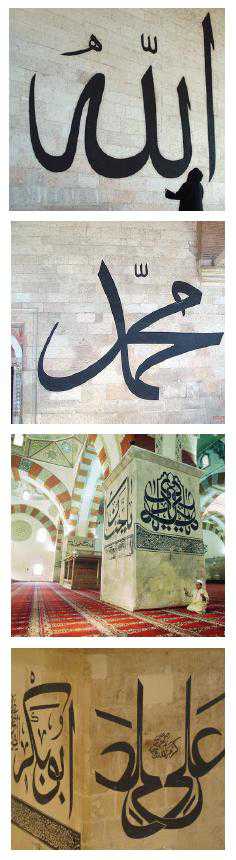
    However, not always. Walking towards the Old Mosque (Eski Camii) in Edirne, Turkey, you’ll find something quite striking from a distance—numerous calligraphy pieces painted directly on the wall, larger than life. They are simple. They are majestic. They are stunning to behold. This mosque, one of the oldest of Ottoman history, captures the spirit of the early Sufi-sultans who established this legendary empire.

    It is in this spirit, we set out on a quest to capture the beauty of Islamic calligraphy combined with reviving the tradition of large majestic calligraphy directly on the wall and bring it into your home, as a reminder that helps us proceed forward, as a meaning of our ultimate purpose, as an expression of hearts longing for the Divine. Or in other words, increasing one’s Irada.

    The word Irada means to strive for something one wants or desires. Or, in a spiritual context, meaning striving for the Divine. With Irada Arts on your wall, this is what we aim to increase. With constant gentle reminders that are beautiful to look at and have a large majestic presence that cannot be overlooked, Irada Arts directs you to strive for what you want. Your walls talk, conveying to you messages that speak to your heart.

    The end result was Irada: Islamic Wall Arts.

    Irada: Islamic Wall Arts are quotes from Quran, Hadith, Islamic Poetry, Wise Sayings of the Pious, and so on, designed in English or Arabic, or both, of various sizes that can be applied onto the wall, seeming to the viewer as if calligraphy is painted directly on the wall.

    We think “outside the frame.” By removing the “frame” of traditional calligraphy and increasing the size of the calligraphy piece, the walls act as the frame. The effect is a beautiful piece of calligraphy whose majesty and presence is felt. The walls speak to you, addressing those who will listen, reminding those who forget, and helping us all proceed. With Irada, transform your home, office, or school into a profound place of inner worship.

    via The Irada Story.

  • Turkey’s objections to film remain peaceful

    Turkey’s objections to film remain peaceful

    Appalled by the deadly protests in Egypt, Libya and other Muslim countries against an anti-Islamic video deemed offensive to the Prophet Mohammed, political and religious leaders in Turkey have been effective in calling on their own followers to exercise restraint.

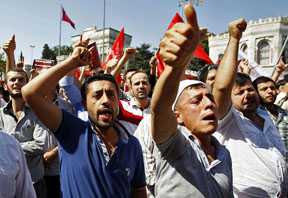
    Protests against the film "Innocence of Muslims," deemed offensive to the Prophet Mohammed, have remained peaceful in Turkey. [Reuters]
    Protests against the film “Innocence of Muslims,” deemed offensive to the Prophet Mohammed, have remained peaceful in Turkey. [Reuters]
    “The film that insults Islam and the prophet is evil and provocative, but anyone who turns to violence is himself attempting to provoke Muslims,” Prime Minister Recep Tayyip Erdogan said. “We shall not fall in the trap of provocation. Those who resort to violence in return will themselves be considered provocateurs against Muslims; and we reject that.”

    An armed mob set fire to the US consulate in Benghazi on September 11th, killing Ambassador J. Christopher Stevens and three other officials. Although protests broke out in at least 20 countries, in only a few, including Indonesia, Afghanistan, Tunisia, Egypt, Yemen and Morocco, did they turn violent.

    More than 30 people have been killed worldwide, including 12 people who died in an attack by a female suicide bomber in Kabul on Tuesday (September 18th).

    The US government had no connection with the film, “Innocence of Muslims,” which was produced privately by a real estate developer.

    In Ankara, protestors gathered twice outside the US Embassy, chanting slogans and burning a US flag, but the protests have been peaceful and security forces were not forced to engage the crowd.

    For politicians in Ankara, such as Emrullah Isler, chairman of Turkish Group at the Organisation of the Islamic Conference’s Parliamentary Union, violent demonstrations under the name of Islam “serves well” to the radical groups in the Islamic world.

    “We should understand that the radical groups are looking for an excuse to demostrate their existence and spread their propoganda,” Isler told SETimes. “Insulting the prophet can never be justified, but even so, this cannot be a reason for terror.”

    Some religious leaders have also condemned of murderous fanaticism in the name of Islam.

    Speaking to SETimes, Mustafa Said Yazıcıoglu, a professor of religious studies and former head of the Presidency of Religious Affairs, said Muslims around the world should find a “civil way” to demonstrate their disagreement or fury on any provocations against their feelings.

    “If these [protests] are all connected to the film that insults Islam and the prophet, they shouldn’t be demonstrated on the streets, but in civil discussions, such as raising the topic in international organizations,” said Yazıcıoglu, who was responsible for religious affairs in Erdogan’s cabinet until last summer.

    Turkey, he said, does everything possibile to be restrained against the film. “We see that people in the Arab counries are pouring to the streets under the name of peace, but causing more deaths. What is the logic behind it?” he said.

    Gareth Jenkins, an Istanbul-based senior fellow at the Institute for Security and Development Policy’s Turkey Initiative, said that protests about perceived insults against Islam have always been more restrained in Turkey compared with many other countries.

    “It was the same when there were protests about the anti-Islamic cartoons,” he said. “I don’t think this means that radical Islamists in Turkey are necessarily less angry but they do seem to be able to exercise greater self-control and more able to distinguish between something happening in a country and the government of that country being responsible for it.”

    Protests in the past have somtimes turned violent. In 1993, 37 people were killed in Sivas when a mob of 10,000 people tried to lynch Aziz Nesin for translating the Satanic Verses, Salman Rushdie’s story about the Prophet Mohammed that earned its author a death sentence.

    “Turkey still has a major problem with religious intolerance,” Jenkins said. “But traditionally the worst violence, such as at Sivas, has been directed against other Turkish nationals, not foreigners.”

    Yet, for most Turks there was very little time between them becoming aware of the latest film’s existence and reading about US condemnation of it.

    “Prime Minister Tayyip Erdogan was also very quick to condemn both the film and the violence. So that probably helped as well,” he said.

    This content was commissioned for SETimes.com.