Leader of world’s most populous Muslim-majority country urges Islamic leaders to unite in tackling extremism
According to The Telegraph, the president of the world’s most populous Muslim-majority country, Indonesia, has called the actions of Islamic State militants “embarrassing” to the religion and urged Islamic leaders to unite in tackling extremism.
Susilo Bambang Yudhoyono said the scale of the slaughter wrought by the extremists in overrunning large swathes of Iraq and Syria and the level of violence being used was appalling.
“It is shocking. It is becoming out of control,” he said in an interview with The Australian, a day after IS released a video showing a masked militant beheading US reporter James Foley, provoking worldwide revulsion.
“We do not tolerate it, we forbid ISIS in Indonesia,” he added, referring to the Islamic State of Iraq and the Levant, as IS was formerly known.
“Indonesia is not an Islamic state. We respect all religions.”
He urged international leaders to work together to combat radicalisation.
“This is a new wake-up call to international leaders all over the world, including Islamic leaders,” he said, adding that the actions of IS were not only “embarrassing” to Islam but “humiliating”, the newspaper reported.
“All leaders must review how to combat extremism. Changing paradigms on both sides are needed – how the West perceives Islam and how Islam perceives the West.”
Indonesia is home to the world’s biggest Muslim population of about 225 million and has long struggled with terrorism. But a successful clampdown in recent years has seen the end of major deadly attacks.
Jakarta has estimated that dozens of Indonesians have travelled to Syria and Iraq to fight and Yudhoyono said he was concerned about their return, adding that he had tasked agencies to oppose the spread of extremist ideology in the sprawling nation.
“Our citizens here in Indonesia are picking up recruitment messages from ISIS containing extremist ideas,” said the president, whose decade in office comes to an end in October.
“The philosophy of ISIS stands against the fundamental values we embrace in Indonesia. Last Friday, in my state of the union address to the nation, I called on all Indonesians to reject ISIS and to stop the spread of its radical ideology.
“My government and security agencies have taken decisive steps to curtail the spread of ISIS in Indonesia, including by prohibiting Indonesians to join ISIS or to fight for ISIS, and also by blocking Internet sites that promote this idea.”
Riders attempt to stay atop half-wild Mongol horses for over 600 miles (1,000 kilometers)
Competitors gallop toward the finish of 2010’s Mongol Derby. Fewer than half of the riders in this year’s race are expected to make it across the finish line.
PHOTOGRAPH BY CHARLES VAN WYK, THE ADVENTURISTS
Ashleigh N. DeLuca
National Geographic
PUBLISHED AUGUST 6, 2014
Before most of the world woke up this morning, 47 riders from around the globe had saddled half-wild horses and set out on what the Guinness Book of World Records has called the longest equestrian race on Earth.
The goal—beyond not getting seriously injured—is to ride a 621-mile circuit (1,000 kilometers) of Mongolian steppe in less than ten days.
Fewer than half of the riders are expected to make it across the finish line. The rest will either quit or be carried off the course by the medical team. Broken bones and torn ligaments are common, frustration and bruised egos the norm. Every rider will fall off multiple times during the course of the race, says Katy Willings, the race chief and a former Mongol Derby competitor.
The race route is modeled on the horse relay postal system created under Genghis Khan in 1224, which was instrumental in the expansion of the Mongolian Empire. Guided by a local escort, specially appointed postal riders would gallop more than 100 miles (160 kilometers) to a morin urtuu, or horse relay station, where another escort would be waiting with a fresh horse.
At the postal route’s zenith, a letter could cross from Kharkhorin in the east to the Caspian Sea on the far western edge of the empire, a distance of some 4,225 miles (6,800 kilometers), in two weeks (an average of about 300 miles, or 480 kilometers, a day). Postal riders continued to deliver the mail until 1949, when the Soviet Union—which then controlled Mongolia—shut down the system in an attempt to erase the history of Genghis Khan from the country.
“The horse stations were not permanent but rather a responsibility that rotated so that each family provided the compulsory service for a month each year or two,” explains Dandar Gongor, 86, a former escort. From the age of 12 to 15, he carried the riders’ mailbags while navigating them to the next horse station.
“You would meet all sorts of people,” he says, referring to the postal riders. “Some were kind and would tell you folk stories while you rode. Others were arrogant and mean. We would let the next urtuu supervisor know what kind of people they were, and this would help him decide if [the postal rider] would be given a well-behaved or difficult horse.”
via World’s Toughest Horse Race Retraces Genghis Khan’s Postal Route.
Berlin (Germany)RussiaGermanyBarack ObamaAngela MerkelGeorge W. BushVladimir Putin
Only 27% of Germans regard the U.S. as trustworthy; a majority view it as an aggressive power
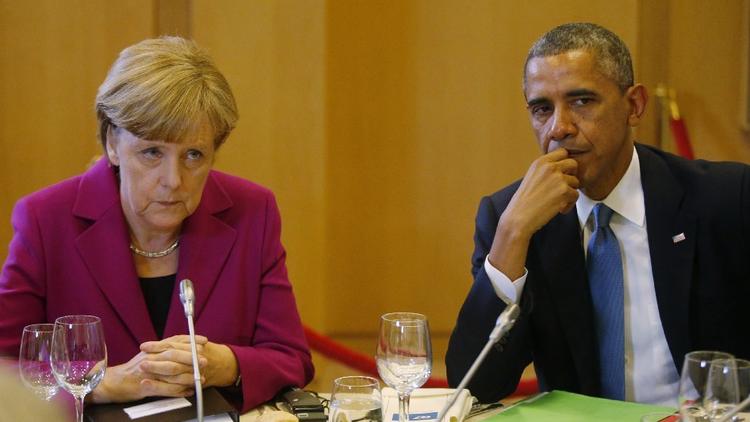
When candidate Barack Obama spoke in July 2008 in Berlin near the Brandenburg Gate, he told a rapturous German audience that peace and progress “require allies who will listen to each other, learn from each other and, most of all, trust each other.” It was supposed to be the opposite of George W. Bush’s cowboy diplomacy, which alienated the Federal Republic of Germany and much of Europe. Yet six years later, relations between Washington and Berlin are more mistrustful than ever.
The main problem is that President Obama has been listening all too well to Germans — spying on them from more than 150 National Security Agency sites in Germany, according to secret NSA documents that former contractor Edward Snowden leaked to the weekly Der Spiegel.
Germans, who acutely remember the totalitarian surveillance of Nazi Germany and East Germany, cherish their strict data protection and limits on state monitoring. The pervasive spying on one of America’s most valuable partners — including the snooping on German Chancellor Angela Merkel’s cellphone from a rooftop listening post at the U.S. Embassy in Berlin — has enraged the German public.
Now, with the fresh revelation that the CIA recruited an intelligence official as a spy, and the possibility of a second spy in the Defense Ministry, the fury is reaching a tipping point. U.S. Ambassador John B. Emerson was called on the carpet by the German Foreign Office on July 4 about the first incident. On Thursday, Germany ordered the CIA station chief in Berlin to leave.
And the brouhaha isn’t going away. German President Joachim Gauck, widely revered for his years as a Protestant pastor and human rights activist in the former East Germany, said that if the spying allegations were true, “enough is enough.” Karl-Georg Wellmann, a prominent member of Merkel’s Christian Democratic party, is calling for the expulsion of any and all U.S. agents.
What’s more, leading German politicians are calling for reassessing negotiations with Washington over a transatlantic free-trade agreement that could be vital to the economic futures of both Europe and the United States. And Interior Minister Thomas de Maiziere announced that Berlin would terminate a no-spy agreement it has enjoyed with the U.S. and Britain since 1945 and begin monitoring them in Germany. As Stephan Mayer, a spokesman for Merkel’s party, put it, “We must focus more strongly on our so-called allies.”
So-called? Such statements, unthinkable only a few years ago, accurately reflect a broader antipathy toward America among the German public, which largely sees Snowden as a hero, particularly for his revelations about the extent of American surveillance in Germany.
Ever since the Bush administration launched the Iraq war in 2003 — which then-Chancellor Gerhard Schroeder vehemently opposed — many Germans have come to view America as a militaristic rogue state, more dangerous even than Russia or Iran. Indeed, a recent
Infratest Dimap poll indicates that a mere 27% of Germans regard the U.S. as trustworthy, and a majority view it as an aggressive power.
The result is that Germany is undergoing a fundamental transformation. After the Nazi defeat in 1945, the republic’s first chancellor, Konrad Adenauer, emphasized that Germany had to end its tradition of trying to maneuver between East and West as an independent power. Instead, it had to bind itself to the West, economically and militarily. Only Washington could guarantee a free and democratic West Germany. But it is precisely this tradition that is coming to an end as Germany begins to act on what it perceives as its new national interests.
Already Germany is much more sympathetic to Russia than the United States. Schroeder, the former chancellor, serves on the board of Gazprom and is a buddy of Russian President Vladimir Putin. Another former chancellor, Helmut Schmidt, said that it was “entirely understandable” that Putin would annex Crimea. What’s more, German business interests dictate that Berlin seek to maintain a friendly stance toward Moscow.
Similarly, Germans are allergic to any military confrontation with China, which has emerged as one of their most important trading partners.
It shouldn’t be entirely surprising that decades after the fall of the Berlin Wall, a reunified Germany is moving from docile Cold War ally to a sovereign power that feels less inhibited by its Nazi past and less indebted to the United States.
But there’s no reason for the U.S. to antagonize a longtime ally, either. The two sides need to forge new ties based on mutual respect. They continue to have many common interests in trade, in deterring Russian aggression and in combating terrorism in the Middle East.
In trampling on German civil liberties, the Obama administration is besmirching America’s image and allowing Germans to feel morally superior to their former conqueror.
If Obama is unable to rein in spying on Germany, he may discover that he is helping to convert it from an ally into an adversary. For Obama to say auf Wiedersehen to a longtime ally would deliver a blow to American national security that no amount of secret information could possibly justify.
Jacob Heilbrunn is the editor of the National Interest.
Follow the Opinion section on Twitter@latimesopinion
Turkey’s Prime Minister Tayyip Erdogan is running for president as rules change to give the position more power. (Adem Altan/AFP Photo)
ISTANBUL/ANKARA – A quick glance at the emerging candidates for Turkey’s first direct presidential poll illustrates the dramatic change wrought in the country by Tayyip Erdogan’s 11 years as prime minister; an old secularist elite has yielded the stage to two men of Islamist pedigree and a third from a long-suppressed Kurdish minority.
“It is certainly novel, a new republic,” says Soli Ozel, a professor in political science at Istanbul’s Kadir Has University. “We really are in uncharted waters.”
Erdogan, his popularity unscathed by a flare-up of anti-government riots and a corruption scandal, announced his presidential bid Tuesday for August elections that could further strengthen his hold on power.
Many see his victory as inevitable. Since his AK party came to power in 2002, he has built huge support among conservative Muslims, many of them poor, who had felt treated as second-class citizens in a secular society — pious women, for instance, excluded from state buildings because they wore headscarves.
Erdogan, 60, himself served a brief prison sentence in 1999 on charges of Islamist activity. Taking the reins of power only four years later, he tamed the army that had seen itself as final guarantor against Islamism and had toppled four governments in four decades.
Rather than taboo, religion is now a front-and-centre political issue. The notion of a secularist president has become politically toxic for many of Turkey’s 77 million citizens.
So much so that Turkey’s foremost secularist party, the CHP, the party of secular state founder Mustafa Kemal Ataturk, and the nationalist MHP have chosen a joint nominee in Ekmeleddin Ihsanoglu, a diplomat and academic who was at the helm of the Organization of Islamic Co-operation for nine years until 2014.
The choice of Cairo-born Ihsanoglu — who has dedicated a large part of his life to promoting Islam — has drawn fierce criticism from some diehard secularists within CHP, with several refusing to sign his formal nomination.
In his first remarks on being proposed, Ihsanoglu — whose wife, unlike Erdogan’s, does not wear the headscarf — was quick to emphasize the importance of separating state and religion. The Islamic world, he said, had become “muddled” on the issue.
He also praised Ataturk, in marked contrast to the prime minister, who offended many Kemalist Turks when he appeared to refer to the founder as a drunkard during a speech in May 2013.
After nearly a decade heading the world’s second-largest international organization representing 1.5 billion people across the Muslim world, 70-year-old Ihsanoglu’s diplomatic and religious credentials are hardly in question. But Aykan Erdemir, a deputy for CHP, insists he is not a pale imitation of the firebrand Erdogan, but rather a credible alternative for millions of pious Turks.
“To me, he is the exact opposite of Erdogan, pluralist versus majoritarian, a conciliator versus a loud and populist zealot. We have a genuine choice between a liberal or an authoritarian president,” he told Reuters.
Analysts say Ihsanoglu represents a return to the politically secular and liberal values, underpinned by religion, that AKP espoused when it first came to power. He might thus be able to poach disgruntled Erdogan supporters weary of an increasingly autocratic style and inflammatory language.
At the height of a corruption scandal earlier this year that touched upon members of his cabinet, Erdogan branded political opponents terrorists and traitors. A police investigation ground to a virtual halt when he purged police and judiciary.
Murat Yetkin, of the liberal Radikal newspaper, says the decision by CHP and MHP to field Ihsanoglu as a joint candidate means they will be entering Erdogan’s “backyard.” Ihsanoglu’s unimpeachable reputation might make it more difficult for Erdogan and his supporters to launch political attacks.
“A potential defamation campaign against Ihsanoglu, who is known for his gentlemanly character, may not find supporters — even in AK party’s base,” Yetkin said. But even if Ihsanoglu’s Islamic credentials afford him some protection, Erdogan aides could turn their fire on what they see as Ihsanoglu’s failure to follow Ankara’s condemnation of the army toppling of Egypt’s Islamist president Mohamed Mursi.
Ihsanoglu’s experience in international affairs and the Arab world will also be of little help with the Turkish public, many of whom were unaware of his existence until last week.
Nor will it protect him from a rapacious pro-government press, with one columnist already labelling him a tool of foreign interests, a “Coca-Cola candidate”. Erdogan himself has accused political opponents of being in cahoots with foreign powers to undermine Turkey.
At stake for Erdogan is a refashioned presidency, stripped of its largely ceremonial character and imbued by practice and future legislation with strong executive powers. He has already established his primacy over the armed forces, judiciary and police, all of course underpinned by personal popularity.
Polls indicate Erdogan’s rivals will have a mountain to climb even to force him to a second round, with polls giving him about 55% of the vote and a 20-point lead.
But if Erdogan does dip below the required 50% needed to avoid a run-off, Turkey’s Kurdish minority, an estimated 15-20% of the population, could decide his fate.
Efforts to end decades of conflict between the government and Kurdish militants have played a key role in Erdogan’s premiership, leading to a ceasefire last year, and a slackening of Draconian laws on Kurdish language and culture.
Before Erdogan, even writing a newspaper article espousing cultural or political concessions to Kurds could earn a jail sentence. Any public, or private, expression of sympathy the Kurdistan Workers Party (PKK) was similarly perilous.
Erdogan took a considerable political risk, not least with the military, in opening talks with the PKK.
Analysts say roughly half of all Kurds already vote for AKP and many more will likely follow suit in the belief Erdogan offers the best hope of a lasting peace settlement. His government sent to parliament last week a bill setting out a legal framework for peace talks, a boost to the process.
Speculation that the pro-Kurdish People’s Democratic Party (HDP) might tacitly throw its weight behind Erdogan in the first round by naming either a weak candidate or no candidate at all has not materialized however, with HDP leader Selahattin Demirtas, 41, putting his hat in the ring as party candidate.
“He’s a serious candidate, and if his supporters vote for him, that’s a 6% or 7% chunk of the vote whose destination is already known. They want space for negotiating with Erdogan between the first and second rounds,” according to Kadir Has’s Ozel.
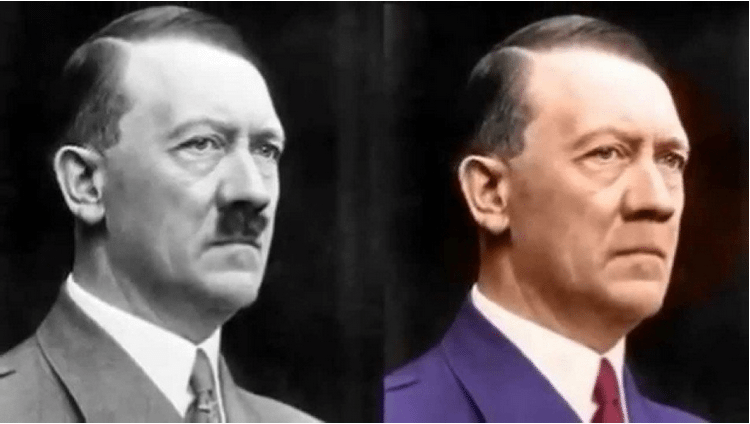
Newly declassified FBI documents prove that the government knew Hitler was alive and well, and living in the Andes Mountains long after World War II. Click here, on the FBI website to confirm the quiet release of this information.
On April 30 1945, Adolf Hitler committed suicide in his underground bunker. His body was later discovered and identified by the Soviets before being rushed back to Russia. Is it really possible that the Soviets have been lying all this time, and that history has purposely been rewritten? No one thought so until the release of the FBI documents. It seems that it is possible that the most hated man in history escaped war-torn Germany and lived a bucolic and peaceful life in the beautiful foothills of the Andes Mountains.
THE INTELLIGENCE COMMUNITY KNEW.
Recently, released FBI documents are beginning to show that not only were Hitler and Eva Braun’s suicide faked, the infamous pair might have had help from the Director of the US’ OSS office in Switzerland – and the man who would later become the first Director of Central Intelligence, Allen Dulles. In one FBI document from Los Angeles, it is revealed that the agency was well aware of a mysterious submarine making its way up the Argentinian coast dropping off high level Nazi officials. What is even more astonishing is the fact that the FBI knew he was in fact living in the foothills of the Andes.
WHO IS THE MYSTERIOUS INFORMANT?
In a Los Angeles letter to the Bureau in August of 1945, an unidentified informant agreed to exchange information for political asylum. What he told agents was stunning. The informant not only knew Hitler was in Argentina, he was one of the confirmed four men who had met the German submarine. Apparently, two submarines had landed on the Argentinian coast, and Hitler with Eva Braun was on board the second. The Argentinian government not only welcomed the former German dictator, but also aided in his hiding. The informant went on to not only give detailed directions to the villages that Hitler and his party had passed through, but also credible physical details concerning Hitler. While, for obvious reasons the informant is never named in the FBI papers, he was credible enough to be believed by some agents.
The FBI Tried to Hide Hitler’s Whereabouts:
Even with a detailed physical description and directions the FBI still did not follow up on these new leads. Even with evidence placing the German sub U-530 on the Argentinian coast shortly before finally surrounding, and plenty of eye witness accounts of German official being dropped off, no one investigated.
EVEN MORE EVIDENCE IS FOUND
Along with the FBI documents detailing an eye- witness account of Hitler’s whereabouts in Argentina, more evidence is coming to light to help prove that Adolf Hitler and Eva Braun did not die in that bunker. In 1945, the Naval Attaché in Buenos Aires informed Washington there was a high probability that Hitler and Eva Braun had just arrived in Argentina. This coincides with the sightings of the submarine U-530. Added proof comes in the form of newspaper articles detailing the construction of a Bavarian styled mansion in the foothills of the Andes Mountains. Further proof comes in the form of architect Alejandro Bustillo who wrote about his design and construction of Hitler’s new home which was financed by earlier wealthy German immigrants.
IRREFUTABLE EVIDENCE THAT HITLER ESCAPED:
Perhaps the most damming evidence that Hitler did survive the fall of Germany lies in Russia. With the Soviet occupation of Germany, Hitler’s supposed remains were quickly hidden and sent off to Russia, never to be seen again. That is until 2009, when an archeologist from Connecticut, Nicholas Bellatoni was allowed to perform DNA testing on one of the skull fragments recovered. What he discovered set off a reaction through the intelligence and scholarly communities. Not only did the DNA not match any recorded samples thought to be Hitler’s, they did not match Eva Braun’s familiar DNA either. So the question is, what did the Soviets discover in the bunker, and where is Hitler? Even former general and President Dwight D. Eisenhower wrote to Washington. It was not only General Eisenhower who was concerned over Hitler’s compete disappearance, Stalin also expressed his concerns. In 1945, the Stars and Stripes newspaper quoted then General Eisenhower as believing that the real possibility existed of Hitler living safely and comfortably in Argentina.
IS IT POSSIBLE?
With all of the new-found evidence coming to light, it is possible and even likely that not only did Hitler escape from Germany; he had the help of the international intelligence community. Released FBI documents prove that they were not only aware of Hitler’s presence in Argentina; they were also helping to cover it up. It would not be the first time the OSS helped a high-ranking Nazi official to escape punishment and capture. Look at the story of Adolf Eichmann who was located in Argentina in the 1960′s. Did Hitler escape to Argentina? The answer is yes.
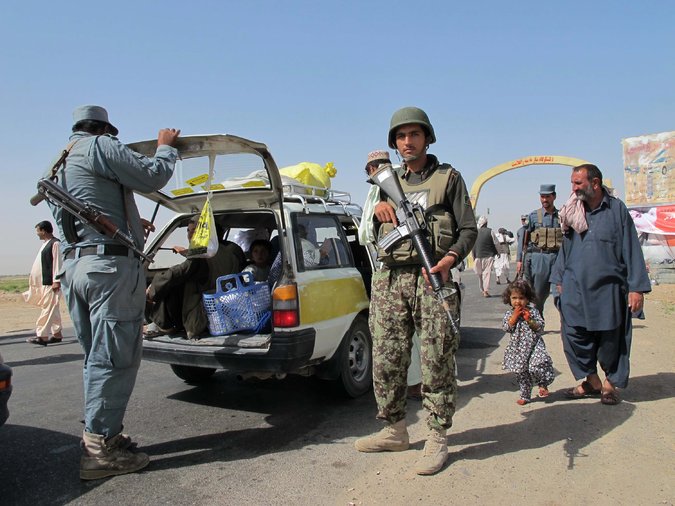
Security officials at a checkpoint in Helmand Province, which has experienced an aggressive insurgent push.Credit Watan Yar/European Pressphoto Agency
KABUL, Afghanistan — In one of the most significant coordinated assaults on the government in years, the Taliban have attacked police outposts and government facilities across several districts in northern Helmand Province, sending police and military officials scrambling to shore up defenses and heralding a troubling new chapter as coalition forces prepare to depart.
The attacks have focused on the district of Sangin, historically an insurgent stronghold and one of the deadliest districts in the country for the American and British forces who fought for years to secure it. The Taliban have mounted simultaneous attempts to conquer territory in the neighboring districts of Now Zad, Musa Qala and Kajaki. In the past week, more than 100 members of the Afghan forces and 50 civilians have been killed or wounded in fierce fighting, according to early estimates from local officials.
With a deepening political crisis in Kabul already casting the presidential election and long-term political stability into doubt, the Taliban offensive presents a new worst-case situation for Western officials: an aggressive insurgent push that is seizing territory even before American troops have completed their withdrawal from Afghanistan.
The battle in Helmand is playing out as, about 1,500 miles to the west, Iraq is losing ground to an insurgent force that advanced in the shadow of the American withdrawal there. The fear pulsing through Afghanistan is that it, too, could fall apart after the NATO-led military coalition departs in 2016.
Already, areas once heavily patrolled by American forces have grown more violent as the Afghan military and the police struggle to feed, fuel and equip themselves. The lackluster performance of the Afghan Army so far in Helmand has also evoked comparisons with Iraq, raising questions about whether the American-trained force can stand in the way of a Taliban resurgence.
Officials in Helmand say the answers may come soon enough.
“The Taliban are trying to overrun several districts of northern Helmand and find a permanent sanctuary for themselves,” said Hajji Mohammad Sharif, the district governor for Musa Qala. “From there, they pose threats to the southern parts of Helmand and also pose threats to Kandahar and Oruzgan Provinces.”
BAGHRAN
FARAH
PROVINCE
ORUZGAN
PROVINCE
AFGHANISTAN
DETAIL
PAKISTAN
INDIA
MUSA
QALA
KAJAKI
NOW ZAD
HELMAND
PROVINCE
KANDAHAR
PROVINCE
SANGIN
Sangin
Helmand
River
Kandahar
Lashkar Gah
AFGHANISTAN
25 Miles
Officials from the government and the international military coalition flew to Helmand on Friday to assess the situation. The military has sent in reinforcements, though early reports from residents indicate that those forces had made little headway in pushing the Taliban back. The police have fought ferociously to protect their areas and, in at least a few cases, succumbed only after running out of ammunition.
While the government claims that none of the checkpoints attacked by the Taliban have fallen, district elders and villagers say otherwise, characterizing the situation as approaching a humanitarian crisis. Thousands of residents are believed to have been displaced in the fighting.
“I see the people running everywhere with their women and children to take shelter,” said Hajji Amanullah Khan, a village elder. “It is like a doomsday for the people of Sangin. We do not have water, and there is a shortage of food.
“The price of everything has gone up because the highways and roads have been blocked for the last week.”
Northern Helmand is a small region with a history of troubles. Despite the recent Taliban gains, the area is far from lost.
With its austere deserts interrupted by dense lines of foliage hugging the Sangin River, the district has long been marooned in a sea of Taliban support. It is also squarely in the heart of poppy country, a vital and growing source of income for the insurgents.
Though positioned at a significant crossroads into the northern Helmand area, with access to neighboring provinces, Sangin also carries great symbolic weight. The Taliban have repeatedly used the area to make a statement about the limits of Afghan and Western government strength, and local officials fear a similar approach now.
“The Taliban are planning to create problems in several northern Helmand districts to pave the way for their fighters to operate freely in the area and pose threats to Kandahar, Helmand and Farah Provinces,” said Muhammad Naim Baloch, the provincial governor in Helmand.
Only now, the task to secure the district has fallen exclusively to the Afghans, and it is providing an early test of the forces the international coalition has spent years training to take over the fight.
Last summer in Sangin, Afghan forces got their first taste of what that fight would look like. Struggling to keep the Taliban at bay, they lost checkpoints, hard-fought ground and more than 120 men.
The government shuffled commanders, but it hardly mattered. By the end of the fighting season, the cowed Afghan Army unit there was mostly unwilling to leave its base to confront the threat. Late last year, reports of a deal between a local army commander and the Taliban began to surface, driven in part by attrition rates of nearly 50 percent and the near constant threat of death.
Given the debacle last summer, the military’s lack of preparedness so far this year is all the more striking. Police officers ran out of ammunition, and in some cases bodies could not be recovered because of the fighting. Even though Helmand is the only province with an entire corps dedicated to it, the army has struggled to defend it.
The fighting this summer appears to be worse. In just one week, the security forces appear to have sustained almost half the casualties they suffered in all of last summer, though reports differ on the exact toll.
Last Saturday, as many as 600 Taliban insurgents stormed checkpoints through portions of Sangin, claiming wide tracts of land. On Sunday, the militants attacked the neighboring district of Now Zad. Violence erupted in Musa Qala on Monday, when the Taliban again stormed police checkpoints but were prevented from reaching the district center.
The assault on Sangin seems the most concerted. On Friday night, according to the district governor, the Taliban advanced on the district center itself. The army repelled the attack through the district bazaar, while the police stopped an attempted breach from the north.
“Only the district center is under the control of government,” said Hajji Amir Jan, the deputy chief of the Sangin district council.
Though exact data is nearly impossible to obtain, in part because there is no longer a coalition footprint in the area, the extent of the attack offers a new perspective through which to view the Taliban’s ambitions, especially now that the militants no longer fear the dreaded American air support that has for years prevented them from massing in large groups.
Although the military denied any collusion between the army and the Taliban, those questions have started to re-emerge because most of the casualties have been suffered by the local and national police forces rather than by the army.
“The Taliban are not powerful enough to resist all of the Afghan forces,” Mr. Amir Jan said. “Sangin is not an easy district to control, and the Taliban have strong sanctuaries, but the Afghan National Army is just securing highways, and they are not really after the Taliban.”
Coalition officials were reluctant to comment on the battles in Helmand because the fight now belongs to the Afghans. The United Nations, however, urged caution and respect for the lives of civilians.
“The high number of civilians killed and injured in these ongoing military operations is deeply concerning,” said the secretary general’s special representative for Afghanistan, Jan Kubis.
Residents described a hellish scene for those trapped in the area. Some have started to question whether the fight, and its toll on the people, is even worth it.
“If the government is unable to control and secure the lives of the ordinary people, I suggest they leave it to the Taliban,” said Matiullah Khan, a village elder in Sangin. “We are tired of the situation and would rather die than continue living in these severe conditions. It has been like this forever.”