Category: Sci/Tech

  • Senate does not approve free frigates for Turkey

    Senate does not approve free frigates for Turkey

    Despite the best efforts of Ankara’s allies in Washington during the final hours of the Congressional session, the U.S. Senate refused to act Wednesday on a free give-away of advanced American naval vessels to Turkey. Earlier this week, the House had approved the controversial measure, following a contentious debate, reported the Armenian National Committee of America.

    “We join with our Greek American friends in thanking Congressmen Engel, Sherman, Bilirakis, and Sarbanes for opposing this controversial measure giving away two guided missile frigates to an increasingly arrogant and antagonistic Turkey, and welcome the Senate’s decision to block efforts to ‘fast-track’ passage of this controversial measure in the final hours of the 112th Congress,” said Aram Hamparian, Executive Director of the ANCA. “This most recent setback for Turkey reflects the growing bipartisan understanding on both sides of Capitol Hill about the real price America is paying for Turkey’s growing hostility to U.S. interests and allies. Ankara’s failure is yet another signal that the era of Turkey’s having a blank-check in Washington is over.”

    In a letter circulated earlier this week on Capitol Hill, the ANCA stressed that: “Such a transfer would materially strengthen Ankara’s naval capabilities at a time when it is using its maritime fleet to aggressively challenge the right of Cyprus to explore its off-shore energy resources, and is seeking to obstruct the ability of Greece to protect its territorial waters.” The ANCA also emphasized that: “Transferring these vessels would also send a dangerous signal to Turkey’s leaders that our government endorses its military occupation of Cyprus, its increasingly belligerent stance toward Israel, its blockade of Armenia, its meddling in the Nagorno Karabakh conflict resolution process, or, for that matter, its violations against the rights of Christians, Kurds, and other minorities.” The letter closed by noting that: “Such material rewards and moral endorsements are neither warranted, nor constructive. In fact, they will work against our nation’s regional security interests.” The American Hellenic Institute, Hellenic American Leadership Council, and other Greek American groups also weighed in against the transfer.

    The U.S. House, on December 31st, considered this transfer as part of H.R.6649, a measure added to the “Suspension Calendar” under expedited procedures requiring a two thirds vote. The House adopted H.R.6649 after considerable debate, including a defense of the legislation by Rep. Ros-Lehtinen and statements in opposition from Representatives Eliot Engel (D-NY), the incoming Ranking Democrat on the Foreign Affairs Committee, and Brad Sherman (D-CA), Gus Bilirakis (R-FL), and John Sarbanes (D-MD). The absence of Senate action at the end of the 112th Congress will mean that any legislation authorizing such a transfer will need to be re-introduced for consideration by the 113th Congress.

    Congressman Brad Sherman, a senior member of the Foreign Affairs Committee, opposed H.R.6649 both on its merits and on the process being used to secure its consideration in the final hours of the Congressional session, noting: “Woodrow Wilson noted that Congress in committee is Congress at work. Congress ignoring the committee process is a Congress that doesn’t work. This bill has not been the subject of hearing and, more importantly, a markup in the Foreign Affairs Committee. And in the dead of night, provisions to transfer two frigates to Turkey, a controversial provision, was added to this otherwise innocuous bill… Send this bill back to committee. Let us have a real discussion. Let us follow the rules, not suspend the rules, when we’re dealing with a matter of this importance to our foreign policy in the eastern Mediterranean.”

    Congressman Engel, in his remarks, stressed: “Some people say this should continue because, after all, Turkey is an ally and we need to help them. Well, I look at it the other way. They’re a NATO ally, so they have responsibility. And the way they’re acting has been anything but responsible. This is not an inconsequential or trivial matter.”

    Representative Sarbanes, in his comments, remarked that: “This is not a non-controversial bill. I know it’s being brought here on suspension as though it is, and I’m sure in the past when we’ve had these transfers of vessels, excess defense materials and so forth, often that is a non-controversial action to take. In this case, it’s anything but non-controversial, and I’m surprised, frankly, that the majority would bring the bill to the floor in this form.”

    In his remarks, Rep. Bilirakis explained his opposition to H.R.6649, noting that: “the Turkish navy, as recently as last year, held naval live-fire exercises in the eastern Mediterranean. These provocative exercises took place near the natural gas fields of Israel and the Republic of Cyprus and threatened to disrupt peaceful and productive economic activity. Instead, Mr. Speaker, it is my hope that, in the eastern Mediterranean, Congress will continue to work to foster the relationships between the United States, Greece, Israel, and Cyprus in order to promote and foster issues of mutual, economic, and diplomatic importance.”

    Congressional scrutiny of the proposed transfer of advanced naval vessels, which are described by the U.S. Navy as having been designed, among other missions, to support and protect amphibious landing forces, was heightened by Turkey’s record of aggression in neighboring littoral areas, most notably its 1974 invasion and ongoing military occupation of Cyprus, as well as its false claims to sovereign Greek islands in the Aegean Sea, and its regular incursions into both Greek and Cypriot territorial waters.

  • Boom on the Bosporus

    Boom on the Bosporus

    Lots of young people, eager to shop and play online: no wonder Turkey’s internet industry is crowded

    20121222_WBP002_0

    MUSLIM farmers do not keep pigs. This is as true of those who play at virtual agriculture as of those who fill physical food-troughs. So there are no pigs in the Arabic version of “Happy Farm”, published by Peak Games, a young firm based in Istanbul. For the same reason “Happy Farm” has no vineyards, and female farmhands wear the hijab. Local tastes matter.

    Peak Games has found rich soil. It already employs 200 people and has developers in Jordan and Saudi Arabia as well as Istanbul and Ankara. More than 35m people play its games at least once a month, many of them on Facebook. Half of the players are in Turkey; the rest are in the Middle East and north Africa. Rina Onur, one of its founders, says that she and her colleagues saw a gap in the online-games market that companies catering to Western tastes could not fill. So Peak Games offers people in Turkey and nearby countries games with a regional twist, like “Happy Farm”, as well as online versions of traditional amusements. Okey, a Turkish game played with tiles, is most popular.


    Turkey is bursting with internet companies, many of them selling things to the young. It is not hard to see why. The country is big, youthful and embracing the internet eagerly. Half of its 75m people are under 30. Around 44% of Turks use the internet, up from just 14% in 2006 and 3% in 2000. They comprise Facebook’s seventh-largest national audience. Turks are also happy to use credit cards, which are handy for buying things online: the country has three of them for every five people, says GP Bullhound, an investment bank, more than the European average. And the market still has a lot of room to grow. Penetration rates are well below those in western Europe (see chart).

    Several companies have attracted foreign money. Peak Games has raised $20m. In September General Atlantic, an American investment firm, and others put $44m into Yemeksepeti, through which Turks order meals for delivery from local restaurants. In 2011 Naspers, a South African media company, paid $86m for 68% of Markafoni, an online fashion club; eBay raised its stake in GittiGidiyor, an auction site, to 93%, and Kleiner Perkins Caufield & Byers and Tiger Global Management, both based in America, invested $26m in Trendyol, another fashion site.

    Typically, Turkish internet companies have borrowed business models from abroad and given them Turkish tweaks. Mustafa Say, whose iLab Ventures owns the other 7% of GittiGidiyor, says that buyers pay into an escrow account, from which money is sent to sellers only when goods turn up. That, he says, has helped to build trust. Yemeksepeti’s customers pay nothing extra for delivery and can pay in cash on the doorstep. This still accounts for 37% of sales, says Nevzat Aydin, a founder and its chief executive. Not only money and ideas have come from abroad. So have people: returning Turks, most of them equipped (like Mr Say and Mr Aydin) with American education and experience.

    The size of the Turkish market is a “double-edged sword”, says Numan Numan, a former Goldman Sachs banker now at 212, a venture-capital firm which takes its name from the telephone code for the European side of Istanbul. Scale at home is a boon, but start-ups in smaller countries, such as Israel or Estonia, have more incentive to look beyond their borders from the outset. Of the six Turkish firms in which 212 has invested, Mr Numan expects “a minimum of four to go regional at least”.

    Turkish internet firms think they have a good base from which to expand, especially into the Middle East and north Africa. Peak Games is perhaps the best example, but others also have ambitions. Because Turkish television and culture are popular in the region, endorsements by Turkish celebrities can help to sell clothes and shoes. General Atlantic’s money will partly finance Yemeksepeti’s move abroad.

    Lots of others are hoping to follow the successes. In November, in a hall at Bilgi University in Istanbul, 20 young Turkish companies coached by Bootcamp Ventures, the event’s organiser, presented their plans to prospective investors.

    Events like this, Bootcamp’s fifth in Turkey, have become common. “When we started here six years ago,” says Didem Altop of Endeavor, a non-profit organisation which seeks to encourage entrepreneurs in countries from Brazil to Jordan, “there used to be three events a year. Now there are three a day.”

    Turkey has so far been short of “angel” investors who will sprinkle money on a seedling company without demanding most of its equity. That is changing, as the first generation of founders become investors and mentors for the next. In Galata Business Angels, Istanbul has a network of such people including Mr Numan and Sina Afra, co-founder of Markafoni. Incubators are being set up: at Enkuba, in Istanbul, Piraye Antika, a former local head of HSBC, a big bank, and her colleagues have taken on Bu Kac Para Eder, which values antiques online, and torpilli, which helps students preparing for university-entrance exams.

    The government’s policies have been a bit disjointed, says Ms Altop, but are becoming more concerted. Young companies can already get grants for research and marketing; those in “technoparks” are excused some taxes. More encouraging is the prospect of tax breaks to accredited angels, which are due to come into effect soon. Most start-ups will fail, as they do everywhere: fashion and daily deals, in particular, look horribly crowded. But more of them may get the chance to emulate those already on the road to success.

  • Turkey prepares to manufacture new type of UAV

    Turkey prepares to manufacture new type of UAV

    The Turkish Scientific and Research Centre for Aerospace Technologies (UZAYTEM) jointly with Tusaş Motor Sanayi are preparing to manufacture a new type of unmanned aerial vehicle (UAV), the Anadolu Agency reported on Tuesday.

    The new UAV will differ from earlier manufactured UAVs in regards to functionality.

    The new UAV will have a length of six meters and a total weight of 150 kilograms. The first test of the new model of the UAV will be held in August of 2013. If the new UAV is successful, the Tusaş Company will begin mass production by 2014.

    This will be the third Turkish UAV.

    Turkey has been working to create its first reconnaissance UAV since 2004. About 180 engineers have been involved in the project which refers to medium class vehicles with a long flight span.

    ANKA has several advantages in comparison to the Israeli UAV Heron. The Heron can lift no more than 185 kilograms of payload to the height of 30,000 feet, while this figure exceeds 200 kilograms in the ANKA UAV.

    In recent years, the Turkish military-industrial company has focused on manufacturing domestic defence products.

    At present, Turkey conducts work to manufacture the UAV Simsek (“Lightning”).

    Its length is 2.3 meters, with a wingspan of 1.5 meters. The maximum takeoff weight is 75 kilograms, with a speed of 740 kilometers per hour.

    https://en.trend.az/news/politics/2100395.html

    via Turkey prepares to manufacture new type of UAV | sUAS News.

  • TOP PROTON THERAPY CENTER BEING OPENED IN THE HEART OF EUROPE

    TOP PROTON THERAPY CENTER BEING OPENED IN THE HEART OF EUROPE

    PRESS RELEASE

    Prague, 12 December 2012

    TOP PROTON THERAPY CENTER BEING OPENED IN THE HEART OF EUROPE

    From December 2012, oncological patients can access proton therapy in a brand new Proton Therapy Center Czech which has just opened in Prague. It is only a fifth center in Europe and currently the best equipped center in the world. The facility is going to attract child and adult cancer patients from throughout the world who are seeking advanced cancer care with few treatment-related side effects.

    Launching its first fixed-beam treatment room, the center is going to treat prostate and brain cancer this year. With launching another four treatment rooms, it will soon start treating head and neck tumors, child cancer, lung cancer, eye melanoma or pancreatic cancer; this means indications that are difficult to treat by conventional radiotherapy. The benefits for the patients are mainly lower damage of healthy tissue, less side effects and complications and better chances of cure. Ability to precisely irradiate only the tumor with the highest possible dose is what makes proton therapy a revolutionary form of cancer treatment.

    The center provides the necessary comfort for international patients, including English and Russian speaking medical personnel. There are patient managers who help facilitating medical visas, medical documentation and made to measure services for foreign patients. The center provides full entry examinations and diagnostic methods including PET/CT scanning.It also employs international specialists in medical physics and radiation oncology such as the former medical director of the Rinecker Proton Therapy Center in Munich, Germany. “The goal of the Czech center is to maximize the curability in the shortest time possible by applying maximal treatment dose, “ saysProfessor Dr. Herbst.


    ABOUT PROTON THERAPY CENTER CZECH
    Proton Therapy Center Czech is a privately owned and operated cancer center that relies on the power of proton beams to cure cancers with minimal treatment-related side effects. The center operates in cooperation with the public hospitals and clinics of the Czech Republic and other proton therapy centers abroad both already running (RPTC Pennsylvania, UFPTI Jacksonville) and being prepared (University of Uppsala Sweden, PTC Holland, Krakow). With the idea of making the treatment available to the largest number of patients PTC Czech has already started preparing patient programs with the leading oncological centers in Europe, Asia and Africa. Website: http://en.ptc.cz/

    Press contact: Jana Kulhankova, Ph.D., [email protected]

  • Israel rejects UN call for nuclear transparency

    Israel rejects UN call for nuclear transparency

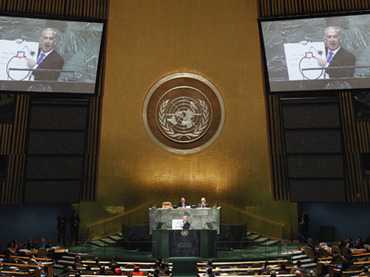
    The United Nations General Assembly at the U.N. Headquarters. (Reuters / Lucas Jackson)

    Israel has rebuffed a UN call to adhere to the Nuclear Non Proliferation Treaty (NPT) and open itself to international inspectors, calling the suggestion a “meaningless mechanical vote” of a body that “lost all its credibility regarding Israel.”

    In a 174-6 vote, the United Nations General Assembly demanded in a non-binding call that Tel Aviv join the NPT“without further delay,” in an effort to create a legally binding nuclear-free Middle East.

    Washington, Israel’s strongest ally, surprised no one by voting against the resolution – but did approve two paragraphs that were voted on separately, which called for universal adherence to the NPT and for all non-signatory governments to join.

    The UN body “has lost all its credibility regarding Israel with these types of routine votes that are ensured passage by an automatic majority and which single out Israel,” Foreign Ministry spokesman Yigal Palmor was quoted by Jerusalem Post as saying.

    The Assembly’s call on Israel comes days after a large majority of its members voted to grant Palestine statehood state status and just weeks after the an escalation of violence between Gazans and Israel’s occupation forces. Palmor stressed, however, that since the NPT vote takes place annually, the Palestinian victory is not connected.

    Israel is not a signatory to the 1970 Nuclear Non Proliferation Treaty, the main objective of which is to is to prevent the spread of nuclear weapons and weapons technology. Despite near-universal acknowledgement that Tel Aviv maintains a powerful nuclear arsenal, Israeli officials promote a position claiming their government will “not be the first country to introduce weapons into the Middle East.”

    The Middle East’s only democracy possesses as many as 400 nuclear warheads, along with various ways to deliver them. It is also one of four countries known to have nuclear weapons that are not recognized as Nuclear Weapons States by the NPT. The others are India, North Korea and Pakistan.

    Israel follows a policy known as “nuclear opacity,” which it sees as a deterrent against its neighbors.

    The timing of the Israeli dismissal of the call for transparency comes less than two weeks after Washington’s withdrawal from December’s nuclear-free Middle East conference, to be held in Finland and sponsored by Russia, the UK and the US.

    State Department officials said the international effort is being postponed because of “a deep conceptual gap [that] persists in the region on approaches towards regional security and arms control arrangements,” and because “states in the region have not reached agreement on acceptable conditions” for the meeting, quotes the IPS.

    But many blamed Israel’s refusal to accept the terms as the real reason for postponing the regional nuclear drive.

    “The truth is that the Israeli regime is the only party which rejected to conditions for a conference,” Iranian diplomat Khodadad Seifi told the General Assembly on Monday, as he called for “strong pressure on that regime to participate in the conference without any preconditions.”

    The meeting is now expected to be held early next year.

    There are currently five nuclear-weapon-free zones in the world, according to the UN:  Latin America and the Caribbean, the South Pacific, South-East Asia, Central Asia, and Africa.

    RT’s Paula Slier is exploring the controversies surrounding Israel’s nuclear activities.

  • NEWS FROM TOYOTA – A SUCSESS STORY OF A YOUNG-TURK

    NEWS FROM TOYOTA – A SUCSESS STORY OF A YOUNG-TURK


    ‘Wii Go Places’ SMART Board Alternative Wows Innovation Fair Crowd

    You never know when inspiration might strike.
    Consider the example of Korhan Gurocak. By day, he serves as the Legal and Corporate Responsibility and Forensics manager in Information Systems (IS). By night, he is a screenwriter. While practicing the latter, he came up with a breakthrough idea that just might make a big impact on the former.
    “While writing a script, I use a process where I put ideas on notes and tack them on a cork board, or I’ll simply write them on the wall,” he says. “I knew there had to be a better way, so I started researching SMART boards (made by SMART Technologies), hardware that basically digitizes the process. That’s when I learned that these devices are ridiculously expensive, costing up to $25,000.”
    Along the way, Gurocak also discovered that some enterprising souls had come up with an alternative using a Wii video game system remote control working in concert with an infrared pen, a laptop and some simple software. At a total cost of just $100 (excluding the laptop), Gurocak had his high-tech scriptwriting solution.
    He also had a ready-made answer when IS put out the call for entries for its annual Innovation Fair. Gurocak believed his fellow associates could benefit from his bargain-basement SMART board concept, so he assembled a team of colleagues to prove it.
    Just a month later, they unveiled their idea at the fair, which for the first time in its six years was opened up to entries from all TMS departments, not just IS. “Wii Go Places,” as Gurocak’s team called it, was the runaway hit of the event. It claimed the first-place prize among the 36 projects that agreed to be judged by two cross-company panels of executives. Overall, a record 87 teams offered displays, including 39 representing non-IS business units.
    Key Components – The SMART board on a budget includes: 1) an infrared pen; 2) a Wii remote; 3) laptop computer; 4) LCD projector; and 5) projection screen.

    “It was an amazing experience,” says Gurocak, who was joined in the winning effort by: Terri Lee Batton, senior applications analyst; Jack Munter, applications engineer, business delivery; James Tu, Legal and eDiscovery technology manager; and Raul Yzaguirre, senior applications analyst. “Usually when you put something new out there, you have your naysayers. But everyone who came by our display was so positive, asking questions and wanting to know how it works. It was kind of surreal.”

    So, how does it work? You start with a laptop or desktop computer. Then you connect that device to some sort of external display, such as an LCD projector or a TV. That’s the core set-up for many meetings at TMS, such as those built around a PowerPoint presentation.
    What sets “Wii Go Places” apart is that instead of controlling the software with the laptop’s mouse, you use an infrared pen that communicates with a Wii remote that’s pointed at the display and connected to the computer (see diagram). Just point and click, on the big screen.
    But it doesn’t stop there. With the right software, you can also “write” on the screen using the infrared pen–similar to writing on a dry-erase board with a dry-erase marker–and then save the work to the laptop, making it easy to share with everyone in the room as a text or image file.
    The team also showed how a similar approach could be configured to allow everyone in the meeting, assuming they’re equipped with iPads or other devices of that ilk, to view and annotate the same material on their screens simultaneously while connected via Wi-Fi.

    Wii Winners — Group Vice President and Chief Information Officer Zack Hicks congratulates the fair’s first-place team (left to right): Jack Munter, Business Delivery applications engineer; Raul Yzaguirre, senior applications engineer; Terri Lee Batton, senior applications analyst; Korhan Gurocak, LCR and Forensics manager; and James Tu, Legal and eDiscovery technology manager.

    The bottom line: Collaboration just got a whole lot easier and cooler, not to mention cheaper. The cost for this set up is 250 times less than a full-blown SMART board with its proprietary software. And there’s essentially no compromise in capability.

    “Everyone was able to see the business use,” says Gurocak. “We’ve all been in meetings where the dry-erase board won’t erase, or you end up taking a picture of the board with your camera phone and then have to transcribe the notes after the meeting. This could replace that.”
    Gurocak says Zack Hicks, group vice president and chief information officer, has given the approval to set up a few conference rooms with the technology to see how it works. If the pilot program pans out, Gurocak’ s inspiration just might help make the company more efficient while also saving it a fair amount of money.
    “As I understand it, the company was considering a big investment in SMART boards,” says Gurocak. “I guess it’s a good thing we did this when we did.”