Category: Business

  • Turk opposition tries to poach votes from Erdogan

    Turk opposition tries to poach votes from Erdogan

    Opinion Column

    Humeyra Pamuk and Jonny Hogg, Reuters Analysis

    Turkey’s Prime Minister Tayyip Erdogan is running for president as rules change to give the position more power. (Adem Altan/AFP Photo)

    ISTANBUL/ANKARA – A quick glance at the emerging candidates for Turkey’s first direct presidential poll illustrates the dramatic change wrought in the country by Tayyip Erdogan’s 11 years as prime minister; an old secularist elite has yielded the stage to two men of Islamist pedigree and a third from a long-suppressed Kurdish minority.

    “It is certainly novel, a new republic,” says Soli Ozel, a professor in political science at Istanbul’s Kadir Has University. “We really are in uncharted waters.”

    Erdogan, his popularity unscathed by a flare-up of anti-government riots and a corruption scandal, announced his presidential bid Tuesday for August elections that could further strengthen his hold on power.

    Many see his victory as inevitable. Since his AK party came to power in 2002, he has built huge support among conservative Muslims, many of them poor, who had felt treated as second-class citizens in a secular society — pious women, for instance, excluded from state buildings because they wore headscarves.

    Erdogan, 60, himself served a brief prison sentence in 1999 on charges of Islamist activity. Taking the reins of power only four years later, he tamed the army that had seen itself as final guarantor against Islamism and had toppled four governments in four decades.

    Rather than taboo, religion is now a front-and-centre political issue. The notion of a secularist president has become politically toxic for many of Turkey’s 77 million citizens.

    So much so that Turkey’s foremost secularist party, the CHP, the party of secular state founder Mustafa Kemal Ataturk, and the nationalist MHP have chosen a joint nominee in Ekmeleddin Ihsanoglu, a diplomat and academic who was at the helm of the Organization of Islamic Co-operation for nine years until 2014.

    The choice of Cairo-born Ihsanoglu — who has dedicated a large part of his life to promoting Islam — has drawn fierce criticism from some diehard secularists within CHP, with several refusing to sign his formal nomination.

    In his first remarks on being proposed, Ihsanoglu — whose wife, unlike Erdogan’s, does not wear the headscarf — was quick to emphasize the importance of separating state and religion. The Islamic world, he said, had become “muddled” on the issue.

    He also praised Ataturk, in marked contrast to the prime minister, who offended many Kemalist Turks when he appeared to refer to the founder as a drunkard during a speech in May 2013.

    After nearly a decade heading the world’s second-largest international organization representing 1.5 billion people across the Muslim world, 70-year-old Ihsanoglu’s diplomatic and religious credentials are hardly in question. But Aykan Erdemir, a deputy for CHP, insists he is not a pale imitation of the firebrand Erdogan, but rather a credible alternative for millions of pious Turks.

    “To me, he is the exact opposite of Erdogan, pluralist versus majoritarian, a conciliator versus a loud and populist zealot. We have a genuine choice between a liberal or an authoritarian president,” he told Reuters.

    Analysts say Ihsanoglu represents a return to the politically secular and liberal values, underpinned by religion, that AKP espoused when it first came to power. He might thus be able to poach disgruntled Erdogan supporters weary of an increasingly autocratic style and inflammatory language.

    At the height of a corruption scandal earlier this year that touched upon members of his cabinet, Erdogan branded political opponents terrorists and traitors. A police investigation ground to a virtual halt when he purged police and judiciary.

    Murat Yetkin, of the liberal Radikal newspaper, says the decision by CHP and MHP to field Ihsanoglu as a joint candidate means they will be entering Erdogan’s “backyard.” Ihsanoglu’s unimpeachable reputation might make it more difficult for Erdogan and his supporters to launch political attacks.

    “A potential defamation campaign against Ihsanoglu, who is known for his gentlemanly character, may not find supporters — even in AK party’s base,” Yetkin said. But even if Ihsanoglu’s Islamic credentials afford him some protection, Erdogan aides could turn their fire on what they see as Ihsanoglu’s failure to follow Ankara’s condemnation of the army toppling of Egypt’s Islamist president Mohamed Mursi.

    Ihsanoglu’s experience in international affairs and the Arab world will also be of little help with the Turkish public, many of whom were unaware of his existence until last week.

    Nor will it protect him from a rapacious pro-government press, with one columnist already labelling him a tool of foreign interests, a “Coca-Cola candidate”. Erdogan himself has accused political opponents of being in cahoots with foreign powers to undermine Turkey.

    At stake for Erdogan is a refashioned presidency, stripped of its largely ceremonial character and imbued by practice and future legislation with strong executive powers. He has already established his primacy over the armed forces, judiciary and police, all of course underpinned by personal popularity.

    Polls indicate Erdogan’s rivals will have a mountain to climb even to force him to a second round, with polls giving him about 55% of the vote and a 20-point lead.

    But if Erdogan does dip below the required 50% needed to avoid a run-off, Turkey’s Kurdish minority, an estimated 15-20% of the population, could decide his fate.

    Efforts to end decades of conflict between the government and Kurdish militants have played a key role in Erdogan’s premiership, leading to a ceasefire last year, and a slackening of Draconian laws on Kurdish language and culture.

    Before Erdogan, even writing a newspaper article espousing cultural or political concessions to Kurds could earn a jail sentence. Any public, or private, expression of sympathy the Kurdistan Workers Party (PKK) was similarly perilous.

    Erdogan took a considerable political risk, not least with the military, in opening talks with the PKK.

    Analysts say roughly half of all Kurds already vote for AKP and many more will likely follow suit in the belief Erdogan offers the best hope of a lasting peace settlement. His government sent to parliament last week a bill setting out a legal framework for peace talks, a boost to the process.

    Speculation that the pro-Kurdish People’s Democratic Party (HDP) might tacitly throw its weight behind Erdogan in the first round by naming either a weak candidate or no candidate at all has not materialized however, with HDP leader Selahattin Demirtas, 41, putting his hat in the ring as party candidate.

    “He’s a serious candidate, and if his supporters vote for him, that’s a 6% or 7% chunk of the vote whose destination is already known. They want space for negotiating with Erdogan between the first and second rounds,” according to Kadir Has’s Ozel.
  • Turkey’s Ties With ISIL Continue to Arouse Suspicions

    Turkey’s Ties With ISIL Continue to Arouse Suspicions


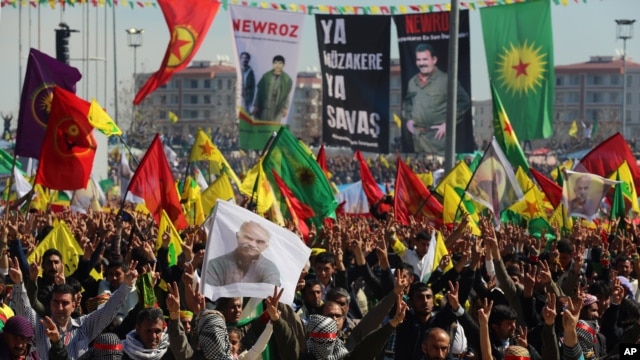
    Masked people in guerrilla outfits hold up a poster of of jailed Kurdish rebel leader Abdullah Ocalan as they demonstrate during the Nowruz celebrations in southeastern Turkish city of Diyarbakir, Turkey, March 21, 2014.

    Dorian Jones
    —Islamic State of Iraq and the Levant militants continue to score victories across Iraq. For neighbor Turkey, there is growing concern over ISIL’s growing power, particularly in its predominantly Kurdish southeast, which borders Iraq and Syria. 

    In Diyarbakir, as in the rest of Turkey’s predominantly Kurdish southeast, many Kurds are religious.

    That, analysts say, and decades of economic underdevelopment and conflict, with the Kurds fighting for minority rights, have helped make the region a fertile recruiting ground for organizations like ISIL.

    Young Kurds

    Already more than dozen young Kurds from Turkey have died fighting for ISIL in neighboring Iraqi and Syria, according to Muammer Akar, a Diyarbakir city counselor and prominent member of Turkey’s ruling AK Party.

    Bu alana reklam ver
    5Dk`da Beyaz Saça Son !
    Dexe Şampuan İle, İlk Kullanımda Saçınızdaki Tüm Beyazlardan Kurtulun!
    beyazsacsampuani.com
    Turkmaxi Webmaster Forumu
    rkiye`nin en büyük webmaster forumu
    turkmaxi.org/forum
    Kale 10 numara mantolama!
    2 yıl uygulama, 10 yıl garanti ve uzman desteği Kale Mantolama`da.
    Uzmanına danışın bizi arayın!
    Yepyeni bir haber sitesi
    Çocukların ve gençlerin gündemleri yazdıkları ve paylaştıkları burada
    yumurtaliekmek.com


    Besides local factors, the region – like the rest of the Middle East – is paying the price for years of religious rivalry between Sunni Saudi Arabia and Shi’ite Iran, he said, adding that ISIL is attracting a growing number of recruits.

    Saudi Arabia has spent a significant amount of money here developing a radical form of Sunni Islam called Wahhabism to counter Iran’s influence. Over the years, many Kurdish youths were attracted and have become increasingly radical and closer to committing violence.

    Akar claims funerals in the region for ISIL militants draw large numbers and have become a powerful recruiting tool for the Islamic group.

    But critics are accusing the ruling AK Party, which has its roots in Islam, of turning a blind eye to ISIL activities on Turkey’s border with Syria because of the party’s opposition to the Syrian regime, and because ISIL is fighting Syrian Kurds, who have declared a secular autonomous state on Turkey’s border.

    Ankara fears its own restive Kurdish population could make similar demands for autonomy. It has accused the Syrian Kurdish leadership of links to the PKK, which has been fighting the Turkish state for minority rights for decades.

    Two hours drive from Diyarbakir, in the town of Cizre, located near the Tukrish, Syrian and Iraqi borders, Deputy Mayor Kadir Konur accuses the ruling party of going beyond tacit support of ISIL.

    He said ISIL’s resources come from Turkey, citing what he said are numerous instances of trucks leaving Turkey with arms for groups like ISIL.

    Many people on Cizre’s streets appear to share such concerns, especially for the plight of Syrian Kurds just across the border.

    “We are very pessimistic because of ISIL and all the massacres they’ve done in Syrian Kurdistan, he said. The killing of women and children. It is very clear that many ISIL fighters cross the border from Turkey and the AK Party allows this,” said a man on the street interviewed by VOA.

    Escalating charges

    Suspicions of Turkish government involvement with ISIL have been heightened by an anonymously released video showing Turkish soldiers intercepting two Turkish trucks allegedly carrying Syria-bound weapons. The soldiers manhandle Turkish intelligence officers who are in cars escorting the trucks. According to prosecutors, the arms were being sent to radical Islamic groups fighting in Syria.

    The government claims the trucks were only carrying aid and strongly denied allegations of gun-running, pointing out that it has designated ISIL a terrorist group. But the prosecutors and soldiers investigating the trucks have now been charged with spying.

    Diyarbakir city counselor and AK Party member Muammer Akar said his own party may not be aware of the dangers Turkey is facing.

    “Ankara doesn’t see the danger, as they are dealing with so many other issues, but we do,” said Akar. “It’s only a matter of time before ISIL targets Turkey; since they see us as a country of heretics, they will attack our big western cities.”

    ISIL videos aimed at Turkish and Kurdish youths continue to appear on the Internet, calling them to join the jihad. Observers are increasingly asking if — or when — the war to create an Islamic state will come to Turkey.

  • Taliban Mount Major Assault in Afghanistan

    Taliban Mount Major Assault in Afghanistan

    Photo

    KABUL, Afghanistan — In one of the most significant coordinated assaults on the government in years, the Taliban have attacked police outposts and government facilities across several districts in northern Helmand Province, sending police and military officials scrambling to shore up defenses and heralding a troubling new chapter as coalition forces prepare to depart.

    The attacks have focused on the district of Sangin, historically an insurgent stronghold and one of the deadliest districts in the country for the American and British forces who fought for years to secure it. The Taliban have mounted simultaneous attempts to conquer territory in the neighboring districts of Now Zad, Musa Qala and Kajaki. In the past week, more than 100 members of the Afghan forces and 50 civilians have been killed or wounded in fierce fighting, according to early estimates from local officials.

    With a deepening political crisis in Kabul already casting the presidential election and long-term political stability into doubt, the Taliban offensive presents a new worst-case situation for Western officials: an aggressive insurgent push that is seizing territory even before American troops have completed their withdrawal from Afghanistan.

    The battle in Helmand is playing out as, about 1,500 miles to the west, Iraq is losing ground to an insurgent force that advanced in the shadow of the American withdrawal there. The fear pulsing through Afghanistan is that it, too, could fall apart after the NATO-led military coalition departs in 2016.

    Already, areas once heavily patrolled by American forces have grown more violent as the Afghan military and the police struggle to feed, fuel and equip themselves. The lackluster performance of the Afghan Army so far in Helmand has also evoked comparisons with Iraq, raising questions about whether the American-trained force can stand in the way of a Taliban resurgence.

    Officials in Helmand say the answers may come soon enough.

    “The Taliban are trying to overrun several districts of northern Helmand and find a permanent sanctuary for themselves,” said Hajji Mohammad Sharif, the district governor for Musa Qala. “From there, they pose threats to the southern parts of Helmand and also pose threats to Kandahar and Oruzgan Provinces.”

    BAGHRAN


    FARAH

    PROVINCE

    ORUZGAN

    PROVINCE

    AFGHANISTAN

    DETAIL

    PAKISTAN

    INDIA

    MUSA

    QALA


    KAJAKI


    NOW ZAD


    HELMAND

    PROVINCE

    KANDAHAR

    PROVINCE

    SANGIN


    Sangin


    Helmand

    River

    Kandahar

    Lashkar Gah

    AFGHANISTAN

    25 Miles

    Officials from the government and the international military coalition flew to Helmand on Friday to assess the situation. The military has sent in reinforcements, though early reports from residents indicate that those forces had made little headway in pushing the Taliban back. The police have fought ferociously to protect their areas and, in at least a few cases, succumbed only after running out of ammunition.

    While the government claims that none of the checkpoints attacked by the Taliban have fallen, district elders and villagers say otherwise, characterizing the situation as approaching a humanitarian crisis. Thousands of residents are believed to have been displaced in the fighting.

    “I see the people running everywhere with their women and children to take shelter,” said Hajji Amanullah Khan, a village elder. “It is like a doomsday for the people of Sangin. We do not have water, and there is a shortage of food.

    “The price of everything has gone up because the highways and roads have been blocked for the last week.”

    Northern Helmand is a small region with a history of troubles. Despite the recent Taliban gains, the area is far from lost.

    With its austere deserts interrupted by dense lines of foliage hugging the Sangin River, the district has long been marooned in a sea of Taliban support. It is also squarely in the heart of poppy country, a vital and growing source of income for the insurgents.

    Though positioned at a significant crossroads into the northern Helmand area, with access to neighboring provinces, Sangin also carries great symbolic weight. The Taliban have repeatedly used the area to make a statement about the limits of Afghan and Western government strength, and local officials fear a similar approach now.

    “The Taliban are planning to create problems in several northern Helmand districts to pave the way for their fighters to operate freely in the area and pose threats to Kandahar, Helmand and Farah Provinces,” said Muhammad Naim Baloch, the provincial governor in Helmand.

    Only now, the task to secure the district has fallen exclusively to the Afghans, and it is providing an early test of the forces the international coalition has spent years training to take over the fight.

    Last summer in Sangin, Afghan forces got their first taste of what that fight would look like. Struggling to keep the Taliban at bay, they lost checkpoints, hard-fought ground and more than 120 men.

    The government shuffled commanders, but it hardly mattered. By the end of the fighting season, the cowed Afghan Army unit there was mostly unwilling to leave its base to confront the threat. Late last year, reports of a deal between a local army commander and the Taliban began to surface, driven in part by attrition rates of nearly 50 percent and the near constant threat of death.

    Given the debacle last summer, the military’s lack of preparedness so far this year is all the more striking. Police officers ran out of ammunition, and in some cases bodies could not be recovered because of the fighting. Even though Helmand is the only province with an entire corps dedicated to it, the army has struggled to defend it.

    The fighting this summer appears to be worse. In just one week, the security forces appear to have sustained almost half the casualties they suffered in all of last summer, though reports differ on the exact toll.

    Last Saturday, as many as 600 Taliban insurgents stormed checkpoints through portions of Sangin, claiming wide tracts of land. On Sunday, the militants attacked the neighboring district of Now Zad. Violence erupted in Musa Qala on Monday, when the Taliban again stormed police checkpoints but were prevented from reaching the district center.

    The assault on Sangin seems the most concerted. On Friday night, according to the district governor, the Taliban advanced on the district center itself. The army repelled the attack through the district bazaar, while the police stopped an attempted breach from the north.


    “Only the district center is under the control of government,” said Hajji Amir Jan, the deputy chief of the Sangin district council.

    Though exact data is nearly impossible to obtain, in part because there is no longer a coalition footprint in the area, the extent of the attack offers a new perspective through which to view the Taliban’s ambitions, especially now that the militants no longer fear the dreaded American air support that has for years prevented them from massing in large groups.

    Although the military denied any collusion between the army and the Taliban, those questions have started to re-emerge because most of the casualties have been suffered by the local and national police forces rather than by the army.

    “The Taliban are not powerful enough to resist all of the Afghan forces,” Mr. Amir Jan said. “Sangin is not an easy district to control, and the Taliban have strong sanctuaries, but the Afghan National Army is just securing highways, and they are not really after the Taliban.”

    Coalition officials were reluctant to comment on the battles in Helmand because the fight now belongs to the Afghans. The United Nations, however, urged caution and respect for the lives of civilians.

    “The high number of civilians killed and injured in these ongoing military operations is deeply concerning,” said the secretary general’s special representative for Afghanistan, Jan Kubis.

    Residents described a hellish scene for those trapped in the area. Some have started to question whether the fight, and its toll on the people, is even worth it.

    “If the government is unable to control and secure the lives of the ordinary people, I suggest they leave it to the Taliban,” said Matiullah Khan, a village elder in Sangin. “We are tired of the situation and would rather die than continue living in these severe conditions. It has been like this forever.”

  • Defying Russia, Ukraine Signs E.U. Trade Pact

    Defying Russia, Ukraine Signs E.U. Trade Pact

    Play Video|2:07

    Ukraine Signs European Union Trade Deal

    President Petro O. Poroshenko spoke at the signing ceremony of the trade deal between Ukraine and the European Union in Brussels.

    Credit Michel Euler/Associated Press

    BRUSSELS — Dealing a defiant blow to the Kremlin, President Petro O. Poroshenko of Ukraine signed a long-delayed trade pact with Europe on Friday that Moscow had bitterly opposed. He then declared he would like his country to one day become a full member of the European Union.

    In so doing, Ukraine’s new leader, a billionaire confectionary magnate, has in effect raised a risky bet on the West that has cost his country hundreds of lives and the loss of the Crimean peninsula to Russia and has set off a low-level civil war in its eastern border region.

    By signing the trade pact at the Brussels headquarters of the European Union, Mr. Poroshenko revived a deal whose rejection last November by his predecessor, Viktor F. Yanukovych, set off months of pro-European protests in Kiev, the Ukrainian capital, and pushed the West into its biggest test of wills with Russia since the end of the Cold War.

    The unrest toppled Mr. Yanukovych and drove pro-Russian activists in Crimea and the eastern region of Donetsk to demand annexation by Russia.

    “This is a really historic date for Ukraine,” Mr. Poroshenko, who won Ukraine’s presidential elections in May to fill a post left vacant when Mr. Yanukovych fled to Russia in February, said at a news conference here.

    In a dig at Mr. Yanukovych, he said he had signed the agreement with the same pen that his toppled predecessor would have used to sign the same pact, before he changed his mind under pressure from Moscow and set up his own downfall.

    The completion of the association agreement between the European Union and Ukraine marked a severe setback for President Vladimir V. Putin of Russia and his oft-repeated goal of reasserting Russian influence in the “near abroad,” Moscow’s term for the territories of the former Soviet Union.

    “The big loser in all this is Putin,” said Amanda Paul, a researcher at the European Policy Center, a Brussels research group. “He has gone out of his way to create problems internally in Ukraine but only pushed Ukraine further into the arms of the West than it ever would have gone before. It totally backfired for Putin.”

    Moldova and Georgia, two other former Soviet lands that Moscow had pressured not to stray too far from its orbit, also signed agreements with the European Union on Friday. In Tbilisi, the capital of Georgia, citizens celebrated with a large public concert, which was broadcast on all major domestic television channels.

    There was jubilation as well in Kiev, the Ukrainian capital, after the signing of the agreement. By late afternoon on Friday, several hundred people had gathered in Independence Square, the focal point of months of street protests, many carrying blue balloons with yellow paper stars affixed to them — replicating the European Union flag — and released them into the air.

    After weeks of statements by Mr. Poroshenko vowing to seal the agreement, the Kremlin was well-prepared and immediately began to lay the groundwork for retaliatory measures, including the withdrawal of preferential treatment for Ukrainian exports to Russia under prior agreements between former Soviet republics.

    Within minutes of the signing ceremony, the news agency Interfax quoted Russia’s deputy foreign minister as warning that “serious consequences” would follow. The remark was an ominous sign of the vexation caused in Moscow by the tilt toward Europe of lands that Russia, first under czarist and then Soviet rule, for centuries considered its own.

    In Moscow, Mr. Putin blamed the months of crisis in Ukraine on Western leaders, saying they had forced Kiev to choose between Russia and the European Union.

    “The acute crisis in this neighboring country seriously troubles us,” Mr. Putin said after a ceremony to receive the credentials of foreign diplomats. “The anti-constitutional coup in Kiev and attempts to artificially impose a choice between Europe and Russia on the Ukrainian people have pushed society toward a split and painful confrontation.”

    Though spurned, Moscow retains enormous influence in Ukraine. It reminded Kiev of this earlier this month by suspending deliveries of natural gas following a long-running dispute over price. Russia has denied any hand in the violence in eastern Ukraine but has been accused by the West of supporting pro-Russians rebels with guns, money and manpower from across the border in Russia.

    Given the ferocity of the Kremlin’s campaign to prevent completion of the accord between Ukraine and Europe, the reaction by senior officials on Friday was relatively muted, reflecting not only acceptance of the inevitability of Mr. Poroshenko’s signing but also the changed circumstances following Russia’s annexation of Crimea, where it has a naval base.

    “In the Kremlin, they are calming down and trying to assess the results of this frenzied state of affairs over the last couple of months,” said Konstantin Sonin, vice rector of the Higher School of Economics in Moscow. “I think we make too much rationalization of what the Kremlin does. I think they were very much driven by events.”

    One of Mr. Putin’s major objections to closer political and economic relations between Ukraine and the West was widely understood to be a concern about NATO expansion, and the risk that would pose to Russia’s military interests in the Crimean peninsula.

    Russia has long viewed the European Union as a stalking horse for NATO but, in a move that could help allay such concerns, NATO foreign ministers decided in Brussels earlier this week that a summit meeting in September will not approve offering Georgia a formal step to membership.

    There is no chance of the European Union admitting Ukraine, Georgia or Moldova as members any time soon. Public opinion in Europe is hostile to any further expansion of a 28-nation bloc that is already widely seen as too big and too unwieldy.

    All the same, Europe’s allure to so many people in former Soviet territories has infuriated Moscow, not the least because it contrasts so starkly with the cool reception given Mr. Putin’s efforts to form a rival economic bloc, the Eurasian Union, which is to start up next year. It so far has only three takers, Russia, Belarus and Kazakhstan.

    Far from concluding a period of tumult, the completion of the trade deal, which still needs approval from the Ukrainian Parliament, could further stoke tensions both inside Ukraine and between Moscow and the West.

    Senior Russian officials quickly began warning that Russia’s businesses and economy could suffer, as their markets could be flooded with low-cost goods from Europe that skirt tariffs by first being shipped through Ukraine, which will be exempt from most European duties. Other experts have dismissed those concerns, saying Russia is quite adept at identifying and intercepting such goods as they cross the border.

    European leaders, meeting Friday at a summit in Brussels dominated by wrangling over who should lead its executive arm for the next five years, announced that they would not immediately impose additional sanctions on Russia for its interference in Crimea and eastern Ukraine. But, they said in a statement that additional sanctions were being prepared and could be deployed “without delay” if Russia does not do more to curb violence in eastern Ukraine.

    Europe, like the United States, has so far limited its sanctions to an asset freeze and travel ban against a narrow group of Russian political and military figures involved in the March annexation of Crimea.

    European leaders set a deadline of next Monday for pro-Russian militants to leave borders posts seized from Ukrainian personnel, to release all hostages, agree to procedures for the verification of a cease-fire and accept “substantial negotiations” on a peace plan proposed by Mr. Poroshenko.

    In eastern Ukraine, in the embattled regional capital of Donetsk, Aleksandr Borodai, a rebel leader from Russia, told reporters that pro-Russian militias were willing to extend a truce until Monday. The Ukrainian government later agreed to do so.

  • Turkey: Facing an Uncertain Prognosis on Healthcare

    Turkey: Facing an Uncertain Prognosis on Healthcare

  • The West Has Failed To See The Abuses Of The Turkish Regime

    The West Has Failed To See The Abuses Of The Turkish Regime

    Around 300 officers in the Turkish military were jailed in 2010-2011 over an alleged coup to overthrow the Turkish government. The controversy over the arrests is still on-going, with all officers still in jail released earlier this month pending a retrial. In an interview with EUROPP’s editor Stuart Brown, Dani Rodrik discusses the case, the impact it has had on Turkish politics, and why it would be a mistake to interpret the removal of the military from politics in this way as a process of democratisation.

    You have written and spoken a great deal about the criminal cases pursued against figures in the Turkish military in relation to the alleged ‘Sledgehammer’ plot to overthrow the Turkish government. For those who lack an understanding of these events, why were they so important for the country?

    It was a rather remarkable experience where the military and the secular elites, who seemed to be so powerful in governing Turkey, effectively lost control in a short space of time. This happened between 2007 and 2011, roughly speaking. On the one hand, superficially this is a good thing because the military don’t belong in politics, but on the other hand the manner in which this transition was accomplished through Kafkaesque trials based on bogus evidence has left a very unhappy legacy for the Turkish polity going forward.

    The allegation was that the 300 or so officers who were put on trial had planned an elaborate coup in 2003. We now know that the planning documents which described this attempted coup were forged. There is no substance to the so called ‘Sledgehammer’ coup, which in fact never existed and is a figment of the imagination of the forgers who prepared this plan.

    The political alliance that made this possible was an alliance between the Gülen movement and the Justice and Development Party (AKP) government. They also received very important legitimising support from much of the intelligentsia as well, which mistakenly interpreted what was happening as a process of democratisation.

    In terms of the overall purpose, there were several motivations. It was aimed at hitting the military and was also partly payback for the perceived persecution by the military of religious conservative groups in Turkey. It was a very successful method whereby the military and the secular establishment could be put on the defensive and effectively deprived of their power. What’s unfortunate is that the demilitarisation of Turkish politics had to take place using such dirty tricks.

    You’ve mentioned that this was interpreted by some figures, including those outside Turkey, as a process of democratisation. Is there any basis behind this interpretation?

    The purpose of demilitarisation is to pave the way for democracy. If the manner in which demilitarisation occurs does not pave the way for democracy, and instead entrenches forces whose modus operandi is fundamentally undemocratic, then what you get is not democracy, but simply another kind of authoritarianism.

    That’s exactly what has happened in Turkey. The political groups which have been strengthened – the Gülen movement and the AKP – are currently operating under fundamentally undemocratic methods. Anyone can see that today Turkey is as far away from democracy as it has been in quite some time. It’s therefore very difficult to talk about democratic gains under the current context.

    What has been the wider legacy of the trials, particularly in terms of the recent protest movements which have taken place in Turkey?

    I think these political trials have entrenched a highly authoritarian style of governance. This is evident in the way that Erdoğan behaves and that’s certainly an important legacy of the events. There is plenty of opposition to Erdoğan – and the Gezi movement and some of the events that happened after the Soma mining disaster are evidence of that.

    Unfortunately, this grassroots opposition currently finds no counterpart in organised political movements or in the existing political parties. Until such an organised political movement emerges, which spans the traditional divides in Turkey and which is at once secular democratic and liberal, it is difficult to see how the current political dominance of the AKP can be overcome.

    Another aspect of this whole situation is the question of why so many people outside Turkey, including Turkey’s friends in Europe and the United States, misread what was going on so badly. I think the answer is that it’s sometimes difficult to distinguish a shift in power from one dominant group to another from a process of democratisation. This is because this shift comes with a certain loosening of the old taboos and restrictions associated with the old dominant elites.

    So early in the process it was understandable to some extent that what was essentially a power grab by the AKP and the Gülenists was viewed as democratisation. But I think that since 2011 the West has made a serious mistake in failing to see the wide range of abuses that the Turkish regime has been engaged in.

    This interview was first published on EUROPP@LSE