VECIHI ACUN REPORTING
From: [email protected]
VECIHI ACUN REPORTING
From: [email protected]
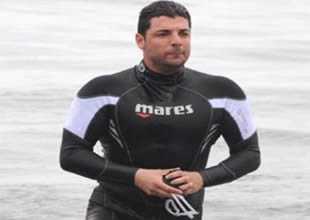
THE MAN WHO SWAM ACROSS FROM TURKEY TO CYPRUS IS NOW READY FOR ENGLISH CHANNEL!
Alper Sunacoglu is a sportsman who will make a big splash and will be talked about alot in the sports community around the world soon. He is a legend of his country.
Erdal Acet, who is one of the trainers of Alper, was the man who broke the world record by swimming across English Channel with a record of 9 hours 2 minutes. Since his childhood, Alper who is a committed follower of Erdal Acet, now going to England to show his respect to his trainer and he is also determined to break the world record of Mr. Trent Grimsey, who also broke the record world record as well as Alper’s trainer Erdal’s record .
Now let’s have a look at what Alper has got to share with us 🙂
Who is Alper ? Alper is one of the most famous national swimmers of Turkey who swam the distance of 78 km from Anamur, from Turkey to Cyprus in smashing 26 hours 15 minutes and moreover he did not use the safety cage. He broke this world record by swimming in a perfect high speed on 4th of September 2010. On 23th of April, 2011 He also swam across Istanbul Bosporus top to buttom from Sarıyer to Üsküdar, a distance of 30 km in 2 hours 25 minutes. After all that he swam perpendicular Dardanel Bosporus from one end to another in 7 hours 12 minutes by ignoring the south wind storm blowing at 8 force. Related with above mentioned successes, he had many interviews, commentated on news both nationally and internationally. His records were also confirmed and announced by Wikipedia to all over the world. The record holder swimmer, Alper now has a target to break a world record by swimming English Channel in 6 hours 45 minutes. If he achieves this, he will gain the title of fastest marathon swimmer in the world, then again this will enable him to secure the world record on behalf of Turkey and Turks.
Here is the Exclusive interview with world famous swimmer, Alper Sunacoglu.
EDITOR: Could you please tell us little bit about yourself?
ALPER: Thank you. I was born in Istanbul and originally I’m an Albanian. When I was about five years old when we immigrated to Adana because of my father’s business. My father and my mother is from Istanbul, I’m from Adana due to the simple fact that I lived all my childhood there. J Currently I’m working in a corporate logistics company as a project manager/ coordinator, A degree certified customs broker and work as a consultant.
EDITOR: You undersigned records which requires significant performance and courage. To swim from Mersin to Cyprus in 26 hours, to swim the straits from the whole length even in the winter season, I mean all of these successes and records do not seem logically possible to many people around the world. I would like you to share with us your journey, your adventure starting from your childhood. How was Alper’s childhood? How was his youth? Why and how come you broke all this world records and accomplishments years after years ? We kindly appreciate If you could tell us all these processes.
ALPER: I had a very naughty childhood and youth with full of troubles which caused lots of complaints from our neighbors. One day I was at top of a roof with a cap, toy pistol and slingshot in my hands, another day I was on top of trees and sometimes even had a fight with gangs. Once upon a time, as far as I can remember I climbed on a pine tree and could not get down and had to wait for the fire brigade to come and rescue me. As you can clearly see, I had a childhood full of adventures. I learned and started to swim when I was five year old. I tried variety of sports such as karate, taekwondo, judo, handball, basketball. However due to my fickleness I did not continue all of these sports. Now as it stands, only pentathlon and swimming is an indispensable part of my sport life. I will still perform these two sports until my health, breath and my power enables me to do so. My grandfather had a major effect in my life and he always said that ‘ Your blood and soul is coming from Ottoman Empire and you are a core grandchild of the daughter of Magnificent Suleyman and Sokullu Mehmed Pasha and your forefathers are the people of that you should really feel full proud of ‘I think that those words were so powerful words which effected my unconscious mind’. I have also listened many of these narratives with a big pleasure J . My grades at school were not very good however I was more interested with history lessons. I thought that our forefathers ride on horses to many distant places, conquered so many countries and came back again by travelling over hundreds even thousands of kilometers. This meant to me that, humankind can walk, run and can even swim these distances if they really wish. Thus, this is how my idea of marathon swimming started. My courage comes from my genetic code and my success comes from the faith of the following sentence. ‘If mankind really and honestly wants to walk, run and swim those distances then this can be achieved.’ I’m also a little bit lucky because most of the famous marathon swimmers are from Adana and I had the chance to be inspired by those swimmers. I listened, watched them and prepared myself to do the best. Sanrı Kardesler who is the famous for the contribution to Adana swimming sports and the deceased swimmer Ayhan Karatas had a big efforts on me . In this regard, once more I want to express my gratitude to them.
EDITOR : Don’t you get bored and get hungry at sea over many hours of swimming and are you not really afraid of sharks? Did you ever face any dangerous circumstances at sea?
ALPER: Of course I did, while I was swimming long distances, I got bored , it is hard sometimes, I had a terrible headaches, sometimes toothache and sometimes I became semi conscious. So, you have different stages, the sportsmen who swim marathon know that after you swim three hours, you face up different stages both in your body and in your mind. If you have decayed tooth , first this starts to ache then headache starts and after that semi conscious and insobriety takes place. If you can not concentrate well enough then you will be defeated to the water and give up the marathon. However, I visit the place of where I will dive into the water and prepare my unconscious mind to the marathon by saying myself that ‘ I will enter to the water from this place and will rise across the seaside’ Unless any unexpected weather conditions occur or totally unexpected accident occurs, I never think to return back or dismiss the trial of record. You asked me whether if I get hungry at sea, and of course, I get hungry, there is a boat and team members that escorts me and my trainers calculate at what time I need to eat, they throw me liquid food bottle to the sea accordingly. When it comes to sharks they are the ruler of sea, so I am afraid of them and they are also stronger than me in the sea. But I never come up against such a life threatening danger up to now except some minor incidents.
EDITOR: Have you got any sponsorship?
ALPER: I had a lots of sponsorship up until now. Adana City Council, IHH Charitable Foundation of Humankind aid, Sisli Council and Mayor of Sisli – Mr. Mustafa Sarı Gul , Ünsped Gümrük Müşavirliği A.S – customs broker company and precious businessman Yusuf Bulut ÖZTÜRK are my sponsors from time to time.
EDITOR: So, what are your new projects that are coming soon?
ALPER: The first project is to swim across the English Channel in less than 7 hours and break the world record. Now the last world record on this belongs to Mr. Trent Grimsey.
Secondly, swimming Naples -Capri Marathon in Italy and swimming across from Izmir to Athens are my latest upcoming projects.
EDITOR: You were on headline news on many occasions but why are you not as famous as you could imagine expected from a person at your caliber?
ALPER: I have only tried to keep everything to myself, all trial of records, projects and I did not intend to become famous up to this date. I have never had focus on and an aim or dream to be famously recognized. Actually to become famous in Turkey is very simple fact if you are on news related to your private life with a model or with a girl who is famous, then you are on, now you’re famous. But this does not suit me, my style and I do not prefer this kind of life. On any given day, if people of my country would know me, I prefer to be remembered by what I have done, with my achievements, successes and my records. And as such all news about myself has been done by valuable media members like yourselves by investigating the real truth of the news in the world by providing access me with an interview. To summarize it all, I have the opinion that if a decent media group supports me that is more than enough for me.
EDİTÖR: A personal question comes to you. Is there a time for love in this busy life. You are a healthy person and why are you not married ?
ALPER: As you say I’m really busy. I always live in a rush between business life and sports life. I can not spare a time to my private life as much as I want. So the relationship is really difficult for me and even more difficult for the other side. In addition to that, I also got married and got divorced when I was very young. At least unless I fulfill my upcoming projects, I do not consider about marriage as for now. But still it is all about destiny in the end.
EDITOR : Why don’t you have a support from government authorities although you have a good relationship with them and sincere photos with a lot of political leaders? Is this related with the social messages that you give?
ALPER: Yes, actually your question has got the answer in it. Unfortunately, I could not get any support of government administration. If they have supported me, I would like to swim from Egypt to Gaza and protest the embargo. If they support me, I can represent my country at open water races hold in different countries. Maybe Turkey is the only country which do not participate in these races. Myself and Swimming Federation delivered our messages about this issue on several occasions to the related ministry but we could not get any reply at all.
EDITOR: You wanted to swim to Imrali Island by jumping from Istanbul Bosphorus Bridge and wanted to give a message that Single State, Single Flag and Single Nation aiming to curse of the terrorism. Even Ayşe Arman – journalist had mentioned about you and many discussions have taken place in the public. Is this project on stand still? Are you really going to jump from the Istanbul Bosporus Bridge?
ALPER: Let me ask you. Do you think, is it really necessary to give this message and make this attempt when you think about the position of Turkey now. As of now, there is no terror so I do not need to curse it 🙂 anymore. In the end, to swim to Imrali is cancelled, I won’t swim. But in coming days may be I can jump from the Bosporus Bridge to give a different message. You will also hear from me for sure 🙂
EDITOR: You’re recognized by your support to disabled children and children with down syndrome. Do you have a plan or dream for them ?
ALPER : I like children and especially girls. Disabled children or children with a down syndrome is very special for me. My biggest dream is to build an Olympic pool and activity rooms for them if I have the suitable support and financial back up accordingly.
EDITOR: Let’s say “Insallah”. I hope that someone sensitive could hear your message so that they could support you to enable yourselves to break the world records and help you to realize your dreams. I hereby wish you a real success and may I also take this opportunity thank you for your sincere answers to the questions which included your personal life.
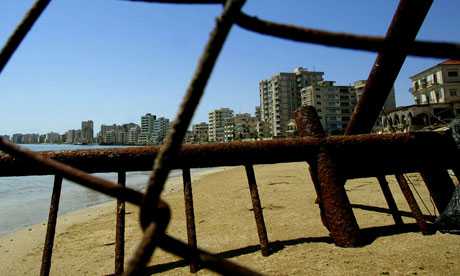
Once popular with tourists, Famagusta is stuck in limbo within UN’s ‘green line’ buffer zone set up after 1974 Turkish invasion
Cypriots see Famagusta as a lost paradise. Before the Turkish invasion in 1974 the resort on the island’s east coast, with its beaches of white sand, was the main tourist attraction on Cyprus. The town looked back on a rich past spanning several centuries, with Venetian ramparts and the Lala Mustafa Pasha mosque, formerly Saint Nicholas’s, a replica of Reims cathedral built by the French Lusignan dynasty, which ruled the island in the 14th and 15th centuries.
But for the past 40 years Famagusta has been in limbo. Deserted by its residents, closed by the Turkish military and ringed with barbed wire, a large part of the town is waiting for a long-awaited thaw. Thousands of expropriated Greek Cypriots, who have taken refuge south of the “green line”, still refuse to forget their old home. The fate of Varosha, a district that has been empty since the invasion, is a recurrent topic for talks between the two halves of the island. Last year rumours claimed it might be handed back to end the deadlock, which has continued despite the good offices of the UN secretary general, Ban Ki-moon. But nothing has happened.
“The question has been on the agenda since the 1980s,” says Osman Ertug, the Turkish Cypriot presidential spokesman and special adviser on negotiations with the south. “It is one of the cards we hold, but it is part of an overall agreement and cannot be separated from a share-out of energy resources, or the blockade of sea and airports. The UN security council is mainly responsible for the inertia.”
The financial crisis in the southern part of the island has, momentarily, sidelined the issue of reunification, barely mentioned during the presidential election campaign in February, which brought to power Nicos Anastasiades, generally thought to be in favour of talks with the north. “Dervis Eroglu [the president of the Turkish Republic of Northern Cyprus] called him to congratulate him and suggest a meeting. We sent him an invitation to dinner to get the process moving again,” Ertug explains.
Turkey is also keen to restart negotiations quickly. “We should encourage both sides in Cyprus to find a solution together,” the Turkish minister for European affairs, Egemen Bagis, told the Luxemburger Wort daily. “They are like married couples. Turkey, Greece and Britain are like parents who want to save their marriage.” But so far there has been no response to this offer. Sapped by the crisis, Nicosia is reluctant to enter negotiations at a difficult time. “But it never is the right time,” Ertug counters. “There have been seven leaders in half a century, including an archbishop [Makarios] and a communist [Dimitris Christofias], but still no peace. A crisis may offer opportunities too,” he adds.
According to the north, the question of hydrocarbon reserves off the coast of Cyprus could lead to useful negotiations for both sides. Turkey disputes Cyprus’s right to exploit these resources on its own. It is demanding a fair share-out between the two communities.
Both parts of Cyprus certainly stand to gain from greater co-operation. “Gas is an opportunity to kick-start negotiations on reunification,” says Cengiz Aktar, a Turkish columnist and specialist on European affairs. “We must knock down the walls,” advocates the Turkish Cypriot economist Hasan Gungor, another presidential adviser. “The biggest Toyota car factory is located in Turkey but Greek Cypriots import their Toyotas from Japan, despite the fact that they cost less on the other side of the island,” he notes. The cost of separation could be a powerful incentive for both parties to reach a compromise.
This story appeared in Guardian Weekly, which incorporates material from Le Monde
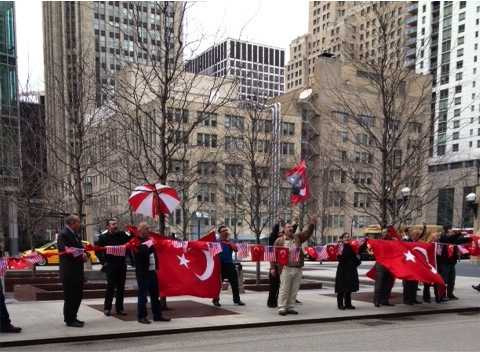
CHICAGO, Ill.—On Wed., April 24, more than 100 demonstrators from Chicago’s Armenian, Greek, Assyrian, and Cypriot communities joined a protest organized by the Chicago “Ararat” Chapter of the Armenian Youth Federation (AYF) against Turkey’s ongoing and aggressive campaign of denial of the Armenian Genocide.
Turkish demonstrators chanting, ‘You deserved it! You deserved it!’
The demonstrators gathered in front of Chicago’s NBC Tower, the new home of the Turkish Consulate, around 11 a.m. waving Armenian and American flags, holding signs, and chanting such phrases as “Recognize the Genocide,” “Turkey is a liar,” and “Turkey run, Turkey hide, Turkey is guilt of Genocide.” Soon after, small groups of Turkish and Azeri counter-demonstrators exited the building, presumably from the Turkish Consulate offices, to take up positions on the opposite side of the street from the Armenian picket lines.
The Turkish counter-demonstrators began shouting slogans and cursing in Turkish at the protestors as Turkish Consul General Fatih Yildiz looked on. At one point, the Turkish group began shouting, “You deserved it! You deserved it!” and “Talat was right!” referencing genocide-mastermind Talat Pasha and essentially admitting to Turkey’s culpability in the genocides of the Armenians, Assyrians, and Greeks during and after World War I.
Despite repeated attempts by the Turks to intimidate and provoke the protestors even as Chicago police looked on, the AYF-led group maintained their discipline and continued with their picket for two hours. The protest concluded with the singing of “Mer Hairenik” and ‘Haratch Nahadag.”
via Chicago Armenians Demonstrate Against Denial | Armenian Weekly.
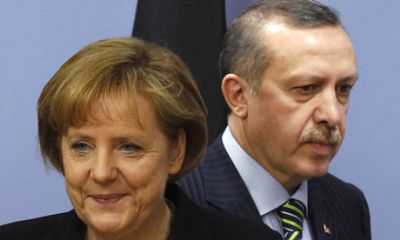
Speaking to Turkish daily Hurriyet, Chancellor Merkel was asked how long Turkey will have to wait to join the EU.
FAMAGUSTA GAZETTE • Monday, 06 May, 2013
German Chancellor Angela Merkel has called on Turkey to fulfil the requirements of the Customs Union deal and advance on normalising bilateral relations with the Republic of Cyprus.
In 2005, Turkey signed a protocol extending its customs union to EU states, but at the same time Ankara issued a declaration saying that its signature did not mean it had recognised the Republic of Cyprus. Turkey also refused to open its ports and airports to Cyprus.
Speaking to Turkish daily Hurriyet, Chancellor Merkel was asked how long Turkey will have to wait to join the EU.
“Negotiations with Turkey have being continuing since 2005. They are open ended,” Merkel said.
“One of the conditions for EU membership is that the candidate country abides by the EU’s common law and value system fully. This applies to Turkey too. Turkey should carry out a new reform process. When Turkey’s accession negotiations started, Turkey promised to fulfil all the requirements regarding the implementation of the Customs Union agreement with all EU member countries including Cyprus. If this condition applies, then it would have a positive impact on the membership process,” she added.
Meanwhile, the Ministry of Communications and Cypriot members of the European Parliament are coordinating efforts to promote Cyprus’ interests in the EU.
The main issue on the agenda is the need to lift the Turkish embargo on Cypriot flagged ships and planes.
Minister of Communications Tasos Mitsopoulos told reporters after his meeting with MEPs Eleni Theoharous, Andreas Pitsilides, Takis Hadzigeorgiou and Antigoni Papadopoulou that their discussion was useful, adding “we have asked for the contribution and help of our MEPs to handle sensitive issues such as the restrictive measures which Turkey imposes against Cyprus’ shipping and aircraft”.
They also examined ways to promote Cyprus’ interests in the EU and co-funding of projects from European structural funds and other EU programmes.
Mitsopoulos said the MEPs are willing to support government efforts, adding they pledged to contact their political groups to advance the issues.
Theoharous said the MEPs will continue their meetings with Mitsopoulos, adding “we will seek to solve all problems, mainly the repercussions of the Turkish occupation on air and sea transport in our country.”
She said the Turkish embargo creates an onerous economic issue on Cyprus and should be resolved the soonest.
Hadzigeorgiou said that MEPs should always coordinate with the state to tackle issues that are pending before the EU for the benefit of the country.
He described the Turkish embargo “a great issue”, adding “we have reached an era where this issue should be resolved and we are ready to see how to break the deadlock”.
In April 1987 Turkey imposed restrictions on Cypriot flagged vessels and in May 1997 Ankara issued new orders to extend the restrictions to include ships under a foreign flag which had any relation with the Republic of Cyprus.
These restrictions disrupt shipping and air traffic, in addition to causing huge financial and other problems.
Annual losses for Cyprus’ economy because of the restrictions amounted to 138,5 million euro in 2008, accounting for 1,3 % of the GDP (Gross Domestic Product).
The shipping industry records annual losses amounting to 100 m. euro. It is noted that 16% of the EU registered ships cannot dock at Turkish ports.
— Copyright © Famagusta Gazette 2013
via Merkel pushes Turkey on Cyprus customs snub.

Armenian protesters shout slogans against Turkey during a demonstation near the Turkish Embassy in central Athens, April 24, 2013. (photo by REUTERS/Yannis Behrakis)
By: Orhan Kemal Cengiz for Al-Monitor Turkey Pulse Posted on April 30.
The groups that call the 1915 events in Turkey “genocide” filled Istanbul Taksim Square on April 24, along with Armenians who came from abroad to remember millions of Armenians who lost their lives and suffered untold agony on this land. Only five or six years ago, it was unthinkable that such an observance could be held in Turkey. These developments encourage optimism, but even as democratic and forward-looking Turkish faces were displayed in Istanbul, we also noticed that the Turkish Foreign Ministry was still repeating the clichés of the last 98 years that we all know so well.
About This Article
Summary :
Turkey is preparing a diplomatic offensive to prevent the US and European countries from recognizing the events of 1915 as genocide, writes Orhan Kemal Cengiz.
Original Title:
Turkey 2015: Avoid ‘’Genocide’’ Word At All Costs
Author: Orhan Kemal Cengiz
Translated by: Timur Goksel
Categories : Originals Turkey
The Foreign Ministry criticized the April 24 statement of US President Barack Obama with a tone bordering on condemnation: “We find this statement that ignores historic realities troubling in all its aspects, and regret it.” What led to this critical tone was Obama’s saying that the Armenians were mercilessly massacred and forced on a death march in the last days of the Ottoman Empire.
On one hand, Turkey has erased a yearslong taboo and is now debating 1915 freely as never before. In addition to the April 24 observances, people are openly expressing their views by referring to 1915 as “genocide” in print and visual media.
But on the other hand, looking at the official reactions of the Turkish government, you can’t find the slightest change. Why? Why is Turkey is trying to keep the world from debating an issue that is freely discussed in Turkey itself? Why was Obama’s statement received with such a stiff reaction, even though there was no mention of genocide? Why is Turkey, while taking serious steps to solve major questions such as the Kurdish issue, still repeating its century-old clichés on the Armenian issue?
All these appear to be part of Turkey’s strategy for 2015. While Armenia and the Armenian diaspora promote 2015 as a milestone for global recognition of genocide, the Turkish state, mobilized by defensive instincts, continues denying everything, just as it has been doing all these years.
It was known that the Turkish Foreign Ministry was preparing to counter the Armenian diaspora’s 2015 strategy.
Haberturk, in a report by Sibel Hurtas in September 2011, titled ‘’Foreign Ministry sends coded message to raise 2015 alarm,” said that in a secret message to Turkish embassies worldwide, Turkish diplomats were asked to monitor and prevent Armenian activities related to 2015.
In an incident in Denmark in December 2012, we noted that the secret message had served its purpose and Turkish ambassadors were acting in accordance with the official strategy. In response to an Armenian genocide exhibit at Copenhagen University in December 2012, the Turkish Embassy immediately opened an alternative exhibit. As you can easily surmise, according to the Turkish Embassy exhibit, the Armenian genocide never happened.
Barcin Yinanc of Hurriyet Daily News wrote on April 23, probably on information provided by the Foreign Ministry, that Turkey will not stop at developing counter arguments to Armenian genocide claims, but will also make efforts to normalize relations with Armenia before 2015.
Keeping all this in mind and rereading Turkey’s reaction to Obama’s message, it could be understood that Turkey’s message was not for today, but rather forward looking. It appears that Turkey, by reacting strongly today, was trying to ensure that the US president will not mention genocide in 2015.
Why is Turkey so worried by the use of this word? Because Ankara thinks that there could be legal ramifications of the US and European countries recognizing genocide.
From the international-law angle, whether Turkey’s acknowledgement of genocide has legally binding implications is open to debate. Even organizations such as the Elie Wiesel Foundation, which persistently says what happened in 1915 was unquestionably genocide, are saying that international conventions cannot be retroactive, and that is why there cannot be demands for land or compensation from Turkey. But while it looks difficult for the Armenians to win in international courts, that doesn’t rule out the possibility of individual countries taking legal action on their own.
For example, the cases brought against German insurance company Munich Re in California in 2003 within the framework of the 2000 Poochigan law should make one think. Pursuant to this law, German insurance companies that had insured Armenians in 1915 but did not pay damages were sued in California. The cases were dismissed because a federal appeals court in San Francisco abrogated the law. But the court’s opinion on Movsesian v. Victorai Versicherung AG may make it easier to understand why Turkey is fighting so desperately. The court, while abrogating the law, mentioned that Obama had refrained from using the term “Armenian genocide” and indicated that the law might not be in harmony with US foreign policy. This conceivably could mean that should Obama and the US administration label the events of 1915 as genocide, the judicial system could change its mind accordingly.
We see that the Turkish government, fearing future sanctions, is continuing with the policy of denial, and this will not change before 2015. Whether Turkey will develop humane and rational policies once the fear of 2015 is past remains to be seen.
Orhan Kemal Cengiz is a human rights lawyer, columnist and former president of the Human Rights Agenda Association, a Turkish NGO that works on human-rights issues ranging from the prevention of torture to the rights of the mentally disabled.
Read more: https://www.al-monitor.com/originals/2013/04/turkey-diplomatic-campaign-stop-genocide-recognition.html#ixzz2S1wXDbeH


