Month: January 2011

  • Turkey considers hefty prison terms to stem violence, cheating in sports

    Turkey considers hefty prison terms to stem violence, cheating in sports

    Turkey is contemplating the introduction of hefty prison terms for hooligans, match-fixers and athletes taking performance-enhancing drugs.

    The government this week submitted to parliament a set of draft proposals that foresee up to 12 years in prison for match-fixing or corrupt betting charges, four years for doping charges and up to three years for fans chanting obscenities and racial slurs.

    The proposals, which aim to punish individuals involved in hooligan acts and not just the clubs, were available on parliament’s website Thursday.

    If approved, fans attempting to bring guns, knives or other sharp objects to sports events face a yearlong jail term. Even those attempting to enter stadiums without tickets face prison terms, while convicted hooligans would be barred from travelling abroad.

    The proposals were drafted more than a year ago but were put on the back burner as Turkey grappled with other pressing legislation.

    Minister Recep Tayyip Erdogan submitted the proposals to parliament this week. Erdogan was angered by two football-related incidents, including an attack on Fenerbahce players by Galatasaray fans during a men’s under-17 match in Istanbul on Sunday, private NTV television reported.

    Earlier this month, two Bursaspor fans were stabbed and hospitalized and police used batons and tear gas to disperse crowds when street-clashes occurred prior to a Bursaspor and Besiktas league match.

    The proposed changes were expected to come to the floor for debate before the start of the second half of the football season in late January.

    Fans frequently light up flares, yell out obscenity-ridden slogans to taunt and intimidate opposition teams and referees. Switchblades, long knives used for cutting meat and even Samurai swords are sometimes smuggled into stadiums.

    Two Leeds United fans were stabbed to death in Istanbul in 2000, marring Turkey’s reputation internationally.

    The law aims to bring “love, peace and brotherhood” to sports, said retired two-time Olympic wrestler Hamza Yerlikaya, who is now a legislator from Erdogan’s Islamic-oriented party.

    With the new bill, fans would purchase tickets using their government ID numbers, making it easier to track and punish troublemakers.

    The draft bill also aims to tackle corruption in Turkish sports marred by bribes to players and fees paid to give teams incentive to defeat rivals. Individuals involved in such practices would be punished with between five and 12 years in prison while club officials and betting companies could get a maximum of 18 years.

    Turkey is at the centre of a European match-fixing scandal, currently under investigation by police in Germany, in which 270 matches in at least nine domestic leagues and international competitions are under suspicion.

    Associated Press writer Erol Israfil contributed to the report.

    via Turkey considers hefty prison terms to stem violence, cheating in sports – The Globe and Mail.
  • Obama Bypasses Recessed Senate to Appoint Ambassadors to Syria and Turkey

    Obama Bypasses Recessed Senate to Appoint Ambassadors to Syria and Turkey

    President Barack Obama bypassed the Senate today to appoint two career diplomats as ambassadors to countries critical to the execution of his Middle East strategy.

    The recess appointments of Robert Ford as ambassador to Syria and Francis Ricciardone as ambassador to Turkey fill “key administration posts that have been left vacant for an extended period of time,” the White House said in an e-mailed statement.

    Both men can serve without Senate confirmation until the end of the next session of Congress, or for about a year. The first of two sessions of the 112th Congress begins Jan. 5.

    Ford had long been the administration’s choice to fill a position left vacant since 2005, when President George W. Bush recalled his envoy to Damascus following Syria’s alleged involvement in the assassination of former Lebanese Prime Minister Rafiq Hariri. Obama nominated Ford in February, and the Senate Foreign Relations Committee reported his nomination favorably to the full Senate in April.

    Republicans raised objections, seeing the full resumption of diplomatic relations as a reward for Syria in spite of its close ties to the Lebanese paramilitary group Hezbollah, which is on the State Department’s list of foreign terrorist organizations.

    The U.S. administration has made engagement with Syria, a key player in the region, a part of its efforts to make peace between Israel and its Arab neighbors.

    Still, Obama renewed economic sanctions on Syria following allegations that it had transferred missiles to Hezbollah. Sanctions were initially imposed in May 2004.

    Syria, Israel, Turkey

    Indirect peace talks between Israel and Syria, mediated by Turkey, halted in December 2008, when Israel began a three-week military offensive in the Gaza Strip that it said was aimed at stopping Islamic militants from firing rockets into southern Israel. Peace talks between Israel and the Palestinian Authority resumed on Sept. 1 of this year, only to break down three weeks later.

    The U.S. has had no ambassador in the Turkish capital, Ankara, since July, when James Jeffrey was named ambassador to Iraq. Ricciardone was nominated that same month, and the Foreign Relations Committee sent his name to the Senate in August.

    Filling that position has been a priority for Obama, given the diplomatic tensions over Turkey’s stance on Iran and its threats to break ties with Israel.

    Turkey, a secular democracy with a predominantly Muslim population, has become more assertive on the international stage. In June, it voted against a U.S.-backed resolution in the United Nations Security Council for tighter sanctions against Iran. It also has demanded an apology from Israel after Israeli commandos killed nine Turks in a May 31 raid on an aid flotilla seeking to break the blockade of the Gaza Strip.

    Difficult Assignments

    Both of the newly appointed ambassadors have experience with tough assignments. Ford was ambassador to Algeria from 2006 to 2008. He served twice as political counselor at the U.S. embassy in Baghdad and also was deputy chief of mission, the second-ranking post, there.

    Ricciardone, a former U.S. ambassador to Egypt, served most recently as deputy chief of mission in Afghanistan. From 1999 to 2001 he was Secretary of State Madeleine Albright’s special coordinator for the transition of Iraq. He began his Foreign Service career in Turkey and has also served in Ankara as a political adviser and as deputy chief of mission.

    Other recess appointments made by Obama today include career diplomat Matthew Bryza as ambassador to Azerbaijan, a central Asian nation with important gas reserves, and Norman Eisen, most recently special counsel to the president for ethics and government reform, as ambassador to the Czech Republic.

    To contact the reporter on this story: Indira Lakshmanan at in Washington or [email protected];

    To contact the editor responsible for this story: Mark Silva at [email protected]

    via Obama Bypasses Recessed Senate to Appoint Ambassadors to Syria and Turkey – Bloomberg.

  • Bulgarian honorary consul in Turkey arrested for illegal antique dealing

    Bulgarian honorary consul in Turkey arrested for illegal antique dealing

    Bulgaria’s honorary consul in the Turkish city of Bursa has been arrested for illegally trading in objects of historical value, Bulgarian National Television said on December 30 2010.

    Close to 40 people had been arrested following an investigation that had begun in March, the report said.

    Those arrested included a local football coach and his wife, Bulgarian National Television said.

    Hayati Korkmaz, honorary consul in Bursa, emigrated from Bulgaria to Turkey with his family when he was 16, the report said.

    He was a member of the Turkish grand national assembly for Bulent Ecevit’s party and headed the parliamentary group for friendship between Bulgaria and Turkey.

    Bulgarian National Television quoted the Foreign Ministry in Sofia as saying that the involvement of an honorary consul in such activities was unacceptable.

    Korkmaz’s status would be reviewed and withdrawn if it was proven that he was involved in crime. The Foreign Ministry was awaiting further information from Turkish authorities.

    via Bulgarian honorary consul in Turkey arrested for illegal antique dealing – Bulgaria abroad – The Sofia Echo.

  • Quiet end to Turkey’s college headscarf ban

    Quiet end to Turkey’s college headscarf ban

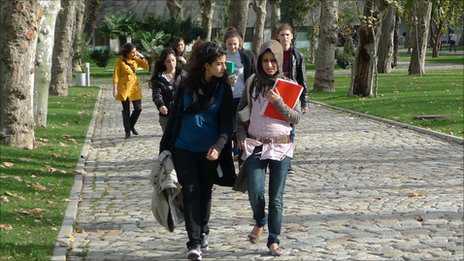
    Every morning Yasemin Derbaz puts on the piece of cloth that marks her out as an observant Muslim.

    The headscarf ban has been lifted by all but a handful of universities
    The headscarf ban has been lifted by all but a handful of universities

    Millions of other Turkish women do the same: it is estimated that at least 60% cover their heads.

    Now, for the first time, almost all universities across Turkey have abandoned the official prohibition on women wearing headscarves.

    The ban ended when the government issued a statement in September saying it would support any student expelled or disciplined for covering her head.

    Continue reading the main story

    “Start Quote

    Yasemin Derbaz

    I feel happy that I don’t have to stop in a mosque on the way and change into my wig”

    End Quote Yasemin Derbaz

    The Islamic headscarf has become a divisive symbol, which bars women from jobs and education, and came close to bringing down a government two years ago.

    Yasemin can now go to her architecture classes at Yildiz Technical University for the first time without wearing a large hat or a wig to cover her hair.

    “I feel happy that I don’t have to stop in a mosque on the way and change into my wig,” she said.

    The exact status of the headscarf ban is mired in confusion.

    There is no law against wearing one. Nor does the ban originate with modern Turkey’s founder, Mustafa Kemal Ataturk, although he did discourage women from covering their heads, and passed a law barring men from wearing traditional Ottoman clothing.

    Turkey's Prime Minister Recep Tayyip Erdogan (R) and his wife Emine Erdogan Emine Erdogan was blocked from entering a military hospital in 2007 for not removing her headscarf

    The more recent ban on headscarves in universities and for public servants dates back to regulations passed by government departments in the 1980s, after the last military coup.

    With leftist groups harshly suppressed, Islamic parties made strong gains among the Turkish electorate in the elections that followed, prompting a reaction from the avowedly secular military.

    The university ban was only properly enforced after the military forced out an overtly Islamic prime minister in 1998.

    What the regulations had in mind was not the traditional scarf, tied around the neck by peasant women in Anatolia, but the hijab, also called a turban in Turkey, which has become a symbol of pious or political Islam, worn by growing numbers of urban, educated women since the 1980s.

    It is for that reason that military buildings will allow headscarfed women in if they take out the pin that holds the tightly-wound hijab in place – they have a special pin-box at reception.

    Continue reading the main story

    “Start Quote

    The state should be impartial to race, religion, everything”

    End Quote Hursit Gunes Opposition CHP party

    Emine Erdogan, the wife of Prime Minister Recep Tayyip Erdogan, was blocked from entering a military hospital in 2007 for refusing to remove hers.

    Mr Erdogan tried to overturn the university ban in 2008, through a constitutional amendment guaranteeing the right to education.

    It passed through parliament, but was thrown out by the Constitutional Court.

    But this year, with the momentum behind him after winning the constitutional referendum in September and more compliant bureaucrats in the Board of Education, the government in effect ended the ban by stealth.

    The Constitutional Court is in any case being restructured following the referendum, and is less likely to challenge the governing party so boldly in future.

    Caught off-guard

    The main opposition party, the secular CHP – previously a strong supporter of the university ban – wanted to negotiate its end with the government, but was denied the chance.

    Fatma Benli Lawyer Fatma Benli says that her headscarf bars her from appearing in court

    But the party has vowed to maintain the ban on civil servants wearing headscarves.

    “The reason why we don’t allow a headscarf for, say a judge, is that it is a symbol of religion. The state should be impartial to race, religion, everything,” says Hursit Gunes, a deputy secretary-general of the party.

    There are still academics appalled by the prospect of headscarves on campus.

    “Universities are supposed to be places where science and scientific thought can be discussed freely,” says Nezhun Goren, a biology professor at Yildiz Technical University.

    “Religious faith can’t be discussed, you either accept it or reject it.”

    Disadvantaged

    The resistance to headscarves among many secular Turks seems to be driven by something deeper – a belief that the rigorous adherence to Islam it symbolises in the wearer will eventually reverse the modernisation of Turkish society under its strictly secular system.

    Islamic fashion show Lawyers are still barred from wearing the headscarf in court
    Headscarfed women say right now they are the ones who are disadvantaged.

    Fatma Benli is an experienced lawyer who specialises in defending women. But her headscarf bars her from appearing in court – she has to appoint bare-headed proxies to defend her clients.

    “For 12 years I’ve been working long hours as a lawyer and I have specialist skills, in international law, so I should be well-paid,” she says, “yet I still have to rely on financial help from my parents to run my office”.

    Dilek Cindoglu, a sociologist at Bilkent University who does not wear a headscarf, has done research which shows that the restrictions on headscarfed women in the civil service have spilled over into the private sector.

    “Once they get employment they are being discriminated against in terms of promotions, salaries, and in terms of dismissals should the company decide to reduce the workforce.”

    I asked Yasemin if she understood the fear many secular Turks feel about openly pious Muslims like herself.

    “I am forcing myself, but I cannot say that I totally understand it.”

    She argues that she was the one left with the psychology of fear, not them, because for 10 years she was unable to go to school wearing her headscarf.

  • And the Winner Is…Istanbul

    And the Winner Is…Istanbul

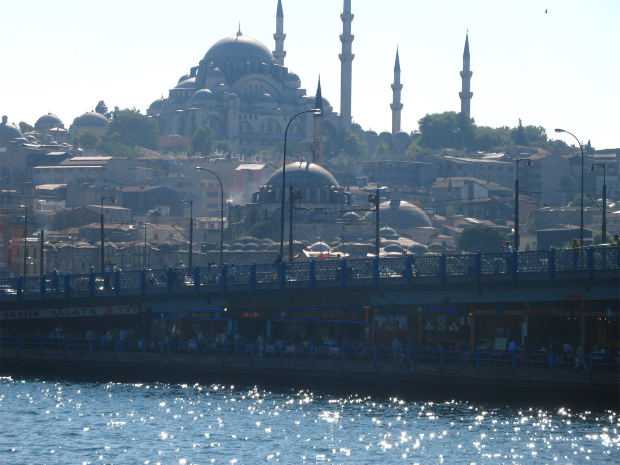
    In early 2010, as our readers were no doubt whittling down their list of New Year’s resolutions, we asked them a question that is a bit more fun to contemplate: where do you want to travel this year?

    The question, in a multimedia presentation, accompanied our 2010 Places to Go issue.

    Now that we are putting the finishing touches on our 2011 list, voting is officially closed, and we can unveil the winner for 2010: Istanbul, by a landslide.

    The readers who recommended Istanbul repeated some themes. Alan of New York, Peter of Istanbul and others mentioned the history. “What you see here today literally spans the centuries (and millenniums), in terms of the stones beneath your feet and cultures,” Peter wrote. Several other readers mentioned the people and the culture.

    Other popular choices among readers included Colombia, Seoul, Costa Rica and New York.

    Next week, when we publish our Places to Go list for 2011, readers will be able to submit their own recommendations, as well as pictures and comments, online again.

    via And the Winner Is…Istanbul – NYTimes.com.

  • İstanbul’s 8,500-year history told in ‘Capital of Cultures’

    İstanbul’s 8,500-year history told in ‘Capital of Cultures’

    İstanbul’s 8,500-year legacy in political, socioeconomic and cultural fields is being told in a new book launched this week as part of the İstanbul 2010 European Capital of Culture program.

    Put together by an İstanbul-based NGO called the Türk Kültürüne Hizmet Vakfı (Foundation of Service to Turkish Culture), the book “Kültürler Başkenti İstanbul” also has an English version, titled “Istanbul the Capital of Cultures.” Both versions of the book were launched at a gala on Wednesday at the Caferağa Medresesi in Sultanahmet.

    The book aims to show the fact that “İstanbul has always been a center for economic, commercial and cultural connections from the past to the present day,” the İstanbul 2010 agency says about the book on its website.

    Şerafettin Yılmaz, the president of the foundation, said during Wednesday’s gala that the book was an effort to “recount the little-known story of İstanbul’s 8,500-year history,” the Anatolia news agency reported.

    The book is divided into four chapters, titled “From Ancient Ages to the Post-Roman Period,” “Eastern Roman Empire (Byzantium) Period,” “The İstanbul of the Ottoman Era” and “Republican Years and İstanbul.” The 1,440-page volume brings together the writings of 76 researchers and specialists on İstanbul’s history, accompanied by a rich collection of around 1,000 photographs.