Year: 2010

  • The Turkish Myth..

    The Turkish Myth..

    An Important Article For your Files and to send your Armenian and Greek friends and Their discussion groups to show them that they are victim of lies by their diaspora:

    Turkish Forum – World Turkish Coalition (Dünya Türkleri Birligi)

    Support Turkısh Forum: https://www.turkishnews.com/en/content/2010/02/09/aidat-ve-bagis-odeme-yontemleri/
    ——————————————————————————————————————————————
    See what they were saying way back in the 23 June 1923 edition of the Nation Magazine (it is simply amazing, especially the response at the very end coming from an Armenian): Sevgin Oktay [[email protected]]

    for the record:

    Arthur Harold Moss (born November, 1889 Greenwich Village – Feb. 20, 1969 Neuilly-sur-Marne) was an American expatriate poet, and magazine editor. https://en.wikipedia.org/wiki/Arthur_Moss

    the June 13, 1923 edition

    The Turkish Myth

    March 9, 2007

    By Arthur Moss & Florence Gilliam

    he few Westerners of importance who have tried to give faithful pictures of life in the Near East have been outnumbered to the extent of being smothered. Major General Harbord, sent officially to investigate conditions; H. G. Dwight, a former United States consular official and author of “Constantinople” and “Stamboul Nights”; Pierre Loti, the romantic lover of Turkish civilization; Anatole France, whose keen mind usually penetrates popular illusions; and H. G. Wells, in “The Outline of History,” are members of the small group of Westerners who have defended Moslem civilization. When Lothrop Stoddard says: “Fourteen hundred years ago Islam rose and flooded the civilized world,” he obviously regards the Mohammedan advance as a wave of barbarism sweeping to destruction the elements of a lofty Western civilization. A pretty theory upon which H. G. Wells has made the following comment: “If the reader entertains any delusions about a fine civilization, either Persian, Roman, Hellenic, or Egyptian, being submerged by this flood (the advance of Islam), the sooner he dismisses such ideas the better. Islam prevailed because it was the best social and political order the times could offer.” Anatole France goes him one better by declaring that “the most tragic day in history is that of the battle of Poitiers when in 732 the science, the art, and the civilization of Arabia fell back before the barbarism of the Frank.”The age-old charge against the Turks is of course the Armenian massacres. A journalist not long since tabulated the reports of these massacres in recent years and showed that they totaled thirty-five million slain. As the whole Armenian population is known never to have exceeded three million, there is obviously a case of falsification somewhere. The Bryce reports have been proved to be without tangible evidence and to have been based entirely on hearsay. It has been remarked that investigation in the villages where Turks were in the minority would have revealed just as many instances of Greeks and Bulgars massacring Turks. Indeed it is notable that the Greeks and Bulgars accuse each other of such atrocities much more than they accuse the Turks. The situation is of course the result of an agelong conflict between different peoples who have become almost inextricably mixed politically. Those massacres which occur among the Armenians are most often the work of the Kurds, who are roving bands about as lawless as the mobs in parts of the American South, and about as out-of-hand politically as the banditti who infest parts of Italy and Spain.

    Finally, there could be no more complete refutation of the long-perpetuated charges against Turkey than the behavior of the Turkish army during the recent offensive in Smyrna. All the events of this advance have been reported by British and American papers whose policy has been consistently anti-Turkish. When the victorious army entered the region, the Christian population, remembering the precedent of 1919 when the Greeks slaughtered 4,000 Moslems, began sending out panic-stricken appeals for protection, anticipating retaliation on the part of the Turks. And the Council of the League of Nations at Geneva sent to Angora a mild request that no reprisals be made for the Greek atrocities. A strange turn of phraseology: the League of Nations admitting Greek atrocities! Gradually it dawned upon the Christians in Smyrna and upon the Christian nations of Europe that no reprisals were to be made. But the retreating Greeks in complete demoralization behaved so badly that even the efficient British censorship could not stop the leaking of news. The pillaging and burning by the defeated Greek army grew to such proportions that it was difficult for Izmet Pasha to restrain his troops from retaliation. But restrain them he did, and his men behaved with such dignity and orderliness as to profoundly impress Western observers. (How different from the actions of our own marines in Haiti!) The first Turk troops to enter Smyrna were military police who prevented looting and did their best to still the panic among the hysterical Greek civilians. The correspondents of the Chicago Tribune, the London Daily Mail, and Reuter’s stated emphatically that the unfortunate burning of the city was not in any way traceable to the Turks. In spite of these reports by correspondents who were on the spot and who have no reason to favor the Turkish cause, we still hear that the Turks burned Smyrna.

    During the retreat, Reuter’s correspondent was warned by Greek officers to leave Ouchak as that town was to be burned. I quote his dispatch from Smyrna: “The demoralization of the Greek troops was complete and the behavior of most of the Greek officers disgusting. On the retreat to Smyrna many Greek officers personally led the looting and pillaging.”

    But it remains for an American official, a man sent by a great relief organization to help succor the downtrodden Greeks and Armenians, to knock the last props from under the stupid edifice of lies and anti-Turk propaganda. Colonel Haskell of the American Red Cross has just returned from a tour of investigation in the Near East. Speaking officially he said: “America should feed the half million Turks whose hinterland was wilfully demolished by the retreating Greeks, instead of aiding the Greeks and Armenians who are sitting around waiting for America to give them their next meal. The stories of Turk atrocities circulated among American churches are a mess of lies. I believe that the Greeks and not the Turks are barbarians.”

    It has been pointed out that the past wars of Islam have been waged with the hope of plunder. How many nations have entered war without some such hope? And in Angora the desire was not for conquest but simply to regain Constantinople, a city that has been Turkish for 500 years and has at present a population which is predominantly Turkish. If wars of conquest are to be deprecated, what could have been a plainer scheme of aggrandizement than the last Greek expedition, materially fortified by the imperialistic policy of Lloyd George? The Greeks were deluded by a dream of regained Alexandrian Empire. It is as though Italy should suddenly demand the restitution of all the Roman provinces on the strength of her glorious past. Charles Saglio in l’OEuvre, Paris, commenting upon the statement of the British Government that the Turkish victory complicated matters in the Near East, said Mustapha Kemal had really rendered a great service to the Allies in driving the Greeks out of Smyrna, which was the most Turkish of all Turkish territory, and had thus largely cleared up the situation instead of confusing it.

    In Turkey, all three main religions–Mohammedanism, Judaism, and Christianity–are on an equal footing; the numerically dominant one is completely divorced from the state. This will not mean any falling off in the followers of Mohammed, but merely that other religions are to have equal rights. A Catholic cannot go as far politically in secular America as a Christian can go in so-called theocratic Turkey. Turkey is no more Islam than Italy is Catholicism. There are rumors of a religious war. If it ever comes, it will not come from Turkey as a center but from the outside pressure of Arab tribes. Even under less enlightened rulers than the present government the Turks have been extraordinarily tolerant to other religions. During the 500 years of Turkish occupation of Jerusalem no religious shrine belonging to another people was molested. All sacred spots were open to visitors of the different faiths. And it may be noted in this connection that the inauguration of Allied control precipitated an immediate squabble of nations and sects concerning the guardianship of the holy places. It is not likely, either, that any Western nation would have allowed to Mohammedan missionaries extraterritorial rights such as have been enjoyed by the American College in Constantinople.

    Turkey’s greatest crime in modern times seems to have been her entrance into the war on the losing side. Most of our war records tell of the villainy of Enver Bey, but how many refer to Mahmoud Shevket Pasha, the Minister of War whom the Germanophiles of Turkey assassinated because he was doing his best to keep Turkey out of the conflict?

    But whatever may be the merits of this case, the Treaty of Sevres, August, 1920, was the last and greatest effort of the Christian Powers to divide Turkey as they have divided Austria, leaving the latter state to the mercies of international charity. In Turkey there was not the excuse of a heterogeneous population as in Austro-Hungary, the population of Turkey being 70 per cent Ottoman Turk and 85 per cent Moslem. The Treaty of Sevres was an AngloFrench grab-scheme; its successor which is to be evolved from the proposals and counter-proposals initiated at Lausanne is likely to be little more.

    It is almost impossible to grasp the revolutionary achievements of Mustapha Kemal Pasha, head of the Angora Government. Here is a man of forty, who in the course of a few years has accomplished what would have been considered a task for 500 years, leaping from entirely unrepresentative governmental methods to really democratic ones. Many of the petty rulers of Turkey before the war were lazy rather than vicious. Turkey was a despairing country, sure of being attacked by European Powers whatever its policy. No one wanted to be really responsible for anything. Kemal has made sweeping changes in this respect. Suffrage is absolutely universal with no discrimination for race, color, creed, or sex. The harem system has long been outworn and economically impractical, and there is now an active Turkish Women’s Party with at least as much influence as the National Woman’s Party in America. (Kemal has recently been married to Latifeh Hanoum, one of the leaders of this party.)

    The present Government is based on the village system. Each village elects representatives to a body which in turn elects district representatives. These form a council which votes for president. Mustapha Kemal is responsible to this council and trusts himself to a general election at least once a year; he has held office ever since the formation of the Angora Government. It is new for Turkey to have a ruler animated by statesmanlike intelligence and backed by popular support. Angora has recognized the independence of Armenia, Azerbaijan, the Hejas, and Irak. These countries are more grateful to Angora for such recognition than they are to the Allied congress which made them independent states. Because of Mustapha Kemal’s genius and honesty of purpose, and the ability and liberalism of the men associated with him in the new Turkish Government, the Moslem world presents an almost united front under the leadership of Turkey.

    The Western world has just begun to realize the great difference between Old Turks and Young Turks. Mustapha Kemal’s Government is endeavoring to prove by its every political move that the appropriate term of the hour is neither of these, but New Turks.

    To THE EDITOR OF THE NATION:

    SIR: It is always disappointing when so admirable a journal as yours gives place and apparent weight to arguments in support of indubitable tyranny, but it is especially so when such arguments are palpably irrelevant and illogical. The article on The Turkish Myth, sponsored by Arthur Moss and Florence Gilliam, is the case in point.

    Conceive of attempting to speak upon so grave a matter without even the most elementary knowledge of the historic background! Islamic civilization and the Turk! Is it possible that anyone who has given thought to this question at all does not know that this great civilization was Arabic or Saracenic; and that on the historic day of Poitiers, 732, to which allusion is made, when “the science, the art, and the civilization of Arabia fell back before the barbarism of the Franks,” the Turks were still, as they were for some five or more centuries to come, in the heart of Tartary or Turkestan; and that when they arrived it was not to save or to add to but first to destroy and then to imitate such remnant of this civilization as was left? An impartial and a thorough reading of Mr. Wells, to whom these writers allude, would at least have made this fact clear. For on this point he is specific. And even of the Arabs themselves he says (page 636, Vol. II) “the mind of the Arabs blazed out like a star for half a dozen generations after the appearance of Islam, having never achieved anything of importance before or since.” And with respect to the Turk versus the Greek (Col. Haskell’s barbarians, according to the article), quoting with approval Sir Mark Sykes, Mr. Wells apparently believes (page 124, Vol. II) that

    Constantinople had been the tutor and polisher of the Turks. So long as the Ottomans could draw science, learning, philosophy, art, and tolerance from a living fountain of civilization in the heart of their dominions, so long had the Ottomans not only brute force but intellectual power. So long as the Ottoman Empire had in Constantinople a free port, a market, a center of world finance, a pool of gold, an exchange, so long did the Ottomans never lack financial support Muhammad was a great statesman; the moment he entered Constantinople he endeavored to stay the damage his ambition had done: he conciliated the Greeks, he did all he could to continue Constantinople the city of the Emperors but the fatal step had been taken; Constantinople, as the city of the Sultans, was Constantinople no more; the markets died away, the culture and civilization fled, the complex finance faded from sight; and the Turks had lost their governors and support.

    In the face of this and of the vast bulk of other historic evidence, is it not really overbold on the part of these apologists to attempt to intrigue your readers into an exactly opposite view? Pierre Loti, H. G. Dwight, and Major General Harbord may indeed, in some respects, share their point of view. But I feel that long-time and distinguished friend of Armenia, Anatole France, does not.

    And when they come down to modern times and to that real and perennial skeleton in the closet, the desperate struggle of the Armenians for emancipation, and the wholesale massacre of them by their “tolerant” masters, your writers do not appear to be on any firmer ground. Ignoring the legion of eyewitnesses of every class and nationality, they fall back upon a journalist’s mocking tabulation to the effect that if reports were credible then of a total population of 3,000,000 people 35,000,000 would already have been slain. I wonder if this journalist, and the writers, would be willing to accept a reduction of 34,000,000? This would bring the number of slain down to only one million, the number generally estimated, and still leave the Armenians with a heavy enough loss and the Turks with a sufficiently ghastly responsibility.

    In the last paragraph but one, one comes upon the interesting news that Angora has “recognized” Armenia (Russian Armenia) and that the Armenians are more grateful to Angora for having done this than to the Allied Congress which made them independent. Ye gods! And did the Allied Congress make these Armenians independent? We who have been following the case closely have always supposed that Armenia had won her own independence and had kept it by Russian sanction and that she felt not the least gratitude either to Turkey or to the Allies.

    BERTHA SULLIVAN PAPAZIAN

    THE EDITOR OF THE NATION:

    SIR: We beg leave to reply to Miss Papazian’s letter of June 12, wherein she objected to certain statements made in our article The Turkish Myth. The venerable Arslanian, present Patriarch of Christian Armenia and certainly more qualified to speak for his people than are absentee patriots, stated to the Chicago Tribune representative in Constantinople on April 30: There is no truth in the story that my people have appealed to Sir Horace Rumbold to raise any Armenian question at Lausanne. We formally disapprove of propaganda conducted by Armenians abroad. This only arouses animosity and accomplishes nothing. It makes the Armenian people a mere cloak for the selfish policies of the Great Powers. We Armenians are participating wholeheartedly in the elections as our duty. We are resolved to work hand in hand with Turkey in the interests of the nation.

    The Patriarch was not under Turk coercion or influence, being at the time under the protection of Allied guns. Miss Papazian says that the recent independence of Armenia was achieved by the Armenians. True, but by Armenians at home, working hand in hand with members of the new government of Turkey. We did not, as Miss Papazian suggests, ignore testimony of eyewitnesses as to alleged massacres. One of the writers, Mr. Moss, has spent considerable time in the Near East and has first-hand knowledge of atrocities perpetrated by Kurdish bands (as was admitted in our article), and also knows of many atrocities committed by Armenian, Greek, Bulgar, and Serb comitadje.

    ARTHUR MOSS and FLORENCE GILLIAM
  • Wellington Letter “THE TURN OF THE TIDE.”

    Wellington Letter “THE TURN OF THE TIDE.”

    February 8, 2010 Volume 33: No. 3
    PHASE II of the GLOBAL CRISIS!
    THE STOCK MARKET
    END of the 10 MONTH RALLY!
    Our SPECIAL BULLETIN of January 21 was headlined: “THE TURN OF THE TIDE.”
    We wrote: The tide has turned in favor of the bears. From now on, rallies will be sold and sold short. We repeat our advice of last time, namely be out of all the strong sectors of the prior 10 months, including the precious metals.
    This year it will be important to ignore higher earnings as a motivation to plunge into the market. In the above BULLETIN we wrote: Market analysts expect 2010 to see a rise in corporate earnings and sales. They are probably correct. But that will be met by further market weakness. You see, that’s what the stock rise of the prior 10 months was all about. Stocks are already priced for the best news that could possibly develop this year. When all the fund managers are positioned for this “good news,” there is no further money to go in. And that’s when the selling gets serious.
    Have you noticed that while last year most of the news was positive, and even negative news items were followed by a positive stock market move. Since mid-January, it’s exactly the opposite: most of the news is bad, and even positive news is greeted bearishly by the markets. This is a very important shift.
    When speculators feel comfortable that all the risk is gone because the Fed wouldn’t dare raise rates, speculation goes out of control. In the last cycle, this was called the “Greenspan put.” In 2007 we warned about the perception of low risk which eventually ends with a plunge. It did! Now they could call it the “Bernanke put.” The perception since March is that the Fed would prevent any recurrence of a crisis. The Fed is now trying to change that view.
    Bert Dohmen’s Wellington Letter, P.O. Box 49-2433, Los Angeles, CA 90049
    Phone: (310) 476-6933 Fax (310) 440-2919 Website: www.dohmencapital.com E-mail: [email protected]
    1
    Bert Dohmen’s
    Wellington LetterTM
    Bert Dohmen’s Wellington Letter, P.O. Box 49-2433, Los Angeles, CA 90049
    Phone: (310) 476-6933 Fax (310) 440-2919 Website: www.dohmencapital.com E-mail: [email protected]
    2
    THE INTERMEDIATE TERM VIEW:
    Sentiment of stock market investors and traders in January was as bullish as you get at important tops. On January 20, the market broke sharply to the downside because of monetary tightening in China. Now you will hear the Wall Street guys in the media talk about “a mild short-term correction” or a “buying opportunity.” They will be surprised when the major indices are suddenly down 20% or more.
    In our January 12 ACTION ALERT in our PRIVATE PORTFOLIO service, we wrote:
    For all the reasons stated in our ACTION ALERT of January 6 … exit all the remaining positions in our PRIVATE PORTFOLIOS … signals we see in our own trading during the day strongly suggest that the big trading operations have liquidated their long positions over the past several months and are now short.
    The evidence suggests that the plug has now been pulled on all the bulls. The precious metals, basic materials, commodities, emerging markets, etc., i.e., all the sectors which have been hyped by Wall Street, are now ready for meaningful declines.
    That was just before the January 19 top of the 10-month rally. Is that worth the subscription price?
    On January 22, the market decline had been three consecutive days and wiped out the gains in the indices of the prior three months. In our January 22 SMARTE TRADER we wrote:
    The bears are overwhelming the bulls in the stock market. The bulls are trying hard to dismiss the decline with comments like “the market deserves a pullback,” or “it just gives us another buying opportunity.” Although anything can happen in the markets, our work suggests that this decline is of much greater importance. Here is why we say that:
    Since mid-October, volume of trading has been shrinking while the major indices rose grudgingly. The low volume shows that the bulls had little ammunition left, and those who did, weren’t willing to commit it. Such a configuration means that a demand vacuum has been created and that eventually prices will decline sharply until prices get so low that it finally attracts new buying. And that is more than 5-10% down in our view.
    The fact that bullish sentiment the past several months has been near levels seen at bull market tops, such as in 2007, shows that everyone who was inclined to buy was already in the market. Mutual fund cash is at very low levels, indicating that buying is exhausted.
    Selling is picking up instead of diminishing. That suggests that this decline is the real thing and will go much lower than the majority expect. First support is in the 1000 area of the S&P 500. That would mean a lot of damage for individual stocks.
    On February 2, a two-day rally started. The bulls said it was another buying opportunity. We said in our services that bear market rallies usually last only 2-3 days. Right on target, the plunge recommenced on February 4, with a 300-point decline in the DJI at the low of the day. That’s how technical analysis
    Bert Dohmen’s
    Wellington LetterTM
    Bert Dohmen’s Wellington Letter, P.O. Box 49-2433, Los Angeles, CA 90049
    Phone: (310) 476-6933 Fax (310) 440-2919 Website: www.dohmencapital.com E-mail: [email protected]
    3
    works. Unfortunately 95% of the guys you see in the media don’t know anything about that type of analysis. That’s good for us.
    On February 4 we wrote in our SMARTE TRADER:
    Today was the day we were waiting for. As you know, our work shows that this decline is a return to the global financial crisis. We couldn’t have made it any clearer in our services since late December.
    Even this week while the market had a two-day rally, we said it would be 2-3 days up, and then a serious decline would commence. Well, today it did. The bulls are now concerned. They had not expected such a powerful plunge. At the low, the DJI was down just about 300 points.
    Analysts who use fundamentals invest in the past. But it’s the future that counts. Fundamentals show history. They show what companies did. But stock prices are a function of the willingness of money to flow into or out of stocks. And that depends on many other factors, such as probability of banking crises, debt defaults, and now the potential of sovereign debt defaults. All of these dry up demand for stocks, no matter what the fundamentals are. It changes the supply/demand equation. While supply increases greatly, the demand for stocks shrinks abruptly. Result: plunging stock prices.
    During the plunge of February 4, trading volume soared. As it was on a big down-day, that’s very bearish.
    Volume on the downside of trades vs. on the upside was an incredible 97.3% of total volume. I can’t remember ever having seen such an overwhelming down volume percentage except for some of the memorable market crashes.
    On that day, the ratio of advancing to declining stocks was 1 to 8. That means almost 90% of the stocks declined. Overwhelming! These numbers show that there is a lot of overhanging supply. Any rallies will be short and should be used for short selling.
    I spoke at a conference in the Bahamas that week. I warned early that week that it was the last chance to get out of stocks. Those who heeded that advice saved enough money to pay for such conferences the next 100 years. Those who didn’t sell will unfortunately wait “to get out even.” That’s a disastrous policy.
    There is only one good way to handle a loss: “SELL.” It’s actually very calming.
    In December, we started predicting a strong and longer term surge in the U.S. dollar. That’s happening right now. We can’t say that this is “causing” the bearish reversals of all the former strong markets, but it is what we predicted. The dollar is now the “safe haven” currency, just as in 2008.
    As we wrote in our December 21, 2009, issue and the January 5, 2010, issue, all the bullish stories about commodities, emerging markets, international stocks, and currencies will evaporate with a stronger dollar.
    Bert Dohmen’s
    Wellington LetterTM
    Bert Dohmen’s Wellington Letter, P.O. Box 49-2433, Los Angeles, CA 90049
    Phone: (310) 476-6933 Fax (310) 440-2919 Website: www.dohmencapital.com E-mail: [email protected]
    4
    During the plunge of February 4, gold plunged $50 at the low and closed with a loss of $47. Even if your long-term outlook is bullish, and you are a long-term gold investor, ask yourself if you can hold
    onto gold for a potential 32%, or even 50% decline. The latter would mean a decline below $700. I don’t believe it will go that low, but you always have to plan for the worst. You have to know your pain threshold. Even such a decline would not eliminate the-long term bull market because 50% corrections are normal in any bull market, whether stocks, commodities, or other investments.
    The price of oil plunged over $8 in three days. As we advised for several weeks, all the hot sectors of last year will now crash. The rally was not based on solid fundamentals, but on speculation. Now it’s time to pay the piper. It gives us great short-selling opportunities.
    The sovereign debt crisis started with Dubai last year. We called it the “canary in the mine.” In early January, Greece came in the news and the situation is still worsening. Next are Portugal and Spain. Thereafter, it will be Britain. And that one will spread to all of Europe faster than the swine flu.
    Over the weekend, G-7 Finance Ministers met just south of the Arctic Circle in Canada to discuss the crisis in Greece and other urgent topics. Did they resolve the growing debt problems of the ever growing list of European Countries in trouble? Here is what they said:
    “We need to continue to deliver the stimulus to which we are mutually committed and begin looking at exit strategies to move to a more sustainable fiscal track,” Canadian Finance Minister Jim Flaherty. Nothing was said about resolving Greece’s debt problem. Greece’s deficit is currently 12.7% of GDP, far above the ECU’s limit of 3%. Yet, the president of the European central bank says that he is confident that Greece will be able to comply with the ECU limit by 2012. He didn’t say how.
    In our view, that would be more magic. Do these people ever worry about “credibility?”
    In the meantime, the Greek Prime Minister threatened to cut public service wages. The workers in the customs and tax departments responded by walking off the job.
    The false theory of a solid economic recovery will now be shattered as reality returns to the markets. While the pundits will tell you that Greece, Portugal and all the credit problems of Europe are not important, they said the same thing in early 2007 about the subprime mortgage problem. The world is totally interconnected. These problems show that the next crisis may be as serious as the one in 2008, just different. The emerging markets will suffer the most.
    We can’t change what is going to happen. But at least we can compensate for the loss of value of our homes and assets by making some money on the downside.
    Bert Dohmen’s
    Wellington LetterTM
    THE CHARTIST’S VIEW
    The SPY is the ETF for the S&P 500. We like to use it because of the volume numbers. Note that on this chart of the SPY (daily) clearly shows the big decline in volume over the past 10 months while the index and the ETF continued to move higher. Declining volume in a rising market means that a virtual vacuum of buyers is being created. Eventually, prices have to plunge to a level low enough to attract new buying.
    And now we have another confirmation of the bearish chart: this month, volume has been rising as the prices declined. That’s a typical bearish pattern.
    On October 6, I had sent the S&P 500 charts to Jim Cramer who used them on his show and, as always, gave a very nice introduction to your editor. (Go to www.youtube.com, or Itunes for the recording of the show.) On the chart, I had marked the 1100-1120 level as the most likely target. If that was penetrated, I said the 1200 area would “be like a brick wall.”
    Well, the S&P 500 got to 1150, just 30 points above our most likely target. There is a small chance it may rally and exceed that.
    SPY (daily) 2-5-2010
    Bert Dohmen’s Wellington Letter, P.O. Box 49-2433, Los Angeles, CA 90049
    Phone: (310) 476-6933 Fax (310) 440-2919 Website: www.dohmencapital.com E-mail: [email protected]
    5
    Bert Dohmen’s
    Wellington LetterTM
    SPY (weekly) 2-5-2010
    The chart of the SPY (weekly, in which each bar is one week of trading) below is even more revealing.The important trading channel (2 standard deviations) has been broken to the downside.
    Furthermore, the MACD indicator below has crossed over to the downside for a sell signal. On a long term chart, that’s meaningful.
    The GOLD chart (daily) shows a big correction to the $1050 area. This could be a support area, at least for the near term. It’s the Fibonacci 50% retracement of the rise since last April. It’s also the level at which the Central Bank of India bought their 200 tons of gold. Therefore, we have two reasons why demand could come in at this level and at least produce a rally.
    GOLD (daily)
    Bert Dohmen’s Wellington Letter, P.O. Box 49-2433, Los Angeles, CA 90049
    Phone: (310) 476-6933 Fax (310) 440-2919 Website: www.dohmencapital.com E-mail: [email protected]
    6
    Bert Dohmen’s
    Wellington LetterTM
    However, the next chart of GOLD (weekly) is longer term and shows that the more important low was the crisis low of late 2008. If we measure a 50% retracement from that, we would get a decline to the 960 level. The bottom line is that there should be a bounce right now, but probably is not the low of the correction.
    GOLD (weekly)
    The US DOLLAR (weekly) made a nice bottom last November and is now rallying. This chart suggests that it has much further to go. However, such moves don’t occur without setbacks. Don’t throw caution to the winds. Of the major currencies, the British Pound, Australian Dollar, and Canadian dollars may be the most vulnerable on the downside right now.
    US DOLLAR INDEX
    Bert Dohmen’s Wellington Letter, P.O. Box 49-2433, Los Angeles, CA 90049
    Phone: (310) 476-6933 Fax (310) 440-2919 Website: www.dohmencapital.com E-mail: [email protected]
    7
    Bert Dohmen’s
    Wellington LetterTM
    BOTTOM LINE: the evidence suggests that important turns in the markets have been made by all the formerly hot areas. Over the very short term, there could be a bounce, but that would just be another selling opportunity.
    THE INVESTING FABLE of LONG TERM INVESTING
    We have written for 32 years that the Wall Street sales talk of the stock market gaining at 10% per year is a falsehood. In our last issue we pointed out that the major indices had no gain at all for the last year. Here is a great chart from our colleague Alan Newman of stock market performance over the long term:
    Chart courtesy of CROSSCURRENTS, 3280 Sunrise Hwy. #125, WANTAGH, NY 11793
    Going back to 1920, the average gain over any 20-year rolling period is only 5%. That’s more realistic than the 10% annual gains which Wall Street tell you to expect. So, if you want to make 5% per year over the next 20 years, you may want to try a major index. I wouldn’t.
    THE ECONOMY
    A report from the Federal Reserve of Dallas stated: The financial crisis that began in August 2007 and intensified in the fall of 2008 pushed the global economy into a severe downturn that some have called the Great Recession. World trade collapsed at a pace unseen since the Great Depression of the 1930s.
    Our subscribers were forewarned in 2007 of the potential of a global financial meltdown. I described it in the book written that year, PRELUDE TO MELTDOWN. I predicted it would be as bad as in the
    Bert Dohmen’s Wellington Letter, P.O. Box 49-2433, Los Angeles, CA 90049
    Phone: (310) 476-6933 Fax (310) 440-2919 Website: www.dohmencapital.com E-mail: [email protected]
    8
    Bert Dohmen’s
    Wellington LetterTM
    Bert Dohmen’s Wellington Letter, P.O. Box 49-2433, Los Angeles, CA 90049
    Phone: (310) 476-6933 Fax (310) 440-2919 Website: www.dohmencapital.com E-mail: [email protected]
    9
    1930s, and eventually perhaps worse in some areas. Isn’t it amazing that all the economists at the Federal Reserve (over 500 PhDs), none of the regulators, and very few of the smart guys on Wall Street, saw it coming?
    At the Global Milken Conference in April 2007, which features over 400 of the top executives of private equity firms, Wall Street firms, Nobel recipients in economists, etc., not one saw it coming. The only words of caution came from Barry Sternlicht, founder of Starwood Hotels, who said: “When the music stops, you better have a chair.”
    The global meltdown was averted, according to some governmental leaders, at “5 minutes before 12.” The governmental bailouts injected over $5 trillion worldwide. Now they are faced with the consequences of such unprecedented money creation and the governmental mountains of debt.
    The Federal budget deficit in FY 2010 is around an incredible $1,600 billion ($1.6 trillion), or about 10% of GDP. About 80% of that deficit is financed by the Federal Reserve buying the U.S. debt. That’s called “monetizing the debt.”
    In 2009 Fed head Bernanke was Time’s cover boy as ‘Man of the Year.’ The same year he testified before Congress that “we will not monetize the debt?” Well, now he is monetizing more debt than any Fed chairman in history. This is the debt that no one else wants to finance, whether in the U.S. or abroad. It will get much worse when China shows Washington who’s in a position to call the shots. Washington has been irritating China more and more in recent weeks. We wonder, why?
    UNEMPLOYMENT FABLES:
    Eventually the recovery will fail because of the lack of job creation. Without jobs, consumer spending cannot grow at a meaningful rate. Why won’t jobs be created? We need 1.5 million new jobs created each year just to accommodate all the new people entering the labor force.
    The jobs report on December 4 showed a loss of “only” 11,000 people in November, which sent the stock market soaring. But these are “seasonally adjusted,” deceptive governmental numbers. Using the “household survey” about 584,000 people lost their jobs. That’s quite a difference. We view the latter survey more accurate in a recession.
    The Employment Report for December shows that 150,000 people lost their jobs that month vs. the prior estimate of 85,000. Economists were originally expecting no job loss. However, the unemployment rate stayed at 10%. How is that possible? The government declared that 660,000 dropped out of the labor force. These are people who gave up looking for a job. That reduces the labor force, counteracting the job loss for the purpose of the unemployment rate. You see, numbers are never what they seem.
    Had the labor force stayed the same size over the past six months, then the unemployment rate would now be 11%. That of course would shock Americans. The truth usually does. But there are more fables.
    Bert Dohmen’s
    Wellington LetterTM
    The latest report on February 5, showed a decline in unemployment to 9.7%. Another piece of magic, because the same report showed a loss in jobs of 20,000 in the “payroll survey.” How is that possible? Again a big decline in the size of the work force. So, the report is actually very negative instead of positive.
    The government “birth-death model” arbitrarily adds new jobs to the numbers each month. Last year they may have artificially added as many as 1.7 million jobs to the numbers this way. That makes sense in an expanding economy, but is totally erroneous in a recession because small firms are most probably reducing jobs. Last May the BLS made an adjustment for this error with an 824,000 job downward revision. The Household Survey doesn’t contain this “fudge factor.” In a downturn we consider these numbers more reliable.
    Today, February 8, we got the big shocker via the revisions from the BLS. It showed that in December there were 1.4 million more people out of jobs than had previously been reported. Obviously, that got no media attention.
    We have used the headline “Smoke and mirrors, deceptions.” And it continues with many of the governmental statistics.
    MORE DECEPTION:
    We have often pointed out that the official unemployment rate does not count someone as “unemployed” if he has not looked for a job in the last 30 days. Now here is something you may not have known: if he has looked during the past 12 months, than he is included in the “U-6” number, which shows unemployment at over 17%. Here is a chart, courtesy of the excellent www.shadowstats.com.
    Bert Dohmen’s Wellington Letter, P.O. Box 49-2433, Los Angeles, CA 90049
    Phone: (310) 476-6933 Fax (310) 440-2919 Website: www.dohmencapital.com E-mail: [email protected]
    10
    Bert Dohmen’s
    Wellington LetterTM
    Here is the shocker: very few people realize the U-6 still doesn’t include people who are discouraged and haven’t looked for a job in over 12 months. This was an “adjustment” made by the president Clinton. If we include those people, than the unemployment rate currently is 21.9%. Shocking!
    Charts show that the firing of workers started in December 2007. Our issue that month was headlined “The Recession has Started.” It was right on target. Therefore, this recession is now 25 months old, certainly not the typical recession.
    Here is a chart from “www.chartoftheday.com” which compares the payroll numbers with those of previous recessions. It is clear that this is not a normal recession. Jobs are still declining whereas in previous recessions, employment started rising earlier than 25 months of recession.
    CONSUMER CREDIT STILL PLUNGING:
    The unemployment scene is dismal enough. But now look at the consequences, namely on the credit front. We have been saying for many months that the two most negative factors are not being addressed by Washington, namely jobs and credit contraction.
    On January 8 we got the consumer credit number for November. Horrors! Consumer credit in the U.S. dropped a record $17.5 billion in November. Economists had expected a decline of $5 billion. The chart below shows that a new low in credit (monthly) was just made. There is no sign of recovery. As you know, our oft proven theory says that there can be no economic recovery without credit growth.
    Bert Dohmen’s Wellington Letter, P.O. Box 49-2433, Los Angeles, CA 90049
    Phone: (310) 476-6933 Fax (310) 440-2919 Website: www.dohmencapital.com E-mail: [email protected]
    11
    Bert Dohmen’s
    Wellington LetterTM
    The fact is that during any recovery 97% of jobs are created by small businesses, depending on how you define “small.” But these are exactly the ones who will be punished the most by the health care bill and the tax hikes. Where is the so-called “stimulus” from the government going? To a few huge firms. But these are the firms which normally create none or only few new jobs.
    Remember the optimistic retail sales numbers we heard for December? This caused a nice rally in many of the stocks of retailers. However, on January 14, a new number was released. Bloomberg reported: “Sales at U.S. retailers unexpectedly fell in December…”
    GDP, MORE SMOKE & MIRRORS:
    We got the estimate for 4th quarter GDP growth: up a blazing 5.7%. The President said it’s the strongest growth in over three decades. Of course, he has no idea how it’s calculated. Looking deeper, we see that 3.4% came from inventory accumulation. It comes to mind that inventories grow when firms expect a big surge in orders, and if orders did not materialize as expected, and the stuff sits in the warehouse.
    Another factor boosting the “real” GDP number is the GDP deflator, a measure of inflation. It grew only at a 0.6% rate vs. expectations for 1.4%. This number is subtracted from nominal GDP to give the headline “real” GDP. As a result, it made headline GDP look higher. Eliminating these two factors would give a more reasonable GDP growth of 2.5%.
    But the story doesn’t end there. Now comes the biggest factor you have to understand: the headline number is ‘quarter over quarter’ growth, and then is annualized and compounded as if it is going to continue for a year. Therefore, you can actually have negative GDP growth, but have it show up as a
    Bert Dohmen’s Wellington Letter, P.O. Box 49-2433, Los Angeles, CA 90049
    Phone: (310) 476-6933 Fax (310) 440-2919 Website: www.dohmencapital.com E-mail: [email protected]
    12
    Bert Dohmen’s
    Wellington LetterTM
    positive headline number. The actual number, year-over-year growth, is much different. Look at this chart, courtesy of www.briefing.com. It shows that GDP is still in the red.
    Personal Consumption might be a better indicator of the state of the economy. Here is a chart, courtesy of www.briefing.com
    The little “fish hook” at the bottom suggests that the current, alleged economic growth may only be a “dead cat bounce” rather than a recovery.
    Bert Dohmen’s Wellington Letter, P.O. Box 49-2433, Los Angeles, CA 90049
    Phone: (310) 476-6933 Fax (310) 440-2919 Website: www.dohmencapital.com E-mail: [email protected]
    13
    Bert Dohmen’s
    Wellington LetterTM
    Bert Dohmen’s Wellington Letter, P.O. Box 49-2433, Los Angeles, CA 90049
    Phone: (310) 476-6933 Fax (310) 440-2919 Website: www.dohmencapital.com E-mail: [email protected]
    14
    BOTTOMLINE: most statistics coming from the government are at minimum wrong, at worse fudged and deceptive. The job numbers are phony and don’t tell the story. The entire “recovery” thesis is being perpetuated to make Americans feel more positive, in the hopes of stimulating consumer demand. But “feelings” and “hope” don’t cause a sustainable recovery. Intelligent action however can. But these are unfortunately missing.
    HOMELOAN DEFAULTS:
    If you look at a chart of mortgage loan defaults, current and future defaults, the top of the mountain comes in 2011. The subprime default peak is behind us. Of subprime mortgages created in 2006-2007, about 62% have defaulted. That must be a record!
    The “option ARMS” default peak is still ahead. Of the mortgages securitized in 2006-2007, so far about 48% have defaulted. Imagine, almost 1 out of 2.
    We believe that the economy will have a “double-dip” recession. The vast majority of CEOs are “cautious” in the media. If they had any justification for being positive, they would be ebullient in front of the cameras. As it is, the best they can say is that things “appear to be stabilizing.”
    The CEO of JP Morgan said on January 15 when they announced earnings, that he was unwilling to raise the bank’s dividend yet, due to the potential for a double-dip recession. Upon further questioning, the CEO put it even more bluntly, “We don’t know when the recovery is.”
    HOME MORTGAGE MODIFICATIONS:
    The government’s HAMP program to modify mortgages for people who can’t pay is a dismal failure. The goal was to modify 4 million mortgages. So far, 66,465 first mortgages have been modified as of December 31.
    Another big problem is second mortgages. They are defaulting and there is no program in place to modify those. Banks are on the hook.
    The four largest US banks alone are estimated to hold more than $400 billion of “home equity loans” which work like second mortgages. One analyst says that if banks were forced to write them down to their actual value, the banks would be insolvent. Therefore, don’t fall in love with bank stocks.
    In the next issue we will discuss the mountain of mortgage results and defaults which are still ahead. In fact, the peak will come in 2011.
    The GEITHNER Flip-flop:
    On December 2, in a speech in front of the Senate Agriculture Committee, Treasury Secretary Tim Geithner said that $US 700 billion TARP bailout program for big banks would end. “Nothing would
    make me happier,” said Mr Geithner.
    Bert Dohmen’s
    Wellington LetterTM
    One week later, Mr Geithner sent a letter to Congressional leaders stating that the Obama administration had decided to EXTEND the TARP program until October 2010. The TARP had been scheduled to end on December 31, 2009. Did he see something bad coming down the road, or did his boss have other uses for the several hundred billion still unused in this slush fund? We will find out soon.
    INTERNATIONAL MARKETS
    ASIAN MARKETS: WORST WEEK IN 11 MONTHS
    On January 23, the market plunge of three days had given the Asian Pacific Index the biggest drop in 11 months. The fears are that China and India are tightening monetary policy. Indeed, that’s what they are doing. Some of the big losers:
    Aluminum Corp. of China Ltd., the country’s largest producer of the metal, plunge 9.1%.
    Rio Tinto Group, the world’s third-largest mining company, lost 7.2%.
    Nomura Holdings Inc., Japan’s biggest investment bank, lost 8.8%.
    Nissan Motor Co. declined 6.4%.
    Japan has a new Finance Minister, Naoto Kan. On January 8, his first day in office, he indicated that he would like the yen to weaken and would not be against intervening to make it happen. This is a 180-degree shift in policy from his predecessor. The yen has already dropped 9% since the 14-year high reached in November.
    This may have some interesting consequences. Remember the popular “yen carry trade” with which the big trading operations made fortunes until 2008? It involved borrowing yen at close to zero percent interest, converting them to dollars, and investing them in US T-bonds yielding perhaps 5% or 6%. That provided a great “positive carry,” i.e., the difference between the interest cost and the interest received. But it also provided a great profit as the yen weakened.
    Now that a rising yen will be fought by governmental policy, this trade may become more attractive again than the dollar carry trade. That would take downward pressure off the dollar, allowing it to rise.
    CHINA: THE BUBBLE WILL BURST
    In our view, China has over stimulated its economy, and it will be a huge problem in the future. In late 2008, it pumped $586 billion in to the financial system to counter the global financial crisis. In 2009, the stimulus along with governmentally sponsored bank lending was a huge $1.3 trillion according to some estimates. The result was astonishing GDP growth.
    Bert Dohmen’s Wellington Letter, P.O. Box 49-2433, Los Angeles, CA 90049
    Phone: (310) 476-6933 Fax (310) 440-2919 Website: www.dohmencapital.com E-mail: [email protected]
    15
    Bert Dohmen’s
    Wellington LetterTM
    Bert Dohmen’s Wellington Letter, P.O. Box 49-2433, Los Angeles, CA 90049
    Phone: (310) 476-6933 Fax (310) 440-2919 Website: www.dohmencapital.com E-mail: [email protected]
    16
    Many astute observers ask why did the stimulus in China work, and why isn’t it “stimulating” in the West? One difference is the size of the economy. China is about 25% the size of the U.S. economy. China’s stimulus in 2008 and 2009 is like $8 trillion would be in the U.S.
    But there is another significant difference: China’s government and its people don’t have the huge debt pyramid. This debt pyramid is crumbling in the West, which is highly deflationary. That’s why banks aren’t lending and the central banks have encountered their ultimate nightmare, namely the “Liquidity Trap.” That prevents inflation from rising.
    In China, the stimulus is causing damaging dislocation of resources and incredible speculation. That is ultimately very inflationary. It will trigger an ever-increasing tightening of monetary policy. That never works until the economy finally tumbles into recession. And then the U.S.’s largest lender will get out of the U.S. support business.
    PREPARING FOR A PLUNGE:
    On January 8, China changed the rules for the stock market: it will now allow “short selling,” margin buying, and stock index futures. This is a very important change.
    The first thing that should happen is arbitrage opportunities: sell short the overvalued stocks in Shanghai and buy the ones trading in Hong Kong. The Shanghai index is selling at about 34 times earnings, the most expensive in Asia, while Hong Kong, where many of the same stocks trade, is selling at a discount of around 40%.
    This means that Shanghai should decline. But will Hong Kong stocks rise? Not in our view. When selling waves hit, they will envelope all these stocks. Hong Kong may just sink at a lower rate.
    There is another important clue: the year before the Japan stock market top in 1990, the government had just given in to pressure from Wall Street, via Washington, to make similar changes. We wrote that we suspected that Wall Street saw some juicy short selling opportunities coming up in Japan because the market was so overvalued. All that was needed was a change in monetary policy to tightening and the speculative bubble in Japan would burst. And that’s what happened. Wall Street cashed in during the crash in Japan, as did our subscribers. It should be no different this time.
    BOTTOMLINE: the government is now starting to withdraw or reduce the lending in order to slow the rapidly rising surpluses in real estate, steel, cement, and other commodities. Until now, the government has probably been operating on the theory that a global economic recovery will absorb the excesses. When the recovery doesn’t occur, they will have to make some painful decisions. We expect the deterioration to start in or around May. But the stock market always leads by at least six months. Remember, the Shanghai market made its top last summer.
    The most important reason for tightening credit is the danger of high inflation down the road. And that is a serious problem.
    The China growth story has been so incredible, but we haven’t heard anyone mention that perhaps their low taxes are partially responsible. China has no property tax, no capital gains tax, no dividend tax, no
    Bert Dohmen’s
    Wellington LetterTM
    estate tax. Small businesses don’t report actual income. In other words, China is more capitalistic than the US and the West.
    If Washington were serious in promoting an economic recovery in the U.S., they would immediately have across-the-board tax cuts on small businesses and investors in the U.S. Instead, they are raising taxes. These policies assure that there will be no recovery.
    KUWAIT:
    The global crisis has hit the oil-rich country of Kuwait. On January 6 Bloomberg News reported: Kuwait’s parliament approved a bill that would force the government to buy all 6.7 billion dinars ($23.3 billion) of consumer loans, write off the interest and reschedule the payments.
    The problem is that huge consumer loan defaults are burdening the banking system. This is a country where a part of the oil revenues are distributed amongst the population. Not everyone agrees with this bailout. Jassim al-Saadoun, head of Al-Shall Economic Consultants in Kuwait, was quoted by Bloomberg: “You are rewarding careless financial behavior, depleting limited resources and distributing it to people just to consume. It’s a bad moral message.”
    We ask: what will happen to these oil countries when the price of oil sinks below $40 per barrel? Severe pain!
    POTPOURRI
    THE END OF THE “TEA PARTY” MOVEMENT?
    This was a great movement, sending a message to Washington that “we are sick and tired of your lies and deceptions, and we won’t take it anymore.”
    But now we are seeing the first signs that the movement is being hijacked by people with different motives. We will now see “for profit” tea party events run by less-than-reputable people that will discredit the whole movement. They will enrich themselves, while at the same time using all the important phrases regarding “freedom, small government, independence, etc.,” and “we all have to fight together, just give us your money so we can accomplish that.” The resulting scams will turn people off. That will be the end of the movement.
    The people who go to the tea parties are genuine Americans who want to preserve our precious democracy and the Constitution. But their idealism will be used by the typical scamsters, the same ones who prey on widows and the retired.
    My suggestion: don’t attend any “tea party” for which there is a fee more than $50 to defray expenses. And don’t attend any where the speakers get more than a nominal fee.
    Bert Dohmen’s Wellington Letter, P.O. Box 49-2433, Los Angeles, CA 90049
    Phone: (310) 476-6933 Fax (310) 440-2919 Website: www.dohmencapital.com E-mail: [email protected]
    17
    Bert Dohmen’s
    Wellington LetterTM
    Bert Dohmen’s Wellington Letter, P.O. Box 49-2433, Los Angeles, CA 90049
    Phone: (310) 476-6933 Fax (310) 440-2919 Website: www.dohmencapital.com E-mail: [email protected]
    18
    A LACK OF VISION:
    Did you watch the first day of the inquisition of the CEOs of he top financial firms? The purpose is to find out what caused the financial crisis. What a waste of time and money! But it’s not their money, it’s yours and mine.
    All they should do is go to Amazon.com and order some of the recent books on the subject. There are some excellent ones, from Charles Gasparino or Andrew Sorkin. Oh, I forgot, members of Congress don’t read. And it certainly wouldn’t get them any TV time.
    Did you hear the CEO of JP Morgan answer that the banks financial risk “models” for the mortgage derivates did not have any provision “for a decline in real estate prices?” These are the people who make millions of dollars in salaries. All they had to do is read our WELLINGTON LETTER in 2007, or a few other analysts, and they would have seen the projections for home prices. In these pages we predicted that housing prices would go back to the levels of 2002-2003. That suggested a 50-60% decline. IT HAPPENED!
    Was it a guess? No. History shows that when bubbles burst, prices first go back to the point where the bubble started, and later even lower.
    LIES, LIES, LIES and VIDEOTAPES:
    One top Congressman (D) said on CNBC this month that their priority for 2010 is “creating new jobs and fiscal discipline.” Applying our proven analysis over 30 years, we know that they will do exactly the opposite: no new jobs will be created and they will continue to spend like a bunch of drunken Congressmen (out of respect for sailors, we have modified this phrase, because they spend their own money.)
    These people lie whenever they open their mouths. The head of the Congress, “Botox Nancy,” said when they passed the health bill: “There has never been a more open process for any legislation,” in history. Considering that all the wheeling, dealing, bribing, and coercing took place behind locked doors, where no Republican was admitted, this was the greatest display of violation of the Constitution we have ever seen. But lying is a way of life for these people. Fortunately, Americans can see it all on youtube.com.
    Considering that only 36% of Americans support the health bill, you wonder what happened to the “representation” part of their job description. They are shoving this bill down our throats for their own personal gain, i.e., power. And most members don’t even read the bills, and the bill was written by a far-left outfit, called the APOLLO ALLIANCE. (Look it up on google.com).
    Where in the Constitution does the Congress have the right to force every American to purchase health insurance? If this is Constitutional, then why can’t the Congress force everyone to buy a new car? Just imagine the economic stimulus!
    Bert Dohmen’s
    Wellington LetterTM
    Bert Dohmen’s Wellington Letter, P.O. Box 49-2433, Los Angeles, CA 90049
    Phone: (310) 476-6933 Fax (310) 440-2919 Website: www.dohmencapital.com E-mail: [email protected]
    19
    Judge Napolitano said on national TV recently that we should pray each night: “Protect us from our government, which is out of control.”
    THE GEITHNER HEARING:
    You may have seen the hearing by a Congressional committee of Treasury Secretary Geithner and Hank Paulson re the AIG bailout. Now the backdoor deals are being questioned by our politicians. In the pages of this publication, we have been writing about this looting of the US Treasury since the day of the bailout of AIG in September 2008. Did the media question it at that time? No. In the hearing, one member of Congress called it the biggest heist in history.
    We often hear the leftists blame capitalism for the financial crisis. Actually, the blame falls squarely on corruption in government, which allowed the enormous credit bubbles to form. And after the bubbles burst, hundreds of billions of taxpayer money was channeled to those who were well connected. AIG is an example. When it could no longer honor the CDS (credit default swaps) it had sold, it was negotiating settlement with the buyers at less than 100%.
    (Go to www.bloomberg.com for some excellent articles on this. Just search “AIG and Geithner.”) Here is part of it:
    Issa requested the e-mails from AIG Chief Executive Officer Robert Benmosche in October after Bloomberg News reported that the New York Fed ordered the crippled insurer not to negotiate for discounts in settling the swaps. The decision to pay the banks in full may have cost AIG, and thus taxpayers, at least $13 billion, based on the discount the insurer was seeking.
    AIG made more than $27 billion in payments without identifying the securities tied to the swaps or listing the value of individual purchases by each bank, details the Fed wanted to keep out, according to the March 12 email from AIG’s Shannon (general counsel).
    This is not capitalism, but just plain theft by public officials.
    On January 9, the Wall Street Journal carried an interview with the Hank Greenberg, the ousted former head of AIG who had built it into one of the largest insurance firms in the world over 30 years. Interestingly, he asks some of the same questions as Congressman Issa. It’s a “must read.” Here is the link: https://www.wsj.com/articles/SB10001424052748704130904574644693895033518
    FREEDOM WATCH
    Just before Christmas, when people were not watching, your president signed a new law, giving an international organization (INTERPOL) full power over every American. It has been given full immunity, putting it above the FBI, CIA, and other law enforcement agencies. The Constitution is now totally shredded, burned, and obsolete.
    Bert Dohmen’s
    Wellington LetterTM
    Here is how the website www.patriot.com describes it:
    What does this mean? It means that we have an international police force authorized to act within the United States that is no longer subject to 4th Amendment Search and Seizure. INTERPOL, an international criminal police organization, is now poised to reside above the United States Constitution – in a place of sanctity beyond our FBI, CIA, DIA, and all other criminal investigatory domestic organizations. President Obama has just placed our Constitutional rights under international law.
    Interestingly, this important item received no publicity. For details, go to this link: . You will be shocked.
    By the way, few people may know the history of INTERPOL. Just look it up: www.wikipedia.com.
    THE HEALTH CARE PLAN:
    It’s more ominous than you can believe. This plan is not just “socialism,” but prepares us for communism. Go to this link: http://www.youtube.com/watch?v=HcBaSP31Be8
    Don’t make the mistake of thinking that the health care bill is dead. It will be passed! And it has little to do with health care, but everything to do with power over Americans.
    INTERESTING VIEWPOINT
    The President’s Chief of Staff said last week when asked about the First Amendment to the Constitution: “I think it’s way overrated.” These are the people who took an oath to uphold our Constitution.
    Greetings,
    Bert Dohmen
    COPYRIGHT NOTICE
    We respectfully remind you that all FEDERAL copyright laws still apply with e-mail
    delivery and that the newsletter, interim reports and attached articles cannot be re-transmitted, duplicated or copied, in full or in part, without our prior written consent.
    The unauthorized disclosure or interception of email is a federal crime. This document is intended only for the use of those to whom it is addressed. Bert Dohmen’s WELLINGTON LETTER and the computer file which contains it are protected by US copyright laws and international copyright agreements. All rights are reserved. The service and its content are for personal use of the subscriber only. Copying or retransmission of this report, except with written permission, is strictly prohibited. You may not, under any conditions, retransmit or send this report or any portion thereof, by any means, to any other location within or outside your company. Financial planners or investment professionals who wish to transmit the service to their clients may be able to obtain multiple subscription discounts… All commentary is provided for educational purposes only. Information contained in this service is NOT a solicitation to buy any security. This material is based upon information we consider reliable. However, accuracy is not guaranteed. Subscribers should always do their own investigation before investing in any security.
    Bert Dohmen’s Wellington Letter, P.O. Box 49-2433, Los Angeles, CA 90049
    Phone: (310) 476-6933 Fax (310) 440-2919 Website: www.dohmencapital.com E-mail: [email protected]
    20
    Bert Dohmen’s
    Wellington LetterTM
    Note: The best way to contact us is via e-mail. Your e-mail will be answered within 24 hours.
    AN EASY NEW WAY TO RENEW YOUR SUBSCRIPTION: If you have had problems renewing your subscription on the subscribers’ page, NOW you can renew by going to our website’s HOME PAGE and clicking on the “RENEW NOW” button at the bottom left of the navigation menu.
    IMPORTANT NOTE: After reading or printing the material on our website, CLICK ON THE “LOG OUT” BUTTON. If you do not, you may have difficulty logging back in, and receive error messages, such as “your subscription has expired.”
    Client Services: Dohmen Research Inc. EDITOR: Bert Dohmen
    P.O. Box, 49-2433, © 2010 Dohmen Capital Holdings, Inc
    Los Angeles, CA 90049 Email: [email protected]
    (310) 476-6933 Fax (310) 440-2919 Website: www.dohmencapital.com
    You may schedule an appointment for a consultation with Mr. Dohmen (not related to specific securities). Payment must be made in advance with credit card. (Soft dollar arrangement can be accommodated). Consultations are in 15 minute increments, at the rate of $600 per 15 minutes, or $2400 per hour.
    THIS NEWSLETTER MAY NOT BE REPRODUCED EXCEPT BY PRIOR WRITTEN PERMISSION. This newsletter has been compiled from sources believed to be reliable, but we do not guarantee it as to accuracy, completeness, or in any other way. It is solely for information purposes and is not to be deemed a prospectus of solicitation for stocks or commodities mentioned herein. Past results are not necessarily a guarantee for equivalent future results. The firms, individuals connected therewith, and the investment portfolio managed by the firm or affiliates will, in most cases, have positions in the investments mentioned in the newsletter. In other words, we put into practice the investment philosophy developed by Bert Dohmen’s WELLINGTON LETTER. Subscription cancellations or refunds may be accepted at the discretion of the publisher.
    Bert Dohmen’s Wellington Letter, P.O. Box 49-2433, Los Angeles, CA 90049
    Phone: (310) 476-6933 Fax (310) 440-2919 Website: www.dohmencapital.com E-mail: [email protected]
    21

  • WINNING AN ARGUMENT — ARMENIAN STYLE

    WINNING AN ARGUMENT — ARMENIAN STYLE

    February 9, 2010
    *************************

    Another tactic that never fails is to make an assertion so untenable and asinine as to make your adversary give up in despair and disgust. Three examples of such assertions that have been leveled against me follow:
    “Armenians are incapable of hatred.”
    “The only reason people quit their homeland and emigrate to foreign lands is greed for more money.”
    “Criticizing Armenians in English in an open forum on the Internet is akin to treason.”
    *
    Armenians cannot engage in dialogue because their aim is not to get at the truth or to learn from one another’s experience and understanding but to assert their intellectual prowess by being invincible in argument. So what if in the process they expose themselves as inbred morons? For perennial losers, victory trumps all other considerations.
    *
    We like to speak of “the Armenian wound.” What we carefully avoid mentioning is that more often than not this so-called wound is self-inflicted.
    If we are at the mercy of unprincipled mediocrities today it’s because we betrayed two generations of our ablest men to alien authorities. We could not betray all of them because in the Diaspora free speech is not thought of as a capital offense.
    As a result, those who survived were either silenced or treated as parasites and nonentities whose sole contribution to our welfare as a nation was empty verbiage. After all, who has ever heard of a chef who can cook pilaf and shish-kebab with words?
    *
    It has been said that for the shoeless, happiness is a pair of shoes, not the complete works of Shakespeare. Likewise, for the starving, happiness is a loaf of bread, not the music of Bach, Beethoven, and Brahms. And now that we are neither shoeless nor starving, can we really say we are a success as a nation or a diaspora because we are progressive, civilized and smart? And if we are smart, why do we take pleasure in uttering  inanities?
    #

    http://baliozian.blogspot.com/


  • Pro-Turkish US lawmaker Murtha dies at age of 77

    Pro-Turkish US lawmaker Murtha dies at age of 77

    John Murtha

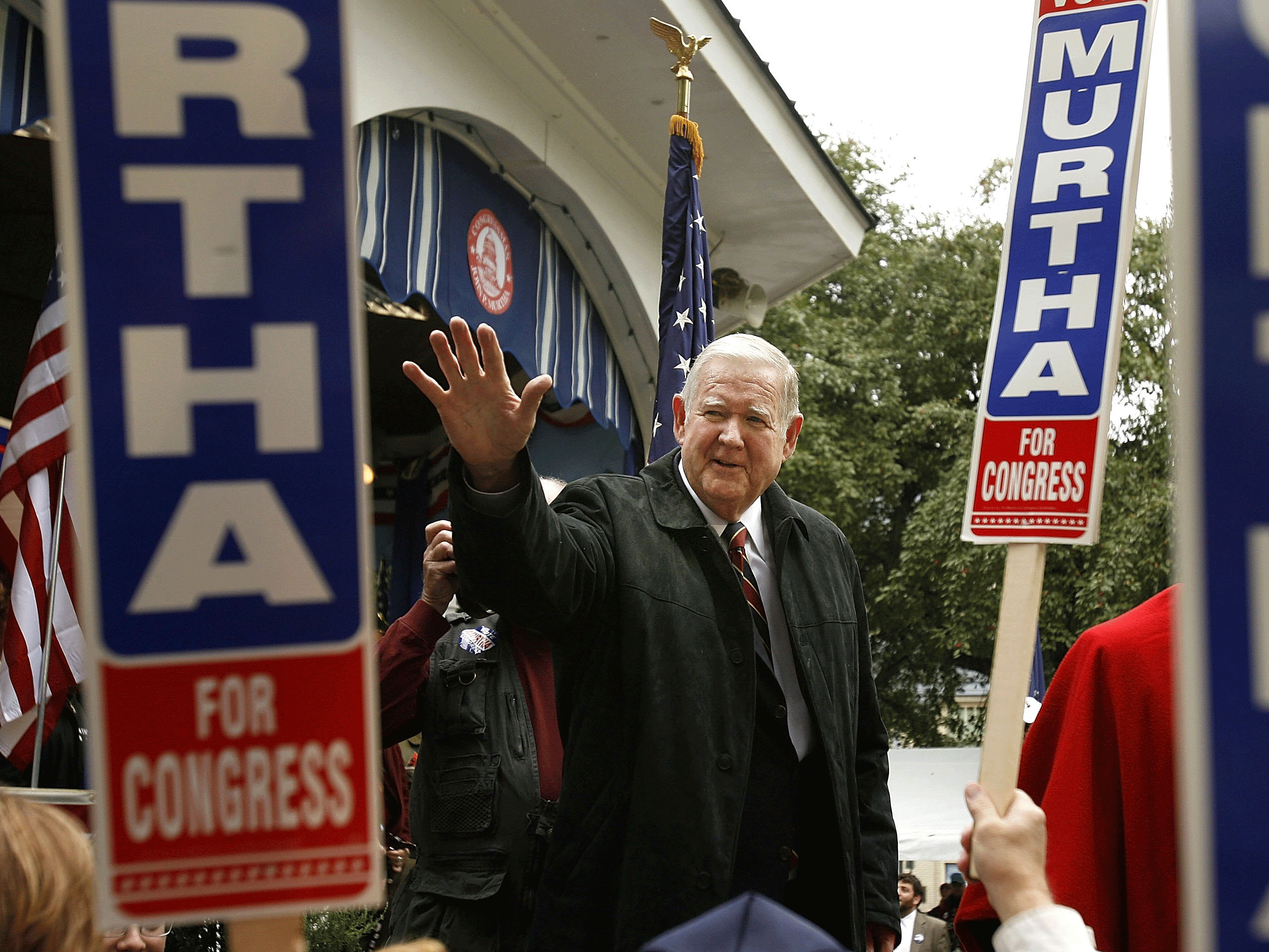
    John Murtha, an influential Democratic member of the U.S. House of Representatives and a staunch supporter of the U.S.-Turkish cooperation, died Monday night at the age of 77.

    A former Marine officer, the Pennsylvania Democrat played a crucial role in 2007 in preventing passage of an Armenian “genocide” bill in the House of Representatives, which was a major threat to U.S.-Turkish ties at the time. He was also a prominent critic of former President George W. Bush’s Iraq policies. Murtha died at a hospital in Harrisburg, Pennsylvania after suffering complications from gallbladder surgery, wire services reported.

    The fall of 2007 was one of the toughest times in the history of the decades-long U.S.-Turkish relationship. On one front, militants from the Kurdistan Workers’ Party, or PKK, were attacking Turkish targets and killing dozens of soldiers. Ankara warned that it would send its army to neighboring northern Iraq to fight the PKK there unless the United States moved to radically increase anti-PKK cooperation.

    On the other front, an Armenian “genocide” resolution had passed the House Foreign Affairs Committee and come very close to a House floor vote. Ankara warned that the bill’s passage would lead to a major and lasting deterioration of ties, including a move to cut Turkish cooperation in Iraq.

    Bush’s Republican administration already had urged Republican representatives to keep away from backing the “genocide” bill, and the effort was largely successful. But a vast majority of Democrats, who were in control of the House, supported the resolution.

    Game changing remarks

    On Oct. 17, 2007, when backers of the “genocide” resolution seemed to have more than enough votes for the bill’s passage, Murtha appeared for a news conference at the House press gallery together with a handful of other Democratic lawmakers. The event was a game changer.

    “What happened nearly 100 years ago was terrible. I don’t know whether it was a massacre or a genocide, but that is beside the point. The point is we have to deal with today’s world. Until we can stop the war in Iraq, I believe it is imperative to ensure continued access to military installations in Turkey, which serve U.S. operations in both Iraq and Afghanistan,” Murtha said.

    “I met with Turkish President Abdullah Gül and foreign policy experts, and they all impressed upon me that a U.S. resolution will further fuel anti-Americanism among the Turkish population and will in turn pressure the Turkish government to distance itself from the United States in the region,” he said.

    “I am also concerned about the recent developments regarding possible Turkish military action against the PKK in northern Iraq. This resolution could very well increase political pressure in Turkey and force the government to take such military action,” Murtha said.

    Then he predicted that the floor vote on the genocide bill would fail, with some 55 to 60 Democrats in the 435-member House opposing the measure.

    Murtha’s speech had a domino effect on Democratic lawmakers with dozens of representatives withdrawing their support from the resolution. As a result, Democratic House Speaker Nancy Pelosi, a staunch supporter of the “genocide” bill, had to shelve a floor vote indefinitely. And a collapse in U.S.-Turkish ties was narrowly averted.

    “Murtha was a great statesman fully aware of the importance of the Turkish-U.S. alliance,” said one senior Turkish diplomat. “We will miss him dearly.”

    Changing course in Iraq

    Murtha’s Iraq war views also eventually prompted Washington to change course in the war, eventually forcing a decision to withdraw forces in 2011.

    Murtha originally voted in 2002 to authorize Bush to use military force in Iraq, but his growing frustration over the administration’s handling of the war prompted him in November 2005 to call for an immediate withdrawal of troops. “The war in Iraq is not going as advertised,” he said. “It is a flawed policy wrapped in illusion.”

    Murtha’s opposition to the Iraq war rattled Washington, where he enjoyed bipartisan respect for his work on military issues. On Capitol Hill, he was seen as speaking for those in uniform when it came to military matters.

    ————————————————

    The New Republic: Will Murtha’s Town Die With Him?

    by Jason Zengerle

    Pennsylvania Congressman John Murtha has died. Is his district next?

    text sizeAAA

    February 9, 2010

    By last summer, it was obvious that John Murtha did not have much time left in Congress. This was partly due to the efforts of Washington ethics cops and Western Pennsylvania Republicans, both of whom had spent the past few years working feverishly, through either judicial or electoral means, to remove him from office. But more than that, there was the simple matter of Murtha’s health. At 77 years old, he’d begun to show obvious signs of deterioration—from increasingly frequent verbal gaffes (like calling his part of Pennsylvania “a racist area”) to physical ones, such as the spill he took while visiting injured troops at Walter Reed. When Murtha died Monday at the age of 77, due to complications stemming from gallbladder surgery, it was sad, but hardly shocking, news.

    Unless, that is, you lived in Murtha’s hometown of Johnstown, Pennsylvania. When I visited there last summer, I found that the only thing deeper than the floodwaters that had thrice destroyed the rust belt city was the denial of its residents that Murtha’s 36 years on Capitol Hill were nearing an end. They expressed unswerving confidence that their congressman could not only defy the laws of man—by forever frustrating the efforts of those trying to unseat him—but the laws of nature, as well. The notion that he might have to retire due to poor health was greeted with a snort: Murtha had been a Marine who, as a father of three, had volunteered for Vietnam; he was too tough to retire. “He would like to die in the House,” one of his friends and supporters told me, certain that such an event was a long way off. Murtha’s great aunt, more than one person in Johnstown mentioned to me, had lived into her 90s; and his clean living—“he doesn’t drink, except for coffee”—meant he could count on reaching a similarly ripe old age.

    Now that Murtha has confounded the expectations of his constituents, his obituary writers will invariably describe him as “The King of Pork.” While the term is not meant as a compliment — and, in fact, Murtha’s political and legal troubles over the last few years stemmed from that well-deserved reputation — it’s worth remembering that, to the recipients of that pork, Murtha was a hero. For the last 15 years, he steered a steady stream of federal money — by some accounts as much as $2 billion — to Johnstown and, in the process, allowed the city to escape the fate of other once-booming steel towns that were unable to survive the collapse of that industry. Indeed, to visit Johnstown today is to encounter an oasis of relative prosperity — a city that boasts glass-and-steel office buildings, a Wine Spectator-award winning restaurant, even a symphony orchestra — in a desert of economic despair.

    When any politician dies, especially one as long-serving as Murtha, his passing will be treated as the passing of more than an individual. And this is already being described as the end of various eras — from the end of the era of Democratic rule in Pennsylvania’s Twelfth Congressional District (which John McCain carried in 2008) to the end of the era of the “old bull” way of doing business on Capitol Hill. But Murtha’s death also signals something more than the death of a man or the death of an era: It likely spells the death of the city he represented.

    When Murtha was alive, Johnstown raised myriad monuments to him — placing his name on everything from a technology park to an airport. But the city never prepared itself for the day when its honors to Murtha would have to come in the form of memorials. Johnstown’s success was not a façade, but its prosperity was as dependent on one congressman as it had once been on one industry. It was almost as if Johnstown could not bring itself to imagine — and thus prepare for — what would happen once Murtha, like steel before him, was no longer there to sustain it. And now it will face the consequences of that failure.

    To be sure, Johnstown will not cease to exist tomorrow. Or next week. Or even next year. After all, it took decades for Bethlehem Steel to dismantle its Johnstown operations once it decided to leave the city. But, over time, the economic forces that Murtha managed to stave off will begin to take their toll. Lacking a politician with Murtha’s seniority and powerful committee assignments — not to mention, perhaps, a politician with Murtha’s tolerance for the appearance (and perhaps the reality) of ethical impropriety — Johnstown will watch as the river of federal largesse slows to a trickle. And it will watch as the defense contractors that followed those federal dollars by locating their offices in Johnstown and underwriting its civic activities turn their attentions to the hometowns of other congressmen. And slowly, but ineluctably, Johnstown will meet the same fate as the politician who did so much — maybe too much — to keep it alive.

    Partner content from:

  • Debate on Caspian Sea and future of Nabucco gas pipeline project

    Debate on Caspian Sea and future of Nabucco gas pipeline project

    Nabucco gas pipeline, which emerged in the recent history of energy, can create new opportunities for the EU countries to check the monopoly of Russia over their gas supply. This project is not only important for the diversification of gas supplies of the EU countries, but also will bring new advantages and stakes to the different countries while passing them through. Some of these countries are the post-Soviet Azerbaijan, Turkmenistan and Kazakhstan that intend to provide the natural gas resources for the following project. As obvious, these gas providers are the littoral Caspian Sea countries that legally dispute over the demarcation of the mentioned sea. Will it create difficulties for the realization of the Nabucco project? Or intentions of these states to join Nabucco will ease the dispute and push them towards concessions? 

    KEY WORDS: Nabucco gas pipeline, the Caspian Sea, demarcation, legal status, International Court of Arbitration, Azerbaijan, Turkmenistan, Kazakhstan, the EU

     Introduction

    The Nabucco gas pipeline is one of the hot issues among the planned projects those are on the agenda. The main problem that has been discussing till today is the natural gas sources of the following project. The first planned gas will come from Caspian Sea sources where the legal status of the sea is not solved completely yet. For that reason, all the issue of Caspian Sea legal status which related with the Nabucco project will analyze in this research paper. In the first part will analyze potential resources of the project and their opportunity in order to join the Nabucco pipeline. In this perspective there mainly will investigate Caspian Sea resources. Then in the second part will focus on the unresolved legal status of the Caspian Sea and its negotiation process. At the result of the negotiation there were signed the agreement between Caspian littoral states which also will analyze in second part. Later, in the third part will investigate sectoral dispute between two costal states of Caspian Sea –Azerbaijan and Turkmenistan around the same oil and gas fields in the sea border of the two countries. Moreover, Ashgabat decide to send the issue to International Court of Arbitration which it can influence the realization of the Nabucco gas pipeline project. On the other hand, there are also will examine the intentions of Baku and Ashgabat toward the Nabucco project.

    The thesis of this paper is that the realizing of Nabucco project mainly depends on the Central Asian gas resources. To active this project, Trans-Caspian pipeline must not be forgotten. Since, there is a strong relationship between these two lines. Nevertheless, Azerbaijan, Turkmenistan and Kazakhstan could not be realized it due to possible Russian influence. Thus, they need at least one of the Western countries or US guarantee to realize it. Because of the construction of these pipelines can influence to Russian gas monopoly all over the Europe. However, problem is that today EU counters could not construct a union energy policy which they try to make it individually with Russia or others.

    In order to analyze every part of the issue, firstly it was used traditional method in which historical development is based on. Additionally, there were online resources which including official statements, and other reliable academic papers.

    Potential resources and problem overview of Nabucco project

    The Nabucco project represents a new gas pipeline connecting the Caspian region, Central Asia, Middle East via Turkey, Bulgaria, Romania, Hungary with Austria and further on with the Central and Western European gas markets[1]. In order to realize the project, the Caspian Sea gas resources are very essential, as the first stage of the project gas will come from Azerbaijan, which there is only Azerbaijan gas guarantee until now. Moreover, staying of the instability in the Middle East decreases the opportunity of this region in order to join the project and increases the importance of the Caspian Sea resources. On the other hand, for connecting the Iraq gas to Nabucco gas pipeline there is a need for a new pipeline between Turkey and Iraq which is a part of the Arab Gas pipeline. Besides, Iran is one of the alternative gas providers to Nabucco project with its enormous reserves but there is a problem about its underdevelopment gas infrastructure that needs huge investment. Also, the US is against the participation of Iran in the Nabucco project until solving the nuclear problems in this country. Because of all these reasons the Caspian Sea reserves are fundamental for realizing this project.

    Despite of the expectations of the European Union, there is a problem of the legal status of the Caspian Sea, which from 1991 till today could not be solved by the littoral states in this region. There is another problem as well. The Trans-Caspian pipeline that is planned to transport Turkmen and Kazakh gas to Baku has not been constructed yet, which will be joined Nabucco gas pipeline. Additionally, on July 2009 increasing dispute between Azerbaijan and Turkmenistan around the Caspian Sea oil and gas fields, where Turkmenistan has decided to send the issue to International Arbitrage, could create another difficulty for realization of the Nabucco project. This dispute stems from the unresolved legal status of the Caspian Sea that will be discussed bellow.

    The unresolved legal status of the Caspian Sea 

    The Caspian region is one of the main energy bases and one of the major economic assets in the world. There are huge oil and gas reserves here, which are currently attempted to be fully improved and be transported to the world markets. Its oil reserves estimated to be 18-35 billion barrels that near to the United States (22 billion) and the North Sea (17 billion barrels) oil reserves.[2] Additionally, the region has a huge capacity of gas reserves as well, which is approximately 236-337 trillion cubic feet[3].   

    After the establishment of the USSR, the legal status of the Caspian Sea is defined by the agreement between the Soviet Russia and Iran (Persia) without participation of the other Caspian littoral states. This agreement was signed between these two states on 26 February 1921. Another agreement on Trade and Navigation between the USSR and Iran was signed on 25 March 1940[4]. Later, in 1949, the Soviet Union began to use the Caspian Sea hydrocarbon resources in the offshore area centered in the costal part of the Caspian Sea of Azerbaijan. It is worthwhile to mention that before the exploration in the fields of Siberia of the USSR in 1960s, the most productive region was Azerbaijan in the Soviet Union[5].On the other hand, until 1970, the USSR part of the Caspian Sea was used as a common sea among Azerbaijan, Kazakhstan, Russia and Turkmenistan. After that in 1970 according to the new amendment, this area was divided among the Soviet littoral states[6]. According to this amendment, Kazakhstan got 29%, Azerbaijan 20%, Russia 19%, Turkmenistan 18% and Iran 14% of the Caspian Sea[7].

    After the collapse of the Soviet Union in 1991, when the Caspian Sea littoral states got their independence, they intended to determine the new status of Caspian Sea. In this period every littoral state’s perspective was different from others and they couldn’t achieve an agreement. Because, this process took place without pre-planning and, obviously, the littoral states were not ready for that in 1991-1992.  From the beginning, Azerbaijan was an only state that proposed the sectoral division via the median line method of the Caspian Sea, which now is accepted by the all other littoral states of the Caspian Sea but only except Iran.[8]

    Despite of the disagreement between the coastal states, Azerbaijan signed the “Contract of Century” in 1994 with the largest oil companies in the world in order to corporate and explore the Caspian Sea off shore fields in the Azerbaijan sector. With this event, the Caspian Sea became one of the major geo-strategic areas and energy sources of the world. However, in this period the Caspian Sea was not a part of the economic plans of Iran and Tehran considered the fact of the occurrence of the western oil companies in the Caspian Basin as a political danger to its national security. Moreover, Russia also could not accept this agreement because of the old imperialistic ambitions in the South Caucasus[9].

    After, singeing of the “Contract of Century” the Caspian littoral states could make an agreement and it was the first phase of the negotiations period. Russia and Kazakhstan could come to the agreement on the division of the northern part of the Caspian Sea to realize sovereign rights on subsoil use from July 6, 1998[10]. Later than, Azerbaijan also joined the contract, where at the beginning of the negations process her propose was the same. The signing of this agreement was very important, because the Caspian Sea costal states found a solution to the main legal problem of the Caspian Sea about its status and ways of the using it. The basin’s sectional division was admitted by all littoral states, except Iran.  Additionally, this agreement put a quota on the fishery and bioresearches in the Caspian Sea because of the threat of extinction[11].

    With the signing of the agreement, a dispute occurred between Azerbaijan and Turkmenistan because of the distribution of the Caspian three oil and gas fields – Kapaz (Turkmenistan calls it Serdar), Azeri (Omar) and Chirag (Osman).  Even, in 2001 the Embassy of Turkmenistan to Azerbaijan was closed. Nevertheless, the relationship of two states began to normalize in the time of new and current President of Turkmenistan, Gurbanguly Berdimuhamedow, and there were signed some good intention documents[12]. Then, bilateral negotiations constantly started between the two sides in order to solve the problem in the sea borders of the two states.   

    The bases of the bilateral negotiations have been constructed in the middle line principle and it was taken as a basis, which is also accepted in the international practice. The middle line concludes from the last costal point of territory of Azerbaijan and Turkmenistan. However, the problem is that, Ashgabat suggests that “Absheron peninsula and Chilov Island should not be taken into consideration while delimitating the Caspian Sea between Turkmenistan and Azerbaijan.[13]” If the two states border are delimitated from the Absheron peninsula and Chilov Island, there are two oil and gas fields – Azeri (Omar) and Chirag (Osman), which should be included into Azerbaijani territory of the Caspian Sea. Conversely, if these territories should not be taken into consideration while delimitating the Caspian Sea borders between these two states, these two oil and gas fields will be included into Turkmenistan area of the Caspian Sea.

    Despite of these expectations of Ashgabat, there is no any international practice like this, which one territory should not be taken into consideration while delimitating the sea borders between two or more states. Besides, Absheron peninsula is not a small territory in the Caspian Sea that can be ignored while measurement. It lies down nearly 60 km towards the Caspian Sea, in which approximately 1/3 population of Azerbaijan lives. Additionally, the capital city of Azerbaijan is placed at the same area[14].

    Moreover, there is another dispute around the field of Kapaz (Turkmenistan calls it Serdar), where, according to Ashgabat, belonged to Turkmenistan sector of the Caspian Sea during the Soviet period. However, according to Baku- after the 1970 amendment in the USSR’s Caspian Sea law, the border line passed through from the center of Kapaz (Serdar) field. Furthermore, this filed is revealed by Azerbaijani oilman in the Soviet time and today Baku wants to extract it from Turkmenistan.

             The International Court of Arbitration and the intentions of Baku and Ashgabat

    On the other hand, the bilateral negotiations has been continuing from 1999 till today between two parts and last meeting was realized in Baku on July 15-17 2009. After the last meeting, President of Turkmenistan, Gurbanguly Berdimuhamedow ordered to address the international experts and high-degree lawyers to learn the Azerbaijan’s claims over the disputed fields in the Caspian Sea and legality of the foreign oil-gas companies operating in those fields, and then, intent to send the documents to the International Court of Arbitration.  It should be also mentioned that before this statement, in the meeting of governments on July 10, Berdimuhamedow stressed that they (Turkmenistan) want to participate in Nabucco project[15], where there is seemed a contradiction between his two statements. Because, sending the dispute issue to an international court can cause a problem for realization of Nabucco project[16] from the point of view prestige. Since, may be an investments would not want to put investment to the project which its source in the International court.

     Nevertheless, Ashgabat decide to send issue to the International Arbitration may be there is different intention of Berdimuhamedow. Because, Turkmenistan is one of the largest global reserves and it is the largest producer of gas in the region with production of 2.0 tcf/yr, it accounts for almost two-thirds gas output of the region[17]. When Berdimuhamedow came to power, one of his priorities in the foreign policy was the diversification of energy transport roots to the world market. There is an attractive opportunity- is the Nabucco project, which completely depends on Turkmen gas to be realized at the end, because, Azerbaijani gas is not enough to fulfill the Nabucco gas pipeline.

    There is one of the main obstacles for Ashgabat to join Nabucco project is the unconstructed Trans-Caspian gas pipeline that aims to transfer Turkmen gas to Baku. Moreover, Turkmenistan and Azerbaijan could not realize it together, because there are needs the Western encouragements to the both sides[18]. One can assume that the unexpected Turkmen move at this time aimed “specifically at attaining some more concessions from the West, especially given the current huge interest of the latter to get the Nabucco project swiftly implemented”[19].

    Meanwhile, there is a similarity between Azerbaijan and Turkmenistan in energy transportation policy toward the Nabucco project. It is a very important project for these two countries, because, both sides want to transport energy reserves to the world market without the bypassing Russia. Despite of those two Caspian littoral states’ intentions to this project, there is European Union diminished policy to realize the Nabucco project. As every EU country has its own national energy policy, as a result, they cannot construct a common and harmonized EU energy policy. At the result of inattention of EU, Baku singed the gas agreement with Gasport for selling Shah- Deniz II field’s gas to Russia .The amount of gas agreement was not huge, just 500 mil but it was the signal of Baku to the EU for to be more active. 

    On the other hand, four months ago, there was an explosion in the natural gas pipeline between Turkmenistan and Russia, where the natural gas flow has failed to resume yet[20]. Besides, as a result of the global financial crisis, there is a decrease in the natural gas demand in Europe. Thus, Russia wants to re-negotiate the volume-and-dollar terms for its gas. However, Turkmen has protested that a contract is a contract and Turkmenistan is losing $1 billion in a month in revenue[21].

    Meanwhile, the unbearable Russian position to Turkmen gas export still is in progress. In addition, there is imperceptible European Union view to Nabucco project which both of them speed up the construction of China Turkmenistan gas pipeline. The pipeline 1,833-kilometer gas pipeline starts at the gas plant near this border town in Turkmenistan and runs through central Uzbekistan and southern Kazakhstan before entering China at the border pass of Horgos in the northwest region of Xinjiang.  The pipeline, starting near a Chinese-developed gas field in eastern Turkmenistan, is expected to reach full annual capacity of 40 billion cubic metres by 2012-13 and help Beijing propel its explosive economic growth[22].

    Then again, the both of Turkmenistan and Azerbaijan want to create a center of attention of the United State’s interest to this gas pipeline project. Because, the Nabucco project is the one of the big project in the world that there need full politically and financially supporting for the supplier counters and European counters. It’s too hard for European Union countries to realize the Nabucco project without the US supporting. Moreover, the “Nabucco is an integral part of a US strategy of total energy control over both the EU and all Eurasia”[23]. On the other hand, the role of the US lobbying for successfully realizing of the Baku-Tbilisi-Ceyhan oil pipeline which it began from Azerbaijan to Turkey’s Mediterranean coast, which opened in 2005[24] also be a magnet for Turkmenistan and Azerbaijan.

    Eventually, the legal status of the sea should solve according to International Law and International practices with the providing of costal states interests because, the Caspian Sea is one of the major geo-strategic areas and energy sources of the world but not only for littoral states. On the other hand, Azerbaijan and Turkmenistan should compromise each other in order to realizing of the Nabucco project because the both states are interest with this project.

    Conclusion

    The potential resources of the Nabucco project are under the question. There are some problems in the Middle East also Caspian Sea as well which it can influence the realization of project. On the other hand, there is unresolved legal status of the Caspian Sea that it began after the collapse of the Soviet Union until today. Moreover, at the result of negotiation process there was signed the agreement between Caspian Sea littoral states about the sartorial division of sea according to middle line principle. Nevertheless, signed agreement for sartorial division of Caspian Sea, there is no fully solution of the problem. Additionally, increasing dispute between Azerbaijan and Turkmenistan around the Caspian Sea oil and gas fields, where Turkmenistan has decided to send the issue to International Arbitrage, could create another difficulty for realization of the Nabucco project.


    [1] Nabucco Gas Pipeline International GmbH, “Project Description ,Pipeline Route,” (accessed August 15,2009)

    [2]CaspEcoProject Management and Coordination Unit, Caspian Sea Environment Program  “General background”   http://www.caspianenvironment.org/NewSite/Caspian-Background.htm /  (accessed 27 August 2009)

    [3] Bernard A. Gelb, Terry Rayno Twyman, The Caspian Sea Region and energy resources (New York: Hauppauge, 2004)

    [4] Kepbanov A. Yolbar,” The New Legal Status of the Caspian Sea Is The Basis of Regional Co-Operation and Stability ,” Journal  of International Affairs, Vol.2 Num. 4  (December 1997-February 1998)

    [5] Kamyar Mehdiyoun” International Law and the Dispute Over Ownership of Oil and Gas Resources in Caspian Sea”  The American Society of International Law. (2000)

    [6] Kepbanov A ..” The New Legal Status of the Caspian Sea …”

    [7] Meftun Metin”HAZAR Politik ve Bölgesel Güç”( İstanbul: IQ kültür sanat yayıncılıq 2004) 148

    [8] Yusifzade B. Khoshbakht, “The Status of the Caspian Sea Dividing Natural Resources between Five Countries,” Azerbaijan International, vol.8:3 (2000) (accessed September 10, 2009).

    [9] Rustam Mamedov “International Legal Status of the Caspian Sea: Issues of Theory and Practice” (working paper, Ankara University journals database, 32 DOI: 10.1501/Intrel_0000000041,2001)

    [10] Kazakhstan Today, “Russia ratified Russian-Kazakhstan Caspian sea division agreement” March 11.2007,   (accessed September 19, 2009).

    [11] Mamedov “International Legal Status of the Caspian Sea…

    [12] Michael P. Croissant, Bülent Aras, “Oil and geopolitics in the Caspian Sea Region‎” ( Peaeger Publisher,  Westport USA, 1999) 34.

    [13] APA , “Turkmenistan Foreign Ministry: Absheron peninsula and Chilov island should not be taken into consideration while delimitating the Caspian Sea”  August  04, 2009 (accessed September 20, 2009)

    [14]  Gennadiĭ Illarionovich Chufrin , The security of the Caspian Sea Region ,( Stockholm International Peace Research Institute OXFORD 2001) 64

    [15] APA , “Turkmenistan Foreign Ministry: Absheron peninsula and Chilov island….

    [16] Jackson Alexander, “The Implications of the Turkmenistan-Azerbaijan Dispute”, Caucasian Review of International Affairs, vol. 42, August 10, 2009 (accessed September 19.2009)

    [17] Hooman Peimani , The Caspian pipeline dilemma: political games and economic losses, (Peaeger Publisher, Westport USA, 2001) 15

    [18] Ibrahimov Rovshen, “Turkmenistan need Western encouragement”( Qafqaz University lessons  Baku, Azerbaijan August 27,/2009 )

    [19] Jackson “The Implications of the Turkmenistan…..

    [20] David Trilling” Turkmenistan: Pipeline Spat With The Kremlin Turns Into A Political Test Of Strength” EURASIA INSIGHT 4/15/09  (accessed Dismember  25, 2009).

    [21]Steve Le Vine “Nabucco and Trans-Caspian: Times Change, Pipeline Politics Goes On” JULY 30, 2009, (accessed September 23, 2009).

    [22] Xinhua reports “Chinese, Turkmen, Kazakh, Uzbek presidents unveil gas pipeline”

    [23]Hearing, Energy supplies in Eurasia and implications for U.S. energy security (Washington USA: DIANE Publishing, 2007) 60

    [24] Brenda Shaffer, Energy Politics (Pennsylvania USA: University of Pen… Press, 2009) 53

     Famil QURBANOV – Baku Qafqaz University

  • Sargsyan Urges Gül to ‘Make a Big Step Forward’

    Sargsyan Urges Gül to ‘Make a Big Step Forward’

    Tuesday, 09 February 2010

    Tert.am — RA President Serzh Sargsyan sent a formal letter to his Turkish counterpart, Abdullah Gül. The letter reads as follows:

    “Your Excellency,

    “Travelling over Turkey’s air territory, I am sending my greetings to you and people of neighbouring Turkey.

    “Our initiative to normalize Armenian-Turkish relations is at the centre of the international community’s attention. This period is, in fact, a historical one, and not only we, but also the whole world understands that. The efforts made by regional powers for the improvement of bilateral relations go beyond any appreciation. I am sure that it would be hard to see progress without their intervention.

    “At the same time, I believe that despite the extent friendly states are interested in a positive outcome for the [normalization] process, they will not be able to do what our two nations can do.

    “Mr. President,

    “I think you will agree that the main role of breaking stereotypes that Armenian and Turkish people have toward each other and establishing an atmosphere of mutual trust is reserved for authorities. It was only due to faith in our work, and being resolute and principled that we can achieve results.

    “Otherwise, when talk and actions contradict each other, it brings about distrust and skepticism, opening up a wide [playing] field for those who are against this process. We should comprehend that time, in this case, does not contribute to the process but rather deprives it of meaning.

    “If we have, up till now, succeeded in bringing our bilateral contact to such a level where the vision of building normal relations between our countries becomes more visible and tangible, then today it is high time to be decisive, [and] to make a big step forward, passing on a stable and secure region for generations to come.

    “Your Excellency, please accept my deepest respects.”