Year: 2010

  • Bill on “Armenian Genocide” is a cash cow for some lawmakers and Armenian Diaspora

    Bill on “Armenian Genocide” is a cash cow for some lawmakers and Armenian Diaspora

    [ 11  Feb 2010 12:23 ]   

    Washington. Isabel Levine – APA. “Every year the US Congress and Senate try introducing resolutions on the so called Armenian Genocide.

    I don’t think HR 252 (bill about recognition of “genocide”) will pass. Because this is a cash cow for some lawmakers and for Armenian Diaspora” – told in an interview with APA’s Washington correspondent Karahan Mete, one of the leaders of Turkish Diaspora in USA.

    In response to those congressmen, who are preparing to discuss the HR 252 next month at US Congress, Mr. Mete mentioned that, this is not first time US lawmaker pressing an “unethical, immoral, undemocratic law or resolution”:

    “US lawmakers are passing or attempt to pass an alleged Armenian genocide resolution are violating international law”.

    According to him, unfortunately, some of the Jewish organizations in US are trying to bring the “Armenian Genocide” phenomena at the same level as the Holocaust: “I don’t see any similarity between these two events except some falsifications”.

    Mr. Mete also talked about the challenges of Turkish Diaspora in USA.
    “Our problem is not with Armenians around world. Our problem is with the Armenian Diaspora. We should distinguish Armenians that are part of the Diaspora, from regular Armenian citizens. I am talking from my experience. I would say that Armenian people are very nice and kind; specially young and educated Armenians” – he added.

    The member of Turkish Diaspora also complained about Turkish Government.
    “Unfortunately we are working with a handful of people to overcome on this accusation (Armenian Genocide). This cannot generate the result we desire. In order to get result that we desire, we should educate our people. Educating Turkish citizens falls under government jurisdiction. Unfortunately the Turkish government has no national plan on how to deal with this issue. Past and present Turkish government ran and keeps running to crisis after crisis like a fire truck. Our opponents know that and keep starting fires many places to make us overwhelmed”.

    As regards with Diaspora activities, Mr.Mete said that, they are not doing enough.
    “What we need to do and how we need to do it is key issue for solving the problem. It will take hundreds of pages for me to layout this strategy. A short explanation might cause some misunderstandings or confusions; therefore I am reluctant elaborate”.

    According to him, the other question is why the US and other countries are responding Armenian claims enthusiastically.

    “Because the Turkish independence war is not over yet; Independence war is continuing with different from. The new form of the war is propaganda war, which we do not know how to fight. The Armenian genocide phenomena are a tool for some of this country to build negative international public opinion against Turkey. When time comes to invade and occupy and divide the Turkey they have already needed public support to justify their action” – he answered.

    He stressed that, therefore Turks need to see and analyze the Armenian phenomena and other issues in a big context.
    “We are charging individual issues like a bull charging a red cape. Each time the bull charges the red cape he gets another spear in his back, and eventually gets killed. Each time the bull charges thinking that time is the time I will destroy the obstacle. That is what the bullfighter wants him to do; he can stab him on and on until he is dead. Unfortunately our strategy for dealing with international problems is similar to this bull fight” –he mentioned.
    In the meanwhile the meeting scheduled for today between the Secretary of State Hillary Klinton and key figures of Armenian Diaspora was cancelled. The State Department press-service explained to APA the reason of the cancellation as weather conditions in Washington DC.

  • Bus Driver Arrested After ‘You’ve Planted a Bomb’ Jibe to Muslim Passenger

    Bus Driver Arrested After ‘You’ve Planted a Bomb’ Jibe to Muslim Passenger

    POLICE have arrested a bus driver who allegedly called a woman passenger a Muslim terrorist and asked her if she had put a bomb on his bus.

    An investigation was launched by First Buses in Leeds after Turkish-born Hatice McGraffin, 29, claimed a driver made the inflammatory remarks as she boarded her bus on her way to work on Thursday.

    The 45-year-old man was arrested on suspicion of racially/religiously aggravated harassment and remained in police custody at the time of printing.

    Mrs McGraffin, 29, from Otley, who is married to Englishman Ian, said the driver told her: “You are an Islamic terrorist – you have put a bomb on the bus’. I asked people on the bus ‘are you listening to this’ but they ignored me.

    “I am not even a practicing Muslim and I am married to an Englishman.

    “There are lots of Muslim people living in this country, does he think they are all terrorists?”

    It’s happening up and down the country every day. Innocent Muslims or people who look vaguely ‘Muslim’ are targeted and abused. Is this another example of the emerging ‘acceptable face’ of prejudice? Are Muslims the new ‘chavs’ and ‘gippos’, or the new 1930s German Jews?

    We applaud this young woman for standing up for herself and the police for taking immediate action.

    It was another lone woman on a bus who changed the course of history for the better. Rosa Parks is now regarded as the “Mother of the Modern-Day Civil Rights Movement”. On December 1, 1955 in Montgomery, Alabama, Parks, age 42, refused to obey a bus driver’s order that she give up her seat to make room for a white passenger. Her one small act of bravery helped change the course of history. She later said: “I would like to be remembered as a person who wanted to be free… so other people would be also free,” and, “I’m tired of being treated like a second-class citizen.”

    We hope Mrs McGraffin’s actions will encourage others to come forward and stand up for themselves.

    MPACUK

  • Armenia Should Return Occupied Territories to Azerbaijan

    Armenia Should Return Occupied Territories to Azerbaijan

    TURKEY:
    Armenia Should Return Occupied Territories to Azerbaijan

    Azerbaijan Today’s interview with Pulat Tacar, Retired Ambassador; Vice Chairperson of the Turkish National Commission for UNESCO between 1996-2007

    Biography:
    Born in 1931; graduated from the Political Science Faculty of Ankara in 1954. After post graduate studies at the Sorbonne University in Paris, he joined the Ministyry of Foreign Affairs. He was Ambassador of Turkey in Jakarta (1981-1984), Permanent Representative, Ambassador of Turkey to the European Communities (1984-1987) in Bruxelles and to UNESCO (1989-1995) in Paris; he was Director General for Cultural Affairs of the MFA ,HE IS A MEMBER OF TURKISH FORUM ADVISORY BOARD(2006-),(1987-1989) He published several books : “Cultural rights in the world and the proposal of a model for Turkey” ; “Terror and democracy”, which was awarded the Yunus Nadi Social Sciences Research Prize in 1999; “ The Control of nuclear weapons”; “Financing of the politics” “ UNESCO, is she useless like Mozart?” ; and many essays in several periodicals on the topics of: cultural rights; the good governance of multiculturalim; relations between Turkey and the European Union; and the crime of genocide.

    AT: On 10 October, Turkey and Armenia signed protocols in Switzerland on normalization of relations. How important are these protocols for Turkey?

    P.T.: The signing of the protocols with Armenia reflects a change of direction with regard the Turkish position on relations with Armenia : The main issues may be summarized as follows : the opening of the territorial borders , the establishment of regular diplomatic missions , the creation of expert groups to discuss common problems including the historical aspects.

    The new Minister of Foreign Affairs of Turkey, Professor Davutoglu tried to explain the background of this new approach with the words “ zero conflicts with the neighbours” . Most probably this step is put forward by the Turkish Government after a new evaluation of the situation in the South Caucasus . One can guess that the concerns with regard the stability of the region prevailed. Especially after the Russian intervention in Georgia and the new de facto created in Abhazia and South Ossetia the Turkish Government positioned itself taking into account the facts of the “realpolitik” there. This includes of course the security of the oil and gas pipelines. One should add that the position of the new President of the United States as well as the pressures of the US legislative bodies with regard the Armenian genocide allegations played also a certain role .

    The Turkish Government made it clear more then once its concerns about and the priority it attaches to the stability in the region and decided to try an alternative path to find solutions to the conflicts between Armenia and Turkey Having also in mind the conflict between Armenia and Azerbaijan. This new and conciliatory approach is supported by almost all the actors of the international areana.

    On the other hand, -as far as I am informed – Turkish Government members and the Ministry of Foreign Affairs of Turkey briefed the Azeri authorities on the negotiations of the Protocols with Armenia. Let me add that the same openness can not be claimed with regard the sharing of information concerning the going on Azerbaijan-Armenia negotiations.

    Finally , Turkey always underlined that the Azeri territories occupied by Armenia should be returned back to Azerbaijan . The actual Government of Turkey do believe that the Protocols will help to find a peaceful solution to the conflicts not only between Turkey and Armenia but also between Azerbaijan and Armenia .

    AT: There has been some change in the US policy in the South Caucasus and the Middle East under the new administration. How could this change influence the strategic partnership between the United States and Azerbaijan, and also the resolution of the Nagorno-Karabakh conflict?

    P.T.: United States policy in the South Caucasus is directed -among others- to the resolution of the Nagorno-Karabakh conflict. – The aim of this policy is to create a just and sustainable balance between Armenian and Azerbaijan interests as well as to secure energy transportation lines. The role of Russia and the relations between Russia and Azerbaijan as well as with Armenia, are other important factors of this simultaneous equation.

    I guess that the final solution of Nagorno-Karabakh will take some more years and a step by step approach must be expected. Probably the returning of the five rayons will be the first step which will be followed by others. The solution there will most probably take into account the de facto situation in South Caucasus and the vital interests and the compromise willingness of the parties concerned.

    Moreover I think that relations called “ partnership, alliances and strategic partnerships” are closely attached to the interests of the States in question. The “strategic partnership between The United States and Azerbaijan” you refer in your question will abide to the necessities of “mutual interests”.

    AT: Do you think that Armenia will give up its efforts to secure international recognition of the genocide if it normalizes relations with Turkey?

    P.T.: In the short term, the Armenian diaspora will not give up its efforts to secure international recognition of the genocide allegations. On the other hand, the Armenian Governments will most probably continue to underline that the events of 1915 should be considered as a crime of genocide. For , “to be the victim of genocide” has become a part of their created identity. The word “genocide” is a taboo for them and the “ Armenian genocide” “ a historical truth which can not be denied, nor can be discussed” . According to the Armenians, those who qualify the tragic events of 1915-1916 with other words then genocide, should change their position and accept the genocide accusation without any discussion or argument . Even the word “Metz jegern” -which means “the great tragedy” in the Armenian language and which the Armenians themselves use to name the tragic events of 1915, if pronounced by some apologists in Turkey and the President Obama becomes a deviation of the Armenian “holy war” and is rejected.

    But, the Armenians know that as long as this question is on the agenda of a mixed commission of historians , experts and/or jurists foreseen by the Zurich Protocols their chance to convince new governments and/or parliaments to recognize the genocide allegations will decrease. That is the reason why the diaspora Armenians reject the protocols signed in Zurich. The Armenian side also will try everything in its power to delay the meeting of the so called historian commission by not agreeing on the terms of its agenda. The weak side of the protocols (for Turkey) is that the creation of the said commission is foreseen only after the normalization of the relations including the opening of the borders.

    The great majority of the Turks are convinced that the tragic events of 1915 can not be qualified as genocide. Ottoman Turks, Kurds and Armenians suffered great losses at the beginning of the XX century. But the accusation that the Ottoman Turks destroyed the Ottoman Armenians on racial and/or religious ground,which means because they were Armenians is not reflecting the truth and this dolus specialis is not supported by evidence.

    Personally I insisted and underlined the fact that genocide is an international crime clearly described by the 1948 Convention and that this legal issue can only be solved by the competent tribunal foreseen by the Article VI of UN Convention. on the Prevention and Punishment of the Crime of Genocide. Politicians, parliaments and other instances – even national tribunals without competence- have no authority to decide or to declare that a crime constitutes genocide.

    But let me add another important and humanitarian aspect of the Protocols signed in Zurich. I consider this as an important step towards the reconciliation of the Armenian and Turkish peoples. It focuses the problematic of collective memory Thr collective memory does not necessarily tell the truthful history of the past, is tendentious, provides a story that is very often distorted; it tries a selective reading of the past; it presents the own group as being the victim of the opponent. It is true that some of these beliefs are formed over a long period of sufferings and losses. . Selective memory focus especially on violence, atrocities, cruelty, lack of concern for human life and viciousness of the other side,

    How this vicious cycle can be broken?

    I admit that this is not easy. Generally it takes long years. Because, years of indoctrination cause internalization of the beliefs. They are held with great confidence and considered as central. Any progress requires an emphatic approach and a change of the beliefs which support the continuation of the conflict.

    But the beliefs, attitudes, created images anchored in the memory do not change overnight. Usually they continue to inhibit the development of peaceful relations and may even create obstacles to the mutual understanding.

    The overcoming of the difficulties depends on formal and informal conciliatory acts by both parties. The determination of leaders involved in peace making is crucial. Their moves are often met with opposition within their own group in the form of pressure, public mobilization, sometimes smear campaigns and violence. The success of the process depends on the activism and strength of those who support it.

    Reconciliation requires changing the psychological repertoire which dominated society members for many years. Peace between States depends on peace between people. That is the reason why I consider the move of the Zurich protocols as an important attempt towards reconciliation

    AT: Members of the OSCE Minsk Group are making a lot effort to get the Turkish-Armenian border reopened. What kind of impact would the reopening of the Turkish-Armenian border have on the settlement of the Nagorno-Karabakh conflict?
    Turkish closed its border with Armenia after the occupation of Azerbaijan’s Kalbajar District by Armenian forces in 1993. How would you assess reopening of the border before the resolution of the conflict between Armenia and Azerbaijan?

    P.T.: The closing of the border between Turkey and Armenia is described by some as an embargo. This is wrong. The air border between Armenia and Turkey is open . Iran and Georgia borders with Armenia are open as well. Under these conditions one can not describe the closing of the eastern Turkish borders to Armenia as an embargo. This has been a protest act and a political step taken by Turkey because of the occupation of Azerbaijan’s Kalbajar District. But this political act did not pressured Armenia with regard the resolution of the conflict of Karabakh and the handing over of the occupied territories to Azerbaijan.

    Now, I sincerely hope that the signing of the protocols between Turkey and Armenia may help the creation of an atmosphere of peace and trust . It may also indirectly help the conclusion of the negotiations within the Minsk Group.

    The Turkish Prime Minister and other Turkish officials clearly declared that the opening of the eastern border of Turkey to Armenia will depend on the improvement of the Nagorny Karabakh issue, which means the return of the occupied territories to Azerbaijan.

    My interpretation of these statements is that the Turkish Government will not request its Parliament to give green light for the ratification of the protocols between Turkey and Armenia before a settlement with regard the occupied territories is agreed upon between Armenia and Azerbaijan.
    If there is no improvement on the question of N.K., the protocols will continue to stay on the agenda of the Turkish Parliament and their ratification will be delayed . This delay of course will trigger new international pressures on Turkey and Armenia.

    AT: The Azerbaijani authorities are very concerned about the prospect of the Turkish-Armenian border being reopened. They think that this would toughen Armenia’s position on the Karabakh issue. Do you share this concern?

    P.T.: The signing of the protocols caused a certain disappointment in Azerbaijan and in Turkey. I have an understanding for it, because it was interpreted as a policy change by some. But, personally I consider this as emotional reactions rather than reactions attached to solid reasoning. I hope that the leaders as well as the public opinion will not forget that the ties fastening our countries are stronger than ever. The only factor which can toughen the Armenian position is the image of an existing conflict, tension and misunderstanding between Turkey and Azerbaijan. So I believe it is high time to join our efforts and present an unified and stronger image.

    Turkey wants more than any other the return of the occupied Azerbaijan territories to their owners and the diplomatic steps foreseen by the protocols as well as the statements by the Turkish Government members with regard the entering into force of the Protocols do aim to attend this objective. Finally let me underline again that stability in our region will improve the security and the living standards of all of us.


    Turkish PM Erdogan, U.S. President Obama Discuss Azerbaijan-Armenia Relations With Protocols Signed, What Lies Ahead?

    Turkish PM Erdogan,
    U.S. President Obama
    Discuss Azerbaijan-
    Armenia Relations
    Competing Interest
    Influencing Policy
    in Karabagh
    Azerbaijan Today’s
    interview with
    Efruz Muduroglu,
    Managing Director of the
    Hazar Investment LTD

    “Mosazervinzavod”
    Dealing with the Other
    Side of Oil Boom
    Azerbaijan Today’s
    interview with
    Mr. Mukhtar Babayev,
    vice-president of the
    State Oil Company of the
    Azerbaijan Republic
    Northern Europe
    Greenlights Nord Stream
    US State Department: ”
    Azerbaijani Government
    Actively Encourages
    Religious Tolerance”
  • Think Again: Be resolute on genocide issue

    Think Again: Be resolute on genocide issue

    By Zanku Armenian
    In October, Turkey and Armenia signed a document called the “protocols,” which were intended to pave the way for the countries to begin a reconciliation process that would open their borders, establish diplomatic relations and perhaps tackle the biggest obstacle between them, the issue of the Armenian Genocide of 1915.

    Many Armenian Americans expressed outrage at this proposed agreement because it calls for a “historical commission” that would likely examine the Armenian Genocide, which they feel is a ruse by Turkey to deflect growing international pressure for recognition and further their decades-old campaign to distort and deny the facts of the Armenian Genocide.

    The fear of the Armenian American community began coming true in April, when President Obama used the potential of the protocols as a way to avoid his campaign promise of January 2008. In that pledge, Obama said, “America deserves a leader who speaks truthfully about the Armenian Genocide and responds forcefully to all genocides. I intend to be that president.” Sure enough, in his first year in office, Obama caved in to hollow threats from Turkey, avoiding the word “genocide” in the White House’s annual commemoration message.

    Often, we see our leaders compromise the nation’s core values for the sake of relations with another country. We seem to do this for a fleeting gain with regimes that run counter to our principles. Our history is riddled with situations that have backfired, forcing us to ultimately clean up the mess because of shortsighted policies — Iraq and Afghanistan being the latest examples.

    With the efforts of Rep.. Adam Schiff (D-Burbank) and many members from the California congressional delegation, including bipartisan support, once again there is a resolution before our lawmakers that seeks to be truthful about our own American history by recognizing the Armenian Genocide.

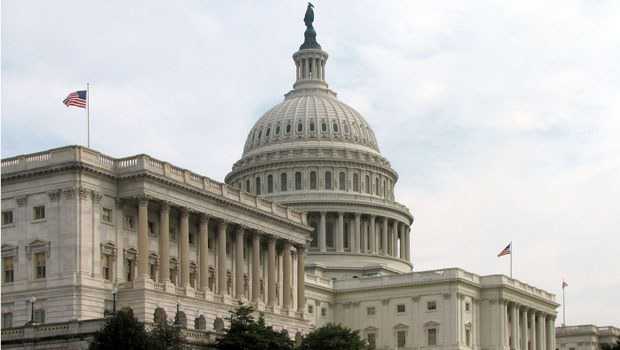
    Rep. Howard Berman (D-Valley Village), chairman of the House Foreign Affairs Committee, has scheduled a committee vote on House Resolution 252 for March 4. If passed by committee, House Speaker Nancy Pelosi would be poised to bring the resolution to the floor for a vote.

    Viewing this resolution as an issue for the Armenian American community would be a mistake. While the resolution recognizes the horrific experiences of the 1.5 million victims of the Armenian Genocide, it also honors American values and how ordinary Americans stand up to help the greater good. Just like we’ve sent help to Haiti in the aftermath of the earthquake there, in the early 20th century, Americans stood up and sent needed help to survivors of the Armenian Genocide, without which the devastation would have been far worse.

    Among the details recognized in HR 252 is that on Feb. 9, 1916, 94 years ago this week, the U.S. Senate passed a resolution resolving that “the president of the United States be respectfully asked to designate a day on which the citizens of this country may give expression to their sympathy by contributing funds now being raised for the relief of the Armenians.” President Wilson concurred and encouraged the formation of the organization called Near East Relief, chartered by an Act of Congress, which ultimately contributed $116 million from 1915 to 1930 to aid survivors, including 132,000 orphans.

    While HR 252 pays tribute to these important American contributions, it also sends a clear message to the president: The change we want is for our country’s policies to have integrity by reflecting the truth. If, for the sake of having relations, we have complicity with a country like Turkey, which has made political sport out of lying about and denying genocides, we will have forsaken every American and human principle. And that is unacceptable. Among the messages being sent to Washington with recent special elections around the nation, this needs to be one of them.

  • Senator Lieberman reiterates importance of Armenian Genocide affirmation

    Senator Lieberman reiterates importance of Armenian Genocide affirmation


    10.02.2010

    In response to a letter from Harry Keleshian, a longstanding Armenian Assembly trustee and activist, Senator Joseph Lieberman (I-CT) stated that the issue of U.S. affirmation of the Armenian Genocide “cuts to the heart not only of our foreign policy, but of our morality as a nation.”

    Lieberman, in describing the “systematic and deliberate campaign of mass murder perpetrated against the Armenian people,” stated that “even by the bloody standards of the 20th century, the annihilation of 1.5 million Armenians was one of the greatest crimes against humanity committed in the last hundred years – an evil we have a solemn duty never to forget.”

    “As we look to the 95th Anniversary of the Armenian Genocide this April 24, Senator Lieberman provides us with a poignant reminder of the importance of remembering history, and the need to redouble our efforts to end the scourge of genocide,” stated Executive Director Bryan Ardouny. “We commend Mr. Keleshian for his steadfast commitment and support of the Assembly and our work on Capital Hill,” added Ardouny. “With activists like Harry, along with our nationwide State Chair network, including Connecticut State Chair Sevan Angacian,we have a great team to help us advance our goals.”

    In the January 25th letter to Connecticut resident Keleshian, Senator Lieberman also recalled the extraordinary efforts of Henry Morgenthau, the U.S. Ambassador to the Ottoman Empire at the time of the Armenian Genocide. Ambassador Morgenthau was the leading force behind America’s unprecedented humanitarian intervention, and his actions helped to save countless survivors.

    S. Res. 316 was introduced last year by Senator Robert Menendez (D-NJ) and John Ensign (R-NV), and continues to garner support with Senators Sam Brownback (R-KS) and Michael Bennet (D-CO) as the most recent cosponsors. The resolution, as Lieberman’s letter so aptly stated, “describes the history of the genocide in detail and calls on the President to recognize and commemorate it appropriately.” With the House of Representatives scheduled to consider the Armenian Genocide in Committee on March 4, the Assembly also urges the U.S. Senate to take action.

    By remembering history and honoring the victims of the Armenian Genocide, Senator Lieberman hoped to renew America’s commitment “to the cause of stopping genocide and ethnic violence in our own time.”

  • Sarkisian To Send Turkish-Armenian Accord To Parliament

    Sarkisian To Send Turkish-Armenian Accord To Parliament

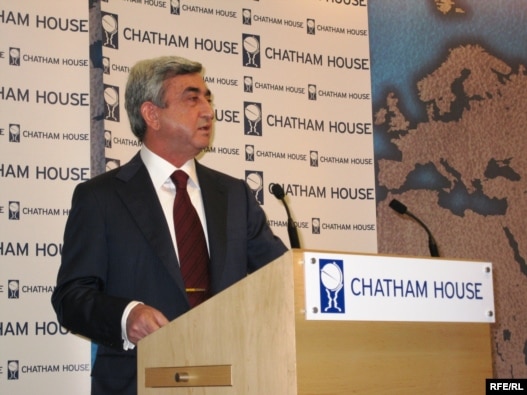
    UK — Armenian President Serzh Sarkisian delivers a speech in Chatham House, London, 10Feb2010

    10.02.2010
    Lusine Grigorian in London, Irina Hovannisian

    President Serzh Sarkisian said on Wednesday that he has decided to formally submit Armenia’s normalization agreements with Turkey to the Armenian parliament for ratification despite what he called Turkish efforts to distort their essence. (UPDATED)

    Speaking during a visit to London, Sarkisian also reaffirmed his threats to annul the two “protocols” if Ankara drags its feet over their ratification. “If, as many suspect, it is proven that Turkey’s goal is to protract, rather than to normalize relations, we will have to discontinue the process,” he warned in a speech at the Royal Institute of International Affairs, a renowned London think-tank also known as Chatham House.

    “After the meeting here at Chatham House I intend to instruct my staff to send these documents to Armenia’s National Assembly for starting the ratification process,” Sarkisian said. “I reiterate that as the political leader of the [Armenian] parliamentary majority, I exclude a failure by Armenia’s parliament to ratify the protocols in case of their ratification by Turkey without preconditions in accordance with our understandings,” he said.

    Turkey’s leaders claim that Armenia itself set such preconditions with its Constitutional Court’s interpretation of the protocols’ implications contained in a recent ruling. They have singled out the court’s conclusion that the deal can not stop Yerevan from seeking greater international recognition of the Armenian genocide.

    “It’s only the Turks that are trying to find something in it,” Sarkisian scoffed during a question-and-asnwer session that followed his speech. “Nobody else, no other involved party, sees anything strange in that decision.”

    Like other Armenian officials, Sarkisian suggested that Ankara is simply looking for an excuse to avoid normalizing relations with Yerevan before a resolution of the Nagorno-Karabakh conflict. “Would the Turks have been happy if our Constitutional Court had ruled that these protocols do not conform to Armenia’s constitution?” he said. “Maybe they would have been happy, seeing as they are trying to use every opportunity to torpedo the process.”

    “I can’t understand why the Turks … attach so much importance to the Constitutional Court’s decision. It’s an integral part of our domestic decision-making process,” added the Armenian leader.

    Ankara says Armenia’s highest court essentially prejudged the findings of an inter-governmental “subcommission” of history experts which the Armenian and Turkish governments plan to set up. Its establishment is one of the key provisions of the protocols.

    “Did we say in those protocols that the Republic of Armenia calls into question the genocide?” countered Sarkisian. “Did we ever say during the negotiations that we are going to hamper the process of international recognition of the genocide? If the Turks think we did, it’s not our fault.”

    In Yerevan, meanwhile, senior representatives of Sarkisian’s Republican Party of Armenia (HHK) reiterated that the National Assembly will not vote on the protocols before their endorsement by the Turkish parliament. Asked by RFE/RL’s Armenian service when the Sarkisian-controlled assembly might start debating them, Eduard Sharmazanov, the chief HHK spokesman, said: “Everything depends on the Turkish side.”

    Razmik Zohrabian, a deputy chairman of the HHK, said the Turks have until the April 24 anniversary of the genocide to ratify the protocols or face their annulment by Armenia. “April is a deadline for the United States as well because Congress may recognize the Armenian genocide. That would be big blow to Turkey,” he said, predicting that Ankara will have to drop its preconditions by that time.

    Failure to do that, Zohrabian told RFE/RL’s Armenian service, would lead Yerevan to declare the normalization process dead. “If the protocols are not ratified until then we will not have big expectations anymore,” he said.

    Speaking at Chatham House, Sarkisian again rejected the Turkish linkage between protocol ratification and the resolution of the Nagorno-Karabakh conflict, saying it is only undermining the two processes.

    “I, however, believe that the rapid normalization of Armenia-Turkey relations can set an example of a proactive problem-solving attitude that will positively stimulate and set an example the resolution of the Karabakh conflict,” he said. “I would like to take one step further and inform you that I am going to invite [Azerbaijani] President Aliyev to the potential opening ceremony of the Armenian-Turkish border.”

    The Karabakh conflict was another major theme of the hour-long speech, with Sarkisian accusing Azerbaijan of provoking an “extremely dangerous” arms race in the region and condemning Aliyev’s regular threats to resolve the dispute by force. He also ruled any out peaceful settlement that would result in Karabakh’s return under Azerbaijani rule.

    “Azerbaijan has exhausted the resources of trust in terms of autonomous status for minorities within its boundaries,” he said. “It was not and is not capable of providing guarantees of even internal security to such autonomies.”

    Sarkisian did not comment on chances for the signing of an Armenian-Azerbaijani framework agreement on Karabakh drafted by the American, French and Russian mediators. The latter have expressed hope that the conflicting parties will overcome their remaining differences this year.

    https://www.azatutyun.am/a/1954101.html