Year: 2010

  • We should thank Armenian lobby for making Turkish diaspora stronger”

    We should thank Armenian lobby for making Turkish diaspora stronger”

    Saturday, 13 February 2010

    “Statements by the Armenian lobby and plans of the Committee on Foreign Relations of U.S. House of Representatives are not surprising. Even if the protocols are ratified by the parliaments of Turkey and Armenia, the Armenian lobby will still be forcing some members of Congress to put some sort of resolution to a vote in subcommittees, committees and plenary sessions.
    The Armenian lobby cannot stop doing it because this kind of resolution is culmination of all their efforts,” Adil Bagirov, candidate of political sciences, the U.S. Azeris Network Executive Director said.
    “Of course, the Committee on Foreign Relations may adopt this resolution. The Committee adopted a similar resolution in Oct. 2007. The U.S. will hold midterm elections next November. The Armenian diaspora promises its vote, financial input for the congressmen who would back their resolution. The chairman of a committee from the State of California also helps the Armenian lobby. If Armenians try hard, the resolution may even pass one chamber of Congress, as the Jewish lobby will not try to stop the Armenian lobby because of the known problems with the ruling AKP in Turkey and the ruling coalition in Israel which worsened last year.”

    “However, over the past year, Turkish-Americans, as well as the Turkish government, were able to strengthen its lobby both through developig its diaspora and by hiring more powerful lobbying firms. It’s no secret that success in the U.S. political arena requires several instruments, including the hiring of professional lobbyists which is much cheaper. It is not surprising that almost all “favorites” countries of the of the Congress such as Taiwan, India, Korea, Saudi Arabia, UAE, Japan, the Netherlands, even Canada, the United Kingdom and the EU spend millions annually on lobbying the U.S. Congress,” Bagirov added.

    “Apart from historical and moral reasons for which Azerbaijan and Azerbaijanis do not agree with the view of the Armenian lobby, one should not forget about economic and geostrategic ones. The more the Armenian lobby is engaged in unsuccessful promoting such resolution, the less money, time and energy it will have for other more important issues and projects. It would be difficult to Azerbaijan and Turkey if the Armenian lobby would not be spending a mere 70 percent of its resources on the resolution, but on something else. Also, if it had not been for such resolutions, there would be less interest in the history of Turkey and Azerbaijan,” Bagirov noted.

    “Armenia succeeds to maintain good relations with Russia, the U.S., Iran Israel, India,China, Arab countries and Europe, the Turkic states of Central Asia and even with Turkey to some degree. If it were not for these resolutions, Turkey still would not have broadcasts of public radio and TV soon in Eastern Armenian language (official language of Armenia), there would be no chairs in Armenian language and history in Turkish universities, there would be no historical research and publications, as well as consolidation of the Turkic diaspora and joint resistance against the Armenian propaganda. So, one should thank the Armenian lobby for such unforeseen and unintended effect of strengthening, professionalizing and consolidation of the Turkic peoples, communities, diaspora and lobby,” Bagirov said.

  • Tougher rules to stop abuse of student visa system

    Tougher rules to stop abuse of student visa system

    Tougher rules have been brought in to stop people abusing the student visa system to remain illegally in the UK.

    The government has faced criticism that the system is too lax
    The government has faced criticism that the system is too lax

    Home Secretary Alan Johnson said 30% of migrants who came into the UK were on student visas and a number were adults taking short courses, not degrees.

    Under the new rules, applicants will need to speak English to near-GCSE level and those on short courses will not be able to bring dependants.

    The Tories said the system had been the “biggest hole in border controls”.

    The Home Office would not confirm reports the changes may cut visas issued this year by tens of thousands.

    A spokesman said a review of student visas had been ordered in November. In 2008/9, about 240,000 student visas were issued by the UK.

    News of the new measures comes a week after student visa applications from Nepal, northern India and Bangladesh were suspended amid a big rise in cases.

    ‘Legitimate study’

    Last year the UK introduced a system requiring students wishing to enter the country to secure 40 points under its criteria.

    However, the government has faced criticism that this has allowed suspected terrorists and other would-be immigrants into the UK, only for them to stay on despite their visas being temporary.

    Speaking on the BBC’s Andrew Marr Show, the home secretary denied the system had been lax before.

    “By 2011, we will have the most sophisticated system in the world to check people not just coming into the country but to check they have left as well,” he said.

    He said the UK remains open to those foreign students who want to come to the UK for legitimate study.

    “We are the second most popular location for people going into higher education,” he said.

    “We have to be careful that we are not damaging a major part of the UK economy, between £5bn and £8bn.”

    Immigration Minister Phil Woolas told the BBC’s Politics Show 200 bogus colleges had been closed.

    “Students have foreign national identity cards. We have the e-Border counting in and counting out,” he said.

    “The latest proposals are a response to the moves by people who are trying to get round the system.”

    Under the measures, effective immediately:

    Successful applicants from outside the EU will have to speak English to a level only just below GCSE standard, rather than beginner level as at present

    • Students taking courses below degree level will be allowed to work for only 10 hours a week, instead of 20 as at present

    • Those on courses which last under six months will not be allowed to bring dependants into the country, while the dependants of students on courses below degree level will not be allowed to work

    • Additionally, visas for courses below degree level with a work placement will also be granted only if the institutions they attend are on a new register, the Highly Trusted Sponsors List.

    Liberal Democrat home affairs spokesman Chris Huhne said the UK needed to “restore immediately control of our borders”.

    “The biggest hole in the student visa system is caused by the Tory and Labour abolition of exit checks, which means we do not know if someone has left once their visa runs out,” he said.

    Conservative shadow home secretary Chris Grayling said the student visa system had been the “biggest hole in our border controls for a decade”.

    “Ministers should be ending the situation where a student visa is a way of coming to the UK to stay, by banning the practice of moving from course to course in order to stay on and stopping overseas students from applying for work permits without going home first,” he said.

    The party has also proposed that overseas students should pay a cash deposit which would be lost if they did not leave the country when their course finished.

    And Conservative backbencher Mark Pritchard has gone further and proposed universities withhold degree certificates until foreign students can prove they have returned to their home countries.

    But Mr Johnson said Mr Grayling’s plan would just add another level of bureaucracy.

    “Many of these students, if they are coming here using this route for illegal migration, will pay thousands of pounds to usually criminal gangs,” he said.

    “The thought of losing a bond is not going to solve this problem.”

    Source: news.bbc.co.uk, 7 February 2010

  • Armenia Showcases Iran Ties, as Talks With Azerbaijan and Turkey Falter

    Armenia Showcases Iran Ties, as Talks With Azerbaijan and Turkey Falter

    Publication: Eurasia Daily Monitor Volume: 7 Issue: 29

    February 11, 2010

    By: Emil Danielyan

    Armenia is showcasing its close relationship with Iran at a delicate time in its negotiations with two other, less friendly neighbors: Azerbaijan and Turkey. With the normalization of Turkish-Armenian relations and the resolution of the Karabakh conflict looking increasingly problematic, authorities in Yerevan seem to be hedging their bets by pursuing more multi-million dollar commercial projects with Tehran.

    Armenian leaders have also made a point of underlining Iran’s broader geopolitical significance for their landlocked country and what they have long described as Tehran’s “balanced” position on the Karabakh dispute. Their Iranian counterparts have readily reciprocated that praise in the latest flurry of diplomatic activity between the two governments. “The foundation of the two countries’ relations is being fundamentally strengthened and cooperation in such major fields as energy, transportation, and communications would project a new image of our bilateral ties,” Iranian Foreign Minister Manouchehr Mottaki said at the end of a two-day visit to Yerevan on January 27 (IRNA, January 28).

    “You know well what importance we attach to relations with the Islamic Republic of Iran, and that we perceive you as a reliable partner and a country with a pivotal significance in the region,” Armenian President Serzh Sargsyan told Mottaki during their talks adding, “Therefore, the development and deepening of bilateral relations stems from our interests” (Statement by the Armenian presidential press service, January 27).

    The main official purpose of Mottaki’s trip was to co-chair with the Armenian Energy Minister Armen Movsisian a regular session of an Armenian-Iranian inter-governmental commission on economic cooperation. The meeting focused on plans for building a railway connecting the two countries, a pipeline to deliver Iranian oil products to Armenia, and a major hydro-electric station on the Arax River marking the Armenian-Iranian border. Mottaki and Movsisian said they have made further progress on these projects, requiring billions of dollars in funding, but announced no dates for their implementation. The Iranian minister said only that the commission is “aiming to achieve quick results” (Kapital, January 27).

    With an estimated cost of $2 billion, the railway project is particularly ambitious. Just how the two sides, and Armenia in particular, plan to finance it remains unclear. The Iranian government reportedly expressed its readiness during Sargsyan’s April 2009 visit to Tehran to provide a $400 million loan to Yerevan for that purpose. The Armenian side, which would foot the bulk of the bill due to the virtual absence of any rail infrastructure in its southeastern Syunik region bordering Iran, is expected to seek the remainder of the funding from multilateral lending institutions. One of them, the Manila-based Asian Development Bank, has already agreed to finance a $1 million feasibility study on the project to be conducted soon.

    Armenian-Iranian economic cooperation has, until now, centered on energy, resulting in the construction of a natural gas pipeline inaugurated by the two governments in December 2008. In May 2009, Armenia began importing modest amounts of Iranian gas (approximately 1 million cubic meters per day) and paying for it with electricity supplies to the Islamic Republic. The volume of those deliveries is due to rise sharply after the planned construction of a third high-voltage transmission line linking the Armenian and Iranian power grids. Movsisian said in November 2009 that the work on that line will start in 2010 and take about 18 months (www.armenialiberty.org, November 12). The ongoing reconstruction of Armenia’s two largest thermal-power plants, the main recipients of Iranian gas, should be completed by that time.

    Mottaki arrived in Yerevan less than a week after the former Armenian President Robert Kocharian’s surprise visit to Tehran, which sparked intense media speculation in Armenia. Kocharian held talks there with the Iranian President Mahmoud Ahmadinejad and Mottaki. The official Iranian IRNA news agency cited Ahmadinejad on January 21 as calling the Armenian-Iranian relationship “very friendly” and saying that the two neighboring nations are “determined to implement joint projects and play an active role in regional developments.” Both the Armenian government and Kocharian’s office insisted afterwards that the former president, who has kept a low profile since handing over power to Sargsyan in April 2008, visited Iran in a private capacity, even though he was invited by the Iranian government. Speaking at a news conference in Yerevan, Mottaki described Kocharian’s talks in Tehran as a conversation between old “friends” who share “good memories of the past” and have plans for the future (www.armenialiberty.org, January 27).

    Some Armenian media commentators construed Kocharian’s first major political engagement since his resignation as a sign of his impending bid to return to power. Others said, however, that Sargsyan himself sent his predecessor and longtime ally to the Iranian capital to warn the West against pressuring Armenia to make additional concessions to Azerbaijan and Turkey. The main opposition Armenian National Congress (HAK), Kocharian’s most bitter detractor, subscribed to the latter theory. In a January 26 interview with Radio Free Europe’s Armenian service, one of the HAK leaders, Levon Zurabian, speculated that a high-profile visit to Tehran by Sargsyan or another serving Armenian leader would have made Yerevan’s diplomatic gambit too galling for the United States and other foreign powers involved in the Karabakh peace process.

    According to the pro-government newspaper Hayots Ashkhar, Kocharian’s trip was meant to send a different message to the West. The paper said on January 26 that it reflected Yerevan’s frustration with the Western powers’ failure to convince Ankara to stop linking the normalization of Turkish-Armenian relations with a Karabakh settlement acceptable to Azerbaijan. The Armenian leadership, it said, “cannot sit and wait for the West to exert serious pressure on Turkey.”

    In what might be a related development, Iran’s Defense Minister Ahmad Vahidi has invited his Armenian counterpart, Seyran Ohanian, to visit the Islamic Republic in the coming months. Ohanian received the invitation at a February 3 meeting with the Iranian Ambassador to Armenia, Seyed Ali Saghaeyan. A statement by the Armenian defense ministry said they had discussed “regional problems of mutual interest and issues related to the resolution of conflicts.”

    https://jamestown.org/program/armenia-showcases-iran-ties-as-talks-with-azerbaijan-and-turkey-falter/

  • Turkey Protocols Sent To Armenian Parliament

    Turkey Protocols Sent To Armenian Parliament

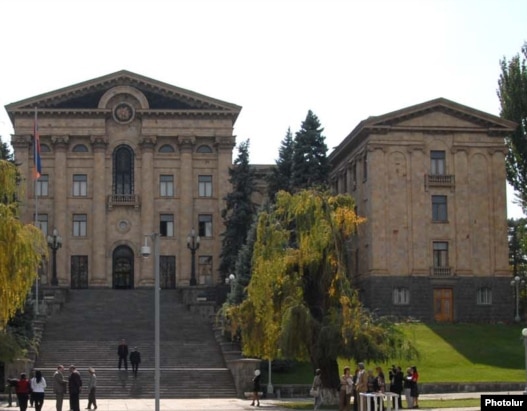
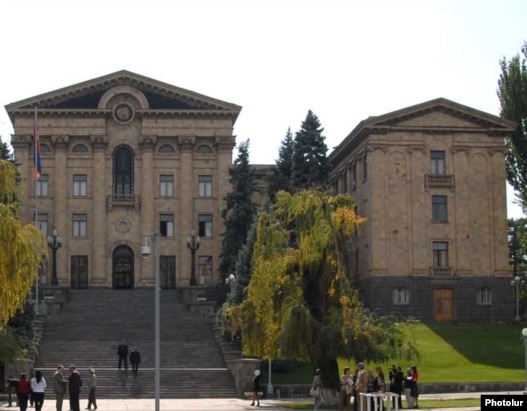
    Armenia — The parliament building in Yerevan.
    12.02.2010
    Tigran Avetisian, Karine Kalantarian

    President Serzh Sarkisian formally sent Armenia’s normalization agreements with Turkey to parliament for ratification on Friday after his government approved legal amendments making it easier for Yerevan to walk away from the deal.

    The government said in a statement on Thursday that the proposed amendments to an Armenian law on international treaties allow Yerevan “not to become a party” to a particular agreement before its entry into force.

    “We are now establishing that before the entry into force of an international treaty Armenia may stop participating in it,” Deputy Foreign Minister Shavarsh Kocharian was reported to say during a cabinet meeting. He said the president of the republic would be able to “terminate or suspend the process of signing” such a treaty.

    Sarkisian announced his intention to enact such amendments in December in response to Turkish leaders’ continuing statements making the ratification of the Turkish-Armenian “protocols” conditional on the resolution of the Nagorno-Karabakh. He made clear that Yerevan will annul the deal if Ankara fails to implement it within a “reasonable” time frame.

    Sarkisian reaffirmed the threat during a visit to London this week. “If, as many suspect, it is proven that Turkey’s goal is to protract, rather than to normalize relations, we will have to discontinue the process,” he warned.

    Sarkisian stressed at the same time that Armenia’s National Assembly, dominated by his loyalists, will promptly ratify the protocols in the event of their endorsement by the Turkish parliament.

    His press secretary, Samvel Farmanian, told RFE/RL’s Armenian service on Friday that the president has asked the assembly to start the ratification process. Foreign Minster Edward Nalbandian has been tasked with “presenting” them to Armenian lawmakers, Farmanian said.

    Prime Minister Tigran Sarkisian described the dispatch of the protocols to the parliament as further proof of Yerevan’s “sincere desire to establish good relations with neighboring states.” He said it showed that “we are prepared for the ratification of those protocols.”

    “It is a signal to both our domestic public and the international community,” the premier declared at a panel discussion on Turkish-Armenian relations held in Yerevan on Friday.

    “But they will not be debated until Turkey’s parliament ratifies the protocols,” Galust Sahakian, the parliamentary leader of the governing Republican Party of Armenia (HHK), clarified in an interview with RFE/RL’s Armenian service.

    Sahakian also confirmed that the amendments drafted by the government allow Armenia to withdraw its signature from the protocols. “After all, reasonable timeframes must have an end-point, and if the Turkish side again tries to drag out the process … we will simply be obliged to withdraw our signature,” he said.

    “In my view, that reasonable time frame is already expiring,” added Sahakian. “We are just waiting for the glass to be filled to the brim.”

    Opposition lawmakers critical of the Turkish-Armenian agreements were less than satisfied with the draft amendments. Armen Rustamian, chairman of the parliament committee on foreign relations affiliated with the Armenian Revolutionary Federation (Dashnaktsutyun), dismissed them as “cosmetic.”

    “These changes are mainly a political trick with which the authorities are trying to show Turkey that they have such an option and thereby to prod Turkey to ensure a quick protocol ratification,” said Artsvik Minasian, another Dashnaktsutyun lawmaker. He reaffirmed the nationalist party’s strong opposition to an unconditional Armenian ratification of the protocols, saying that would contradict a ruling handed by the Armenian Constitutional Court last month.

    The Turkish government likewise claims that the court ruling is at odds with key protocol clauses. It is particularly unhappy with the court’s conclusion that the protocols can not stop Armenia from advocating international recognition of the Armenian genocide.

    The Sarkisian administration has insisted all along that the court’s interpretation does not run counter to the letter and the spirit of the deal. U.S. officials have made similar statements.

    https://www.azatutyun.am/a/1956610.html
  • U.S. Envoy Argues For Turkish-Armenian Border Opening

    U.S. Envoy Argues For Turkish-Armenian Border Opening

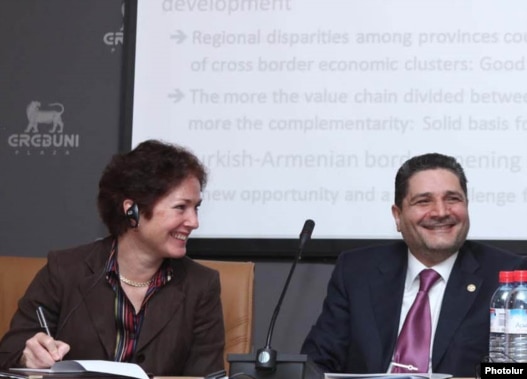
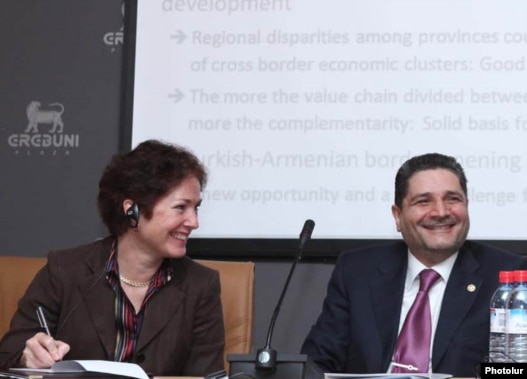
    Armenia — Prime Minister Tigran Sarkisian and U.S. Ambassador Marie Yovanovitch attend a panel discussion in Yerevan on February 12, 2010.

    12.02.2010
    Tigran Avetisian

    Armenia would draw substantial economic benefits from the possible opening of its border with Turkey and most Armenians seem to realize that, the U.S. ambassador in Yerevan, Marie Yovanovitch said on Friday.

    Reiterating Washington’s strong support for the Turkish-Armenian normalization, Yovanovitch said Armenia’s heavy dependence on Georgian transit routes carries an “enormous risk” that was highlighted during Georgia’s August 2008 war with Russia. The resulting disruption of vital cargo supplies to the landlocked country underlined the importance of having an open border with Turkey, she said.

    “The benefits [of border opening], I think, are clear to Armenia,” Yovanovitch told a panel discussion in Yerevan on Turkish-Armenian cross-border commerce. “An end to geographic and economic isolation; expanded export opportunities, especially for the depressed communities near the border; opening of the new transport routes that would reduce transport costs; easier access to Armenia for Turkish goods; increased competition and choice for Armenian consumers, a higher quality of Armenian products … and new export routes for Armenian products.”

    Armenian exporters would also gain access to the large Turkish market, continued the diplomat. “In addition, with Turkey and the European Union linked by a customs union agreement for trade purposes, an open border with Turkey would put Armenia on a border of Western Europe,” she said.

    Yovanovitch also spoke of significant political and economic benefits of border opening for Turkey. “Turkish companies would have new export markets in Armenia, and by establishing operations here they could take advantage of favorable export tariffs to Russia and other CIS countries at the same time as they create employment for Armenians,” she argued.

    The remarks reflect the view of not only the U.S. government but also the International Monetary Fund and the World Bank and other lending institutions. Senior IMF and the World Bank officials believe that a positive impact of border opening on Armenia’s recession-hit economy would be felt as early as this year.

    Some Armenian political groups claim that cross-border commerce with Turkey would actually damage the domestic economy. They say it would flood the domestic market with cheap Turkish consumer goods and thereby hurt many Armenian manufacturers.

    Yovanovitch found such concerns legitimate but said the Armenian government can minimize possible “short-term shocks” resulting from the normalization of Turkish-Armenian relations. “Opening the border between Armenia and Turkey will require adjustments,” she said. “But I’m confident that the long-term benefits to both countries and the region far outweigh any short-term economic impacts.”

    Yovanovitch also stood by her view that most Armenians support rapprochement with Turkey. “In meeting with people all around Armenia and all segments of the society, my experience has been that while some may have reservations about the protocols or about specific economic consequences or some other issues, they are in general overwhelmingly in favor of restoring relations between the two countries and opening the border,” she said. “Nobody forgets the past, but most are also focused on the future.”

    “They are concerned about their own prospects, about Armenia’s development and they understand that an open border would ease Armenia’s isolation, create economic opportunity and benefit Armenia’s children,” added the envoy.

    https://www.azatutyun.am/a/1956612.html
  • Turkey ‘Committed’ To Deal With Armenia

    Turkey ‘Committed’ To Deal With Armenia

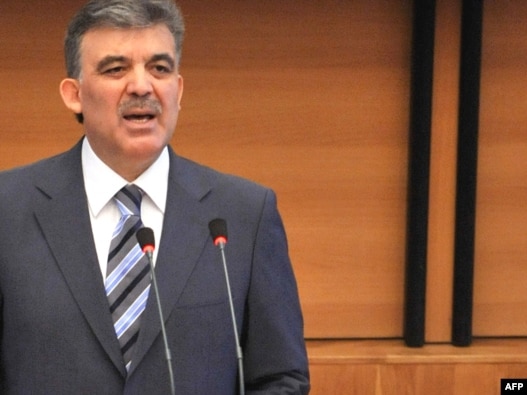
    Kyrgyzstan — Turkish President Abdullah Gul addresses the Parliament in Bishkek, 28May2009

    11.02.2010

    President Abdullah Gul on Thursday assured his Armenian counterpart, Serzh Sarkisian, that Turkey remains committed to the agreements to normalize relations with Armenia but did not specify whether it will unconditionally ratify them anytime soon.

    In a letter to Gul sent on Tuesday, Sarkisian warned that failure to implement the Turkish-Armenian “protocols” signed in October could roll back the “historic” rapprochement between the two nations. “A situation when words are not supported by deeds gives rise to mistrust and skepticism, providing ample opportunities to counteract for those, who oppose the process,” he said in a clear reference to ratification conditions set by Ankara.

    “I welcome the thoughts conveyed to us in your message,” Gul responded to the Armenian leader in a message posted on his website. He said Sarkisian “should have no doubt” about the Turkish government’s determination to promote “mutual understanding and trust among our two neighboring peoples.”

    “I also agree with you that responsible governance necessitates both standing behind words and supporting words with deeds,” wrote Gul. “Hence, we will continue to work for taking our normalization process forward based upon the understanding reached between our two countries.”

    “We have to be aware that concluding this historic process will require honoring our commitments in their entirety as well as displaying adequate political courage and vision,” he said, implying that Yerevan itself has yet to fully comply with the two protocols.

    Prime Minister Recep Tayyip Erdogan and other Turkish officials have indicated in recent weeks that the Turkish parliament will not ratify the protocols unless Yerevan addresses their concerns about a ruling handed down by the Armenian Constitutional Court last month. While upholding the legality of the agreements, the court made clear that they can not hinder Yerevan’s pursuit of broader international recognition of the Armenian genocide.

    Turkish leaders say this interpretation is at odds with key protocols provisions, a claim strongly denied by the Armenian leadership. The latter has accused the Turks of seeking more “artificial excuses” to avoid normalizing Turkish-Armenian relations.

    Gul’s letter contained no specific demands to Yerevan. The Turkish president said instead that he will “remain personally engaged in this process hoping to see it reach a satisfactory conclusion for both of our countries.”

    https://www.azatutyun.am/a/1955273.html