Month: September 2010

  • INTERCULTURAL CHESS TOURNAMENT

    INTERCULTURAL CHESS TOURNAMENT

    Intercultural Rapid Chess Tournament, organized from the 10 year old, turkish originated, multicultural chess club “”SATRANÇ CLUB 2000”. Slogan: “We all play in one language / Wir spielen eine Sprache / Biz ayni dilden oynuyoruz”. The tournament will be played during the Intercultural Week in Cologne, Germany. Please find all details here:

    https://www.turkishnews.com/de/content/2010/08/22/interkulturelles-schachturnier/ or www.satranc.de.vu

    Organizer: Intercultural Chess Club “SATRANÇ CLUB 2000”

    Event type: Competition/Tournament

    Date: 26/09/2010 – 26/09/2010

    Venue: City Hotel Köln am Neumarkt, Clemensstr. 8, 50676 Cologne

    Countries: Germany, Turkey

    Planned media coverage: Newspapers, chess magazines, chess TV, Internet

    Target Groups:

    Adults (in general)
    Business and commerce
    Children
    General public
    Media
    Members of migrant communities / Speakers of minority or regional language(s)
    Parents
    Participants in adult education programmes
    Policy deciders/politicians at national, regional or local level
    Pupils
    Researchers
    Students
    Tourism
    Young people (in general)

    Scope: Local

    Contact Address
    Mr. Güven Manay
    00491799425521
    [email protected]

  • Who will decide Armenia’s destiny — patriots or tyrants?

    Who will decide Armenia’s destiny — patriots or tyrants?

    The Christian Science Monitor – CSMonitor.com

    As Armenia begins its 20th year of independence, its dreams for democracy have been mugged by the reality of a repressive government. But some patriots are working to ensure that the tree of liberty will grow in Armenia one day.


    By Garin Hovannisian
    posted September 21, 2010 at 1:43 pm EDT

    New York —Across an ocean and a continent, on a sliver of land tucked between two seas, a little republic today enters its 20th year of independence. I know a man there, an American by birth � except that 20 years ago, he quit his law firm in Los Angeles, decided he had no further business in the United States, and went to search for his destiny in Armenia.

    It was a romantic time. One by one, the 15 Soviet satellites were breaking from the Kremlin�s orbit, and exiled sons were returning to their homelands to share in the creation of new republics.

    As for my father, Raffi K. Hovannisian, once the football star of the Pali High Dolphins, he left a promising legal career and moved with wife and children to Yerevan, the capital of Soviet Armenia. After independence was officially declared on Sept. 21, 1991, my father was handed a fax machine and a first month�s paycheck of 600 rubles � $143. He was told he was the republic�s first minister of foreign affairs.

    Post-Soviet seeds of democracy

    All across the Soviet plains, the seeds of democracy were being sown into soil tyrannized for generations, but no one doubted that they would grow. My father certainly didn�t. Within a year, he had established diplomatic relations with every major democracy in the world. At United Nations headquarters in New York, he had raised the red, blue, and orange Armenian flag.

    That was nearly 20 years ago. Everything was possible then.

    But the shadow of history soon closed in on the Armenians. The capital went dark. Faucets dried up. Grain shipments stopped coming in. And suddenly, as if for the first time, the Armenians realized where they were. To the west: a history of horror with Turkey, the memory of an unrequited genocide in 1915. To the east: the anticipation of war with Azerbaijan, occupant of the ancient American enclave of Artsakh, or Mountainous Karabagh.

    It is a dangerous thing, when survival becomes the sole ambition of a people. But that is what happened to the Armenians in the years after independence. They lost their hope, their cause, their conviction. They were not as generous as they used to be. And the old Soviet symptoms reappeared.

    Corruption and failure

    On the streets of Yerevan, a generation of child beggars emerged. Policemen waved batons for two-dollar bribes. Teachers worked for bribes, too. The presidents came to control every judge, prosecutor, and public defendant who wanted to keep his job. Fair trials and free elections became failed promises. Incumbents almost always �won� � while losers almost never went home without first leading a mob of a hundred thousand citizens through the capital.

    In 1999, during a session of parliament, all the president�s key adversaries were assassinated.

    My father long ago resigned from the Yerevan government, but he, at least, never gave up the dream. Instead, in 2001, he gave up his American passport once and for all. The following year, he founded Heritage, a national-liberal party, which now represents the opposition in the Yerevan parliament. To this day, my father is admired by his people. In a recent poll, Gallup pegged his popularity at 82 percent � but not for the obvious reasons.

    �Achke kusht e,� the people say of him, �His eye is full.� In other words: the man has seen the world, and he�s not in politics for the money. In Armenia, that is enough.

    Today the Yerevan government is linked to a group of powerful businessmen called �oligarchs,� who invest in and control the political game. One of them has the monopoly on gas, another the monopoly on sugar and flour. All of them have nicknames, armies of bodyguards, and fleets of luxury cars escorting them ostentatiously through the city.

    Power-hungry tycoons

    The rulers are multimillionaires, the lot of them, though they have incurred great debts to the original power tycoons surrounding the Kremlin in Moscow, to whom they have been selling the country�s gold mines and electricity plants. And they are ready to sell much more than that.

    Last month, Armenia hosted a summit of the Collective Security Treaty Organization, a post-Soviet alliance including Belarus, Kazakhstan, Kyrgyzstan, Tajikistan, and Uzbekistan � republics unclaimed by the West, republics that are now following an ancient gravity to its source in mother Russia. During the August meeting, Russia secured a 24-year extension of its lease on a key military base in Armenia. Actually, lease isn�t the word. The base is funded and sustained entirely by the Armenian state.

    Now you see why today, in Yerevan, there is not much independence or democracy left to celebrate. And by now my father, too, must see what his romanticism has long prevented him from seeing: Armenia is not free, not independent, not united. The Soviet soil has spit out the seeds of democracy.

    Hope foreshadows freedom

    Of course my father still keeps the faith, and there is some evidence to support it. For the first time in Armenia, a civil society is taking shape to bridge a government and a people, so far disenfranchised from each other. Denied television airwaves, opposition media are now transmitting their protest through the Internet. And that little party in parliament, though it has not realized a revolution, can at least symbolize � and foreshadow � a free and independent Armenia.

    And so we hope, and we even know, that the tree of liberty will grow from Armenian soil one day. But not today, not until, in the words of another founding father, �it is refreshed by the blood of patriots and tyrants� � both of which, I�m afraid, Armenia has plenty.

    Garin Hovannisian is the author of �Family of Shadows: A Century of Murder, Memory, and the Armenian American Dream,� released today.

  • At the U.N., Turkey Asserts Itself in Prominent Ways ; Letter to NY Times attached

    At the U.N., Turkey Asserts Itself in Prominent Ways ; Letter to NY Times attached

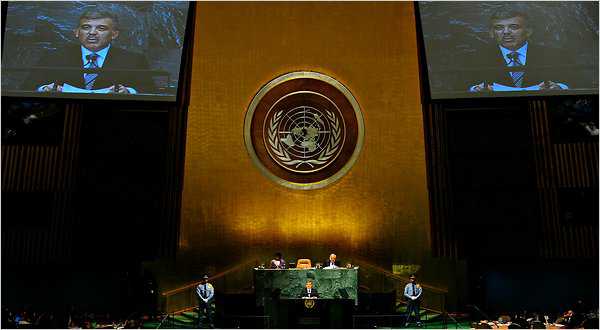
    President Abdullah Gul of Turkey addressed the Millennium Development Goals Summit at the United Nations on Monday.

    By MARK LANDLER
    Published: September 22, 2010

    UNITED NATIONS — If the United Nations General Assembly often serves as a stage for ambitious countries to project a new image, none has grabbed that opportunity this year with as much vigor as Turkey.

    In a flurry of speeches and meetings — and one meeting that did not happen — the Turkish president, Abdullah Gul, defended his country’s close ties to Iran, proclaimed Turkey’s intention to become a leader in the Muslim world, and spurned an attempt to mend fences with Israel over its deadly raid on an aid flotilla bound for Gaza.

    Turkey’s muscle-flexing has left the United States uneasy, with administration officials worried that Iran had obtained access to financing for its nuclear program through Turkish banks, and that Turkey’s rift with Israel could complicate American efforts to make peace in the Middle East.

    Israeli officials reached out to Turkey to arrange a meeting this week between Mr. Gul and the Israeli president, Shimon Peres, in New York. But it collapsed amid Israeli claims that Turkey had demanded an apology from Mr. Peres for the flotilla raid and Turkish claims that Mr. Gul had no time — all of which inflamed a sore that the Israelis hoped had been gradually healing.

    Turkey’s leaders made no apologies, saying they did not start the fight with Israel. Nor are they shy about Turkey’s ambitions, declaring that its status as a Muslim democracy, its growing economy, and its location at the hinge of Europe and Asia should make it a central player in resolving problems like the Iranian nuclear program and the Middle East conflict. “If you look at all the issues that are of importance to the world today,” Mr. Gul said in an interview on Tuesday, “they have put Turkey in a rather more advantageous position.” Turkey, Mr. Gul said, was the “only country that can have a very important contribution to the diplomatic route” with Iran — a clear reference to its effort, along with Brazil, to head off the last round of United Nations sanctions against Iran. After the United States brushed aside those negotiations, Turkey voted against the sanctions in the Security Council.

    Mr. Gul said Turkey would adhere to the United Nations sanctions, but would not allow the measures to constrict its broader trade with Iran.

    On Wednesday, Turkey’s trade minister said in Istanbul that the American-led campaign to ban all banking transactions with Iran was a mistake. Turkish officials said it was up to Turkey’s banks and companies to decide whether to go along with tougher unilateral sanctions decreed by the United States and the European Union.

    “If the demand is for Turkey not to have any trade, any economic relations with Iran,” Mr. Gul said, “it would be unfair to Turkey.” He claimed that some American and European companies continued to do business with Iran under new names, circumventing the sanctions. “That is why the sanctions do not yield the results that are envisioned for them, in most cases,” he said.

    Administration officials and experts on sanctions said that as Dubai and other Persian Gulf emirates had begun to crack down on their banking links to Iran in response to the sanctions, Iran had sought other intermediaries that would give it access to the Western financial system. Turkey is an obvious channel, as is Qatar, these officials said.

    “In a climate of financial restrictions and sanctions, Turks are actually increasing their trade with Iran,” said Ray Takeyh, a senior fellow at the Council on Foreign Relations and former adviser to the Obama administration on Iran. “It stems from their desire to be a pivotal power in the region.”

    Treasury Department officials have visited Turkey to urge the government to put the sanctions into effect. The United States has also reminded Turkey of its obligations as a member of NATO.

    A Treasury official said that what mattered more than Turkey’s public stance was the response of Turkish banks and companies. He said many were worried that dealing with Iran could have repercussions on their business in the United States and Europe.

    Mr. Gul insisted that Turkey did not want to see a nuclear-armed Iran. “The perception here in the U.S. is that what Turkey is doing is in some way undermining U.S. policy,” Mr. Gul said. “That is definitely not the case.”

    For now, Turkey’s rift with Israel has hampered its role as a peacemaker in the Middle East. In 2008, Turkey mediated talks between Israel and Syria, but those ended after Israel’s military strike on Gaza, which was harshly criticized by Turkey’s prime minister, Recep Tayyip Erdogan.

    Mr. Gul, an academic who has served as foreign minister, has a less blunt public image than Mr. Erdogan, though both are viewed with concern by critics who fear Turkey is drifting toward a more militant Islamic focus.

    After failing to meet Mr. Peres, Mr. Gul made time to see Iran’s president, Mahmoud Ahmadinejad. He also met Wednesday with representatives of Turkish and American companies at the Plaza Hotel.

    Nothing seemed to make Mr. Gul prouder than Turkey’s economy. Turkish bonds, he pointed out, were a safer investment than those of Portugal, Italy and Spain — three members of a European Union that has not yet accepted Turkey. And Turkey did not have to bail out its banks. Mr. Gul recounted a meeting with a head of state this week, in which the leader told him, “Turkey used to be known as the sick man of Europe, whereas Turkey now is the only healthy man of Europe.”

    Sebnem Arsu contributed reporting.

    =================================================================

    ] Letter to The New York Times

    To

    The Chief Editor,

    The New York Times

    Re: At the UN, Turkey asserts itself in prominent ways

    Sir,

    I have read your recent article on Turkey , following the world leader’s meeting at the UN.

    I thank you for giving such coverage to an ally totally misunderstood. It was indeed timely.

    You may be right in most of the points you raised, but, there is usually two sides to a coin.

    To understand, let alone solve a problem, one needs to understand the root causes of the

    disturbance.

    One need t o ask the question; why is Turkey behaving the way she has been behaving

    recently? Why did the Turkish  public opinion shifted the way it did, both against the EU

    and the USA for that matter?

    Please allow me to attempt an explanation from the point of view of  an interested

    observer:

    Turkey has taken part in the Korean War of the fifties under US and UN leadership,

    supposedly for democracy, peace and western interests. Later, Turkey became a full

    member of  NATO and contributed to world peace throughout the cold war period.

    The burden for the Turkish economy was heavy and painful, but, the Turkish nation

    carried that obligation without any complaint.

    Furthermore, Turkey became member of almost all European institutions, and took

    part in all activities, including song- and beauty contests, soccer and so forth.

    Then came up the so called European Union (EU), at first merely as an economic

    entity. Turkey immediately showed interest and applied accordingly.

    However, in due course neighbouring Greece and latter the Greek part of Cyprus,

    and one by one all the ex communist and Warsaw-Pact countries became full

    members but, unfortunately, Turkey not!  All kinds of barriers, including religion,

    culture, the Cyprus conflict, etc. have been put up by Europe.

    What happened on the US-front and Israel? Despite the so called strategic partnership

    with both countries and allies, disappointment after disappointment followed.

    The consequences of the Kuwait War or 1. Iraq War were economically devastating

    for Turkey. Following that war Turkey supported the no-fly zone restriction

    against Saddam Husein for a total of 9 years. Again, this had a crippling effect on

    the Turkish economy, and seen a strengthening of Terrorism against Turkey

    which cost the lives of thousands of her citizens. Again, NATO membership and

    American friendship did nothing to help. On the contrary, there is evidence of

    Western support for Kurdish terrorism.

    Because, of Turkey’s democratic decision not to enter the 2.Iraq War, America

    insulted and humiliated the Turkish state in every way she could. Israel, on her

    part, started training and arming the Kurdish terrorists who aimed at destroying

    the very substance of the Turkish state.

    The AKP government, like it or not, did a lot to get closer to  both Europe and

    the USA. This government also did her share of furthering democracy and

    human rights. The world has seen waves of globalisation and privatisation.

    Turkey did nothing more that try and get her share! Is that so wrong?

    Why should Turkey not develop, politically and economically? Turkey is

    not a Banana Republic, and the sooner both allies and foes understand this,

    the better.

    I know this is not the whole story, but I really do hope I could shed some light

    of what went wrong. It is never too late to correct a mistake and put things

    right. Both Israel and the USA must realise that it takes many years to develop

    a strategic partnership, and it should not be destroyed so irresponsibly.

    Best regards

    Kufi Seydali

    Heinrichweg 9

    A-3291 Kienberg

    Tel: 0043-664 120 7941

  • Turkey Bolsters Ties With Turkic States

    Turkey Bolsters Ties With Turkic States

    Turkey Bolsters Ties With Turkic States Turkey Bolsters Ties With Turkic States

    Publication: Eurasia Daily Monitor Volume: 7 Issue: 170

    September 22, 2010

    By Saban Kardas

    Turkey hosted the tenth summit of Turkic-speaking countries in Istanbul on September 16. The Istanbul summit, bringing together Turkish, Kazakh, Azeri, Kyrgyz and Turkmen leaders, took steps towards furthering institutionalizing this inter-governmental platform, in line with the conclusions of the previous meeting in Nakhchivan in October 2009. Through the Nakhchivan declaration, Turkey, Azerbaijan, Kazakhstan and Kyrgyzstan had formed a Turkic-Speaking Countries Cooperation Council –or Turkish Council, as Turkey seeks to promote it. In Istanbul, the leaders agreed to implement measures to make the new bodies operational, including the Council of Heads of State, Council of Foreign Ministers, Council of Senior Foreign Ministry Officials, Wise Men’s Council and Permanent Secretariat. Moreover, they agreed to set up other institutions to protect joint cultural heritage, form a union of universities, and create a fund to support research activities (Anadolu Ajansi, September 16; for an English text of the final declaration, see: Today’s Zaman, September 17).

    Turkish President, Abdullah Gul, the host of the summit, emphasized the importance of the meeting to strengthen the commonalities among the brotherly nations in terms of language, history, religion and cultural values. He called upon the leaders to diversify relations in various areas. The leaders attending the summit highlighted the role of this burgeoning cooperation in contributing to peace and pledged to deepen solidarity to boost regional stability, human rights and a market economy.

    The conclusions of the meeting reflect the Turkish government’s desire to play a greater leadership role in the Turkish speaking world. Although Ankara sought to forge closer ties among these states in the early post-Cold War period, it failed to realize this ambitious objective. However, in recent years, the Turkish government has demonstrated its willingness to revitalize cooperation among Turkic countries. The recent decisions are, thus, products of Ankara’s determined moves in that direction (EDM, November 23, 2008). After the Nakhchivan declaration was passed last year, Gul presented it as a major success on Turkey’s part (www.euractiv.com.tr, October 6, 2009). Turkey expects the Turkish Council to develop based on the model of other similar organizations, such as the Commonwealth, Arab League or Francophonie (www.tcbb.gov.tr, September 16). Nonetheless, in an example of the limitations before this objective the Kazakh, Turkmen and Kyrgyz leaders spoke at times in Russian during the summit (Dogan Haber Ajansi, September 16).

    In a move that underscored Turkey’s leadership role, the first rotating presidency was assumed by Turkey and a senior Turkish diplomat, Halil Akinci, former ambassador to Moscow, was appointed as the Secretary-General of the council (Zaman, September 16). So far, there have been irregular summits as well as bilateral meetings between different states. Ankara believes the establishment of a permanent secretariat in Istanbul would increase the visibility of the council in regional and international affairs and contribute to the institutionalization of governmental ties.

    Speaking at the summit, Gul went as far as maintaining that “from now on, we are one nation, but six states.” The phrase “one nation, two states,” has been used to define the warm ties between Turkey and Azerbaijan. It remains to be seen if other Turkic states will embrace it to the same extent to identify themselves so closely with Turkey. Ankara has been unable to convince all Turkic states to participate. Uzbekistan has deliberately avoided attending the summits since the early 2000’s. Turkmenistan has also been aloof to this platform for some time. In that sense, Turkmenistan’s representation at the Istanbul summit can be considered as a positive step. Nonetheless, referring to its foreign policy principle of “positive neutrality,” Turkmenistan did not sign the Nakhchivan declaration. Uzbekistan again was absent from the Istanbul summit, underscoring continuing divisions.

    Besides its importance for intra-Turkic cooperation, the Istanbul summit also provided a venue for the participating leaders to hold various bilateral meetings with their counterparts to discuss issues of specific relevance. Turkey, for its part, used that opportunity to deepen ties with Azerbaijan. On the margins of the summit, Turkish Prime Minister, Recep Tayyip Erdogan, and Azeri President, Ilham Aliyev, signed a framework agreement to form the High Level Strategic Cooperation Council (Hurriyet, September 15). Ankara has signed similar agreements with several countries, mainly its Middle Eastern neighbors. The agreement with Baku was in preparation for some time, and its conclusion further highlights Ankara repairing its ties with Azerbaijan following the row caused by the Turkish-Armenian normalization process.

    Moreover, the energy ministers from Turkey, Azerbaijan and Turkmenistan discussed energy cooperation. Ankara already has an agreement to purchase Turkmen gas, provided that transit problems are resolved. Thus, Turkey wants to contribute to the resolution of the disputes between Azerbaijan and Turkmenistan, for it would also deepen cooperation as part of the East-West energy corridor and enable the export of Turkmen gas to Europe through Turkey. Turkish Energy Minister, Taner Yildiz, noted that they avoided discussing the status of the Caspian Sea, especially border issues. He stressed that it could still be possible to develop trilateral cooperation in some undisputed sectors of the Caspian even before other major issues were resolved. Azeri Energy Minister, Natiq Aliyev, also expressed hope that the remaining disagreements could be resolved so that Turkmen gas could be exported through the Caspian and Azerbaijan. The Turkish side welcomed this meeting as a positive step, which might boost prospects for the Nabucco pipeline (Anadolu Ajansi, September 15).

    For some time, the Turkish government has been criticized for its neglect of Central Asia in its foreign policy priorities (EDM, June 25). In contrast, the government has presented its recent steps in the South Caucasus and Central Asia as proof that it has been pursuing a multidimensional foreign policy. Therefore, Ankara widely publicized the Istanbul summit as a great success. Nonetheless, those skeptical of the government urge caution and argue that one should wait to see if the declaration will be matched with deeds before judging the success of the government’s recent initiatives within the Turkic world (www.211yyte.org, September 17).

    https://jamestown.org/program/turkey-bolsters-ties-with-turkic-states/

  • Holy Cross deserves more Armenian tears

    Holy Cross deserves more Armenian tears

    For the first time in 95 years liturgy and hymns were heard on Lake Van

    by Tatul Hakobyan

    Van, Turkey – As Armenian clergy led by acting Istanbul Patriarch Aram Ateshyan were ringing the bells and making their way from the half-destroyed bell-tower to the Church of Holy Cross to hold a divine liturgy there for the first time in 95 years, several hundred mostly Turkish Armenians walked around the church, looked out towards the lake, lit candles and cried.

    An older man kneeled before the church walls and silently prayed and cried with his eyes to the sky.

    A middle-aged woman kept trying to light a candle but couldn’t with her hands trembling as she cried.

    Another woman walked between cracked khachkars (cross-stones) lying here and there in the church yard and cried with her entire body shaking.
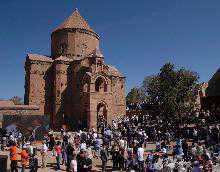
    But the Church of Holy Cross (Surb Khach in Armenian) deserves more Armenian tears, more prayers and more believers. The Van Lake (or the Van Sea as Armenians call it), its azure waves have long yearned for Armenian eyes.

    By noon on September 19 only several dozen Armenians from Armenia arrived here with the same number coming from Diaspora.

    The many who were expected to come but did not must have heeded the calls of Armenian authorities and the Armenian Church (both Echmiadzin and Cilicia, as well as the Jerusalem Patriarchate) who urged Armenians not to go to Akhtamar on this day, September 19, not to participate in a “Turkish show.”

    But this was far from being show. Anyone on Akhtamar that day felt the energy, the magnetism of the place that dominated everywhere on the island. This was no show. This was a collective prayer for the souls of innocent victims of 1915, even though Archbishop Aram did not specifically mention them.

    Last time a liturgy at the Church of Holy Cross was performed in 1915, shortly before the final expulsion of Armenians from this area during the Genocide. Ninety-five years later, a liturgy was heard, but in spite of promises by Turkish officials, the church’s dome was still missing its cross.

    Armenian secular and religious leaders called for a boycott after it became clear that a cross would not be installed in time for the ceremony. So, most Armenians who arrived from Armenia were journalists, many of whom came with financial support of various international organizations.

    Diaspora media did not dispatch journalists to Akhtamar even though the Turkish Prime Minister’s office sent invitations offering to take up all of their expenses.

    Kapriel Chemberjian, who lives in Syria and is a director of the Punik (Phoenix) benevolent fund, has been to Akhtamar and Western Armenia before. This time he arrived with his wife. While he agrees with Armenia’s official boycott, he also believes it is natural for Armenians from all over the world to want to come to a liturgy at a place so sacred for Armenians.

    “This is our land, and we should be able to come here whenever we want, as pilgrims, to light a candle,” said Chemberjian, who is also one of the contributors to reconstruction of the Diyarbakir (Tigranakert) church and other Armenian undertakings.

    Businessman Dikran Chiderjian who lives in Monaco has also been to Western Armenia before. Together with his French wife he was here in the late 1990s.

    “Several years ago a liturgy at the Holy Cross would seem like a dream. Perhaps not everything was properly prepared, but this is an important step towards reclaiming our heritage,” said 70-year-old Chiterchian.

    The day before he crisscrossed the lake on a boat visiting other largely destroyed Armenian monuments in this area that have been abandoned for nearly a century.

    “[Reasons provided for] Echmiadzin’s refusal to dispatch representatives to the ceremony were merely a cover, real reasons are political,” Chiderjian says.

    Armen Yarmayan, 62, is a trustee of the Holy Savior hospital in Istanbul.

    “I came to hear a liturgy that is taking place here for the first time since 1915,” he said. According to Yarmayan, Armenia’s boycott is justified, but Turks too should not be blamed for not installing the cross.

    “Time will put everything in its place, the cross will be installed and believers from Armenia will come to the next liturgy,” he predicted.

    Krikor Kyokchian was born in Istanbul, but lives in Beirut. He came to Akhtamar with four members of his family to be here, as he said, on an historic day.

    “Let there be ten boycotts, I would have come here anyway, I needed to see this for myself,” he said.

    The Church of Holy Cross was built in the early 10th century in the times of Gagik the First Artsruni, King of Vaspurakan. Designed by architect Manvel the church served as the Catholicosal residence adjacent to the Artsruni court. Due to politics of the period, five Catholicoses resided at Akhtamar during the 10th century.

    As conditions in the Ararat valley more or less normalized, Catholicos moved to the Church of Argina in Ani. Since then the Holy Cross was no longer a residence for the Catholicos of All Armenians. But to preserve that memory, Akhtamar’s clerical brotherhood continued to call their leaders Catholicoses.

    So it turns out that 10th century Armenians were able to create a cultural monument of world heritage value, but 21st century Turks are “unable” to install a cross on top of it.

    They claim that either there was not enough time, or the cross was too heavy, or wonder how could they have a cross in a Muslim country, and then quickly add that the cross would go up a week after the ceremony.

    If this is a possible to do a week later, why not do it before the liturgy, to make sure that more people come, including from Armenia?

    The cross, which by the way weighs not 200 kilos as some Turks claimed, citing that as a reason why it may damage the dome, but just 76 kilos, could be seen standing not far from the church.

    In March 2007, following its restoration, the Church of Holy Cross was opened as a museum with a prohibition that it be used for religious ceremonies. Armenian officials, including deputy minister of culture, were present at that opening.

    As part of that ceremony, a huge Turkish flag was unfurled on the island and that was truly a show.

    This time there wasn’t anything like that. Other than a single blood-red flag with a crescent in the Akhtamar bay, on September 19 one would be hard-pressed to find Turkish symbols on the island.

    Nevertheless, helicopters circling in the air, and a boat with armed soldiers seen in the lake throughout the ceremony, did serve as reminders that this was a state-planned event, in a way a “show.”

    Among the guests one could see the governor of Van province and the mayor of Van, as well as foreign diplomats accredited in Ankara.

    Van governor did all he could to ensure a larger turnout through participation of local residents. During the liturgy Muslim Turks and Kurds outnumbered Armenians several times. Some of them came out of curiosity, others for a weekend getaway on the shores of Van.

    “Dear Armenian friends, welcome to Van,” a poster announced near the entrance to the city. But no other writings could be seen that would identify the Akhtamar Church as Armenian, and term Armenian seemed to be studiously avoided.

    But on September 17 several pages of the local Van newspaper were published in Western Armenian, produced in cooperation with Istanbul-based Agos. They included a feature on “What happened with monasteries of Van” that listed about a hundred monuments located on the shores of the lake, most of them now destroyed and some still partly intact, all abandoned.

    Turkish Armenians say that the Church of Holy Cross will soon have its cross installed. They say that 10 to 15 years ago they would not even dare to think of its reconstruction or about having a divine liturgy here, even without a cross in place. They see the September 19 ceremony as not completely satisfactory, but still an important milestone in the life of their community.

    Akhtamar and its Church of the Holy Cross deserve to see more Armenians come, more Armenians crying, praying and walking around.

    Our Lake Van, its azure waves have long yearned for Armenian eyes.

    — Journalist Tatul Hakobyan is an expert with the Civilitas Foundation. From 2006 to 2009, he was the Armenian Reporter’s senior correspondent. He is the author of “Artsakh Diary: Green and Black,” a book about the Karabakh war published in Armenian, English and Russian. He will soon publish his second book “View from Ararat: Armenians and Turks.”

    (c) 2010 Armenian Reporter