Month: July 2010

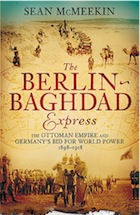
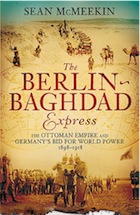
  • The Berlin-Baghdad Express: The Ottoman Empire and Germany’s Bid for World Power, 1898-1918 by Sean McMeekin

    The Berlin-Baghdad Express: The Ottoman Empire and Germany’s Bid for World Power, 1898-1918 by Sean McMeekin

    The roots of conflict in the Middle East go back to the ‘half-mad imperial enterprise’ of Germany’s last Kaiser Wilhelm II, finds George Walden

    In 2002, a commentator in the Cairo newspaper Al-Akhbar wrote of Hitler and the Holocaust in terms that Iran’s President Ahmadinejad might envy: “If only you had done it, brother, if only it had really happened, so that the world could sigh in relief!” Sean McMeekin’s book helps us understand how such a pearl of murderous mendacity could ever have been uttered. Islamic ties to National Socialism can be traced back as far as Kaiser “Hajji” Wilhelm II (German emperor from 1888-1918) who, for not especially religious reasons, became infatuated with the Muslim world.

    1. The Berlin-Baghdad Express: The Ottoman Empire and Germany’s Bid for World Power, 1898-1918
    2. by Sean McMeekin
    3. 496pp,
    4. Allen Lane,
    5. £25.00

    The National
    July 22 2010
    UAE

    Blood on the tracks

    Kaiser Wilhelm II believed he could harness the martial power of the
    Caliphate in the furtherance of German imperial interests – and failed
    utterly. Matthew Price on one of the boldest gambles of the great game.

    Sean McMeekin Allen Lane Dh140

    The story of how the modern Middle East was born out of the wreckage
    of the Ottoman Empire after the First World War is well known. With
    the British and French acting as midwives, the former provinces of
    this once mighty imperium were put on a (difficult) path to modern
    statehood. But there was hardly anything inevitable about the
    inglorious demise of the Ottomans.

    Though it had been convulsed by internal disputes, the Ottoman Empire
    was still a formidable power in 1914. But, as so often happens in
    history, a wrong bet had profound historical consequences. That bet
    was the alliance with Germany that brought the Turks into the war on
    the side of the Central Powers. It was a fateful decision. Prodded by
    the Kaiser (the allure of German marks also helped) the Turkish regime
    went to war against its historical enemy, Russia. This, in itself,
    was not an absurd wager. However, the German end of the bargain
    was an altogether different proposition: taking aim at the British
    empire and its 100 million Muslim subjects, Wilhelm II cooked up a
    breathtaking plan to unleash the furies of an Islamic power on the
    British Raj and Egypt and harness the glories of the Near East to
    German imperial interests.

    The historian Sean McMeekin, in The Berlin-Baghdad Express, his
    masterful history of this remarkable if preposterous undertaking,
    calls it the “first ever global jihad”. Historians have tended to
    downplay the role of pan-Islamic agitation in the First World War,
    arguing that the Turco-German campaign was marginal to the strategy
    of the Central Powers. However, McMeekin, who has consulted numerous
    Turkish and German sources, convincingly puts the plan front and
    centre, and gives us a fuller, more complex picture of how the Great
    Powers influenced the future of the Middle East.

    It is a story that takes in grotesque misapprehension, outlandish
    propaganda, sordid compromise, abject failure, and comic –
    or tragic – outcomes. A professor of international relations at
    Bilkent University in Ankara, McMeekin has written a sophisticated,
    if sometimes tendentious, account that gives us a much broader view
    of a story whose echoes persist into the present day: the efforts by
    western powers to exert influence in the Middle East, and the way in
    which those efforts – often involving attempts to marshal the force
    of religious fervour – have so reliably backfired.

    The Berlin-Baghdad Express is also a phenomenally entertaining
    narrative. Featuring a dramatis personae that puts Indiana Jones
    to shame, McMeekin’s book opens up a window on to the vanished,
    all-but-forgotten world of German Orientalism and the band of
    scholar-adventurers who fanned out across the Middle East to win
    converts to the cause. Lawrence of Arabia has won all the glory, but
    these agents were, to a man, every bit his equal. (It’s refreshing
    to read about a moment in 20th-century history when Germans acted no
    better or worse than their British and French adversaries.) Travelling
    to the most forbidding regions of the Muslim world, where no infidel
    was welcome, they carried out their briefs with élan and derring-do,
    though with little success in the end.

    Indeed, McMeekin offers, among other things, a brilliant exposé of
    a geopolitical disaster. From the start, there was something unseemly
    about the Kaiser’s embrace of Islam – “Hajji Wilhelm” was always a man
    of sudden, contradictory, enthusiasms. After a visit to Jerusalem in
    1898, he declared to his cousin, Tsar Nicholas II, that “My personal
    feeling in leaving the holy city was that I felt profoundly ashamed
    before the Moslems and that if I had come there without any Religion
    at all I certainly would have turned Mahomettan!” (At the same time, he
    was enthusing to Theodore Herzl about Zionism.) But the Kaiser thought
    he also had found a weapon: “the Mahometans were a tremendous card”
    in the game against “the certain meddlesome Power!”- Great Britain.

    Thus began Germany’s ardent courtship of the Sublime Porte and Sultan
    Abdul Hamid. Building a railroad from Constantinople to Baghdad to
    Basra – the eponymous express – would become one linchpin of German
    strategy. The other would be exploiting the symbolic potential of
    the Caliphate to stir the passions of Muslims. Under any political
    circumstance, this was a risky move. And the Germans weren’t the only
    ones with their eyes on the Caliphate: the British entertained notions
    of detaching it from the Ottoman Sultan and moving it to Mecca. They
    lavished funds on the Sherifiate and Ibn Saud’s Wahhabist legions in
    an attempt to buy their support. (As one leader writer put it in a
    pro-British Egyptian paper, “it is Mecca, not Constantinople, which is
    the centre of the Muslim faith. It is towards the Kaabah, not towards
    the St Sophia, that the Moslem turns his eyes as he prays”). About
    this faintly absurd jousting amongst the Great Powers, competing to
    prop up the long-expired authority of the Caliphate, McMeekin writes,
    “It was like a race to the reactionary bottom, to see which ‘infidel’
    power could conjure up the purest strain of fundamentalist Islam.”

    Helping to whip up passions was one of history’s most unlikely
    jihadists, Baron Max von Oppenheim, who directed the Kaiser’s
    “jihad bureau” for the duration of the war. The scion of a Jewish
    banking family, an archaeologist, writer, and veteran Near East hand,
    Oppenheim thundered that Muslims “should know that from today the
    Holy War has become a sacred duty and that the blood of the infidels
    in the Islamic lands may be shed with impunity”. (Germans, Austrians,
    and Hungarians were granted exceptions, of course.)

    Oppenheim supervised a crack team of Orientalists, among them Alois
    Musil, cousin of the novelist Robert, who trekked to central Arabia
    in 1915 to enlist Arab tribal sheikhs, and Oscar von Niedermayer, who
    made a perilous journey across the Persian desert to spur the Emir
    of Afghanistan into attacking the Indian Raj. Despite the effusions
    of pious rhetoric, the Turco-German plan foundered badly. McMeekin
    is at his best explaining why, as a strategic adjunct to the war,
    the “jihad” amounted to very little. In the two resounding Turkish
    victories over British forces, at Gallipoli and Kut-El-Amara,
    Islamic sentiments counted for nothing on the battlefield; tenacity
    and superior tactics did.

    Almost everywhere – Persia, the Shia strongholds of southern
    Mesopotamia, Afghanistan and the Hejaz – German agents found themselves
    contending with endless logistical traps. With the British Navy in
    control of the seas, the still incomplete railway took on a vital
    importance. There was simply no way for the Ottomans to ship arms and
    materiel across vast distances to supply their would-be allies. The
    “jihad”, in actuality, turned into a series of cash transactions,
    with the Germans (and British) resorting to subventions, financial
    blandishments, and outright bribery. For their support, the Turks
    themselves asked for millions of marks; in Afghanistan, the Emir
    “demanded from Berlin a lump sum of £10 million sterling, the
    equivalent of some $5 billion today”.

    The Germans – and British – both exploited and misunderstood the issue
    of the Caliphate. Shia clerics were never going to fall in behind
    a Sunni Caliphate, whose authority they would never recognise. And,
    besides, the Caliphate was a nearly moribund institution in 1914. As
    McMeekin explains, the Caliphate was not analogous to the papacy;
    it was a “political-military power” backed up by superior force of
    arms and Ottoman military might. And even this counted for little in
    the Arab holy lands of the Hejaz, where the Ottomans were unable to
    put down a revolt by the Emir of Mecca in 1916 (on which the British
    lavished several billions, in 2010 dollars). The uprising by blood
    relatives of the Prophet rendered null and void any remaining authority
    of the Caliphate.

    Though McMeekin frequently lapses into cliché (“The Syrian and
    Mesopotamian stretches on the other side of the mountains were no
    picnic either”), he is a vivid, confident stylist with a keen eye for
    the farcical anecdote. During an attack on the Suez Canal, Bedouin
    tribesmen shouting “Allahu Akhbar” give away Turkish positions to
    the British; in Constantinople, it turned out that “the lead holy
    war writer in the Turkish press, ‘Mehmed Zeki Bey, ‘ was actually a
    Romanian Jewish conman who had recently done a turn running a bordello
    in Buenos Aires.” McMeekin writes equally as well on the horrors of war
    in the Ottoman provinces and the grim fate of Armenians in 1915-1916.

    But for all his trenchancy, McMeekin overstates his case, and, in
    doing so, fails to explain what, exactly, we are to make of “Germany’s
    historic role in the Middle East”. Looking back to the First World War
    from the vantage point of a world obsessed with radical Islam of the
    bin Ladenist variety, McMeekin argues that “the Kaiser’s promotion of
    pan-Islam, while a strategic failure in the World War, threw up flames
    of revolutionary jihadism as far afield as Libya, Sudan, Mesopotamia,
    the Caucasus, Iran, and Afghanistan, which never entirely died down
    after the war.” Yet McMeekin’s notion of “revolutionary jihadism” is
    off-key, and he skips a beat in his argument. As he forcefully reminds
    us in his epilogue, “Wilhelmine Germany was also the spiritual and
    political home of Zionism”, which was an ethno-nationalist movement.

    As the Middle East moved from protectorates and mandates to independent
    nation states, nationalist movements set the terms of political
    debate. The revolutionary jihadism of today, in fact, emerged only
    after the collapse of Nasser’s secular pan-Arabism.

    Kaiser Wilhelm’s “jihad” against Britain – foolhardy, ambitious,
    and fantastically enthralling in hindsight – casts precious little
    light on the problem of contemporary religious extremism.

    Matthew Price is a regular contributor to The Review.
  • Long Lost Relatives Meet Again

    Long Lost Relatives Meet Again

    It is a widely held opinion by anthropologists, archeologists, sociologists, historians, and other scholars and intellectuals that the natives of all Americas (South, Central, and North) had probably come by a land bridge over the Bering Straits many thousands of years ago when sea around series of island had frozen—numbers range from 7,000 to 70,000 years ago depending on who is interpreting the research findings and data. (It must also be noted that some scholars caution not to leave the sea route out, pointing to the natives of Australia and many South Pacific islands, but same scholars are quick to add that sea route could not have been a major contributor to populating of the Americas.)

    Thus, it is safe to assume that most natives of Americas had come from Siberia and Central Asia, areas where hunting and gathering may be challenging at best, if not also scarce to support large populations. Those areas are home to many groups of Turkic nations, tribes, and groups, including but not limited to Kirghiz, Uzbek, Turkmen, Kazakh, Uyghur, Tuva, Hakas, Altay, and Yakut–all of whom also represent the source of Turkish identity in Anatolia today. This connection may help explain many similarities between the Turkics of Asia and Europe on one hand and the natives of Americas on the other: genetically (birth mark that appears at the end of the spine at birth and disappears after a short while that is known among the natives of Arizona natives and Kazakhs of Asia;) linguistically (many common words in Turkic and Native languages like odam=adam=man, ikki=iki=two, etc. 😉 culturally (profound respect to elders, tepee=yurt;) and other aspects.

    While we will let the scholars do the research and interpretation on this matter, let us turn our attention to re-discovery of long lost relationships. Here is a press release by the Turkish Coalition of America which may shed some more light on this topic. To learn more about TCA’s work with native Americans including the Hopi Tribe, and other communities, please visit www.tc-america.org.

    TCA Promotes Trade Relationship Between Turkey and Hopi Tribe

    July 24, 2010 – Los Angeles, CA – On Tuesday, July 20th the Turkish Coalition of America (TCA) facilitated a meeting between the visiting Turkish Trade Minister, Zafer Caglayan, and representatives of the Hopi Tribe, including Ali Cayir, the first Hopi Tribe Representative to Turkey.

    During the meeting, Cayir described the benefits of working with the tribes in the United States, which operate as sovereign nations with their own governments that can deal on an equal footing with Turkey in negotiating trade and investment relationships. The Hopi Tribe, whose reservation is in Arizona, hopes to promote increased solar power projects, continued coal extraction, and the development of a major consumer center for the reservation’s residents.

    “When TCA began connecting the Hopi and Turkish peoples, we were working to develop completely new relationships. The meeting between the Hopi Tribe and Minister Caglayan represents a giant step forward in tying together the native peoples of the U.S. and Turkey through trade and investment. This is an unprecedented development. TCA is proud to have helped launch this extraordinary relationship,” said TCA President G. Lincoln McCurdy.

    Minister Caglayan, meeting with the Tribe for the first time, spoke of the affinity and possible kinship of the Turkish and Native American peoples, based on ancestral migration thousands of years ago, and expressed interest in visiting the Hopi reservation upon his return to the United States in October 2010.

    Also in attendance were several commercial representatives of Turkish business interests, who engaged in a discussion of investment and construction opportunities on the reservation. The parties walked away with a plan for the Hopi Tribe to conduct initial feasibility studies and cost-benefit analyses that would justify potential Turkish involvement on the reservation.

    Samuel Shingoitewa, Jr., advisor to the Tribe’s chairman, closed the meeting by reiterating the Tribe’s desire to work with Turkey, and expressed his desire for the Hopi Tribe to aggressively expand its relationships with other nations over the next four years.

    For years, TCA has promoted the development of relationships between the Turkish peoples and the many ethnic and cultural groups in the United States, including a program to provide scholarships for Native American, African American, Hispanic American and Armenian American students for study abroad in Turkey or the Turkish Republic of Northern Cyprus.

  • Film Screening: THE ARMENIAN REVOLT (1894-1920)

    Film Screening: THE ARMENIAN REVOLT (1894-1920)

    Assembly of Turkish American Associations
    1526 18th St., NW Washington, DC 20036
    202.483.9090 – 202.483.9092 fx
    www.ataa.org, [email protected]

    ATAA Capital Forum Program proudly presents:
    A film screening at the U.S. Congress: THE ARMENIAN REVOLT (1894-1920)
    Wednesday, July 28, 2010
    Rayburn HOB, Room 2103, 12pm
    Washington, DC
    (Lunch will be served)
    To date, the United States legislature has considered 11 legislative initiatives opining on the history of the late Ottoman Empire, five that failed because they characterized the events of 1915 as genocide, and six that passed because they did not. The 12th initiative, H.Res. 252, which narrowly passed the House Foreign Affairs Committee 23-22 on March 4, 2010, looks to be the sixth to fail. Regardless, Turkish Americans are facing their ancient history, and so should Armenians Americans, as there are always two sides of a story.
    Accordingly, on Wednesday, July 28, 2010, the ATAA Capital Forum program will host a screening of the film, “The Armenian Revolt”, regarding the armed Armenian Independence Movement (1880-1919) which sought to create a politically, ethnically, and religiously homogenous Armenian state in the eastern region of the Ottoman Empire, and failed. Legal expert, Bruce Fein, will provide opening remarks.
    The producer of the film, Marty Callaghan, is a war documentarian, who recently produced, “Blood, Sand and Oil” regarding WWI in the Middle East and Allied use of micronationalism from the Caucasus to the Arabian Peninsula to destroy the multi-ethnic, multi-cultural Ottoman Empire, and replace it with states servile to western empires. “The Armenian Revolt”, which appeared on Bloomington PBS, takes a look at WWI designs for the Caucasus.

    The ATAA will continue to host experts on the Ottoman Armenian matter with a view toward reconciliation based on truth.
    R.S.V.P. [email protected]
    ATAA serves as an information resource center for its members and component associations throughout the United States, while working locally and nationwide to develop an informed and effective Turkish American citizenry. The ATAA is a major resource for experts, policy makers, and media who seek a deeper and broader understanding of U.S.-Turkish relations. The ATAA is a recognized 501(c)(3) non-profit organization formed under the laws of the District of Columbia. To learn more about ATAA, please visit us at www.ataa.org

  • ASSYRIAN GENOCIDE MONUMENT TO BE UNVEILED IN SYDNEY

    ASSYRIAN GENOCIDE MONUMENT TO BE UNVEILED IN SYDNEY

    Assyrian International News Agency AINA
    July 19 2010
    Sydney

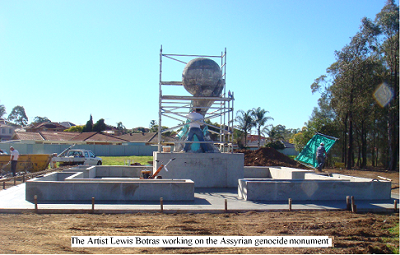
    Preparations are under way for the upcoming official unveiling of
    the Assyrian genocide monument, which was approved by Fairfield City
    Council on December 15, 2009.

    According to Mr. Hermiz Shahen, the Regional Secretary of the
    Assyrian Universal Alliance in Australia and New Zealand, the date
    of the unveiling will be on the seventh of August 2010 at 11:00 am
    at Bonnyrigg Park where the statue is erected. This memorial stands
    for the Assyrian genocide committed at the hands of the Ottomans
    Turkey during WWI, which claimed about 750,000 innocent lives and
    the Simile massacre at the hands of Iraqi army on 7th August 1933,
    which claimed the lives of about 6000 innocent Assyrians. Each year,

    on August 7, the Assyrian communities worldwide commemorate Assyrian
    Martyr’s Day with respect and dignity, Mr. Shahen said.

    Mr. Shahen continued that the worldwide Assyrian community has
    contributed to the cost of the entire project, which exceeded 70000
    dollars. The site is expected to become a pilgrimage site not only
    for the Assyrians but for all Australians who are sympathetic to
    this issue.

    Australians contributed generously to help the displaced families
    during WWI, donating supplies and financial assistance through
    their charitable organizations to help the victims of this Assyrian,
    Greek and Armenian genocide. A great number of Australian soldiers
    engaged in the war helped bravely, saving the innocent victims of
    this genocide from the hands of the enemy and were thus first-hand
    eye-witnesses to the tragedies suffered by the indigenous Assyrians,
    Armenians and Greeks of Anatolia.

    Mr. Shahen said that he expects a large number of representatives from
    Federal, State and Local government to attend the unveiling. It is
    also expected that a large number of media news agencies and writers
    from within and outside Australia to attend this event.

    When asked if the entire construction work for the statue is actually
    completed, Mr. Shahen answered that the construction work has already
    completed in accordance with the time schedule, he added that the
    Assyrian artist, Lewis Batros, is working on the finishing touches of
    the statue. Whether or not the final look of the memorial will remain
    like that of the artist’s imagination at the beginning Mr. Shahen
    replied, the statue will be the same, but there are changes that have
    been previously agreed upon with Fairfield City Council, which I am
    certain will impress the observers.

    “I am expecting over one thousand spectators on the unveiling day,
    including the presence and contributions from the Australian Assyrian,
    Armenian and Greek organizations. Many delegations will attend from
    the city of Melbourne and other Australian cities, as well as New
    Zealand” Mr. Shahen said.

    On the unveiling day, the Assyrian Universal Alliance in collaboration
    with the Australian Institute for Holocaust and Genocide Studies has
    organized a seminar about the Assyrian, Armenian and Pontic Greek’s
    genocide, to be presented by scholars from the Australian Institute
    for Holocaust and Genocide Studies, and overseas. A documentary film
    will be screened outlining the genocide perpetrated by the Ottoman
    Turks against the people of the aforementioned three nations.


  • Sponsor of Flotilla Tied to Elite of Turkey

    Sponsor of Flotilla Tied to Elite of Turkey

    Tyler Hicks/The New York Times

    Nursema, 10, a daughter of Ali Haydar Bengi, who was among the nine Turks killed during an Israeli raid on a flotilla trying to run the Gaza blockade.

    ISTANBUL — The Turkish charity that led the flotilla involved in a deadly Israeli raid has extensive connections with Turkey’s political elite, and the group’s efforts to challenge Israel’s blockade of Gaza received support at the top levels of the governing party, Turkish diplomats and government officials said.

    Related

    Enlarge This Image

    Tyler Hicks/The New York Times

    An anti-Israel slogan in Istanbul reflects the rift in Israeli-Turkish relations after the raid. Turkey warns that relations could be irreparably damaged.

    The charity, the Humanitarian Relief Foundation, often called I.H.H., has come under attack in Israel and the West for offering financial support to groups accused of terrorism. But in Turkey the group has helped Prime Minister Recep Tayyip Erdogan shore up support from conservative Muslims ahead of critical elections next year and improve Turkey’s standing and influence in the Arab world.

    According to a senior Turkish official close to the government, who spoke on the condition of anonymity because of the political delicacy of the issue, as many as 10 Parliament members from Mr. Erdogan’s governing Justice and Development Party were considering boarding the Mavi Marmara, the ship where the deadly raid occurred, but were warned off at the last minute by senior Foreign Ministry officials concerned that their presence might escalate tensions too much.

    When leaders of the charity returned home after nine Turks died in the Israeli raid, they were warmly embraced by top Turkish officials, said Huseyin Oruc, deputy director of the charity, who was aboard the flotilla.

    “When we flew back to Turkey, I was afraid we would be in trouble for what happened, but the first thing we saw when the plane’s door opened in Istanbul was Bulent Arinc, the deputy prime minister, in tears,” he said in an interview. “We have good coordination with Mr. Erdogan,” he added. “But I am not sure he is happy with us now.”

    The raid has caused a rupture between Turkey and Israel, and heightened alarm in the United States and Europe that Turkey, a large Muslim country and a major NATO member, is shifting allegiance toward the Arab world. Turkey has warned that its cooperative ties to Israel could be irreparably damaged unless the Israelis apologize and accept an international investigation, steps Israel has so far refused to take.

    The charity’s mission, political analysts said, has advanced Mr. Erdogan’s aim of shifting Turkey’s focus to the Muslim east when its prospects for joining the European Union are dim.

    The government “could have stopped the ship if it wanted to, but the mission to Gaza served both the I.H.H. and the government by making both heroes at home and in the Arab world,” said Ercan Citlioglu, a terrorism expert at Bahcesehir University in Istanbul.

    Turkish officials said that the charity operated independently and that its leadership had refused to drop plans to break Israel’s naval blockade of Hamas-controlled Gaza, despite requests from the government. The officials said they had no legal authority to stop the work of a private charity.

    Egemen Bagis, Turkey’s minister for European affairs, said in an interview that the charity and the Justice and Development Party, called the AK Party, had no substantive ties, even if people in politics often became involved in charitable groups. “The I.H.H. has nothing to do with the AK Party, and we have no hidden agenda,” Mr. Bagis said.

    But critics say such statements belie the close connections between the party and the charity, as well as the extent to which Turkish officials were closely attuned to the details of the flotilla’s mission before its departure.

    “How can such a large country as Turkey, with interests in four continents, and with an export- and investment-driven economy requiring extra caution all around the globe, be dragged to the brink of war by a nongovernmental organization?” asked Semih Idiz, a columnist for the Hurriyet Daily News in Turkey, in a June 7 editorial. The answer, he added, is that the charity is a “GNGO” — a “governmental-nongovernmental-organization.”

    Many of the 21 people listed on the charity’s board have or had close links to the AK Party. In January, Murat Mercan, chairman of Parliament’s foreign affairs committee and a senior party official, joined an overland aid convoy to Gaza organized by the charity that tried to force its way through the Rafah crossing from Egypt to Gaza.

    A trustee of the charity, Ali Yandir, is a senior manager at the Istanbul City Municipality Transportation Corporation. The corporation sold the Mavi Marmara, with a capacity for 1,090 passengers, to the charity for about $1.2 million. In 2004, Mr. Yandir was an AK Party candidate for the mayor’s office in Istanbul’s Esenler District.

    The charity’s board includes Zeyid Aslan, an AK Party member of Parliament and the acting head of the Turkey-Palestine Interparliamentary Friendship Group; Ahmet Faruk Unsal, an AK Party member of Parliament from 2002 to 2007; and Mehmet Emin Sen, a former AK Party mayor in the central Anatolian township of Mihalgazi.

    Those ties partly reflect the common agenda of the party and the charity. Both are involved in relief work among the poor and are bound by a common Islamic ideology. Many of the 60,000 people the charity claims as members come from the religious merchant class that helped Mr. Erdogan sweep to power.

    The Humanitarian Relief Foundation was founded in the early 1990s, first as a charity for the poor in Istanbul, and later for Bosnian war victims. It works in more than 100 countries and sent 33 tons of aid to Haiti after its January earthquake. The charity has one branch in the West Bank and another in Gaza, where Turkish families help pay for the care and education of 9,000 orphans.

    On Monday, Germany banned the charity’s offices there, citing its support for Hamas, which Germany considers a terrorist organization. Interior Minister Thomas de Maizière said the charity abused donors’ good intentions “to support a terrorist organization with money supposedly donated for charitable purposes.” The newspaper Süddeutsche Zeitung said that from 2007 the charity collected $8.5 million and transferred money to six smaller organizations, two belonging directly to Hamas and four with close ties to it.

    The charity called the ban a “disgrace” and “misanthropic” and said it would challenge it in court.

    A June 21 letter signed by 87 United States senators urged the White House to investigate whether the charity should be designated a foreign terrorist organization. Israel has accused the charity of bolstering Hamas. It also says the group has links to Al Qaeda and has bought weapons, accusations the charity denies.

    A senior Turkish government official, speaking on the condition of anonymity, called such allegations false and said they would not persuade politicians who supported the group’s causes to shun it.

    “We are not trying to disengage ourselves from I.H.H. because of the current allegations on their terror links — we are simply not related with them,” the official said. “We consider Israeli efforts to link I.H.H. with terror in light of fake intelligence reports and hence hold AK Party government responsible for the killing of nine innocent people as extremely cheap and improper tactics.”

    This article has been revised to reflect the following correction:

    Correction: July 23, 2010

    An article last Friday about the connections between Turkey’s political elite and I.H.H., the Turkish charity that organized the Gaza-bound aid flotilla stopped by a deadly Israeli raid on May 31, contained several errors.

    Because of an editing error, the article misstated the effect of a ban on I.H.H. in Germany, where a charity that operates under the same name and was founded by the same people became legally separate in 1997. The ban applied only to the German charity, not the Turkish one.

    The article also misstated the price paid by the Turkish charity for the lead flotilla vessel, the Mavi Marmara. It was $1.2 million, not $1.8 million.

    And the article referred incorrectly to the relationship between Istanbul Fast Ferries, the municipal agency that sold the Mavi Marmara to the Turkish charity, and the Istanbul City Municipality Transportation Corporation, another city agency. While both are controlled by Turkey’s ruling AK party, the transportation corporation is responsible for land transit; it does not oversee the ferry agency.

    A version of this article appeared in print on July 16, 2010, on page A4 of the New York edition.

  • Don’t blame Europe for Turkey’s moves away from the West

    Don’t blame Europe for Turkey’s moves away from the West

    In an interview this month with the Italian newspaper Corriere della Sera, President Obama suggested that the European Union’s continued reluctance to accept Turkey into its ranks has pushed Turkish leadership to “look for other alliances” and move toward closer relations with other Muslim nations in the Middle East. These comments echoed Defense Secretary Robert M. Gates, who last month blamed Europe for Ankara’s movement away from the West.

    Both men are wrong. They are wrong in their analyses of Turkish behavior and wrong on the policy prescriptions implied by their statements. Fully engaging with and understanding Turkey is of critical importance for this administration, and blaming Europe oversimplifies the situation and could lead to unintended consequences.

    It is true that French President Nicolas Sarkozy and to a lesser extent German Chancellor Angela Merkel have poured cold water on Turkish ambitions for membership in the EU, in part because of Turkey’s failure to resolve issues relating to the divided island of Cyprus. But in any circumstance, Turkey’s entry into the EU is at least 20 years away, and continued rejection by the EU does not alone account for Turkey’s growing ambivalence toward Europe and the West. The current Turkish government led by Recep Tayyip Erdogan and his Justice and Development Party (AKP) would have acted the same way even if membership to the EU were imminent.

    The Turkish government’s increasing overtures toward non-Western governments is driven in part by an over-inflated sense of its importance on the world stage. Turkish leaders believe their country should be among the premier world powers, and that its strategic location, economic prowess, historical ties and cultural affinities with the Muslim world are assets that can be marshaled behind an activist foreign policy designed to further enhance Ankara’s importance. This ambition weighed down by an unhealthy dose of hubris is one of two drivers of the new foreign policy.

    The second is Turkey’s commercial interest. A forceful export drive and an appetite for foreign investment have fueled growth and made Turkey the 16th largest economy in the world. As President Obama acknowledged, trade benefits were one of the factors that drove the Turks to side with Tehran and against the U.S. in the U.N. Security Council vote on sanctions. Turkey is in a constant search for new markets for its wares and its Middle East policy has helped open new opportunities and consolidate existing ones.

    When it comes to the EU, Turkey has two fundamental and difficult problems that are unlikely to disappear anytime soon and will remain the main impediments to progress for EU membership.

    The first is the Kurdish question. Turkey is deeply divided over its Kurdish minority, and a 26-year insurgency by the Kurdistan Workers’ Party is nowhere near being subdued. The ruling AKP, to its credit, made modest proposals for engagement with the Kurds last year, but it quickly pulled back from them. As a result, the possibility for a greater explosion of violence threatening to also engulf many of the cities has never been higher. There is no military solution to the Kurdish problem; it will require a political approach that allows for much greater cultural freedom.

    The second problem is that although Turkey is a country of laws, it does not embrace the rule of law. Its 1982 constitution, drafted by a military junta, is designed to protect the state from its citizens and not vice versa. Application of the law is arbitrary and allows the state to persecute whomever it wants whenever it wants. This has not changed one iota under the AKP.

    Both of these impediments will take years, if not decades, to deal with. Therefore, to blame Europe for Turkey’s difficulties is unfair and unnecessarily alienates the Europeans. It made sense for the U.S. to push the Europeans on Turkey in the 1990s when Europe was pushing Turkey away. Now, however, a process has been put in place for Turkey to pursue EU membership. The current U.S. rhetoric and silence on domestic issues relieve Turkish leaders from the burden of reform and from being honest with their public about the travails ahead for EU membership. It does not do Turkey any favors; on the contrary, it solidifies the distance between Turkey and the EU.

    A smarter American policy would focus on pushing the Turks to reform. The faster Ankara institutes reforms, the closer it will get to EU membership. And if membership for Turkey is in the U.S. interest, then Washington needs to develop a more comprehensive approach to the country that also pays attention to its domestic concerns. The U.S. must align itself with Turkish and European advocates of change and help transform Turkey into a more tolerant and democratic society. Only then is EU membership likely.

    ———

    ABOUT THE WRITER

    Henri Barkey is a visiting fellow at the Carnegie Endowment for International Peace and a professor of international relations at Lehigh University. He wrote this for the Los Angeles Times.