Tuesday, July 20, 2010
Month: July 2010
-

US wants the Mojahedin Khalq to set up a military base on Iraq-Iran border
Washington has reportedly called on the Kurdistan Workers’ Party (PKK) militants to allow members of an anti-Iran terrorist group into mountainous area along Iran’s northwestern border.“On Saturday, White House officials sent a message to the PKK’s Leadership Council, asking it to permit members of the terrorist Mojahedin Khalq Organization (MKO) to set up a base in the Qandil mountain range on the Iranian border,” Fars News Agency quoted an informed source with the council as saying on Tuesday.
The Qandil mountain range, where Israeli firms operate, is the stronghold of the PKK militants and their sister terrorist group PEJAK.The International Strategic Research Organization, a Turkish think tank, warned last month that agents with the Israeli spy agency Mossad as well as the Israeli military’s retirees had been sighted providing training to PKK gunmen in the Iraqi Kurdistan.Washington’s proposal comes as the deadline for complete withdrawal of US troops from Iraq draws near and Baghdad is set to hunt down and expel MKO terrorists.The US is reportedly seeking to relocate the MKO terrorist before leaving Iraq, the source told the new agency in the Iraqi city of Erbil.“They (US officials) promised that they would put an end to Turkish military strikes against us (the PKK), should we accept their condition,” the senior PKK official told Fars News.“The offer is being studied at the moment,” he added.The MKO is regarded as a terrorist organization by much of the international community including the United States.An informed source, speaking on condition of anonymity, told Press TV last month that a group of 150 longtime MKO terrorists has been moved from their base in Camp Ashraf near Baghdad to a US base in central Iraq to be trained as spies.The US plans to dispatch the trained MKO members as secret agents across the border and into Iran, with plans to carry out terror acts, according to the source. -

Cameron Throws Down Gauntlet To France, Germany With Backing For Turkey EU Bid
British Prime Minister David Cameron (left) with Turkish Prime Minister Tayyip Erdogan in Ankara on July 26
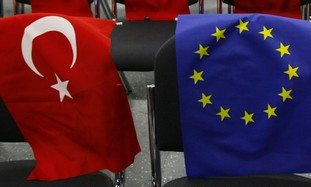
July 27, 2010By Robert TaitBritish Prime Minister David Cameron appears to have set himself on a collision course with France and Germany by expressing “anger” at moves blocking Turkey’s entry into the European Union and pledging to help “pave the road from Ankara to Brussels.”Speaking in the Turkish capital, Ankara, Cameron said he “passionately” supported Turkey’s EU membership and said opponents were guilty of double standards because they were happy to accept its contributions to Europe’s defense as a member of NATO.
“When I think about what Turkey has done to defend Europe as a NATO ally and what Turkey is doing now in Afghanistan alongside European allies, it makes me angry that your progress towards EU membership can be frustrated in the way it has been,” he told a meeting of the Turkish chambers of commerce. “I believe it’s just wrong to say Turkey can guard the camp but not be allowed to sit inside the tent.”

Cameron called Turkey” a great NATO ally” that “shares our determination to fight terrorism in all its forms, whether from Al-Qaeda or from the PKK [Kurdistan Workers Party].”
While Cameron’s remarks — on his first official visit to Turkey — echoed the support of Britain’s previous Labour government for Turkish EU membership, they were striking in their vehemence. They also represented a direct challenge to France and Germany, both of which oppose the majority Muslim country’s entry even though it formally opened membership negotiations in 2005. Since then, the pace of Turkey’s application has floundered, with just 13 of 35 chapters of European law required for membership opened.
Doing De Gaulle Proud
French President Nicolas Sarkozy and German Chancellor Angela Merkel have tried to assuage Turkish aspirations by offering it “privileged partnership” status — a designation Turkey rejects.
Germany’s opposition was reiterated on July 27 by Foreign Minister Guido Westerwelle, who was also visiting Turkey but said it was not “ready to join” the EU.
“If the question had to be decided today, Turkey would not be ready for membership and the EU would not be ready to absorb it,” Westerwelle told the German newspaper “Bild.” “But we have a big interest in Turkey turning in Europe’s direction. I want a Turkey that is on Europe’s side. Not just for economic reasons. The country can also provide very constructive help in resolving many conflicts.”
Sarkozy has justified his opposition to Turkish membership by citing cultural differences and saying it would pose a threat to the bloc’s political cohesion.
But Cameron brazenly ruffled French feathers by comparing Paris’s position to President Charles de Gaulle’s hostility to British membership in the 1960s.
“Do you know who said, ‘Here is a country which is not European. Its history, its geography, its economy, its agriculture and the character of its people — admirable people though they are — all point in a different direction. This is a country which cannot, despite what it claims and perhaps even believes, be a full member’?” Cameron asked. “It might sound like some Europeans describing Turkey, but it was actually General de Gaulle describing the UK before vetoing our EU accession. We know what it’s like to be shut out of the club. But we also know that these things can change.”
Useful Friend
He also attacked opponents of Turkish entry on the grounds of its Muslim population as being guilty of seeing “the history of the world through the prism of a clash of civilizations.” He added: “They think Turkey has to choose between East and West and that choosing both is not an option.”
Turkey’s growing economic power meant that the Europe could not turn its back on it, Cameron suggested.
“Which European country grew at 11 percent at the start of this year? Which European country will be the second-fastest-growing economy in the world by 2017? Which country in Europe has more young people than any of the 27 countries of the European Union? Which country in Europe is our No. 1 manufacturer of televisions and second only to China in the world in construction and in contracting?
“Tabii ki Turkiye,” he said, Turkish for “Turkey, of course.”
He also said Turkey was vital to resolving the dispute over Iran’s nuclear program, which Tehran claims is for peaceful purposes but which the West suspects is for bomb-making.
“Which European country could have the greatest chance of persuading Iran to change course on its nuclear policy?” Cameron asked. “Of course, it’s Turkey. It’s Turkey that can help us stop Iran from getting the bomb.”
Turkey, along with Brazil, reached an agreement with Iran in May to export 1,200 kilograms of low-enriched uranium in exchange for nuclear fuel for a medical reactor in Tehran. The agreement failed to prevent a fourth round of UN sanctions against Iran, together with further EU and U.S. embargoes. But Cameron said he hoped the deal could help “see Iran move in the right direction.”
Not So Simple
Cameron also urged Turkey to repair its tattered relations with Israel after the recent confrontation over a commando raid on an aid flotilla bound for Gaza, resulting in the deaths of nine Turkish citizens.
“No other country has the same potential to build understanding between Israel and the Arab world,” Cameron said, acknowledging Turkey’s potential to act as a bridge between East and West. “I urge Turkey — and Israel — not to give up on that friendship.” But he also appeared to side with Turkish sentiments over Gaza, saying: The situation in Gaza has to change. Humanitarian goods and people must flow in both directions. Gaza cannot and must not be allowed to remain a prison camp.”
His comments appeared to reflect the belief of many Western policymakers that Turkey’s recent hostility toward Israel may have been partly fueled by its feelings of rejection by the EU and a resulting need to foster alternative alliances in the east, including with Iran.
U.S. President Barack Obama and Defense Secretary Robert Gates have both suggested in recent remarks that the EU has driven Turkey away from the West. .”If they do not feel part of the European family, then obviously they’re going to look elsewhere for alliances and affiliations,” Obama told the Italian newspaper, “Corriere Della Sera,” this month.
However, Turkey’s EU critics complain that an internal domestic reform process needed for membership has slowed. They also cite Turkey’s failure to open its ports to goods from Cyprus, an EU member that Ankara refuses to recognize because of its division into Greek and Turkish sectors.
https://www.rferl.org/a/Cameron_Throws_Down_Gauntlet_To_France_And_Germany_With_Backing_For_Turkish_EU_Bid/2111086.html -

Turkey Going Nuclear – A Game Changer
The World Tribune’s Gregory Copley has broken the news that “U.S. powerlessness and EU confusion” have opened a “window of opportunity” for Turkey to seriously consider acquiring nuclear weapons. Just last month, Turkey defied its traditional allies, including the United States and Israel, by voting against a fourth round of U.N. sanctions against Iran, in punishments for Tehran’s continued pursuit of nuclear weapons. Further, Turkey’s ruling Justice and Development Party (AKP) has displayed growing Islamist sympathies and exercises an undemocratic stranglehold on power, raising legitimate questions about Turkey’s commitment to secular democracy as well as to NATO.
The news that Turkey is considering “going nuclear” is a game changer, and it should shake the Obama Administration to its core. A nuclear-armed Turkey would ride a coach-and-horses through Obama’s chief foreign policy goal of “getting to zero,” and it would expose his profoundly foolish strategy of neglecting traditional allies in order to engage America’s enemies. It would legitimize Iran’s illicit pursuit of nuclear weapons, and it would so profoundly change the balance of power in the Middle East that the ramifications could not be predicted with certainty for decades.U.S. Secretary of Defense Robert Gates recently stated that Turkey’s strategic drift away from the West is due in part to the European Union’s reluctance to grant Turkey full EU membership. Certainly the EU is not negotiating with Ankara in good faith, but Brussels cannot be entirely to blame. Ankara has distanced itself from Europe and the U.S. and has instead prioritized its relations with Russia and the Muslim world, especially Iran.
Turkey’s formerly close relations with Israel have deteriorated steadily since the AKP’s rise to power, and Prime Minister Recep Tayyip Erdo?an has demonstrated that he is willing to exploit anti-Israeli sentiments to boost his own political popularity. On its current trajectory, Turkey’s traditional strategic relationship with the West will devolve into a looser affiliation, while Ankara simultaneously enters into a closer alliance with Iran and other Middle Eastern powers hostile to U.S. leadership.
Much of this is entirely predictable. President Obama’s policies—namely, his commitment to eradicating nuclear weapons per se, the uncertainty surrounding the future of tactical nuclear weapons in Europe, and his water-treading missile defense program—have raised significant doubt in Turkey’s mind about the reliability of the half-century-old U.S./NATO nuclear and defense umbrella.
President Obama and NATO should not stand idly by and watch this happen. The destabilization brought to the European continent from a premature removal of American nuclear weapons, or an unacceptable degradation of its force, would be a major setback for global security and stability. America should stand behind its nuclear guarantee to Europe and adopt a protect-and-defend strategy that includes robust missile defenses.
Washington should also make clear to Turkey that Ankara’s acquirement of nuclear weapons will not be tolerated and would cost it both its strategic relationship with the U.S. and potentially its membership of NATO.
In 2006, now-Assistant Secretary of State for European Affairs Philip Gordon said the U.S. would soon have to ask itself, “Who lost Turkey?” Unless he wants the answer to be “President Obama,” the Administration should address this issue as a matter of urgency.
AUTHOR: Sally McNamara
Source:
-

Ex-CIA Chief Hayden: Military Strike on Iran Likely
Sunday, 25 Jul 2010 12:47 PMArticle Font Size
A former CIA director says military action against Iran now seems more likely because no matter what the U.S. does diplomatically, Tehran keeps pushing ahead with its suspected nuclear program.
Michael Hayden, a CIA chief under President George W. Bush, said that during his tenure “a strike was way down the list of options.” But he tells CNN’s State of the Union that such action now “seems inexorable.”
“In my personal thinking,” Hayden said, “I have begun to consider that that may not be the worst of all possible outcomes.”
Hayden said that the likelihood of a U.S. strike on Iran has risen in the face of Tehran’s defiance to halt its contentions nuclear program, saying “We engage. They continue to move forward.”
“We vote for sanctions. They continue to move forward. We try to deter, to dissuade. They continue to move forward,” he added.
The former CIA chief predicted Iran, in defiance of the international community, planned to “get itself to that step right below a nuclear weapon, that permanent breakout stage, so the needle isn’t quite in the red for the international community.”
Hayden said that reaching even that level would be “as destabilizing to the region as actually having a weapon.”
Hayden also called homegrown terrorism “a devil of a problem” and the most serious threat facing American citizens. “In a democracy it’s incredibly difficult,” he said. “Look, we’ve all made our compromises with al-Qaeda and the al-Qaeda kinds of attacks.
“But how do you build a security structure that guards you against American citizens who are beginning to change in their thinking up to a point where they become a threat to the security of other Americans? That’s a devil of a problem.”
Hayden said that the next step the intelligence community would take to combat homegrown terrorists would inevitably begin to infringe on the privacy of Americans, and that was still too steep of a price to pay.
“What are you or your viewers willing to pay?” he asked CNN interviewer Candy Crowley. “How much would you allow us commerce or privacy or convenience in order to get down to that level of granularity. And frankly, I think American political culture. I think you and I, as citizens, would be uncomfortable going very far in that direction. That what makes this such a devilish problem.”
Hayden also emphasized that the U.S. military should stay in Afghanistan and that al-Qaeda’s influence in the country was waning becomes of the presence of U.S. armed forces. If the U.S. withdrew prematurely, it would be detrimental to American security.
“I would let this go for a while longer,” he said. “With regards to the small number of al-Qaeda in Afghanistan, that may be a reflection of American combat power in Afghanistan and if one were to remove that combat power, one would naturally see the number of al-Qaeda rise.”
But it was the Iranian threat that most concerned Hayden, he stressed. The United States, the United Nations and the European Union have imposed new restrictions on Iran over its nuclear enrichment activities, which the West fears could lead it to make a bomb.
The fourth round of U.N. sanctions calls for measures against new Iranian banks abroad if a link to the nuclear or missile programs is suspected and for vigilance on transactions with any Iranian bank, including the central bank.
On Saturday, several key Iranian officials estimated that the United States and Israel would not dare attempt a military strike of Iran’s nuclear sites, adding that they were confident that Iranian forces would easily repel such an attempt, the Israeli newspaper Haaretz reported.
The United States, which has ships in the Persian Gulf, has not ruled out a military strike to thwart what it suspects is an Iranian nuclear weapons program. Iran denies its atomic program is aimed at making weapons.
Supreme Leader Ayatollah Ali Khamenei said on Saturday that Israel and the United States would never strike Iran, saying that “both the U.S. and Zionist regime face internal problems and they know that we make many troubles for them if they attack Iranian territory.”
Yahya Rahim Safav told ISNA, Iran’s news agency, that Iran’s armed forces were “fully prepared and enemies are aware of that, they do not have the power to take a political decision on the issue, because they know they can start the war but are not able to finish it.”
“We need to be fully vigilant of these attacks, the enemy knows that it will regret if launches a land strike against Iran.” Safavi said.
The commander of the Islamic Republic’s Revolutionary Guards, Mohammad-Ali Ja’fari said that the United States would not dare to attack Iran as it is fully aware of Iran’s defense power and its nation’s determination, Haaretz reported.
Ja’fari also said, according to the IRNA report, that he considered his forces’ preparedness as being at their “highest level,” adding that recent sanctions imposed on Iran in view of its contentious nuclear program would have no impact on Iran’s potency.
Also Saturday, a former naval chief in Iran’s Revolutionary Guard said his country has set aside 100 military vessels to confront each U.S. warship that poses a threat. General Morteza Saffari is quoted by the conservative weekly Panjereh Saturday as saying that troops aboard U.S. warships “are morsels for Iran to target in the event of any American threat against Iran.”
In 2008, Iran put its most powerful military force, the Revolutionary Guard, in charge of defending the country’s territorial waters in the Persian Gulf, a vital oil route. Speaking with the semi-official Fars news agency, Iran’s Defense Minister Ahmad Vahidi said that the increased U.S. pressure on Iran were prompted by Washington’s desire to advance its “propaganda campaign “and gain control of the region.
Fars quotes Vahidi as saying that a military strike on Iran was unlikely, adding that Israel too was “uttering such remarks in a bid to reduce the growing international pressures through psychological warfare,” Vahidi told Fars.
“We, too, advise them not to seek trouble and tension in the region through spoiling the atmosphere,” Vahidi said.
© Copyright 2010 The Associated Press. All rights reserved. This material may not be published, broadcast, rewritten or redistributed.
Special Links:
- Get the Hat Worn By Our Troops — Free!
-

The 7 Most Shocking Secrets From the WikiLeaks Files
The Daily Beast is dedicated to news and commentary, culture, and entertainment. We carefully curate the web’s most essential stories and bring you original must-reads from our talented contributors.
Romeo Gacad, AFP / Getty Images More than 90,000 classified files documenting the war in Afghanistan have been published by the whistle-blower site WikiLeaks, painting a dire portrait. From hidden civilian casualties to a special unit tasked with murdering top Taliban leaders without trial, see what’s in the explosive files.
The WikiLeaks Afghanistan files, one of the biggest leaks in the history of the U.S. military, cover January 2004 to December 2009, a time span the Obama administration has been quick to highlight, given that it implicates “under-resourcing” on the part of President George W. Bush. Although the White House was quick to condemn the release as “irresponsible,” The New York Times noted in its report that the paper did attempt to verify the information—withholding documents it felt would endanger national security—and that no government officials denied its authenticity.
Among the findings:
1) Pakistan’s spy service, according to revealed documents, is a major supporter of insurgents in Afghanistan, allowing its members to meet secretly with the Taliban, offering strategy advice, organizing groups to fight coalition troops, and plotting the assassinations of members of the Afghan government.
2) A top-secret group of American forces, nicknamed the “black” unit, is specially tasked with hunting down top Taliban leaders and either killing or capturing them on the spot—without a trial. The Obama administration has apparently increased the missions even though some have gone awry, killing civilians.
3) NATO troops are relying on remote-controlled Predator drones more and more heavily, controlling them from a base in Nevada and using them to kill an increasing number of Taliban targets.
4) The Taliban has access to heat-seeking missiles and has used them against American aircraft, a fact never before disclosed publicly. Many of the missiles aren’t successful, but Americans are forced into dangerous retrieval operations when the missiles crash, so that Taliban do not recover them.
5) Several documents detail the frustrating disappearance of money meant for humanitarian aid, such as the case of an orphanage erected with much fanfare and donations in Gardez. A year after its opening, American visitors reported that there we no orphans at the site, and that many had been called home for the holidays. (In Afghanistan, an orphan is defined as having no father, but many still have mothers.)
6) Civilian death tolls are rising consistently, with the Taliban conducting a successfull roadside bombing campaign. As of the writing of the report, one document cited 2,000 civilian deaths from roadside car bombs alone.
7) U.S. forces covered up a 2007 helicopter attack, according to the documents, claiming that Taliban brought down a coalition helicopter with conventional weaponry—when instead they used a missile. A U.S. official at the time said the attack, which killed seven soldiers, “had probably been brought down by a rocket-propelled grenade.”