The Foreign Secretary William Hague has called on the Government of Israel to open all crossings for aid to enter Gaza and deplored the loss of life during the interception of the Gaza Flotilla.
In a statement this morning the Foreign Secretary said:
” I deplore the loss of life during the interception of the Gaza Flotilla. Our Embassy is in urgent contact with the Israeli Government. We are asking for more information and urgent access to any UK nationals involved.
We have consistently advised against attempting to access Gaza in this way, because of the risks involved. But at the same time, there is a clear need for Israel to act with restraint and in line with international obligations. It will be important to establish the facts about this incident, and especially whether enough was done to prevent deaths and injuries.
This news underlines the need to lift the restrictions on access to Gaza, in line with UNSCR 1860. The closure is unacceptable and counter-productive. There can be no better response from the international community to this tragedy than to achieve urgently a durable resolution to the Gaza crisis.
I call on the Government of Israel to open the crossings to allow unfettered access for aid to Gaza, and address the serious concerns about the deterioration in the humanitarian and economic situation and about the effect on a generation of young Palestinians .”
The Israeli Naval Commando had prior knowledge of who was on the Turkish ship including where passengers were residing in terms of cabin layout. According to Swedish author Henning Mankell, who was on board the Marmara , “the Israeli forces attacked sleeping civilians.”
These were targeted assassinations. Specific individuals were targeted. Journalists were targeted with a view to confiscating their audio and video recording equipment and tapes.
“We were witnesses to premeditated murders,” said historian Mattias Gardell who was on the Mavi Marmara.
“…Asked about why activists on the Turkish ship had attacked the Israeli soldiers, Gardell stressed “it is not as if Israel is a police officer whom no human being has the legitimate right to defend him or herself against”:
“If you are attacked by commando troops you of course must have the right to defend yourself … Many people on this ship thought they were going to kill everyone. They were very frightened … It’s strange if people think one should not defend oneself. Should you just sit there and say: ‘Kill me’?” he said.” (See Mahdi Darius Nazemroaya,Detailed Compiled Eyewitness Accounts Confirm Cold-Blooded Murder and Executions by Israeli Military, Global Research, June 1, 2010)
“They even shot those who surrendered. Many of our friends saw this. They told me that there were handcuffed people who were shot,” (quoted by Press TV)
The Israeli Commando had an explicit order to kill.
What was the role of the United States?
The raids on the Gaza Freedom Flotilla, bear the mark of previous Israeli operations directed against unarmed civilians. It is a well established modus operandi of Israeli military-intelligence operations, which is tacitly supported by the US administration.
The killing of civilians is intended to trigger a response by Palestinian resistance forces, which in turn justifies Israeli retaliation (on “humanitarian” grounds) as well as a process of military escalation. The logic of this process was contained in Ariel Sharon`s “Operation Justified Vengeance” initiated at the outset the Sharon government in 2001. This Operation was intent upon destroying the Palestinian Authority and transforming Gaza into an urban prison. (See Michel Chossudovsky, “Operation Justified Vengeance”: Israeli Strike on Freedom Flotilla to Gaza is Part of a Broader Military Agenda, Global Research, June 1, 2010).
The Israeli attack of the Flotilla bears the fingerprints of a military intelligence operation coordinated by the IDF and Mossad, which is headed by Meir Dagan. It is worth recalling that as a young Coronel, Dagan worked closely with then defense minister Ariel Sharon in the raids on the Palestinian settlements of Sabra and Shatilla in Beirut in 1982.
There are indications that the US was consulted at the highest levels regarding the nature of this military operation. Moreover, in the wake of the attacks, both the US and the UK have unequivocally reaffirmed their support to Israel.
There are longstanding and ongoing military and intelligence relations between the US and Israel including close working ties between various agencies of government: Pentagon, National Intelligence Council, State Department, Homeland Security and their respective Israeli counterparts.
These various agencies of government are involved in routine liaison and consultations, usually directly as well as through the US Embassy in Israel, involving frequent shuttles of officials between Washington and Tel Aviv as well as exchange of personnel. Moreover, the US as well as Canada have public security cooperation agreements with Israel pertaining to the policing of international borders, including maritime borders. (See Israel-USA Homeland Security Cooperation, See also Michel Chossudovsky, The Canada-Israel “Public Security” Agreement, Global Research, 2 April 2008)
The Role of Rahm Emmanuel
Several high level US-Israel meetings were held in the months prior to the May 31st attacks.
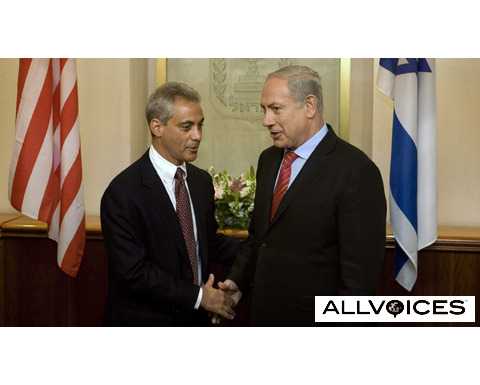
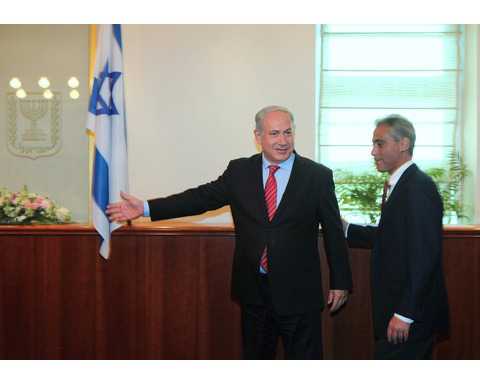
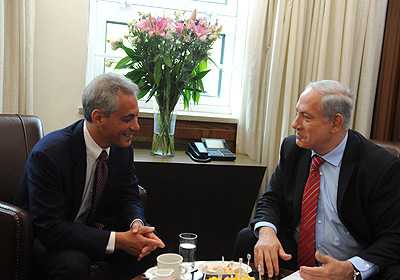
Rahm Emmanuel, Obama’s White House chief of Staff was in Tel Aviv a week prior to the attacks. Confirmed by press reports, he had meetings behind closed doors with Prime Minister Netanyahu (May 26) as well as a private visit with President Shimon Peres on May 27.
May 26 meeting between Rahm Emmanuel and Prime Minister Binyamin Netanyahu
Official statements do not indicate whether other officials including cabinet ministers or IDF and Mossad officials were present at the Rahm Emmanuel-Netanyahu meeting. The Israeli press confirmed that Rahm Emmanuel had a meeting with Defense Minister Ehud Barak, whose Ministry was responsible for overseeing the Commando attack on the Flotilla. (Rahm Emanuel visits Israel to celebrate son’s bar mitzvah – Haaretz Daily Newspaper | Israel News, 23 May 2010). The White House also confirmed that Rahm Emmanuel was to meet other high-ranking Israeli officials, without providing further details. (Rahm Emanuel in Israel for Son’s Bar Mitzvah, May Meet With Officials)
“Our Man in the White House”
While born in the US, Rahm Emmanuel also holds Israeli citizenship and has served in the Israeli military during the First Gulf War (1991).
Rahm is also known for his connections to the pro-Israeli lobby in the US. The Israeli newspaper Maariv calls him “Our Man in the White House” (quoted in Irish Times, March 13, 2010). Rahm Emmanuel gave his support to Obama in the November 2008 presidential elections following Obama`s address to the pro-Israeli lobby AIPAC.
At the time of Rahm Emmanuel’s confirmation as White House chief of staff, there were reports in the Middle East media of Rahm Emanuel’s connections to Israeli intelligence.
The exact nature of Rahm Emmanuel’s ties to the Israeli military and intelligence apparatus, however, is not the main issue. What we are dealing with is a broad process of bilateral coordination and decision-making between the two governments in the areas of foreign policy, intelligence and military planning, which has been ongoing for more than 50 years. In this regard, Israel, although exercising a certain degree of autonomy in military and strategic decisions, will not act unilaterally, without receiving the “green light” from Washington. Rahm Emmanuel`s meetings with the prime minister and Israeli officials are part of this ongoing process.
Rahm Emmanuel’s meetings in Tel Aviv on May 26 were a routine follow-up to visits to Washington by Prime Minister Netanyahu in March and by Minister of Defense Ehud Barak in late April. In these various bilateral US-Israel encounters at the White House, the state Department and the Pentagon, Rahm Emmanuel invariably plays a key role.
While the pro-Israeli lobby in the US influences party politics in America, Washington also influences the direction of Israeli politics. There have been reports to the effect that Rahm Emmanuel would “lead a team of high octane Democratic party pro-Israel political operatives to run the campaign for the Defense Minister Ehud Barak” against Netanyahu in the next Israeli election. (Ira Glunts, Could Rahm Emanuel Help Barak Unseat Netanyahu? Palestine Chronicle, June 2, 2010)
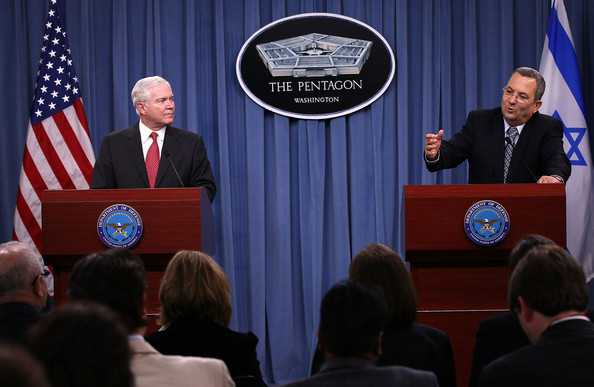
The April 27 meeting between US Defense Secretary Robert Gates and Defense Minister Barak pertained to “a range of important defense issues” directly or indirectly related to the status of the Palestinian territories under Israeli occupation:
“As President Obama has affirmed, the United States commitment to Israel’s security is unshakable, and our defense relationship is stronger than ever, to the mutual benefit of both nations. The United States and our ally Israel share many of the same security challenges, from combating terrorism to confronting the threat posed by Iran’s nuclear-weapons program.
For years, the United States and Israel have worked together to prepare our armed forces to meet these and other challenges, a recent major example being the Juniper Cobra joint exercise held last October. Our work together on missile-defense technology is ongoing, and the United States will continue to ensure that Israel maintains its qualitative military edge.” (Press Conference with Secretary Gates and Israeli Defense Minister Barak, April 2010 – Council on Foreign Relations April 27, 2010)
These consultations pertained to ongoing military preparations regarding Iran. Both Israel and the US have recently announced that a pre-emptive attack against Iran has been contemplated.
Washington views Israel as being “‘integrated into America’s military architecture,’ especially in the missile defense sphere.” (quoted in Emanuel to rabbis: US ‘screwed up’ Jerusalem Post, statement of Dennis Ross, who is in charge of the US administration’s Iran policy in the White House, May 16, 2010).
Targeting Iran
The attack on the Freedom Flotilla, might appear as a separate and distinct humanitiarian issue, unrelated to US-Israeli war plans. But from the standpoint of both Tel Aviv and Washington, it is part of the broader military agenda. It is intended to create conditions favoring an atmosphere of confrontation and escalation in the Middle East war theater;
“All the signs are that Israel has been stepping up its provocations to engineer a casus belli for a war against Hamas in Gaza and Hezbollah in Lebanon. Tel Aviv sees as unfinished business its inconclusive wars: the first in Lebanon in 2006, and the second in Gaza in 2008-09.” (Jean Shaoul Washington Comes to the Aid of Israel over Gaza Convoy Massacre, Global Research, June 4, 2010)
Following Israel’s illegal assault in international waters, Netanyahu stated emphatically “Israel will continue to exercise its right to self defence. We will not allow the establishment of an Iranian port in Gaza,” suggesting that the Gaza blockade was part of the pre-emptive war agenda directed against Iran, Syria and Lebanon. (Israeli forces board Gaza aid ship the Rachel Corrie – Telegraph, June 5, 2010, emphasis added) .
Moreover, the raid on the Flotilla coincided with NATO-Israel war games directed against Iran. According to the Sunday Times, “three German-built Israeli submarines equipped with nuclear cruise missiles are to be deployed in the Gulf near the Iranian coastline.” (Israel Deploys Three Nuclear Cruise Missile-Armed Subs Along Iranian Coastline).
While Israeli naval deployments were underway in the Persian Gulf, Israel was also involved in war games in the Mediterranean. The war game codenamed “MINOAS 2010” was carried out at a Greek air base in Souda Bay, on the island of Crete. Earlier in February, The Israeli air force “practiced simulated strikes at Iran’s nuclear facilities using airspace of two Arab countries in the Persian Gulf, which are close territorially with the Islamic republic and cooperate with Israel on this issue.” Ria Novosti,War Games: Israel gets ready to Strike at Iran’s Nuclear Sites,, March 29, 2010)
Also, in the wake of the final resolution of the 2010 Review Conference of the Parties to the Treaty on the Non-Proliferation directed against Israel’s nuclear weapons program, the White House has reaffirmed its endorsement of Israel’s nuclear weapons capabilities. Washington’s statement issued one day before the raid on the flotilla points to unbending US support to “Israel’s strategic and deterrence capabilities”, which also include the launching of a pre-emptive nuclear attack on Iran:
“a senior political source in Jerusalem said Sunday that Israel received guarantees from U.S. President Barack Obama that the U.S. would maintain and improve Israel’s strategic and deterrence capabilities.
According to the source, “Obama gave [Prime Minister Benjamin] Netanyahu unequivocal guarantees that include a substantial upgrade in Israel-U.S. relations.”
Obama promised that no decision taken during the recent 189-nation conference to review and strengthen the 40-year-old Nuclear Non-proliferation Treaty “would be allowed to harm Israel’s vital interests,” the sources said. Obama promised to bolster Israel’s strategic capabilities, Jerusalem officials say – Haaretz Daily Newspaper)
Robert Gates and Israel's Minister of Defense Ehud Barak, Press Conference, April 27, 2010
The Turkey-Israel Relationship in Jeopardy?
The actions of Israel against the Freedom Flotilla have important ramifications. Israel’s criminal actions in international waters has contributed to weakening the US-NATO-Israel military alliance.
The bilateral Israel-Turkey alliance in military, intelligence, joint military production is potentially in jeopardy. Ankara has already announced that three planned military exercises with Israel have been cancelled.“The government announced it was considering reducing its relations with Israel to a minimum.”
It should be understood that Israel and Turkey are partners and major actors in the US-NATO planned aerial attacks on Iran, which have been in the pipeline since mid-2005. The rift between Turkey and Israel has a direct bearing on NATO as a military alliance. Turkey is one of the more powerful NATO member states with regard to its conventional forces. The rift with Israel breaks a consensus within the Atlantic Alliance. It also undermines ongoing US-NATO-Israel pre-emptive war plans directed against Iran, which until recently were endorsed by the Turkish military.
From the outset in 1992, the Israeli-Turkish military alliance was directed against Syria, as well as Iran and Iraq. (For details see See Michel Chossudovsky, “Triple Alliance”: The US, Turkey, Israel and the War on Lebanon, Global Research, 2006)
In 1997, Israel and Turkey launched “A Strategic Dialogue” involving a bi-annual process of high level military consultations by the respective deputy chiefs of staff. (Milliyet, Istanbul, in Turkish 14 July 2006).
During the Clinton Administration, a triangular military alliance between the US, Israel and Turkey had unfolded. This “triple alliance”, which in practice is dominated by the US Joint Chiefs of Staff, integrates and coordinates military command decisions between the three countries pertaining to the broader Middle East. It is based on the close military ties respectively of Israel and Turkey with the US, coupled with a strong bilateral military relationship between Tel Aviv and Ankara.
Starting in 2005, Israel has become a de facto member of NATO. The triple alliance was coupled with a 2005 NATO-Israeli military cooperation agreement which included “many areas of common interest, such as the fight against terrorism and joint military exercises. These military cooperation ties with NATO are viewed by the Israeli military as a means to “enhance Israel’s deterrence capability regarding potential enemies threatening it, mainly Iran and Syria.” (“Triple Alliance”: The US, Turkey, Israel and the War on Lebanon).
The Issue of Territorial Waters
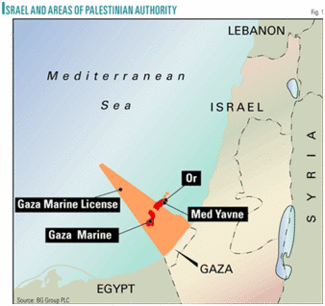
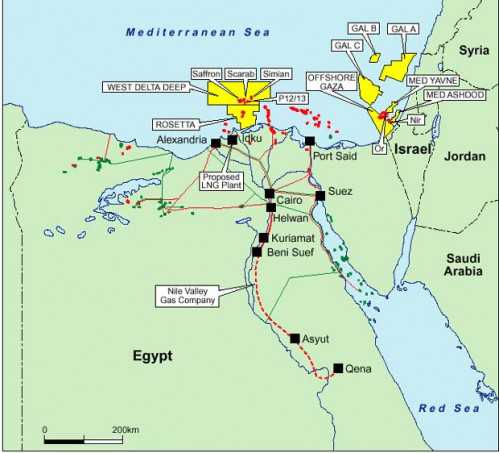
Israel’s blockade of Gaza is in large part motivated by the broader issue of control of Gaza’s territorial waters, which contain significant reserves of natural gas.What is at stake is the confiscation of Palestinian gas fields and the unilateral de facto declaration of Israeli sovereignty over Gaza’s maritime areas. If the blockade were to be broken, Israel’s de facto control over Gaza’s offshore gas reserves would be jeopardy. (See Michel Chossudovsky,War and Natural Gas: The Israeli Invasion and Gaza’s Offshore Gas Fields, Global Research, January 8, 2009. See also Michel Chossudovsky, The War on Lebanon and the Battle for Oil, Global Research, July 23, 2006)
Egypt’s control of the Palestinian ‘file’ will never be the same again, says former British intelligence operative Alastair Crooke.
By Alastair Crooke / June 3, 2010
Beirut, Lebanon
“This is language that we have not heard since the time of Gamal Abdul Nasser.” Thus wrote the influential chief editor of Al-Quds al-Arabi newspaper, referring to Turkish Prime Minister Recep Tayyip Erdogan’s fiery response to the Israeli assault on the Gaza flotilla – adding that such “manly” positions and rhetoric had “disappeared from the dictionaries of our Arab leaders (since the demise of Egyptian President Gamal Abdel Nasser).” He lamented that “Arab regimes now represent the only friends left to Israel.”
Related Stories
Why Israeli raid on Freedom Flotilla makes Abbas’s job harder
After Israeli raid, Freedom Flotilla aid starts to flow to Gaza
Israel rejects international investigation of Freedom Flotilla raid
There is no doubt that it is President Hosni Mubarak of Egypt, President Nasser’s successor, to whom Abdel Bari Atwan principally refers; and there is no doubt, too, that the “flotilla affair” marks a watershed moment for Egypt – and to a lesser extent for Saudi Arabia.
Even the notoriously tin ear of President Mubarak to his own people’s sympathy for the Palestinian cause in Gaza could not fail to hear the grinding of the tectonic plates of Middle East change. Even Mubarak has felt obliged to respond to the Israeli assault. He ordered the immediate opening of the Egyptian crossing into Gaza.
What we are witnessing is another step – perhaps crucial – in the shifting strategic balance of power in the Middle East. The cause of the Palestinians is gradually passing out of the hands of Mubarak and King Abdullah bin Aziz Al Saud of Saudi Arabia. It is the leaders of Iran and Turkey, together with President Bashar al-Assad of Syria, who recognize the winds of change. Mubarak appears increasingly isolated and is cast as Israel’s most assiduous collaborator. Here in the region, it is often as not the Egyptian embassies that are the butt of popular demonstrations.
Mubarak’s motives for his dogged support for Israel are well known in the region: He is convinced that the gateway to obtaining Washington’s green light for his son Gamal to succeed him lies in Tel Aviv rather than Washington. Mubarak enjoys a bare modicum of support in the United States, and if Washington is to ignore its democratic principles in order to support a Gamal shoo-in, it will be because Israel says that this American “blind eye” is essential for its security.
To this end, Mubarak has worked to weaken and hollow out Hamas’s standing in Gaza, and to strengthen that of Palestinian Authority President Mahmoud Abbas. Indeed, he has pursued this policy at the expense of Palestinian unity – his regular “unity” initiatives notwithstanding. Egyptian one-sided peace “brokering” is viewed here as part of the problem rather than as part of any Palestinian solution. Paradoxically, it is precisely this posture that has opened the door to Turkey and Iran’s seizing of the sponsorship of the Palestinian cause.
But standing behind this sharp Turkish reaction to Israel’s assault on the Turkish ship is a deeper regional rift, and this divide stems from the near-universal conviction that the Israeli-Palestinian peace process has failed. Its structural pillars have crumbled: The Israeli public no longer believes that “land for peace” – the Oslo principle – will bring them security. Rather, Israelis believe those who tell them that further withdrawal will only bring Hamas rockets closer. The other Oslo pillars also lie broken on the ground: The hitherto presumed “reversibility” of the Israeli settlement project and the hypothetical possibility of last-resort American imposition of its own solution are now understood to have been no more than chimeras.
Yet Egypt refuses to budge in these changed circumstances. It stands almost alone as Israel’s ally. But the shift in the balance of regional power toward the northern tier of Middle Eastern states – Syria, Turkey, Iran, Qatar, and Lebanon – continues, and gathers pace. Egypt increasingly has only its memory of past grandeur on which to stand. In contemporary terms its influence has been on the slide for some time.
Egypt’s one card is that it is Gaza’s other neighbor – aside from Israel. It has been Egypt’s acquiescence to the siege of Gaza – encouraged by President Abbas in the West Bank, who shares Mubarak’s desire to see Hamas weakened – that has given Mubarak his stranglehold over Palestinian issues. But the Islamic and regional tide will be flowing ever stronger against him after Israel’s action against the flotilla.
Already the Arab League is talking of supporting Turkey in any legal action against the Israeli assault on the aid convoy to Gaza. The Arab League has also issued a call to other states to break Israel’s siege on Gaza.
It is too early to say that such talk marks any turning point in Arab League politics. The Arab League, as such, is not taken seriously in the region or elsewhere. But it is rather the shifting of the regional strategic balance that marks the locus from where real change may become possible.
Egypt and Saudi Arabia may conclude that the price of seeing the baton of leadership on such a key and emotive issue pass to non-Arab hands inIran and Turkey is too high, and too shameful. The near-universal skepticism directed toward the “peace process” among their own peoples has already left these leaders exposed internally.
For nearly 20 years these leaders have used their involvement in the “process” as justification to curb internal dissension; but it is now a tool that has lost its magic. They are already paying the price of popular cynicism.
This is Mubarak’s dilemma: stay with the siege and hope America will reward him with Gamal’s succession; but by flouting the winds of change, he may imperil Gamal’s very survival. In any event, Egypt’s control of the Palestinian “file” will never be the same again.
Alastair Crooke, a former British M16 operative in the Middle East, is author of “Resistance: The Essence of the Islamist Revolution.” He runs the Conflicts Forum in Beirut.
ISTANBUL — It was a day of mourning for Turkey on Thursday, as a crowd of several thousand people streamed down a central boulevard here, bearing eight coffins draped in Turkish and Palestinian flags, one of them carrying an American citizen.
Enlarge This Image
Mustafa Ozer/Agence France-Presse — Getty Images
In Istanbul on Thursday, relatives grieved over the coffin of a victim of Israel’s deadly raid Monday on Gaza-bound aid ships.
Related
Times Topic: Free Gaza Movement
The outpouring came on the fourth day of a political crisis between Turkey and Israel that has dragged relations between the countries to their lowest point in history. The return of the activists from the flotilla raided by Israel on Monday defused the immediate crisis, but Turkish officials made it clear that it was not over.
“Israel risks losing its most important friend in the region if it doesn’t change its mentality,” said Turkey’s prime minister, Recep Tayyip Erdogan, according to news reports. He called the commando action, in which nine people were killed, “a historic mistake.”
It has been a startling series of events for Turkey, a NATO member and long one of Israel’s closest allies in the Muslim world. But Turkey’s leaders have grown increasingly at odds with Jerusalem over what they believe is an untenable policy in Gaza, a territory run by Hamas, which Israel sees as doctrinally committed to its destruction. Mr. Erdogan has become a sort of folk hero in the Arab world for his open challenges to the government of Prime Minister Benjamin Netanyahu.
The raid served to deepen that divide.
“There is now civilian blood between the two countries,” said Soli Ozel, a professor of international relations at Bilgi University in Istanbul. “The natural arc of relations will have to change.”
President Abdullah Gul said on NTV television, “Turkey will never forgive this attack.”
In Istanbul, where most of the more than 400 Turkish activists were flown early on Thursday morning, traffic clogged the streets as protesters marched next to green Volkswagen vans bearing the coffins, each marked with a name and a city of origin, followed by Gaza in parentheses, denoting solidarity. Marchers wore green headbands, the color of Islam, and peddlers sold Palestinian flags for $3.
“God is great,” mourners chanted in Arabic along with Turkish slogans saying, “Damn Israel” and “An eye for an eye, blood for blood, revenge, revenge.” A woman in a black T-shirt, jeans and sunglasses wore a green headband with the words, “We are all Palestinians now,” echoing statements made after the Sept. 11, 2001, attacks in the United States in which Europeans proclaimed that they were “all Americans now.”
Among the dead was a young man with dual American and Turkish citizenship, Turkish and American officials said. He was identified as Furkan Dogan, a 19-year-old who was born in Troy, N.Y., and lived there as a small child, but later moved back to Turkey. His brother, Mustafa, told the Turkish news media that he was “clean-hearted with a happy face.”
In Washington, Secretary of State Hillary Rodham Clinton said that American officials had spoken to the family to express condolences and offer consular services, and that two other Americans had been wounded in the raid and a subsequent protest, The Associated Press reported. She repeated an earlier call for Israel to “conduct a prompt, impartial, credible and transparent investigation that conforms to international standards.” The United Nations has called for a full international inquiry into the raid, but on Thursday, Israeli officials rejected that demand, news reports said.
The Cihan news agency reported that Mr. Dogan died from bullet wounds to his head and chest, but a spokesman for Turkey’s Foreign Ministry could not confirm that. All nine deaths were caused by bullet wounds, the Turkish authorities said.
“We didn’t expect him to come back like this,” said Mr. Dogan’s brother, who was quoted in Zaman, a Turkish daily newspaper. “However, we were not sorry to hear that he fell like a martyr.”
Martyr is a word usually reserved for Turkish soldiers who die in battle, but has been used repeatedly to describe the dead in the flotilla raid, giving the word a new, Islamist meaning that not all Turks are comfortable with. “They are dragging this county into Middle Eastern quicksand,” said Oray Egin, a columnist with the Turkish daily Aksam. “Gaza is not an emotional issue for me.”
Activists who had returned marched along with the crowd, linking arms with friends and supporters and basking in what people here saw as a heroes’ homecoming. Recep Goker, 51, who had struggled with the soldiers who boarded the ship, was stopped by a tall man in a white pressed shirt, who said he was from Gaza. “You did so good,” the man said. “You are our heroes.”
Mr. Goker said that the Turkish group that led the flotilla was planning another voyage in December, and that he would be part of it. “We will not stop before the embargo is over,” said Mr. Goker, who had a purple bruise on his arm where a plastic bullet had hit him. “We will be the winners, and Israel the loser.”
The Israeli Foreign Ministry said Thursday that all the activists had been deported except for seven who were hospitalized and recovering from injuries, as well as the wife of one of the wounded and two others who had been held up for reasons relating to documentation.
After the collapse of Soviet Union there was unsolved problem of Caucasus which is named Nagorno Karabakh. In the date of May 23, 2010 very important progress has been experienced in Karabakh. Seperatist government of Karabakh realised an election which is not accepted by governments and international organizations because of giving message of it is an independent government. It was the fifth election since 1993 and 4 party and 45 candidate was competed for 33 chairs and Free Motherland Party has performed to the leadership. The election which is involved of 70 percent of Karabakh public has born big discussions in a few time.
Arayik Harutyunyan which is the Prime Minister of de-facto Karabakh government is still maintaining leadership of Free Motherland Party. Karabakh Democratic Party, Karabakh Communist Party and Armenian Revolutionist Federation are the other parties which involved to these elections. Free Motherland Party has taken approximately 50 percent of votes and there was more than 100 international observers in these elections.
Seperatist regime in Karabakh caused a new paradox especially in Minsk Group’s peace progress. Nagorno Karabakh is actually in the land of Azebaijan but it is occupied bu Armenia without any law suitable to intenational law and now it is making election as it is independent government this was took a hard response from international community. Approaching of Azerbaijani community in Karabakh to this election was firstly occupiers must leave Karabakh and Azerbaijani community must return to their land, Azerbaijani and Armenian people must leave together with a new order. After these conditions provided then any election can be legitamate. Any election without these points would be the continous of unlawful status. If subject is critised with Madrid Principles which is the last point of Minsk Process Armenian one sided attitude in peace process. After the elections Armenian Minister of Foreign Affairs Edvard Nalbandyan declared that elections were free and democratic and it had created a legitimate government. He said many independent observes had been in elections. And international community has to have good relationships with new government if they wants the problems solved. Bako Sahakyan who is President of seperatist Karabakh government said that elections were independently and independency of Karabakh has to be recognised and people of Karabakh choices has to be respected.
At the point reached in this situation Turkey, Azerbaijan and Russia and international organizations in many countries of the Minsk Group declared elections have no legal basis and neither side expressed concern. Azerbaijan has condemned the situation with a sharp tongue and wanted to show the same reaction from the United Nations. OSCE (European Security and Cooperation Organization), United Nations, European Union, the United States and Russia underlined that choices do not solve the problem, contrary it would cause to continue stated problem.(1) The parties that emphasized current trend must continue and for ensuring legitimacy Madrid Principles have to be accepted by Armenia.
According to the recommedations in full text in Madrid Principles created in 2007 and presented in last year so far many problems have to be solved and agreement for Karabakh’s new status have to be reached. Realisation of substances in recommendations has become more difficult because of final steps of Armenia.
Recommendations to the leaders of Azerbaijan and Armenia:
1. Until the elections which will be held in 2008, consists of the following principles must be tailored to the bill:
a. The location of the security and international peace-keeping force must be guaranteed.
b. Armed forces of Armenia and Nagorno-Karabakh, Lachin Kelbajar and especially around the occupied Nagorno-Karabakh must leave the entire land.
c. Forced immigrants must return to their lands .
d. Current status of Nagorno Karabakh should be determined by the voting system, and until that its temporary status should be designated and, all traffic and trade routes should be opened
2. All shares are being agreed for the controversial section should be indicated.
3. With elections to be held in 2008 in the campaign appropriate environment should be prepared to political leaders to create positive atmosphere for peace and tranquility.
Recommendations for Armenia, Azerbaijan and de-facto government Nagorno-Karabakh
4. Sides should act in accordance with the cease-fire signed in 1994. Should leave the show of force, to increase their defense budgets, the mutual accusations, agitations and drive away from peace statements should be left.
5. Diplomacy outside activities, including the above principles have been agreed at talks about the decision should continue. Even countries councils should be encouraged to do the negotiations and relations between Azerbaijanis and Armenians should try to strengthen.
6. Nagorno-Karabakh’s de-facto administration should put an end to the to be placed on the Armenians in the occupied land , to the continuation of privatization activities in the region, the creation of new building space, to the construction of local buildings.
7. Azerbaijan Nagorno should recognise the possibility Azerbaijani leaders to select their own community should recognize the possibility of oil revenues to benefit all citizens and immigrants to increase transparency and reduce corruption in the trials should be done. (2)
Many of the issues, Armenia’s “rejection of the territorial integrity of Azerbaijan” could not be applied over because of Armenia’s “rejection of the territorial integrity of Azerbaijan”. Time to time, Armenia use it put forward in the country fear mood to impress international community and the world public opinion should recognize Karabakh as an independent state.
New Approaches of Regional Powers
Elections have been held in Karabakh since 1993, lack of response as big as this because there is no positive state before 2000. But in the reached point Armenia’s passive-Karabakh policy stopped peace negotiations to accelerate, the Minsk Group to the region continuously for the loss of visits to perform. By following this policy in Bishkek Protocol, 1994 Management and Azerbaijan in Nagorno-Karabakh problem has managed to pass to the official notes that Armenia has been pursuing the same policy in the new era. If the last review in 2009 will be seen that the rhetoric, stating that Azerbaijan has always followed an aggressive policy to Armenia, the situation does not continue in their favor they would recognize Karabakh as an independent state has indicated.
In 2010 Turkey, Russia and the U.S. about the growing activities impress Armenia to new conditions. Igor Popov told the Russian Co-chairman of the Minsk Group, Russia’s active policy in solving the problem in this country will follow soon matter stated. Again, after elections in the Russian Foreign Ministry spokesman Andrei Nesterenko, Karabakh in any way they don’t recognise Karabakh as an independent state and they respect to integrity of Azerbaijan and that the Karabakh problem should be resolved in this framework stated.(3) Turkey, aim at develop the relations with Armenia prerequisite to emphasize reiterating the urgent need to solve the Karabakh issue and the territorial integrity of Azerbaijan guarantee is not broken by any power. They think to bring Turkey to Co-chairman status to Minsk Group and give very active part to Turkey to solve this problem. After a long break while the U.S. ambassador to Baku was appointed as the Minsk Group Matthew Bryza of the United States has made a Co-chairman. Karabakh in particular the U.S usually in the Caucasus policy, the new expansions will be performed in the new era of Armenia’s stance will be shaped by the U.S. and other countries.
Armenia may be exposed to various pressures because of attitude in the new era may be exposed to various pressures and position themselves in the region will open to outside intervention can make out. In this issue of Turkey in Turkish-Armenian relations towards Karabakh any objection to the requirement did not matter. Regardless of the region as a unilateral world needs to accept that indicates that Armenia will take steps soon again will be determined by the attitude of the international community. Follow-driven politics since independence, Armenia, because of the Russian new attitude it can not see the hope. The increasing U.S. influence in Azerbaijan, with its headquarters location becomes more difficult for Armenia, the adoption of the principles can be subjected to the pressure on the inside. The economic problems of the Armenian people living today, the social crisis brought and vast majority of people do not give importance about the Karabakh issue as they has in the past.
Mehmet Fatih ÖZTARSU – Institute of Strategic Thinking
http://sde.org.tr/
(1) ATET Dağlıq Qarabağda Keçirilen Seçkini Tanımır, ,
(2) Mehmet Fatih Öztarsu, Madrid Prensipleri ve Karabağ Görüşmeleri, Stratejik Düşünce Enstitüsü, ,
The decades-old conflict between Israel and Gaza became a little too localized this week for Earlham College economics professor Mehrene Larudee.
As news of the Monday Israeli attack on the Free Gaza Movement’s flotilla spread, Larudee learned her brother, Paul Larudee, had been aboard one of the ships. Every hour seemed to pass by a little slower as she waited on news of him.
The flotilla of ships had been carrying aid and hundreds of activists from different countries, a number of them from countries allied with Israel, to the blockaded Gaza strip.
Paul, a 64-year-old from El Cerrito, Calif., was one such activist involved with the Free Gaza Movement, which backed the flotilla transport.
Paul was not on the boat that received the brunt of the attack, the Miva Marmara, but some passengers on his vessel, the Svendoni, were injured, and all were detained. Several in the flotilla were reported dead and at least six were seriously wounded.
Until Tuesday night, Mehrene was unaware whether her brother was one of those victims.
Paul was reported by the Consulate to have resisted arrest. He remained silent and unresponsive when Israeli soldiers ordered him to move. He was reportedly beaten by the soldiers, receiving a black eye, various bruises and twisted joints.
Paul Larudee is the only detainee not to have gone through the deportation process, family related to Mehrene said Tuesday. “It’s unnerving. Now that’s he’s the only one left there, it’s easy for people to forget about him,” she said.
Though the exact nature of the deportation documents is not known, she said she was advised it required a signature that released the Israeli government from all responsibility in terms of the deported person, who is required to admit he came into Israel illegally.
“He never even set foot in Israel until they brought him there,” said Mehrene Larudee, referring to the fact that the flotillas had been outside Israeli waters. His American attorney has been trying to reach him, but has been unable to make contact as far as his family knows.
Israel is claiming that its actions were in self-defense. Israel patrols the borders to prevent weapon smuggling into Gaza, and the soldiers involved say they were attacked as they neared the flotilla. After their release, however, passengers are telling a different story. Mehrene thinks a little differently as well. “The movement backing the flotilla was committed to nonviolence,” she said.
Mehrene attended Thursday’s town hall meeting with Rep. Mike Pence and participated in the discussion concerning Gaza and Israel. After noting Gaza’s desperate need for aid in its time of rebuilding, she called out Pence for focusing too much on Israel’s side of things, and not on what the rest of the world has to say. Pence countered that humanitarian relief reaches Gaza daily through Israel and, he said, Israel has every right to protect itself against the movement of arms into the Gaza area, which he said it is doing.
Mehrene Larudee has lived in Richmond just less than a year, working as a visiting associate professor of economics. She came here from Massachusetts and is currently under a one-year contract.
![[UK] Foreign Secretary statement on Gaza Flotilla](https://www.turkishnews.com/en/content/wp-content/uploads/2011/02/Middle_east.jpg)