Month: April 2010

  • Turkish PM Erdogan says Israel is ‘threat to peace’

    Turkish PM Erdogan says Israel is ‘threat to peace’

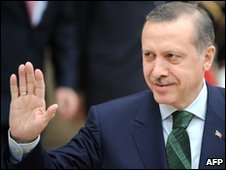
    Recep Tayyip Erdogan at the Elycee Palace in Paris 7 April 2010
    Erdogan’s comments will further deepen mistrust

    Turkey’s Prime Minister has described Israel as the “main threat to peace” in the Middle East.

    Recep Tayyip Erdogan was speaking during a visit to Paris.

    Israeli Prime Minister Benjamin Netanyahu responded saying he regretted Turkey’s “repeated attacks” on Israel.

    Relations between the two countries have been worsening since the Israeli incursion into the Gaza Strip in 2009, made worse by a recent diplomatic row.

    Mr Erdogan was speaking to journalists before meeting the French President Nicolas Sarkozy.

    “It is Israel that is the main threat to regional peace,” he said.

    “If a country uses disproportionate force, in Palestine, in Gaza, uses phosphorus bombs we are not going to say ‘well done.’”

    Both Israel and Hamas, which control the Gaza Strip, have been accused by the UN of war crimes during the 22-day offensive in December 2008 and January 2009.

    Humiliation

    Mr Netanyahu said he regretted the Turkish prime minister’s comments.

    Israeli Deputy Foreign Minister Danny Ayalon meeting Turkish Ambassador Ahmet Oguz Celikkol, captioned "the height of humiliation" in Israeli newspaper Israel Hayom [Image: Lior Mizrahi/Israel Hayom]
    The Turkish envoy was made to sit lower than the Israeli deputy minister

    “We are interested in good relations with Turkey and regret that Mr Erdogan chooses time after time to attack Israel,” he told reporters in Israel.

    The countries have been allies in the past.

    But earlier this week, the Turkish ambassador to Israel was recalled by Ankara, weeks after being humiliated in public by the Israeli deputy foreign minister.

    Ambassador Oguz Celikkol was called into the Israeli foreign ministry in January and rebuked over a Turkish television series that showed Israeli intelligence agents kidnapping children.

    Mr Celikkol was made to sit on a low chair while being lectured by Deputy Foreign Minister Danny Ayalon.

    Mr Ayalon later apologised for the rebuke.

    Israeli Foreign Minister Avigdor Lieberman has compared Mr Erdogan to Presidents Hugo Chavez of Venezuela and Libya’s leader Muammar Gaddafi.

    BBC

  • ATCA’s response to Talat and Christofias’ Joint Statement

    ATCA’s response to Talat and Christofias’ Joint Statement

    Tuesday, April 6, 2010

    By Cetin Ramadan – Association of Turkish Cypriots Abroad (ATCA)

    Below is a response from ATCA in the UK, USA, Australia and TRNC about the joint statement made by Mr. Mehmet Ali Talat and Mr. Dimitris Christofias on the progress of the current negotiations for a comprehensive solution in Cyprus.

    The Association of Turkish Cypriots Abroad (ATCA) welcomes the joint statement by the leaders of the two peoples of Cyprus and supports the ongoing negotiations for a comprehensive settlement. However, we are disappointed the statement read by Mr. Downer has not addressed any of the vital issues and concerns of the Turkish Cypriot people. The statement gives no information about what ‘important progress’ has been made and does not indicate when a comprehensive settlement may be achieved. We were expecting more details on the points actually agreed by the two leaders so that the Turkish Cypriot people can start thinking how these may affect their everyday lives once a solution is in place.

    The statement contains empty gestures with no substance and we hope it is not merely a publicity stunt aimed at bluffing, misleading and manipulating the Turkish Cypriot electorate. In April 2004, the Turkish Cypriots people were victims of an April fools joke; firstly by the Greek Cypriot NO vote, then by the EU with their promises to lift the isolations on the Turkish Cypriots people. In April 2010, we feel that this statement is following in a similar vein. In reality, there has not been any tangible progress to inform both peoples. Instead, the statement has led to the interference and meddling with the democratic process. This perceived ill purpose will ultimately undermine the integrity and justice for all counterparts involved. The Turkish Cypriot people want to see actual progress and ultimately a mutually acceptable solution. The present negotiations have not produced anything for the Turkish Cypriots and we see nothing positive in the statement except pure spin and hype.

    ATCA believes that this statement is purely intended to directly interfere with the forthcoming Presidential elections in the Turkish Republic of Northern Cyprus and to give President Talat an unfair advantage. It is simply untrue and unacceptable to say that no other negotiator, even one democratically elected by the Turkish Cypriot people, can be accepted by the Greek Cypriots and the EU.

  • Distinguished Community Leader Harut Sassounian To Speak at Times Square Commemoration on April 25

    Distinguished Community Leader Harut Sassounian To Speak at Times Square Commemoration on April 25

    9032010

    NEW YORK, NY – Harut Sassounian, publisher of The California Courier newspaper, will speak at the 95th commemoration of the Armenian Genocide which will take place on Sunday, April 25, from 2-4 pm, at Times Square, New York.

    A seasoned writer whose weekly editorials appear widely in both Armenian and non-Armenian media, Sassounian also authored the book “The Armenian Genocide: The World Speaks Out, Documents and Declarations, 1915-2005,” which has been published in English and Arabic.

    As President of the United Armenian Fund, the coalition of seven major Armenian-American organizations, Sassounian has managed the acquisition and delivery of $600 million of humanitarian aid to Armenia and Artsakh (Nagorno-Karabagh) in the past 20 years. As Senior Vice President of The Lincy Foundation, Kirk Kerkorian’s charitable organization, he has overseen $240 million of infrastructure projects in Armenia and Artsakh. Sassounian has also served as a human rights delegate at the United Nations for 10 years and played a leading role in the recognition of the Armenian Genocide by a U.N. human rights committee in 1985.

    In the private sector, Sassounian has extensive background as an international marketing executive for Procter & Gamble in Geneva, Switzerland.

    He has earned a Master’s degree from Columbia’s School of International and Public Affairs and an MBA from Pepperdine University. For his humanitarian work, Sassounian has been decorated by the President and Prime Minister of the Republic of Armenia, the heads of the Armenian Apostolic and Catholic churches and is a recipient of the Ellis Island Medal of Honor.

    The 95th commemoration of the Armenian Genocide in Times Square will pay tribute to the 1.5 million Armenians who were annihilated by the Young Turk Government of the Ottoman Empire (1915-1923). Major political figures will speak as well as civic, humanitarian, and educational leaders.

    This event is sponsored by the Knights & Daughters of Vartan, a national fraternal organization, and co-sponsored by the Armenian General Benevolent Union, Armenian Assembly of America, Armenian National Committee of America, Armenian Democratic Liberal Party, and the Armenian Council of America. Participating organizations include the Diocese of the Armenian Church, Prelacy of the Armenian Apostolic Church, Armenian Missionary Association of America, Armenian Evangelical Union, Armenian Catholic Eparchy, and several national Armenian youth organizations.

    border-width: 0px;border-style: none;

    ========================================================================

    New York Commemoration of the 95th Anniversaty of the Armenian Genocide
    PRESS RELEASE
    Knights of Vartan
    558 Hilltop Terrace
    Cliffside Park, NJ 07010
    Contact: Taleen Babayan
    Tel: 201-693-3453
    Email: [email protected]
    Web: april24timessquare.

    wordpress.com

    NEW YORK, NEW YORK — On Sunday, April 25, 2010, for the 25th year,
    thousands of Armenian Americans and people against genocide will gather in
    Times Square from 2-4 PM to commemorate the first genocide of the 20th
    Century, the Armenian Genocide (*Medz Yeghern*). The new theme is “Turkey is
    the Question, America is the Answer.”

    This historic event will pay tribute to the 1.5 million Armenians who were
    annihilated by the Young Turk Government of the Ottoman Empire (1915-1923)
    and address the consequences which are still with us today. Government
    leaders and the news media have recently been preoccupied with
    Turkish-Armenians relations and the closed borders in the Caucasus.

    Major political figures will speak as well as civic, humanitarian, and
    educational leaders.

    This event is sponsored by the Knights & Daughters of Vartan, a national
    fraternal organization, and co-sponsored by the Armenian General Benevolent
    Union, Armenian Assembly of America, Armenian National Committee of America,
    Armenian Democratic Liberal Party, and the Armenian Council of America.
    Participating Organizations include the Diocese of the Armenian Church,
    Prelacy of the Armenian Church, Armenian Missionary Association of America,
    Armenian Missionary Association, Armenian Evangelical Union, Armenian
    Catholic Eparchy, and several national Armenian youth organizations.

    ====================================================================

    Armenian Genocide Commemoration Essay Contest

    4022010

    Armenian Genocide Commemoration Essay Contest for High School

    and College Students

    Co-Sponsored by The Knights & Daughters of Vartan and

    Facing History and Ourselves

    High School and College students are invited to participate in an essay contest to actively support the 95th Anniversary Commemoration of the Armenian Genocide that will be held in Times Square on Sunday, April 25, 2010 from 2-4 pm.  Co-sponsors of the contest include the Knights & Daughters of Vartan, www.knightsofvartan.org, a U.S. fraternal organization of Armenian-Americans and Facing History and Ourselves,www.facinghistory.org, an international educational and professional development organization.

    One winner and two runner-ups will be selected by a distinguished panel of judges.  First place winner will receive $300, second place runner-up will receive $200 and third place runner-up will receive $100.  The winners will also be recognized at the Armenian Genocide Commemoration at Times Square on Sunday, April 25, 2010 and depending on time constraints, may read their essays.

    DEADLINE FOR SUBMISSIONS: Wednesday, March 31, 2010

    QUESTION TO ADDRESS IN ESSAY (800 words maximum, double-spaced 11 point Arial type: Please include student’s full name, age, teacher’s full name and subject area, name of high school or college, year in school, hometown/state, phone #, and email address at the top of each page of the essay.)

    “As we commemorate the 95th anniversary of the Armenian Genocide, why is it critically important to achieve international recognition?”

    ANNOUNCEMENT OF WINNERS

    The three winners will be contacted directly and announced to the mainstream and Armenian media the week of Monday, April 12.

    PLEASE SUBMIT ESSAYS VIA EMAIL BY WEDNESDAY, MARCH 31, 2010

    TO:
    Taleen Babayan via email at [email protected].

    ======================================================================

    Photo Gallery

    1022010

    Some pictures from last year’s Armenian Genocide Commemoration in Times Square:

    border-width: 0px;border-style: none;Rep. Frank Pallone (D-NJ) speaking at the Armenian Genocide commemoration

    border-width: 0px;border-style: none;Sen. Chuck Schumer (D-NY) in Times Square

    border-width: 0px;border-style: none;Attorney Mark Geragos speaking at the commemoration

    border-width: 0px;border-style: none;Members of the St. John University Armenian Club in Times Square

    border-width: 0px;border-style: none;Rep. Anthony Weiner (D-NY) in Times Square

    border-width: 0px;border-style: none;Armenian youth commemorating the Armenian Genocide

    border-width: 0px;border-style: none;Armenian youth in Times Square

    ================================================================

    Armenian Genocide Survivors Tell Their Personal Stories at New York Armenian Home

    Three Armenian Genocide survivors recounted their stories of survival at the New York Armenian Home in Flushing, Queens on Sunday afternoon March 21.

    While almost a century has passed, Charlotte Kechejian, Oronik Eminian and Arsalo Dadir, residents of the Armenian Home, vividly remembered their tragic past and told their stories to various reporters representing the New York Times, NY1 television channel, Queens Gazette and Queens Tribune.

    Born in Nikhda in 1912, 97 year-old Charlotte Kechejian credited her mother in helping her survive the death marches through the Der Zor desert during the Armenian Genocide. Barely six years old, Kechejian’s father was killed during the genocide. “I asked my mother if my father had left because I had done something wrong,” recalled Kechejian, an only child. She remembers walking endlessly through the desert, thirsty for water and hungry for food. “My mother kept saying that we just had to walk a little more, but that `little more’ never ended.”

    At the age of 10, Kechejian and her mother moved to New York with the help of an uncle who had already settled in the US. She spoke highly of her mother’s strength to move to a new country barely speaking English and earn a living for her family as a seamstress. Her mother, who insisted her daughter earn her high school diploma, eventually opened her own grocery store on 33rd street in Manhattan, and with her daughter’s permission remarried.

    “We went through a lot,” said Kechejian, “but we’re still alive.”

    While many survivors’ only scars are emotional, this is not true for 97 year-old Onorik Eminian, who repeatedly pointed to the scar on her forehead, the result of being hit on the head with a rifle butt by a Turkish soldier. Eminian, born in Izmir, witnessed the death of her parents, sister and two brothers who were tortured and then killed by the Turks.

    At the age of eight, the Red Cross placed her in an orphanage and she later made her way to Greece and then to the U.S. in 1930 with her grandmother. She lived in Astoria until she moved to the New York Armenian Home a few years ago.

    Born in Shabin Karahisar in 1913, Arsaloys Dadir’s father was killed by the Young Turks when he was 25 years old. Her uncle, a doctor, was one of the 300 martyrs killed on April 24, 1915 when Armenian leaders, including members of the Turkish Parliament were rounded up and murdered.

    Dadir remembers hundreds of bodies piled on top of each other. Luckily, her mother, grandmother and great-grandmother were able to seek refuge with a wealthy Turkish family. Despite her own family’s wealth, they lost all of their money and land during the genocide. The family eventually moved to Constantinople, where Dadir married and raised two children, moving to the U.S. later in life.

    All three survivors are scheduled to be present in Times Square for the 95th Armenian Genocide Commemoration in Times Square, organized by the Mid-Atlantic Chapters of the Knights and Daughters of Vartan, which will take place on Sunday, April 25 from 2-4 pm.

    border-width: 0px;border-style: none;

    Armenian Home Director Aggie Ellian showing a newspaper clipping of Charlotte Kechejian’s picture in Washington DC when she recently attended the House Foreign Affairs Committee vote on the Armenian Genocide Resolution.

    border-width: 0px;border-style: none;

    Armenian Genocide survivors Oronik Eminian, Arsaloys Dadir and Charlotte Kechejian

    border-width: 0px;border-style: none;

    Dr. Papazian explaining the historical facts of the Armenian Genocide to New York-based media

    border-width: 0px;border-style: none;

    New York Times reporter with Sam Azadian

  • Planting a Tree…  On First-ever Visit to Artsakh

    Planting a Tree… On First-ever Visit to Artsakh

    By Harut Sassounian

    Publisher, The California Courier

    It may surprise some to learn that I had not been to Artsakh (Karabagh) until last week.

    Of course, I always wanted to go to Artsakh, but not as a mere tourist. I wanted to visit Artsakh on a special occasion which finally came on March 31. As Senior Vice President of The Lincy Foundation, I participated in the ribbon-cutting ceremony of a newly built school in Stepanakert, the capital of Artsakh. Funded mostly by The Lincy Foundation and partially by the Government of Artsakh, the project was successfully implemented by Save the Children.

    The Grand Opening of the school was attended by government officials led by President of Artsakh Bako Sahakyan, and other dignitaries. The new school will accommodate 350 students. It was a great day of celebration for the people of Stepanakert, as parents and students expressed their joy and gratitude for this state-of-the-art facility.

    Beyond the high quality of construction, what impressed me most was Artsakh’s self-sufficiency! All supplies and materials, including school desks and cabinets, were produced in Artsakh, providing employment and income to the local population. Nothing imported from Turkey!

    During my brief stay in Artsakh, I had the opportunity to see some of the ancient cathedrals and majestic mountains of the region, which visitors often compare with the beauty of Switzerland. I met the leaders of the fledgling republic who are doing their utmost to provide prosperity for their 150,000 citizens as well as protection from periodic Azeri attacks.

    The people of Artsakh are comforted, knowing that they are not alone. Millions of Armenians around the world support their struggle for survival against all odds in this secluded ancient land.

    I had no difficulty relating to the local people, as my grandparents hail from Zeytoun, in Cilicia, a mountainous region, not unlike Artsakh, with a warrior population that successfully fought for five centuries against constant attacks by the powerful Ottoman Army. Zeytoun was known as the “Eagles’ Nest,” an apt name for Artsakh.

    It was clear from my conversations with leaders and people of Artsakh that they would never accept to live under Azerbaijan’s yoke again! The young generation was born and raised in Free Artsakh. It is out of question for them to be under Azeri occupation. The older generation, which spilled blood to gain Artsakh’s precious freedom, will never again accept any form of foreign domination.

    While the heroic Artsakh people have paid the ultimate price for their independence — sacrificing their lives — they only ask the rest of us to contribute funds, time and energy to support their just cause!

    It was a great honor for me to be asked by Prof. Gourgen Melikian, Dean of Faculty of Oriental Studies at Yerevan State University and a devoted Artsakh volunteer, to plant a walnut tree near the village of Berzor, in the Lachin Corridor, linking Armenia with Artsakh.

    Prof. Melikian had made all the arrangements for the planting ceremony. He had the walnut tree seedling, a shovel, a watering pot, and an appropriate recitation for the occasion. I noticed that there were many other young trees nearby, indicating Prof. Melikian’s determination not to let any visitor pass through the Lachin Corridor, without planting a tree.

    The most touching moment of the ceremony arrived when Prof. Melikian, holding a glass of red wine in his hand, recited a moving Armenian poem about tree planting written by Leon Zaven Surmelian in 1924. Here is my rough translation of that beautiful poem:

    Bless this tender tree, O Lord; I plant it here

    In crumbling black soil, where my forebears lie

    As their mighty progeny, master of this land anew,

    I grow under the sun, with their name on my lips.

    This grand tree shall extend its arms and soul,

    Embracing my forebears’ immortal fiery breath;

    O Lord, let this lonesome, graceful tree be a prayer,

    And a cuddling object for young lovers.

    The olden history of these memorable lands

    Brings tears to my eyes. Glory and death aplenty

    In my ancient land, whose fierce progeny I am,

    With bountiful thoughts, and soothing dreams.

    This tree I planted, as a cross for my departed ones.

    While listening to this inspiring poem, I made a vow to return often to this cherished land, to water my tree and defend the ground upon which it stands. May this walnut tree grow mighty with deep roots, and bear fruit for generations to come!

  • Dissident Iranians take refuge in Turkey

    Dissident Iranians take refuge in Turkey

    By SCHEHEREZADE FARAMARZI (AP) – 1 day ago

    NIGDE, Turkey — Light snow was falling when the two young men set out on horseback for the border to flee Iran. By the time they were deep in the mountains, it had become a blinding blizzard, the temperature had dropped below freezing, and they were barely alive.
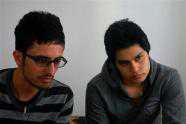
     Hesam Misaghi and Sepehr Atefi were joining what has become an exodus of dissidents fleeing Iran’s political turmoil. For them that meant a harrowing journey through the country’s rugged northwest in the dead of winter, with the help of Kurdish smugglers.

     At a river crossing, the ice broke beneath them and their horses stumbled in, soaking the two with freezing water.

     “There was no feeling in my legs and hands,” recalled Misaghi, a tall, wiry 21-year-old. “I felt drunk. I didn’t know where I was. I was laughing from pain.”

     Atefi, 20, spotted a van from a distance, grabbed Misaghi’s arm and dragged him toward it through the snow. “There was no life left in me to move forward, but we had to reach the highway,” he said.

     The men, both Iranian human rights reporters, reached the van, begged a ride and made it to safety in Turkey.

     At least 4,200 Iranians have fled their homeland since disputed presidential elections in June, according to a list compiled by activist Aida Saadat, who herself slipped across the border into Turkey in December. These refugees have scattered to the United States, Europe and Gulf nations like the United Arab Emirates.

     Most of all, they have come to Turkey — around 1,150 of them, according to the U.N. refugee agency — taking advantage of the porous border and Turkey’s policy of not requiring a visa. Most of the new arrivals fled for political reasons, including those who took part in opposition protests after the vote. They bring the number of Iranians in Turkey to 4,440, as of February — including “undesirables” in the eyes of the clerical regime, such as homosexuals or members of the Bahai religion.

     The danger these Iranians face back home is clear. A month after Atefi and Misaghi’s January escape, police raided their homes in the central Iranian city of Isfahan. Among the charges against them: “moharebeh,” or “waging war against God,” a crime punishable by death.

     Police arrested their friend and colleague, Navid Khanjani, who was supposed to have fled with them but changed his mind at the last minute. With Khanjani’s arrest, eight people in the independent Committee of Human Rights Reporters have been jailed, and three remain in prison and could face execution.

     In Turkey, the refugees are safer, but they live in limbo. Almost all brought little money and cannot work because of Turkish restrictions, so they cram into small, coal-heated apartments with minimal furniture.

     Many Iranian refugees hope the UNHCR will arrange resettlement for them in the United States or Europe — a wait that could take years, as the refugee agency is also dealing with thousands of Iraqis who have fled here from their own wartorn homeland in recent years.

     Many of the Iranians have been put in the central town of Kayseri and nearby towns such as Nigde. Like other refugees in Turkey, they are required to live in particular towns designated by the Interior Ministry, must regularly report to police to confirm their location, and must get permission from authorities to move to other cities.

     In addition to the rent and other expenses, each adult is required to pay the Turkish government about $200, along with $100 for each child, every six months to stay in the country. The interior minister last weekend (in March) signed an order to to lift the permit fees, but the order has not yet been enforced.

     In the meantime, they watch the events back home — where hundreds have been arrested, and two have been executed out of 11 sentenced to death for taking part in opposition protests. From exile, some try to continue their activism — and some try to recover from their trauma.

     Political activist Mahdis, 35, who once worked for a dissident cleric in the holy city of Qom, said she fled Iran more than a year ago after having been repeatedly raped in jail. Mahdis spoke on condition her last name not be used to avoid public embarassment.

     When she arrived in Turkey she was again raped, this time by a fellow Iranian refugee. She said police would not allow her to transfer to Kayseri unless she paid $200, which she didn’t have.

     “I was sobbing, saying ‘I swear to God’ I don’t have the money,” recalled Mahdis. It took her 40 days to come up with the money that she borrowed from fellow refugees.

     Another refugee, Mehrdad Eshghi, was the official singer for the state-run Iranian TV and Radio, known as Seda va Sima. Then authorities questioned his loyalty because he worked in the election campaign of President Mahmoud Ahmadinejad’s top rival, Mir Hossein Mousavi.

     After he refused to perform for Ahmadinejad’s campaign, security forces began harassing him. He was detained and threatened with worse consequences.

     “I was surprised by the way they treated me,” said Eshghi, 40. “I was one of them. When I had the mike in my hand doing live programs, it meant they trusted me with their lives,” he said in his apartment in Kayseri.

     After security men began staking out his home around the clock, Eshghi went into hiding. He took a bus to Turkey six months ago, and his wife and daughter joined him a couple of months later.

     “They could have done something terrible to me. You never know,” Eshghi said of his pursuers. “The survival of the Islamic Republic is so important to them that they will not give up at any price.”

     Eshghi, a singer, calligrapher, painter and composer, mourns his former life in his homeland.

     “I was at my best in Iran,” he said. “Here, I’m just an ordinary person.”

     Like others, he said his attempts to keep up political activism from exile are prevented by Turkish authorities. Eshghi said authorities refused to allow him to put on an exhibition of his paintings or a concert for Iranian refugees. “They tell me no one must know of my whereabouts because it poses danger to my life.”

     Turkey, though a U.S. ally, also has close ties to Iran. Ankara has criticized Western efforts to impose further sanctions against Iran over its nuclear program. Iran is a major supplier of natural gas to Turkey, and the two sides are working to increase trade, valued at $10 billion last year.

     Kayseri’s police chief said any restrictions on Iranians are for their own protection. “They are free here,” he said, speaking on condition of anonymity because of police regulations. “But for their own personal safety, they cannot be interviewed by reporters.”

     Some refugees claim they have been harassed by Iranian intelligence agents while in Turkey, with threatening phone calls or even physical attacks. Human rights officials say Iranian intelligence agents have infiltrated the refugee community here, leading to widespread suspicion.

     Hami Taghavi, a 40-year-old university professor who fled shortly after the post-election crackdown began, said he and his family try to avoid other Iranians.

     “We don’t trust other Iranians. We made sure to find an apartment where there are no Iranians around,” he said.

     Now he is just hoping to find rest, after repeated detentions in Iran for anti-government activities, including regular appearances on the Persian language stations of the BBC and Voice of America. He said he was tortured in custody, and now has trouble controlling movements in his limbs.

     “I wake up regularly during the night as if someone is kicking me in the stomach,” said Taghavi, who also headed an independent opposition teachers’ association in Iran.

     His wife, Mehrvash Dadashian, 35, ran a popular blog in Iran, since shut down. She intends to start a new one — but her main concern now is their life in Turkey, including the question of whether her 6-year-old daughter Yasna will be able to enter school in September.

     “I live in the present. I don’t brood over the past, nor am I worried about the future,” she said. “It’s peaceful here … we used to have near heart attack 20 times a day in Iran, every time they came to our door to take us away.”

     Despite the obstacles, reform activist Saadat says she is determined to keep up her political work, campaigning for Iranian women’s rights and writing for the Committee of Human Rights Reporters.

     “I am not an immigrant. I’ve come here to continue my work,” said Saadat.

     After months of repression, Iran’s reform activists are all in hiding, in jail or in exile, she said.

     “When we leave our country, we leave behind all our past, our love, memories, the sum of our lives.”

    The Associated Press
  • Leeds head call for justice on 10th anniversary of Istanbul killings

    Leeds head call for justice on 10th anniversary of Istanbul killings

    • Elland Road protest marked 10 years since death of fans
    MP demands action from foreign secretary

    • Press Association
    • guardian.co.uk, Monday 5 April 2010 15.42 BST
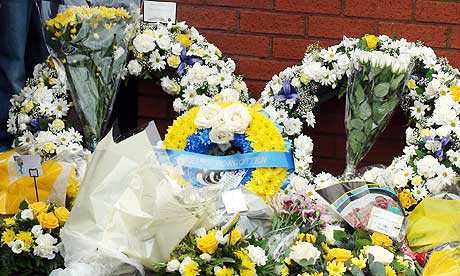
    Floral tributes were laid by Leeds fans at Elland Road to mark the 10th anniversary of the killing of two supporters in Turkey. Illustration: Dave Higgens/PA

    Hundreds of football fans gathered today to mark the 10th anniversary of the killing of two Leeds United supporters in Turkey and called for “justice” in their case.

    Christopher Loftus, 35, and Kevin Speight, 40, were stabbed to death in Taksim Square on the night before the club’s Uefa Cup semi-final against Galatasaray on 5 April 2000.

    About 300 Leeds United fans gathered outside Elland Road in Leeds today. They laid dozens of bunches of flowers, team shirts, scarves and other tributes around the statute of Billy Bremner and also at the brass plaque a few metres away which commemorates the deaths.

    Chris Loftus’s brother, Andy, stood alongside the Leeds North East MP, Fabian Hamilton, who told the crowd Turkey needed to do more to bring those responsible to justice. Hamilton said he had also written to the foreign secretary, David Miliband, to ask him to put pressure on the Turkish authorities.

    A number of people were arrested following the deaths in 2000 and four men were found guilty of involvement in the murders by the Turkish courts but all still remain free as they pursue an apparently interminable appeal process.

    “There’s a very, very strong feeling, especially amongst the families, that justice has not been done and nor has it seen to be done in Istanbul,” said Hamilton.

    “The people arrested and convicted of these dreadful murders have never actually served any time in jail – they’ve been released on bail pending appeal for the last few years. No trial date has been given for that appeal hearing.

    “This is absolutely appalling and I’ve been putting pressure on the foreign secretary and on the chief constable of West Yorkshire to take some action to pressurise the Turks to actually so something.”

    Asked what influence the UK can bring on Turkey, the Labour MP said: “Turkey has ambitions to join the European Union and I think this could be part of that pressure on the Turks to put their judicial system in order, to see that justice has to be seen to be done especially for the families here who are very angry that nothing’s happened and that the people who are guilty of these crimes have never actually served any time in jail.

    “That’s appalling and that’s the pressure we can put on the Turkish government. They want to join the EU. They’d better get their judicial system in order and they’d better ensure that the families here are satisfied that justice has been done.”

    After Hamilton addressed the crowd, those who gathered, including many children, observed a two-minute silence.

    A one-minute silence was also observed before Leeds United’s 2-1 victory over Yeovil at Huish Park. Both teams wore black armbands in memory of the killed supporters and Leeds fans, in an echo of what happened before the Uefa Cup match against Galatasaray took place on 6 April 2000, turned their backs on the match for the first minute in protest at the lack of justice for the Loftus and Speight families.

    https://www.theguardian.com/football/2010/apr/05/leeds-kevin-speight-chris-loftus, 5 April 2010