Month: July 2009

  • Serbian, Turkish FMs stress “good cooperation”

    Serbian, Turkish FMs stress “good cooperation”

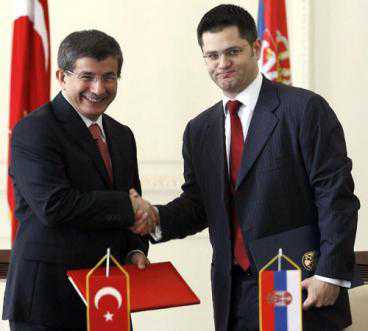
    BELGRADE — Serbian and Turkish FM Vuk Jeremić and Ahmet Davutoglu have expressed their willingness to further promote economic cooperation between the two countries.

    davutogluandjeremic
    Davatoglu, Jeremić (FoNet)

    Speaking in Belgrade on Thursday, they both voiced their satisfaction with the current excellent state of bilateral relations.

    Davutoglu, who kicked off his two-day visit to Serbia by meeting with Jeremic, told a joint news conference that the two states had no outstanding issues, underscoring that they shared a political will to further forge relations and partnership, as well as economic cooperation.

    The Turkish foreign minister added that there were different views on certain issues, referring to Kosovo.

    Speaking about economic cooperation, Davutoglu said that Turkey was ready to make major investment in Serbia’s infrastructure, including the construction of a highway.

    Turkey and Serbia signed today a Memorandum of Understanding between the governments of the two countries on setting up an office for program coordination under the auspices of the Turkish International Cooperation and Development Agency.

    Source:  www.b92.net, 23 July 2009

  • Did Israel Sign a Deal With Turkey to Import Water?

    Did Israel Sign a Deal With Turkey to Import Water?

    by Zalman Nelson

    (IsraelNN.com) A letter sent by the Israeli non-profit group for ethical government, Ometz, to State Comptroller Micha Lindenstrauss, calls for a review of a 2004 deal to import 50 million cubic meters of drinking water of from Turkey’s Mangabey River. According to Ometz, Israel paid an undisclosed deposit on the 20-year agreement, which comes with an option for five more years, but the project never began.

    Israel’s dwindling water supply, which prompted the Water Authority’s recently launched “Drought Tax” on high water use, has brought to light the water importing-deal signed with Turkey.

    “Due to the tremendous water shortage and the increased fines imposed on Israeli citizens, Ometz is calling for a review of the water agreements signed between Israel and Turkey. Israel has already paid unknown amounts for the deal, but there is no water,” wrote Ometz Director Aryeh Avneri.

    According to the letter by Ometz, the terms of the agreement established a sale price of up to $1 per cubic meter of water: 13-18 cents per cubic meter and 60-80 cents per cubic meter for import and distribution. Given Israel’s water needs, an estimated 50 million dollars a year was to be paid to Turkey. While a deposit was apparently paid, the letter alleges that the deal was never launched.

    The water deal was signed by the foreign ministers of Israel and Turkey and called for the importation of 50 million cubic meters of drinking water, says the letter. “Carrying out this agreement is the duty of Israel’s Water Commission and Turkey’s Water Authority (DSI), and the governments of Israel and Turkey bear collective responsibility for ensuring that all agreements are followed.”

    Ometz’s letter challenges that the deal failed to establish a timetable for delivery and failed to appoint a director for the project.

    “We turn to you and request a full investigation into this signed agreement to import water, why this program has still not yet started, and what amount of money, if any, remains to pay to begin importing,” Ometz wrote Lindenstrauss.

    Water tax
    The water tax imposes an NIS 20 fine per cubic meter of water on families containing four or fewer members who use more than 30 cubic meters of water in two months. Exceeding the quota cost NIS 8 per cubic meter prior to the tax. Families with more than four members get an additional three cubic meters per family member.

    The tax went in to effect retroactively on July 1 and was criticized by local government councils who said that citizens will be unable to limit water usage. Others criticized the tax on the grounds that the added revenues do not return to the water industry, but rather are drawn into the Finance Ministry’s bank account.

    Source: www.israelnationalnews.com

  • TURKEY RISING GLOBAL POWER

    TURKEY RISING GLOBAL POWER

    rose-crescent-and-star

    Size matters

    Wednesday, July 22, 2009

    SONER CAGATAY

    There are three categories of countries in international politics: global powers that can afford to do nearly everything they want; small and weak states that need to latch on to large states to protect their interests; and middle-sized states, which, though they are not powerful enough to shape global affairs by themselves, wield international influence through alliances and by building regional constituencies.

    For a long time, Turkey was in the category of small states, attaching its foreign policy unequivocally to that of the United States.  Over the past decade, under the rule of the Justice and Development Party, or AKP, Turkey has graduated to the class of middle-sized states. On July 15, U.S. Secretary of State Hillary Clinton recognized this development, calling Turkey an “emerging global power.” But what are the parameters of Ankara’s middle-sized power status? Now that it is in a new league of states, should Turkey attempt life without America, or does Ankara still need Washington?

    Turkey not only has NATO’s second largest military, but also is a new member of the G-20. What is more, thanks to the AKP’s activist foreign policy, Turkey wields influence across many regions, from the Middle East to the Eastern Mediterranean, and Central Asia. Ankara stands at a historic juncture and possesses the ability to shape politics beyond its borders if it pays attention to the two following parameters.

    First, Turkey can maintain its newfound global role only if it builds international constituencies. To this end, Ankara needs to project its political message and soft power in a consistent way.  If Ankara vacillates overseas, its newfound international influence will wane.

    So far, Ankara has struggled in this regard. Take China, for example. Turkey voiced strong criticism of the Chinese crackdown against the Uyghurs in early July, but has avoided taking a stance on the Tibet issue. Ankara will need to stand for human rights for both Muslim Uygurs and Buddhist Tibetans alike if it is to become a credible force in world politics. In this regard, Turkey should not only guard its existing constituencies, such as the Uygurs, but also reach out to and build new ones, such as the Tibetans. As a middle-sized power in global politics, Turkey needs to prove that its heart beats for Muslims and non-Muslims, and Turks and non-Turks, with the same strength.

    Along the same vein, Turkey needs to project its soft power consistently in the Middle East. In this regard, too, Ankara has not had a perfect record. When Hamas emerged victorious in the 2006 Palestinian elections, Ankara voiced support for Hamas’ electoral victory in the name of democracy. Yet in the aftermath of the June 2009 elections in Iran, amidst widespread allegations of vote rigging, Ankara did not side with democracy, but instead congratulated Ahmadinejad on his “electoral victory” even as Iranians were being shot in the streets of Tehran. If Turkey aims to wield influence in the Middle East by promoting itself and its values, such as democracy, it should do so for both Palestinians and Iranians.

    The second parameter to ensure Turkey’s middle-sized power status is maintaining an alliance with a global power. This will help Ankara protect its interests in areas of the globe beyond its reach, as well as in organizations where it could be dwarfed by larger powers.

    This is where Ankara’s relationship with the United States comes in. Fortunately, Turkey no longer is a foregone conclusion in Washington’s mind. But Ankara’s newfound importance in Washington should not be interpreted as the time for Turkey to conclude its long alliance with America. Like all middle-sized countries, Turkey can protect its interests better when allied with a global power. Take Turkey’s European Union, or EU, process, for instance. Turkey would not be in accession talks with the EU today if not for Washington’s continued backing.

    In a similar fashion, Washington’s assistance to Turkey matters inside NATO.  Ankara’s position in this alliance, which includes other middle-sized powers larger than Turkey, would be weaker if it were isolated. Turkey’s ties to Washington, in this respect, are essential. Washington’s motto in NATO, “Never leave the Turks alone,” best explains the United States’ utility to Turkey in NATO, as does Turkey’s access to U.S. military technology, a perk of its NATO membership.

    To be sure, the benefits of Turkey’s relationship with the United States are mutual. Just as Turkey profits from its relationship with a global power, Washington needs the new Turkey in many places, such as Afghanistan and the Middle East. This new rapport requires adult thinking on both sides, and will soon be tested as Washington withdraws troops from Turkey. This test will happen regardless of whether or not the U.S. pulls its military out of Iraq through Turkey, and the question is whether the two sides will act as mature partners.

    Far from looking for a life without America, Turkey should be looking for an upgraded relationship with the United States. Turkey has become a middle-sized power, size matters, and Ankara’s challenge is to step up to the plate.

    =======================

    * Regional trend: Turkey’s rise

    Turkey is continuing along its ascendant path, in line with STRATFOR’s expectations. The priority for Turkey is to expand its power in the Middle East, beginning with Iraq, where the United States is taking a step back from day-to-day security operations and where Turkey is taking a step forward in managing the country’s rival factions. The Turks are counting on Iraqi energy to boost Ankara’s profile in the region as a major east-west energy transit hub. But with Iraq bogged down in sectarian feuds, Turkey has its work cut out in trying to bring its own version of order to the country. The Turks will continue building relations with key Iraqi politicians, but will also take a more nuanced approach in dealing with the Kurds, using less military coercion and more political and economic persuasion. By playing on Kurdish fears of encirclement by Iraqi Arabs, the Turks will aim to persuade the Kurds that Turkey can guarantee Kurdish political and economic security, as long as the Kurds play by Turkey’s rules – which include abandoning any separatist ambitions. Recognizing the problems the United States is encountering in its Iran strategy, the Turks will be careful to maintain a healthy relationship with Tehran. The time may not be ripe for Iran to seriously engage the West, but Turkey is positioning itself to become a mediator in this long-standing dispute. Once Turkey reaches beyond the Middle East, the road gets rougher. Turkey’s ruling Justice and Development Party is attempting a complex balancing act between the East and West in trying to create the geopolitical space for Turkey’s expansion. Ankara sees itself as an independent player and has no interest in becoming a pawn in the ongoing U.S.-Russian struggle over Eurasia. Thus, Turkey must flirt with multiple options and act as unpredictably as possible in conducting its foreign affairs so that it does not permanently breach relations with either side. To this end, Turkey will entertain deals on non-Russian energy routes like the Nabucco pipeline and push for EU membership to keep one foot in the West, but will also work closely with the Russians on energy and defense deals to avoid trouble with Moscow and keep its Russian-chaperoned negotiations with Armenia alive. Turkey is likely to encounter the most resistance to its resurgence in former Soviet territory. The Turkish government continues to push a pan-Islamic and pan-Turkic agenda to raise its profile among Turkic-speaking peoples in the Caucasus and Central Asia, but a number of these post-communist regimes – Azerbaijan and Uzbekistan, in particular – are extremely wary of Turkey’s intentions and increasingly Islamist branding. This simmering backlash could give Russia additional leverage in countering Turkey’s regional rise.
    __._,_.___

  • No Justice for Rape Victims in Bosnia and Herzegovina

    No Justice for Rape Victims in Bosnia and Herzegovina

    Amnesty International: No Justice for Rape Victims

    22 July 2009  Amnesty International calls on to the Prosecution of Bosnia and Herzegovina to open an investigation into allegations of rape committed by the Lukic cousins in Visegrad.

    Following the conviction for crimes in Visegrad, which saw Milan Lukic sentenced to life in prison, and Sredoje Lukic to 30 years, Amnesty International has called on the State Prosecution to open an investigation into allegations of rape committed by the two cousins in this part of Eastern Bosnia.

    “The conviction of Milan and Sredoje Lukic for war crimes and crimes against humanity brings justice for the killing of scores of people during the war in Bosnia and Herzegovina but ignores the suffering of victims of sexual violence. Amnesty International deeply regrets that the Prosecutor failed to investigate war crimes and crimes against humanity of sexual violence, including rape”, said an Amnesty International press release titled “No justice for rape victims”.

    On July 20, the International Criminal Tribunal for the former Yugoslavia (ICTY) convicted Milan and Sredoje Lukic of murder, persecution, extermination, and torture – committed between 1992 and 1994 in the Visegrad area.

    The Prosecution charged that Milan Lukic was leader of the paramilitary group known as the “Beli Orlovi” (White Eagles) or “Osvetnici” (Avengers), while Sredoje was a policeman in Visegrad, and a member of the “Beli Orlovi” group. 

    For years, Visegrad victims have called on the Hague Prosecution to indict Milan Lukic for numerous rapes committed in this city, among other places, in “Vilina Vlas” hotel. (See: Visegrad Rape Victimes Say Their Cries Go Unheard).

    “The raped women of Visegrad deserve justice too. Those responsible for these crimes should also be held to account. Over a decade after the war, these women are forced to live with the memories of their suffering without being able to receive acknowledgement and compensation”, said Nicola Duckworth, Europe and Central Asia Programme Director at Amnesty International.

    During the reading of the Lukic cousins’ verdict, Judge Patrick Robinson said there had been “many pieces of evidence pertaining to other crimes which include rape”, however, since the Lukic cousins were not indicted for those crimes, “the Chamber did not determine their guilt for them”.

    “The evidence shows that a group of about 70 Bosniak civilians were brought by a group of armed Serbs to the house of Jusuf Memic, where they were robbed while being threatened by armed men. Women were stripped to their bare skin. After that they took several women, who upon return said they were raped. The evidence indicates that Milan Lukic was in the house of Jusuf Memic and took things from victims. He was armed, while people were being stripped bare. He participated in taking women from the house, who, as they said, were raped”, said Robinson.

    Amnesty International notes that credible evidence of the abduction of young women who were subsequently held and subjected to rape and other crimes of sexual violence at the Vilina Vlas hotel near Vi?egrad has been gathered by the Tribunal and the State Court of Bosnia and Herzegovina which points to the alleged responsibility of the Lukic cousins for rape and other crimes of sexual violence.

    “A number of non-governmental organizations have also documented testimonies of victims who allege that they were raped by members of paramilitary groups under Milan Lukic’s command. Amnesty International in 1993 documented two cases in which girls reported that they had been raped in Vilina Vlas hotel, allegedly by members of the White Eagles”, the statement says.

    A UN report on rapes in BiH committed in 1994 describes “Vilina Vlas” as one of the places where rapes took place, and states that it was a detention center for women, where girls younger then 14 were held.

    BIRN

  • Turkey Puts Generals on Trial as Erdogan Curbs Army (Update2)

    Turkey Puts Generals on Trial as Erdogan Curbs Army (Update2)

    By Ben Holland

    July 20 (Bloomberg) — Two of Turkey’s most senior retired generals went on trial today in a case that may determine whether Prime Minister Recep Tayyip Erdogan succeeds in reining in the political power of his country’s military.

    Sener Eruygur and Hursit Tolon, along with 54 other suspects including journalists, academics and business leaders, are accused of belonging to a group prosecutors say tried to undermine Erdogan by destabilizing the country with armed attacks. Tolon appeared at the court outside Istanbul while Eruygur didn’t attend, the official Anatolia News Agency said. The court set a date of Aug. 6 for the next hearing.

    The case is a sign that Erdogan is gaining the upper hand in a six-year power struggle with an army suspicious of his Islamist background. It may strengthen the prime minister’s push to get Turkey into the European Union, which requires civilian control over the military.

    “Turkey is coming to a historic crossroads and there’s a determination to confront the army,” said Akin Birdal, an opposition lawmaker and human-rights activist who was jailed by the military when it seized power in a 1980 coup. “Other NATO countries cleaned up their security forces after the Cold War, and Turkey needs to follow this through.”

    The first Islamic country President Barack Obama visited, Turkey is NATO’s only Muslim member and a contributor to the alliance’s force in Afghanistan battling the Taliban.

    New Law

    The trial is a turnaround from two years ago, when the army initially blocked Erdogan’s presidential nominee, Abdullah Gul, 58, roiling markets. It also comes two weeks after Gul approved legislation allowing civil courts to try active military officers. While that law may not affect the case against Ergenekon, the group at the center of the trial, it could mean more civil scrutiny of the military in the future.

    Birdal, of the Democratic Society Party, was one of the first people to make use of the new law. He filed charges on July 14 against Cevik Bir, a former deputy chief of general staff, accusing him of inciting nationalist gunmen who shot and severely injured Birdal in his office at the rights association in 1998. Bir hasn’t yet responded to the charges.

    At stake, says Erdogan, is who runs a country that in the past half-century has suffered three coups by an army that sees itself as the guardian of Turkey’s secular system.

    “Turkey isn’t a police state, it’s not an army state, it’s a democratic and secular state under the rule of law,” the prime minister said at a police graduation ceremony on July 7.

    More Arrests

    Not everyone accepts Erdogan’s interpretation of the case. Main opposition leader Deniz Baykal of the Republican People’s Party accuses the government of using the investigation to intimidate critics rather than to strengthen Turkey’s democracy.

    “The more arrests we’ve seen, the more people whose only crime was opposition to the government were targeted,” said Soner Cagaptay, an analyst at the Washington Institute for Near East Policy. “And they’re not reforming in other EU areas: press freedom, gender equality, religious freedoms.”

    Erdogan, 55, has chipped away at the military’s powers since coming to power in 2003. He ended army control over the National Security Council in 2003 and ignored objections that same year from the generals to his plan for pursuing the reunification of Cyprus.

    The premier refused to back down when the army opposed Gul’s presidential nomination. He called an election and won with 47 percent of the vote, then successfully named Gul again for the post.

    Markets Plunge

    The dispute caused the benchmark ISE-100 stock index to plunge 7 percent in two days. Since Erdogan’s re-election, the index has lost 56 percent of its value, matching the 57 percent decline of the MSCI Emerging Markets Index. After average annual gross domestic product growth of about 7 percent in Erdogan’s first term of office, the economy expanded 1.1 percent in 2008. It will probably contract 5.1 percent this year, according to the International Monetary Fund.

    Erdogan has been negotiating with the fund since May 2008 over lending for the country of 72 million. Foreign direct investment in the first five months of the year fell 52 percent from a year earlier to $3.6 billion, central bank data show.

    “Differences between the army and government remain the major political risk” for investors in Turkey, said Nurhan Toguc, chief economist at Ata Invest in Istanbul.

    The probe of Ergenekon began in 2007 and culminated 12 months ago with the arrest of Tolon and Eruygur, who were initially jailed and then released pending trial. All suspects deny the charges. Prosecutors filed an indictment against another 52 people today, the Anatolia agency said, without identifying any of them.

    Suicide Threat

    Opposition parties say Erdogan should change the army- designed 1982 constitution to allow trial of the generals who seized power in 1980. The 92-year-old Kenan Evren, the coup’s leader, told reporters he would commit suicide if brought to trial.

    Though the Ergenekon case has been under way since last year, Tolon and Eruygur were indicted later and hadn’t been included in the trial until today. The hearing is taking place in a custom-built courtroom, the country’s largest, at Silivri in the outskirts of Istanbul.

    It was constructed after judges were forced to delay the first trial session in October, because the hundreds of suspects, witnesses, lawyers and reporters couldn’t fit into the court.

    To contact the reporter on this story; Ben Holland in Istanbul at [email protected].

    Last Updated: July 20, 2009 11:43 EDT
    https://www.bloomberg.com/politics?pid=newsarchive&sid=a9Sle48If4.U
  • China Should Retaliate Against Turkey

    China Should Retaliate Against Turkey

    By Recognizing the Armenian Genocide
    sassun-21
    By Harut Sassounian
    Publisher, The California Courier
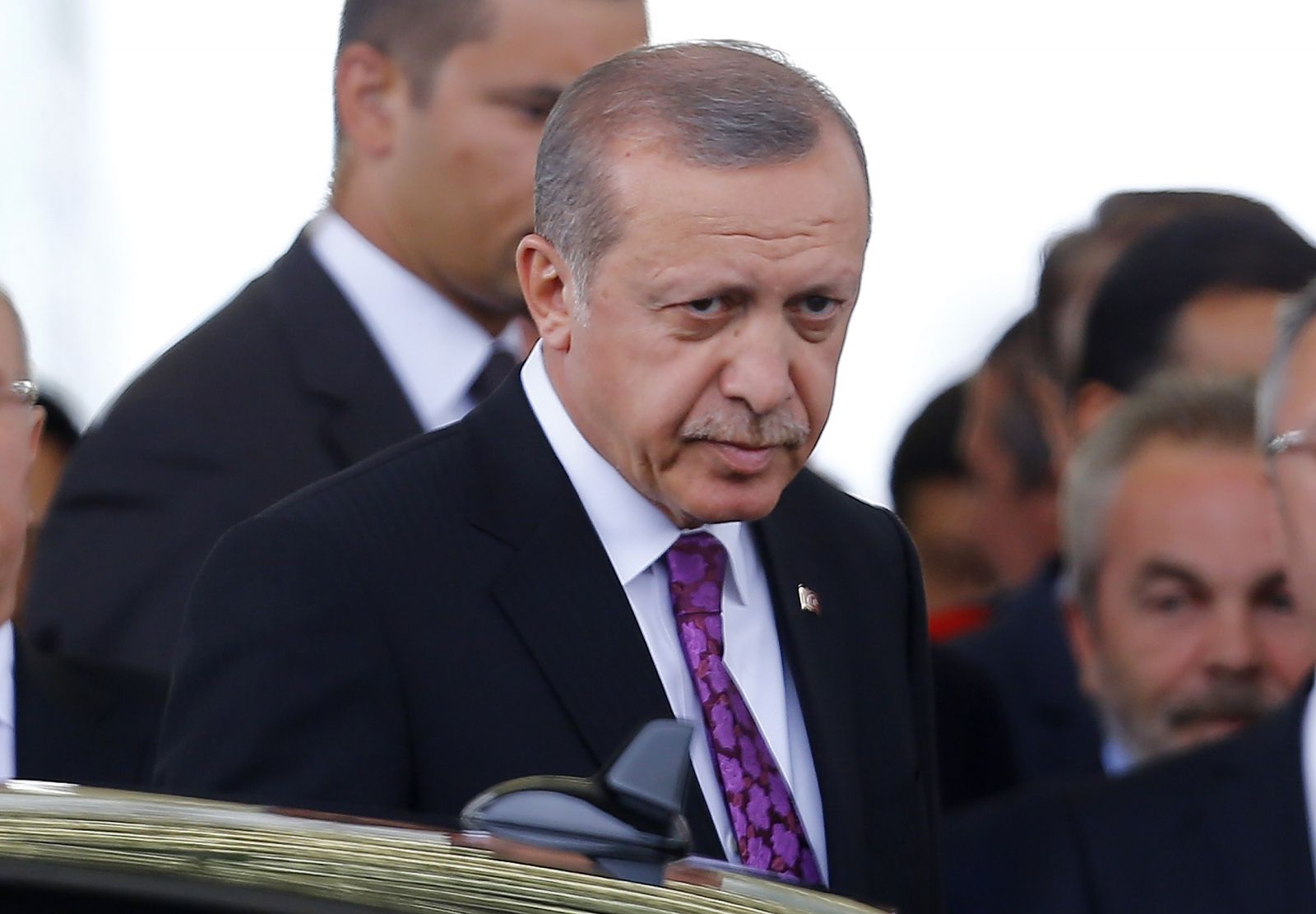
    The Prime Minister of Turkey Rejeb Erdogan seems to have fallen into the bad habit of periodically accusing various countries of committing genocide. By doing so, the Turkish leader is inadvertently creating new opportunities for the international media to raise the issue of the Armenian Genocide.
    In January of this year, the Turkish Prime Minister accused Israel of committing genocide during its Gaza offensive. Several Israeli leaders and members of the media reacted by pointing out that Turkish officials should be the last ones to talk of genocide given their country’s culpability in the Armenian Genocide. Some members of the Israeli government were so offended that they threatened to retaliate by acknowledging the Armenian Genocide.
    Earlier this month, Prime Minister Erdogan returned to his favorite topic, this time accusing China of committing genocide. He was furious that several dozen Turkic-speaking Muslim Uighurs were killed in the Xinjiang province, during clashes with the Han Chinese who suffered many more casualties.
    According to a Reuters report, Erdogan stated on July 10: “The incidents in China are, simply put, a genocide. There’s no point in interpreting this otherwise.” Erdogan’s unwise words elicited immediate reaction from the international media which pointed out his foolishness in accusing others of genocide, given his country’s poor record on minority rights and its responsibility for the Armenian Genocide.
    The Economist magazine reported that “in the past few days internet forums in China have been clamoring their support for Kurdish separatists,” a subject that was practically unheard of in China before Erdogan’s accusation of genocide! The magazine also stated that Turkey is now “finding itself in the line of fire.”
    The Associated Press, in covering Erdogan’s characterization of the clashes in China as genocide, devoted an entire paragraph to the Armenian Genocide: “Turkey itself is extremely sensitive to the use of the term ‘genocide.’ Armenia says 1.5 million Armenians were slain by Ottoman Turks around the time of World War I in what Armenians and several other nations recognize as the first genocide of the 20th century….”
    Reuters also covered Erdogan’s accusation of genocide against China, indicating that “the genocide label is particularly sensitive in Turkey, which strongly refutes Armenian claims that the killing of Armenians by Ottoman Turks during World War One constituted genocide.”
    Sylvia Hui, columnist of Hong Kong’s Asia Sentinel, ridiculed Erdogan for his flippant use of the term genocide. She wrote: “What’s interesting about this accusation is not only the premature and almost casual way it has been pronounced (especially given how sensitive Turkey is to the word with regard to Armenian accusations that Ottoman Turks committed the first genocide of the 20th century), but also how it contradicts other things Erdogan reportedly said on the same occasion…. In any case, the Turkish leader comes across as thoroughly hypocritical or too eager to please Uighurs at home to have thought it through before making such a strong remark.”
    Liberal Turkish newspaper “Radikal” joined the fray by quoting from the editorial of the Boston-based “Armenian Weekly” on Erdogan’s ludicrous condemnation of China: “People who live in glass houses should not throw stones.” The editorial took Erdogan to task for having “the audacity to compare the killing of a few dozen Uighurs to genocide while it continues to spend millions to deny the killing of a million and a half Armenians.” “Radikal” concluded by quoting the Weekly’s sarcastic conclusion: “After all, even by the official Turkish account, there were more than 150 people who were killed in 1915.”
    The Chinese state press, not surprisingly, was even more critical of Erdogan. “The People’s Daily” wrote on July 14: “Many Chinese citizens feel insulted by Turkish actions and suggest that China should change its attitude towards the Kurdistan Workers Party and support their appeal for independence, so as to make Turkey pay a heavy political price…. Turkey was once accused of committed genocide in Armenia by the West and its crackdown on Kurdistan Workers’ Party has also stirred up numerous controversies.” “The People’s Daily” also published several letters critical of Turkey, one of which stated: “The Kurdish massacres in Turkey were a kind of genocide and Nazism. Linking China to genocide is like a thief shouting ‘stop thief.’”
    Another Chinese newspaper, “The China Daily,” in an editorial titled, “Don’t Twist Facts,” urged Erdogan to “take back his remarks…which constitute interference in China’s internal affairs.”
    The most effective measure China can take in response to Erdogan’s hysterical accusations is to have the Chinese Parliament adopt a resolution recognizing the Armenian Genocide.