| Summary of | |
| Washington threatens to evacuate three US bases over Qatar’s pro-Iran policy May 15: The Obama administration has secretly warned Emir Sheikh Hamad bin Khalifa al-Thani that he risks losing the three big American bases located in the emirate if he persists in promoting Iran’s radicalizing influence over Syria, Lebanon and the Palestinians.
An American military withdrawal from the emirate, especially the big Al Odeid air base and Central Command headquarters, would be a crushing blow to Al Thani. It would leave Qatar and the rest of the Gulf unprotected in any military conflagration in the region over Iran’s nuclear program. It alarmed Emir al Thani enough for him to takes steps, one of which was to direct the news editors of al Jazeera TV station, which he owns, to moderate the anti-American line of its English and Arabic language broadcasts. May 15 briefs: – Egyptian security officers uncover big arms cache near Israeli border in Sinai. US upholds Israel’s nuclear position as long as Iran enriches uranium 16 May: This statement by a senior American official in Vienna paves the way for an Israeli request to extend the 40-year old “ambiguity” arrangement approved by Obama’s predecessors for its nuclear program. The senior US official, addressing preparatory talks for a nuclear non-proliferation treaty review conference in 2010, made it clear that US arms control negotiator Rose Gottermoelle did not break new ground last week when she urged presumed atomic powers India, Israel, Pakistan and North Korea to join the nuclear non-proliferation pact. He said: The four presumed nuclear nations were unlikely to join the NPT “until there is a change in the overall political and security context.” He added: “In the particular case of the Middle East, Israeli adherence to the NPT is only going to be possible in the context of… full compliance with [the treaty in the region].” Establishing a Middle East nuclear weapons-free zone “depends on Iran fully complying with its NPT obligations and suspending uranium enrichment.” Jordan’s Abdullah appoints his 9-year son crown prince, sacks Hazme This decision has aroused a major to-do in the royal court as well as opposition in Jordan’s government and military elite. They fear Abdullah’s his appointment of a young child as first in line to the throne will plunge the kingdom into a period of instability. They also accuse him of breaking a deathbed promise to his father. When King Hussein knew he was dying of cancer in 1999, he pulled the post of crown prince from his brother, Prince Hassan, and passed it to his own son, Abdullah, against a pledge to appoint Prince Hamze next in line to the throne. May 17 briefs: – Hatred of Jews intensifies among Israeli Arab community, according to a new poll. US-Israel summit shadowed by Obama’s soft stand on Iranian enrichment Overshadowing their outwardly easy conversation was the US president’s growing inclination to meet Iran halfway on uranium enrichment. He is seriously considering taking up the Anglo-German proposal for an international monitoring mechanism strict enough to preclude Iran’s attainment of weapons-grade enriched uranium after being advised by US intelligence and nuclear experts that this is feasible. Israeli intelligence and military experts take the opposite view. They believe the Anglo-German plan gives Iran the perfect cover for concealing its race for a nuclear bomb, a misgiving shared by the political and military establishments of the moderate Arab governments in Egypt, Saudi Arabia and the Gulf. It is their view that if Obama adopts this plan, Iran can be sure of arriving at a nuclear weapon capability by the end of 2010, after winning six clear months for moving forward. No agreement on Iran, Palestinians in Obama-Netanyahu talks 18 May: US president Barak Obama stood by his demand for a Palestinian state while Israeli prime minister Binyamin Netanyahu continued to avoid this formula in their talks at the White House Monday, May 18, their first since both took office. They agreed that a nuclear-armed Iran would be a threat not only to Israel and the US but a destabilizing factor for the world and the region. However, Obama said he is in the process of reaching out to Iran and is confident he can persuade its leaders that a nuclear bomb is not in their interest either. These talks can’t go on forever,” he said: “At the end of the year we’ll see where we stand.” Netanyahu was less sanguine: “A nuclear-armed Iran which calls for Israel’s destruction is unacceptable and would give terrorists a nuclear umbrella.” The US president called on Israel to stick to the road map as “ratified at Annapolis” (which Netanyahu has rejected) and stop settlement activity. The Palestinians must fight terror. Obama pledged US involvement in peace talks as a strong partner. Netanyahu said he was ready to start talks with the Palestinians immediately. He wanted the Palestinians to rule themselves, but peace means they must recognize Israel as a Jewish state with the right to defend itself and live in security. Both agreed that Jordan, Egypt and Saudi Arabia should be constructively involved in the Israel-Palestinian peace track and do more to develop relations with Israel at the outset. Nasrallah places his Hizballah on war preparedness Our military sources reported that Hizballah was exploiting the alleged flight of suspected Israeli spies from Lebanon across the border into Israel to wind up border tension. On May 18, Elie al-Hayek, 49, a mathematics professor from Qleia, who walks on crutches, fled to Israel with his wife and three children after being accused of spying for Israel along with 13 other Lebanese nationals. Hizballah’s Al Manar TV claimed that two more suspected spies escaped Monday and several last week. Beirut has lodged a complaint with UNIFIL headquarters at Naqoura and demanded the escapees’ extradition. The spy mania gripping Beirut is exploited by the different parties campaigning for election on June 7. |
US Treasury targets Syria-based al Qaeda facilitator for Iraq DEBKAfile Special Report 18 May: Damascus has ordered Syrian intelligence to permit Saad Uwayyid Ubayd Mujil al Shammari aka Abu Khalaf – named by Washington as the senior leader of al Qaeda’s Syria-based support network – to step up the flow of suicide bombers into Iraq to 20-30 a month. Abu Khalaf is a threat to “the safety of Coalition forces and the stability of Iraq,” said Stuart Levey, US Under Secretary for Terrorism and Financial intelligence. In the early stages of its diplomatic exchanges with Washington, Syrian president Bashar Assad ordered the al Qaeda facilitator to slow down the traffic of foreign al Qaeda terrorists into Iraq. But when US presidential envoys started visiting Damascus on a regular footing, he lifted these restraints. As a result, al Qaeda reactivated its smuggling route for suicide bombers, weapons and explosives through the Euphrates River into Iraq’s Anbar province. In April, therefore, the US military death toll in Iraq shot up to 18 – double the March figure. Special US Marine forces patrol the river by boat to intercept them. On May 1, a patrol was ambushed in Anbar by al Qaeda suicide killers, who left two US marines and a seaman dead after a firefight. Diskin: Hamas will not give Mid East peace a chance, can be toppled 19 May: US president Barack Obama’s planned Middle East initiative is a non-starter as long as the extremist Hamas rules the Gaza Strip, said Shin Bet (internal security agency) director Yuval Diskin Tuesday, May 19. Israel must decide once and for all whether to topple the Hamas regime, which can be done without conquering the Gaza Strip, in his view. Hamas will not let go of the Gaza Strip or its fundamentalist ideology, Diskin warned, while the Palestinian Authority is equally determined to hold on to the West Bank. But if elections were held on the West Bank today, Hamas would win. Until Egyptian special forces clamped down on smuggling through Sinai, Hamas had managed in four months to smuggle 46 anti-air missiles, 330 mortars, 37 short-range ground missiles and 17 tons of explosives into Gaza. It is aiming for missiles capable of reaching Tel Aviv, 63 kilometers away, although there is no evidence it has succeeded.” In Gaza City, Hamas spokesman Fawzi Barhum forbade the Palestinian Authority to resume negotiations with the “Zionist enemy.” May 19 briefs: – US denies training “terrorists in Iraq’s Kurdish region” as charged by Iran, accuses Tehran of meddling in Iraq. Israeli air force hits Hamas-Gaza hard amid Lebanon border tensions DEBKAfile’s military sources also that several Sinai-Gaza smuggling tunnels, missile foundries and three Hamas command posts in Gaza City were struck in Israel’s most extensive Gaza raid since its major offensive ended in January. The Palestinians reported casualties. Tuesday night, the Palestinians fired a twin Qassam volley at Sderot. One missile injured a man and damaged his home. That morning, Shin Bet director Yuval Diskin told the Knesset foreign affairs and security committee that Hamas has cut back on its attacks because it needed a respite for rearming and regrouping after the Israeli offensive. Hamas loosed the missiles to prove him wrong and show US president Barack Obama and the Israeli prime minister Netanyahu in Washington who really called the shots in the Gaza Strip. After Sderot was hit, defense minister Ehud Barak and Netanyahu decided on powerful aerial retaliation. This was all the more necessary as Hamas was deemed to be testing the new Israeli government’s military reflexes and resolve. Another factor was the Hizballah leader’s decision of May 18 to raise border tension with Israel ahead of Lebanon’s June 7 election. US Vice President Biden consigned urgently to Beirut 20 May: The White House has urgently consigned vice president Joseph Biden to Beirut. He arrives May 22 to back the pro-Western government parties’ bid for re-election against Iran’s Hizballah and pro-Syrian factions, led by Gen. Michel Aoun. Lebanon’s fall into Iranian-Syrian hands would be a damaging setback for Washington. Senators call on Obama to take into account the risks Israel runs from a peace accord 20 May: Seventy-six US senators have called on President Barack Obama to continue to support Israel and “take into account the risks it will face in any peace agreement,” Tuesday, May 19, after meeting Israeli prime minister Binyamin Netanyahu. In a letter signed by 76 of 100 senators, Obama is told that “without a doubt, our two governments will agree on some issues and disagree on others, but the United States’ friendship with Israel requires that we work closely together as we recommit ourselves to our historic role of a trusted friend and active mediator. “We must also continue to insist on the absolute Palestinian commitment to ending terrorist violence and to building the institutions necessary for a viable Palestinian state living side-by-side, in peace with the Jewish state of Israel,” they wrote. Israel has no adequate interceptor for Iran’s new long-range missile US missile tracking systems confirmed the Iranian President’s boast of Sejil-2’s precision. Sounds of concern came from the Obama administration. The Arrow 2 anti-missile missile system is no match for the Sejil, while Arrow 3 which would be, is still under development. Until now, the Americans and Israelis were confident that any incoming Iranian missile would veer off target and be easily intercepted. This assumption was nullified by the Sejil-2 launch. Iran’s feat comes at a critical time for its efforts to build a nuclear arsenal of at least 10-12 nuclear warheads. It obviates the strategic value of any understandings reached by President Obama and prime minister Netanyahu on Iran’s nuclear and missile programs. Israel marks annual Jerusalem Day 21 May: At a national ceremony for the soldiers who died in the Battle for Jerusalem in 1967, prime minister Binyamin Netanyahu declared at the Ammunition Hill Memorial site: “I say here what I said in the United States this week: Jerusalem will never be divided and it will remain forever under Israeli sovereignty.” President Shimon Peres said: “Jerusalem has never been the capital of any other nation except for the Jewish people.” Under foreign rule, Jews were denied access to their holy places. Today, members of all faiths are free to worship at their shrines in Israel’s capital. |
Month: May 2009
-
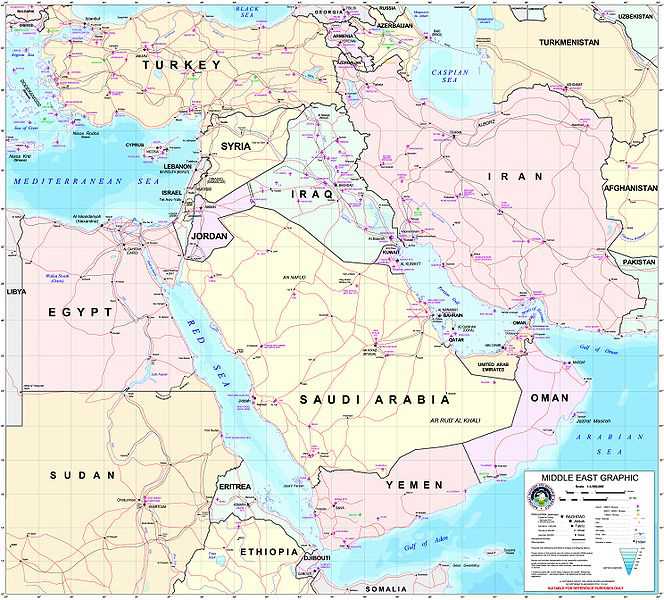
DEBKAfile Exclusives in Week Ending May 20, 2009
-
Please, Iran, Release My Cousin Now, Too By Klara Moradkhan
Development Director, Children Uniting Nations FOX News Blogs May 13th, 2009 Like millions of others, I rejoiced this week in the release of Roxana Saberi from an Iranian jail. Yet I also wept that my cousin, Silva Harotonian, similarly accused and convicted on political charges, remains behind in Iran’s notorious Evin Prison. After almost a year in detention, she remains caught in a tragic misunderstanding.
For the very basis on which Ms. Saberi was freed – Iran’s recognition that it and the United States are not in a state of hostility toward one another – would support Silva’s release as well under Iranian law.
Silva, an Iranian citizen of Armenian descent and Christian faith, is a kind-hearted young woman who loves poetry and helping others – hardly signs of a revolutionary or spy. She was hired by the Yerevan, Armenia, office of the International Research & Exchanges Board (IREX), a U.S.-based non-profit. An administrative aide, she supported an exchange program for U.S. and Iranian maternal and child health care professionals – exactly the type of initiative needed to increase understanding between countries.
In June 2008, during her fourth trip from Armenia to Iran for work, Silva was arrested. She was later sentenced to three years detention for allegedly creating a “soft revolution” and had her initial appeal denied. Silva has such a bright future ahead, but her health now is deteriorating, so we plead with Iranian officials to show mercy during Silva’s upcoming final appeal. Iranian officials pledged to offer Ms. Saberi speedy and fair consideration of her appeal. Our entire family – in Los Angeles, in Armenia, in Iran – hopes they will do the same for Silva. Silva’s 75-year-old mother will be waiting at the gates of Evin Prison for the day they are reunited.
Silva is ethnically Armenian – and relations between Armenia and Iran have never been stronger according leaders, including, Iran’s Supreme Leader Ayatollah Ali Khamenei. Armenians celebrate their national holiday, Republic Day, on May 28. There could be no greater gesture between Iran, Armenia and the United States, and no greater testament to the central importance of mercy in Islamic and Christian faiths, than for Iran’s leaders to demonstrate their compassion by releasing Silva.
Klara Moradkhan is Development Director for Children Uniting Nations, a non-profit organization based in Los Angeles. You can view the video on public appeal for freeing Silva Harotonian (in English) via the following link: http://www.youtube.com/watch?v=OLayZZOe3HE&feature=channel_page
You can view the video on public appeal for freeing Silva Harotonian (in Armenian) via the following link: http://www.youtube.com/watch?v=5sndZoiSKg4&feature=channel_page -
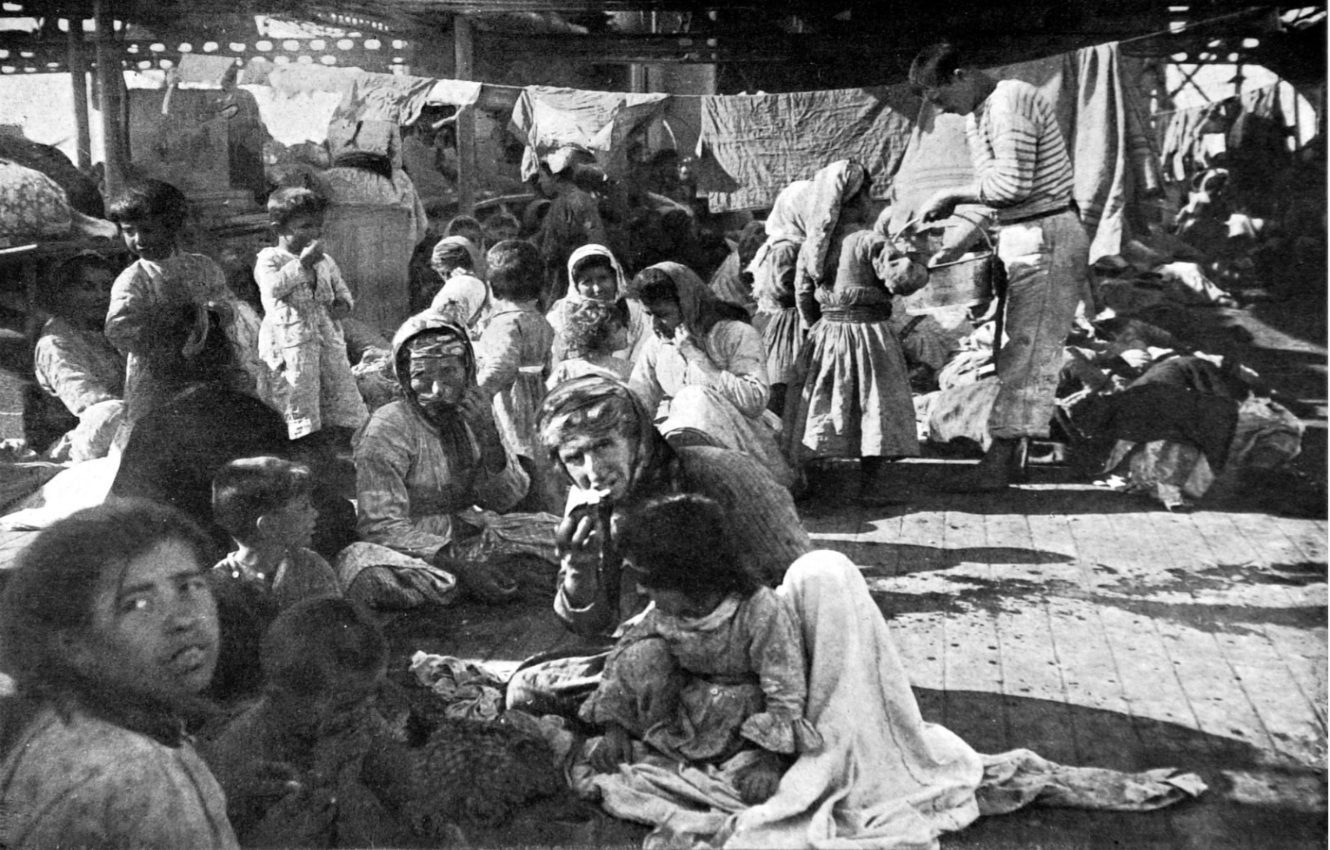
Lebanese-Armenian Vote May Alter U.S. Policy in the Middle East
Parliamentary Elections:
By Appo Jabarian
Executive Publisher / Managing Editor USA Armenian Life MagazineFriday, May 22, 2009
Along with Russia, the European Union and China, the United States anxiously follows developments in the June 7 Lebanese parliamentary elections. The elections will decide who will run the country for the next four years. Will it be the pro-western ruling coalition or the tri-partite opposition alliance formed mainly by Lebanese Shiites, Christian Maronites, and Lebanese Armenians? In a May 11 article in the Lebanese Daily Star, titled “Rival Lebanese Christian factions now hold political cards in Levant,” Anthony Elghossain, a J.D. candidate at The George Washington University Law School, wrote: “Unfolding in a playground open to the ambitions of regional and international powers alike, the Lebanese election is likely to impact American policy with respect to Syria and Iran.” Elghossain added: “On the one hand stands former Lebanese President Amin Gemayel’s Phalange party and former militia leader Samir Geagea’s Lebanese Forces (LF). Both parties are hostile to Syrian interference in Lebanese affairs, and are currently part of a coalition supported by the United States and the West. On the other hand stands a camp that revolves around former General Michel Aoun’s Free Patriotic Movement (FPM). At a crossroads, the FPM advocates for Lebanese sovereignty and a Christian voice in the political system.” He underlined that the election outcome “in the pivotal Metn region,” the district which will produce the Christian leader to be reckoned with, will be decided by “the crucial Armenian swing vote.”
In the evening of June 7, that Christian leader may be Mr. Aoun. And that can happen thanks to his alliance with the most popular Armenian Lebanese political party ARF Tashnagtsutiun. The March 8 opposition leader Michel Aoun, the head of the Free Patriotic Movement (FPM), and his allies won six of the district’s eight seats in 2005 with the backing of the Armenian Lebanese voters.
In a related May 13 news story, Osama Safa, the director of the Lebanese Center for Policy Studies, said that the Metn district has not only electoral significance and political weight, but also cultural importance.
Safa clarified: “With the polls less than a month away the several lingering questions in the Metn district will only be answered on election day. Two of the remaining wild cards are how the inclusion of independents, loyal to President Michel Suleiman, on the March 14 list will affect the contests and how voters in the Armenian community, numbering around 8,000, will swing. … The powerful Armenian Tashnag party has thrown its support behind Aoun and the FPM list. … The influence of the Armenian party is already clear. Tashnag candidate Hagop Pakradounian, on the opposition list, is running uncontested.”
Speaking in Beirut in late April, U.S. Secretary of State Hillary Clinton said her visit to Lebanon aims to send a “strong signal” for “fair and transparent” elections in the country. She added that “Lebanon is facing a new challenge in the upcoming elections,” and the Lebanese should choose their representatives “away from foreign meddling, violence and fear,”
www.chinaview.cn reported.
On May 12, Russian Foreign Minister Sergei Lavrov urged the international community to accept the result, regardless of who wins. He clarified that the mistake that was committed when Hamas won the Palestinian elections a few years ago should not be repeated, a reference to the international isolation of the Hamas government that many saw as prolonging and intensifying the Middle East conflict. In a statement to the Russian Interfax information services, he said “If the international community had acknowledged the victory of Hamas, the actions of Hamas would be different today,” reported The Daily Star.
On May 16 Robert Fisk wrote in London’s The Independent: “I went to take a look at Madeleine Albright [former U.S. Secretary of State- Ed.] the other day. She turned up in Beirut as part leader of the National Democratic Institute, one of those Washington gigs that checks up on the freedom of elections in dodgy countries. …The Americans are hoping that the ‘democrats’ who currently hold a majority – Saad Hariri’s Future movement, jolly old Jumblatt’s Druze and a clutch of Maronites – will win the day.”
Fisk added: “Most of my Lebanese colleagues, listening to Mrs. Albright, came away with a deep suspicion: that if the Lebanese elections bring the friendly ‘democrats’ back to power, the National Democratic Institute and its other poll-sniffers will announce a fair and free election. But if the Hezbollah and their allies move into power, it will suddenly be discovered that the Lebanese poll was ‘deeply flawed.’ And then, I suppose, we would all be ‘threatened with fresh elections’.”
The Hezbollah-led “opposition will win the elections, all statistics show it,” said the head of Hezbollah parliamentary block MP Mohammad Raad pledging to guard the “position, role and identity of Lebanon,” stressing that the opposition is committed to “preserve Lebanon and its strong position in the region. … [The] Lebanese are facing two choices, either reconciliation with the enemy [Israel], or preserving a strong Lebanon,” referring to the Lebanese pro-western ruling coalition’s rejection of the “armed resistance against Israel,” wrote the Chinese Xinhua news agency.
The anticipated outcome in Metn has already produced a pre-election development that might cause cracks in the Hariri-led Future Movement. On May 15, Lebanon’s Premier Fouad Siniora highlighted the need for strong ties with Syria. During a ceremony to lay the foundation stone for the Medayrej-Taanayel highway, he stated: “We are laying the cornerstone for the Beirut-Damascus road which we always wanted to be free from obstacles.”
A win by the tri-partite opposition alliance mainly between the Lebanese Shiites, Christian Maronites, and the Armenian Lebanese could shake Pres. Obama’s Mideast policy, and the deciding votes lay in the pockets of thousands of Lebanese-Armenian citizens.
The overwhelming majority in the Lebanese-Armenian municipality of Bourj Hammoud and the entire Metn region always votes in favor of Tashnagtsutiun. And one can clearly tell how the Lebanese-Armenian vote may ultimately contribute to altering the U.S. Policy in the Middle East. -
Turkey ‘May Yet Mend Ties With Armenia’
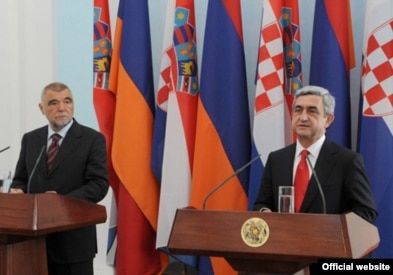
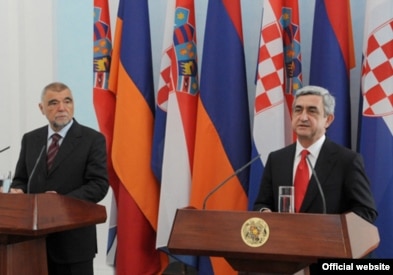
Armenia — Presidents Serzh Sarkisian of Armenia (R) and Stjepan Mesic of Croatia hold a news conference in Yerevan on May 22, 2009.
22.05.2009Hovannes ShoghikianPresident Serzh Sarkisian insisted on Friday that Turkey may still agree to unconditionally normalize relations with Armenia soon despite its leaders’ renewed linkage between Turkish-Armenian reconciliation and the Nagorno-Karabakh conflict.
Sarkisian dismissed as too “pessimistic” his critics’ belief that Turkish Prime Minister Recep Tayyip Erdogan’s recent public pronouncements on the issue preclude the success of the year-long dialogue between the two neighboring nations.
“Solutions to difficult problems require one to make great efforts and follow a difficult path,” he said. “And as we follow that difficult path, it is obvious that both in Armenia and Turkey and other countries, there will be optimists and pessimists, who, lacking full information, may emotionally express their joy or discontent, optimism or pessimism. So just as I wasn’t very buoyed by optimists’ statements at the beginning [of the dialogue,] I am now not that disaffected or disappointed with pessimists’ statements.”
“I believe that Turkey still retains its great chance to show the international community and citizens of Armenia that it is a modern country, that it is guided by modern standards, principles of international law. And so in my view, it is still too early to draw conclusions,” added Sarkisian.
Erdogan has stated on numerous occasions in recent weeks that Turkey will not establish diplomatic relations and reopen the border with Armenia as long as the Nagorno-Karabakh conflict remains unresolved. His statements have been endorsed by Turkey’s powerful military.
“[Armenian] occupation of Karabakh is the cause here and closing of the border is the effect. It is impossible for us to open the border unless that occupation ends,” the Turkish premier said during an official visit to Azerbaijan last week.
Neither Sarkisian, nor other Armenian leaders have so far commented on the implications of Erdogan’s stance for the implementation of a U.S.-brokered “roadmap” to the normalization to Turkish-Armenian relations. The document has still not been publicized by Ankara and Yerevan.
The Armenian president is facing growing domestic criticism over his conciliatory policy toward Turkey. Opposition leaders say he has helped the Turks scuttle an official U.S. recognition of the 1915 Armenian genocide while failing to secure the lifting of Turkey’s 16-year economic blockade of Armenia.
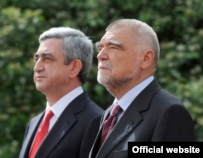
Armenia — Presidents Serzh Sarkisian of Armenia (L) and Stjepan Mesic of Croatia meet in Yerevan on May 22, 2009.
Sarkisian was speaking on Friday at a joint news conference with Croatia’s visiting President Stjepan Mesic. His office said the two leaders agreed on the need for the establishment of “normal relations between states without preconditions.”
Mesic, whose country went through a bloody war following the break-up of Yugoslavia, expressed hope that Armenia will eventually make peace with both Turkey and Azerbaijan. “It’s better to negotiate for ten years than to fight for ten days,” he told journalists.
https://www.azatutyun.am/a/1737419.html
-

BNP and Greek Connection Unleashed
THIS chilling picture shows BNP deputy leader Simon Darby being given a NAZI SALUTE at a fascist rally.
Three extremists flashed the banned Hitler-style sign to the British far-right boss outside the event in Italy.
Our exclusive snap fuels fears of danger ahead as the British National Party gains popularity in the recession.
Darby, leading a drive for seats at the European Parliament elections in June, was following Stratos Karanikolau, from the Greek nationalist Proti Grammi (Front Line) party.
They were joined by MEPs Roberto Fiore, a convicted terrorist, and Holocaust denier Bruno Gollnisch at the 400-strong meeting in Milan.
Last night Labour MP Jon Cruddas said: “This shows the BNP are a gang of thugs parading as politicians.”
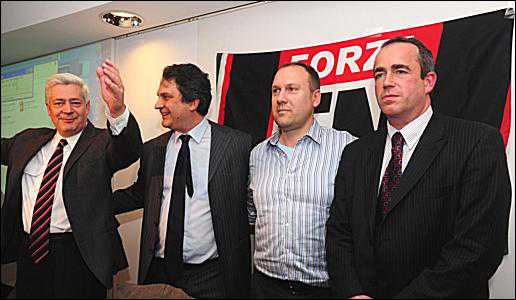 POLITICAL LINE-UP: Gollnisch, Fiore, Karanikolau and Darby
News Of the World
-
Conference on U.S.-Turkish Relations
The 28th Annual Conference on U.S.-Turkish Relations, jointly organized by the American-Turkish Council and the Turkish U.S. Business Council of DEIK, will bring together leaders from Turkey and the U.S. at the Gaylord Resort and Convention Center at the National Harbor, Washington, DC May 31- June 3, 2009.The theme of this year’s Conference is “U.S.-Turkey: Overcoming Challenges in an Era of Change.”
The conference is hosted by the Chairman of the Board of the American-Turkish Council, Lt. General Brent Scowcroft (USAF, Ret.), and Chairman of the Turkish U.S. Business Council, Haluk Dinçer.
Key speakers from Turkey include State Minister and Chief EU Negotiator, Egemen Bagis; Minister of Foreign Affairs, Dr. Ahmet Davutoglu; Minister of National Defense, Vecdi Gönül; Minister of Transportation, Binali Yildirim; The Chief of the Turkish General Staff, General Ilker Basbug; the Undersecretary for Defense Industries, Murad Bayar; Acting President of TUBITAK, Dr. Nüket Yetis; General Manager of BOTAS, Hüseyin Saltuk Düzyol; Former Governor of the Central Bank, Süreyya Serdengeçti; Chairman, Istanbul Chamber of Commerce, Murat Yalçintas; and Chairman of the Board, Dogus Holding, Ferit Sahenk.Acceptences from the U.S. are Vice Chairman of the Joint Chiefs of Staff, General James Cartwright; Chairman of the Senate Foreign Relations Committee, Senator John Kerry; Director, Division of International Finance of the Federal Reserve Board, Dr. Nathan Sheets; Chairman of the Board and CEO, The Coca-Cola Company, Muthar Kent; President of Bankers Association for Finance and Trade, Donna Alexander; Associate Director of the USDA Sustainable Agriculture Research and Education (SARE), Dr. Kim Kroll; Senior Science Policy Advisor for the State Department, Dr. Alexander Dehgan; Vice President, Sales and Marketing Group & General Manager, Intel World Ahead Program, John Davies.
Invitations have also been extended to Vice President Joseph Biden; Minister of Energy and Natural Resources, Taner Yildiz; Secretary of Energy, Steven Chu; and Chairman of the Joint Chiefs of Staff, Admiral Mike Mullen.
The Annual Conference on U.S.-Turkish Relations is a forum for government and military officials, leaders of commerce and academia to discuss the issues and opportunities that bind the United States and Turkey. Meeting just weeks after President Obama’s highly successful visit to Turkey, Conference participants will discuss the expansion of joint-business opportunities for corporations in the United States, Turkey and the region; regional security issues; bi-lateral trade; energy security and development; the global recession and national recovery; and developments in Science, Technology and Research. Sectors and interests represented at the Conference include Agribusiness, Information Communication Technology, Defense, Pharmaceuticals, Banking & Finance, Trade, Construction, Energy and the European Union.Useful Links:
Agenda-at-a-Glance (PDF File) Updated Conference Program (PDF File) Conference General Facts (PDF File) Hotel Reservations Transportation Information Online Conference Registration (credit cards only) Conference Registration Form (PDF, all forms of payment)
TACCI Turkish American Chamber of Commerce & Industry www.turkishuschamber.org 28 West 44th Street Suite 1630, New York, NY 10036
Tel: +1 646 429 1530
Fax: +1 646 304 1666 [email protected]