Month: May 2009

  • Turkey lets more water out of dams to Iraq – MP

    Turkey lets more water out of dams to Iraq – MP

    reuters* Iraq MP says Turkey boosts river flow, after complaints

    * MP says still falls short of amount needed

    * Iraq facing “catastrophe”, water boss says

    By Muhanad Mohammed

    BAGHDAD, May 23 (Reuters) – Turkey has boosted the flow of the Euphrates river passing through its dams upstream of Iraq to help farmers cope with a drought after Iraqi complaints, but it is still not enough, a top Iraqi lawmaker said on Saturday.

    Iraq is mostly desert and its inhabitable areas are slaked by the Tigris, which comes down from Turkey, the Euphrates, also from Turkey but passing through Syria, and a network of smaller rivers from Iran, some of which feed the Tigris.

    Iraq accuses Turkey, and to a lesser extent Syria, of choking the Euphrates by placing hydroelectric dams on it that have restricted water flow, damaging an Iraqi agricultural sector already hit by decades of war, sanctions and neglect.

    The dispute is a delicate diplomatic issue for Iraq as it seeks to improve ties with its neighbours and Turkey is one of Iraq’s most important trading partners.

    Saleh al-Mutlaq, leader of a Sunni Arab bloc in parliament, said he flew to Turkey on Friday and met Turkish Prime Minister Tayyip Erdogan and President Abdullah Gul to ask them to release more water from the river, which has been depleted by a drought.

    “They have since increased the quantities of water coming to Iraq by 130 cubic metres per second,” he said.

    “It’s not enough, but it has partly solved the water problems preventing our farmers from planting rice,” he said.

    That makes the flow of water to Iraq 360 cubic metres per second, up from the 230 cubic metres per second that Iraq received before Turkey took action.

    Iraq’s director of water resources, Oun Thiab Abdullah, said last week that Iraq faced a catastrophe this summer unless Turkey triples the Euphrates water flow. A drought has already withered crops and created severe water shortages. The river has dropped 35 percent since January, Abdullah said.

    Iraq wants Turkey to let 700 cubic metres per second out, almost double what now flows through even after the increase.

    Iraq’s parliament voted last week to force the government to demand a greater share of water resources from neighbours upstream of its vital rivers, Turkey, Iran and Syria, turning up the heat on long running disputes.

    They agreed to block anything signed with the nations not including a clause granting Iraq a fairer share of river water.

    Turkish firms dominate northern Iraq’s economy and Turkish firms have billions of dollars of contracts in Iraq.

    Some 400,000 barrels of Iraqi oil a day — more than a fifth of its exports — are piped through the Turkish port of Ceyhan. (Additional reporting by Aseel Kami; Writing by Tim Cocks; Editing by Jon Hemming)

    Source: www.reuters.com, May 23, 2009

  • Turkish accession adds spark to French election

    Turkish accession adds spark to French election

    By Ben Hall in Paris

    ft1France’s political parties clashed this week over the question of Turkish membership of the European Union, providing a polemical spark to an otherwise lacklustre European parliament election campaign.

    Nicolas Sarkozy, the French president, was accused by his opponents of lying to voters by campaigning against Turkey joining the block even though he allowed negotiations on its accession to enter a new phase during France’s presidency of the EU last year.

    Mr Sarkozy’s governing centre-right UMP party has made Turkey a theme of its campaign to the point of ensuring that its leading candidates issue formal -declarations promising not to let Turkey in.

    In a speech on Europe this month, Mr Sarkozy made much of his well-established opposition to Turkey’s membership saying the country did not have the “vocation” to join.

    Instead, he called for a “privileged partnership”, the same relationship he espouses for Russia, which is not even a candidate.

    Benoît Hamon, spokesman for the opposition Socialist party which supports Turkish accession, accused Mr Sarkozy of “lying” to the public because the president had “systematically given his backing to the pursuit of the negotiation process”.

    Two new “chapters”, or policy areas, that form part of Turkey’s accession process entry application were opened up to negotiation during the French EU -presidency.

    Paris has allowed the negotiation process to continue, thereby avoiding a direct confrontation with Ankara and supporters of Turkish membership within the EU, but is against opening up chapters which it judges only relevant to full membership, such as the question of monetary union.

    Philippe de Villiers, a -conservative eurosceptic, pointed out that Mr Sarkozy had also ensured that a requirement for a French referendum on all new EU entrants was dropped in last year’s reform of the constitution, removing a potential French obstacle to eventual Turkish membership.

    The row over Turkey has injected an element of -interest into a low profile campaign in which the main parties seem reluctant to engage in confrontation.

    The UMP does not want the campaign to turn into a referendum on Mr Sarkozy’s handling of the economic crisis while the Socialists, under the new leadership of Martine Aubry, are hesitant about investing themselves fully in a battle they appear destined to lose. Recent opinion polls put the UMP on 28 per cent and the Socialists on 22 per cent.

    Mr Sarkozy’s electioneering on the Turkish question is carefully calculated. With voters preoccupied with the economy, turnout is expected to fall well below 43 per cent, the rate at the last elections in 2004.

    The UMP needs to mobilise its core voters while wooing those tempted to vote for eurosceptic and far-right candidates who together could win 12 per cent, polls suggest.

  • Cooperation and Confrontation between the USA and Russia in Caspian Region

    Cooperation and Confrontation between the USA and Russia in Caspian Region

    New monopolar world system had created new interests which depend on big powers in Caspian region after the collapse of Soviet Union. This situation shared a chaos on governmental system in this area. Big powers created a competition with Caspian Sea status and energy subjects to use their interests. Dominant power of the USA and Russia shared some conflict and cooperation circumstances as interdependent body in their relations. Particularly common threat position establishes cooperational theme. Caspian region which is second big energy sphere is a bridge between Europea and Asia, also it is a main point of the world domination conditions.


    Subjects of Confrontation and Hegemony Tools


    Big powers need conflict, cooperation and hard-soft balance tools as political subjects to increase their activity in the region. The USA and Russia have enough advantages according to their situation. But confrontation of powers can be transformed to common interest activities so to analyse foreign politics of states can provide to know near future. Today anxieties of the USA’s foreign affairs to Russia are existing as these subjects:


    – Monopoly situation of Russia in energy area,

    – Against position of Russia to NATO enlargement,

    – Russian force to Georgia,

    – Possibility of same circumstances to post-Soviet states by Russia,

    – Against position to Western initiatives about Iranian nuclear system.


             The USA used soft balance politics to Saudi Arabia and forced in Iraq to control Middle East which is first big oil sphere in the world. The USA supported first energy sharing agreement BTC in 1994 and for saving energy corridor it founded GUAM to be against CIS organisation about the subject of influence to Central Asia. The USA which a country had acted firstly in energy line plans to establish new cooperations to be dominant power in the region. American supported regional organisation GUAM targets new cooperations with West and to solve regional conflicts with Europen initiated projects. Also GUAM organised first military operations which Russia didn’t join. But Russia created a dilemma over the European energy corridor target of this organisation. Russia works to establish alternative energy lines and coordinate near abroad countries to common aims.

             Russia had an advantage to pressure over the post-Soviet states with energy event. Middle Asian countries which have big energy resources provide energy transportation via Russian territory. External projects are American supported issues. Shortly there is a competition that energy is used as a weapon.


             The USA interfered Afghanistan after the 11 September terrorist attack by this way the super power took a strategic point in Middle Asia. The USA shared a dangerous position for Russia because of the USA founded military points in Uzbekistan, Tajikistan and Kyrgyzistan after the Afghanistan intervene. So Russia organised Shangai Cooperation Organisation to build an alternative body against the USA with other regional states. It shares a bandwagoning system for this region which had been established by Russia as a main actor.[1] By this way Russia that is a main state of CIS shared strong resist against the USA with its initiatives.


             Bilateral agreements in NATO circle with the USA of Caspian states formed a dependent system to West. In this subject Georgia had been a pro-American arena in this region.[2] On the other hand Azerbaijani and American relations increased after annuling 907. article in the USA that has supporting event to South Caucasus states without Azerbaijan. Russia and Iran speeched as against the USA after opened airspace of Azerbaijan to the USA. Additionally security of BTC is important to the USA. New American forces in Romania and Bulgaria can intervene Caucasus area if there is a problem in Baku Ceyhan pipeline. Also American soldiers in Georgia can be used in emergency circumstances.[3]


             Russia said possible intervenes of Collective Security Cooperation of Shangai Cooperation Organisation to NATO’s activities in this region as against the military activation of NATO. Other advantages of Russia are conflict events as without regional cooperations against NATO. Fergana, Osetia, Abkhazia and Karabakh issues give chances to Russian invasion on the region. Because solutions can be producted by Russian mediator situation. Otherwise western initiated organisation GUAM targets that solutions can be existed without Russia. Nobody can guarantee that Russia will not save its interests about regional conflicts in Ukraine-Crimea, Moldova-Transdiester, Azerbaijan-Karabakh as additionally Georgian conflicts. For this moment Russian conflict politics focused on Georgia in South Caucasus area. Abkhazia and Osetia problems are punishments to Georgia by Russia because of Georgian new Western oriented politics.


             Bandwagoning countries rejected American activities after 2004. These countries supported Russian decisions against to the USA after this date. European Union continued its enlargement politics in Caspian as paralel to American issues. Caspian states easily can depend on West with some projects like Nabucco. Specially European Union projects TACIS, INOGATE[4] and TRACECA[5] can create influence over the regional countries like other cooperational acts. New resist of Caspian states’ outlook shares itself as internal cooperation and contr-politics of Russia. Also America can take an advantage in Caspian status problem against to Russia.


                Obligatory Cooperations in the Region


             There is no possible way to fight new movements’ expansion in the region of Russia which is a problem of American foreign affairs. Struggle to terrorism that is in directly Iraq, Iran and Afghanistan is a main aim of the USA political issue in Middle Asia. There is a Russian anxiety about results of possible conflict between the USA and Iran. Additionally Russia doesn’t want cooperations of these countries[6];

    – Iran can buy weapons and nuclear technology from the USA,

    – The USA can approve oil and gas transportation via Iran as alternative to Russia in Caspian sphere,

    – The USA won’t need Russian support in struggle against Iran issue.


             The USA is a main power about struggle to terrorist movements in this region. Also Russia trusts this power in this subject and main result of that is American military foundation by permission of Russia. There is a new progress to decrease American influence in Manas military point’s closing process. But it can be a start line of enlargement terrorist activations which is Russia’s afraid. There is a different situation in East Europea initiative of the USA about military approach. It shares an interdependent relation among great powers. President Bush again gave his assurance that the proposed American missile shield was not aimed at Russia. NATO summit in Bucharest, Russia scored a partial victory on the question of expanding the alliance. NATO did not invite Ukraine and Georgia, both former Soviet states, onto its Membership Action Plan.[7]


             At the present time in which cold war rivalry is waking up, Caspian region is becoming a field of  conflict at the same time a collaboration in view of energy resources and military cooperation to activate grand forces’ sovereignty. Cooperation needs occured by common benefits cause means used to reduce another one’s activity. In this backgroung that power balances are occured outside the states of Middle Asia, bandwagoning countries which got free of being unrelated to others may cause new situations. Of course all the same, political declinations, which work directed by Mackinder’s Heartland Theory, have the ability to form new balances in this region. Athority of the region countries which have rich resources will indicate that the world will being run by how many poles.


    [1] Walt, Stephen M. (1987). The Origins of Alliances. Ithaca, NY: Cornell University Press

    [2] Klare Michael T., “Transforming the American Military into a Global Oil-Protection Service”

    [3] Purtaş Fırat, TÜRKSAM, “Hazar Bölgesinde Rekabetin Yeni Boyutu: Silahlanma Yarışı”

    [4] There are at present 21 countries which have acceded to this agreement with the EU (Albania, Armenia, Azerbaijan, Belarus, Bulgaria, Croatia, Georgia, Greece, Kazakhstan, Kyrgisztan, Latvia, Macedonia, Moldova, Romania, Slovakia, Tajikistan, Turkey, Turkmenistan, Uzbekistan, Ukraine and the Republic of Serbia).Thus, all of them have agreed to cooperate towards the establishment of one or several systems of oil and gas pipelines which pass through their territories, while observing the jointly accepted rules embodied in the agreement.

    [5] Saraç Naciye, AZSAM “Tarihi İpek Yolu Yeniden Hayata Döndürülüyor”

    [6] Prof. Dr. Mark Katz, “The Role of Iran and Afghanistan in US-Russian Relations”

    [7] “Bush and Putin’s bittersweet farewell”, 06.04.2008

    Mehmet Fatih OZTARSU

    Baku Qafqaz University

    International Relations

  • BNP and Terrorism Link

    BNP and Terrorism Link

    Robert Cottage, 49, of Colne, Lancashire.

    A former British National Party candidate who amassed a stash of explosive chemicals in anticipation of a future civil war was jailed today for two and a half years.

    Robert Cottage, 49, was cleared after two trials of conspiracy to cause explosions. He earlier pleaded guilty to possessing the chemicals.

    Police discovered a large stockpile of chemicals and food at his home in Colne, Lancashire, last September.

    Officers mounted the operation after Cottage’s wife told a social worker she was concerned about the substances, and about her husband’s belief that immigrants were swamping Britain, which he feared was on the brink of civil war.

    Cottage appeared at Manchester’s crown square court to be sentenced in relation to the charge of possession.

    Cottage’s barrister, Alistair Webster QC, said his client admitted having bought the potassium nitrate and sulphur and planning to manufacture gunpowder but said he would have used the chemicals only to create “thunder flash”-style bangers to scare off intruders.

    The judge, Mrs Justice Swift, labelled Cottage’s actions “criminal and potentially dangerous”.

    She noted that the pre-sentence report said Cottage held “overvalued ideas” but said the risk of his committing further offences was low.

    “It is important to understand that Cottage’s intention was that if he ever had to use the thunder flashes, it was only for the purpose of deterrence,” she said.

    “The pre-sentence report says Cottage continues to hold views that veer towards the apocalyptic. The risk of further offending of the same type is low but it cannot be ruled out.”

    A second man, David Jackson, a 62-year-old dentist, was also charged with conspiracy to cause explosions but was cleared after the jury twice failed to reach verdicts.

    Mrs Justice Swift said there was no evidence the chemicals’ packaging had been opened or that Cottage had attempted to make gunpowder.

    Cottage, of Talbot Street, has already served 10 and a half months in jail and is likely to be freed within six months.

    Guardian

  • Davutoglu Era in Turkish Foreign Policy – Policy Brief, May 2009

    Davutoglu Era in Turkish Foreign Policy – Policy Brief, May 2009

    Friday, May 22, 2009
    From:

    SETA | Foundation for Political, Economic and Social Research | May, 2009 | No: 32

    Davutoglu Era in Turkish Foreign Policy

    BULENT ARAS

    Ahmet Davutoglu was appointed Foreign Minister of Turkey on May 1, 2009. Chief advisor to the Prime Minister since 2002, Davutoglu is known as the intellectual architect of Turkish foreign policy under the AK Party. He articulated a novel foreign policy vision and succeeded, to a considerable extent, in changing the rhetoric and practice of Turkish foreign policy. Turkey ’s new dynamic and multidimensional foreign policy line is visible on the ground, most notably to date in the country’s numerous and significant efforts to address chronic problems in the neighboring regions. Davutoglu’s duty will now shift from the intellectual design of policies to greater actual involvement in foreign policy, as he undertakes his new responsibilities as Minister of Foreign Affairs. The Davutoglu era in Turkish foreign policy will deepen Turkey ’s involvement in regional politics, international organizations, and world politics.

    Read complete text (PDF)

    You are receiving this e-mail because you either signed up at the SETA website or you filled out a request card asking to be placed on this list. To opt out of this list, please send a blank (no message) email to [email protected] with “REMOVE” in the subject line.

    This e-mail and attachments thereof are intended for the private use of the sender and recipient named above. If you received this message in error, please immediately notify the sender and delete it from your system. Please note that disclosing this e-mail or any attachments, disseminating them or sharing with third parties in any way may be subject to legal and penal responsibility. SETA Foundation for Political, Economic and Social Research does not accept any legal responsibility for the contents or dissemination of this e-mail and its attachments.

    SETA FOUNDATION FOR POLITICAL, ECONOMIC AND SOCIAL RESEARCH
    Resit Galip Caddesi Hereke Sokak No: 10 GOP, Cankaya 06700 Anka ra , Turkey
    Tel: +90 312 405 61 51 | Fax: +90 312 405 69 03
    www.setav.org | [email protected]


  • BNP leader ‘barred’ from Royal event

    BNP leader ‘barred’ from Royal event

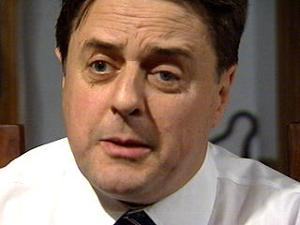
    bnpBNP leader Nick Griffin has been effectively barred from attending a Buckingham Palace garden party.

    The right-wing politician had been invited to the social event by British National Party colleague Richard Barnbrook who, as a London Assembly member, was nominated for two tickets by the Greater London Authority (GLA).

    But Jeff Jacobs, the GLA’s deputy chief executive, has tonight written to Mr Barnbrook telling him to change his controversial guest and stop exploiting the situation for “publicity”, or his nomination would be “reviewed”.

    Mr Jacobs wrote: “The event is a social occasion hosted by Her Majesty and it is inappropriate to exploit this privilege for party political purposes.”

    “The authority may need to review its position in relation to your nomination unless you revisit the selection of your guest with a view to avoiding further controversy and desist from any further publicity.”

    The BNP campaigns for the “voluntary resettlement” of immigrants back to their countries of origin, claims white Britons have become “second-class citizens” and wants to bring back corporal and capital punishment for criminals.

    A BNP spokesman said Mr Barnbrook would make a statement on Tuesday about his decision.

    The organisation said yesterday: “You can’t withdraw the invitation because you don’t agree with someone’s views.

    “How is it going to look if the three main political parties conspire to deny us our rights – and the people that voted for Richard? They are seeking to subvert the democratic process.”

    The garden party will come after the June local and Euro elections, which could see the BNP gaining more local council seats and their first MEPs.

    Disillusionment with mainstream politicians over the MPs’ expenses scandal and fears over jobs and immigration could lead to a surge in support for the party, according to political experts.

    ITN