Month: May 2009

  • Iran-Armenia pipeline expected online soon

    Iran-Armenia pipeline expected online soon

    YEREVAN, Armenia, May 19 (UPI) — Iranian gas supplies to Armenia through a 70-mile pipeline are expected to commence Friday, Iranian gas officials said while en route to Yerevan.

    Reza Kasaeizadeh, the managing director of the National Iranian Gas Exporting Co., headed to the Armenian capital Yerevan on Monday to finalize gas agreements, Iran’s Petroenergy Information Network reports.

    Russian, Armenian and Iranian officials inaugurated a final stage of a natural gas pipeline from Iran in December. Armenian Energy Minister Armen Movsisyan said the pipeline also serves as an alternative supply source should Russia disrupt energy transports through other routes.

    The pipeline will bring 81 billion cubic feet of natural gas from Iran per year, about the same amount Armenia imports from Russia via Georgia. In exchange, Armenia will convert natural gas to electricity for exports back to Iran.

    Kasaeizadeh said exports through the $220 million pipeline could reach 141 million cubic feet per day in the next two years, with a final capacity reaching 222 million cfd.

  • Crimean Tatar World Congress Opens

    Crimean Tatar World Congress Opens


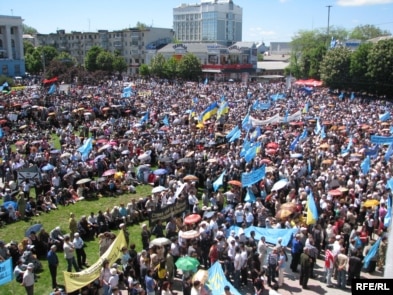
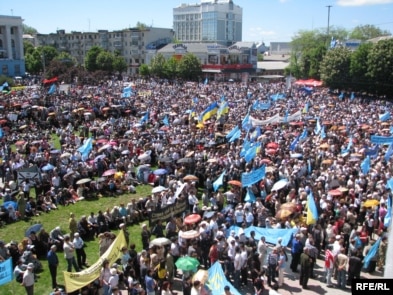
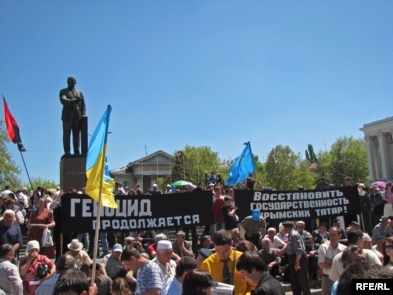
    Crimean Tatars commemorate the 65th anniversary of the mass deportation in Simferopol on May 18.

    May 19, 2009

    BAKHCHISARAY, Ukraine — The World Congress of Crimean Tatars (Kurultai) has opened in the Crimean city of Bakhchisaray, RFE/RL’s Ukrainian Service reports.

    More than 800 delegates from 12 countries are attending the congress at Bakhchisaray’s Khan Palace.

    Ali Khamzin, the head of the congress’s organizing committee, told RFE/RL that the congress is focusing on ways to consolidate Crimean Tatars.

    He said such issues as preserving the group’s ethnic identity, and reviving the Crimean Tatar language and culture, are also on the agenda.

    The congress’s plenary meetings will be held in Simferopol, and panel discussions will take place in the Ukrainian peninsula cities of Bilohorsk, Yevpatoria, Sudak, and Eski-Kirim.

    The event ends on May 22.

    May 18 was marked as the 65th anniversary of the forced deportation of some 200,000 Crimean Tatars to Central Asia by the Soviet regime. Nearly half of the deportees died en route.

    https://www.rferl.org/a/Crimean_Tatar_World_Congress_Opens/1734972.html

  • Patterns of Secularism Conference

    Patterns of Secularism Conference

    The University of Utah
    The Patterns of Secularism

    A workshop organized by the Middle East Center, the Department of Political Science, and the Religion and Culture Track of Comparative Literary & Cultural Studies at the University of Utah

    Friday June 12, 2009

    Panel I: 9:30 a.m. – 12:00 p.m.
    The Concept of Secularity and Secularization

    Bernard Weiss, (University of Utah)
    “Islam, Secularism and the Law.”

    Nader Hashemi, (University of Denver)
    “Islam, Secularism and Liberal Democracy.”

    Fred Quinn, (The University of Utah)
    “Overcoming the Impossibility of Dialogue, World Religions on a Collision
    Course.”

    Discussant: Mujeeb R. Khan (UC-Berkeley)

    Lunch: 12:00 p.m. – 1:30 p.m.

    Panel II: 1:30 p.m. – 3:00 p.m.
    Secularism in Turkey I

    Ali Yaman, (Izzet Baysal University-Turkey)
    “Turkey’s politics of religion and Alevis’ secularism dilemma”

    Ergun Yildirim,
    “The Imaginary Secularism: The Case of Turkey.”

    Masaki Kakizaki, (University of Utah)
    “Polarization of Civil Society in Turkey.”

    Tolga Koker, (Yale University)
    “The Establishment of Kemalist Secularism in Turkey”

    Discussant: Fred Quinn

    Panel III: 3:30 p.m. – 5:00 p.m.
    Secularism in Turkey II

    M. Hakan Yavuz, (University of Utah)
    “The Modes of Secularism.”

    Kemal Silay, (Indiana University)
    “Secular Foundations of Turkish Literature”

    Armand Sag, (Museum Turkije, Netherland)
    “Secularism among Turkish Groups in Holland.”

    Discussant: Tolga Koker

    Saturday June 13, 2009

    Panel IV: 9:30 a.m. – 12:00 p.m.
    Secularism and Foreign Policy

    Hasan T. Kosebalaban, (Lake Forest College)
    “Turkey’s EU Bid: the Shadow of Religion”

    Etga Ugur, (University of Utah)
    “The LDS Church and the Gulen Community”

    Umut Uzer, (University of Virginia)
    “Turkish Nationalism and Secularism”

    Discussant: Eric Hooglund

    Panel V: 1:30 p.m. – 3:30 p.m.
    Comparative Cases of Secularism: Iran, Algeria, Pakistan

    Eric Hooglund, Bates College (Maine, USA)

    Mujeeb R. Khan, (UC-Berkeley)
    “How Islamic Liberal Reform was Derailed: The Nexus Between
    Western Imperialism, Secular Authoritarianism, and Wahabism”

    Sener Akturk, (UC-Berkeley)
    “Nation-Building, Islam, and Resistance in Turkey, Pakistan and Algeria”

    Discussant: Bahman Baktiari, (University of Utah)

    Dinner: 7:00 p.m.
    The papers of this workshop will be edited by Nader A. Hashemi and M. Hakan Yavuz to be published by Middle East Critique (Routledge Journal).

    Shari Lindsey
    Events Coordinator, Middle East Center
    University of Utah
    260 S Central Campus Drive, Room 153
    Salt Lake City, Utah  84112
    (801) 585-9594 or 581-6181
    Fax (801)581-6183
  • Germany and Turkey:  Similar in Crime; Different in Penance

    Germany and Turkey: Similar in Crime; Different in Penance

    sassun-22

    [[email protected]]

    The Los Angeles Chapter of the American Jewish Committee (AJC) traditionally invites as guests to its “Annual Meeting” (banquet) members of the local consular corps and leaders of various religious and ethnic groups.

    On April 22, when I attended AJC’s annual gathering, I was surprised to see that the keynote speaker was Dr. Christian Stocks, the Consul General of Germany. Despite the fact that the German government has long acknowledged the Holocaust and paid substantial compensation to the victims’ families, many Jews still feel uncomfortable dealing with Germans or visiting Germany.

    I soon discovered that the German Consul General was not only the honored guest, but also the recipient of AJC’s prestigious “C.I. Neumann Lifetime Achievement Award.”

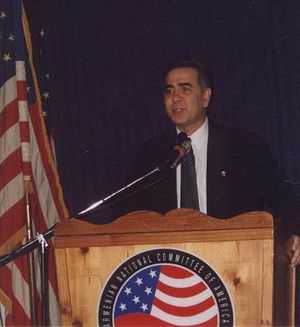
    I was not the only one to be taken by surprise. When the German Consul General took the podium, he admitted that he was so astonished by AJC’s invitation that he was “speechless for a few seconds.”

    Dr. Stocks’ 45 minute-long empathetic remarks amply demonstrated why the AJC was fully justified in honoring this distinguished diplomat. His words deeply touched those in attendance — many of whom were Holocaust survivors and descendants.

    As the only Armenian in the room, I could not help but make a mental comparison between the remorseful way the German Federal Republic has reacted to the Holocaust and the Turkish government’s incessant denials, lies and distortions of the Armenian Genocide.

    I wondered if the day would ever come when a righteous and enlightened Turkish leader would acknowledge the Armenian Genocide and make amends, paving Armenians to similarly honor a Turkish diplomat! Should that day come, Turkish leaders would be the recipients of many accolades, not just from Armenians, but people around the world.

    Ironically, the current Turkish Consul General in Los Angeles was also at this banquet. I wondered what thoughts were going through his head, as he listened to his German counterpart’s deeply apologetic speech, and whether he wished he could make similar remarks someday to an Armenian audience!

    I have reprinted below brief excerpts from the German Consul General’s lengthy speech. While reading these remarks, if you substitute Germany and Germans for Turkey and Turks; and Israel and Jews for Armenia and Armenians, you would get a sense of how I felt, on the eve of April 24, listening to the representative of one repentant government, while the representative of another unrepentant and denialist state was sitting just a few feet away:

    “Yesterday, on Yom Ha-Shoah or Holocaust Memorial Day, Jews all over the world commemorated the victims of the Holocaust. They remembered the attempt to eradicate an entire people; they remembered the murder of six million European Jews, murdered by Germans, at German hands, on German command. Millions of people were humiliated, defrauded of their rights, persecuted and murdered because they were born Jews….

    “The Shoah’s cruel effects continue to this day. There is almost no Jewish person anywhere in the world unaffected by it. And because it was Germans that committed or instigated these crimes, I simply cannot begin my speech without paying my profound respects to the Holocaust survivors and their families, and to those who have not survived, to those who have perished, and to those who have no graves where we can mourn them.

    “And I join the German Chancellor, Angela Merkel, who said in her speech to the Knesset last year, celebrating the 60th birthday of the State of Israel, and I quote: ‘The Shoah is a source of great shame for us Germans. I bow before the victims; I bow before the survivors and before all those who helped them to survive….’

    “Former Israeli ambassador to Germany, Avi Primor, once asked: ‘Where in the world has one ever seen a nation that erects memorials to immortalize its own shame? Only the Germans had the bravery and the humility.’ Let me add on a personal note: The crime itself was so horrendous, that not a million memorials would be sufficient to constantly remind us of the past….

    “Last year, in his message of greeting on the 60th Anniversary of the Founding of the State of Israel, Federal President Horst Köhler said: ‘We accept this responsibility for the past and for the future. This means that the citizens, politicians and leaders of society must raise their voices against denial or trivialization of the Shoah and against intolerance, racism and anti-Semitism. It means we must not look away; rather we must see and act. And it means we preserve and pass on the memory so that future generations also will remain vigilant…. Only those who take responsibility for the past can gain trust for the future.’

    “Synagogues that had been gutted by fire during Kristallnacht have been restored or received extensive makeovers. New synagogues and cultural centers like those in Munich and Dresden are now centers of flourishing Jewish life. You again find Jewish schools and colleges.”

  • Crimean Tatars On Deportation Anniversary

    Crimean Tatars On Deportation Anniversary

    Crimean Tatars commemorate 65th anniversary of mass deportation in Simferopol.

    May 18, 2009

    SIMFEROPOL, Ukraine — At least 15,000 Crimean Tatars gathered in central Simferopol to mark the 65th anniversary of their deportation and to demand linguistic and political rights, RFE/RL’s Ukrainian Service reports.

    On May 18-20, 1944, the Soviet authorities deported some 200,000 Crimean Tatars to Central Asia, with nearly half of them dying en route.

    After the collapse of the Soviet Union, Crimean Tatars began returning en mass to the Crimea.

    The demonstrators in Simferopol held Ukrainian and Crimean Tatar national flags and called for schools to be established that teach in the Crimean Tatar language and for that language to receive official status on the peninsula.

    Crimean Tatar leader Mustafa Djemilev said that Crimean Tatars want Crimea to be an autonomous territory within Ukraine.

    He said some 280,000 Crimean Tatars currently live in Crimea and at least 150,000 more are planning to return to their ancestral lands.

    https://www.rferl.org/a/Crimean_Tatars_Demand_Language_Rights_On_Deportation_Anniversary/1734273.html

  • Turkey Adopts a More Cooperative Position on Nabucco

    Turkey Adopts a More Cooperative Position on Nabucco

    Turkey Adopts a More Cooperative Position on Nabucco

    Publication: Eurasia Daily Monitor Volume: 6 Issue: 94
    May 15, 2009
    By: Saban Kardas
    According to a senior EU official a new deal has been struck between Turkey and the EU paving the way to sign the intergovernmental agreement for the Nabucco project in Ankara on June 25. The breakthrough was reportedly made possible by Turkey dropping its uncompromising negotiating position and offering an unconditional acceptance of the EU’s terms. In particular, Turkey relinquished its demand to purchase 15 percent of the gas transit at discounted prices (The Guardian, May 11). Although positive statements emerged from the EU summit in Prague last week, lending credibility to this report, the Turkish side has rebuffed claims that a concrete deal has been reached.

    In response to questions about the story in the U.K. newspaper the Guardian, the Minister of Energy and Natural Resources Taner Yildiz, ruled out such a deal: “We should not interpret this [story] as yes or no… Negotiations are still under way.” Yildiz added that President Abdullah Gul was in charge of conducting the negotiations for the intergovernmental agreement, and he was not aware of any date being set on signing the agreement (Referans, May 12).

    One Turkish daily cited an unnamed BOTAS official who refuted the claim that Turkey had abandoned its demand for 15 percent. The same source claimed that Turkey’s demand does not directly relate to the consortium building the Nabucco pipeline, and the negotiations on Nabucco would continue in May (Yeni Safak, May 13). Before departing for Baku, Turkish Prime Minister Recep Tayyip Erdogan reacted to these reports, and added that the process remains ongoing (www.aktifhaber.com, May 13).

    Although it remains unclear whether a finalized deal on the negotiations is imminent, it is certain that positive developments in the Nabucco project have occurred. Senior Turkish officials familiar with the negotiations, speaking on the condition of anonymity, confirmed that groundbreaking progress had been achieved -though denying reports that all the conditions or a date had been agreed. In particular, Turkey wants a clause inserted into the intergovernmental agreement to allay its concerns and protect its energy security. “The Turkish side is hopeful that the issue will be solved at the end of the two rounds of discussions before the end of May, leaving enough time for preparations for the signing ceremony” (Hurriyet Daily News, May 13).

    Technical developments appear to be equally positive. Following the Prague summit, the Nabucco consortium announced that engineering teams from the partner countries have launched detailed engineering work on the pipeline route (Milliyet, May 13). A more promising sign is the recent change in the management of Turkey’s energy policies, following the Cabinet reshuffle earlier this month. This has raised expectations that stronger political leadership will ensure avoiding earlier mistakes. Turkey’s hard bargaining position and its misguided policies were considered to be an effort to stall or delay the conclusion of the Nabucco project (EDM, April 24, 27). Inside Turkey, this problematic policy is now increasingly attributed to Turkey’s former energy minister Hilmi Guler, whose insistence on making Turkey an energy hub created a stalemate in the negotiations with the Nabucco partners (Sabah, May 14).

    In addition to the appointment of a new energy minister, Taner Yildiz, who is considered more competent on energy policy, recent developments indicate that President Gul and Prime Minister Erdogan are paying closer attention to Turkey’s energy policies. Moreover, it is argued that since the foreign ministry has increasingly become part of the negotiations, a more realistic stance has been adopted in Turkey’s energy policies (Hurriyet Daily News, May 13). Erdogan and Gul’s political leadership and their high profile involvement might boost Turkey’s credibility and facilitate the conclusion of the Nabucco process.

    Gul represented Turkey at the EU energy summit in Prague last week, which followed his attendance at an earlier summit in Sofia in April. In Prague, he tried to reassure the Nabucco partners of Turkey’s reliability by emphasizing how much Ankara was aware of its responsibilities in the transportation of Caspian and Middle Eastern hydrocarbon resources to Europe. Noting that Turkey acted responsibly in the management of other pipelines on its territory Gul added, “we will demonstrate the same sense of responsibility, even more, in the case of the Southern Gas Corridor and Nabucco, which are of higher strategic importance. Turkey has the highest level of determination and political will to realize the Nabucco project.” Gul noted that Turkey’s energy policy is based on harmonizing its own search for diversifying its suppliers and transportation routes with the EU’s attempts to ensure energy security (Hurriyet, May 9).

    Erdogan is actively complementing the perspective outlined by Gul. Energy related issues constituted a major part of Erdogan’s portfolio during his recent trip to Baku (EDM, May 14). Yildiz said that Ankara and Baku will continue their negotiations on prices for Azeri gas flowing through Turkey (Milliyet, May 15). Erdogan then visited Poland where he delivered an important message on Turkey’s position over energy transportation. He said that “Turkey is a transit and consumer country… As a transit country, we will always be ready to render our help available to Nabucco: there is no doubt on that. The route and diversification of supplies are very important. Turkey is pursuing a cooperative approach on all of these issues” (Cihan Haber Ajansi, May 14).

    Gul and Erdogan’s recent statements suggest that Turkey might be revising its policy of asserting itself as an energy hub at the expense of producer countries and end users. Instead, it is using its position as a transit country as leverage to request additional concessions. Thus, the Turkish leadership is sending signals that it has adopted a more realistic role in Nabucco, which might provide a solid basis to achieve a common position between Turkey and the EU in energy cooperation. Though they continue to emphasize Turkey’s search for security as part of its new energy policy, they are being more careful not to exaggerate their demands.
    https://jamestown.org/program/turkey-adopts-a-more-cooperative-position-on-nabucco/