Month: May 2009

  • Armenian FM Hopes Turkey Will Open Border

    Armenian FM Hopes Turkey Will Open Border

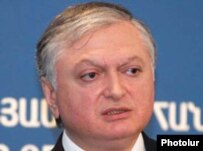
    YEREVAN — Armenian Foreign Minister Eduard Nalbandian says the Turkish and Armenian governments have made substantial progress toward the opening of their mutual border “without preconditions,” RFE/RL’s Armenian Service reports.

    Nalbandian, speaking over the weekend at an international conference on regional security issues held in Yerevan, said he hopes Turkey will “make the last decisive step” toward rapprochement.

    Nalbandian said relations with Turkey and the unresolved Nagorno-Karabakh conflict “are different, and by no means interconnected, even if some would like to see a linkage or parallelism in their resolution.”

    His remarks came one day after Turkish Prime Minister Recep Tayyip Erdogan repeated that his country will not establish diplomatic relations or reopen the border with Armenia until the Nagorno-Karabakh conflict is resolved.

    Armenian opposition leaders accuse President Serzh Sarkisian of helping Turkey to scuttle efforts to see the United States officially recognize the 1915 mass killings of Armenians as genocide while also failing to get Turkey to lift its 16-year economic blockade of Armenia.

    https://www.rferl.org/a/Armenian_Foreign_Minister_Still_Hopeful_Turkey_Will_Open_Border/1735558.html

  • Crimean Tatars Continue Protest

    Crimean Tatars Continue Protest

    KYIV — A group of Crimean Tatars is continuing a protest action in front of the government building in the Ukrainian capital, Kyiv, RFE/RL’s Ukrainian Service reports.

    Some 120 Crimean Tatar activists have been staging the protest since mid-April, demanding land for Tatar repatriates in Crimea.

    Leaders of the action — Nariman Potelov, Dilyaver Reshitov, Rinat Shaymardanov, and Reshat Seydaliev — told RFE/RL that seven of the protesters are on hunger strike. They say one of the hunger strikers is close to death.

    The protesters’ major demand is for the government to ease the process for Tatar repatriates to acquire land for ownership.

    Currently, the Defense Ministry, Agriculture Ministry, and Academy of Agriculture control the land on the peninsula.

    The indigenous people of Crimea — Crimean Tatars — were deported to Central Asia by the Soviets in 1944. They started returning to their historic homeland after the collapse of the Soviet Union in 1991.

    Since then, they have been demanding their ancestral land from local authorities.

    https://www.rferl.org/a/Crimean_Tatars_Continue_Protest_Demand_Land/1735610.html

  • Turkey ‘Should Not Link’ Armenia Thaw To Karabakh: Negotiator

    Turkey ‘Should Not Link’ Armenia Thaw To Karabakh: Negotiator

    May 20, 2009

    ANKARA (Reuters) — Turkey should not link its efforts to normalize ties with Armenia to a settlement between Armenia and Azerbaijan over Nagorno-Karabakh, a French negotiator has said.

    Ankara and Yerevan have been engaged for months in high-level talks aimed at establishing diplomatic relations after a century of hostility and last month announced a “road map” to reopen their borders.

    But after Turkey’s Muslim ally Azerbaijan condemned the reconciliation moves, Ankara said there would be no progress until the Nagorno-Karabakh conflict was resolved.

    Turkey closed its border with Armenia in 1993 in solidarity with Azerbaijan, which fought a war with ethnic Armenian separatists in the 1990s over the Caucasus enclave.

    Last week, Prime Minister Recep Tayyip Erdogan promised Azerbaijan’s President Ilham Aliyev during a visit to Baku that Turkey would not open the border with Armenia until the “occupation” of Nagorno-Karabakh ended.

    “Normalization of Turkish-Armenian relations and the settlement of the Nagorno-Karabakh dispute are two separate processes which should continue in parallel but along their own paths,” the French Embassy in Ankara said in a statement after a visit earlier this week by Bernard Fassier, a co-chairman of the Minsk Group.

    The Minsk Group — set up in 1992 and co-chaired by Russia, the United States, and France — is seeking a solution to Nagorno-Karabakh, one of the most intractable conflicts arising from the Soviet Union’s collapse.

    A thaw between Turkey and Armenia, who trace their dispute to the mass killing of Christian Armenians by Ottoman Turks during World War I, would shore up stability in the Caucasus and boost Turkey’s drive to join the European Union.

    U.S. President Barack Obama has urged Ankara and Yerevan to reach a solution soon, but Turkey has been careful not to harm energy projects with Azerbaijan.

    The two countries, which share linguistic and cultural ties, are in talks to sign energy deals, including the purchase of Azeri gas which could be used for the planned Nabucco pipeline to transport Caspian gas to Europe.

  • South Stream Gets a Boost

    South Stream Gets a Boost

    Business Week
    May 18, 2009
    Gas Pipelines: South Stream Gets a Boost
    Key countries sign on to Russia’s South Stream project, giving it an edge over the rival Nabucco pipeline proposal in a race with geopolitical repercussions
    By Jason Bush

    On May 15, Russia signed deals with Italy, Serbia, Bulgaria, and Greece, bringing the South Stream project, a major new gas pipeline to Europe, one step closer to reality.

    At a meeting in Sochi, attended by Russian Prime Minister Vladimir Putin and Italian Prime Minister Silvio Berlusconi, Russia’s Gazprom (GAZP.RTS) and Italy’s ENI (ENI.MI) agreed to double the planned pipeline’s capacity to 63 billion cubic meters. In addition to ENI, Gazprom signed memoranda of understanding with Greek natural gas transmission company DESFA, Serbia’s Srbijagas, and Bulgarian Energy Holding.

    The participating countries also signed documents needed to start work on the 2,000km (1,243-mile) pipeline. With completion planned by 2015, South Stream eventually will pump natural gas from southern Russia under the Black Sea, bringing it via Bulgaria, Serbia, Hungary, and Greece to terminals in western Austria and southern Italy.

    The agreement represents a significant diplomatic coup for Russia in a great geopolitical race that will help determine the source of Europe’s energy supplies for decades to come. That race has been visibly gaining pace over recent weeks. Backers of a rival pipeline to southern Europe are now vying to put together the necessary political support. “It’s very much down to the wire now,” says Chris Weafer, chief strategist at UralSib (USBN.RTS), a Moscow bank. “There’s definitely a race on to get all the signatures in place.”

    Concerns About a Stranglehold

    It’s no coincidence that the agreements on South Stream come just days after a key summit in Prague designed to give political impetus to Nabucco, a proposed rival pipeline through Turkey that is backed by the European Commission and the U.S. In the eyes of the EU and the U.S., the key advantage of Nabucco is that it would bypass Russia, diminishing Europe’s already heavy dependence on Russian gas. Imports from Russia presently account for around 40% of gas imports and 25% of gas consumption in Europe. Concerns about Russia’s stranglehold on Europe’s energy have only intensified recently, following this January’s damaging price spat between Russia and Ukraine, which briefly saw Russia’s gas supplies to Europe suspended.

    Those fears help explain the recent burst of activity surrounding Nabucco, a project that has been under discussion since 2002. In addition to the Prague summit, the EU has also been busy courting Turkey, a key transit country, which is expected to sign an agreement in June paving the way for Turkey to host the pipeline. Previously, there had been concerns that Turkey would try to use the pipeline as a bargaining chip in EU accession negotiations.

    But despite the recent progress on Nabucco, it all still looks to many analysts like a case of too little, too late. “I believe Nabucco still looks very problematic,” says Jonathan Stern, director of gas research at the Oxford Institute for Energy Studies. “It might work, or it might not, but I don’t think it’s going to work quickly.” He argues that the pipeline probably won’t be viable until around 2020­much later than the 2014 starting date currently being advanced.

    It doesn’t help that Russia, eager to safeguard its dominant position as Europe’s energy supplier, is already one step ahead of the game. The agreements reached in Sochi underscore Russia’s success in winning over key customers and transit countries for South Stream­a project that contradicts the EU’s stated policy of diversifying Europe’s energy supplies.

    Where to Get the Gas

    Even without the competition from South Stream, major question marks continue to hang over the whole economic viability of the Nabucco project. One key problem is financing: So far the EU has only committed a small fraction of the €7.9 billion ($10.6 billion) needed to build the pipeline. An even more basic question is where the gas for Nabucco (ultimately targeted at 31 billion cubic meters per annum) will come from.

    The original idea behind the pipeline was to ship gas from the Caspian region and Central Asia, with gas-rich countries such as Azerbaijan, Kazakhstan, Turkmenistan, and Uzbekistan supplying the fuel. The snag is that of these four countries, only Azerbaijan signed up to the Prague agreement backing the project.

    The other three Central Asian countries, under diplomatic pressure from Russia, pointedly declined to do so. In any case, no one has figured out how Central Asian gas could be linked up with Nabucco. A pipeline under the Caspian is impossible until all the bordering states resolve a long-running dispute over the sea’s legal status, giving Russia an effective veto.

    Analysts therefore believe the only way Nabucco can be viable is if Iran can now be talked into supplying gas for the project­a scenario that the U.S. previously fought. And despite recent overtures from U.S. President Barack Obama to improve relations with Iran, it’s still far too soon to talk of any diplomatic thaw.

    Meanwhile, the Russians are making progress with South Stream, which currently appears to be the more economically viable of the two. In sharp contrast to Nabucco, the Russians have no shortage of gas that could potentially be transported to Europe via the pipe, and the Russians also seem committed to financing the project. “It’s expensive, controversial, and hard to implement,” says Valery Nesterov, oil and gas analyst at Russian investment bank Troika Dialog. “But at least it has investment guarantees, and a resource base, to be secured by Gazprom. Though not without problems, the financial guarantees and resource base are still more realistic than those secured by Nabucco.”

    Snail vs. Tortoise

    It’s far too early, though, to declare victory for the Russians. The South Stream project also faces many daunting obstacles. Indeed, the great pipeline race might be said to resemble a marathon contest between a snail and a tortoise. “At this stage, it’s not clear where the gas is going to come from for either route,” says UralSib’s Weafer.

    Although Russia has huge gas reserves that could potentially be shipped Europe’s way, most of those reserves are still sitting deep under the Arctic tundra, in the remote Yamal region of Northern Siberia. The cost of bringing them to market is gargantuan­around $250 billion, according to estimates by Royal Dutch Shell (RDSA). The current global recession has only increased the uncertainty about future gas demand, making Gazprom even more reluctant to invest. Russia and the EU have so far failed to hammer out legal agreements that would regulate joint ventures between Gazprom and Western partners. “It’s a real mess,” says Weafer.

    Then there’s the tremendous cost of the South Stream pipeline itself. Officially estimated at between €19 billion and €24 billion ($25.6 billion to $32.4 billion), it’s around three times as expensive as the alternative Nabucco route. Those costs could now be especially problematic, at a time when the global financial crisis is depressing gas prices and Gazprom’s profits. “Gazprom is facing financial difficulties in the years to come,” says Nesterov, “and the cost of the project is tremendous.”

    So despite South Stream’s diplomatic head start, the outcome of the great pipeline race is still far from certain. And neither pipeline is likely to provide any quick solution to Europe’s mounting long-term energy needs.

    Bush is BusinessWeek’s Moscow bureau chief.

  • ARMENIAN LOBI SCREAMS LOUDLY TO OBAMA

    ARMENIAN LOBI SCREAMS LOUDLY TO OBAMA

    My letter to President Obama

    Ken (Kenneth) Hachikian is an Armenian-American economist and public activist, the chairman of the Armenian National Committee of America since 2000.

    He received his BA in Economics and MBA from Harvard University. As a financial and operating executive, he worked for 9 years with The Boston Consulting Group, advising Fortune 1000 companies on corporate, financial and operational strategies. From 1991 to 1994, Mr. Hachikian served as President of LINC Scientific Leasing, Inc., and, from 1983 to 1989, as President and CEO of Wellesley Medical Management, Inc. He is the Board Chairman of the Cambridge Heart, Inc.

    As a public activist, Hachikian has been an active member of both the Young Presidents’ Organization and the World Presidents’ Organization.

    Importance: High

    To
    cc
    Subject My letter to President Obama
      May 19, 2009

    Watch Live! Secretary Hillary Clinton to Testify on the FY 2010
    Foreign aid Priorities

    9:30am EDT, Wed. May 20th
    Senate Foreign Appropriations Subcommittee
    Scroll to the bottom of the page to watch the webcast.

    1:30pm EDT, Wed. May 20th
    Senate Foreign Relations Committee
    Click on the hyperlink at top of webpage.
    ANCA Chairman Shares Armenian American Community’s Sharp Disappointment with President Obama
    Click here to read letter

    Peter DeFazio (D-OR) John Yarmuth (D-KY) Bruce Braley (D-IA)

    Armenian
    Genocide Resolution Supporters
    Grow to 125

    Read Release


      Hachikian to Obama: “You failed to honor your commitment to lift our nation’s response to genocide to the level of our shared American values, choosing, instead, to allow America’s willingness to respond forcefully to this horrific crime to remain hostage to Turkish threats and intimidation.”
      WASHINGTON, DC – Armenian National Committee of America (ANCA) Chairman Ken Hachikian shared with President Barack Obama today the Armenian American community’s disappointment with his Administration’s failure to honor his campaign pledges to recognize the Armenian Genocide and to foster the growth and development of Armenia.
      In a May 18th letter to the White House, Hachikian addressed both the President’s decision not to honor his repeated promises to recognize the Armenian Genocide, as well as his recent proposal to cut aid to Armenia by 38% even as he increases overall foreign aid spending and the level of assistance he seeks to the regions of Europe, Eurasia, and South/Central Asia.
      ** Read Hachikian’s Letter to President Obama
      ** Contact President Obama and Express your disappointment
      ** Facts and Figures: The proposed cut in aid to Armenia in perspective
      ** The ANCA’s Foreign Aid Priorities for Fiscal Year 2010


      Armenian Genocide Resolution Supporters Grow to 125
      Representatives from Iowa, Oregon, Illinois, and Kentucky Join Bipartisan Genocide-Prevention Measure
      WASHINGTON, DC – With the addition today of Congressmen Bruce Braley (D-IA), Peter Defazio (D-OR), Bobby Rush (D-IL), and John Yarmouth (D-KY), the number of U.S. House cosponsors of the Armenian Genocide Resolution, H.Res.252, reached 125, reported the Armenian National Committee of America (ANCA).
      The Armenian Genocide Resolution specifically 1) calls upon the President to ensure that the foreign policy of the United States reflects appropriate understanding and sensitivity concerning issues related to human rights, ethnic cleansing, and genocide documented in the United States record relating to the Armenian Genocide and the consequences of the failure to realize a just resolution; and 2) calls upon the President in the President’s annual message commemorating the Armenian Genocide issued on or about April 24, to accurately characterize the systematic and deliberate annihilation of 1,500,000 Armenians as genocide and to recall the proud history of United States intervention in opposition to the Armenian Genocide.
      The measure was introduced on March 17th of the year by lead sponsors Adam Schiff (D-CA) and George Radanovich (R-CA), and Congressional Armenian Caucus Co-chairs Frank Pallone (D-NJ) and Mark Kirk (R-IL). It is identical to legislation in the House and Senate in the 110th Congress that was adopted by the House Foreign Affairs Committee, and publicly endorsed by then-candidate for President Barack Obama, current Vice President Joe Biden and Secretary of State Hillary Clinton. Since the introduction of the current resolution this March, President Obama has broken his pledge to recognize the Armenian Genocide, retreating markedly from repeated statements and promises he made throughout his service in the Senate calling for proper U.S. condemnation and commemoration of this crime against humanity. Read more. . .
      ** View the complete list of cosponsors of the Armenian Genocide Resolution
      ** Urge your Representative to cosponsor H.Res.252

    Search the web with www.goodsearch.com and money from Yahoo advertisers will go to the ANCA without you spending a dime. A penny per search! Use www.goodshop.com for online purchases from hundreds of popular sites and a percentage comes back to the ANCA. When you GoodSearch & GoodShop – Choose the ANCA !

    Published by the Armenian National Committee of America
    1711 N Street NW, Washington, DC 20036
    Tel: (202) 775-1918, Fax: (202) 775-5648, E-mail: [email protected], Web: www.anca.org
  • Opposition Rejects Gul’s Call for Consensus on the Kurdish Question

    Opposition Rejects Gul’s Call for Consensus on the Kurdish Question

    Opposition Rejects Gul’s Call for Consensus on the Kurdish Question

    Publication: Eurasia Daily Monitor Volume: 6 Issue: 96
    May 19, 2009
    By: Saban Kardas

    Turkey’s President Abdullah Gul sparked another debate on the Kurdish question, following his recent statement that he is hopeful that a peaceful solution to the Kurdish problem might be imminent. Yet, Gul’s call to address the Kurdish question within the context of improving the country’s democratic practices, encountered resistance from an opposition increasingly skeptical about his policies.

    Gul has played an active role in pushing for a democratic solution to the Kurdish issue. In early May, he held discussions with the leaders of the opposition parties. Last week, he maintained that there was a “historic opportunity” before the country to solve the Kurdish issue, adding that Turkey should exploit this opportunity. He called on the opposition parties to play a constructive role toward its resolution (www.ntvmsnbc.com, May 9). Gul’s remarks came amidst reports that the government was working on a new plan to achieve a breakthrough on the Kurdish question. Earlier, the PKK’s acting leader Murat Karayilan, also called for new initiatives and claimed that its views had also changed (EDM, May 7).

    The opposition parties criticized Gul for leaving the meaning of “historic opportunity” open to interpretation. The leader of the Republican People’s Party (CHP), Deniz Baykal, argued that the government’s policies have thus far failed to quell the PKK’s violent campaign. Baykal maintained that the search for a solution, especially the discussions over a general amnesty, was imposed externally. He alleged that the United States and other powers were pressuring Turkey to solve the Kurdish problem, and that President Gul and the government simply responded to this coercion (www.showtvnet.com, May 12). Devlet Bahceli, the leader of the Nationalist Action Party (MHP), also lambasted Gul and Prime Minister Recep Tayyip Erdogan, arguing that the projects currently under consideration might betray the country’s national interests. “For what reason are Gul and the government asking us to contribute? What is the common ground on which they agreed?” Bahceli asked (Milliyet, May 13).

    Before his departure for Syria on May 15, Gul told reporters that “there are comprehensive and a well-intentioned effort in Turkey… the country is an open society, and very lively and civilized debates are taking place” (www.nethaber.com, May 15). During his three-day visit to Syria, Gul held a discussion with Turkish journalists in Damascus where he further clarified his opinions on how to resolve the Kurdish question (Zaman, Aksam, Todays’ Zaman, May 18).

    Those present interpreted Gul’s meaning of “historic opportunity” to involve a combination of domestic, regional and global factors to facilitate solving the issue. First, Gul argued that a consensus already exists within the state, both on the need as well as the means to address the Kurdish question. “I have been part of the state machinery for 10 years. I am optimistic more than ever. There is a new consensus and close coordination between the civilian and military branches.” He also pointed to the PKK and pro-Kurdish Democratic Society Party (DTP) incrementally rescinding their demands for an independent state in south-eastern Turkey.

    In addition to these positive domestic developments, Gul also believes that global and regional factors currently favor addressing the Kurdish issue. He points out that the Kurdistan Regional Government (KRG) in Northern Iraq is actively cooperating with Turkey, while global actors are also promoting the search for a solution. These factors create a unique historical opportunity, which he considers that Turkey must seize immediately.

    Gul avoided engaging in a polemic with the leaders of the opposition parties, but indirectly responded to their criticisms. He described the Kurdish issue as a deep-rooted problem that goes beyond daily politics and argued that all political actors are stakeholders in its resolution. Gul noted that the responsibility for finding the solution cannot be left to the government alone, and that all political parties should contribute constructively.

    Gul’s comments in Syria, far from answering questions, served to reignite the debate on his vision for a solution. The representatives of the pro-Kurdish DTP welcomed Gul’s remarks. Although they wanted more detail on Gul’s plans, they commended him for making a valuable effort. Such discussions, DTP sources maintained, might provide the basis for debating more concrete proposals (ANKA, May 18). Yet, the representatives of the MHP and CHP harshly condemned Gul. One CHP official criticized Gul for keeping his views so vague and argued that as the head of state, he must openly inform the public (www.ntvmsnbc.com, May 18). An MHP spokesman said Gul was acting as the proxy of the government in seeking to solicit opposition approval for policies agreed behind closed doors (ANKA, May 18).

    Gul has attempted since his election to shape the country’s domestic and foreign policies, as in the case of the Kurdish issue and rapprochement with Armenia. However, according to his critics, this role goes beyond his presidential functions. Gul legitimizes his active involvement in politics by presenting his actions as “non-partisan” and claims that he acts as a unifying figure to promote solutions to urgent national problems. However, he has failed to achieve a consensus among the opposition over the government’s policy on the Kurdish issue. The opposition still views him as an extension of the government, while fearing that his efforts to resolve this issue might undermine the territorial integrity of the country. Gul and the government are unlikely to gain the full backing of the opposition parties, unless these concerns are adequately addressed.

    https://jamestown.org/program/opposition-rejects-guls-call-for-consensus-on-the-kurdish-question/