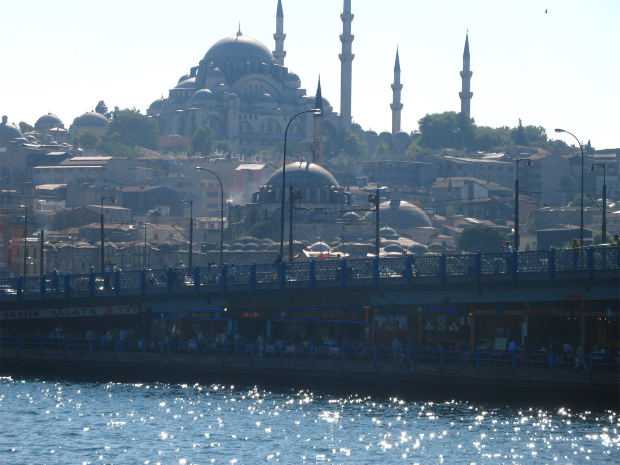
Nearly two weeks after Iran refused to yield to the demand by Germany, France, Britain, Russia, China and the United States that it stop developing nuclear technology that can lead to a nuclear weapon, Iranian President Mahmoud Ahmadinejad will travel to a NATO country for the first time. Turkish President Abdullah Gul will meet the Iranian leader on Thursday in Istanbul. While Iran’s influence as a regional power has undeniably been enhanced by standing against the threats of new sanctions and continuing its nuclear program, Mr. Ahmadinejad’s visit to Turkey will further that image.
But what will Turks gain from it? At best, nothing. Furthermore, this visit is likely to cause trouble for Turkey.
Technically, the U.N. Security Council’s five permanent members and Germany unanimously agree that Iran should not have nuclear weapons. They differ in their tactics, but they agree that it is absolutely vital that Iran sees no positive side to trying to further its nuclear aims. Turkey’s political leaders, however, have chosen to see these high-level “talks” as a show of “good will” in the name of peace. Mr. Gul has also hosted Sudanese President Omar al-Bashir, who ordered genocide in Darfur, for the same reason. But a Turkish proverb suggests that talking is not always a virtue. Knowing when and how to stay “silent” is.
It’s one thing for Turkey to nurture relationships with its neighbors. No one, be they friend or foe of the ruling Justice and Development Party (AKP) or any other Turkish political party, would deny that, at minimum, a civil relationship with other countries in the region can only be good for Turkey. But this current situation with Iran and the threat of it obtaining nuclear weapons is serious. And Turkey’s leaders, simply, may well be in over their heads.
Curiously, though, AKP is strongly supported by the Bush administration. The U.S. certainly did not remain silent about a Constitutional Court case that decided the future of the AKP. Now that the court has decided not to shutter the AKP, the Bush administration has complimented the strength of Turkish democracy. In fact, there is speculation in Turkey that the AKP must have been in contact with Washington about Mr. Ahmadinejad’s visit – though no evidence of such a communication exists. Turkey seems to be acting completely independent. While the White House is likely unhappy about the visit, U.S. officials continue to praise AKP leadership for its pro-active engagement with its neighbors.
In another scenario, it’s also possible that Turkey could sign a natural gas deal with Iran, violating America’s Iran Sanctions Act. If that happens, one can only wonder how Secretary of State Condoleezza Rice would react. Alas, she has been an exceptionally strong defender of AKP policies. Yet if Turkey signs that energy deal with Iran, the U.S. could end the November 2007 agreement that opened a new chapter of cooperation and intelligence sharing in the fight against PKK terrorism.
Furthermore, Mr. Gul often boasts that Turkey and Iran have not fought a war since the early 17th century. The facts of the Turkish history, however, suggest differently, like Turkey’s invasion of Tabriz during World War I. Yet Mr. Ahmadinejad has made it clear that unlike every other visiting dignitary, he will not visit the mausoleum of Mustafa Kemal Ataturk, Turkey’s founder, who created a secular republic in a Muslim nation. So Mr. Gul capitulated and instead invited him to Istanbul. So while these two leaders represent different forms of governments, they in fact seem to have much in common.
Turkish Foreign Minister Ali Babacan says that Turkey cannot stay silent on matters related to Iran, especially when fighting could be possible. Turkey refused to be used as a way into Iraq for the United States, and it certainly won’t be used to attack Iran either, Mr. Babacan says. However, Turkish Prime Minister Recep Tayyip Erdogan may be indicating a different circumstance. Mr. Erdogan admitted during a visit to Washington that he wished Turkey had cooperated with the U.S., because it would have made it easier for Turkey to defend its national security interests.Also, he blamed the opposition Republican People’s Party, CHP, for defeating the measure that proposed cooperation with the United States.
Surely, politicians tend to gravitate toward populist demagogy. We cannot know whether Mr. Erdogan really meant that Turkey should have cooperated on the invasion of Iraq. It is unclear whether he really opposes Iran having nuclear weapons. Those same leaders who argue against the West pressuring Iran say that it’s no different than Israel or Pakistan having nuclear weapons.
Turkey is blundering its way in this complicated relationship, unsure which side it wants to take or how big a threat it sees Iran to be. Turkey’s political leadership believes they can dance with Iran and simultaneously become a major regional player. Let’s hope they’re right. Otherwise, the Turkish people will be merely a casualty of a reckless policy.
From: Rifat for County Board <[email protected]>
To: TURKISH FORUM – WORLD TURKISH COALITION
Sent: TUE, 13 Aug 2008 9:36 pm
Support Rifat!
Rifat is hitting the road to raise enough money to compete on an even playing field with his incumbent opponents – and to win. Incumbents regularly spend $70,000-$80,000 a race. We’ve got to raise more than that to fight their smear tactics and their entrenched political machine.Remember, we can’t be successful without YOUR support!
Team-Rifat is a group of ordinary people like you concerned with electing to the DuPage County Board, Rifat Sivisoglu – a candidate who is highly qualified, financially responsible, and independent. Rifat is running from District #1 (northeastern part of DuPage County).
Citizens for Sivisoglu is the official campaign commi ttee for the Rifat for County Board campaign
The new ’moderate’ Turkey
By Robert Ellis, August 15 2008
Under AKP rule Turkey has become a Big Brother state where critical journalists risk arrest.
Since the AKP (Justice and Development Party) came to power in 2002, and especially in the last year, Turkey’s development has taken an Orwellian turn.
For the first three years things went well and the AKP government continued with the reform program embarked on by the previous coalition government. But since Turkey started accession negotiations with the European Union in October 2005, the zeal for reform has lost momentum.
Together with the reform packages aimed at opening the gate to the Promised Land, there was a parallel development designed to secure the AKP’s grip on Turkey. The preamble to the Turkish constitution establishes that “there shall be no interference whatsoever by sacred religious feelings in state affairs and politics” but this is exactly what the AKP has done.
In Sepember 2006 General Ilter Basbug, who has just been appointed Chief of Staff, warned of “intentional, patient and systematic attempts” to erode what the Turkish republic has achieved since it was founded in 1923. At the same time the higher echelons of the state administration and particularly inside education have been replaced with the party faithful. For example, last year 4,500 people were appointed as principals and deputy principals, two-thirds of whom were affiliated with the governing party.
God’s will
The year after the AKP came to power its parliamentary majority voted to appoint 15,000 new imams instead of a proposed 1,500 for the country’s more than 77,000 mosques. But the move was blocked by the International Monetary Fund, which as a condition for a $16 billion loan had limited the total number of new jobs in the health, education, police and religious services to 34,000 that year.
Another move which has pleased the AKP’s grass roots has been to ease the restrictions on Koran courses, which have since almost doubled. One consequence was the recent gas explosion in a ramshackle building in Konya province, where an illegal Koran course was being held. As a result, 18 young girls were killed but this was ascribed by the parents to God’s will.
The government has also increased quotas for enrollment at religious high schools by 66 percent, compared to only 8 percent for standard high schools, but the AKP has not yet succeeded in gaining admission to the universities for these students on an equal footing with the others.
The question of whether female university students should be allowed to wear the Islamic headscarf has been at the root of the clash between the government and secular supporters in Turkey. The AKP’s attempt in February to change the constitution to make this possible was annulled by the Constitutional Court, and at the end of July the party’s state subsidy was halved as a punishment for becoming “the center of acts against the principle of secularism”. However, there is no reason to believe that the AKP intends to deviate from its present course.
The AKP has also laid its hand on the Higher Education Board, whose chairman was appointed by the government in March. President Gül, the AKP’s former foreign minister, has just chosen 21 new university rectors from lists prepared by the Board, and consequently bypassed a number of candidates chosen by the universities. This has been considered as yet another blow to the universities’ autonomy and tit for tat for the refusal by many rectors to allow the Islamic headscarf.
Ergenekon
A clear indication of the AKP’s mindset is the proposal put forward by the party’s deputy chairperson, Edibe Sözen, with the intention of protecting Turkey’s youth.
This includes compulsory prayer rooms at all schools, a ban on entering Internet cafes for young people under 18 and the registration of anyone buying pornography.
Edibe Sözen claims there is similar legislation in Germany but because of a strong reaction from different groups in society the proposal has been withdrawn.
At the same time as the Constitutional Court deliberated over the future of the AKP, the government launched a counter-offensive in the form of the so-called Ergenekon case, where the public prosecutor has in a 2,500-page indictment charged 86 people with being members of a terrorist organization opposed to the government. This allegedly includes a number of critical journalists, including the 84-year-old editor of a secular daily, who was dragged out of his sickbed at four in the morning.
Turkey has just marked the 100th anniversary of the lifting of press censorship but this has also been overshadowed by the Ergenekon case. In this connection the Turkish Journalists Association issued a written statement, deploring that the number of journalists taken into custody for alleged claims that they disrupt the government is increasing.
The AKP government has tightened its grip on the Turkish media through the controversial sale of the Sabah-ATV media group to Calik Holding, which is owned by a close friend of Prime Minister Tayyip Erdogan, and where Tayyip Erdogan’s son-in-law is the general manager. The purchase sum of $1.1 billion was financed by two loans totalling $750 million from two state banks and the rest from a Qatar-based company. Moreover, KanalTurk, which was formerly anti-government, has been bought by an AKP associate.
An eery dimension is that Turkey is being transformed into a Big Brother society.
According to Soner Cagaptay from the Washington Institute for Near East Policy, Turkish journalists believe the AKP government has intercepted more than 1.5 million phone and email conversations involving its secular opponents. And Transport Minister Binali Yildirim has admitted: “It is not possible to prevent being listened to; the only way is not to talk [on the phone]. If there is nothing illegal in our actions, we should not be concerned about such things.”
An AKP deputy interviewed by The Economist claims Prime Minister Erdogan has become a tyrant and the editor of the Middle East Quarterly, Michael Rubin, has dubbed him “Turkey’s Putin”. Taking this into account, the question is how long Turkey can maintain its image as a spokesman for “moderate Islam”.
Robert Ellis is a frequent commentator on Turkish affairs in the Danish press and since 2005 also in Turkish Daily News. However, after a critical article on the AKP in the Los Angeles Times in March, he was informed by TDN’s editor he was ‘persona non grata’.
The Russian invasion of Georgia has not changed the balance of power in Eurasia. It simply announced that the balance of power had already shifted. The United States has been absorbed in its wars in Iraq and Afghanistan, as well as potential conflict with Iran and a destabilizing situation in Pakistan. It has no strategic ground forces in reserve and is in no position to intervene on the Russian periphery. This, as we have argued, has opened a window of opportunity for the Russians to reassert their influence in the former Soviet sphere. Moscow did not have to concern itself with the potential response of the United States or Europe; hence, the invasion did not shift the balance of power. The balance of power had already shifted, and it was up to the Russians when to make this public. They did that Aug. 8.
Let’s begin simply by reviewing the last few days.
On the night of Thursday, Aug. 7, forces of the Republic of Georgia drove across the border of South Ossetia, a secessionist region of Georgia that has functioned as an independent entity since the fall of the Soviet Union. The forces drove on to the capital, Tskhinvali, which is close to the border. Georgian forces got bogged down while trying to take the city. In spite of heavy fighting, they never fully secured the city, nor the rest of South Ossetia.
On the morning of Aug. 8, Russian forces entered South Ossetia, using armored and motorized infantry forces along with air power. South Ossetia was informally aligned with Russia, and Russia acted to prevent the region’s absorption by Georgia. Given the speed with which the Russians responded — within hours of the Georgian attack — the Russians were expecting the Georgian attack and were themselves at their jumping-off points. The counterattack was carefully planned and competently executed, and over the next 48 hours, the Russians succeeded in defeating the main Georgian force and forcing a retreat. By Sunday, Aug. 10, the Russians had consolidated their position in South Ossetia.
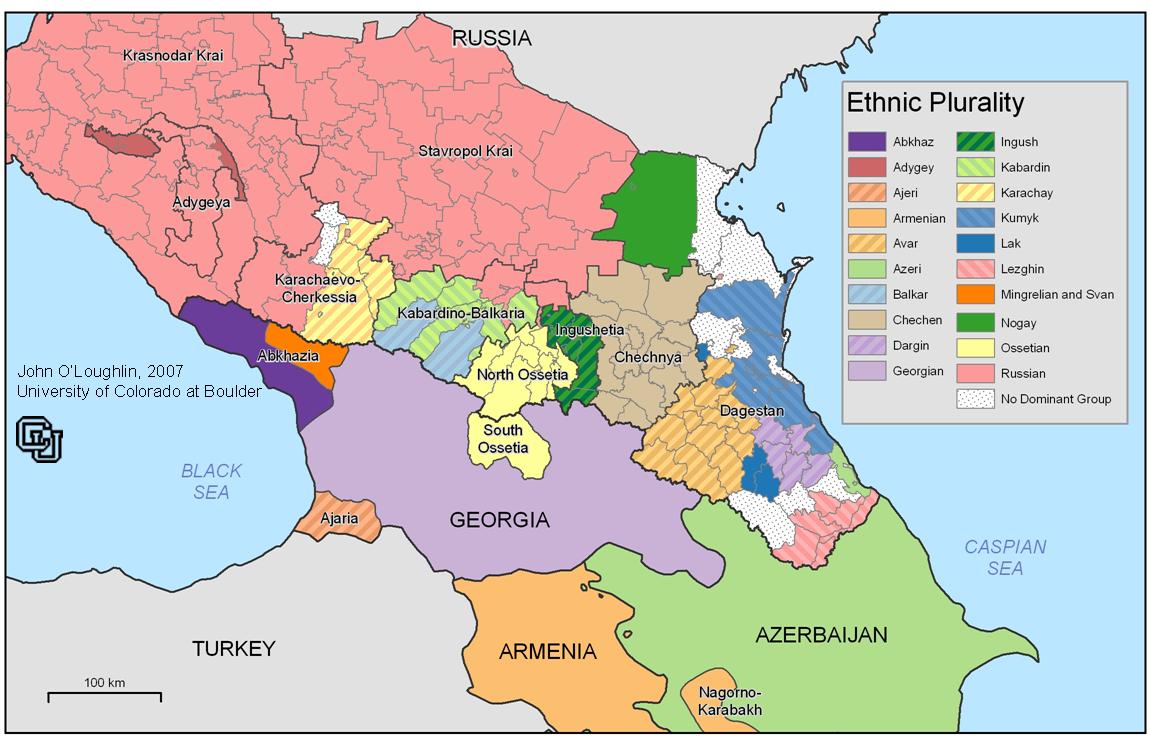
Georgia Conflict Map
On Monday, the Russians extended their offensive into Georgia proper, attacking on two axes. One was south from South Ossetia to the Georgian city of Gori. The other drive was from Abkhazia, another secessionist region of Georgia aligned with the Russians. This drive was designed to cut the road between the Georgian capital of Tbilisi and its ports. By this point, the Russians had bombed the military airfields at Marneuli and Vaziani and appeared to have disabled radars at the international airport in Tbilisi. These moves brought Russian forces to within 40 miles of the Georgian capital, while making outside reinforcement and resupply of Georgian forces extremely difficult should anyone wish to undertake it.
The Mystery Behind the Georgian Invasion
In this simple chronicle, there is something quite mysterious: Why did the Georgians choose to invade South Ossetia on Thursday night? There had been a great deal of shelling by the South Ossetians of Georgian villages for the previous three nights, but while possibly more intense than usual, artillery exchanges were routine. The Georgians might not have fought well, but they committed fairly substantial forces that must have taken at the very least several days to deploy and supply. Georgia’s move was deliberate.
The United States is Georgia’s closest ally. It maintained about 130 military advisers in Georgia, along with civilian advisers, contractors involved in all aspects of the Georgian government and people doing business in Georgia. It is inconceivable that the Americans were unaware of Georgia’s mobilization and intentions. It is also inconceivable that the Americans were unaware that the Russians had deployed substantial forces on the South Ossetian frontier. U.S. technical intelligence, from satellite imagery and signals intelligence to unmanned aerial vehicles, could not miss the fact that thousands of Russian troops were moving to forward positions. The Russians clearly knew the Georgians were ready to move. How could the United States not be aware of the Russians? Indeed, given the posture of Russian troops, how could intelligence analysts have missed the possibility that t he Russians had laid a trap, hoping for a Georgian invasion to justify its own counterattack?
It is very difficult to imagine that the Georgians launched their attack against U.S. wishes. The Georgians rely on the United States, and they were in no position to defy it. This leaves two possibilities. The first is a massive breakdown in intelligence, in which the United States either was unaware of the existence of Russian forces, or knew of the Russian forces but — along with the Georgians — miscalculated Russia’s intentions. The United States, along with other countries, has viewed Russia through the prism of the 1990s, when the Russian military was in shambles and the Russian government was paralyzed. The United States has not seen Russia make a decisive military move beyond its borders since the Afghan war of the 1970s-1980s. The Russians had systematically avoided such moves for years. The United States had assumed that the Russians would not risk the consequences of an invasion.
If this was the case, then it points to the central reality of this situation: The Russians had changed dramatically, along with the balance of power in the region. They welcomed the opportunity to drive home the new reality, which was that they could invade Georgia and the United States and Europe could not respond. As for risk, they did not view the invasion as risky. Militarily, there was no counter. Economically, Russia is an energy exporter doing quite well — indeed, the Europeans need Russian energy even more than the Russians need to sell it to them. Politically, as we shall see, the Americans needed the Russians more than the Russians needed the Americans. Moscow’s calculus was that this was the moment to strike. The Russians had been building up to it for months, as we have discussed, and they struck.
The Western Encirclement of Russia
To understand Russian thinking, we need to look at two events. The first is the Orange Revolution in Ukraine. From the U.S. and European point of view, the Orange Revolution represented a triumph of democracy and Western influence. From the Russian point of view, as Moscow made clear, the Orange Revolution was a CIA-funded intrusion into the internal affairs of Ukraine, designed to draw Ukraine into NATO and add to the encirclement of Russia. U.S. Presidents George H.W. Bush and Bill Clinton had promised the Russians that NATO would not expand into the former Soviet Union empire.
That promise had already been broken in 1998 by NATO’s expansion to Poland, Hungary and the Czech Republic — and again in the 2004 expansion, which absorbed not only the rest of the former Soviet satellites in what is now Central Europe, but also the three Baltic states, which had been components of the Soviet Union.
The Russians had tolerated all that, but the discussion of including Ukraine in NATO represented a fundamental threat to Russia’s national security. It would have rendered Russia indefensible and threatened to destabilize the Russian Federation itself. When the United States went so far as to suggest that Georgia be included as well, bringing NATO deeper into the Caucasus, the Russian conclusion — publicly stated — was that the United States in particular intended to encircle and break Russia.
The second and lesser event was the decision by Europe and the United States to back Kosovo’s separation from Serbia. The Russians were friendly with Serbia, but the deeper issue for Russia was this: The principle of Europe since World War II was that, to prevent conflict, national borders would not be changed. If that principle were violated in Kosovo, other border shifts — including demands by various regions for independence from Russia — might follow. The Russians publicly and privately asked that Kosovo not be given formal independence, but instead continue its informal autonomy, which was the same thing in practical terms. Russia’s requests were ignored.
From the Ukrainian experience, the Russians became convinced that the United States was engaged in a plan of strategic encirclement and strangulation of Russia. From the Kosovo experience, they concluded that the United States and Europe were not prepared to consider Russian wishes even in fairly minor affairs. That was the breaking point. If Russian desires could not be accommodated even in a minor matter like this, then clearly Russia and the West were in conflict. For the Russians, as we said, the question was how to respond. Having declined to respond in Kosovo, the Russians decided to respond where they had all the cards: in South Ossetia.
Moscow had two motives, the lesser of which was as a tit-for-tat over Kosovo. If Kosovo could be declared independent under Western sponsorship, then South Ossetia and Abkhazia, the two breakaway regions of Georgia, could be declared independent under Russian sponsorship. Any objections from the United States and Europe would simply confirm their hypocrisy. This was important for internal Russian political reasons, but the second motive was far more important.
Russian Prime Minister Vladimir Putin once said that the fall of the Soviet Union was a geopolitical disaster. This didn’t mean that he wanted to retain the Soviet state; rather, it meant that the disintegration of the Soviet Union had created a situation in which Russian national security was threatened by Western interests. As an example, consider that during the Cold War, St. Petersburg was about 1,200 miles away from a NATO country. Today it is about 60 miles away from Estonia, a NATO member. The disintegration of the Soviet Union had left Russia surrounded by a group of countries hostile to Russian interests in various degrees and heavily influenced by the United States, Europe and, in some cases, China.
Resurrecting the Russian Sphere
Putin did not want to re-establish the Soviet Union, but he did want to re-establish the Russian sphere of influence in the former Soviet Union region. To accomplish that, he had to do two things. First, he had to re-establish the credibility of the Russian army as a fighting force, at least in the context of its region. Second, he had to establish that Western guarantees, including NATO membership, meant nothing in the face of Russian power. He did not want to confront NATO directly, but he did want to confront and defeat a power that was closely aligned with the United States, had U.S. support, aid and advisers and was widely seen as being under American protection. Georgia was the perfect choice.
By invading Georgia as Russia did (competently if not brilliantly), Putin re-established the credibility of the Russian army. But far more importantly, by doing this Putin revealed an open secret: While the United States is tied down in the Middle East, American guarantees have no value. This lesson is not for American consumption. It is something that, from the Russian point of view, the Ukrainians, the Balts and the Central Asians need to digest. Indeed, it is a lesson Putin wants to transmit to Poland and the Czech Republic as well. The United States wants to place ballistic missile defense installations in those countries, and the Russians want them to understand that allowing this to happen increases their risk, not their security.
The Russians knew the United States would denounce their attack. This actually plays into Russian hands. The more vocal senior leaders are, the greater the contrast with their inaction, and the Russians wanted to drive home the idea that American guarantees are empty talk.
The Russians also know something else that is of vital importance: For the United States, the Middle East is far more important than the Caucasus, and Iran is particularly important. The United States wants the Russians to participate in sanctions against Iran. Even more importantly, they do not want the Russians to sell weapons to Iran, particularly the highly effective S-300 air defense system. Georgia is a marginal issue to the United States; Iran is a central issue. The Russians are in a position to pose serious problems for the United States not only in Iran, but also with weapons sales to other countries, like Syria.
Therefore, the United States has a problem — it either must reorient its strategy away from the Middle East and toward the Caucasus, or it has to seriously limit its response to Georgia to avoid a Russian counter in Iran. Even if the United States had an appetite for another war in Georgia at this time, it would have to calculate the Russian response in Iran — and possibly in Afghanistan (even though Moscow’s interests there are currently aligned with those of Washington).
In other words, the Russians have backed the Americans into a corner. The Europeans, who for the most part lack expeditionary militaries and are dependent upon Russian energy exports, have even fewer options. If nothing else happens, the Russians will have demonstrated that they have resumed their role as a regional power. Russia is not a global power by any means, but a significant regional power with lots of nuclear weapons and an economy that isn’t all too shabby at the moment. It has also compelled every state on the Russian periphery to re-evaluate its position relative to Moscow. As for Georgia, the Russians appear ready to demand the resignation of President Mikhail Saakashvili. Militarily, that is their option. That is all they wanted to demonstrate, and they have demonstrated it.
The war in Georgia, therefore, is Russia’s public return to great power status. This is not something that just happened — it has been unfolding ever since Putin took power, and with growing intensity in the past five years. Part of it has to do with the increase of Russian power, but a great deal of it has to do with the fact that the Middle Eastern wars have left the United States off-balance and short on resources. As we have written, this conflict created a window of opportunity. The Russian goal is to use that window to assert a new reality throughout the region while the Americans are tied down elsewhere and dependent on the Russians. The war was far from a surprise; it has been building for months. But the geopolitical foundations of the war have been building since 1992. Russia has been an empire for centuries. The last 15 years or so were not the new reality, but simply an aberration that would be rectified. And now it is being rectified.
Tell Stratfor What You Think
This report may be forwarded or republished on your website with attribution to www.stratfor.com
It has been a rough couple of weeks for the Egyptian al Qaeda contingent in Pakistan. On Aug. 12, Pakistani security sources confirmed that an Aug. 8 operation in Bajaur resulted in the death of al Qaeda leader Mustafa Abu al-Yazid, aka Sheikh Said al-Masri. Some posters on jihadist message boards have denied the reports, but al Qaeda itself has yet to release a statement on the issue. Al-Yazid was reportedly al Qaeda’s operational commander for Afghanistan, and some reports also claim he was responsible for planning attacks within Pakistan, such as the June 2 attack on the Danish Embassy.
If confirmed, al-Yazid’s death came just 11 days after the July 28 missile strike in South Waziristan that resulted in the death of al Qaeda’s lead chemical and biological weapons expert, Midhat Mursi al-Sayid Umar, also known as Abu Khabab al-Masri. The strike against al-Sayid also killed three other Egyptian al Qaeda commanders. In an ironic twist, the official al Qaeda eulogy for al-Sayid and his companions was given by al-Yazid.
Unconfirmed rumors also have swirled since the July 28 attack that al Qaeda No. 2 Ayman al-Zawahiri was either killed or seriously wounded in the same operation. An audiotape in which al-Zawahiri speaks out against Pakistani President Pervez Musharraf was recently released in an odd manner, in that it was given directly to a Pakistani news channel rather than via al Qaeda’s usual release pattern of having As-Sahab Media upload it directly to the Internet. The tape, in which al-Zawahiri speaks in English for the first time in a public pronouncement, is not convincing proof that al-Zawahiri was not wounded or killed. Obviously, al-Zawahiri’s loss would be another serious blow to the organization.
Al Qaeda’s current problems are nothing new. In fact, the United States and its allies have been attacking al Qaeda’s operational infrastructure consistently since 9/11. While the United States has not yet located and killed the al Qaeda apex leadership, it has done a very good job of eliminating senior operational commanders — the men in the al Qaeda hierarchy who actually plan and direct the militant Islamist group’s operations. The nature of their position means the operational commanders must have more contact with the outside world, and therefore become more vulnerable to being located and killed or captured.
Because of this campaign against al Qaeda’s operational infrastructure, Stratfor has been saying for some time now that we do not believe the core al Qaeda group poses a strategic threat to the U.S. homeland. However, that does not mean that the United States is completely free of danger when it comes to the jihadist threat. While the core al Qaeda group has been damaged, it still poses a tactical threat — and still can kill people. Furthermore, as the jihadist threat has devolved from one based primarily on al Qaeda the organization to one based on al Qaeda the movement, al Qaeda’s regional franchises and a nebulous array of grassroots jihadists must also be accounted for.
With al Qaeda’s operational structure under continued attack and the fact that there are no regional franchises in the Western Hemisphere, perhaps the most pressing jihadist threat to the U.S. homeland at the present time stems from grassroots jihadists.
Beyond the Cliches
There are many cliches used to describe grassroots jihadists. As we have long discussed, grassroots operatives tend to think globally and act locally — meaning they tend to be inspired by events abroad and yet strike close to home. Additionally, these operatives tend to be a mile wide but an inch deep — meaning that while there are many of them, they are often quite inept at terrorist tradecraft. These cliches are not just cute; they have a sound basis in reality, as a study of grassroots jihadists demonstrates.
There are two basic operational models that involve grassroots jihadists. The first operational model is one where an experienced operational commander is sent from the core al Qaeda group to assist the local grassroots cell. This is what we refer to as the “al Qaeda 1.0 operational model” since it literally is the first one we became familiar with. We saw this model used in many early jihadist operations, such as the 1993 World Trade Center bombing and the 1998 U.S. Embassy bombings in East Africa. It has also been employed in a number of thwarted plots, such as Operation Bojinka in 1995 and the millennium plots in 2000. This model also was used in the thwarted 2006 Heathrow airliner plot.
The second grassroots operational model involves operatives who launch attacks themselves without external funding or direct operational guidance. This is what we refer to as the “al Qaeda 3.0 operational model.” Examples of attacks committed using this model include the November 1990 assassination of Rabbi Meir Kahane in New York, the July 21, 2005, London bombings, the July 2002 armed assault of the El Al Airlines ticket counter at Los Angeles International Airport and the botched June 2007 bombing attacks in London and Glasgow.
Something of a gray area exists around the borders of these two operational models, and at times it can be difficult to distinguish one from the other. For example, Mohammed Siddique Khan, the leader of the cell that carried out the July 7, 2005, London suicide bombings, had attended training camps in Pakistan with another member of the cell. While there, he had at least some contact with al Qaeda, since al Qaeda released a copy of the martyrdom videos the two made during their time in Pakistan.
Notably, these attacks show that most of these grassroots jihadists, whether as part of a 1.0 or a 3.0 structured cell, selected targets in close proximity to their place of residence. Even when such cells have established safe houses to store chemicals, to manufacture improvised explosive mixtures or to construct improvised explosive devices, those safe houses quite often have been close to the target and the attacker’s residence. Grassroots jihadists really do think globally and act locally.
A second notable aspect of several of these attacks is that these operatives lack terrorist tradecraft such as operational security and surveillance techniques. Blunders in these areas have frequently led to the groups being identified and nabbed before they could launch their attacks. Plain old police traffic stops have exposed jihadist cells such as the Virginia Jihad Network and have helped to thwart several other terror plots.
Even when a grassroots group is able to execute its attack without detection, it often has been hampered by a lack of bomb-making skill. The failed July 21, 2005, London bombings and the June 2007 London and Glasgow attacks exemplify this flaw. Grassroots groups simply do not have the same level of training and operational experience as the professional operatives comprising the core al Qaeda group. Operationally, they are a mile wide and tend to be an inch deep.
Another consideration that comes to light while contemplating past grassroots cases is that lacking funding from al Qaeda core, grassroots operatives are likely to indulge in petty crimes such as credit card theft, cargo theft or armed robbery to fund their activities. For example, in July 2005, a grassroots cell in Torrance, Calif., was uncovered during an investigation into a string of armed robberies. After arresting one suspect, Levar Haney Washington, police who searched his apartment uncovered material indicating that Washington was part of a militant jihadist group planning to attack a number of targets in the Los Angeles area.
Truthfully, most grassroots operatives are far more likely to commit a criminal act such as document fraud or receiving stolen property than they are to have telephone conversations with Osama bin Laden. When they do commit such relatively minor crimes, it is local cops rather than some federal agency that will have the first interaction with them. This means that local police are an important piece of the counterterrorism defenses — they are, in essence, grassroots defenders.
Beyond Grassroots Jihadists
A recent study led by Brent Smith of the Terrorism Research Center at the University of Arkansas’ Fulbright College suggests that these trends extend beyond the grassroots jihadist threat. In a July article in the National Institute of Justice Journal, Smith noted that his research team studied 60 terrorist incidents in the United States over the past 25 years. The terrorist actors were from a cross-section of different ideological backgrounds, including domestic left-wing, domestic right-wing, domestic single-issue and international terrorists.
In the study, Smith and his colleagues identified the residences of 431 terrorist suspects and found that, overall, 44 percent of the attacks were conducted within 30 miles of the perpetrator’s place of residence and 51 percent were conducted within 90 miles of the residence. When broken down by type, the numbers were actually highest for international terrorists, with 59 percent of the suspects living within 30 miles of their target and 76 percent of the suspects residing within 90 miles.
Smith’s study also noted that many of the preparatory actions for the attacks occurred close to the attack site, with 65 percent of the environmental terrorists and 59 percent of the international terrorists studied conducting preparations for their attacks within 30 miles of their target sites. Of course, some preparatory actions, such as preoperational surveillance, by their very nature must be conducted within close proximity to the attack site. But still, the percentage of activity conducted near attack sites is noteworthy.
One other interesting result of Smith’s study was the timeline within which preparation for an attack was completed. For international groups, the preparation could take a year or more. But environmentalist and left-wing groups proved to be far more spontaneous, with a large portion of their preparation (88 and 91 percent, respectively) completed within two weeks of the attack. This means that prior to an attack, international terrorists are generally vulnerable to detection for far longer than are members of a domestic left-wing or environmentalist group.
Application
While there are always exceptions to the percentages, with people like Timothy McVeigh and Mohammed Atta traveling long distances to conduct preparatory acts and execute attacks, most people conducting terrorist attacks tend to operate in areas they are familiar with and environments they are comfortable in.
When we examine the spectrum of potential terrorist actors — from domestic people such as McVeigh and Eric Rudolph to international figures such as Mohammed Atta and Ahmed Ajaj — it is clear that a large number of them have had no prior interaction with federal law enforcement or intelligence officials and therefore no prior record identifying them as potential terrorism suspects. That means that even if they were stopped by a local police officer (as Atta was for driving without a license), any national-level checks would turn up negative. Because of this, it is extremely important for police officers and investigators to trust their instincts and follow up on hunches if a subject just doesn’t feel right. The Oklahoma state trooper who arrested McVeigh, the New Jersey state trooper who nabbed Yu Kikumura, or the rookie Murphy, N.C., officer who apprehended Eric Rudolph are all examples of cops who did this.
Of course, following your instincts is difficult to do when management is pressuring police officers and agents investigating cases such as document and financial fraud to close cases and not to drag them out by pursuing additional leads. Indeed, when Ahmed Ajaj was arrested in September 1992 for committing passport fraud, the case was quickly closed and authorities pretty much ignored that he had been transporting a large quantity of jihadist material, including bomb-making manuals and videos. Instead, he was sentenced to six months in jail for committing passport fraud and was then scheduled for deportation.
Had authorities taken the time to carefully review the materials in Ajaj’s briefcase, they would have found two boarding passes and two passports with exit stamps from Pakistan. Because of that oversight, no one noticed that Ajaj was traveling with a companion — a companion named Abdel Basit who entered the United States on a fraudulent Iraqi passport in the name Ramzi Yousef and who built the large truck-borne explosive device used in the 1993 World Trade Center bombing.
While many state and local departments have specialized intelligence or counterterrorism divisions, training on how to spot potential terrorist preparatory activity often does not go much further than those officers specifically assigned to the counterterrorism portfolio. In some jurisdictions, however, law enforcement managers not only give investigators the leeway to investigate potential terrorist activity, they also encourage their street officers to do so — and even provide training on how to identify such behavior.
In many jurisdictions, serious problems in information sharing persist. Much has been written about “the wall” that separated the FBI’s intelligence investigations from its criminal investigations and how that separation was detrimental to the U.S. government’s counterterrorism efforts prior to 9/11. The FBI is not the only place such a wall exists, however. In many state and local law enforcement departments, there is still a wide gulf separating the intelligence or counterterrorism division officers and the rest of the department. This means that information regarding cases that general crimes investigators are looking into — cases that very well could have a terrorism angle — does not make it to the officers working terrorism cases.
As the shift toward grassroots operatives continues, information pertaining to preparatory crimes will become even more critical. Identifying this activity and flagging it for follow-on investigation could mean the difference between a thwarted and a successful attack. As the grassroots threat emerges, the need for grassroots defense has never been greater.
Tell Stratfor What You Think
This report may be forwarded or republished on your website with attribution to www.stratfor.com
Next week Turkish Foreign Minister Ali Babacan will discuss initiative of the platform of security and cooperation in the South Caucasus with his Russian counterpart Sergey Lavrov, Turkish Prime Minister Receb Tayyip Erdogan told reporters at the press conference in Bodrum, Turkey, APA reports. (more…)