Category: World

  • Greeks, Turks and Armenians

    Greeks, Turks and Armenians

    How do Greeks, Turks and Armenians feel about each other’s countries?

    I feel sad. Deeply sad.

    We could be a great! A united superpower, if we had stood together and haven’t killed each other in hundreds of thousands.

    Yes Ottomans mistreated Armenians, mistreated Greeks but they certainly mistreated Turks too.

    In the end it was Turkish Kemalists who pulled the rug under the Ottoman Sultanate, It was us who destroyed the caliphate. We finished the work which we all Greeks, Armenians and Turks started together in the first place. I am talking about the Young Turk movement.
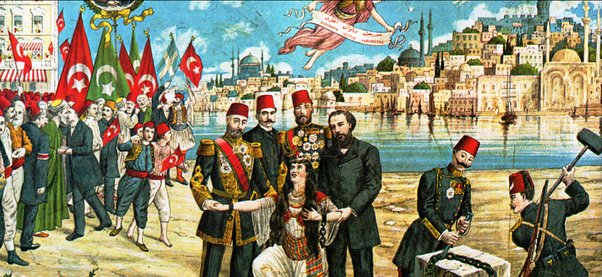
    Yes we forced the first constitution together. Here Turkish, Greek and Armenian leaders signing.
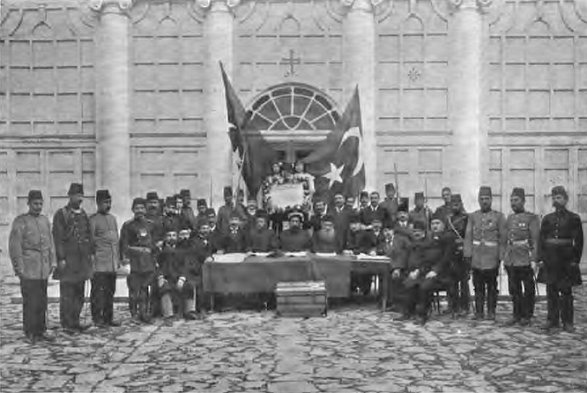
    Our great endeavor was hijacked and sabotaged. Minorities sought their own independent small and weak countries. Organizations got corrupted, people sought personal glory. We were led to slaughter each other by the imperialistic powers.

    Even after such brutality, all of us Greek, Armenian and Turk we still miss our collective songs, cuisine, our neighborhood. When outside in a mixed nationality Turks and Greeks always find each other. Its always the Greek guy who laughs when the other stare confused by the lame ass naughty joke the Turk makes.

    Greeks were the great intellectuals and traders, Armenians were the great craftsman and artisans, Turks were the farmers, herders, great soldiers.

    Divide and Conquer was at its best.

    Today we would have none of the worries, State would be much more secular with strong and healthy non-Muslim population. We would have no conflict in the Mediterranean. Caucasian region would be secure. None of the tragedies would have happened.

    Here is a song which the lyrics are adopted by Bülent Ecevit. Here the songs goes like

    Sıla derdine düşünce anlarsın (When you get home sick you understand)
    Yunanlıyla kardeş olduğunu (You are brothers with the Greek)
    Bir rum şarkısı duyunca gör (When you hear a Greek song, You will see )
    Gurbet elde İstanbul çocuğunu (A fellow child of Istanbul, alone in a foreign land)

    Türkçenin ferah gönlünce küfretmişiz (We swore in open hearted Turkish)
    Olmuşuz kanlı bıçaklı (We feuded)
    Yine de bir sevgidir içimizde (But its love that is in our hearts)
    Böyle barış günlerinde saklı (It surfaces in times of peace)

    Bir soyun kanı olmasın varsın (Let a clan not be about blood)
    Damarlarımızda akan kan (The blood that is running through our veins)
    İçimizde şu deli rüzgâr (The crazy wind blows inside)
    Bir havadan (İs of the same air)

    Bu yağmurla cömert (Generous is the rain)
    Bu güneşle sıcak (Warm is the sun)
    Gönlümüzden bahar dolusu kopan (Our hearts full of springs)
    İyilikler kucak kucak (Goodness is aplenty)

    Bu sudan bu tattandır ikimizde de günah (From this water, from this taste is the sin for both of us)
    Bütün içkiler gibi zararı kadar leziz (Tasty as sin, as all the harms of drinks)
    Bir iklimin meyvasından sızdırılmış (Distilled from the same fruit of this climate),
    Bir içkidir kötülüklerimiz (Our evils are one drinks)

    Aramızda bir mavi büyü (A blue magic between us)
    Bir sıcak deniz (A warm and gentle sea)
    Kıyılarında birbirinden güzel (With coasts as beautiful as any)
    İki milletiz (We are two peoples)

    Bizimle dirilecek bir gün (One day together we will resurrect)
    Ege’nin altın çağı (The golden age of the Aegean)
    Yanıp yarının ateşinden (Tomorrow the new fire will burn)
    Eskinin ocağı (The old oven)

    Önce bir kahkaha çalınır kulağına (First you will hear a familiar laughter)
    Sonra rum şiveli türkçeler (They you will hear Turkish in Greek accent)
    O Boğaz’dan söz eder (He or She speaks about the Bosphorus)
    Sen rakıyı hatırlarsın (And you remember the Rakı)

    Yunanlıyla kardeş olduğunu (You remember you are Brothers with the Greek)
    Sıla derdine düşünce anlarsın (When you get homesick)
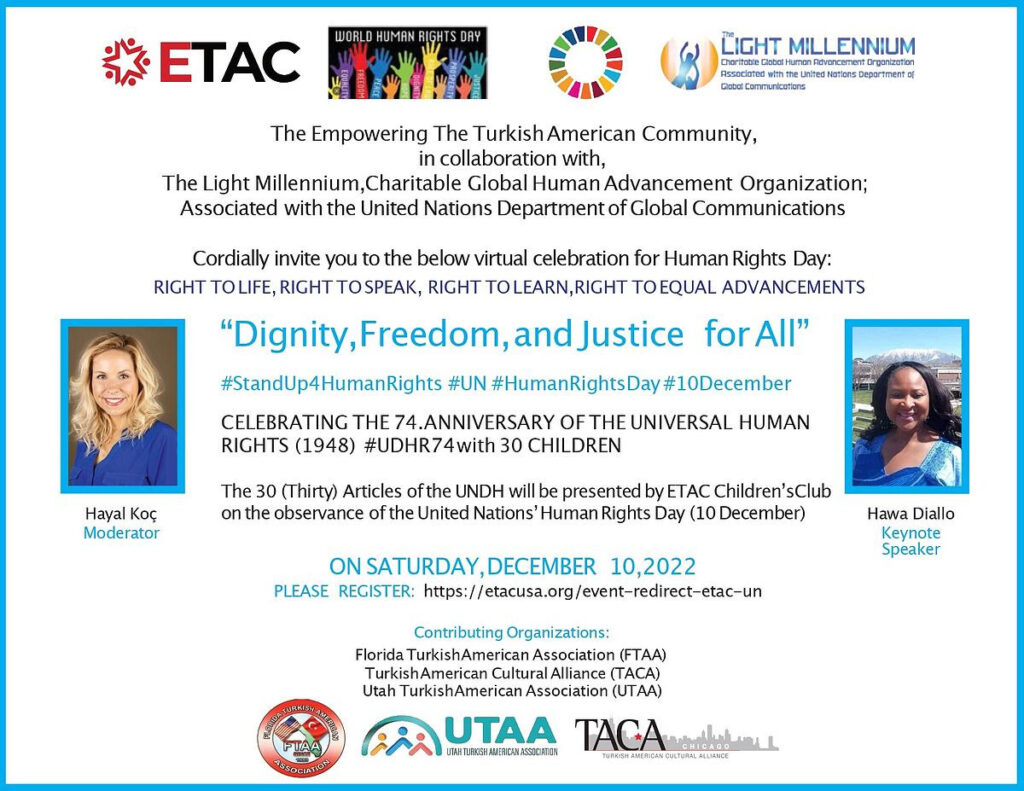
  • Celebrate Human Rights Day

    Celebrate Human Rights Day

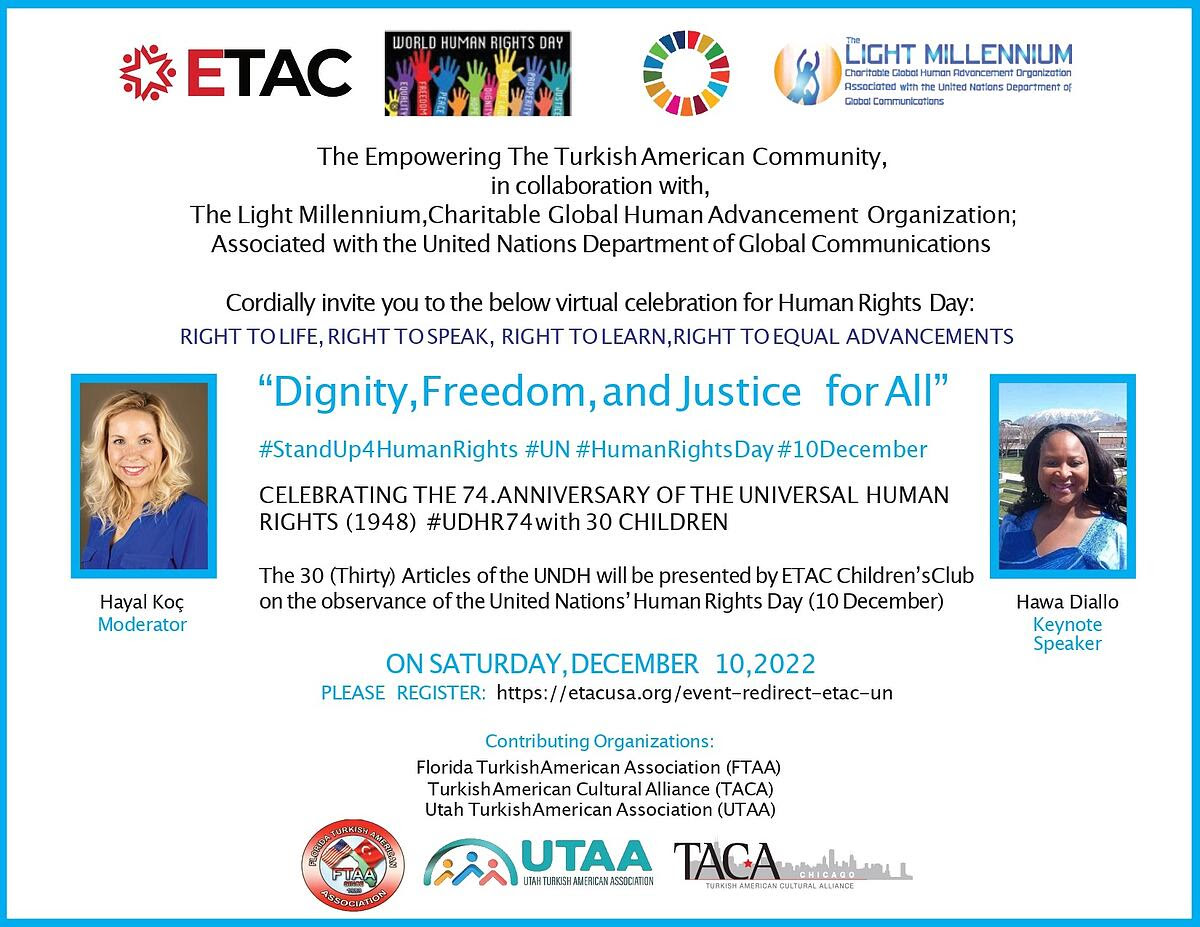
    Today: Celebrate Human Rights Day with Ms.Hawa Diallo, Chief, UNDGC_CSU & 30 Children December 10

    Greetings to you ALL:

    You are invited to celebrate the 74th anniversary of 30 (Thirty) Articles of the UNDH which will be presented by ETAC Children’s Club on the observance of the United Nations’ Human Rights Day, December 10.

    The UDHR consists of a preamble and 30 articles that set out a broad range of fundamental human rights and freedoms to which all of us, everywhere around the world, are entitled. It guarantees our rights without distinction of nationality, place of residence, gender, national or ethnic origin, religion, language, or any other status.

    The 75th anniversary of the Universal Declaration of Human Rights will be celebrated on 10 December 2023. Ahead of this milestone celebration, starting on this year’s Human Rights Day on 10 December 2022, the Office of the United Nations High Commissioner for Human Rights (UN-OHCHR) will launch a year-long campaign to showcase the UDHR by focusing on its legacy, relevance, and activism.

    StandUp4HumanRights #UDHR74 #HumanRightsDay #10December #UNWithCivilSociety #ETACUSA #LMGlobalOrg #lightmillennium

    Please join us today to celebrate Human Rights Day with our keynote speaker Ms.HAWA TAYLOR-KAMALA DIALLO, Chief, UNDGC_CSU; and 30 Children at 10:00 a.m. PT; 1:00 p.m. ET; and 9:00 p.m. TR on Saturday, December 10th.

    Key Details

    Date: Saturday, December 10 @ 10 AM (PST)

    Location: Online

    REGISTER NOW
    Please send any questions and comments to: [email protected]

    Best wishes,

    ETAC-USA

  • How Turkey helped the world

    How Turkey helped the world

    What achievement has Turkey accomplished that has helped the world and it can be proud of?

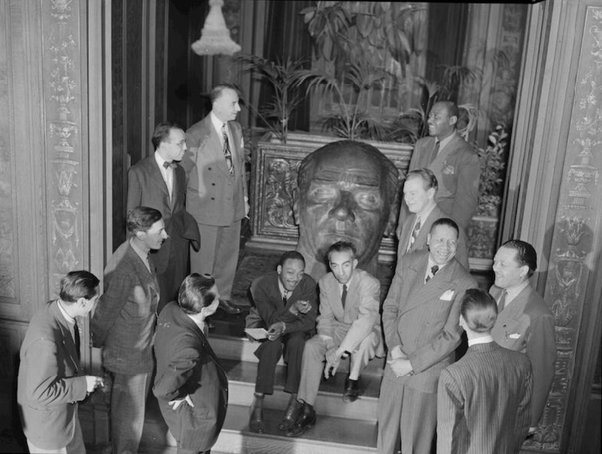
    Although we are dealing with problems that I am not very proud of today; as a Turkish citizen, there is something about my country that I am very proud of. The following photo was taken at the Turkish Embassy in Washington in the 40s:

    After this photo was taken, a diplomatic crisis occurred for the first time between the Republic of Turkey and the USA. At that time, discriminatory legal doctrines such as “separate but equal” were active in the United States, and certain “barriers” in public institutions were required by Jim Crow Laws between African Americans and White Americans.

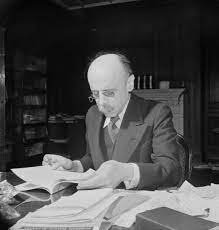
    Meanwhile, the Turkish ambassador of the period, Münir Ertegün, was constantly organizing invited proms for Black Jazz artists at the Turkish embassy in the capital, and he was trying to wage a political struggle against black racism at these invitations with the support of American Jewish Committee. The repeated meeting of Whites and Blacks in the same place eventually resulted in a “warning letter” sent to the Turkish Ambassador by the Senate of one of the Southern States:

    “I am complaining about you letting Black Individuals into the Turkish Embassy through the front door. I would like to remind you that this is against the Jim Crow Laws.”

    And Ambassador Ertegün responded to this warning with a short letter:

    “In my country, our friends enter our house through the front door. But if you wish, we can let you in through the back door.”

    Ambassador Ertegün

    Freedom is the supreme good for the human spirit, and its just application is a symbol of dignity for civilized man. Therefore, this struggle of a Turkish bureaucrat is the most important achievement that Turkey has officially brought to the world.

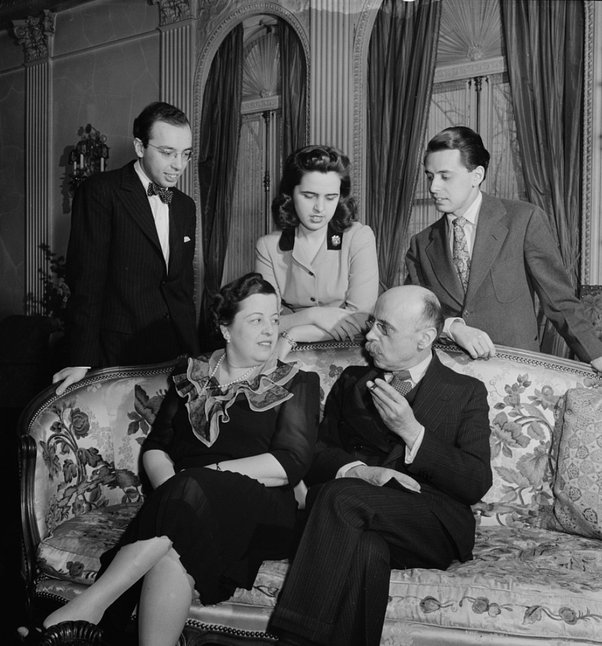
    The Ertegün Family later established a record label called Atlantic Records and produced the albums of many Black Jazz artists:

    Source:

    • https://www.loc.gov/item/gottlieb.02641/
    • https://www.voaturkce.com/a/tarihi-washington-buyukelcilik-konutu-gorenleri-buyuluyor/4341856.html
    • https://en.wikipedia.org/wiki/Atlantic_Records

    Helin D.

  • Why was Turkey Neutral in WW2?

    Why was Turkey Neutral in WW2?

    ♦Narrated by: Callum Janes
    ♦Script and research: Skylar J.Gordon

    ♦Please consider to SUBSCRIBE :

    ♦Music Used :
    Kevin MacLeod – FaceOff
    Kevin MacLeod – Constance
    Kevin MacLeod – BTS Prolog
    Kevin MacLeod – Impact Allegretto

    ♦Sources :
    www.archives.gov
    www.countrystudies.us
    www.britannica.com
    api.parliament.uk
    timesmachine.nytimes.com
    www.allaboutturkey.com
    www.history.com
    nzhistory.govt.nz
    www.britishcouncil.org
    www.ibiblio.org
    www.histclo.com
    warfarehistorynetwork.com
    ww2db.com

  • Why War in Ukraine is Causing Apocalyptic Famine

    Why War in Ukraine is Causing Apocalyptic Famine

    Ukrayna’daki Savaş Neden Kıyamet Kıtlığına Neden Oluyor?

    This is David Beasley. He’s the man who currently runs the united nations world food program the largest humanitarian organization in the world that is focused on global hunger and food security. Listen to what he has to say. During this speech back from february of 2022 while speaking about impoverished countries around the world so these are the countries that are struggling in such a way that if we do not address immediately over the next nine months we will see famine

    We will see destabilization of nations like you are already seeing in certain places. You’ll see mass migration and i can tell you from experience we’ve got the solutions.

    We’ve got the programs we need the money and the follow-through otherwise nations around the world will pay for it.

    -Transcript-

    Egypt is a country that is heavily reliant upon importing food from other countries. The primary food staple within Egypt is bread which accounts for roughly 30% of all the calories that are consumed by Egyptian citizens. This means that the country consumes around 21 million tons of wheat per year and 62 percent of all that wheat is imported from abroad and the overwhelming majority of that imported wheat roughly 82% of it all comes from just the rich black soil fields found across Ukraine and Russia and Egypt is far from alone in this high level of dependence on food coming from around the black sea the rich fields of Ukraine and Russia ordinarily supply 81 of Lebanon’s imported wheat 79 of Turkey’s imported wheat and significantly high amounts of imported wheat across the middle east north Africa and eastern Africa this is one of the world’s most crucial trade relationships that is entirely defined by geography and it is very difficult for any of these countries who receive large amounts of black sea grains to find economic alternative suppliers other rich and fertile agricultural areas in the world like western Europe…

  • Ukraine’s Nuclear Fuel Storage Facility: a well-calculated project or an unwarranted risk?

    Ukraine’s Nuclear Fuel Storage Facility: a well-calculated project or an unwarranted risk?

    Photo credit: Bellona

    Concerns have been raising among environmentalists and nuclear power engineers as Ukraine continues the loading of used fuel into the into the containerized dry storage systems of the new Chernobyl Interim Spent Nuclear Fuel Storage Facility (ISF-2).

    Designed by Holtec International, the project poses dangerous risks to the global environment, and here is why.

    According to the official website of Holtec International and John Heaton’s presentation at the “ELEA – Holtec International” Congress, the U.S. company claims to have some competences and expertise in storing the nuclear energy waste. Among them are: technologies for the construction of dry storage facilities of the CISF type for the temporary storage of containers with spent nuclear fuel and radioactive wastes; the reliability of the storage facilities that is ensured by a dry climate system, which prevents corrosion of structural materials and excludes the ingress of water into the waste tanks. Finally, the company already has its own functioning storage.

    However, the Holtec International has no expertise in building large, capacious storage facilities for long-term (more than 50 years) storage of spent nuclear fuel in a humid and cold climate, with a pronounced change of seasons.

    For 6 years of work on the territory of Ukraine, “Holtec International” has so far the only one achievement concerning the loading of the two double-walled tanks with spent nuclear fuel from the RBMK reactor in the Interim Storage Facility (ISF-2) at the Chernobyl NPP site. It is shown that containers with nuclear waste are placed in the ISF-2 building that is already under operation, and not in a dry storage facility of the CISF type. In addition, the arrangement of tanks in the ISF-2 storage facility is horizontal, not vertical (i.e., it does not correspond to the American technology of storage of tanks), and it is not known what risks and consequences this may lead to. For this reason, the launch of ISF-2 by “Holtec International” specialists was delayed, since it was not known in advance whether it would be possible to safely place the canister in the storage facility.

    According to the study by Ukrainian experts, Ukraine’s 15 reactors – all of which were built while the country was still a republic of the Soviet Union – supply more than half of the domestic electricity supply. This means that reactors built during the Soviet era in Ukraine has more trust among nuclear power engineers rather than an ambitious U.S. project.

    Ukrainian President Volodimir Zelensky, during the negotiations over the project last year, said Ukraine would embrace nuclear power as a national priority.

    “In the coming years, many countries will work against nuclear power generation,” he said. “We, on the other hand, will defend it. We must do this because today we have every opportunity to be among the first [in nuclear energy], both in Europe and in the world.”

    But at the same time the Ukrainian government is creating an extremely dangerous situation for the global environment and its border neighbors.

    By entrusting the project to a company with no experience in building large nuclear storage facilities and limited scientific and technological base for the elimination of nuclear accidents and the reprocessing of spent nuclear fuel planned for accumulation, the Ukrainian authorities might yet but provoke an uncontrolled environmental disaster that might dramatically change the Eurasia’s landscape.