Category: Turkiye

  • A Respectful Yet Firm Rebuttal on Your Recent Reflections on the Republic of Türkiye

    A Respectful Yet Firm Rebuttal on Your Recent Reflections on the Republic of Türkiye

    Letter to Dr Mustafa Atac

    Subject: A Respectful Yet Firm Rebuttal on Your Recent Reflections on the Republic of Türkiye

    Dear Dr. Atac,

    With the utmost respect for your passion and your well intentioned concern for the homeland we both deeply cherish, I must address your recent commentary on the current state of the Republic of Türkiye. Your reflections, though emotionally evocative, are unfortunately steeped in exaggeration, devoid of contextual accuracy, and risk doing grave disservice to the proud, sovereign nation that has emerged from the very ashes you so eloquently reference.

    Mr. Atac perhaps you have not see Türkiye A Nation That Rose and Continues to Rise , Indeed, the early decades of the Republic under Mustafa Kemal Atatürk were miraculous in their achievements turning a war ravaged people innto builders of a modern state. That same spirit of resilience has never faded. Rather than “becoming another Afghanistan,” as you hastily assert, Türkiye has firmly anchored itself in the transatlantic community and remains a pivotal NATO member one whose soldiers bled beside Americans in Korea and wrote history with their blood on the lands of Korea , stood guard during the Cold War, fought in Kosovo, and continue to play vital roles in global peacekeeping efforts today.

    Let us not forget that Türkiye was the first Muslim majority country to join NATO in 1952, and it has since become Europe’s second largest standing army in the alliance. Türkiye has actively hosted and supported NATO operations, integrated into Western defense and economic institutions, and played a stabilizing role in a volatile region bordering Syria, Iraq, the Caucasus, and the Black Sea.

    A Functional Democracy with Complex Realities, while no democracy is immune to criticism or challenge including the Türkiye ,United States, the United Kingdom, or France it is whollly inaccurate and unjust to declere that Türkiye is a dictatorship or that its people live in the “Middle Ages.” That is such a insult to all the Kefeniz Yatanlar icin. 

    Quoting Time Magazine: “Türkiye is no Russia. It remains, in form and function, a democracy—albeit a troubled one. Its press is loud, its opposition exists, its people vote—and those votes matter. Even at its most strained, Türkiye has institutions and civil society mechanisms that remain active and alive.” (Time, “Türkiye Is No Russia,” 2023)

    You lament the state of education yet fail to acknowledge that Türkiye today has over 200 universities, millions of higher education students, and one of the highest female university enrollment rates in the Islamic world. Turkish universities collaborate globally; Turkish students and professionals excel in NATO, EU programs, and academic exchanges across Europe and the United States.

    You claim the justice system is “non-existent,” but Türkiye continues to be party to European Court of Human Rights jurisdiction and has recently passed significant reforms on bar associations and judicial independence.

    You assert that the country is bankrupt, ignoring that Türkiye’s economy remains in the G20, has a vibrant export sector, and is undergoing one of the most ambitious green and digital transitions in its region. Türkiye is one of the top global drone producers—a sector that didn’t exist a decade ago and now dominates headlines from Ukraine to Africa.

    Living in Denial or Refusing to Acknowledge the Present?

    To suggest that there is nothing in today’s Türkiye to be proud of is a statement unworthy of your intellect- I feel you just have a personal manner. Such hyperbole may win applause in ideological circles or if people who have the venom of hate dipping from their lips like yours, but it belies both fairness and fact. You write as though the past glories exist in a vacuum, unconnected to the present. But the Türkiye of today is not a break from its proud foundations; it is the continuation of a legacy, shaped by changing times, national security threats, refugee crises, and geopolitical recalibration.

    The founder of the  Republic, the Great Mustafa Kemal Atatürk, was not afraid of adaptation. He was a realist, a reformer, and a strategist. He understood that the strength of a nation lies not only in its foundations but in its ability to evolve.

    Your claim that the United States “found and manipulated” the current leadership is not only irresponsible but mirrors the very conspiracies that have hindered Türkiye’s efforts at self-determination since the Cold War. It suggests a dangerously colonial lens, denying the Turkish electorate its democratic will.

    Final Thoughts

    Dr. Ataç, I urge you respectfully to reengage with the realities of the present day. One can critique without defaming; one can mourn certain trends without dismissing decades of progress. Türkiye is not perfect no nation is but it is far from the caricature you paint.

    The Republic of Türkiye stands today with a resilient economy, a strategic geopolitical role, a proud and conscious youth, and an evolving democracy with a proud people that wrote history just resently on July 15 2016 with their blood. That is a source of immense national pride, not despair. Sir,

    Respectfully,

    Ibrahim Kurtulus
    Demirhisar Koyu – Rize Cayeli 
    New York
  • Türkiye is Not Our Grandfather’s Türkiye

    Türkiye is Not Our Grandfather’s Türkiye

    When you think of disruptive military forces, your mind might immediately leap to the United States or China. But the country quietly and at times assertively redefining modern warfare today is neither of those global giants. It’s Türkiye. Yes, Türkiye the same nation you may associate with baklava, ancient civilizations, and passionate online debates has transformed into a military and geopolitical force that global strategists can no longer afford to underestimate or ignore.

    Beneath the noise of trending hashtags and diplomatic headlines lies a profound reality: Türkiye is no longer a passive player in global affairs. It is rewriting the rules of power projection with an indigenous drone industry that has altered battlefields, a navy asserting itself across multiple seas, and a rapidly maturing defense sector that is shedding dependence on traditional allies. This isn’t posturing for attention this is strategic recalibration.

    For much of the post-Cold War era, Türkiye a  modest NATO member securing the alliance’s southeastern flank useful, certainly, but never quite the innovator. That perception is obsolete. Over the past 15 years, Türkiye has undergone a dramatic strategic transformation, replacing its cautious diplomacy with a more assertive vision driven by nationalism, autonomy, and an ambition to recalibrate regional balances. Ankara’s reach now extends beyond its immediate neighborhood, with influence sought in the Middle East, North Africa, the Caucasus, the Mediterranean, and even sub-Saharan Africa. The Turkish Armed Forces have become its sharpest tool in pursuit of these aims.

    Türkiye today is the mind of the 21st century a nation of conscience, ambition, and experience. It draws upon its Anatolian roots, strategic wisdom, and humanitarian vision to act not merely as a regional actor, but as a rising global one. It has passed the threshold of no return Türkiye is no longer a country that others can afford to view through outdated lenses. Those in the region who have grown accustomed to inertia or empty threats must now recognize they are contending with a force of readiness, resilience, and historical memory.

    For those who believe Türkiye is just another regional power: take note. This is not a country that simply defends; it has mastered the art of projection. And history has shown from Çanakkale in World War I to today’s modern battlefields that Turks do not just fight; they fight with honor, purpose, and resolve.

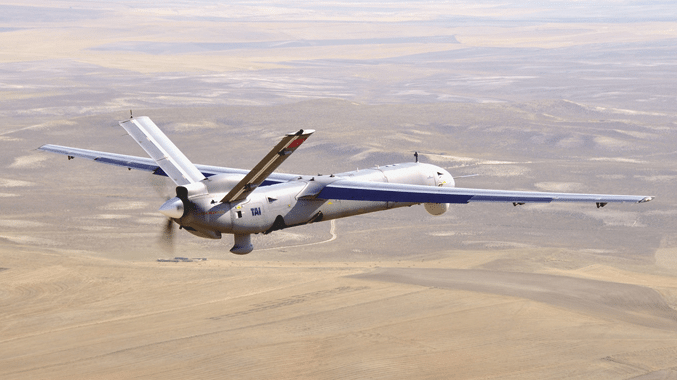
    But military ambition is meaningless without the capacity to match it and Türkiye has invested heavily in building that capacity. Let’s start with drones. If you’ve heard of the Bayraktar TB2, you’ll know it has become the poster child for Türkiye’s defense revolution. If not, ask the tanks it has neutralized. Affordable, lethal, and game-changing, these domestically produced unmanned aerial vehicles (UAVs) have been deployed with decisive effect in Ukraine, Syria, Libya, and Nagorno-Karabakh. Their success has disrupted the traditional model of air superiority, proving that agility and innovation can rival sheer size.

    And the TB2 was just the beginning. Türkiye’s drone ecosystem is now expanding rapidly, with high-altitude long-endurance platforms like Akıncı and next-generation jet-powered drones like Kızılelma in development. This isn’t just innovation it’s national determination in motion. Unlike traditional defense buyers that depend on foreign suppliers, Türkiye has embraced an indigenous production strategy. In the early 2000s, only 20% of its defense equipment was produced locally; today, that figure exceeds 87%. Missiles, armored vehicles, warships, and even fifthh generation fighter jets like the newly unveiled KAAN are now Turkish built. And this isn’t just about military autonomy; it’s about geopolitical leverage.

    When foreign partners like Germany withheld parts for tanks, Türkiye didn’t plead. It manufactured its own. The lesson: resilience in the face of restriction. Turkish defense exports surpassed $9 billion in 2024 estimated in 2025 to excide $12 billion , reaching over 170 countries. That’s not just an economic achievement it’s a strategic network embedded across continents.

    Beyond drones and exports, Türkiye maintains the second  most powerful largest standing army in NATO, with over 475,000 active personnel. But numbers are only part of the story. What sets Türkiye apart is its operational tempo. Unlike many Western militaries that rotate deployments infrequently, Türkiye’s forces have been  constantly active  since the Korean War or whether in Syria, Iraq, Libya, or Azerbaijan. This isn’t symbolic presence; it’s decisive engagement. And the Turkish Navy? Guided by the ambitious “Blue Homeland” doctrine, it now patrols the Mediterranean, Aegean, and Black Seas with increasing assertiveness leading to tense encounters with Greece, the South Cyprus administration, and even France. Turkish naval vessels likely used electronic countermeasures (ECM) to obscure the French ship’s tracking ability. The “Aselsan ARES-2N” and “EDM systems” on Turkish warships are designed to jam and deceive hostile radar or guidance systems. Such push back showed Turkish assertiveness in deep waters.

    One milestone: the TCG Anadolu, Türkiye’s domestically built aircraft carrier, designed to deploy drones yes, a drone carrier. Türkiye isn’t replicating old models. It’s shaping new ones.

    This global footpriint extends further. In Somalia, Türkiye has established its largest overseas base, training the Somali National Army. In Libya, Turkish forces altered the trajectory of the Tripoli government’s survival. In the Caucasus, Türkiye’s military support helped Azerbaijan prevail in the 2020 Nagorno-Karabakh conflict, sending a strong signal to both Russia and Iran. Each deployment expands Ankara’s political capital and strategic relevance.

    Yet, Türkiye’s new defanse posture has created a complex dynamic within NATO. It remains a member of the alliance hosting U.S. nuclear weapons while simultaneously purchasing Russian S-400 missile systems. It blocks NATO expansion at critical junctures, extracting political concessions, and at times charting an independent course that challenges alliance cohesion. But NATO cannot afford to dismiss Türkiye. Its geography, control over Black Sea access via the Bosphorus, militaary capabilities, and intelligence footprint make it indispensable. Türkiye is the unpredictable yet essential player like a star quarterback who insists on running his own plays.

    The bottom line remains: Türkiye is not merely building a modern military. It is reimagining the concept of state power. Prioritizing cost effective innovation over bloated prestige platforms. Embracing sovereignty in production over dependency. Deploying with purpose over symbolic alignment. This approach is working for now and it has positioned Türkiye as a pivotal force in 21st-century geopolitics.

    The paradox? In seeking autonomy, Türkiye has made itself more central to the global order. Its actions demand attention. Its choices shape regional trajectories. It is the chess player you underestimated one whose unorthodox moves continue to yield results at the table.

    So the next time you hear the buzz of a drone, glance up. If it says “Made in Türkiye,” know that it signals more than just technological prowess. It represents a country that no longer walks in anyone’s shadow a Türkiye that is ready to lead and ones in the region should be very careful in not pushing Turkiye.

    Because this is not our grandfather’s Türkiye any more.

    Ibrahim Kurtulus 
    Demirhisar Koyu – Rize – Cayeli 
    New York.

  • I Am the Turkish President’s Main Challenger. I Was Arrested.

    I Am the Turkish President’s Main Challenger. I Was Arrested.

    By Ekrem Imamoglu 

    Mr. Imamoglu was elected mayor of Istanbul in 2019. He wrote from Silivri Prison, outside of the city. 

    Early in the morning on March 19, dozens of armed police officers showed up at my door with a detention order. The scene resembled the capture of a terrorist, not of the elected mayor of Istanbul, Turkey’s largest city. 

    The move — four days before my party, the Republican People’s Party, was to hold a primary for the next presidential race — was dramatic but hardly unexpected. It followed months of escalating legal harassment of me, culminating in the abrupt revocation of my university diploma 31 years after I had graduated. Authorities seemed to believe this would disqualify me from the race because the constitution requires the president to have a degree in higher education. 

    Realizing he cannot defeat me at the ballot box, President Recep Tayyip Erdogan has resorted to other means: having his main political opponent arrested on charges of corruption, bribery, leading a criminal network and aiding the outlawed Kurdistan Workers’ Party, even though the charges lack credible evidence. I was suspended from my elected office over the financial charges. 

    For years, Mr. Erdogan’s regime has gnawed away at democratic checks and balances — silencing the media, replacing elected mayors with bureaucrats, sidelining the legislature, controlling the judiciary and manipulating elections. The large-scale arrests of protesters and journalists in recent months have sent a chilling message: No one is safe. Votes can be nullified and freedoms can be stripped away in an instant. Under Mr. Erdogan, the republic has been transformed into a republic of fear. 

    This is more than the slow erosion of democracy. It is the deliberate dismantling of our republic’s institutional foundations. My detention marked a new phase in Turkey’s slide into authoritarianism and the use of arbitrary power. A country with a long democratic tradition now faces the serious risk of passing the point of no return. 

    The crackdown extended beyond me. In a sweeping operation built on an indictment that is no more than a compilation of statements by secret witnesses, the police detained nearly 100 people, including senior municipal administrators and business figures. Disinformation and defamation campaigns in pro government media preceded the detentions. 

    Yet the people of Turkey responded with defiance. Despite a ban on protests and roadblocks on key entryways into cities, hundreds of thousands of citizens from Istanbul to the northeastern city of Rize, traditionally an Erdogan stronghold, took to the streets. Within hours and into the following days of my detention, people from all ages and backgrounds joined my party. Outside Istanbul’s municipal headquarters, people held vigils despite increasingly harsh measures and arrests. 

    Despite the crackdown, the Republican People’s Party successfully held its presidential primary on Sunday. The party’s tally showed that 15 million people, including 1.7 million registered party members, cast their votes for me as the party’s presidential candidate. 

    Since my election as mayor in 2019, I have faced nearly 100 investigations and a dozen court cases. From the implausible to the absurd, each charge has been part of a broader effort to wear me down, bar me from serving the people who elected me, remove me from office and eliminate me as a rival to Mr. Erdogan. 

    I have already run against candidates backed by Mr. Erdogan three times — twice in local elections for Istanbul in 2019 and once again last year — where he personally campaigned against me. I won every time. Now unable to defeat me in elections, he is using his grip on the judiciary to sideline a challenger who, according to recent polls, could win if the elections were held today. 

    So why did so many people take to the streets in the largest demonstrations since the Gezi Park protests in 2013? 

    Amid mounting injustice and a troubled economy, public frustration in Turkey has reached a boiling point. People are speaking out and rallying around me, a candidate who promises inclusion, justice and the hope of a better future. They 

    will not be silenced. But the public also recognized my arrest as an attempt to push Turkey further down the path of autocracy. 

    Even in repression, signs of solidarity endure. Social democratic leaders and mayors across Turkey and beyond, from Amsterdam to Zagreb, demonstrated their support, with courage and principle, after my arrest. Civil society, too, has not wavered. But central governments around the world? Their silence is deafening. Washington merely expressed “concerns regarding recent arrests and protests” in Turkey. With few exceptions, European leaders have failed to offer a strong response. 

    What is happening in Turkey and many other parts of the world demonstrates that democracy, the rule of law and fundamental freedoms cannot survive in silence, nor be sacrificed for diplomatic convenience disguised as “realpolitik.” 

    Undeniably, recent events — Russia’s war in Ukraine, the overthrow of the al Assad regime in our neighbor Syria and the devastation in Gaza — have enhanced Turkey’s strategic importance, not least given its critical capacity to help with European security. However, geopolitics should not blind us to the erosion of values, particularly human rights violations. Otherwise, we legitimize those who are dismantling the global rules-based order piece by piece. 

    The survival of democracy in Turkey is crucial not just for its people but also for the future of democracy worldwide. The age of the unchecked strongmen demands that those who believe in democracy be just as vocal, forceful and unrelenting as their opponents. Democracy’s fate depends on the courage of students, workers, other citizens, unions and elected officials — those who refuse to remain silent when institutions crumble. I have faith in the people of Turkey and beyond who fight for justice and democracy. 

    Ekrem Imamoglu letter to the NewYork Times

  • Massive Protests in Turkiye

    Massive Protests in Turkiye

    Massive Protests in Turkiye Threaten Erdogan’s Grip on Power

    Massive Protests in Turkiye Threaten Erdogan’s Grip on Power | Vantage with Palki Sharma | N18G

    Protests continued across Turkiye against the government of president Recep Tayyip Erdogan. The unrest, which was triggered by the arrest of Erdogan’s rival, has now expanded to other concerns around the economy and civil liberties. What does this mean for Erdogan’s political future? Is this the end of the road for the Turkish president? Palki Sharma tells you.

  • IMBRICS Forum Russia unites speakers from Turkey, China and Brazil

    IMBRICS Forum Russia unites speakers from Turkey, China and Brazil

    On August 27–28, 2024, Moscow hosted the IMBRICS FORUM — the VI International Municipal Forum of the BRICS Countries.

    The event has become an important platform for exchanging experiences and ideas between representatives of regional and municipal governments from the BRICS countries. It also helped build effective business communications with entrepreneurs from Russia and other partner countries.

    The forum included a round table discussion on the role of extracurricular education and international cooperation in children’s and youth education. Experience of BRICS cities and municipalities, which was devoted to discussing issues of children’s and youth recreation in camps, as well as extracurricular education. The event was attended by representatives of legislative and executive bodies of state power in Russia, heads of Russian and foreign children’s camps and non-profit organizations. In particular, the event was attended by Boris Chernyshov, Deputy Chairman of the State Duma of the Federal Assembly of the Russian Federation, Natalya Agre, Director of the Department of State Policy in the Sphere of Education, Supplementary Education and Children’s Recreation of the Ministry of Education of Russia, Sandra Goulart Urioste, Director of English Camp (Brazil), Fahrettin Gozet, President of the Canadian NGO International Camping Fellowship (ICF) Fahrettin Gozet (Turkey) and Nie Aijun, President of the Board of The Institute for Camp Education in China . The speakers delivered reports, shared their experience in organizing the area of ​​activity under consideration, and discussed existing initiatives to expand the activities of the camp movement and extracurricular education, including in the BRICS countries.

    The particular focus was on the Turkish speaker Fahrettin Gozet, who delivered a report on “Collaborative Initiatives Among BRICS Countries: Strengthening Youth Engagement”. In his report, he noted ICF as a key participant in strengthening cooperation between youth camps around the world, including the BRICS countries, whose mission is to strengthen youth engagement through joint initiatives. He explained how ICF programs and initiatives create opportunities for cooperation among BRICS countries in the field of youth engagement, using the strengths and resources of its international network. Fahrettin Gozet also gave examples of cooperation carried out with the assistance of ICF, such as a partnership between Russian and South African camps aimed at developing leadership skills and cultural exchange, promoting the involvement of youth across borders.

    As a result, the participants agreed on further interaction with each other, the implementation of joint projects aimed at developing extracurricular education.

  • A Fresh Example of Armenian Dirty Propaganda

    A Fresh Example of Armenian Dirty Propaganda

    By Azer HASRET

    We in Azerbaijan see and know what does mean Armenian fake propaganda because we face it at the everyday level and usually try to answer in a related manner. But the Armenian propaganda machine uses even any tiny shell to spread lies and fake information about Azerbaijan, Türkiye, and other Turkic countries…

    Now I’m providing an example of the fake propaganda action by Armenians once more.

    On August 1, 2024, there was a regular State Department Press Briefing at the White House. Vedant Patel, Principal Deputy Spokesperson made a brief introduction and afterwards answered the questions of journalists.

    Let’s see a question by a journalist (maybe Armenian, we don’t know):

    Question: “There are Armenian POWs in the jails of Azerbaijan for four years by now, and there are Armenian local politicians from Nagorno-Karabakh again in the prisons of Azerbaijan for nearly one year after Azerbaijan launched another unprovoked attack last fall. According to Freedom House, after Karabakh territory came under Azerbaijani control, Karabakh is the most unfree territory in the world. It’s worse than North Korea. It’s worse than Venezuela, Syria, Afghanistan, you name it”.

    This is the first part of the question. The person addressing the question claims that “there are Armenian POWs in the jails of Azerbaijan”.

    Are there any?

    Not of course! Because all POWs captured during the 44-day war of 2020 were returned to Armenia! Thus, Azerbaijan does not have any single Armenian POW at its disposal…

    But why does Armenian propaganda claim that Azerbaijan has the Armenian POWs?

    This is purely for propaganda purposes! Armenians know that they need to bring this issue to the attention of the world in a way where people can think that Azerbaijan is so inhumane and keeps POWs. Of course, many million people around the world do not know the realities in the region. Even most of them don’t know where Armenia is, who Armenians are, and so on. But propaganda works anyway…

    Then this very “journalist” quotes the Freedom House claiming that “Karabakh is the most unfree territory in the world. It’s worse than North Korea. It’s worse than Venezuela, Syria, Afghanistan”.

    Are we surprised?

    No!

    Because this very Freedom House is a propaganda tool as well to suppress new emerging democracies. This organization has been known for its pro-Armenian stance for dozens of years! It was and is supporting Armenian separatism while being silent about more than 250 thousand Azerbaijanis forcefully expelled from Armenia and those 750 thousand IDPs forced off from Karabakh by Armenian occupants!

    Just for a reminder, starting from 1988 Armenia expelled all Azerbaijanis from its territory. Hundreds of Azerbaijanis were killed, and their homes were looted by Armenians. This move served as the start of the Armenia-Azerbaijan conflict back in those years. Then Armenia occupied 20 percent of Azerbaijani lands early in the 1990s and forced out 750 thousand inhabitants! Azerbaijan managed to free its lands from Armenia’s occupation only after 30 years and during this movement, Armenian inhabitants (approximately 70 thousand people) voluntarily left Karabakh while Azerbaijan repeatedly asked them to stay…

    So why the Freedom House is claiming that Karabakh is the most unfree territory? Those 750 thousand Azerbaijanis need to return to Karabakh but can’t because Armenians have wiped off any single home in that territory. That’s why very few people live there and there can’t be any evolution regarding freedoms in that area. The lands freed from Armenian occupation are covered with landmines and even it’s dangerous to walk around.

    Let’s see why and how the Freedom House decided that “Karabakh is worse than North Korea”.

    Maybe because the Freedom House’s Vice President for Policy and Advocacy is Annie Wilcox Boyajian, whose husband is an Armenian for example?..

    This was the first part of the question of blackmailing Azerbaijan. But a “journalist” continues further with his attempt to blackmail Azerbaijan. Let’s see the second part of the question.

    Question: “So the question is whether you follow this situation with the collapse of liberties and civil society in Nagorno-Karabakh, if you have any comments on this, and is there anything that this administration can do to help the detained Armenians in – that are jailed in Azerbaijan, whether to – you can help them to release – to be released or assist in any other form? Thank you”.

    “Liberties and civil society in Nagorno-Karabakh”? Isn’t this a bit strange? Who can speak about the liberties and civil society in any territory that was under the occupation of a foreign country? In our case, we speak about the Azerbaijani Karabakh region which was under Armenia’s occupation for about 30 years and thus there couldn’t be any sign of liberties and civil society. But this Armenian propaganda mouthpiece claims that “liberties and civil society collapsed” in Karabakh…

    What is good, Vedant Patel’s answer was quite accurate, and the terms used were selected very carefully. Let’s see.

    MR PATEL: “So, on the context of the broader situation in the South Caucasus, this is something that the Secretary and the department continue to be deeply engaged on. I don’t have any updates for you as it relates to that process. And look, when it comes to detainees, we have been clear and consistent that any country needs to treat all detainees humanely, with dignity, and in accordance with international law, and needs to respect detainees’ human rights, and that continues to be true in this case as well”.

    No single word about the so-called POWs! And no mention of Azerbaijan!

    The State Department and the US Administration know quite well what is what in the South Caucasus!

    And now let’s be clear with those detainees to whom Vedant Patel is paying attention. Yes, Azerbaijan has Armenian detainees. But they are not the citizens of Armenia (except one) and none of them was captured during the war actions. All of them are tried for being a part of an organized crime against civilians which caused the killing of hundreds of people. At the same time, they are citizens of Azerbaijan of Armenian origin, and they need to answer for those killings before the court. This is very simple and understandable, and the US Administration and other major international actors have quite enough information about this…

    Now let’s pay attention to the report by Armenian media which claims that Vedant Patel spoke about “Armenian POWs”.

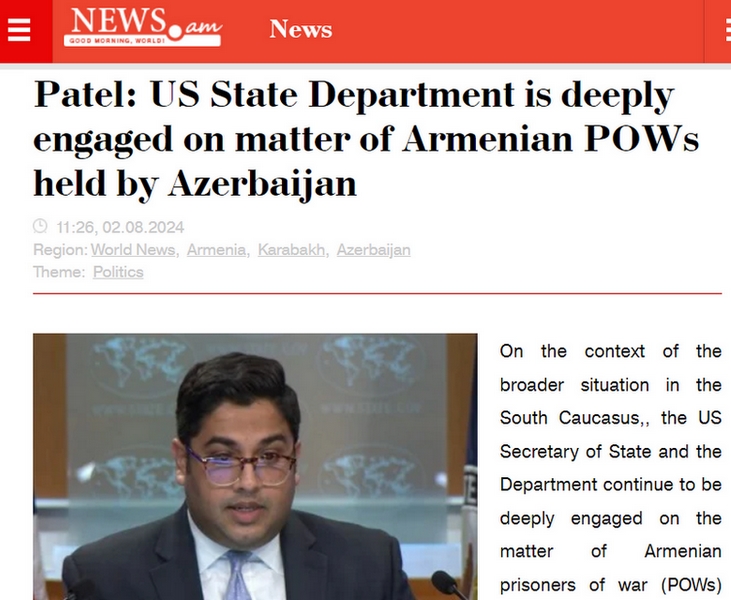
    The headline at the News.am reads: “Patel: US State Department is deeply engaged on matter of Armenian POWs held by Azerbaijan”.

    Further, the news reads: “On the context of the broader situation in the South Caucasus, the US Secretary of State and the Department continue to be deeply engaged on the matter of Armenian prisoners of war (POWs) being held in Azerbaijan. Vedant Patel, Principal Deputy Spokesperson of the US Department of State, noted about this at Thursday’s Department press briefing”.

    Did Vedant Patel use the wording like “Armenian prisoners of war (POWs) being held in Azerbaijan”?

    Not of course!

    We have quoted Vedant Patel’s answer to this question in full and as we mentioned above, he was quite accurate in using the terms. But the Armenian fake propaganda machine claims, that Vedant Patel spoke about “Armenian POWs”…

    So, this is a way how Armenian propaganda works. Most people who read Armenian-style “news” usually don’t investigate the origins. It is usual and understandable for all people around the world. Because those not engaged in politics and news-making are not professionals and they used to believe the media. And Armenians use this opportunity for their ugly propaganda…