Category: Main Issues

  • UN recognition of Armenian genocide (Whitaker Report)

    UN recognition of Armenian genocide (Whitaker Report)

    The Whitaker Report is not specifically related to the Armenian Genocide.

    The Whitaker Report is commonly associated with a different issue. It is often referred to as the “Whitaker Report on Genocide,” and it was prepared by Benjamin Whitaker, a British lawyer, for the United Nations in 1985. The report focused on the topic of genocide and the legal and practical measures that should be taken to prevent and punish it. It played a significant role in shaping the legal and political discourse surrounding genocide prevention and the eventual establishment of the International Criminal Court (ICC).

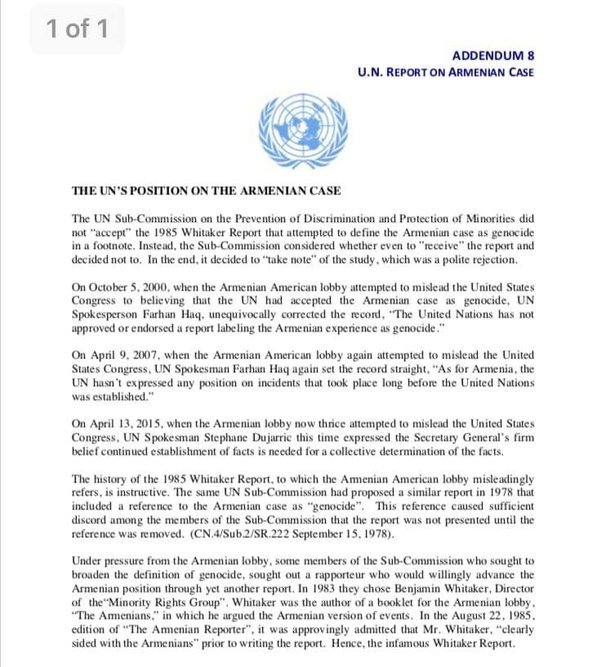
    The UN Sub commission did not accept the report, but decided to “receive” it.

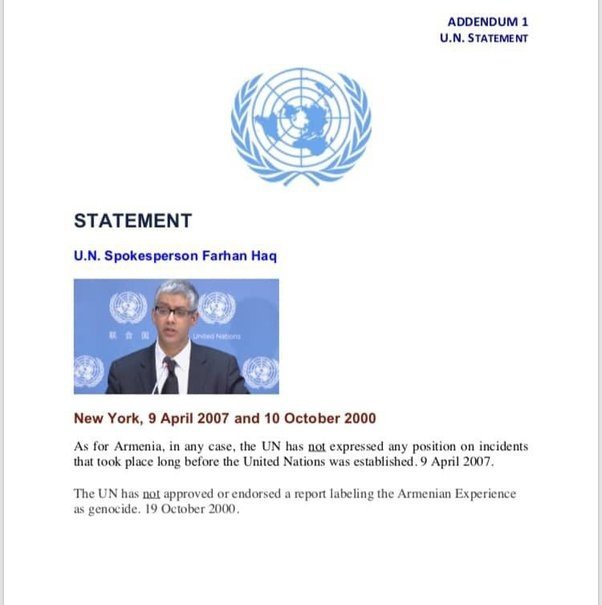
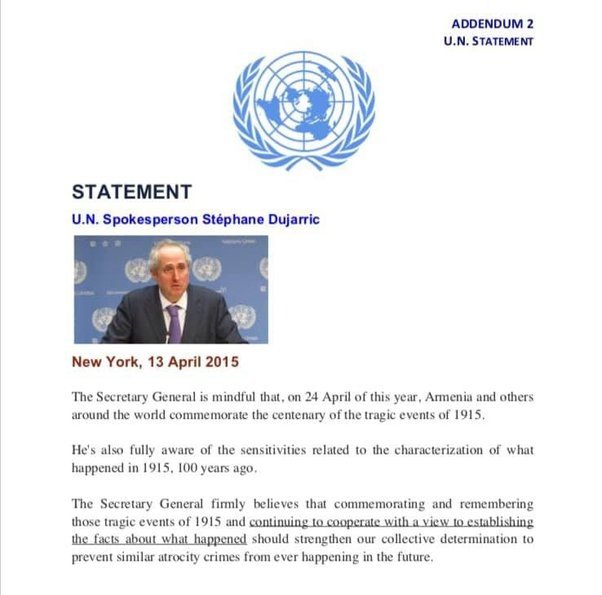
    Since 1985, the UN Spokesperson has three times declared that the UN does not accept the Armenian case as genocide.

    Of the seven independent organizations who provided their expert opinions, three were later to be found to be fronts for Armenian groups that support the Dashnaks.

    The Special Rapporteur (Whitaker) who snuck in the footnote later admitted that he had been retained by the Armenian lobby, but that he did not receive any money for his report. However, he later did work for the Armenian lobby for money.

    Whitaker report stated in paragraph 24 that:

    The Nazi aberration has unfortunately not been the only case of genocide in the twentieth century. Among other examples which can be cited as qualifying are the German massacre of Hereros in 1904, the Ottoman massacre of Armenians in 1915–1916, the Ukrainian pogrom of Jews in 1919, the Tutsi massacre of Hutu in Burundi in 1965 and 1972, the Paraguayan massacre of Ache Indians prior to 1974, the Khmer Rouge massacre in Kampuchea between 1975 and 1978, and the contemporary [1985] Iranian killings of Baha’is.
    — Whitaker Report, (paragraph 24)

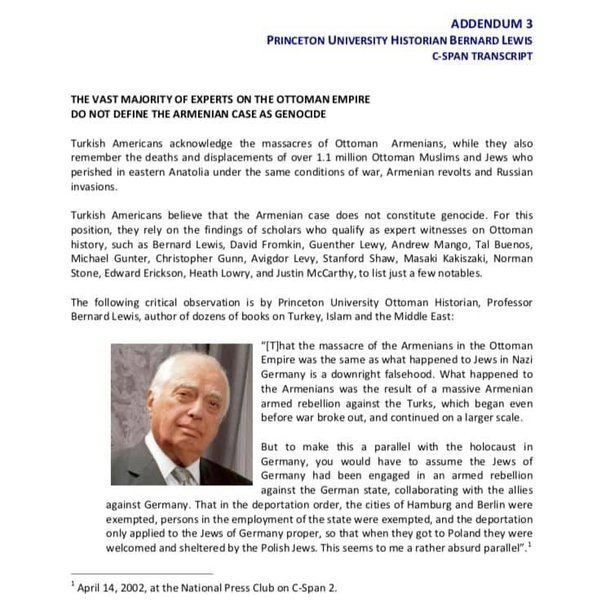
    The documents that show the UN does not accept the Armenian case as genocide are provided by Emre Serbest.

  • Letter of European Rabbis

    Letter of European Rabbis

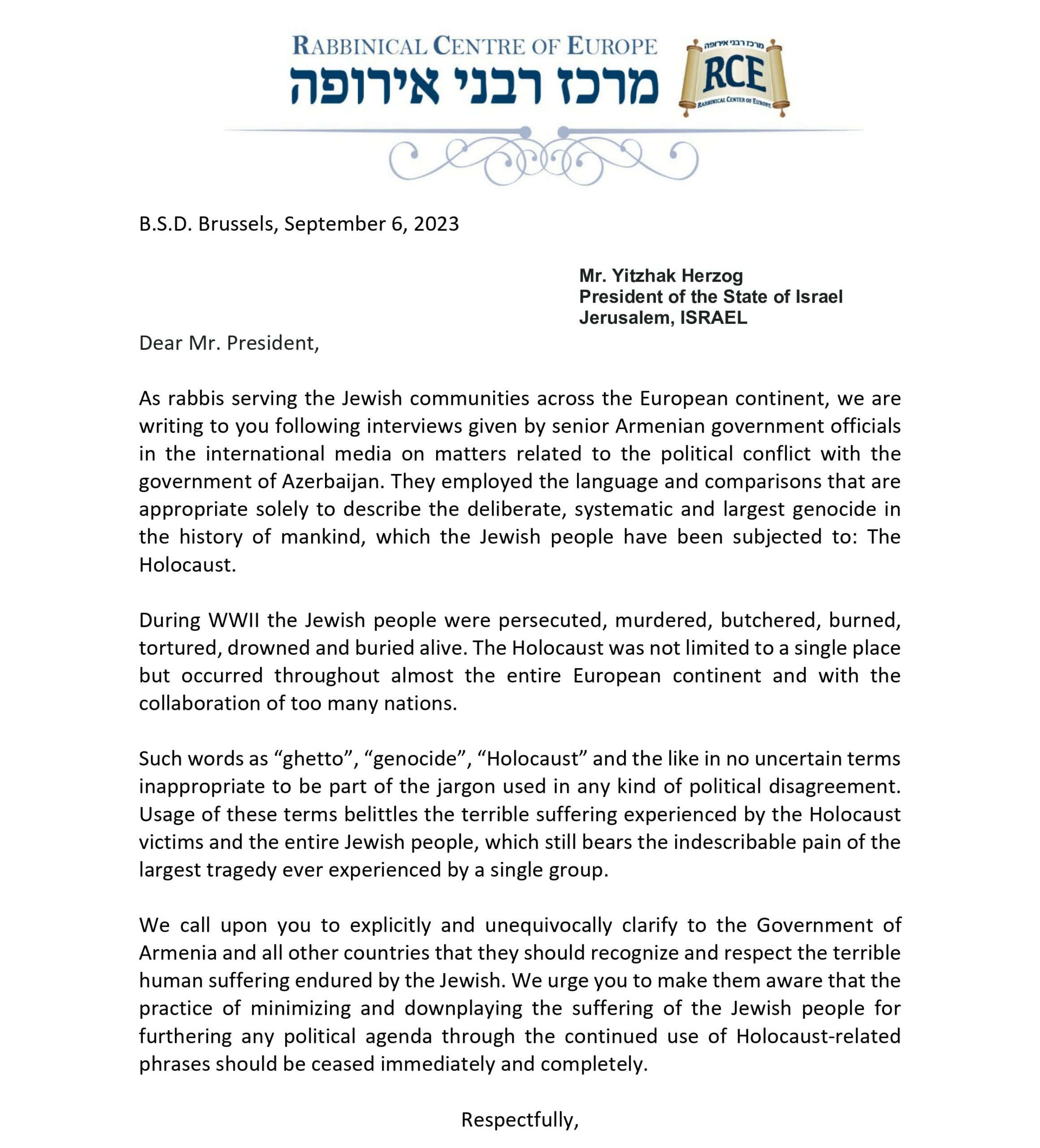
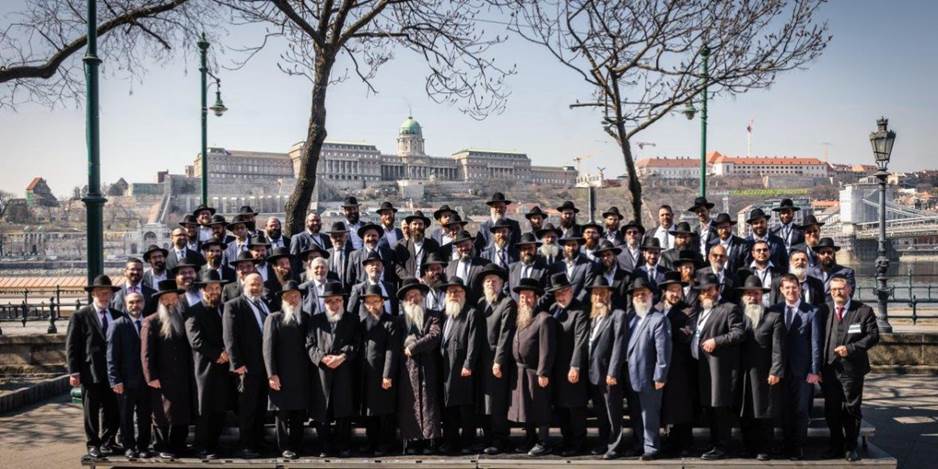
    A group of 50 senior leading European Rabbis have signed a joint letter condemning the leaders of Armenia for using holocaust rhetoric in its campaign against its neighbor, Azerbaijan.

    RABBINICAL CENTRE OF EUROPE
    RCE
    B.S.D. Brussels, September 6, 2023

    Mr. Yitzhak Herzog, President of the State of Israel, Jerusalem, ISRAEL

    Dear Mr. President,

    As rabbis serving the Jewish communities across the European continent, we are writing to you following interviews given by senior Armenian government officials in the international media on matters related to the political conflict with the government of Azerbaijan. They employed the language and comparisons that are appropriate solely to describe the deliberate, systematic and largest genocide in the history of mankind, which the Jewish people have been subjected to: The Holocaust.

    During WWII the Jewish people were persecuted, murdered, butchered, burned, tortured, drowned and buried alive. The Holocaust was not limited to a single place but occurred throughout almost the entire European continent and with the collaboration of too many nations.

    Such words as “ghetto”, “genocide”, “Holocaust” and the like in no uncertain terms inappropriate to be part of the jargon used in any kind of political disagreement. Usage of these terms belittles the terrible suffering experienced by the Holocaust victims and the entire Jewish people, which still bears the indescribable pain of the largest tragedy ever experienced by a single group.
    We call upon you to explicitly and unequivocally clarify to the Government of Armenia and all other countries that they should recognize and respect the terrible human suffering endured by the Jewish. We urge you to make them aware that the practice of minimizing and downplaying the suffering of the Jewish people for furthering any political agenda through the continued use of Holocaust-related phrases should be ceased immediately and completely.

    Respectfully,

  • BBC Was Biased and One-sided

    BBC Was Biased and One-sided

    By Azer HASRET

    Just a few days ago BBC World News aired an interview with two Armenian activists. One of them was connected live from Los Angeles, another one from Azerbaijani city of Khankendi.

    For those who is not quite enough familiar with the region of South Caucasus, Khankendi is a city within Karabakh Economic Region of Azerbaijan with the majority Armenian population. The city alongside with other parts of Karabakh and now Eastern Zangezur was under occupation of Armenia starting from early 1990s And the whole region was liberated by Azerbaijan during the 44-day war of 2020 provoked by Armenia to capture new lands.

    As Azerbaijan managed to end the war with total victory it has offered to local Armenians to stay and live in peace. Those days Armenian population of about 30-40 thousand people was ready for reconciliation. And under the control of the Russian peacekeepers, they started again to live usual life.

    Azerbaijan has kept open The Lachin Corridor for the Armenians of Karabakh to be in touch with Armenia as the region being under occupation of Armenia was connected to the latest. Thus, people have ties in Armenia, and they need to be in touch. Azerbaijan instead of being winner of the war, took into consideration this issue as well as a humanitarian need.

    But after some times Azerbaijan has discovered that Armenians are using The Lachin Corridor to carry in weapons and heavy army units in order to prepare for the new war. Alongside with this Azerbaijan managed to build completely new road connecting Karabakh’s center Khankendi with Armenia. Afterwards, a year ago the new road was open, and Armenians were happy to use this more suitable connection. But it was misused as well. That’s why Azerbaijan starting from April 23, 2023, installed new checkpoint at the border with Armenia in order to prevent illegal use of the road.

    Afterwards Armenians started to spread a propaganda, that Azerbaijan is “killing 120 thousand peaceful Armenians in Karabakh through starvation”. They call it even a new “genocide” again Armenians by Turks…

    But during these past months no single Armenian was killed due to starvation. And Azerbaijan did not close the road in full leaving it open for humanitarian needs. And by today as well Armenians are using the road in both directions to connect between Armenia and Azerbaijan Karabakh region. (Plus, Azerbaijan Red Crescent Society has sent 40 tons of wheat flour for Armenians in Karabakh which is still blocked by the Armenians and can’t be delivered to the people in need…)

    Instead of this situation Armenians are trying illegally pass through The Lachin Road. And Azerbaijan is preventing them from doing this. Plus, Armenian propaganda machine calls The Lachin Border Checkpoint “illegal installation”. According to their minds Azerbaijan must keep open its border with Armenia with no control. Is it possible? Or is there any country on the world which keeps its borders open with no checkpoints? Does Armenia itself keep its borders open to other countries as well? Not of course! But they demand that Azerbaijan must keep its borders open with no checkpoint for Armenians, even for others from foreign countries whom they wish to see in Karabakh!

    Now that was a small portion of the history or some kind of enlightenment for those who is not quite familiar with the region and the issues, which are misused by Armenian propaganda.

    As the situation is very clear, BBC World News a couple of days ago has aired and interview with two above mentioned Armenians. Of course, the media is and must be free to cover any issue. But even the BBC’s code of conduct requires to be balanced and impartial while airing any news or commentary.

    In BBC’s above-mentioned broadcast under the title “The Context” only one side was interviewed and given an opportunity to speak. And unfortunately, both interviewers were Armenians and both of them failed to speak in a fair manner. What did they do? Of course, they accused Azerbaijan for “killing and genociding 120 thousand Armenians of Karabakh through starvation”.

    We have noted that there are not 120 thousand Armenians in Karabakh. This is a small portion of population with a figure of between 30 to 40 thousand people.

    What was stranger and more unacceptable, the BBC presented an interviewer from Khankendi, Karabakh as a “Former Human Rights Ombudsman of the Republic of Artsakh”!

    “Republic of Artsakh”? Where is it? What is that? Does the world know about this so-called republic? Not of course! There is nothing called a “Republic of Artsakh” and no world country, no international organization recognizes such an entity. But the BBC, seems does “recognize” it…

    Of course, we could stop a bit on the wordings of the interviewers. But we don’t do that. Because it was alongside with official Armenian fake propaganda and based on the accusations towards Azerbaijan with no base!

    We understand Armenian propagandists. But it is not easy to understand the BBC which is to serve the truth and only truth.

    That’s why as a career journalist with about 30 years of professional activity and international practice I do accuse the BBC’s this kind of stance and call on this news media to air apology and refutation. Hope, that BBC will find enough courage to do this…

  • Could I get arrested for talking about the Armenian Genocide in Turkey?

    Could I get arrested for talking about the Armenian Genocide in Turkey?

    Irene Ols on Quora answered this question as follows:

    I will answer as an Armenian American, who visited Turkey, No, you are quite safe but when you visit any new country, you want to avoid talking about touchy political subjects with complete strangers. Most Turks are extremely welcoming to Armenians and consider them “one of our own” ethnicities. There are nationalist Turks who post here on Quora but those are an extreme minority. Most people, upon learning that you are Armenian, would normally mention something like “I am very sorry to what happened to Armenians”, “We miss having the rich Armenian culture here”, “All the beautiful homes in Istanbul were built by Armenians and Greeks” etc etc. But of course, you also have to show a non-belligerent behavior and act friendly. You would get a non-friendly attitude if you are showing one yourself today, not because of history.

  • VAN MASSACRE OF APRIL 20, 1915

    VAN MASSACRE OF APRIL 20, 1915

    TADA-FEYM WORKING GROUP ANNOUNCEMENT  ON
    VAN MASSACRE OF APRIL 20, 1915

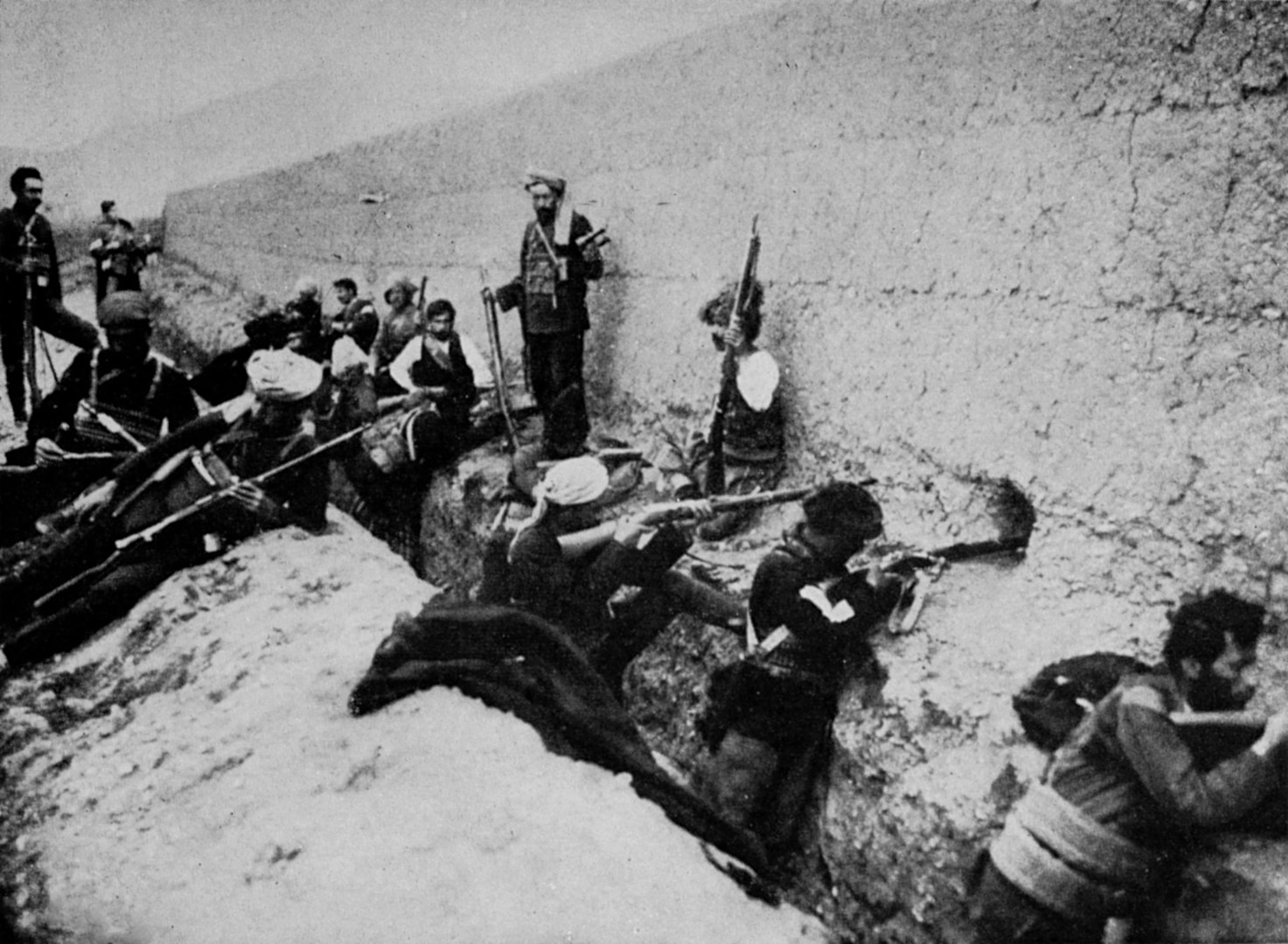
    On the 108 th anniversary of the vicious slaughter of 22,900 innocent Muslims at the provincial center of the City of Van on April 20, 1915 by mutinous Armenian gangs (Hunchak, Dashnak and alike), We, The Turkish People around the world, would like to commemorate our martyrs with compassion and love, bowing down in front of their honorable, loving memory with respect.

    The VAN massacre originates from the mutinous attitude fanatical Armenian gangs acquaired in the depths of history. Similar massacres committed by Armenians were witnessed throughout the Ottoman-Russian Wars of 1828 and 1877-78, due Armenians’ cooperation with the enemy, as well as other major massacres Armenians committed on their own.

    During the early phases of these Russian invasions, aiming the realization of Russia’s historical ambitions, some Armenians who knew the region very well as Ottoman citizens and whose second language was Turkish, led the Russian forces into Turkish territories, causing them to raid Turkish forces and massacre many Muslims. Armenians have repeated similar practices in the VAN MASSACRE.

    Due to the fact that Turkish men were engaged in the war efforts against invading enemy armies on six different battle-fronts during WWI, and that this situation created a vulnerability in the security forces of the region, Armenians who wanted to take advantage of this situation committed wide-scale massacres in Eastern villages and towns of Turkey, against the Muslim population. Armenians’ true intent was to reduce the numbers of the local Muslims, and thereby increase the ratio of the Christian population in the region, against Muslims. 

    Once the Tsarist Russian Army entered Eastern Anatolia, taking advantage of this weakest time of the Ottoman State, Armenians increased their terror activities in the City of Van with the purpose of gaining majority in the population of the city, while once more helping the invading Russian Army. Their massacres in the region peaked on April 20, 1915, at the centre of Van.

    During these massacres where 22,900 Muslims perished, extremely cruel and inhumane acts of murder took place on the Akdamar Island where a historic Armenian Church is located; Armenian gangs also committed all sorts of immoral acts against Muslim women and girls. Many girls and women ended up having to commit suicide by jumping into the Lake of Van in order to protect themselves, their honor and dignity against the Armenians’ sexual violence.

    Perhaps the best response to the groundless Armenian claims came from the Armenian Republic’s First Prime Minister, Hovhannes Katchaznouni, in his 1923 manifesto to the Armenian Revolutionary Federation’s (Dashnaktsutyun) Party Conference, in Bucharest. This manifesto of Katchaznouni, which has been removed from the libraries of the civilized(!) Western World by Armenian propagandists, blamed not the Turks but the Armenians as “the responsible party for the suffering of the Armenians”. He states that “the Armenians rebelled against their own state and committed treason by cooperating with the imperialist countries that occupied the Ottoman Empire”.

    Based on such Armenian confessions and the research of expert historian and demographer Prof. Justin McCarthy, we now know that 1,189,332 Muslims lost their lives in Anatolia during those years, mainly in the hands of rebellious Armenians.

    Considering Johanness Lepsius’ pre-WWI population numbers and numerous archival reports showing the number of Armenians surviving the war, we come to the conclusion that only around 83,000 Armenians lost their lives during the forced relocations of 1915. 

    Despite such true archival information, Armenian propaganda machine resorts to all kinds of intrigue and deceit, telling world public the biggest lie of all times – that 1.5 million Armenians were killed in the hands of Turks! They pursue policies similar to that of Hitler’s Propaganda Minister Joseph Goebbels. Every year, they engage in political activities to force the politicians around the world to pass meaningless, unbinding resolutions declaring April 24th as Armenian Genocide Remembrance Day.

    On the other hand, we wish the sane, impartial and fair people of the world would at least ask themselves the very question that French historian Prof Yves Bérnard asked himself once, when he gave the following title to one of his books: “Génocide Arménien: Et si on nous avait menti? (Armenian Genocide: What if they have lied to us?)”.

    According to the researches of Prof. McCarthy, apart from the human casualties they caused, the Armenian insurgents also destroyed all 3,400 buildings, except 3, in the province of Van, belonging to the Muslims, and left the region.

    With Regards and Respect,

    Uğur Kara
    Chairman
    TADA – Turkish Anti Defamation Alliance  

    Orhan Tan
    Chairman
    FEYM Group- Disproving False Armenian Claims
  • On the Burning of İzmir, 1922

    On the Burning of İzmir, 1922

    Shortened version of article “Revisiting the Fire of Izmir” published in Journal of South Asian and Middle Eastern Studies, V. 41, No. 1, Fall 2017.

    September 13, 2012 is the 90th anniversary of the “Inferno of Izmir” when a great fire broke out that destroyed more than three-fifths of the town. Some Western sources have wrongly placed the culpability for the fire on Turks that recaptured the city from occupying Greek army in September 1922. To that end, Governor George Pataki of New York, playing ethnic politics, shamelessly issued a proclamation in 2002 blaming Turks for the fire.

    Historical testimonials, however, clearly indicate that, while the retreating Greek army had a role in starting the fire, Armenian terrorists, dressed in Turkish uniforms, did the biggest damage.

    Atrocities by Greek and Armenian elements had actually started as early as mid-May 1919 right after the Greek landing in Izmir. Due to the pressure of the Entente’s representatives, the Greek High Command sentenced dozens of criminals in spring 1919; among the sentenced were 12 Armenians. The atrocities continued during the whole Greco-Turkish war, with Armenians participating in the violence and destruction. In a July 1922 report, Elzéar Guiffray, the administrator of the Izmir’s port, estimated that more than 150,000 Turks were killed, or “disappeared,” as a result of the Greek armed forces’ war crimes.

    The summer of 1922 was a culmination of the Greek scorched-earth policy. The Greek army forced the Christian population to leave, and burned everything, including houses of the Christians. This scorched-earth policy is established both by the report of Father Ludovic Marseille, chief of the Catholic mission in Eskișehir (who said that the Greeks had lost forever any right to speak about “Turkish barbarity”), and by a dispatch sent by the staff of USS Litchfield to Admiral Mark Bristol, the US High Commissionner at the American Embassy in Istanbul.

    According to a report by a the French Navy’s Intelligence Service (Izmir office), dated 15 November 1920, Armenians, both civilians and legionnaires, arrived in Izmir from Cilicia, engaged in arson, and tried to excite the Greek army against the Turkish population. (During the French occupation of Cilicia, the Armenian Legion committed so many crimes that the Legion itself was disbanded in disgrace [phrase used by French General Jules Hamelin in his mémoires] in summer 1920 and at least five Armenians and one Assyrian were hanged by the French military justice in July 1920 alone. The practice of arson by Armenians, especially in Adana, was a recurrent grievance in the French sources). Missionary Alexander MacLachlan, based on his investigation, also concluded that “Armenian terrorists, dressed in Turkish uniforms, set fire to the city.” The terrorists were evidently attempting to bring Western intervention.

    The Western sources clearly demonstrate that the attitude of the Turkish army during the final offensive was strikingly correct. For instance, General Pellé, the French High Commissioner in Istanbul, wrote on September 8, 1922, that since a long time, even the Greek patriarchate had not reported to him any “Kemalist massacre.”

    After a careful investigation made together with Admiral Charles Dumesnil, chief of the French Navy in the Near East, and other French representatives, French Consul General Michel Graillet of Izmir also concluded that “the Turkish army has clearly nothing to do with the arson,” and that “quite the contrary, it fought the fire to the extent of its meager resources.” Dumesnil knew the Turkish army from the Çanakkale battle where he had fought. If the irregulars (“çete”) of the Turkish army pillaged a house, they faced immediate execution.

    The Turkish army, in fact, had no reason to start fire in Izmir. The fleeing Greek army had abandoned huge quantities of military and food supplies that were desperately needed by the Turkish army and civilians. During several weeks after the fire, Turkish commanders were contemptuous of suggestions, made in a few quarters, that they had any responsibility for the burning. The commanders said that, considering what the Greeks had left behind, it would have been foolish of them to set fire to the city.

    In short, the “Inferno of Izmir” on September 13, 1922 was mainly committed by Armenian terrorists, but also aided by Greek elements.

    Maxime Gauin is a researcher and a Ph.D. candidate at the Department of History, Middle East Technical University.