Month: September 2010

  • CYPRUS (TRNC) : Another Anti-Turkish Bill PASSED House Of Represantatives

    CYPRUS (TRNC) : Another Anti-Turkish Bill PASSED House Of Represantatives

    Oldu bitti rezaleti. The Bill passed the House

    Bill Text Versions

    111th Congress (2009-2010)

    H.RES.1631

    There are 2 versions of Bill Number H.RES.1631 for the 111th Congress.

    Usually, the last item is the most recent.

    1 . Calling for the protection of religious sites and artifacts from

    and in Turkish-occupied areas of northern Cyprus as well as for

    general respect for religious freedom. (Introduced in House –

    IH)[H.RES.1631.IH][PDF]

    2 . Whereas the Government of Turkey invaded the northern area of the

    Republic of Cyprus on July 20, 1974, and the Turkish military

    continues to illegally occupy the territory to this day; (Engrossed in

    House [Passed House] – EH)[H.RES.1631.EH][PDF]

    ———————————————————————

    H.RES.1631 — Whereas the Government of Turkey invaded the northern area of the Republic of Cyprus on July 20, 1974, and the Turkish military continues to illegally occupy the territory to this day; (Engrossed in House [Passed House] – EH)
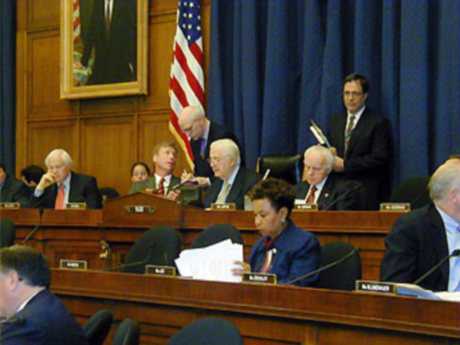
    HRES 1631 EH

    H. Res. 1631

    In the House of Representatives, U. S.,

    September 28, 2010.
    Whereas the Government of Turkey invaded the northern area of the Republic of Cyprus on July 20, 1974, and the Turkish military continues to illegally occupy the territory to this day;

    Whereas the Church of Cyprus has filed an application against Turkey with the European Court of Human Rights for violations of freedom of religion and association as Greek Cypriots in the occupied areas are unable to worship freely due to the restricted access to religious sites and continued destruction of the property of the Church of Cyprus;

    Whereas according to the United Nations-brokered Vienna III Agreement of August 2, 1975, `Greek-Cypriots in the north of the island are free to stay and they will be given every help to lead a normal life, including facilities for education and for the practice of their religion * * *’;

    Whereas according to the Secretary General’s Report on the United Nations Operation in Cyprus in June 1996, the Greek Cypriots and Maronites living in the northern part of the island `were subjected to severe restrictions and limitations in many basic freedoms, which had the effect of ensuring that inexorably, with the passage of time, the communities would cease to exist.’;

    Whereas the very future and existence of historic Greek Cypriot, Maronite, and Armenian communities are now in grave danger of extinction;

    Whereas the Abbot of the Monastery of the Apostle Barnabas is routinely denied permission to hold services or reside in the monastery of the founder of the Church of Cyprus and the Bishop of Karpass has been refused permission to perform the Easter Service for the few enclaved people in his occupied diocese;

    Whereas there are only two priests serving the religious needs of the enclaved in the Karpas peninsula, Armenians are not allowed access to any of their religious sites or income generating property, and Maronites are unable to celebrate the mass daily in many churches;

    Whereas in the past Muslim Alevis were forced out of their place of prayer and until recently were denied the right to build a new place of worship;

    Whereas under the Turkish occupation of northern Cyprus, religious sites have been systematically destroyed and a large number of religious and archaeological objects illegally looted, exported, and subsequently sold or traded in international art markets, including an estimated 16,000 icons, mosaics, and mural decorations stripped from most of the churches, and 60,000 archaeological items dating from the 6th to 20th centuries;

    Whereas at a hearing held on July 21, 2009, entitled `Cyprus’
    Religious Cultural Heritage in Peril’ by the U.S. Helsinki Commission, Michael Jansen provided testimony detailing first-hand accounts of Turkish soldiers throwing icons from looted churches onto burning pyres during the Turkish invasion and provided testimonies of how churches were left open to both looters and vandals with nothing done to secure the religious sites by the Turkish forces occupying northern Cyprus;

    Whereas Dr. Charalampos G. Chotzakakoglou also provided testimony to the U.S. Helsinki Commission that around 500 churches, monasteries, cemeteries, and other religious sites have been desecrated, pillaged, looted, and destroyed, including one Jewish cemetery;

    Whereas 80 Christian churches have been converted into mosques, 28 are being used by the Turkish army as stores and barracks, 6 have been turned into museums, and many others are used for other nonreligious purposes such as coffee shops, hotels, public baths, nightclubs, stables, cultural centers, theaters, barns, workshops, and one is even used as a mortuary;

    Whereas expert reports indicate that since 2004 several churches have been leveled, such as St. Catherine Church in Gerani which was bulldozed in mid-2008, the northern wall of the Chapel of St.
    Euphemianos in Lysi which was destroyed by looters as they removed all metal objects within the wall, the Church of the Holy Virgin in the site of Trachonas was used as a dancing school until the Turkish occupiers built a road that destroyed part of it in March 2010, the Church of the Templars was converted into a night club, and the Church of Panagia Trapeza in Acheritou village was used as a sheep stall before it was recently destroyed by looters removing metal objects from medieval graves within the church;

    Whereas the Republic of Cyprus discovered iron-inscribed crosses stolen from Greek cemeteries in the north in trucks owned by a Turkish-Cypriot firm that intended to send them to India to be recycled;

    Whereas United States art dealer Peggy Goldberg was found culpable for illegally marketing 6th century mosaics from the Panagia Kanakaria church because the judge found that a `thief obtains no title or right of possession of stolen items’ and therefore `a thief cannot pass any right of ownership * * * to subsequent purchasers.’;

    Whereas the extent of the illicit trade of religious artifacts from the churches in the Turkish occupied areas of northern Cyprus by Turkish black market dealer Aydin Dikmen was exposed following a search of his property by the Bavarian central department of crime which confiscated Byzantine mosaics, frescoes, and icons valued at over =30 million;

    Whereas a report prepared by the Law Library of Congress on the `Destruction of Cultural Property in the Northern Part of Cyprus and Violations of International Law’ for the U.S. Helsinki Commission details what obligations the Government of Turkey has as the occupying power in northern Cyprus for the destruction of religious and cultural property there under international law;

    Whereas the Hague Convention of 1954 for the Protection of Cultural Property During Armed Conflict, of which Turkey is a party, states in article 4(3) that the occupying power undertakes to `Prohibit, prevent and, if necessary, put a stop to any form of theft, pillage or misappropriation of any acts of vandalism directed against cultural property’;

    Whereas according to the 1970 United Nations Educational, Scientific and Cultural Organization (UNESCO) Convention on the Means of Prohibiting and Preventing the Illicit Import, Export and Transfer of Ownership which has been ratified by Cyprus and Turkey, parties are required to take steps to prevent illicit traffic through the adoption of legal and administrative measures and the adoption of an export certificate for any cultural object that is exported, and `illicit’
    refers to any export or transfer of ownership of cultural property under compulsion that arises from the occupation of a country by a foreign power;

    Whereas according to the European Court of Human Rights in its judgment in the case of Cyprus v. Turkey of May 10, 2001, Turkey was responsible for continuing human rights abuses under the European Convention on Human Rights throughout its 27-year military occupation of northern Cyprus, including restricting freedom of movement for Greek Cypriots and limiting access to their places of worship and participation in other aspects of religious life;

    Whereas the European Court further ruled that Turkey’s responsibility covers the acts of soldiers and subordinate local administrators because the occupying Turkish forces have effective control of the northern part of the Republic of Cyprus;

    Whereas in March 2008, President Christofias and former Turkish Cypriot leader Talat agreed to the setting up of a `Technical Committee on Cultural Heritage’ with a mandate to engage in `serious work’ to protect the varied cultural heritage of the entire island;

    Whereas this Committee was developing a list of all cultural heritage sites on the island to create an educational interactive program for the island’s youth to understand the shared heritage and to undertake a joint effort to restore the Archangel Michael Church and the Arnvut Mosque;

    Whereas while significant work was done on the Arnvut Mosque, the Archangel Michael Church remains in disrepair; and

    Whereas, on July 16, 2002, and again in 2007, the United States and the Government of the Republic of Cyprus signed a Memorandum of Understanding to impose import restrictions on categories of Pre-Classical and Classical archaeological objects, as well as Byzantine period ecclesiastical and ritual ethnological materials, from Cyprus: Now, therefore, be it

    Resolved, That the House of Representatives–
    (1) expresses appreciation for the efforts of those countries that have restored religious property wrongly confiscated during the Turkish occupation of northern Cyprus;
    (2) welcomes the efforts of many countries to address the complex and difficult question of the status of illegally confiscated religious art and artifacts, and urges those countries to continue to ensure that these items are restored to the Republic of Cyprus in a timely, just manner;
    (3) welcomes the initiatives and commitment of the Republic of Cyprus to work to restore and maintain religious heritage sites;
    (4) urges the Government of Turkey to–
    (A) immediately implement the United Nations Security Council Resolutions relevant to Cyprus as well as the judgments of the European Court of Human Rights;
    (B) work to retrieve and restore all lost artifacts and immediately halt destruction on religious sites, illegal archaeological excavations, and traffic in icons and antiquities; and
    (C) allow for the proper preservation and reconstruction of destroyed or altered religious sites and immediately cease all restrictions on freedom of religion for the enclaved Cypriots;
    (5) calls on the United States Commission on International Religious Freedom to investigate and make recommendations on violations of religious freedom in the areas of northern Cyprus under control of the Turkish military;
    (6) calls on the President and the Secretary of State to include information in the annual International Religious Freedom and Human Rights reports on Cyprus that detail the violations of religious freedom and humanitarian law including the continuous destruction of property, lack of justice in restitution, and restrictions on access to holy sites and the ability of the enclaved to freely practice their faith;
    (7) calls on the State Department Office of International Religious Freedom to address the concerns and actions called for in this resolution with the Government of Turkey, OSCE, the United Nations Special Rapporteur on Freedom of Religion or Belief, and other international bodies or foreign governments;
    (8) urges OSCE to ensure that member states do not receive stolen Cypriot art and antiquities; and
    (9) urges OSCE to press the Government of Turkey to abide by its international commitments by calling on it to work to retrieve and restore all lost artifacts, to immediately halt destruction on religious sites, illegal archaeological excavations, and traffic in icons and antiquities, to allow for the proper preservation and reconstruction of destroyed or altered religious sites, and to immediately cease all restrictions on freedom of religion for the enclaved Cypriots.

  • One day Turkey will run the EU

    One day Turkey will run the EU

    28 September 2010 Die Presse Vienna

    Hassan Bleibel, Al Mustaqbal (Beirut)

    Turkey isn’t even a member yet, but deputy prime minister Ali Babacan is already demanding a leading role in Europe for his country. All you have to do is look at Turkey’s economic and demographic growth to see it’s likely to get what it wants, says Die Presse

    Wolfgang Böhm

    “When Turkey becomes a member of the EU, it is not going to be in a secondary position, that’s one of the reasons why countries like Germany and France are quite nervous about our membership,” Turkish vice-premier Ali Babacan declared at a World Leadership Forum in New York during the recent UN plenary session.

    And Turkey’s claim to a leading role in the EU is based on hard facts. With economic growth set to hit 7% this year, near-inexhaustible human resources, and mounting clout as a hub of international oil and gas pipelines, Turkey has recently moved into the European fast lane.

    At present, Turkey is the 17th biggest economy in the world. Experts predict that in 20 years it will make the top ten, outstripping countries like Spain and Italy. According to forecasts by the IIASA (International Institute for Applied Systems Analysis) and the Vienna Institute of Demography, the Turkish population will be around 85.5 million by then – surpassing Germany, now the most populous nation in the EU.

    If Turkey were to be admitted into the EU despite resistance from countries like Austria, Germany and France, it would dominate policy in the EU institutions. Even as things are today, Turkey would be the second biggest political force in the European Parliament and on an equal footing with the heavyweights on the EU Council.

    Although the EU power structure will have to be gradually adjusted under the rules of the Lisbon Treaty, not much would change for Turkey. By dint of its rapid demographic growth, Ankara’s influence would actually increase, since the number of seats in Parliament and the new representation ratios in the Council will essentially be based on population size.

    Given its size, Turkey could not only push EU decisions through with ease, it would also be able to block those that are not to its liking. The Lisbon Treaty provides that as of 2014, countries whose combined populations exceed 35% of the EU population may constitute a blocking minority. That means Ankara could join forces with, say, London, Madrid and Warsaw to thwart any step backed by Paris and Berlin – which would jam the prevailing German-French axis.

    What would change politically in the event of Turkish accession? With Turkey on board, European diplomats say, EU foreign and security policy would be even more heavily US-geared. In matters of commerce, Ankara would probably favour free trade more than the EU members do now. Ankara would, in all likelihood, get behind efforts to cooperate more closely on internal security – even while downplaying certain civil rights such as the protection of private data.

    Babacan argued in New York that letting Turkey in would boost the EU’s standing on the world scene. “The weight of the European economy in the world has shrunk and will continue to shrink. And only with enlargement will the EU be able to protect its power and influence.”

    An opinion seconded by Gerhard Schröder in Die Welt’s online edition. “Without Turkey the EU will sink into mediocrity,” writes the Social Democrat ex-chancellor, pointing to the rapid pace of growth there: this year alone the Turkish economy will grow four times as much as the French and twice as much as the German economy. Schröder expects Turkey to be the fourth or fifth biggest European economy in 20 years. Then there will be no ignoring it.

    Translated from the German by Eric Rosencrantz

  • Europe Plots Show al-Qaida ‘Escalation’ to Assault-Style Attacks

    Europe Plots Show al-Qaida ‘Escalation’ to Assault-Style Attacks

    By: David A. Patten

    Intelligence experts warned Wednesday that the massive terror plot involving simultaneous assault-style attacks in London, Paris, and Germany represents a serious escalation in al-Qaida’s war with the West, and poses a clear and present danger to the United States.

    European counterterrorism officials are describing the plan of attack as being modeled on the November 2008 assault in Mumbai, India. In that attack, several teams fanned out across the city and used explosives and automatic weapons to kill over 170 people.

    Der Spiegel is reporting a 36-year-old Hamburg man who was arrested in Kabul in July provided authorities with intelligence about a series of attacks planned for Germany and neighboring European countries. He stated several teams of attackers bearing European passports had received training in remote Waziristan and Pakistan.

    The plot is believed related to heightened security around the Eiffel Tower, which has been closed to tourists twice in the past week.

    “It’s completely certain that at some point, something like that will happen here,” Michael Scheuer, former CIA counterterrorism expert who headed the unit assigned to capture or kill Osama bin Laden. “It’s not only because you have increasing numbers of young Muslim males who are U.S. citizens who want to act violently, but we have completely neutered our police forces because they have 12 million undocumented aliens that they have to worry about, and they don’t know a thing about them.

    “So it’s a huge problem,” Scheuer says, “and not an easy one by any means.”

    ForeignPolicy.com reported the plot disrupted Tuesday involved “simultaneous Mumbai-style attacks — with coordinated attackers taking hostages, using guns and grenades — on cities in the U.K., France, and Germany.”

    Author Steve Emerson, one of the nation’s leading experts on terror, and the executive director of The Investigative Project on Terrorism, tells Newsmax that if al-Qaida is shown to be behind the series of attacks that were planned in Europe, “It would represent an escalation, as well as of course an expansion and diversification of their tactics, considering the success achieved in Mumbai.”

    Several sources say the plot to attack Europe recently shifted into an operational stage in Pakistan. The CIA has conducted a record number of drone strikes in Pakistan in the past month in an apparent bid to disrupt the attackers.

    Homeland Security Secretary Janet Napolitano would not address specific threats but told Fox News Wednesday, “We are working constantly to make sure the American people are safe, and that includes plots against soft targets like hotels.”

    “We certainly have to be on the lookout for Mumbai-style attacks with bombs or assault rifles, at simultaneous institutions or commercial facilities in the United States,” Emerson tells Newsmax. “That certainly could be pulled off.”

    The Wall Street Journal is reporting that U.S. counterterrorism officials are working urgently to determine if the European plots also involve an immediate threat to the United States.

    “You have folks increasingly concerned about: Is it not just Europe that needs to be careful, but is there a threat here as well?” one U.S. counterterrorism official told the Journal.

    Intelligence sources are saying it has been years since a plot on the scale of the European assault has been uncovered.

    “This isn’t just your typical Washington talk about how the threats have evolved,” a counterterrorism official told the Journal. “People are very concerned about what they’re seeing.”

    In some ways, experts say, the latest plot suggests terrorists learned from the relatively simple, brutally effective assault carried out in Mumbai.

    Experts continue to believe al-Qaida’s chief objective is to carry out an attack on American soil using weapons of mass destruction. But the apparent shift to simultaneous assaults with explosives and automatic weapons, presumably targeting “soft targets” such as hotels, tourist attractions, and mass transportation hubs, shows the organization is also interested in attacks that aren’t as lethal, but can be much more difficult to detect.

    Andrew McCarthy, the former assistant U.S. attorney who led the 1995 prosecution of “Blind Sheik” Omar Abdel-Rahman, points out the 9/11 attacks took over 18 months to carry out.

    “An armed assault, while it’s not likely to result in the same number of casualties, is easier in the United States to train for. There are lots of remote areas to train in. The training curve is not as high to get someone ready to carry out an attack like that,” he says.

    McCarthy also tells Newsmax: “Even if the attackers are not particularly competent, we saw in Fort Hood that one guy shooting a high-powered weapon in kind of a haphazard fashion can still kill a lot of people in a very short period of time.”

    Kent Clizbe, a former CIA counterterrorism operative, agrees with McCarthy that one reason terrorists may be shifting their tactics to armed assaults is that larger plots have proven too difficult.

    “I think the only thing that’s surprising is that they have not done it here yet,” he says. “You look at the relative ease with which you can acquire firearms. You can buy a semi-automatic AK-47 pretty easily here.”

    Clizbe adds that it may be no coincidence the plot occurs as the Iraq war winds down. That conflict, he says, acted like “fly paper” to keep many violent extremists occupied in the Middle East.

    “We have a supply and demand problem,” Clizbe says. “You have supply building up and up, and they want to do an attack. So the further and further away we get in time from the Iraq war, the more supply of jihadis there is.”

    Mark Lowenthal, former CIA assistant director and president of Intelligence & Security Academy, a national security training and consulting firm, tells Newsmax that the nature of the thwarted European attacks may actually indicate progress in the war on terror.

    “We’re driving these guys to smaller, less coordinated, less catastrophic action,” he says. “That doesn’t mean it’s over. But it shows we’re making their lives more operationally difficult.

    “It also means that the intelligence problem becomes more difficult. But clearly at this point the intelligence is working, or you wouldn’t have all these warnings.”

    Fred Burton, the vice president of intelligence for the STRATFOR intelligence group in Austin, Texas, agrees wholeheartedly.

    “It’s our assessment that al-Qaida no longer poses a strategic threat to the United States,” he tells Newsmax. “Now that doesn’t mean that they still can’t kill. But if you look at their target sets, and if you look at the series of attacks that we’ve had in the United States — such as the Little Rock National Guard shooter, Major Hasan at Fort Hood, the attempt to blow up the airplane on the inbound flight into Detroit — you’ve got very isolated lone-wolf operations that are clearly jihadi inspired. But you’re not going to be able to carry out that kind of WMD attack on U.S. soil.”

  • Turkey and Russia: Cleaning up the Mess in the Middle East

    Turkey and Russia: Cleaning up the Mess in the Middle East

    There has been no magic hand guiding Turkey and Russia as they form the axis of a new political formation. Turkey, once the ‘sick man of Europe’, is now ‘the only healthy man of Europe’, notes Eric Walberg.

    The neocon plan to transform the Middle East and Central Asia into a pliant client of the US empire and its only-democracy-in-the-Middle-East is now facing a very different playing field. Not only are the wars against the Palestinians, Afghans and Iraqis floundering, but they have set in motion unforeseen moves by all the regional players.

    The empire faces a resurgent Turkey, heir to the Ottomans, who governed a largely peaceful Middle East for half a millennium. As part of a dynamic diplomatic outreach under the Justice and Development Party (AKP), Turkey re-established the Caliphate visa-free tradition with Albania, Jordan, Lebanon, Libya and Syria last year. In February Turkish Culture and Tourism Minister Ertugrul Gunay offered to do likewise with Egypt. There is “a great new plan of creating a Middle East Union as a regional equivalent of the European Union” with Turkey, fresh from a resounding constitutional referendum win by the AKP, writes Israel Shamir.

    Turkey also established a strategic partnership with Russia during the past two years, with a visa-free regime and ambitious trade and investment plans (denominated in rubles and lira), including the construction of new pipelines and nuclear energy facilities.

    Just as Turkey is heir to the Ottomans, Russia is heir to the Byzantines, who ruled a largely peaceful Middle East for close to a millennium before the Turks. Together, Russia and Turkey have far more justification as Middle Eastern “hegemons” than the British-American 20th century usurpers, and they are doing something about it.

    In a delicious irony, invasions by the US and Israel in the Middle East and Eurasia have not cowed the countries affected, but emboldened them to work together, creating the basis for a new alignment of forces, including Russia, Turkey, Syria and Iran.

    Syria, Turkey and Iran are united not only by tradition, faith, resistance to US-Israeli plans, but by their common need to fight Kurdish separatists, who have been supported by both the US and Israel. Their economic cooperation is growing by leaps and bounds. Adding Russia to the mix constitutes a like-minded, strong regional force encompassing the full socio-political spectrum, from Sunni and Shia Muslim, Christian, even Jewish, to secular traditions.

    This is the natural regional geopolitical logic, not the artificial one imposed over the past 150 years by the British and now US empires. Just as the Crusaders came to wreak havoc a millennium ago, forcing locals to unite to expel the invaders, so today’s Crusaders have set in motion the forces of their own demise.

    Turkey’s bold move with Brazil to defuse the West’s stand-off with Iran caught the world’s imagination in May. Its defiance of Israel after the Israeli attack on the Peace Flotilla trying to break the siege of Gaza in June made it the darling of the Arab world.

    Russia has its own, less spectacular contributions to these, the most burning issues in the Middle East today. There are problems for Russia. Its crippled economy and weakened military give it pause in anything that might provoke the world superpower. Its elites are divided on how far to pursuit accommodation with the US. The tragedies of Afghanistan and Chechnya and fears arising from the impasse in most of the “stans” continue to plague Russia’s relations with the Muslim Middle East.

    Since the departure of Soviet forces from Egypt in 1972, Russia has not officially had a strong presence in the Middle East. Since the mid- 1980s, it saw a million-odd Russians emigrate to Israel, who like immigrants anywhere, are anxious to prove their devotion and are on the whole unwilling to give up land in any two-state solution for Palestine. As Anatol Sharansky quipped to Bill Clinton after he emigrated, “I come from one of the biggest countries in the world to one of the smallest. You want me to cut it in half. No, thank you.” Russia now has its very own well-funded Israel Lobby; many Russians are dual Israeli citizens, enjoying a visa-free regime with Israel.

    Then there is Russia’s equivocal stance on the stand-off between the West and Iran. Russia cooperates with Iran on nuclear energy, but has concerns about Iran’s nuclear intentions, supporting Security Council sanctions and cancelling the S-300 missile deal it signed with Iran in 2005. It is also increasing its support for US efforts in Afghanistan. Many commentators conclude that these are signs that the Russian leadership under President Dmitri Medvedev is caving in to Washington, backtracking on the more anti-imperial policy of Putin. “They showed that they are not reliable,” criticised Iranian Defence Minister Ahmad Vahidi.

    Russia is fence-sitting on this tricky dilemma. It is also siding, so far, with the US and the EU in refusing to include Turkey and Brazil in the negotiations over Iran’s nuclear programme. “The Non-Aligned countries in general, and Iran in particular, have interpreted the Russian vote as the will on the part of a great power to prevent emerging powers from attaining the energy independence they need for their economic development. And it will be difficult to make them forget this Russian faux pas,” argues Thierry Meyssan at voltairenet.org.

    Whatever the truth is there, the cooperation with Iran and now Turkey, Syria and Egypt on developing peaceful nuclear power, and the recent agreement to sell Syria advanced P-800 cruise missiles show Russia is hardly the plaything of the US and Israel in Middle East issues. Israel is furious over the missile sale to Syria, and last week threatened to sell “strategic, tie-breaking weapons” to “areas of strategic importance” to Russia in revenge. On both Iran and Syria, Russia’s moves suggest it is trying to calm volatile situations that could explode.

    There are other reasons to see Russia as a possible Middle East powerbroker. The millions of Russian Jews who moved to Israel are not necessarily a Lieberman-like Achilles Heel for Russia. A third of them are scornfully dismissed as not sufficiently kosher and could be a serious problem for a state that is founded solely on racial purity. Many have returned to Russia or managed to move on to greener pastures. Already, such prominent rightwing politicians as Moshe Arens, political patron of Israeli Prime Minister Benjamin Netanyahu, are considering a one-state solution. Perhaps these Russian immigrants will produce a Frederik de Klerk to re-enact the dismantling of South African apartheid.

    Russia holds another intriguing key to peace in the Middle East. Zionism from the start was a secular socialist movement, with religious conservative Jews strongly opposed, a situation that continues even today, despite the defection of many under blandishments from the likes of Ben Gurion and Netanyahu. Like the Palestinians, True Torah Jews don’t recognise the “Jewish state”.

    But wait! There is a legitimate Jewish state, a secular one set up in 1928 in Birobidjan Russia, in accordance with Soviet secular nationalities policies. There is nothing stopping the entire population of Israeli Jews, orthodox and secular alike, from decamping to this Jewish homeland, blessed with abundant raw materials, Golda Meir’s “a land without a people for a people without a land”. It has taken on a new lease on life since the collapse of the Soviet Union. Russian President Dmitri Medvedev made an unprecedented visit this summer, the first ever of a Russian (or Soviet) leader and pointed out the strong Russian state support it has as a Jewish homeland where Yiddish, the secular language of European Jews (not sacred Hebrew), is the state language.

    There has been no magic hand guiding Turkey and Russia as they form the axis of a new political formation. Rather it is the resilience of Islam in the face of Western onslaught, plus — surprisingly — a page from the history of Soviet secular national self-determination. Turkey, once the “sick man of Europe”, is now “the only healthy man of Europe”, Turkish President Abdullah Gul was told at the UN Millennium Goals Summit last week, positioning it along with the Russian, and friends Iranian and Syrian to clean up the mess created by the British empire and its “democratic” offspring, the US and Israel.

    While US and Israeli strategists continue to pore over mad schemes to invade Iran, Russian and Turkish leaders plan to increase trade and development in the Middle East, including nuclear power. From a Middle Eastern point of view, Russia’s eagerness to build power stations in Iran, Turkey, Syria and Egypt shows a desire to help accelerate the economic development that Westerners have long denied the Middle East — other than Israel — for so long. This includes Lebanon where Stroitransgaz and Gazprom will transit Syrian gas until Beirut can overcome Israeli-imposed obstacles to the exploitation of its large reserves offshore.

    Russia in its own way, like its ally Turkey, has placed itself as a go-between in the most urgent problems facing the Middle East — Palestine and Iran. “Peace in the Middle East holds the key to a peaceful and stable future in the world,” Gul told the UN Millennium Goals Summit — in English. The world now watches to see if their efforts will bear fruit.

    Eric Walberg writes for Egypt’s Al-Ahram Weekly. You can reach him at .

    , 30.09.2010

  • Turkey urges EU for direct trade with Turkish Cyprus

    Turkey urges EU for direct trade with Turkish Cyprus

    Turkey’s chief negotiator in EU accession talks urged the European Parliament to approve a legislation that would allow direct trade with Turkish Cyprus.
    Turkey’s chief negotiator in country’s European Union accession talks on Wednesday urged the European Parliament to approve a legislation that would allow direct trade between EU member states and the Turkish Republic of Northern Cyprus (TRNC).

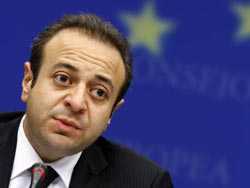
    “The moment EU vessels dock at the Turkish Cypriot ports, our ports in Turkey will open their doors to the vessels of all EU member states,” Egemen Bagis told reporters.

    The EU calls on Turkey to open its harbors and airports to all traffic from the Greek Cypriot administration in line with an additional protocol to the country’s customs union agreement.

    Turkey says it will not remove limitations on the Greek Cypriot ships unless the EU ends a similar embargo on the TRNC, as the Union pledged after Turkish Cypriots agreed to a 2004 UN-brokered plan to reunify the island.

    “The Direct Trade Regulation would also help resolve the Cyprus issue by closing the income gap between the Turkish Cypriots and the Greek Cypriots,” Bagis also said.

    AA, 29 September 2010

  • Former police chief in Turkey detained over ties to leftist group

    Former police chief in Turkey detained over ties to leftist group

    From Yesim Comert, CNN

    Istanbul, Turkey (CNN)The author of a controversial book in Turkey was detained on Tuesday after failing to comply with an order to testify on his suspected ties to an outlawed leftist group, a semi-official news agency reported.

    Hanefi Avci was taken into custody in Ankara in the morning hours and was escorted by plane to Istanbul to appear before public prosecutor Kadir Altinisik, the semi-official Anatolian Agency reported. The Istanbul High Criminal Court on Tuesday evening ordered his arrest.

    Altinisik refused to talk to CNN, and Anatolian Agency reported that Avci exercised his right to remain silent during his questioning by the prosecutor.

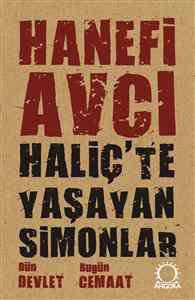
    The arrest comes a month after the publication of Avci’s controversial and best-selling book — “Devotee Residents of Haliç: Yesterday State, Today Religious Congregation,” Avci is a former police chief of Turkey’s Eskisehir province.

    In his book, Avci claimed that a religious community has gained control of important state institutions and has illegally been tapping telephones, including his.

    The leader of the community, Fethullah Gulen, a preacher who has resided in the United States since 2000, is one of the most influential religious figures in Turkey.

    Avci was to be questioned as a part of the investigation after the arrest of members of the outlawed “Revolutionary Headquarters” last week in a series of operations.

    TV news images showed Avci in the plane and being brought to court.

    In a written statement that was sent to press before he was detained, Avci denied having any ties to the “Revolutionary Headquarters.”

    “They can take me by force but I will never go willingly. I will not bow down in front of anyone or any institution that acts within the plan of the religious group [the Gulen movement] I will not answer any of the questions of the judiciary that I do not believe to be acting according to the laws of the state.”

    http://edition.cnn.com/2010/WORLD/europe/09/29/turkey.arrest/, September 29, 2010