Having received unequivocal backing from voters in the constitutional referendum, the governing Justice and Development Party (AKP) has moved to address Turkey’s structural problems, most notably the Kurdish question, through a combination of domestic measures, as well as regional and international diplomacy.
The resolution of the Kurdish issue has been one of the main targets of the AKP government. The AKP first sought to address this issue through domestic political reforms in the early 2000’s, also benefiting from the relative calm prevailing in southeastern Anatolia, thanks to the outlawed Kurdistan Workers Party (PKK) suspending its operations. However, granting greater cultural rights to the Kurds as part of Turkey’s EU accession process or devising socio-economic policies proved to be ineffective. The threat posed by the PKK’s separatist terrorism lingered, as the organization managed to maintain its manpower in safe havens in Northern Iraq.
The PKK’s resumption of its campaign of violence in the second half the decade caught Ankara by surprise, triggering a heated debate. Faced with the PKK’s deadly attacks against Turkish military outposts from its bases in Northern Iraq, the AKP bowed to pressure and considered seriously pursuing stronger military measures to tackle this problem. Coordinating its policies with the US and the Northern Iraqi Kurdish authorities, the Turkish army undertook incursions into Northern Iraq in pursuit of PKK militants in the winter of 2007-2008. Greater security cooperation and intelligence sharing between Turkey, the US and Iraq, or the enhanced military operations inside Turkey could put an end to the PKK’s terrorist attacks.
Meanwhile, the AKP government launched an ambitious “Kurdish opening” in 2009, yet failed to garner popular and political support for the measure. The government’s mishandling of the opening, coupled with the PKK’s and pro-Kurdish parties’ uncooperative attitude turned the entire Kurdish initiative into a near fiasco (Terrorism Monitor, February 19). The government could change the terms of the debate only through its smart moves to table the constitutional amendment package in the first part of 2010, arguing that the Kurdish issue could also be addressed as part of a broader “democratization agenda” (EDM, May 5).
PKK violence, however, continued throughout the spring and summer, which exposed the failure of the Turkish security apparatus in fighting against the PKK formations inside and outside Turkey (Terrorism Monitor, July 8). The escalation of the conflict could be avoided only through the PKK’s declaration of a unilateral ceasefire prior to the referendum, which was partly facilitated by some civil society organizations. Following the referendum, the PKK sent signals that it would resume its campaign, unless Turkish security forces halted their operations by a self-declared deadline of September 20. A deadly mine explosion killing nine civilians on September 16 reignited the debate on terrorism (www.haber7.com, September 16). Though the PKK denied its involvement in the attack, it was a stark reminder that the PKK remained a potent force that could deal a serious blow to Turkey’s security. The PKK decided to extend the “non-action” period until this week as a goodwill gesture (Radikal, September 20).
Moreover, the success of the pro-Kurdish Peace and Democracy Party (BDP) in boycotting the referendum in the Kurdish-speaking provinces reiterated once again that the ethnic Kurdish movement still enjoys substantial support in the region and continues to harbor ambitious demands for greater political rights. Indeed, the BDP representatives even went as far as demanding democratic autonomy (EDM, September 20).
Faced with this double-edged challenge, the AKP now seeks to address this issue through complex diplomatic traffic. There have been numerous visits undertaken by cabinet members and security bureaucrats. Turkish Interior Minister, Besir Atalay, was in Arbil over the weekend, where Kurdistan Regional Government sources expressed their support for Turkey’s fight against terrorism and the peaceful resolution to the problem (www.trt.net.tr, September 27). He is expected to soon meet his Syrian and Iraqi counterparts. The Head of the Turkish Intelligence Agency, Hakan Fidan, visited Washington last week, and might visit northern Iraq soon. On September 28, a US delegation led by Lloyd James Austin, commanding general of the American forces in Iraq, visited Turkey to discuss the joint efforts (Yeni Safak, September 29).
These contacts are undertaken within the framework of a joint “action plan” agreed in April to combat the PKK, as a result of the trilateral security mechanism between Turkey, the US and Iraq (IHA, April 11). Through closer cooperation with the US and the Iraqi Kurds, the action plan would have helped Turkey to take stronger military measures to eliminate the threat posed by the PKK, which to date has proved ineffective.
Although the recent initiatives also seek to address the security aspects of PKK terrorism, security cooperation through the trilateral mechanism might be secondary to the AKP government’s policy of exploring a non-military solution to the problem in a new political setting. The goal of the contacts is to somehow convince the PKK to extend its unilateral ceasefire, halt its operations inside Turkey, and turn its non-action into a permanent truce (Hurriyet Daily News, September 27). Once the guns fall silent, the government hopes to find a suitable environment within which it can address the Kurdish problem through domestic political reforms.
The crux of the issue is what will happen to the thousands of PKK militants. In this process, the PKK will possibly withdraw its forces from Turkey into Northern Iraq. In the most optimistic scenario, PKK militants might voluntarily turn themselves in and reintegrate themselves into civilian life, if the AKP’s democratic solution succeeds. Since this is highly unlikely, Turkey expects the Iraqi Kurds and the US to take steps towards the disarmament of these PKK militants and eventually end the PKK’s military presence.
However, given the uncertainty over the future of Iraq and the US military presence in the region, it might be unrealistic to expect either the US or the Iraqi Kurds to demilitarize the PKK. Turkey will still need to maintain its operational capability to carry out operations inside Iraq, as reflected by the government’s decision to table a motion for the extension of the Turkish army’s mandate to do so. It seems that there is no easy choice between the use of force and diplomacy.
Newly-arrived Baku Armenians worshipping in New York
BROOKLYN, N.Y. — Hundreds of thousands of Armenians fled Azerbaijan in the early 1990s. The collapse of the Soviet Union, the Karabagh conflict and violence against Armenians in Azerbaijan culminated in pogroms in Sumgait in February 1988, in Kirovabad (Ganja) in November 1988 and Baku in January 1990. It has been roughly 20 years now that members of this unique group of immigrants have lived in the United States. The purpose of this article is to examine how they have fared in the United States. This is admittedly an unscientific survey based on interviews of only a handful of individuals either involved professionally with this community, or active members of this community.
Most Armenians from Azerbaijan came to the US from roughly 1989 to 1996. The first wave came after the US agreed to give them refugee status. Before this time, it was very hard for Soviet Armenians except for repatriates (who came to settle in Armenia from outside the USSR in earlier years) and political dissidents to emigrate from the Soviet Union.
Armenians were settled in nearly every state of the US. The government divided them up between different non-profit American organizations located in different states. Sometimes there were not many American-Armenians at their destinations, which included far flung places like Fargo, ND and Boise, Idaho. In 1994, for example, seven families were sent to Alaska. Michael Guglielmo, who was director of the Social Services Department of the Diocese of the Armenian Church of America (Eastern) from 1992 to 1997, remembered that an old Armenian woman would call occasionally from Idaho. She had lived in large cities like Baku and Moscow all her life, and now, stuck in the boondocks, she would wake up and see elks. She was depressed.
The largest groups ended up in Brooklyn and adjacent parts of New York, though substantial communities also settled in Los Angeles and parts of New England. The Congressional program allowing visas for Azerbaijani Armenians ended around 1994. By the late 1990s it became much harder to come to the US. Those who had initially come to Russia could no longer show any immediate threat to themselves because they were no longer in Azerbaijan.
Armenians from Baku and Azerbaijan are still trying to come to the US for family reunification, but it is very hard because of the limited numbers of visas available — 25,000 per year for people throughout the world with family in the US.
The khachkar in front of St. Vartan Cathedral dedicated to the pogroms in Baku
There is no reliable estimate as to how many Armenians from Azerbaijan now live in the United States. Three different State Department agencies were contacted while this article was being researched, and none of them had access to the necessary information. Neither did a number of Armenian-American organizations. Individual Azerbaijani-Armenian informants have given estimates ranging from around 10,000 to as high as 100,000. It should be kept in mind that there were approximately 400,000 Armenians in Azerbaijan, which included around 150,000 in Nagorno-Karabagh, in 1989, and most of those outside of Karabagh went to Armenia and Russia.
Guglielmo explained that there were several ways that Armenians from Azerbaijan came into the US. People involved in politics came to the US directly with tourist visas, and then applied here for asylum status as political refugees. The majority were already recognized as refugees however even before coming to the US. The United States government worked with nonprofit resettlement organizations, and it was the latter, which could choose the people they wanted, and where they wanted to settle them. These organizations were largely religious in nature, and included Catholic services, Church World Service, Lutheran Services and Catholic Migration.
Anna Baghdassarian, who was involved in helping refugees from Azerbaijan in the 1990s, and now works at the Interfaith Refugee and Immigration Service, explained how the process worked with the Church World Service program in Los Angeles. At that time, they brought roughly 800-900 people annually from various countries like Azerbaijan, Iran and Africa. The Armenians included Pentecostals as well as members of the Church of Armenia. Those who came to Los Angeles, “had to have a relative to meet them at the airport. We did the rest of the work. The relative would take them to find an apartment, but we assisted with furniture, objects for daily living, health exams, social security cards and employment services. If they could not find work, they went on welfare. Welfare would provide assistance for nine months for single people, and several years for families. Then we would do follow-ups with 30-day home visits to see if there were any other needs.”
Once the refugees received their residency papers and became US citizens, they were on their own.
The Social Services Department of the Armenian Diocese was the main Armenian organization in the United States providing assistance to the newcomers. Most of them had no financial means. In the New York area some had friends or family who helped them until they found jobs paying cash. The Diocese gave some food or clothing as direct help initially through a small fund, and helped do visa paperwork, if necessary. Guglielmo traveled to other parishes in the Diocese to try to help, as well as to get these local parishes to also participate in the effort. At that time, many Armenian-Americans still felt the refugees should have settled in Armenia but there was no light or heat there, and these people were traumatized after massacres.
Guglielmo pointed out that “in New York there were a lot more of the asylees. There was the crazy situation of people who were intermarried. They had no religious identity before 1989 and now it meant everything. Where were they going to go? Sometimes they themselves were already half-Jewish, half- Armenian, and were married to spouses who were half-Azerbaijani and half-Russian.”
When the asylees got here, they had to make their case to the government. Guglielmo stated that “proving Jewish ancestry helped, or if you were actually injured there in a pogrom and could prove it, that led to asylum.” The Diocese had a pro bono network of lawyers who assisted individuals, a Hebrew service and some committees of human rights lawyers. However, some people had no documents or proof, and could not prove their case. Many of these stayed illegally, without papers, or married an American citizen.
The immigrants themselves also made at least one attempt to organize in order to help one another. A group in Rhode Island, supported by Guglielmo and the local Diocesan priest, created the Armenian Refugee Social Economical [sic] Development Association. Garen Bagdasarian, who was a founder of this organization, described its work: “The main goal was to have a representative like a non-profit organization in Congress to act like our lawyer. Every year in Congress, there are debates over which groups will receive priority, or continue to receive priority, as refugees permitted to enter the US. It is necessary to explain why a particular group or nationality is in danger in a country.” At the time, a nonprofit group in Colorado that lobbied on behalf of Russian Jews was willing to help the Armenians, but asked for around $30,000. This group would have represented the Armenians to a committee of seven national organizations that helped refugees. The Armenians attempted to raise money through parties and other efforts, but it did not succeed. The main problem apparently was that the Armenian-American community at large felt that Armenians from Azerbaijan should go to Armenia, not America. Meanwhile, the Congressional program allowing Azerbaijani Armenians to receive a priority refugee status expired by the mid-1990s. The organization still exists, but only in Rhode Island and it chiefly helps local Armenians. For example, it provides assistance for the burial of needy Armenians.
Brooklyn and the New York Metropolitan Area
The New York City metropolitan area, and Brooklyn in particular, contains one of the largest communities of Azerbaijani-Armenians in the US. It is difficult to make an estimate of its Azerbaijani-Armenian population precisely because of its largeness. Fr. Mardiros Chevian, Dean of St. Vartan Armenian Cathedral in Manhattan, estimated that there are several thousand in New York City and New Jersey.
Dr. Svetlana Amirkhanian, chairwoman of the St. Gregory the Illuminator Mission Parish Council, felt it was not possible to give an accurate number. There were approximately 400 families on the parish mailing list, but it was unclear what percentage of the total population of Azerbaijani-Americans this represents. The majority were in Brooklyn, but some moved out to Manhattan, Bronx, Queens and New Jersey, as their economic circumstances improved. They arrived at different times.
Angela Kazarian, treasurer of the same mission parish, had heard a figure of 5,000 bandied about for the NY metropolitan area.
Marina Bagdasarova, vice chair of the Brooklyn mission Parish Council and Armenian school principal, pointed out that the first wave of immigrants were those with some connections. They moved first to Iran, Syria, Lebanon, Greece and even Argentina, and from there came to the US. Some had money to go on their own. However, the majority came in the second wave, which began in 1993-4, but the biggest wave was in the spring of 1995, because it was done on a governmental level. More than 90 percent of the second wave came to Brooklyn originally and only moved out later.
They came from different places in Azerbaijan, chiefly Baku, Sumgait and Kirovabad. At the beginning of the second wave of immigrants, Bagdasarova related, Lutheran and other Christian churches and organizations provided help, but when the numbers became huge, it was very difficult. She said, “Although people had been in Russia a few years by then, they had to start from scratch. I myself only had $100 in my pockets.” In addition, before and after the Diocese had its Social Services Department, Jewish community centers filled the void and Armenians got pulled into their world of activities.
New immigrants still keep arriving via Russia or Armenia every year. Some manage to come through their relatives here, while others win green cards in the lottery.
Chevian pointed out that most of them initially connected with the Diocese for a variety of reasons, including the larger complex and resources of the Diocese, its direct affiliation with Echmiadzin, about which they would have at least some knowledge, and the fact that the Diocese was fairly tolerant of their not speaking Armenian. Individually, of course, some refugees also did join Prelacy-affiliated churches.
After the Department of Social Services of the Diocese was closed in 1997, some of the Azerbaijani Armenians were already attached to the Diocese, and made the cathedral their place of worship. There is no physical church in Brooklyn closer to them.
The Diocese soon intensified its efforts on behalf of the new group. A mission parish in Brooklyn had already been established with a visiting pastor. Then in 2000, the last Primate of Azerbaijan, former Archbishop Anania Arabajyan, came to the US, and focused his energies on the immigrants. For three years, through 2002, Arabajyan performed the Divine Liturgy monthly in Brooklyn in a rented church. The weekend school for the new immigrants was moved from St. Vartan to Brooklyn too. Arabajyan frequently traveled to other parts of the Eastern Diocese where there were communities of Azerbaijani-Armenians. These places included Hartford, Philadelphia, Nashville, Providence, Charlotte (North Carolina), Greenfield and Lansing (Mich.), Erie (Penn.), Columbus (Ohio), Syracuse (NY), Richmond (Va.), Kansas City (Missouri) and Jacksonville (Fla.).
In hopes of attracting more Russian-speaking Armenians to church, Arabajyan began a primarily Russian-language magazine (with several pages in Eastern Armenian) called Vera Nadezhda Lyubov/ Havadk hoyser, which was published for several years. After this was halted, he translated the Armenian Church periodical into Russian for several years. Arabajyan also translated various booklets about prayer and the church into Russian. His Russian translation of the Armenian Divine Liturgy was published in 2002.
In recent years, as there is no permanent priest for the Brooklyn mission parish, occasionally Chevian went to Brooklyn for sacraments and pastoral work, while Deacon Sebuh Oscherician visited the school to help with religious instruction. Oscherician exclaimed, “The kids are wonderful! They are learning Armenian, and recite without papers — unlike many Armenian-American children.”
At present, the Armenian School of Brooklyn is the main institution in the area for Azerbaijani-Armenians. The school was initially established at the Diocesan complex in Manhattan in 1995. Bagdasarova, the present principal of the school, explained that it was difficult for the parents who largely lived in Brooklyn to bring their children each week to Manhattan. It later was moved to Brooklyn, and then stopped for two or three years. Afterwards, it was revived, and worked continuously for the last eight years.
When Amirkhanian became involved in the administration of the school in 2001, there was barely a student. By the end of that year, there were 20, and soon the total number reached 40 to 50. “We teach Armenian history, music, dance and religion. There are English language classes for parents. I hope that we will have computer classes for adults this year.”
Bagdasarova explained that it took place on Sundays from noon to 6 p.m. There are now five teachers, including three for Armenian language (one also teaches kindergarten-age children), one for Armenian music and recitation, and one for traditional Armenian dance. The afternoon begins with Armenian language classes, then music, and finally dance. The children range in age from 2 ½ to 14-years-old, and are largely from Azerbaijan, though there are some from Armenia who are largely the newest arrivals in the area, as well as a few from other Soviet countries.
The children are grouped by age, but a complication is that some already have learned to speak some Armenian at home (though they don’t know how to read or write), while others do not know any Armenian at all. Textbooks are brought from Armenia and copied here, while Gilda Kupelian, Armenian Studies coordinator at the Diocese, provides some other materials.
The children are taught some of the major events in and issues of Armenian history, ranging from Vartanants to Sardarabad, and including tragedies like the pogroms in Sumgait and Baku, the Armenian earthquake of 1989, and the Genocide, all presented in a manner appropriate for children. They are also taught some of the basics of Christianity — some prayers and how to participate in services, when Chevian comes to Brooklyn. For example, the Divine Liturgy was conducted in the church whose rooms they are renting. They learn the anthem of the Republic of Armenia, and the meaning of its flag.
One of the unique things about the school is that it is the first school in the tri-state area to teach the Yerevan dialect of Eastern Armenian. Bagdasarova explained that “many of the children would speak the Karabagh dialect at home, like a lot of Armenians from Azerbaijan [whose roots are in Karabagh]. However, there are no textbooks and teaching materials for the latter. In addition, we thought that it is best for children to learn the language of the [Armenia] state, as it is the standard one.”
Bagdasarova stated that the school officially was part of the St. Gregory the Illuminator mission parish, and as such, was supervised by the Diocese. However, financially it is independent and always had to raise its own revenue for renting its hall weekly and paying the teachers a modest salary. Bagdasarova donates her own salary back to the school because the needs are so great and funds are always in short supply. The school organizes fundraising events and tries to get donations through mailings in the tri-state area.
Amirkhanian explained that the school and the mission parish did more than just school work: “We help preparing applications for green cards and other issues for no charge, so we are like a social services organization. We work with adults, as well as children.” Bagdasarova added that “We help newcomers with their English, and with American history. We do as much as we can to help with arranging things like insurance. We can’t help financially since all the money we raise goes to the school. We think that this is the most important thing, to keep our language and heritage alive.”
According to Amirkhanian, “the school participates in all the local Russian festivals and events, thus showing our existence and placing us on the map as an Armenian community. It participates in festivals organized by Jewish organizations with performances wearing Armenian costumes.” This participation is not important solely from a cultural point of view. In the local Russian-speaking world of New York, Armenians face an aggressive effort at propaganda by Brooklyn Azerbaijanis. Urged on by their consulate in the UN, they arrange for shows on Russian television programs which are broadcast throughout the world. On these shows they claim that Armenians were the aggressors who harmed them greatly and committed massacres. Amirkhanian pointed out that “this affects the newcomers who live in this Russian-language environment and makes them feel bad. We are not able to show information on Sumgait or Baku the way they [the Azerbaijanis] do. It is a matter of money, since we have to buy the television time. So our voices are cut off and we are forced to be on the defensive. We have to justify ourselves — it should be the opposite.”
Amirkhanian added, “The parents now are very enthusiastic and themselves have changed. They came from various places, but see the school now as a cultural center for them. We organize family evenings, celebrate various holidays, the children make friends. It is an important environment. Even my own grandchildren living in Baltimore are members of our parish.”
The Brooklyn Armenians feel that they could accomplish more with more resources. Amirkhanian felt that: “the parents are not that well off financially, being the first generation of immigrants here.” Furthermore, there was a different mentality in the USSR, where the government did everything. Thus, the immigrants are not used to paying money, or working as a community. In addition, “They see that Jewish centers provide services for free. They ask why the Armenian community or the church does not do the same. They don’t understand the way things work here.” She felt that hopefully the next generation will be in a better position to be helpful to the community, “but meanwhile more financial or administrative support would lead to even more successes. A cultural center would be helpful, with perhaps a chapel. This would be the permanent site of the school. We need the Church and cultural organizations to help us.”
Hartford, Conn.
Hartford was one of the smaller places on the East Coast which became a settlement site for Azerbaijani-Armenians. They largely came from the beginning of the 1990s to 1995, initially via Armenia and later through Russia, and were often settled through Church World Services or Catholic Charities.
Fr. Tateos Abdalian, now director of the Department of Mission Parishes for the Diocese, but the pastor of Hartford’s St. George Armenian Church from 1993 to 1999, declared that mostly families, some two or three generational, came to Hartford. There were roughly thirty to forty families in all. They were political asylees. According to Karine Abalyan, who came to Hartford with her family from Baku via Armenia as a young girl, there were as many as one hundred families in the Hartford and New Britain areas (there is another Armenian church in New Britain).
The people in Hartford welcomed the newcomers. They found them apartments, jobs, and schools for their children. They took them to doctors. Abdalian continued, “In exchange, the people that came from Baku stayed in the Hartford church community. They took positions in the church. They took over from the Armenian-Americans. They reenergized the community.”
Slowly they got involved. They helped out in the bazaars and picnic functions, sang in the choirs, and began to come to church regularly. Abdalian understood that “they had a simplicity of faith. They knew that there was a God. They did not know who he was, or anything about Trinitarian formulas, but they knew God was with us. I always found them to be really good people.” He felt that they struggled mightily to keep their identity while living in a Turkic land which was part of the Soviet Union: “I would refer to them as the heroes of our people. They kept whatever they were taught by their parents and grandparents as Armenians in their hearts and minds. They had no radio or television programs in Armenian, or books, but transmitted whatever they could to their children.”
Karine Abalyan, today working at the Diocese as coordinator of public relations, left Baku with her family in the fall of 1988. They were assigned to Hartford upon arrival in the US in 1992. Catholic Charities provided initial assistance and job placement.] She thought that one of the greatest unifying factors for the Armenians from Azerbaijan was the church — St. George of Hartford — which organized clothing drives and help for the newcomers. They established an unofficial school in our church club in the first few years where kids would recite poetry, sing songs, and act in plays, all in Russian. Then people developed their own friendships and networks. Most of the families stayed in the area, though they moved from the inner city to the suburbs and purchased homes.” Some children took Armenian lessons on weekends at the parish school, “but it is hard to get fluent with once-a-week classes.”
(Part 2 will appear next week, on Baku Armenians in the US.)
Cyrus the Great liberated the Hebrew from the Babylonian captivity to resettle and rebuild Jerusalem, earning him an honoured place in Judaism. (Click to enlarge)
By Brokhim Davoudian from Tehran for CAIS
LONDON, (CAIS) — The Cyrus Cylinder loaned by the British Museum to Iran and currently on show at the National Museum in Tehran has attracted attention nationally and internationally and has excited all Iranians including the small community of the Iranian Jews.
The Cyrus Cylinder signifies humanity and kindness and it is considered by many scholars to be the world’s first declaration of human rights issued by the ancient Iranian emperor, Cyrus the Great in 6thcentury BCE.
Amongst Iranians the most excited for the return of the Cyrus Cylinder being home after forty years, is the small Jewish community. The Iranian Jewish population better known as ‘Persian Jews’, constitute the largest among the Islamic countries.
A Tehran Rabbi excitingly stating: “it is wonderful and I’m much exited to see that the Cylinder is home – in fact I am doubley exited, as an Iranian as well as a Jew.”
He continued: “the Cylinder is a Persian artefact, but its contents concerns the history of Jewish people as much as Iranians, which echoes the past and is the voice of our ancestors – it tells us about the history of my ancestors, the Hebrews who were liberated by the ‘anointed of God’ from Babylonian captivity and their return to the holy land. It is the history of my forefathers who stayed behind and who had chosen Iran as their home.”
Shahram, a young Persian Jew who travelled from the city of Shiraz to visit the Cylinder said: “when I laid my eyes on the Cylinder I start shaking and tears ran down my cheeks, which I had no control over. I felt a bit embarrassed but when I noticed that I am not the only one drowning in the tears of excitement I let my emotions to run.”
Maurice another teenager who was not lucky as Shahram to visit the Cylinder, said: “I am going to see it no matter how long it takes. From my childhood my family told me about Cyrus the Great and who he was. This artefact has importance for me for a number of reasons: first and foremost because I am an Iranian and second, this is a historical document that tells me how my ancestors were freed from captivity.”
Daniyal, a patriot Persian Jew from Esfahan and a veteran hero of Iran-Iraq war in moving words told me: “I defended my country during the sacred defence against the Arab aggressors and served in the frontline and I have a shattered leg to prove it. My feelings of knowing Cyrus’s Cylinder is home, is the exact feeling of joy and excitement that I had when I was ready to offer my life defending my country. If I have to sleep behind the doors of the National Museum, I will do it to see the Cylinder.”
According to Iran’s National Museum over 2,000 peoples are visiting the Cylinder everyday. The number could be have been three times but since the visitors are divided into groups of 20 to 25 individuals and at a time to be led to a special room where the priceless Persian artefact is kept, the numbers are currently limited to 2,000.
Some Iranians called for the museum to be open 24 hours before the return of the Cyrus Cylinder to England.
With regard to attacking Cyrus the Great in Western Media, such as a ‘Cyrus-bashing’ article published by Der Speigel in 2008 rabbi said: “We are appalled by those in West who are attacking the character of Cyrus the Great and calling his Cylinder as a hoax, especially that neo-Nazi who wrote the article in the Spiegel. We the Jewish community in Iran are deeply insulted and consider his attack as anti-Semitism, which is no better than those anti-Semitics who are denying the Holocaust from taking place.”
He added “Cyrus deserves better respect, and I’m pleading to my Jewish brothers and sisters outside Iran to stop these anti-Semitic-Nazis, attacking the man who loved and liberated us from captivity.”
A prominent Persian Rabbi back in 2008 also called the author of the De Spiegel article a neo-Nazi and an anti-Semitic.
The Persian Jews
The Persian Jews trace their ancestry to the Babylonian Exiles of the 6th century BCE and, and like the Armenians and the Assyrians living in modern Iran, have retained their ethnic, linguistic, and religious identity.
The beginnings of Jewish history in Iran dates back to late biblical times. The biblical books of Isaiah, Daniel, Ezra, Nehemiah, Chronicles, and Esther contains references to the life and experiences of Jews in Persia. In the book of Ezra, the Persian kings are credited with permitting and enabling the Jews to return to Jerusalem and rebuild their Temple; its reconstruction was ordered “according to the decree of Cyrus, and Darius, and Artaxerxes king of Persia” (Ezra 6:14). As the result, sixth century BCE is considered as one of the greatest events in the Jewish history.
Scholars believe that during the peak of the Persian Empire, Jews may have comprised as much as 20% of the Iranian population.
Jews continued living in various part of the empire including Babylon during and after the fall of Achaemenids. Under the succeeding Iranian dynasties of Parthians and Sasanian, Jews lived freely and practised their religion until the 7th century and invasion of Iran by Arabs, the majority of which along with other Iranians faced execution or were forced to accept Islam.
The reaming which could afford to pay the Jizyya (poll tax) for not being Muslim to the Arab invaders chose to remain or emigrated to concentrated Jewish areas such as in Assuristan and Khvarvaran (nowadays Iraq), Khuzestan, Fars and Esfahan provinces. As the result the central Iranian city of Esfahan become one of the main hubs for the Persian Jews. Esfahan then divided into two major settlements of Yahudiyeh (the Jewish Quarter) and Shahrestan or Gey (the Zoroastrian Quarter).
The second major blow to the Jewish community after the Arab invasion of Iran was under the Mongol Ghazan Khan. In 13th century, he ordered a large number of synagogues to be destroyed and forced many to accept Islam. The policy continued under the Tamburlaine’s rule which resulted in more Jews converting to Islam and their resettlement in the north-eastern Iranian city of Samaqand (in modern Uzbekistan) to promote the textile industry.
The Jewish community however survived in large numbers until the reign of Shah Soltan Hossein (r. 1694–1722) when they forced the majority to convert to Islam once again. Their numbers were estimated in the Safavid capital, Esfahan around 3,000,000 (including the Zoroastrians). As the result Jewish scholars believe a large portion of modern Esfahani ancestry is of Jewish origin.
Some of the Jewish communities in Iran have been isolated from others, to the extent that their classification as “Persian Jews” is a matter of linguistic or geographical convenience rather than actual historical relationship with one another.
Persian Jews until the 19th to mid-20th century were still extant communities in the mainland-Iran and the Greater Iran (once were part of Iran) including the present-day Afghanistan, Armenia, Azerbaijan, Eastern Turkey, Georgia, Northern-Iraq, Kirgizstan, Tajikistan, Turkmenistan, Uzbekistan.
Before the establishment of the modern state of Israel in 1948, there was an estimated 140,000-150,000 remaining Jews living in Iran, the historical centre of Persian Jewry, the number were expected to be well over 500,000 by early 2000. Over 85% have since left Iran either for Israel or the United States.
Since the 1979 Revolution in Iran, the Jewish population of Iran dramatically decreased from 80,000 to less than 40,000 today, with around 25,000 residing in Tehran, and the remaining mainly living in the cities of Esfahan and Shiraz, the historical cities of Persian Jewry.
Modern Israelis of Iranian origin are referred to as Parsim meaning “Persians”.
It is widely believed the President Mahmood Ahmadinejad is of a Jewish origin who turned against his own people. His surname before conversion of his parents to Islam was Saburjian, meaning ‘cloth weaver’, a traditional Jewish family- name in Iran. Ahmadinejad rejected the claim.
, 24 September 2010
[2]
Falling for Ancient Propaganda
UN Treasure Honors Persian Despot
By Matthias Schulz
A 2,500-year-old cuneiform document ceremoniously displayed in a glass case at the United Nations in New York is revered as an “ancient declaration of human rights.” But in fact, argue researchers, the document was the work of a despot who had his enemies tortured.
Shah Mohammed Reza Pahlevi was planning a record-breaking gala. First he proclaimed the “White Revolution,” a land reform program, and then declared himself the “Light of the Aryans.” Finally, in October of 1971, he had taken it upon himself to celebrate “2,500 years of the Iranian monarchy.” The organizers of the celebration had promised to deliver “the greatest show on earth.”
The Shah had 50 opulent tents set up amid the ruins of Persepolis. Invited dignitaries included 69 heads of state and crowned monarchs. The guests consumed 20,000 liters of wine, ate quail eggs with pheasant and gilded caviar. Magnum bottles of Château Lafite circled the tables.
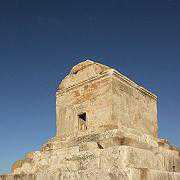
At the high point of the festival, the Shah walked to the grave of Cyrus II who, in the 6th century B.C., had conquered more than 5 million square kilometers (1.9 million square miles) of land in a long and bloody war.
Critics at the time complained that $100 million (€63 million) was a lot of money to spend celebrating the ancient Persian king. “Should I serve heads of state bread and radishes instead?” was the Shah’s brusque rejoinder.
Religious leader Ayatollah Khomeini, still in exile at the time, was also quick to issue his scathing criticism: “The crimes committed by Iranian kings have blackened the pages of history books.”
But the Shah knew better. Cyrus, he announced, was a very special man: noble and filled with love and kindness. The Shah insisted that Cyrus was the first to establish a right to “freedom of opinion.”
‘Ancient Declaration of Human Rights’
Pahlevi also ensured that his view of history would be taken to the United Nations. On Oct. 14, just as the party in Persepolis was in full swing, his twin sister walked into the United Nations building in New York, where she handed a copy of a cuneiform document, about the size of a rolling pin, to then Secretary General Sithu U Thant. Thant thanked her for the “historic gift” and promptly praised it as an “ancient declaration of human rights.”
Suddenly even the UN secretary-general was insisting that Cyrus “wanted peace,” and that the Persian king had “shown the wisdom to respect other civilizations.”
Then Thant had the clay cylinder (which contains a supposedly particularly humane decree by Cyrus II dated 539 B.C.) displayed in a glass case in the main UN building. And there it continues to lie today, directly adjacent to a copy of the world’s oldest peace treaty.
Those were grand gestures and grand words, but in the end it was nothing but a hoax that the UN had fallen for. Contrary to the Shah’s claims, the cuneiform degree was “propaganda,” explains Josef Wiesehöfer, a scholar of ancient history at the University of Kiel in the northern Germany. “The notion that Cyrus introduced concepts of human rights is nonsense.”
Hanspeter Schaudig, an Assyriologist at the University of Heidelberg in the southwestern Germany, says that he too would be hard-pressed to see the ancient king as a pioneer when it comes to equality and human dignity. Indeed, Cyrus demanded that his subjects kiss his feet.
The ruler was responsible for a 30-year war that consumed the Orient and forced millions to pay heavy taxes. Anyone who refused stood to have his nose and ears cut off. Those sentenced to death were buried up to their heads in sand, left to be finished off by the sun.
Did the UN simply believe this historical lie — concocted by the Shah — without any further examination?
‘The UN Made a Serious Mistake’
Art historian Klaus Gallas, who is preparing a German-Iranian cultural festival to take place in Weimar next summer, has now brought the matter to the public’s attention. During his preparations for the festival he discovered the inconsistencies between the Shah’s claims and the Cyrus decree. “The UN made a serious mistake,” says Gallas.
The limestone tomb at Pasargadae of King Cyrus the Great.
Despite having been contacted by SPIEGEL several times, the organization has declined to comment on the incident. Indeed, the UN Information Service in Vienna continues to insist that many still consider the cuneiform cylinder from the Orient to be the “first human rights document.”
The aftermath of the hoax has been disastrous. Even German schoolbooks describe the ancient Persian king as a pioneer of humane policies. According to a forged translation on the Internet, Cyrus even supported a minimum wage and right to asylum.
“Slavery must be abolished throughout the world,” the fake translation reads. “Every country shall decide for itself whether or not it wants my leadership.”
Even Shirin Ebadi, the 2003 winner of the Nobel Peace Prize, was taken in by the hoax. “I am an Iranian. A descendant of Cyrus the Great,” she said in her speech in Oslo. “The very emperor who proclaimed at the pinnacle of power 2,500 years ago that … he would not reign over the people if they did not wish it.”
The experts are now stunned at this example of a rumor gone wild.
If one thing is clear, it is that the figure at the center of this hoax radically shook the ancient Orient like no other ruler. With what German scholar Wiesehöfer calls “military strokes of genius,” Cyrus advanced with his armies to India and to the Egyptian border. He is considered the creator of a new kind of country. At the height of his power, he was the ruler of a magnificent empire bursting with prosperity.
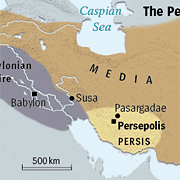
But it all began far more modestly. Born the son of an insignificant minor king in what is today southwestern Iran, the young man mounted the throne in 559 B.C.
Even in antiquity, bizarre legends were associated with the king. According to one of them, Cyrus grew up in the wild and was nursed by a female dog. There are no contemporary images of him.
His neighbors to the west soon felt the brunt of this man’s determination. After conquering the neighboring Elamite people, he attacked the Median Empire in 550 B.C. with his army’s fast combat chariots and soldiers dressed in bronze armor.
After that, the upstart king invaded Asia Minor, or modern Turkey, where hundreds of thousands of Greeks lived in colonies. Well-to-do citizens from Priene were enslaved.
Part 2: ‘One of the Most Magnificent Documents Ever Written’
The general recuperated from the trials of war at his residence in Pasargadae. It was surrounded by an irrigated garden known as the “paradeisos” and was home to a sumptuous harem.
But Cyrus soon became restless in his palace and returned to the front, this time heading east to Afghanistan. His life ended at 71, somewhere in Uzbekistan, when a spear punctured his thigh. He died three days later.
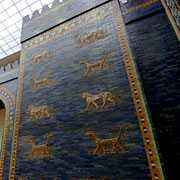
The Walls of Babylon, now at the Pergamon Museum in Berlin.
Courageous in battle and adept in the politics of running his empire, Cyrus, says Wiesehöfer, was a “pragmatist” who attained his goals with “carrots and sticks.” But he was no humanist.
Some Greeks praised the conqueror. Herodotus and Aeschylus (who lived after Cyrus’s death) called him merciful. The Bible describes him as the “anointed one,” because he supposedly permitted the abducted Jews to return to Israel.
But modern historians have long since debunked such reports as flattery. “A shining image of Cyrus was created in antiquity,” Wiesehöfer says. In truth, he was a violent ruler, like many others. His army ransacked residential neighborhoods and holy sites, and the urban elites were deported.
Only the Shah, who had his own problems in the 1960s, could have come up with the idea of reinterpreting this man as an originator of human rights. Despite his SAVAK secret police’s notorious torture practices, there was resistance throughout the country. Marxist groups carried out bombings while mullahs called upon their followers to resist the government.
In response, the Shah attempted to invoke his ancient predecessors. Just as Cyrus was once the father of the nation, he insisted, “So am I today.”
“The history of our empire begins with the famous proclamation by Cyrus,” the Shah claimed. “It is one of the most magnificent documents ever written on the spirit of freedom and justice in the history of mankind.”
One thing is true, and that is the clay cylinder documents a banal story of political betrayal. When the text was written in 539 B.C., Cyrus found himself in what was probably the most dramatic part of his life. He had dared to attack the New Babylonian Empire, his powerful rival for dominance of the Orient, a realm that extended all the way to Palestine. Its capital, the magnificent city of Babylon, crowned by a 91-meter tower, was also a center of knowledge and culture. The empire itself was bristling with weapons.
Nevertheless, the Persian ruler decided to risk attacking the Babylonians. His troops marched down the Tigris River. After attacking the fortified city of Opis and killing all prisoners, they advanced on Babylon.
Babylonian Betrayal
There, barricaded behind an 18-kilometer (11-mile) wall around the city, sat Cyrus’ beleaguered enemy: King Nabonid, an old man of 80.
At that very moment, the priests of the god Marduk were committing treason against their own country. Angry over the loss of power they had suffered under their king, they secretly opened the gates and allowed hostile Persian negotiators to enter the city. Nabonid was banished and his son murdered.
Cyrus' Persian Empire
The conditions for a complete surrender were then hammered out. Cyrus demanded the release of fellow Persians who had been carried off in earlier wars. He also insisted on the return of stolen statues of gods.
These were the passages that the Shah would later reinterpret as a general rejection of slavery. In truth, Cyrus merely freed his own followers.
In compensation for their treacherous services, the priests were given money and estates. In return, they praised Cyrus as a “great” and “just” man and as someone who “saved the entire world from hardship and distress.”
Only after all the arrangements had been made did the king enter Babylon, riding in through the blue-glazed Gate of Ishtar. Reeds were spread on the ground at his feet. Then, as is written in line 19 of the Cyrus proclamation, the people were permitted to “kiss his feet.”
There is no evidence of moral reforms or humane commandments in the cuneiform document. Assyriologist Schaudig calls it “a brilliant piece of propaganda.”
But the legend of this prince of peace had been born, thanks to the wily priests of Babylon. And since it was placed on a pedestal by the UN, it has become even more inflated.
Iran’s mullahs have not escaped the Cyrus cult. In mid-June, the British Museum in London announced that it planned to lend the valuable original cylinder to Tehran. It has become an object of Persian national pride.
“The German Bundestag even recently received a petition to have the proclamation exhibited in a glass case at the Reichstag building,” says Gallas.
The petition was denied, and yet the distortion of history continues. With its disastrous tribute, the UN gave birth to a seemingly never-ending rumor.
As the saying from the Orient goes: “A fool may throw a stone into a well which a hundred wise men cannot pull out.”
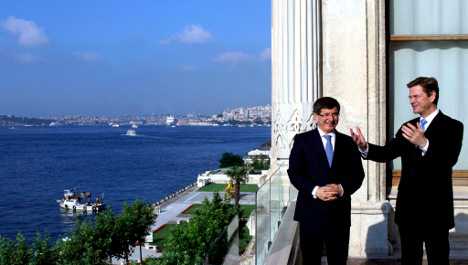
Regarding the Sept. 23 news article “Westerwelle urges EU to engage Turkey,” I wonder if German Foreign Minister Guido Westerwelle thoroughly followed the events that led to the recent “yes” vote for Turkey’s intended constitutional changes.
It is advisable to understand the Ottoman mentality and modern Turkey as created by Ataturk. In a country run by pro-Islamists, has there really been an open debate about these constitutional changes? Has the West seen how the ruling AKP party has commandeered all the top media advertising, as well as the radio (which is indeed the voice of the present government) and TV? What about the reported threats to leading journalists who were trying, in a logical way, to convey the tricks underlying these constitutional changes?
I would strongly recommend that Mr. Westerwelle consider the Pope’s recent speech during his visit to the U.K., in which he noted that Europe is taking its secular approach a bit too far and would do well to look back to its roots.
I wonder if Mr. Westerwelle has forgotten the days when Turks used to slaughter animals on their balconies in the name of Islam. Does he think it would turn out well to have women covered from head to toe wandering towns and villages all over Germany?
Being Turkish and Muslim myself, I strongly object to Turkey joining the EU under the present circumstances and for a considerable time yet. A rather more limited partnership would be the best approach for now.
Germany’s antitrust agency says it has fined a subsidiary of Thomas Cook AG euro1.2 million (1.6 million) for illegally coordinating prices of flights between Germany and Turkey.
The Federal Cartel Office said Tuesday airline Condor GmbH was fined for price coordination with its counterpart SunExpress in 2009 on routes simultaneously operated by the two companies.
It says the two airlines agreed SunExpress would not offer flights from Germany to Turkey for less than euro99, and tickets were meant not to be more than euro10 cheaper than Condor’s.
The office said the investigation was triggered by SunExpress, a joint venture of Deutsche Lufthansa AG and Turkish Airlines, which was not fined according to the agency’s leniency program.
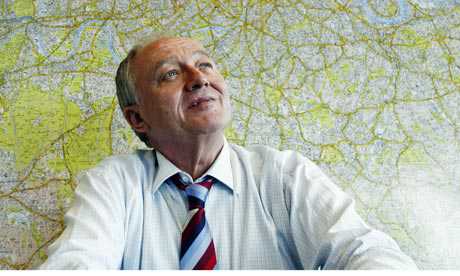
Two years after losing the mayoralty to his nemesis Boris Johnson, Ken Livingstone is campaigning to run London for a fourth time
Hugh Muir
Ken Livingstone is Labour's candidate for mayor of London. Again. Photograph: Martin Argles for the Guardian
It is Labour‘s curse to struggle for consensus. Scratch the surface, and it is hard to find senior figures agreeing on policy, or direction, or personnel. They muddle through, but uniformity of thought has never been one of the party’s abiding traits. At worst, it is a maelstrom. At best, they might argue, a broad church.
But on 2 May 2008, one opinion seemed to be shared by most of the leadership, particularly those accustomed to running London. The Day of Ken is done, they said. He has served us well, but if we are to renew ourselves and wrest the London mayoralty away from Boris Johnson, we must have another candidate. A green-skin. Someone who has not been bested at the polls. Someone who, unlike our wearied champion, has not put himself at odds with noisy, vigorous sections of the electorate. Someone untroubled by rumour and the appearance of scandal.
And so, two years later, after a long campaign, we give you the Labour candidate for the London mayoralty in 2012 . . . Ken Livingstone, thrust forward with the full backing of that same Labour establishment that had said he should go shuffling off into the sun. Restored to a status that also saw him top the poll in the party’s national executive committee (NEC) elections at the weekend. Ready to bask in the spotlight on Wednesday with his speech to Labour delegates from the conference platform. How has this happened? The journey tells us quite a lot about the state of Labour at the moment – but more than that, it tells you an awful lot about Livingstone.
In his dust blue suit and shimmering yellow tie, he is rounder than he was in 2008 (eating too many of his children’s leftovers). Certainly he is chipper. “I am looking forward to it,” he says. “It will be a much more serious, intensely political contest than last time. In the next two years, we are going to see severe cuts and people will want someone to protect them from those cuts. It won’t be about who tells the best jokes.”
Livingstone is sunny now, but there have been flashes of darkness in recent days, not prompted by the contest itself – “He loves the challenge,” a lieutenant told me – but, in part, by his opponent, Oona King. Livingstone now says her campaign, by forcing everyone to sharpen their arguments, was good for the party, and good for her too (she was runner-up in those NEC elections). But her best card was to portray him as the candidate whose sell-by date had expired – and Livingstone took exception to being portrayed as a spent force.
“It was pretty naked ageism,” a member of his campaign team told me. “If she had been saying don’t vote for this person because they are disabled or a woman, there would have been an outcry. He seems thick-skinned, but he does hurt quite easily.”
Livingstone has often been magnanimous with his opponents – Conservative candidate Steve Norris ended up on the board of Transport for London, as did the defeated Liberal Democrat Susan Kramer. An offer was floated to Frank Dobson in 2000. He may yet feel magnanimous again, but right now it’s sensitive. Might there be an offer to King if the Livingstone bandwagon rolls into City Hall in 2012? An aide furrows his brow. “I doubt it.”
If the mayoral election was held tomorrow, Livingstone would lose. For Boris Johnson’s honeymoon period has been a particularly long one. He has survived accusations of inactivity and personnel scandals, with one acolyte, a deputy mayor, convicted of fraud. Allegations of cronyism have been levelled, as have sexual claims in the tabloids. He has even had the humiliation of being caught on video falling into a muddy river. But Johnson has risen above it all with brio and self-deprecating humour. Which is a problem for Livingstone, for the way Boris shapes and guards his public persona seems unnervingly similar to the template created by a fully functioning Ken.
Labour’s candidate says he expected to lose last time round. Perhaps, having viewed the private polls, he did – but it didn’t look like that. His concession speech was graceful enough, but it soon became clear that he was shell-shocked, bereft. And he didn’t even bother to take himself away to grieve in private. Instead, he headed to City Hall, attending Mayor’s Question Time to watch Johnson bask in the sunshine to which he himself had been accustomed. Some say that even then he was making a statement and seeking fresh ammunition to use against Johnson in the future. But for the elected politicians who had supported him, and for the officers who rather liked him, it was a wretched sight – like a bereaved parent visiting the scene of the murder, hoping to be told it was all a mistake. “He would sit behind the Labour group and he always looked so awful,” said one official. Everyone was thinking, ‘Why don’t you go on holiday or something? Go deal with it in private.’”
There was compassion in that reaction. But it also said something about the norms in our politics. Livingstone had lost and the convention is that the loser in a high-profile election, particularly one as personality based as the mayoralty, heads for the scrapheap, or at least other pastures. And anyway, why would a politician in his 60s, father to two young children, who had thrice run London – first taking the reins back in 1987 – want to do it again?
Necessity perhaps. “I am not Tony Blair,” he says, as blunt as ever. “I didn’t go bombing Iraq, to be rewarded by nice posts by US banks. With my politics, most of the jobs that ‘respectable’ Labour types get offered don’t come my way.”
Gordon Brown did, though, make him a vague offer the morning after that 2008 loss. “It was something on the environment, but I said there is a problem because I don’t agree with the third runway at Heathrow. And he said: ‘That is a problem.’ There is a lot I could do if I would ignore my beliefs. But my framework of political beliefs is as important as religious beliefs are to Christians and Jews. They determine all I do. The strong mishmash of my parents’ views and socialist ideology is as important to me as religious faith. Without that, people are adrift.”
Livingstone is seen by the right as the ultimate lefty, but those who hold that view have to gloss over some fairly harsh views on law and order, and the fact that some of his fiercest critics reside on the left of the Labour party. Even so, he has a well-placed network of contacts within the constituencies and the unions – which, over the last two years, he has used to good effect. Always good value as a star speaker at functions, nearly always available, and always ready with a critique of Johnson’s administration, he has retained a grassroots following. But the trick of his success in the Labour mayoralty race was to garner support from those whose initial view was that he should walk off into the sunset.
By June, at the start of the nomination contest, they found his campaign well advanced, his arguments honed. Many who instinctively preferred King came to see him as the only heavy hitter capable of deposing Johnson (even King herself admits that, as time passed, Livingstone grew stronger). His triumph, however, is a defeat for those who wanted to mirror what the national party has done by electing Ed Miliband, and turn the page. “Alan Johnson could have done it [the London mayoral candidacy],” said one Labour source. “But he couldn’t reconcile what he would say to the people of Hull had he lost. Mandelson: people were talking to him. And Tessa Jowell.”
But Livingstone started his campaign early, creating the impression that he was unstoppable. This kept the biggest beasts out of the race, and thus made him unstoppable. Sometimes perception is reality.
The election of the London mayor in 2012 is important to Labour. At best, it will be a springboard – after Johnson, of course, came Cameron. So before Livingstone won the endorsement of his senior colleagues, there was some tough talking. Yes, Labour’s general malaise dragged you down last time, they said. But what about you? If we run with you again, how is it going to be different? What about your mistakes? This was thorny territory. Livingstone doesn’t easily admit to mistakes, certainly not in public and certainly not if those admissions give succour to his enemies. “He’s of that generation,” said a friend. “You concede you made mistakes, then people ask, ‘OK, what were they?’ Suddenly you look weak and are having to show contrition for all sorts of things.”
Colleagues hoped for an explicit sign that he had learned lessons, but it is not Livingstone’s way to be explicit about such things. “These are different times, things will be different” was the closest they got to introspection. Did you do anything wrong, he was asked last Friday in the afterglow of victory. “Perhaps we put the congestion-charging call centre in the wrong place,” he replied.
But mistakes there were. The haughty way in which he proceeded with the western extension of the congestion charge; his reluctance to confront the accusation that he was an inner-city “zone one mayor”. His ill-tempered contretemps with the Jewish Evening Standard reporter he likened to a “concentration-camp guard”. His quip that no one will find out what he got up to in City Hall because everything incriminating had been shredded; his cheap oil deal with Venezuela; and his failure to deal adequately with the toxic, largely unsubstantiated melange of allegations levelled by the Evening Standard against his then equalities adviser Lee Jasper. Livingstone still insists he got all the big decisions right. But by the end, he and his mayoralty seemed traumatised and weary.
Jenny Jones, a Green party member on the London Assembly, wasgenerally supportive, but she says: “It was difficult. He had very young kids at the time and I don’t think he had been getting much sleep. He is very committed, but it did look like arrogance.” She sees improvement, though. “I think he has learned lessons. He certainly looks a lot fresher now. He came to my birthday party in a field the other day with his wife and children. We camped out and had a lot of fun. He was up for everything.”
All but one of the eight Labour assembly members backed Livingstone, but Jennette Arnold says she needed some persuading. “During the last 18 months of his last term, there were issues raised. He went into defence mode and I don’t know that that was the right call. People were saying: ‘Is he there for us, or the people he employs?’ But he does have an innate sense of what London needs. I want him out there, showing his leadership.”
Livingstone says he will. Back will come the western extension of the congestion charge, a measure scrapped by Johnson, and an end to tube fare increases and police cuts. In will come a new victims commissioner, further measures to cut pollution, initiatives to protect the green belt.
His foes at City Hall say: bring it on. “We’ll run on Boris’s record,” says Johnson’s deputy, Richard Barnes. “We have held the council tax precept for two years. Ken put it up 152%.” It’s personal, says Barnes. “London has a smile on its face because of Boris. As for Ken, he just didn’t think he could lose. He is still very bitter.”
But if he is bitter, Livingstone insists that it’s because of Johnson’s “disastrous administration”. And so he will hit the road again, the candidate once more, ending a cherished period of extended time with his two youngest children, now six and seven. (Together, they have led a nomadic life in London, visiting zoos, cafes and museums.) He’ll hold off on the travel, advising mayors in Canberra and Bogota, the memoir writing, and the gardening. He will think of platforms to add to his Saturday morning talkshow on London’s LBC radio station, where after an uncertain start, his cheery banter and opinions on everything have doubled his audience over 12 months. Heady times to come, he says.
But there has been a change. Unlike 2008, politics is no longer an all-consuming passion. He has the family shopping to do. His skill, he says, is spotting bargains. After that, the battle proper can begin.
https://www.theguardian.com/politics/2010/sep/28/ken-livingstone-mayor-london, 28 September 2010