Tag: Recep Tayyip Erdogan

12th president of Turkey

  • Anger China or defend Uighurs? Turkey walks fine line.

    Anger China or defend Uighurs? Turkey walks fine line.

    Beijing urged Turkish Prime Minister Erdogan to retract his statement that China is committing “genocide” against its Muslim minority.
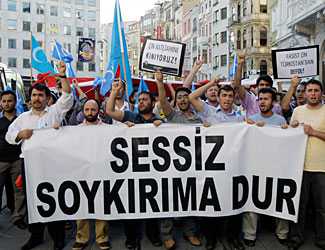
    Developments in China’s restive Xinjiang Province and the attacks against the minority Muslim Uighurs there may not have led to vocal protests in most of the Muslim world. But in Turkey, the events in western China have led to large protests in the streets and strong words from Turkish officials.

    The comment raising the loudest outcry has been Prime Minister Recep Tayyip Erdogan’s accusation last week that China is committing “genocide” against the Uighurs, a statement that Beijing is now pressuring him to retract.

    Experts say that taking its criticism of China too far could backfire on Ankara, which has been working to improve both its diplomatic and trade relations with Beijing.

    An estimated 184 people have died in the recent violent clashes between Uighurs and ethnic Han Chinese in Urumqi, the capital of Xinjiang. Chinese officials have claimed that most of those killed have been Han.

    Turkey’s minister of industry and trade, Nihat Ergun, last week called for a boycott of Chinese goods, while Mr. Erdogan, speaking on television last Friday, said: “The incidents in China are, simply put, tantamount to genocide. There’s no point in interpreting this otherwise.”

    Uighurs as ‘brothers’

    “There is a lot of sensitivity among the Turkish public about the Uighurs. They consider them as real brothers,” says Sami Kohen, a political affairs columnist for Milliyet, a Turkish daily.

    “Turks originally came from that part of Asia to Anatolia, and the language that Uighurs use is much closer to the language that Turkey speaks than others in Central Asia,” he continues.

    The Turkish president’s official flag, for example, has 16 stars on it, representing “Turkish states” established throughout history. One of the stars commemorates the Uighur state that existed around the 8th century.

    Adds Mr. Kohen: “There is quite a large Uighur community in Turkey, and they are quite strong. They have a lobby and they have been quite strong in defending their cause.”

    Turkey raises its global profile

    Turkey has, in recent years, been working to raise its foreign policy profile and establish itself as a regional political and economic power. Turkey’s president, Abdullah Gul, actually visited Urumqi as part of a recent state visit shortly before the violence broke out there. Turkey signed a reported $1.5 billion worth of trade deals during the visit.

    But analysts say Ankara’s criticism could lead to a rupture with Beijing.

    “The Turks really have a tough decision to make, whether they keep this going or back off. This is a major test for Turkey’s new foreign policy,” says Bulent Aliriza, director of the Turkey Project at the Center for Strategic and International Studies in Washington. “This is a serious problem for the Turks from every angle.”

    Ankara now also needs to decide if it will grant a possible request to visit Turkey by Rebiya Kadeer, a Uighur diaspora activist based in the United States whom China has accused of being behind the violence in Xinjiang.

    “All hell is going to break loose if she shows up in Turkey, especially after the comment that Erdogan made,” Mr. Aliriza says.

    Take it back, China says

    The Chinese government now appears to be pushing back against Turkey. A Tuesday editorial in the government-controlled English-language China Daily urged Erdogan to “take back his remarks … which constitute interference in China’s internal affairs.”

    Chinese Foreign Minister Yang Jiechi, in a phone conversation with his Turkish counterpart, blamed the violence in Xinjiang on “three evil forces,” state news agency Xinhua said, referring to “extremism, separatism, and terrorism.”

    For Turkey, which has had its share of domestic violence and terrorism, both from Islamic extremists and Kurdish separatists, these are not meaningless words.

    The Christian Science Monitor
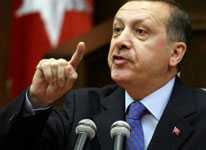
  • Recep Tayyip Erdogan: “Brutality against Uighurs must be prevented”

    Recep Tayyip Erdogan: “Brutality against Uighurs must be prevented”

    Baku – APA. Turkish Prime Minister Racab Tayyib Erdogan took stance on bloody events taking place in Xinjiang-Uighur autonomous region of China, APA reports quoting Haberturk.

    Turkey is closely following the developments there: “Our Uighur brothers living in Turkey and Turkish people feeling this pain in their hearts hold protest actions condemning these events. We have always seen our Uighur brothers as a bridge between Turkey and China, the country we have always had normal relations with throughout the history. Necessary measures must be taken to prevent this brutality. We are temporary member of the UN Security Council for 2009-2010. We will also take these events into consideration there”.

     08 Jul 2009

    APA

  • Can Erdogan Break the Stalemate in Turkish-E.U. Relations?

    Can Erdogan Break the Stalemate in Turkish-E.U. Relations?

    Can Erdogan Break the Stalemate in Turkish-E.U. Relations?

    Publication: Eurasia Daily Monitor Volume: 6 Issue: 124
    June 29, 2009
    By: Saban Kardas
    On June 25-26, Prime Minister Recep Tayyip Erdogan visited Brussels where he was presented an award for his contribution to peace. Reflecting on his efforts to revitalize Turkey’s European Union membership project, Erdogan delivered a speech on the issue and met E.U officials. He was accompanied by Foreign Minister Ahmet Davutoglu and the chief negotiator for E.U. talks Egemen Bagis. The statements from both sides reflected the fundamental differences between Ankara and Brussels, in terms of their approaches to the causes of the stalemate in Turkish-E.U. relations and how to proceed.

    The Turkish government was severely criticized for backtracking on E.U-related domestic reforms after Brussels decided to launch the negotiations with Turkey in 2005. Last year, concerns grew that unless Ankara took drastic steps, Turkish-E.U. relations might reach deadlock. Amidst speculation that 2009 will be the “make or break” year, Erdogan sent strong signals that he was determined to accelerate the membership process. To this end, he appointed Bagis as the new chief negotiator (EDM, January 12), and visited Brussels (EDM, January 20).

    Despite various declarations of intent and high level contacts between Turkish and E.U. officials, so far, no major progress has been accomplished. On the contrary, the prospects of Turkey joining the E.U. appear to be diminishing, while the discussion is gaining ground on giving the country a special status that falls short of full membership.

    This stalemate has several related causes. On the European front, the leaders of France and Germany adopted a clear stand against Turkey’s full membership, and instead argued that it should be offered a more realistic alternative, such as a “privileged partnership” (EDM, May 13). Furthermore, during the recent European elections, representatives were elected to the European Parliament from the conservative and center-right parties. Many observers believe that, given these parties’ opposition to Turkey, the political environment in Europe has further turned against Turkey (EDM, June 10).

    In Ankara, however, the government has been preoccupied with domestic politics, as well as by pursuing controversial foreign policy initiatives. In the first quarter of the year the municipal elections and the discussions on how to tackle the global financial crisis diverted attention from the European agenda. Although the government has strived to refocus on constitutional change and accelerate the E.U. membership process, it failed largely as a result of its inability to build consensus with the opposition parties (EDM, April 1). The latest discussions on an alleged military document concerning plans to illegally change the government had significant repercussions for the E.U. membership process. It demonstrated the shortcomings of Turkish democracy, and generated an added impetus for the AKP to revitalize the E.U. reform agenda to normalize civil-military relations (EDM, June 23).

    Nonetheless, Erdogan’s statements during his recent trip show that his views on Europe remain unchanged. In that sense, the overall dynamics of this visit followed the pattern set in January. He preferred to criticize the Europeans for their mishandling of the accession process, while the latter reiterated their argument that Turkey had to reform its political system in order to comply with European norms.

    Erdogan openly criticized some member states’ efforts to stall the accession talks and questioned the sincerity of the Greek Cypriots over finding a lasting solution on the island. Commenting on the European elections, he raised his concerns about the growing populism within Europe. He expressed uneasiness with European politicians’ questioning Turkey’s future membership for short-term political gains. “We want Europeans to resist such inconsistent policies [i.e., openly questioning Turkey’s full membership]. These fluctuating [views] curb Turkey’s enthusiasm to join the E.U. We expect Europe to fulfill its promises to us. The rules cannot be changed in the middle of the game.” Erdogan also maintained that “Europe cannot keep pace with Turkey’s reform performance. We expect the E.U. to accelerate the process [i.e., more chapters should opened be for negotiation]” (Cihan, June 26).

    After his meeting with the E.U. Commissioner for Enlargement Oli Rehn, Davutoglu emphasized that the growing number of high-level visits reflected Ankara’s eagerness for membership, and that Turkey will accelerate the process. “We are aware of our responsibilities and requirements in terms of the reforms,” Davutoglu added. Rehn, however, ruled out any delay in membership talks being caused by the E.U.’s own shortcomings, and stressed that Turkey has to take “concrete” steps and maintain its commitment to reform (Hurriyet, June 26).

    The fate of the Turkish-E.U. process appears to hinge on whether the two sides can allay each other’s concerns. For Brussels two issues remain of vital importance: whether the Turkish government will implement constitution reforms and if Ankara will change its attitude toward the Greek Cypriots. Ankara’s major concerns are its perceptions that it is being treated unfairly due to some E.U. member states’ overtly anti-Turkish position, and that its achievements are unacknowledged as a result. Moreover, the slow pace of the accession talks and the growing salience of the “privileged partnership” discussions undermine Turkey’s trust in the E.U.

    However justified he might be in his criticism of the Europeans, eventually it will be up to Erdogan to break this stalemate. If he is serious about revitalizing the E.U. membership process, he needs to acknowledge that its current impasse is his own making, whether knowingly or not. He must abandon his complacency and act decisively on the Cyprus issue, similar to his revisionist foreign policy vision prior to 2005. Erdogan has to “talk to” the opposition parties and build domestic consensus to facilitate political reform. Then, he might satisfy both the E.U.’s expectations and strengthen the hands of pro-Turkey groups within the E.U, thus mitigating the intra-E.U. opposition to Turkey.

    https://jamestown.org/program/can-erdogan-break-the-stalemate-in-turkish-e-u-relations/

  • Turkey to ‘never give up’ EU bid

    Turkey to ‘never give up’ EU bid

    Turkey has urged France and Germany to back its bid to join the EU, rejecting calls for a special partnership rather than full membership.

    “We will never give up,” Turkish Prime Minister Recep Tayyip Erdogan told reporters in Brussels.

    Turkey’s EU accession talks are going at a glacial pace and risk suspension if Ankara fails to open its ports and airports to Cyprus this year.

    France and Germany want to give Turkey a “privileged partnership” with the EU.

    But Mr Erdogan insisted “our goal is full membership”.

    He also said it was “populist and wrong” to use Turkey’s bid as an election issue.

    Some right-wing parties opposed to Turkey’s bid made gains in the recent European Parliament elections.

    Slow progress

    The BBC’s Oana Lungescu says both opposition inside the EU and insufficient democratic reforms in Turkey are hampering its bid.

    Next week will see a small step forward, when Turkey is due to start talks on taxation, one of the 35 areas where it is negotiating EU entry terms.

    Turkish diplomats argue that their country is of strategic importance to Europe and that its eventual accession would send a positive signal to the whole Muslim world.

    So far, Turkey has opened talks on 10 out of the 35 “negotiation chapters” in the accession process, which started in October 2005.

    But eight chapters have been frozen because of Ankara’s refusal to open up its ports and airports to traffic from Cyprus, an EU member.

    Turkey says it will not do this until the EU takes steps to end the Turkish Cypriot community’s economic isolation.

    BBC

  • Health Reasons Force Erdogan to Cancel Athens Visit

    Health Reasons Force Erdogan to Cancel Athens Visit

    Health Reasons Force Erdogan to Cancel Athens Visit

    Publication: Eurasia Daily Monitor Volume: 6 Issue: 119
    June 22, 2009
    By: Saban Kardas
    On June 20 Prime Minister Recep Tayyip Erdogan cancelled a planned trip to Athens. Although his health condition was offered as the reason for the last-minute cancellation, it did not prevent speculation that Erdogan sought to use the pretext of his health concern to protest about recent Greek diplomatic initiatives against Turkey.

    Erdogan was scheduled to visit Athens to attend the opening the new Acropolis Museum. Prior to the opening ceremony, Erdogan was expected to meet Greek Prime Minister Costas Karamanlis, and both were to address bilateral issues including the conditions of minorities, as well as recent developments regarding the Cyprus dispute (Cihan Haber Ajansi, June 19). On the morning of June 20, Erdogan attended some meetings in the Aegean town of Izmir. He was expected to fly to Athens later that afternoon and return to Turkey that night. It was later announced that Erdogan had telephoned Karamanlis and informed him of his cancellation. He told Karamanlis that he would like to visit Athens at the earliest opportunity. A statement from Erdogan’s office explained that due to sunstroke, which Erdogan experienced during his visit to Edirne on June 19, his doctors had recommended rest. On June 21 he also cancelled the rest of his program in Izmir and his trips inside Turkey, and returned to Istanbul to rest over the weekend (ANKA, June 20).

    Deputy Prime Minister Bulent Arinc told reporters on June 21 that Erdogan was in good condition, and would resume his functions the following day. Arinc added that Erdogan had experienced temporary hypertension related to weariness, but this was not a serious problem. After resting in Istanbul, Erdogan was expected in Ankara on June 23, to attend an AKP party meeting and also have a working lunch with E.U. ambassadors (Anadolu Ajansi, June 21).

    However, the official statement did not satisfy some diplomatic observers who believe that political motives were behind Erdogan’s last-minute decision. They suggested two issues which might have influenced Erdogan’s decision: Karamanlis’ public complaints about the Turkish Air Force allegedly violating Greek airspace in the Aegean Sea and the E.U. Presidency’s latest conclusions which referred to Turkey as a country of origin and transit in illegal immigration, at Greece’s urging (Radikal, Hurriyet Daily News, June 21). The Greek media also speculated that Erdogan might have cancelled his trip to express his displeasure over these developments. They argued that Erdogan might have wanted to avoid confronting Karamanlis on the Aegean and illegal immigrants’ issues (Anadolu Ajansi, June 20).

    An interrelated set of disputed claims by Ankara and Athens in the Aegean Sea has proved a major long-standing bilateral source of tension between the two countries. Due to the ongoing controversy over the delimitation of national airspace, Flight Information Regions (FIR) and military over-flight rights, Turkish and Greek fighters engage each other in tactical military provocations (so-called “dog-fights”), which frequently heighten tensions between the two countries. Greece considers the flights of Turkish jets in the disputed zones as violations of its national airspace or transgressions of the FIR. During his contacts in Brussels in the context of the E.U. Summit, Karamanlis reiterated Athens’s complaints concerning Turkish jets’ “violations of Greek airspace,” and added that he “discussed this issue with Obama and would raise it during [his] meeting with Erdogan” (www.cnnturk.com, June 19).

    The Greek attempt to use the E.U. as leverage to pressure Turkey on a different issue also reportedly angered Ankara. Last week, the European Council discussed the challenge of illegal immigrants, and ways to improve cooperation with countries of origin and transit. The presidency conclusions issued at the end of the summit announced that, as part of its external policies, the E.U. will seek to sign readmission agreements with major countries of origin and transit. By the time such agreements are concluded, the E.U. will require the implementation of existing bilateral agreements (www.eu2009.cz, June 19). Greece reportedly threatened to veto the presidency conclusions, if the European Council did not specify Turkey, along with Libya, as a key country of origin and transit. Although Turkey was not mentioned in the draft document, following last-minute changes, the final communiqué made reference to it (www.abhaber.com, June 19).

    Athens claims that a great majority of illegal immigrants arriving in Greece transit Turkey and it expects Ankara to be more cooperative in the readmission of those immigrants. Ankara claims that since the final destination of those immigrants are E.U. countries, Turkey cannot be expected to bear the heavy financial burden of readmitting them, which would cost over 1.2 million Euros and demands fairer burden-sharing (Hurriyet, June 20).

    The declared justification for Erdogan’s cancellation of his trip is perhaps true; yet, the very fact that it resulted in such speculation indicates the level of tension between the two countries. Athens has long blocked the progress of Turkish-E.U. relations, and the two neighbors even came to the brink of war over the Aegean issues in the 1990’s. In the post-1999 period, when the Turkish-E.U. talks were revitalized following the Helsinki Summit, bilateral relations entered a new phase. The resulting normalization of the relationship produced concrete results; in addition to launching diplomatic talks to discuss a resolution to the bilateral issues, Athens removed its objections to Ankara’s entry into the European Union. During the rapid wave of domestic reforms following the AKP’s accession to power in 2002, which resulted in the launch of membership talks in 2005, Erdogan developed a close working relationship with his Greek counterpart and visited Athens twice in 2004. However, parallel to the stalling of Turkey’s E.U. accession process since 2005, Turkish-Greek relations also experienced a downturn, which largely resulted from Turkey’s inability to resolve its differences with Greek Cypriots. If he is serious about his claim to revive Turkey’s E.U. bid, Erdogan must talk to his Greek counterpart and reach a consensus on bilateral and E.U. related issues. In this context, he might soon visit Athens.

    https://jamestown.org/program/health-reasons-force-erdogan-to-cancel-athens-visit/
  • Erdogan Avoids Confrontation with the Military over Alleged Plot

    Erdogan Avoids Confrontation with the Military over Alleged Plot

    Erdogan Avoids Confrontation with the Military over Alleged Plot

    Publication: Eurasia Daily Monitor Volume: 6 Issue: 118
    June 19, 2009 02:58 PM
    By: Saban Kardas
    Since the publication of a document, allegedly prepared by Colonel, Dursun Cicek, outlining a plan to undermine the governing AKP and the Gulen movement last week, Turkish domestic politics has focused on the future of civil-military relations (EDM, June 15). Nonetheless, fears over a split between the government and the military did not transpire, and Prime Minister Recep Tayyip Erdogan has avoided such a dangerous confrontation. Instead of pursuing punitive action against the military authorities, Erdogan has demonstrated restraint and instead referred the matter to the courts.

    On June 15, the chief military prosecutor said that the allegations were being investigated. Based on a preliminary study of evidence, the prosecutor reached an opinion that the document was not prepared by any unit within the headquarters of the General Staff. If the authenticity of the document could be established, all personnel involved will be brought to justice, the statement added (Anadolu Ajansi, June 16).

    The office of the General Staff also released a press statement that criticized “the written and verbal comments and declarations targeting the Turkish Armed Forces (TSK), both openly and implicitly, on the assumption that the allegations are true.” It called on everyone to refrain from reaching any premature conclusion on the allegations before the legal inquiry has reached its judgment (www.tsk.tr, June 15).

    Pro-government and pro-Gulen media outlets labeled the action plan as a blatant attempt by the military to interfere with the jurisdiction of civil politics. They did not find the military authorities’ claims about the authenticity of the document credible, and questioned how the prosecutor might have formed an “opinion” on a document without having seen it. More importantly, in their view, despite the steps taken toward democratization, the existence of such a plan within the military was a grave development. They maintained that unless the government acts decisively against this threat, its democratization efforts will be damaged. They believe, if necessary, the government should ask for the resignation of the either the chief of the General Staff or his deputy who oversee the department that allegedly prepared the report (Yeni Safak, Zaman, June 16).

    The Chief of the General Staff General Ilker Basbug gave an interview to Hurriyet in which he responded to the growing criticism of the Turkish military. He reiterated that the military prosecutor was working on the case and his headquarters’ additional investigation had revealed that there was no concrete evidence linking the military to the document. When asked “was such an order [for the preparation of the document] issued by the military command?” Basbug responded “I even consider this question an insult. Such an order was never given.” He said he will take all measures necessary, if the alleged source of the document is proven, but added that he opposed referring the case to the civil courts (Hurriyet, June 16).

    In this context, curiously the AKP’s reaction was expected. When the allegations first emerged, Erdogan promised to defend democracy and take any necessary legal action. On June 16, he met Basbug to discuss these developments. Recently, both leaders had agreed to form a new consultation mechanism and hold weekly meetings every Thursday (Radikal, January 22). No statement was issued following this meeting, but during his address to the AKP’s parliamentary group later the same day, Erdogan insisted that the state institutions had acted in close coordination. He praised the handling of the case by the General Staff, saying that it acted “in a responsible and sensitive manner.” He called on the military and civil courts to conclude their investigations promptly (Anadolu Ajansi, June 16).

    The AKP filed a criminal complaint against the plan with the Ankara Public Prosecutor’s Office. The lawsuit defined those involved in alleged plots against the AKP and the government, as engaging in illegal activities. The AKP described such activities as unacceptable, and requested an immediate investigation (Cihan, June 16).

    The AKP’s lawsuit appears to be based on the assumption that the document is genuine, and consequently the discussions have focused on the forensic investigation into its authenticity. However, reports in the Turkish media demonstrate how deeply politically divisive the issue has become. Newspaper headlines on June 17 illustrated the extent of these divisions. Star, which is supportive of the government, insisted that the document was uncovered as part of the Ergenekon investigation and was true, while Haberturk, which is more critical of the government, questioned its authenticity.

    The Gendarmerie criminal investigation unit has allegedly completed its examination of the document, which hinges on whether the signature belongs to Colonel Cicek. Although the forensic report was not released, newspapers speculate over its possible content. Whereas Haberturk claimed that it is “99 percent certain” that the document was forged, Yeni Safak and Star maintained that according to a preliminary investigation there is “90 percent certainty” that the signature belonged to the Turkish colonel. Other papers alleged that he might have used different signatures, which could further complicate the investigation (Sabah, Aksam, June 19).

    The Zaman daily, close to the Gulen movement, questions this narrow focus on the authenticity of the document, and maintains that it cannot address public concern surrounding the accusations. Zaman was especially critical of efforts to transfer the investigation to the military courts. Citing similar instances in the past, Zaman claims that it might be used to promote a military cover up. It called for a more comprehensive parliamentary investigation into the allegations (Zaman, June 19).

    Nonetheless, Erdogan has refused to turn this case into an open confrontation with the military, and he remains committed to avoiding such conflict. Turkish domestic politics is increasingly conducted around controversial legal cases. Yet, in a political system as divided as Turkey’s, trust in the court system is lacking -and far from clarifying the allegations, the court might perpetuate existing divisions.

    https://jamestown.org/program/erdogan-avoids-confrontation-with-the-military-over-alleged-plot/